
R E S E A R C H A R T I C L E
Open Access
Systematic review and meta-analysis comparing
land and aquatic exercise for people with hip or
knee arthritis on function, mobility and other
health outcomes
Stephanie I Batterham
1, Sophie Heywood
2and Jennifer L Keating
1*Abstract
Background:Aquatic and land based exercise are frequently prescribed to maintain function for people with arthritis. The relative efficacy of these rehabilitation strategies for this population has not been established. This review investigated the effects of aquatic compared to land based exercise on function, mobility or participants’perception of programs for people with arthritis.
Methods:Medline, CINAHL, AMED and the Cochrane Central Register of Controlled Clinical Trials were searched up to July 2010. Ten randomised, controlled clinical trials that compared land to aquatic exercise for adults with arthritis were included. Study quality was assessed with the PEDro scale. Data relevant to the review question were systematically extracted by two independent reviewers. Standardised mean differences between groups for key outcomes were calculated. Meta-analyses were performed for function, mobility and indices that pooled health outcomes across multiple domains.
Results:No differences in outcomes were observed for the two rehabilitation strategies in meta-analysis. There was considerable variability between trials in key program characteristics including prescribed exercises and design quality. Components of exercise programs were poorly reported by the majority of trials. No research was found that examined participant preferences for aquatic compared to land based exercise, identifying this as an area for further research.
Conclusion:Outcomes following aquatic exercise for adults with arthritis appear comparable to land based exercise. When people are unable to exercise on land, or find land based exercise difficult, aquatic programs provide an enabling alternative strategy.
Background
Aquatic therapy encompasses a range of approaches and may include passive immersion in mineral, hot or cold water. It may also incorporate the use of saunas, spas or exercise therapy. Aquatic exercise utilises the principles of hydrostatics and hydrodynamics to create challenges that promote health through exercise in water. The ben-efits of aquatic exercise are thought to result from water’s unique characteristics including warmth that
reduces pain and muscle spasm [1-3], buoyancy that decreases loading of joints [4], resistance to movement through turbulence and hydrostatic pressure, and the equal pressure from all directions applied to an immersed object at a given depth [3]. The unique char-acteristics of exercising in water may allow people to perform exercises that they would be unable to perform on land.
Arthritis is a process of inflammation and degenera-tion associated with pain, stiffness, joint instability and deformities that can significantly affect daily life. Arthritis is the major cause of disability and chronic pain in Australia with 3.85 million Australians affected * Correspondence: [email protected]
1
Department of Physiotherapy, Monash University Peninsula campus, McMahons Rd, Frankston, Australia
Full list of author information is available at the end of the article
every year. [5] It has no cure. Regular moderate physi-cal activity provides a wide range of health benefits and graded exercise programs are effective interven-tions for knee osteoarthritis [6]. Both strength training and aerobic exercise lead to significant improvements in pain, physical function and general health although patient adherence to long term exercise is poor [7].
Geytenbeek (2002) found moderate quality evidence supporting aquatic exercise for pain, function, self effi-cacy, joint mobility, strength and balance outcomes for people with any disability [8]. The effects of aquatic exercise for people with arthritis were not investigated. In 2009, Bartels et al. reviewed the effectiveness of aquatic exercise for the treatment of knee and hip osteoarthritis compared to alternative strategies. The review included studies published till 2006 and con-cluded that aquatic exercise improves function (SMD = 0.26, 95% CI 0.11 to 0.42) and quality of life (SMD = 0.32, 95% CI 0.03 to 0.61) compared to no exercise control outcomes [9]. At that time only one study comparing aquatic to land exercise was available for review. Thomas et al. (2009) reviewed the treatment of knee osteoarthritis and concluded that aquatic exercise resulted in strength benefits compared to control inter-ventions or land based exercise but did not quantify treatment effects [10]. Callahan (2009) evaluated all exercise interventions for participants with chronic arthritis and concluded that both aerobic and muscle strengthening exercises are safe and moderately effec-tive for people with chronic arthritis [11]. Aquatic exercise appears to be a useful strategy for regaining movement and function loss associated with arthritis, but it is more expensive and resource intensive than land based exercise. It would be advantageous for those prescribing exercise to consider the nature and magnitude of effects on function when aquatic pro-grams are compared to land based propro-grams for this population. In addition, previous reviews have not summarized the content of exercise programs, making program replication difficult for readers.
Objectives
This review explicitly assessed the relative advan-tages of aquatic exercise compared to land based exercise for people with arthritis on the outcomes of function or mobility. In addition this review sought data on participant perception of aquatic compared to land based exercise with respect to satisfaction, enjoyment and compliance. Data were extracted to identify how function and mobility outcomes of exercise programs have been measured and to sum-marise the components of reported land and aquatic exercise programs.
Methods
Inclusion Criteria
Types of Studies
Randomised controlled clinical trials were included. The study must have been reported in English as translation funding was not available. Studies must have reported that one group performed aquatic exercise and the com-parison group participated in land based exercise; this could have included any exercise training for strength, endurance, resistance or aerobic capacity whether gym or home-based. To allow conclusions regarding the rela-tive effects of aquatic and land exercise, papers were only included if they provided data that enabled out-comes following aquatic and land based exercise to be tested for significant differences.
Types of participants
Participants had to be people with rheumatoid arthritis or osteoarthritis.
Types of Outcome measures
Trials must have reported function, mobility or patient satisfaction outcomes using any assessment instruments.
Exclusion Criteria
Trials in which participants performed aquatic or land based exercise in conjunction with other interventions were excluded unless the effects of aquatic compared to land based exercise could be partitioned from reported data. Participants less than 18 years of age were excluded due to the additional management implications associated with an immature musculoskeletal system. Participants who exercised as part of rehabilitation immediately following joint replacement surgery were excluded as the review focus was effectiveness for people with joints affected by arthritis.
Search Strategy
Medline, CINAHL, AMED and the Cochrane Central Register of Controlled Clinical Trials were searched from the commencement of each database to July 2010. A sensitive search was developed using the terms ‘aqua-tic physiotherapy’, ‘hydrotherapy’ or ‘water exercise’ interventions for people with‘arthritis’,‘osteoarthritis’or ‘rheumatoid arthritis’. No terms relating to the‘ compari-son’ and ‘outcome’ of trials were searched to avoid excessive exclusion of trials in an area where limited research has been conducted. The full electronic search strategy is available from the first author on request.
Study Selection
an inclusion and exclusion checklist. Disagreements were resolved through discussion; if this failed a third researcher was consulted.
Quality Assessment
All included trials were critically appraised using the 11 item PEDro scale [12-14], 10 of which were scored using explicit decision rules. All trials were indepen-dently assessed by the first author. A search for included papers was then performed on PEDro and quality assessment scores compared to those determined by two independent PEDro assessors where these were available [15]. If there was disagreement on an item’s assessment, these were assessed independently by another researcher. If no quality score was available in the PEDro database, the paper was independently assessed by both reviewers.
Item 4 (baseline comparability) was not fulfilled if there was a significant and important difference (95% confidence that SMD > 0.2) between groups at baseline for one measure of disease severity or one key outcome measure. If more than one outcome was measured by trials, only one outcome had to achieve baseline similar-ity to this fulfil criteria. Item 8 (key outcome measures were obtained for more than 85% of participants who were assessed at baseline) was calculated using data for each group (rather than for the pooled intervention and comparison group) when relevant data were reported.
Data extraction
All data extraction and calculations were performed independently by two reviewers. Both sets of data were then compared for discrepancies and these were resolved through discussion.
The following data were systematically extracted: study design details, participant characteristics and base-line demographics, affected joints, duration of arthritis, group numbers, participant age and inclusion criteria, intervention and control group conditions including pool temperature, group size, supervision of the exercise intervention, provision of a home exercise program, compliance of participants, number of drop outs, length of interventions, duration and number of sessions, fea-tures and components of aquatic and land-based exer-cise including the provision of warm-up, stretching, cool down, balance, strengthening and functional exercises.
Data assessing function, pooled indices and mobility outcomes were also extracted. The World Health Orga-nization defined six domains for the assessment of health [16]. These include pain, self care, usual activities, cognition, mobility and affect. Domains considered rele-vant to function were usual activities and self care. Out-comes that encompassed multiple domains were classified as pooled indices. Mobility was assessed
through the extraction of data on walking ability and dynamic balance. If trials specified data collected under a range of walking speeds, data for the fast pace was extracted. To assess patient perception of the program any outcome that assessed patient enjoyment, satisfac-tion or any other type of feedback of the exercise pro-grams was extracted.
To compare effectiveness of interventions for each relevant outcome, point measures and measures of variability were extracted. Means and standard devia-tions of outcomes measured immediately following the intervention were extracted and analysed. When neces-sary, the standard deviation [sd] was approximated by dividing the inter-quartile range by 1.35. Medians were used as best estimates of means. Standard error [SE] was converted to sd using the formula SE = sd/(√n). These data points were then used to calculate Hedges [17] corrected standardised mean differences [SMD] and 95% confidence intervals [CI] to assess intervention effects. The SMD was the difference between two means normalised using either pooled or control group stan-dard deviations (the former where no significant differ-ence in control and intervention standard deviations was observed). This index is useful for comparing data collected using different scales. A SMD <0.2 was consid-ered a small effect, 0.5 (>0.2, <0.8) a moderate effect and >0.8 a large effect [18]. Data at baseline and imme-diately following the intervention were extracted. Long term effectiveness of interventions was not assessed as it was beyond the scope of the review. If trials did not use Intention-To-Treat analysis [ITT], per-protocol data were extracted for analysis.
Meta analysis
Pooling of data across multiple studies can provide an improved estimate of the effect of the intervention as a consequence of the larger number of total participants and reduction in random error due to sampling differences.
Meta-analysis was performed using Review Manager (RevMan5) software[19]. Heterogeneity between trials was assessed using the I2 statistic. Heterogeneity was considered substantial if I2 was greater than 50% and a random effects model applied; otherwise a fixed effects model was used for the analysis [20]. SMDs were used where different scales were used to measure comparable outcomes across trials. Scale directions were aligned by adding negative values where required.
Results
Search yield
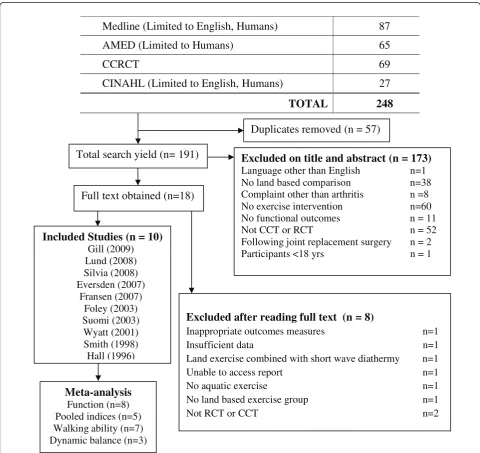
these 8 papers were excluded as they did not meet inclusion criteria and10 papers were included in the review. (Figure 1)
Quality Assessment
A summary of the quality assessment scores and the decisions for each item are shown in Table 1 for all included trials.
Data Extraction
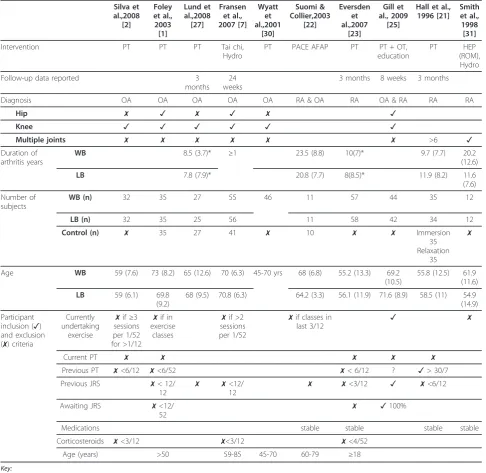
Study design features are shown in Table 2. Participant numbers reported in Table 2 are the numbers initially
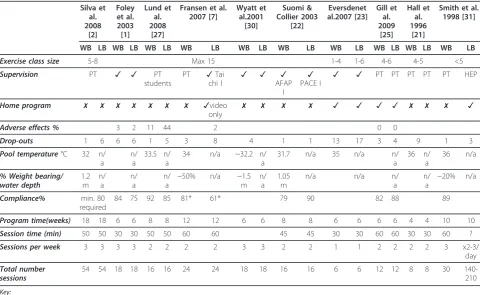
allocated to groups. Data describing the intervention design is shown in Table 3.
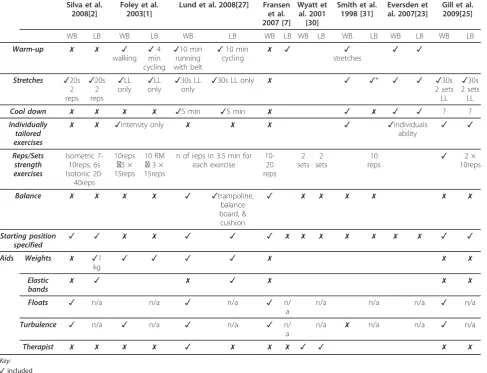
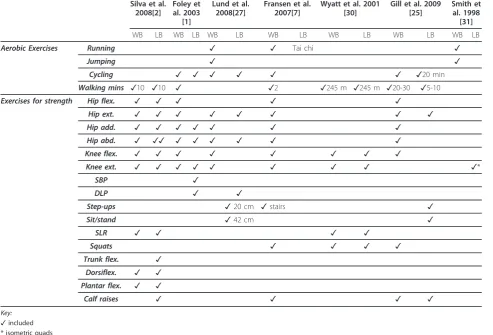
Features and components of aquatic and land based exercise interventions are described in Table 4. Hall et al. and Suomi & Collier did not provide any information about the exercise interventions and are not included in the table [21,22]. Suomi & Collier state that the pro-grams were based on People with Arthritis Can Exercise (PACE) and Arthritis Foundation Aquatic Program (AFAP) protocols but these could not be found [22]. Hall et al. reported that exercises were designed to increase range of movement and muscle strength and
Medline (Limited to English, Humans)
87
AMED (Limited to Humans)
65
CCRCT 69
CINAHL (Limited to English, Humans)
27
TOTAL 248
Duplicates removed (n = 57)
Total search yield (n= 191)
Excluded on title and abstract (n = 173)
Language other than English n=1 No land based comparison n=38 Complaint other than arthritis n =8 No exercise intervention n=60 No functional outcomes n = 11
Not CCT or RCT n = 52
Following joint replacement surgery n = 2 Participants <18 yrs n = 1
Excluded after reading full text (n = 8)
Inappropriate outcomes measures n=1
Insufficient data n=1
Land exercise combined with short wave diathermy n=1
Unable to access report n=1
No aquatic exercise n=1
No land based exercise group n=1
Not RCT or CCT n=2
Full text obtained (n=18)
Included Studies (n = 10)
Gill (2009) Lund (2008) Silvia (2008) Eversden (2007)
Fransen (2007) Foley (2003) Suomi (2003) Wyatt (2001) Smith (1998) Hall (1996)
Meta-analysis
[image:4.595.57.538.255.708.2]Function (n=8) Pooled indices (n=5) Walking ability (n=7) Dynamic balance (n=3)
that the type, duration and frequency of exercises were standardized in consultation with physiotherapists [21].
There was considerable variability in the details pro-vided about the exercise interventions. The majority of exercise programs were not detailed enough to allow them to be reproduced with confidence (Table 5).
Seven of the ten included trials presented information about exercises in their programs (Table 6). Eversden et al., Suomi and Collier and Hall et al. did not provide details of either program [21-23]. Eversden et al. stated that exercises focussed on joint mobility, muscle strength and functional activities [23]. Therefore none of these trials have been included in Table 6. Fransen et al. did not provide any details about the Tai Chi inter-vention [7].
Intervention effects
Physical function
A number of outcomes were used to establish changes in participant’s physical function (Additional File 1). The Western Ontario and McMaster Universities Osteoar-thritis Index [WOMAC] has established reliability and validity for this population [24]. Function component scores as reported by Fransen et al., Gill et al. and Foley et al. were included [1,7,25]. Silva et al. reported a total WOMAC score; this result was included with pooled indices [2]. The Knee Injury and Osteoarthritis Out-come Score [KOOS] is based on the WOMAC [26,27]. The activities of daily life component score of the KOOS was used to assess function. The Health Assess-ment Questionnaire [HAQ] is a self reported disability Table 1 Summary of Quality assessment scores
Silva et al., 2008 [2] Foley et al., 2003 [1] Lund et al., 2008 [27] Fransen et al., 2007 [7] Wyatt et al., 2001 [30] Suomi & Collier,2003 [22] Eversden et al., 2007 [23] Gill et al., 2009 [25]
Hall et al., 1996 [21]
Smith et al., 1998 [31]
1. eligibility criteria
✓ ✓ ✓ ✓ ✓ ✓ ✓ ✓ ✓ ✓
2. random allocation 1 drawing of lots 1 computer generated 1opaque envelopes 1 computer generated
1 1randomly
assigned 1flipping virtual coin 1random numbers table 1random numbers table 1random allocation
3. allocation concealed
1likely 1sealed opaque envelopes, 1 baseline measures prior 1after baseline assessment 0not described
0unlikely 1sealed opaque envelopes 1sealed envelopes 1 independent coordinator 1 independent allocator
4. baseline similarity 1VAS (pain), WOMAC 1Walk speed, ASE (pain) 1VAS (pain), KOOS ADLs 1WOMAC pain & function
0(1)no outcomes comparable
1ADLs & Pain comparable 1VAS (pain), EQ-SD 1 WOMAC pain & function
1Knee ROM, AIMS2
1Morning stiffness,
HAQ
5. patient blinding
0 0 0 0 0 0 0 0 0 0
6. therapist blinding
0 0 0 0 0 0 0 0 0 0
7. assessor blinding
1 1 1 1 1 0 1 1 1 1
8. adequate follow-up
081% land
0(1)80% aquatic, 74% land
0(1)96% aquatic, 80% land 193% aquatic, 89% Tai chi 191% overall 191% patients each group 081% aquatic, 69% land 186% land 89% aquatic
194% overall 092% aquatic, 75%
land
9. ITT analysis 1 1 1 1 0 0 1 0 0 0
10. between group comparisons
reported
1 1 1 1 1 1 1 1 0pre/post
test
1
11. post intervention point & variability
measures 1means & SDs 1medians & IQR 1means & SDs
1means & SDs
1mean & SDs
1means & SDs
1medians & IQR
1means & SDs
1means & SDs
1means & SDs
TOTAL 7/10* 7/10(8) 7/10(8) 8/10* 5/10(6) 5/10* 7/10* 7/10* 6/10* 6/10*
Key:
* accessed by PEDro with same score obtained
✓yes (not scored) (x)
PEDro assessment by PEDro reviewers differs and is x 1 yes (scored)
Table 2 Study design
Silva et al.,2008
[2]
Foley et al., 2003 [1]
Lund et al.,2008 [27]
Fransen et al., 2007 [7]
Wyatt et al.,2001
[30]
Suomi & Collier,2003
[22]
Eversden et al.,2007
[23]
Gill et al., 2009
[25]
Hall et al., 1996 [21]
Smith et al., 1998 [31]
Intervention PT PT PT Tai chi,
Hydro
PT PACE AFAP PT PT + OT,
education
PT HEP
(ROM), Hydro
Follow-up data reported 3
months 24 weeks
3 months 8 weeks 3 months
Diagnosis OA OA OA OA OA RA & OA RA OA & RA RA RA
Hip ✗ ✓ ✗ ✓ ✗ ✓
Knee ✓ ✓ ✓ ✓ ✓ ✓
Multiple joints ✗ ✗ ✗ ✗ ✗ ✗ >6 ✓
Duration of arthritis years
WB 8.5 (3.7)* ≥1 23.5 (8.8) 10(7)* 9.7 (7.7) 20.2
(12.6)
LB 7.8 (7.9)* 20.8 (7.7) 8(8.5)* 11.9 (8.2) 11.6
(7.6)
Number of subjects
WB (n) 32 35 27 55 46 11 57 44 35 12
LB (n) 32 35 25 56 11 58 42 34 12
Control (n) ✗ 35 27 41 ✗ 10 ✗ ✗ Immersion
35 Relaxation
35
✗
Age WB 59 (7.6) 73 (8.2) 65 (12.6) 70 (6.3) 45-70 yrs 68 (6.8) 55.2 (13.3) 69.2
(10.5)
55.8 (12.5) 61.9 (11.6)
LB 59 (6.1) 69.8
(9.2)
68 (9.5) 70.8 (6.3) 64.2 (3.3) 56.1 (11.9) 71.6 (8.9) 58.5 (11) 54.9 (14.9)
Participant inclusion (✓) and exclusion (✗) criteria
Currently undertaking
exercise
✗if≥3 sessions per 1/52 for >1/12
✗if in exercise
classes
✗if >2 sessions per 1/52
✗if classes in
last 3/12 ✓ ✗
Current PT ✗ ✗ ✗ ✗ ✗
Previous PT ✗<6/12 ✗<6/52 ✗< 6/12 ? ✓> 30/7
Previous JRS ✗< 12/
12 ✗ ✗
<12/
12 ✗ ✗
<3/12 ✓ ✗<6/12
Awaiting JRS ✗<12/
52 ✗ ✓
100%
Medications stable stable stable stable
Corticosteroids ✗<3/12 ✗<3/12 ✗<4/52
Age (years) >50 59-85 45-70 60-79 ≥18
Key:
✗included
✓participants (with this feature not included) * mean (sd) estimated from median (IQR) n number of participants
sd standard deviation > more than
< within (designated time period) /7 days
/12 months / 52 weeks
AFAP Arthistis Foundation Aquatic Program. HEP home exercise program. JRS joint replacement surgery. LB land-based intervention. OA osteoarthritis. OT occupational therapy home visit. PACE People with Arthritis Can Exercise. PT physiotherapy. RA rheumatoid arthritis. ROM range of movement. WB aquatic intervention.
measure related to activities of daily living [28]. The Arthritis Impact Measurement Scale 2 [AIMS2] assessed health status, and physical function subscale data was extracted [21].
Pooled indices
Indices that incorporated multiple domains of health were included as pooled indices (Additional File 2). Where multiple pooled indices were measured in a sin-gle trial, those measures that encompassed the greatest number of domains were pooled for meta-analysis. The outcomes that were included in the pooled indices assessment were the SF12, KOOS, Lequesne Index, WOMAC and EQ5D. The 12 is a subset of the SF-36 health survey and can be split into two components, a mental and physical component summary [29]. Wyatt et al. [30] did not measure a function or a pooled index and therefore was not included inextracted data.
Mobility
[image:7.595.57.538.99.394.2]Walking ability was assessed by measuring walk speed (Additional File 3). All trials except Foley et al. reported time taken to walk a specific distance [1]. Foley et al. reported walk speed in ms-1without specifying distance walked [1]. The most common distance walked was between 10 m and 15 m however participants in some trials were assessed over 1609 m and 792 m. Dynamic balance incorporated functional aspects of mobility including the 30 second chair stand and the Timed Up & Go test. The Timed Up & Go test incorporates sit-to-stand, walking around a cone 3 m away and returning to sitting [7,22]. The 30 second chair stand involves tim-ing the number of sit-to-stand repetitions possible in 30 seconds [25]. Lund et al. and Hall et al. did not report relevant outcomes, and were not included in extracted data[21,27].
Table 3 Intervention Design
Silva et al. 2008
[2]
Foley et al. 2003 [1]
Lund et al. 2008
[27]
Fransen et al. 2007 [7]
Wyatt et al.2001
[30]
Suomi & Collier 2003
[22]
Eversdenet al.2007 [23]
Gill et al. 2009
[25]
Hall et al. 1996
[21]
Smith et al. 1998 [31]
WB LB WB LB WB LB WB LB WB LB WB LB WB LB WB LB WB LB WB LB
Exercise class size 5-8 Max 15 1-4 1-6 4-6 4-5 <5
Supervision PT ✓ ✓ PT
students
PT ✓Tai
chi I
✓ ✓ ✓
AFAP I
✓ PACE I
✓ ✓ PT PT PT PT PT HEP
Home program ✗ ✗ ✗ ✗ ✗ ✗ ✗ ✓video
only ✗ ✗ ✗ ✗ ✓ ✓ ✓ ✓ ✗ ✗ ✗ ✓
Adverse effects % 3 2 11 44 2 0 0
Drop-outs 1 6 6 6 1 5 3 8 4 1 1 13 17 3 4 9 1 3
Pool temperature°C 32 n/ a
n/ a
33.5 n/ a
34 n/a ~32.2 n/
a
31.7 n/a 35 n/a n/
a
36 n/
a
36 n/a
% Weight bearing/ water depth
1.2 m
n/ a
n/ a
n/ a
~50% n/a ~1.5
m n/
a 1.05
m
n/a n/a n/
a n/
a
~20% n/a
Compliance% min. 80 required
84 75 92 85 81* 61* 79 90 82 88 89
Program time(weeks) 18 18 6 6 8 8 12 12 6 6 8 8 6 6 6 6 4 4 10 10
Session time (min) 50 50 30 30 50 50 60 60 45 45 30 30 60 60 30 30 60 ?
Sessions per week 3 3 3 3 2 2 2 2 3 3 2 2 1 1 2 2 2 2 3 x2-3/
day
Total number sessions
54 54 18 18 16 16 24 24 18 18 16 16 6 6 12 12 8 8 30
140-210
Key:
✓included
✗not included in intervention
* % of participants who attended greater than 50% of classes AFAP Arthritis Foundation Aquatic Program
HEP home exercise program (3 recheck appointments with physiotherapist) I instructor
LB land based intervention n/a not applicable
PACE People with Arthritis Can Exercise PT Physiotherapist
WB aquatic intervention
Table 4 Overview of exercise program components
Silva et al. 2008[2]
Foley et al. 2003[1]
Lund et al. 2008[27] Fransen et al. 2007 [7]
Wyatt et al. 2001 [30]
Smith et al. 1998 [31]
Eversden et al. 2007[23]
Gill et al. 2009[25]
WB LB WB LB WB LB WB LB WB LB WB LB WB LB WB LB
Warm-up ✗ ✗ ✓
walking ✓
4 min cycling
✓10 min running with belt
✓10 min
cycling ✗ ✓ stretches✓ ✓ ✓
Stretches ✓20s 2 reps
✓20s 2 reps
✓LL
only ✓
LL
only ✓
30s LL
only ✓
30s LL only ✗ ✓ ✓* ✓ ✓ ✓30s
2 sets LL
✓30s 2 sets LL
Cool down ✗ ✗ ✗ ✗ ✓5 min ✓5 min ✗ ✓ ✗ ✓ ✓ ? ?
Individually tailored exercises
✗ ✗ ✓intensity only ✗ ✗ ✗ ✓ ✓individuals
ability
✓ ✓
Reps/Sets strength exercises
Isometric 7-10reps, 6s Isotonic
20-40reps
10reps ྡ3 × 15reps
10 RM ྡ3 × 15reps
n of reps in 3.5 min for each exercise
10-20 reps
2 sets
2 sets
10
reps ✓
2 × 10reps
Balance ✗ ✗ ✗ ✗ ✓ ✓trampoline,
balance board, & cushion
✓ ✗ ✗ ✗ ✗ ✗ ✗
Starting position specified
✓ ✓ ✗ ✗ ✓ ✓ ✓ ✗ ✗ ✗ ✗ ✗ ✗ ✗ ✓ ✓
Aids Weights ✗ ✓1
kg ✓ ✓ ✓ ✓ ✗ ✗ ✗
Elastic
bands ✗ ✓ ✗ ✓ ✗ ✗ ✗
Floats ✓ n/a n/a ✓ n/a ✓ n/
a
n/a n/a n/a ✓ n/a
Turbulence ✓ n/a ✓ n/a ✓ n/a ✓ n/
a
n/a ✗ n/a n/a ✓ n/a
Therapist ✗ ✗ ✗ ✗ ✓ ✗ ✗ ✗ ✓ ✓ ✗ ✗
Key:
✓included
✗not included
* 5 reps of 8-10 general ROM exercises
ྡprogressed to LB land based intervention LL lower limb
n/a not applicable n number reps repetitions RM repetition maximum WB aquatic intervention
Table 5 Variation in detail provided for exercise interventions across included studies
Silva et al.2008
[2]
Foley et al.2003
[1]
Lund et al.2008 [27]
Fransen et al.2007 [7]
Wyatt et al.2001
[30]
Suomi & Collier2003
[22]
Eversden et al.2007 [23]
Gill et al.2009
[25]
Hall et al.1996 [21]
Smith et al.1998
[31]
Aquatic exercise intervention
✓ ✗ ✓ ✓ ✗ ✗✗ ✗✗ ✓ ✗✗ ✗
Land-based exercise intervention
✓ ✗ ✓ ✗✗ ✗ ✗✗ ✗✗ ✓ ✗✗ ✗
Key:
✗Some exercises reported
✗✗No specific exercises reported
[image:8.595.58.542.608.691.2]Participants Perceptions
Hall et al. were the only authors to report measures of patient perception of the program [21]. No differences were observed in enjoyment of water compared to land based exercise programs.
Meta analysis
Meta-analysis was performed for function, mobility and pooled indices. Scale direction was adjusted as required using negative values; for function outcomes higher score indicated better health. For function outcomes a non significant SMD between groups of 0.13 (95% CI = -0.31, 0.04) in favour of land based exercise was found. As there were significant baseline differences between groups for Foley et al. SMD = 0.81 (95% CI = 0.33,
1.30) favouring land based exercise, meta-analysis was repeated excluding data from this study [1]. Removing this data improved the statistical heterogeneity (I2= 0%) of included trials (n = 249 aquatic, 243 land based) and resulted in an overall non-significant SMD of 0.07 (95% CI = -0.26, 0.12) (Figure 2).
[image:9.595.56.550.103.438.2]For indices that encompassed multiple health domains higher scores indicated better health. As significant sta-tistical heterogeneity was detected (I2 = 58%) a random effects model was used. No significant difference between groups was observed (SMD 0.10, 95% CI = -0.22, 0.42). A significant difference at baseline, SMD = -0.4 (95% CI = -0.03, 0.78) was detected for Fransen et al. As a result the analysis was repeated without this data [7]. Statistical heterogeneity was still significant (I2 Table 6 Exercise descriptions in included studies
Silva et al. 2008[2]
Foley et al. 2003
[1]
Lund et al. 2008[27]
Fransen et al. 2007[7]
Wyatt et al. 2001 [30]
Gill et al. 2009 [25]
Smith et al. 1998 [31]
WB LB WB LB WB LB WB LB WB LB WB LB WB LB
Aerobic Exercises Running ✓ ✓ Tai chi ✓
Jumping ✓ ✓
Cycling ✓ ✓ ✓ ✓ ✓ ✓ ✓20 min
Walking mins ✓10 ✓10 ✓ ✓2 ✓245 m ✓245 m ✓20-30 ✓5-10
Exercises for strength Hip flex. ✓ ✓ ✓ ✓ ✓
Hip ext. ✓ ✓ ✓ ✓ ✓ ✓ ✓ ✓
Hip add. ✓ ✓ ✓ ✓ ✓ ✓ ✓
Hip abd. ✓ ✓✓ ✓ ✓ ✓ ✓ ✓ ✓
Knee flex. ✓ ✓ ✓ ✓ ✓ ✓ ✓ ✓
Knee ext. ✓ ✓ ✓ ✓ ✓ ✓ ✓ ✓ ✓*
SBP ✓
DLP ✓ ✓
Step-ups ✓20 cm ✓stairs ✓
Sit/stand ✓42 cm ✓
SLR ✓ ✓ ✓ ✓
Squats ✓ ✓ ✓ ✓
Trunk flex. ✓
Dorsiflex. ✓ ✓
Plantar flex. ✓ ✓
Calf raises ✓ ✓ ✓ ✓
Key:
✓included * isometric quads abd. abduction add. adduction DLP double leg press ext. extension flex. flexion
LB land based intervention m measured in meters not minutes SBP seated bench press
= 57%) and no significant difference between interven-tions (n = 136 aquatic, 132 land based) was detected (SMD 0.19 (95% CI = -0.19, 0.56) (Figure 3).
Function outcomes and indices that encompassed multiple domains of health were pooled (Figure 4). Nine trials (n = 281 aquatic and 275 land based) were included. Statistical heterogeneity was not significant (I2 = 33%) and no significant difference between groups was observed (SMD 0.07 (95% CI = -0.24, 0.10)).
For mobility outcomes a smaller scores indicated bet-ter health. The pooled SMD was 0.03 (95% CI = -0.16, 0.21) indicating no statistically significant difference between exercise strategies. Suomi and Collier and Wyatt et al. both reported data that indicated significant between group differences at baseline [22,30]. When data were pooled without data from these trials hetero-geneity improved (I2 = 0%) but conclusions were unchanged (Figure 5). No significant difference between groups (n = 198 aquatic, 197 land based) was found (SMD = 0.04 (95% CI = -0.15, 0.24)).
Three trials assessed dynamic balance or mobility [7,22,25] and all provided data that indicated baseline
similarity between groups. Statistical heterogeneity was significant (I2 = 52%) and a random effects model was applied (Figure 6). No significant difference between groups (n = 97 aquatic, 100 land based) was detected (SMD 0.16 (95% CI = -0.29, 0.62))
Discussion
For all outcomes assessed in this review no statistically significant differences were found for outcomes follow-ing water based compared to land based exercise. This finding was not affected by exclusion or inclusion of trials with significant differences between groups prior to the intervention.
Although the majority of trials excluded participants with a history of surgery within the previous three months, some trials did not report against this charac-teristic. The results should therefore be considered to reflect outcomes for participants who were, in most cases, participating in treatment for arthritis.
[image:10.595.63.538.89.229.2]Trials assessed a variety of measures relating to func-tion, pooled indices and mobility. While a wide variety of functional outcomes were used, the WOMAC was
Figure 2Meta-analysis of function removing the data for Foley, et al.,[1]showing a non significant difference between the two exercise strategies.
[image:10.595.60.538.559.703.2]the most common. The majority of trials assessed timed walks. Suomi and Collier and Wyatt et al. reported data for a 792 m and a 1609 m walk test respectively [22,30]. These longer distances require different training and may test walking endurance as well as speed. Both trials had significant group differences at baseline confound-ing a view of the effectiveness of interventions for this outcome.
Significant baseline differences distort post-interven-tion SMDs and may hinder a true reflecpost-interven-tion of between group differences. Significant baseline differences may also signal inadequate randomisation of participants.
Analysis with and without trials with significant baseline differences did not change any review conclusions.
[image:11.595.65.539.90.304.2]Only two trials, Foley et al. and Suomi and Collier found a statistically significant difference between land and aquatic exercise for any assessed outcome [1,22]. Foley et al. reported a significant difference between groups for function and pooled indices [1]. Significant baseline differences for function (SMD =-0.81, 95% CI -1.30, -0.33) favouring land based exercise) were found and attrition rates of 26% for land based and 20% of aquatic study participants further confounded a view of valid differences in intervention effects. Although Suomi
Figure 4Meta-analysis of function and indices which included multiple health domains showing a non significant effect for differences between the two exercise strategies.
[image:11.595.57.541.513.704.2]and Collier found a significant intervention effect for the 792 m walk, assessment of the veracity of this result is confounded [22]. There were significant baseline differ-ences and few participants (10 in each group).
Exercise Intervention
Water and land both provide an environment for exer-cise. Regardless of the exercise medium, program goals can vary significantly. They may focus on improving function, range of movement or strength. Differences between land based programs are seen in descriptions of Tai Chi, gym or home based exercise programs. Aquatic programs also varied substantially (see Tables 4 &5).
Justification for the content of exercise interventions or exercise selection was rarely provided and few trials reported enough detail for both land and aquatic pro-grams to be reproduced reliably.
No rationale was provided for the water depth at which exercises were performed and no authors reported the use of shallow water to progressively increase weight bearing and resistance. There was also no explanation for the inclusion or exclusion of bal-ance and trunk control exercises. No authors reported the use of high intensity exercise in the water, for example with increased turbulence and speed. The resistance used in water exercise was also highly vari-able. Quantification of resistance applied in the aqua-tic programs through turbulence, buoyancy, therapists or elastic bands was not described in any of the trials. In the aquatic programs a wide variety of equipment was used to provide resistance including noodles, rings, kickboards, gaiters, balls, floats and aqua belts, but the reasons for these choices were not stated. Depth and temperature of water appeared similar across trials.
Conclusion
Overall aquatic and land based exercises appeared to result in comparable outcomes for participants. Meta-analysis did not provide confidence that either aquatic
or land based exercise provide better function or mobi-lity outcomes. Variabimobi-lity in study parameters, study quality and exercise interventions may have contributed random error to outcomes, confounding the view of effects, however it is likely that both approaches yield comparable results. Most trials had design flaws, limiting confidence in observed effects. Three high quality trials (Silva et al., Smith et al. and Fransen et al.) each found no significant difference in outcomes for land compared to aquatic exercise [2,7,31].
High quality trial design, with intention-to-analysis, adequate follow-up and baseline similarity, would advance the quality of work in this field. Arguments for choice of exercise components and rationale for exercise choice and parameters would advance the science of exercise in water. There is a lack of information on patient satisfaction or adherence to exercise interven-tions despite the importance of patient engagement in exercise programs.
Clinical Applications
[image:12.595.60.539.89.210.2]Both aquatic and land based exercise programs appear to result in comparable outcomes for function, mobility or pooled indices. The prescription of aquatic exercise for arthritic conditions may not be warranted due to the cost and limited availability of aquatic programs. For the blanket prescription of aquatic exercise for people with arthritis, high quality trials showing clear benefits of aquatic programs compared to land based programs are required. On the other hand aquatic exercise appears neither more nor less effective than land based exercise. For people who have significant mobility or function limitations and are unable to exercise on land, aquatic exercise appears to be a legitimate alternative that may enable people to successfully participate in exercise. Clinical decision making regarding exercise choice should consider patients’specific requirements and dis-abilities, patients’ preferences, therapist expertise and best available evidence as well as practical considera-tions such as availability and cost.
Additional material
Additional File 1: Effects of intervention on function.
Additional File 2: Effects of intervention on outcomes that encompass multiply health domains.
Additional File 3: Effects of interventions on mobility.
Abbreviations
ADL: Activities of Daily Life;AIMS2: Arthritis Impact Measurement Scale 2;
ASE: Arthritis Self-Efficacy score;CI: Confidence Interval;HAQ: Health Assessment Questionnaire;IQR: Inter-quartile range;KOOS: Knee Injury and Osteoarthritis Outcome Score;MCS: Mental component Summary Scale;
PCS: Physical Component Summary Scale;QoL: Quality of Life;ROM: Range of Movement;SMD: Standardised Mean Difference;VAS: Visual Analogue Scale;WOMAC: Western Ontario and McMaster Universities Osteoarthritis Index;50FWT: 50 Foot Walk Test.
Author details
1
Department of Physiotherapy, Monash University Peninsula campus, McMahons Rd, Frankston, Australia.2The Melbourne Sports Medicine Centre, 4/250 Collins St, Melbourne, Australia.
Authors’contributions
All authors participated in the design of the review and read and approved the final manuscript. SH repeated the selection of studies for inclusion in the review, data extraction and analysis. JK supervised the overall development of the review, clarified statistical analysis methods, assisted in the interpretation of results and writing of the manuscript and provided a third independent assessment where necessary. SB developed inclusion/exclusion criteria, performed the searches on the databases, designed tables for data extraction, performed data extraction and meta-analysis. Both authors wrote the text of the review.
Competing interests
There are no financial or non-financial competing interests for any authors. The systematic review was completed as partial fulfilment of the Bachelor of Physiotherapy with Honours degree (Monash University).
Received: 19 November 2010 Accepted: 2 June 2011 Published: 2 June 2011
References
1. Foley A, Halbert J, Hewitt T, Crotty M:Does hydrotherapy improve strength and physical function in patients with osteoarthritis–a randomised controlled trial comparing a gym based and a hydrotherapy based strengthening programme.Annals of the rheumatic diseases2003,62:1162-1167.
2. Silva LE, Valim V, Pessanha APC, Oliveira LM, Myamoto S, Jones A, Natour J:
Hydrotherapy versus conventional land-based exercise for the management of patients with osteoarthritis of the knee: a randomized clinical trial.Physical Therapy2008,88:12-21.
3. Campion MR:Hydrotherapy: principles and practiceOxford: Butterworth-Heinemann; 1997.
4. Harrison R, Bulstrode S:Percentage weight-bearing during partial immersion.Physiotherapy Practical1987,3:60-63.
5. What is Arthritis. [http://www.arthritisaustralia.com.au/index.php/arthritis-information.html].
6. Zhang W, Moskowitz RW, Nuki G, Abramson S, Altman RD, Arden N, Bierma-Zeinstra S, Brandt KD, Croft P, Doherty M,et al:OARSI recommendations for the management of hip and knee osteoarthritis, Part II: OARSI evidence-based, expert consensus guidelines.Osteoarthritis & Cartilage2008,16:137-162. 7. Fransen M, Nairn L, Winstanley J, Lam P, Edmonds J:Physical activity for
osteoarthritis management: a randomized controlled clinical trial evaluating hydrotherapy or Tai Chi classes.Arthritis & Rheumatism: Arthritis Care & Research2007,57:407-414.
8. Geytenbeek J:Evidence for effective hydrotherapy.Physiotherapy2002,88:514-529. 9. Bartels EM, Lund H, Hagen KB, Dagfinrud H, Christensen R,
Danneskiold-Samsoe B:Aquatic exercise for the treatment of knee and hip osteoarthritis.Cochrane Database of Systematic Reviews2009.
10. Thomas A, Eichenberger G, Kempton C, Pape D, York S, Decker AM, Kohia M:Recommendations for the treatment of knee osteoarthritis, using various therapy techniques, based on categorizations of a literature review.Journal of Geriatric Physical Therapy2009,32:33-38. 11. Callahan LF:Physical activity programs for chronic arthritis.Current
Opinion in Rheumatology2009,21:177-182.
12. de Morton NA:The PEDro scale is a valid measure of the methodological quality of clinical trials: a demographic study.Australian Journal of Physiotherapy2009,55:129-133.
13. Macedo LG, Elkins MR, Maher CG, Moseley AM, Herbert RD, Sherrington C:
There was evidence of convergent and construct validity of Physiotherapy Evidence Database quality scale for physiotherapy trials. Journal of Clinical Epidemiology2010,63:920-925.
14. Maher CG, Sherrington C, Herbert RD, Moseley AM, Elkins M:Reliability of the PEDro scale for rating quality of randomized controlled trials. Physical Therapy2003,83:713-721.
15. PEDro: Physiotherapy Evidence Database.[http://www.pedro.org.au/]. 16. Sadana R, Tandon A, Serdobova I, Cao Y, Xie WJ, Chatterji S, Ustün BL:
Describing Population Health in six Domains: comparable results from 66 household surveys.Geneva, Switzerland: World Health Organization; 2002. 17. Hedges LV, Olkin I:Statistical Methods for Meta-AnalysisOrlando: Academic
Press, Inc; 1985.
18. Cohen J:Statistical power analysis for the behavioral health sciences.2 edition. Hillsdale, New Jersey: Lawrence Erlbaum Associates, Inc; 1988. 19. The Cochrane Collaboration:Review Manager (RevMan).Copenhagen: The
Nordic Cochrane Centre;, 5.0 2008.
20. Higgins J, Thompson S, Deeks J, Altman D:Measuring inconsistency in meta-analyses.BMJ2003,327:557-560.
21. Hall J, Skevington SM, Maddison PJ, Chapman K:A randomized and controlled trial of hydrotherapy in rheumatoid arthritis.Arthritis Care & Research1996,9:206-215.
22. Suomi R, Collier D:Effects of arthritis exercise programs on functional fitness and perceived activities of daily living measures in older adults with arthritis.Archives of physical medicine and rehabilitation2003,
84:1589-1594.
23. Eversden L, Maggs F, Nightingale P, Jobanputra P:A pragmatic randomised controlled trial of hydrotherapy and land exercises on overall well being and quality of life in rheumatoid arthritis.BMC Musculoskeletal Disorders2007,8.
24. Bellamy N, Buchanan WW, Goldsmith CH, Campbell J, Stitt LW:Validation study of WOMAC: a health status instrument for measuring clinically important patient relevant outcomes to antirheumatic drug therapy in patients with osteoarthritis of the hip or knee.Journal of Rheumatology1988,15:1833-1840. 25. Gill SD, McBurney H, Schulz DL:Land-based versus pool-based exercise
for people awaiting joint replacement surgery of the hip or knee: results of a randomized controlled trial.Archives of Physical Medicine & Rehabilitation2009,90:388-394.
26. A User’s Guide to: Knee injury and Osteoarthritis Outcome Score (KOOS).
[http://www.koos.nu/KOOSGuide2003.pdf].
27. Lund H, Weile U, Christensen R, Rostock B, Downey A, Bartels E, Danneskiold-Samsoe B, Bliddal H:A Randomized Controlled Trial of Aquatic and Land-Based Exercise in Patients with Knee Osteoarthritis. Journal of Rehabilitation Medicine2008,40:137-144.
28. ARAMIS: HAQ.[http://aramis.stanford.edu/HAQ.html].
29. SF-36®Health Survey Update.[http://www.sf-36.org/tools/sf36.shtml]. 30. Wyatt FB, Milam S, Manske RC, Deere R:The effects of aquatic and
traditional exercise programs on persons with knee osteoarthritis. Journal of Strength and Conditioning Research2001,15:337-340. 31. Smith SS, Mackay-Lyons M, Nunes-Clement S:Therapeutic benefit of
aquaerobics for individuals with rheumatoid arthritis.Physiotherapy Canada1998,50:40-46.
Pre-publication history
The pre-publication history for this paper can be accessed here: http://www.biomedcentral.com/1471-2474/12/123/prepub
doi:10.1186/1471-2474-12-123
![Figure 2 Meta-analysis of function removing the data for Foley, et al.,[1]showing a non significant difference between the twoexercise strategies.](https://thumb-us.123doks.com/thumbv2/123dok_us/195840.1018218/10.595.60.538.559.703/figure-analysis-function-removing-significant-difference-twoexercise-strategies.webp)
![Figure 5 Meta-analysis of walking ability without data for Suomi and Collierdifference between the two rehabilitation strategies [19]and Wyatt, et al., [27]showing a non significant.](https://thumb-us.123doks.com/thumbv2/123dok_us/195840.1018218/11.595.65.539.90.304/figure-analysis-walking-collierdifference-rehabilitation-strategies-showing-significant.webp)

