Open Access
Research article
Time-course of exercise and its association with 12-month
bone changes
Riikka Ahola*
1, Raija Korpelainen
1,2,3, Aki Vainionpää
1,4, Juhani Leppäluoto
5and Timo Jämsä
1,6Address: 1Department of Medical Technology, Institute of Biomedicine, University of Oulu, Oulu, Finland, 2Department of Sport and Exercise
Medicine, Deaconess Institute of Oulu, Oulu, Finland, 3Institute of Health Sciences, Unit of General Practice, University of Oulu, Oulu, Finland, 4Department of Physical Medicine and Rehabilitation, Seinäjoki Central Hospital, Seinäjoki, Finland, 5Department of Physiology, Institute of
Biomedicine, University of Oulu, Oulu, Finland and 6Department of Radiology, Oulu University Hospital, Oulu, Finland
Email: Riikka Ahola* - [email protected]; Raija Korpelainen - [email protected]; Aki Vainionpää - [email protected]; Juhani Leppäluoto - [email protected]; Timo Jämsä - [email protected]
* Corresponding author
Abstract
Background: Exercise has been shown to have positive effects on bone density and strength. However, knowledge of the time-course of exercise and bone changes is scarce due to lack of methods to quantify and qualify daily physical activity in long-term. The aim was to evaluate the association between exercise intensity at 3, 6 and 12 month intervals and 12-month changes in upper femur areal bone mineral density (aBMD) and mid-femur geometry in healthy premenopausal women.
Methods: Physical activity was continuously assessed with a waist-worn accelerometer in 35 healthy women (35-40 years) participating in progressive high-impact training. To describe exercise intensity, individual average daily numbers of impacts were calculated at five acceleration levels (range 0.3-9.2 g) during time intervals of 0-3, 0-6, and 0-12 months. Proximal femur aBMD was measured with dual x-ray absorptiometry and mid-femur geometry was evaluated with quantitative computed tomography at the baseline and after 12 months. Physical activity data were correlated with yearly changes in bone density and geometry, and adjusted for confounding factors and impacts at later months of the trial using multivariate analysis.
Results: Femoral neck aBMD changes were significantly correlated with 6 and 12 months' impact activity at high intensity levels (> 3.9 g, r being up to 0.42). Trochanteric aBMD changes were associated even with first three months of exercise exceeding 1.1 g (r = 0.39-0.59, p < 0.05). Similarly, mid-femoral cortical bone geometry changes were related to even first three months' activity (r = 0.38-0.52, p < 0.05). In multivariate analysis, 0-3 months' activity did not correlate with bone change at any site after adjusting for impacts at later months. Instead, 0-6 months' impacts were significant correlates of 12-month changes in femoral neck and trochanter aBMD, mid-femur bone circumference and cortical bone attenuation even after adjustment. No significant correlations were found at the proximal or distal tibia.
Conclusion: The number of high acceleration impacts during 6 months of training was positively associated with 12-month bone changes at the femoral neck, trochanter and mid-femur. These results can be utilized when designing feasible training programs to prevent bone loss in premenopausal women.
Trial registration: Clinical trials.gov NCT00697957
Published: 12 November 2009
BMC Musculoskeletal Disorders 2009, 10:138 doi:10.1186/1471-2474-10-138
Received: 4 November 2008 Accepted: 12 November 2009
This article is available from: http://www.biomedcentral.com/1471-2474/10/138
© 2009 Ahola et al; licensee BioMed Central Ltd.
Background
Exercise during youth and adolescence positively affects peak bone mass, while exercise during adulthood can maintain bone mass and mechanical competence and can potentially prevent women from osteoporosis and fragil-ity fractures [1-3]. In particular, impact exercise that induces high strains at high rates in the bone has been found to promote bone strength [4,5]. In exercise inter-ventions with healthy premenopausal women, a 1-3% net gain in bone mineral density has been observed at mechanically loaded sites in comparison with controls [6-8]. In our previous study, we found that supervised high-impact training resulted in significant bone density gains in the proximal femur and positive changes in bone geometry [9,10]. Furthermore, the intensity of exercise measured from the acceleration signal was associated with bone changes [11,12].
Despite the evidence that suggests that exercise can signif-icantly influence bone properties, knowledge of the time course of exercise and bone changes is scarce. Typically, exercise interventions with premenopausal women last 6-12 months, because bone increments are considered to be slow [6]. The role of the first months of exercise in the bone change is unclear, and it would be essential to know how the intensity of the exercise during the first months of training affects bone changes at 12 months.
Currently, accelerometers as portable, cheap and light-weight are widely used to measure daily physical activity in exercise studies [13]. When studying the relationship of exercise and bone health, exercise intensity and bone loading can be measured from acceleration peak ampli-tude [14]. Despite the objective measurement of exercise time and intensity, there are challenges related to compli-ance, data reduction and interpretation in long-term con-tinuous measurements [15]. In our previous study we developed the first device that could measure the daily intensity of impacts at the waist over a long period of time [16]. This accelerometer was used to continuously meas-ure daily physical activity in healthy premenopausal women who were participating in a 12-month popula-tion-based exercise trial [9,11]. Using this technology, we previously calculated an average for the 12 months to describe exercise. We now analyzed more deeply the course of the exercise and calculated the average for the first three months and six months as well.
The aim was to evaluate the association between exercise intensity at 3, 6 and 12 month intervals and 12-month changes in upper femur BMD and mid-femur geometry during high-impact exercise in premenopausal women. The general purpose was to obtain new information for adjusting exercise prescriptions.
Methods
The subjects were 35 healthy women (age 35-40 years, mean 38.3, SD 1.9) who participated in impact exercise training for 12 months [9]. Average height was 162.9
(6.0) cm and BMI was 25.5 (4.6) kg/m2. At baseline, they
were not participating in impact-type exercises or long-distance running more than three times a week. Mean cal-cium intake was 1101.1 (532.7) mg per day as assessed from a dietary questionnaire, and 21.2% reported smok-ing and 39.4% use of oral contraceptives [11].
Daily physical activity was measured both during exercise training and habitual living. The study protocol was approved by the Ethical Committee of the Northern Ostrobothnia Hospital District, Oulu, Finland, and all participants gave written informed consent. The proce-dure of the study was in accordance with the Declaration of Helsinki.
Exercise program
The group training (step aerobic) was supervised by a physiotherapist and carried out three times a week for 12 months as previously presented [9,11]. The 60-minute training workout consisted of a warm-up period, high-impact training and a cool-down period. The progressive high-impact period included versatile movements, such as step aerobic patterns, stamping, jumping, and running. The intention of the impact exercise was to create nonha-bitual bone strains in order to enhance bone mechanical competence in the lower extremities. The programs were modified bimonthly to become progressively more demanding by including higher jumps and drops. After 3 months of training, one step bench (height 10 cm) was used to enhance the impact effect, and after 6 months, two to three benches were used (height 20-30 cm in total). Compliance to exercise program was 1.4, 1.3 and 1.0 times a week in 0-3, 0-6 and 0-12 months, respectively. Additionally, the participants were given a home program (10 min daily), which consisted of patterns of exercise similar to those in the supervised sessions. Weekly com-pliance of the home program was on average 2.4 times per week.
Physical activity measurements
Physical activity was measured with an accelerometer (body movement monitor, Newtest Ltd., Oulu, Finland). The monitor recorded vertical acceleration peaks up to 9.2
g (g, acceleration of gravity 9.81 m·s-2) with a threshold
of 0.3 g. All subjects were asked to carry the monitor on a
pre-analyzed and classified according to peak accelera-tion. Using this data reduction method of classification, the continuous measurement time was extended to sev-eral weeks. The reduced data were transferred into a server computer approximately every second week. Compliance was checked from the accelerometer data and individual average daily distribution of impacts was calculated for the analysis for the days, when the monitor was worn.
The average number of daily acceleration peaks (impacts) was first analyzed at the 32 acceleration levels from 0.3 to
9.2 g as given by the device, 0 g corresponding to standing
(acceleration of gravity 1 g subtracted). This resulted in a
32-level histogram of impacts according to their peak acceleration value. To simplify accelerometer output, we then combined the numbers of impacts in these 32 levels to five levels using summation to describe exercise
inten-sity: 0.3-1.0 g (e.g., walking), 1.1-2.4 g (e.g., stepping),
2.5-3.8 g (e.g., jogging), 3.9-5.3 g (e.g., running and
jump-ing), and 5.4-9.2 g (e.g., jumping and drop-jumping). We
have used these five levels in our previous study [11]. Finally, we calculated the average daily number of impacts for each individual during 0-3, 0-6, and 0-12 months at these five acceleration levels.
We have tested the precision and accuracy of the acceler-ometer-based method with a three-dimensional proto-type of the body movement monitor [17]. The reproducibility error as the root-mean square coefficient
of variation (CVRMS) was 4.0%. The peak acceleration
val-ues had a high correlation (r = 0.989, n = 572 recordings)
with the values obtained simultaneously using a standard optical motion analysis system [18]. The acceleration val-ues were also significantly correlated with peak ground reaction force measured with a force plate (Pearson's
cor-relation coefficients r = 0.735 for the peak acceleration
and r = 0.937 for the area under the acceleration peaks; n
= 462 recordings), when the acceleration values were mul-tiplied by body weight [11]. The 3D-prototype and the 1D device used in the current study had a high correlation in
simultaneous measurements during exercise training (r =
0.971, n = 41 subjects) [11].
Bone measurements
Bone measurements were performed at baseline and after
12 months. Areal bone mineral density (aBMD, g/cm2)
was measured using dual x-ray absorptiometry (DXA; Hologic Delphi QDR, Bedford, MA, USA) at the left prox-imal femur. The femoral neck and trochanter were ana-lysed separately. The same operator performed all scanning and analyses. The cross-sectional geometry of the mid-femur, proximal tibia, and distal tibia was assessed bilaterally as previously described with a spiral quantitative computed tomography (QCT) scanner (Sie-mens Somatom Emotion, Sie(Sie-mens GmbH, Munich,
Ger-many), and the mean of both legs was used in the analysis [10]. Three cross-sectional scans were made, one at mid-femur (50% of the estimated bone length from the distal endplate of the femur), one at proximal tibia (67% from the distal endplate of the tibia) representing cortical bone and one at distal tibia (5%), representing trabecular bone. The scan lines were adjusted using the scout view of the scanner software. Subject positioning was standardized, and one qualified radiographer performed all measure-ments. The slice thickness was 3 mm and pixel size was
0.34 × 0.34 mm2. The images were saved in DICOM
for-mat and analysed using the GEANIE 2.1 bone analysis software (Bonalyse Ltd., Jyväskylä, Finland). The image analysis was based on Hounsfield Units (HU), which describe the x-ray attenuation of each voxel of the image, characterizing the local density. Ranges from -250 to 5 HU, from 5 to 220 HU and from 220 to 3000 HU were used to separate fat, muscle and bone from each other, respectively. Cortical bone was separated from trabecular bone using a threshold of 450 HU. Measurements from the mid-femur and proximal tibia included bone perio-steal circumference (mm), cortical cross-sectional area
(CSA, mm2), cortical attenuation (HU), mean cortical
thickness (mm), maximum and minimum cortical cross-sectional moment of inertia weighted by HU (CSMI, HU
cm4), and muscle CSA (mm2). From the distal tibia,
trabecular attenuation (HU) was measured as a relative measure of trabecular bone mineral density.
The DXA scanner was calibrated daily by bone phantoms (Hologic, Bedford, MA, USA) for quality assurance, and no evidence of machine drift appeared during this study. The CV of the DXA measurement in the laboratory has previously been found to be 0.5% [19]. QCT calibration quality assurance was performed daily according to the manufacturer's recommendations. Reproducibility of the QCT measurements was tested from the duplicate
meas-urement of 15 subjects. CVRMS for distal tibia in our
labo-ratory was 1.2%, varied between 0.2% (minimum CSMI) and 0.5% (cortical thickness) for mid-femur, and between 0.5% (circumference) and 1.5% (maximum CSMI) for proximal tibia [20].
Statistical analysis
The data were analysed using SPSS statistical package (SPSS 16.0 for Windows, SPSS, Chicago, IL, USA). We
cal-culated Pearson's correlation coefficients (r) between
average daily numbers of impacts in 0-3, 0-6 and 0-12 months and 12-month %-changes in the proximal femur aBMD and bone geometry. Correlations were calculated separately for values of each subject at each level. The
Ben-jamini-Hochberg procedure was used to correct p-values
for multiple comparisons [21,22]. A corrected p-value of <
We used multiple linear regression to determine the con-tribution of number of impacts at different acceleration levels to 12-month bone changes at each measured site. The number of impacts at each acceleration level was entered separately into the models. In addition, separate models were built for 0-3, 0-6 and 0-12 months' periods of exercise. The number of impacts, baseline weight, weight change, baseline bone measurement value, com-pliance to exercise, and calcium intake were entered into the model using stepwise procedure. Then, a two-level hierarchical model was built to adjust also for impacts at later months of the trial using 0-3 or 0-6 months' impacts as explanatory variables, the number of impacts at 3-12 months or 6-12 months being entered into the model in the second hierarchical block.
Results
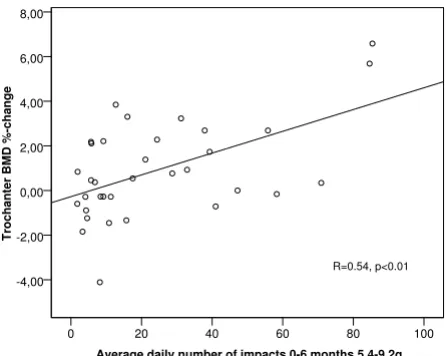
The average daily numbers of impacts at different acceler-ation levels during 0-3, 0-6 and 0-12 months are pre-sented in Table 1. A scatter plot between 12-month trochanteric aBMD change and daily number of impacts at > 5.4 g in 0-6 months is shown in Figure 1. Correlation
coefficients r between the average impact activity data
dur-ing 0-3, 0-6 and 0-12 months and aBMD changes at the femoral neck and trochanter are presented in Figure 2.
Femoral neck aBMD change was not significantly corre-lated with impact activity within the first three months, while six months of impact exercise at high intensity levels (> 3.9 g) were positively associated with bone change (r =
0.42, p < 0.05) (Figure 2A). In multivariate analysis after adjusting for impacts at later months and other factors sig-nificantly associated with response variables in univariate analyses, the number of 0-6 months' impacts > 3.9 g was still significantly associated with 12-month femoral neck BMD change. The association remained the same with cumulative exercise over a period of 12 months (r = 0.39, p < 0.05, Figure 2A).
A positive association was found between trochanter aBMD change and exercise during the first three months
(r = 0.39-0.48, p < 0.05) (Figure 2B) in univariate analysis.
The significant association disappeared in multivariate analysis after adjusting for impacts at later months. The
number of impacts in 0-6 months exceeding 1.1 g were
correlated with trochanter BMD change (r = 0.55, p < 0.01,
Figure 2B) and this was also confirmed in multivariate analysis. A similar association was found with cumulative
exercise over a period of 12 months, and exercise > 1.1 g
was significantly associated with trochanter BMD change, Correlation between daily number of high impacts at 0-6
[image:4.612.320.523.96.335.2]months and 12-month trochanter aBMD change
Figure 1
Correlation between daily number of high impacts at 0-6 months and 12-month trochanter aBMD change. A scatter plot between 0-6 month average daily numbers of impacts at 5.4-9.2 g and trochanteric BMD %-change. N = 34 (DXA data was missing from one subject). r = 0.54, p < 0.01.
Average daily number of impacts 0-6 months 5.4-9.2g 100 80
60 40
20 0
Trochanter BMD %-change
8,00
6,00
4,00
2,00
0,00
-2,00
-4,00
R=0.54, p<0.01
Correlation between impact exercise at different time inter-vals and 12-month aBMD changes in proximal femur
Figure 2
Correlation between impact exercise at different time intervals and 12-month aBMD changes in proxi-mal femur. Pearson's correlation coefficients (r) between the impact exercise at different acceleration levels in 0-3, 0-6 and 0-12 months, and yearly aBMD changes A) in the femoral neck, and B) trochanter. N = 34 (DXA data was missing from one subject), g = acceleration of gravity (9.81 m·s-2), * p <
0.05, ** p < 0.01 after Benjamini-Hochberg corrections, (*)
[image:4.612.67.290.461.639.2]explaining 25-35% of the change depending on the accel-eration level.
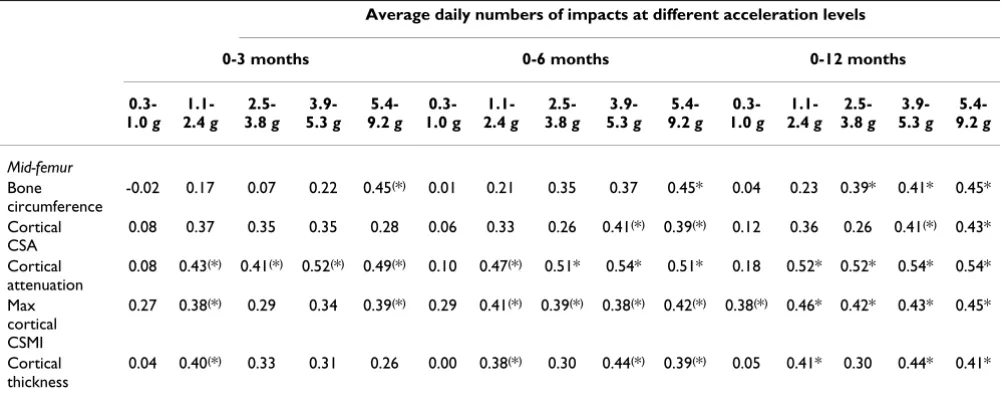
Associations between impact activity during 0-3, 0-6 and 0-12 months and 12-month changes in mid-femur corti-cal bone geometry are presented in Table 2. Changes in mid-femoral cortical geometry were positively associated with impact exercise within the first three months of exer-cise alone, but this association did not remain in multivar-iate analyses after adjusting for impacts at 3-12 months. Positive correlations were also found between impacts at 0-6 months and cortical geometry changes (Table 2). In multivariate analysis after adjusting for covariates and impacts at later months, mid-femur circumference and cortical attenuation changes were significantly explained by impact activity. The average daily numbers of impacts from baseline to 12 months significantly explained the changes in mid-femur cortical bone geometry, the
acceler-ation thresholds being 1.1 g for cortical thickness, cortical
attenuation, and maximal cortical CSMI; 2.5 g for bone
circumference and 5.4 g for cortical CSA. No significant
correlations were found at the proximal or distal tibia (data not shown).
Discussion
For the first time, using continuous impact exercise mon-itoring, we found that average daily number of high impacts during six months of training was significantly associated with 12-month aBMD changes at the femoral neck and trochanter area. A positive relationship was also found in bone circumference and cortical bone attenua-tion in mid-femur.
The results of this study complement our previous studies, in which we calculated correlations using a yearly average of acceleration values with a larger sample size, including also non-exercises [10,11]. These results are in good agree-ment with previous studies in which five to six months of high-impact exercise were needed to increase aBMD in the femoral neck and trochanter [23-25]. However, in a recent study nine weeks of strength training with plyometric jumping elicited a small, but significant increase in femo-Table 1: Average daily numbers of impacts during 0-3, 0-6 and 0-12 months
0-3 months 0-6 months 0-12 months
0.3-1.0 g 7964.7 (6804.8-9124.5) 7828.2 (6796.4-8860.1) 8833.3 (7809.6-9857.0)
1.1-2.4 g 601.5 (477.3-725.7) 615.9 (490.1-741.6) 654.0 (514.6-793.4)
2.5-3.8 g 117.3 (88.5-146.2) 147.7 (100.8-194.6) 143.9 (94.0-193.8)
3.9-5.3 g 43.6 (32.5-54.7) 55.4 (39.7-71.1) 52.5 (37.7-67.3)
5.4-9.2 g 14.3 (9.5-19.2) 23.7 (15.5-31.8) 24.6 (16.5-32.7)
Values are mean (95% confidence interval), g = acceleration of gravity (9.81 m·s-2)
[image:5.612.52.562.100.182.2]Average daily numbers of impacts at different acceleration levels during 0-3, 0-6 and 0-12 months of the exercise.
Table 2: Correlation between the impact exercise at 0-3, 0-6 and 0-12 months and bone geometry changes
Average daily numbers of impacts at different acceleration levels
0-3 months 0-6 months 0-12 months
0.3-1.0 g
1.1-2.4 g
2.5-3.8 g
3.9-5.3 g
5.4-9.2 g
0.3-1.0 g
1.1-2.4 g
2.5-3.8 g
3.9-5.3 g
5.4-9.2 g
0.3-1.0 g
1.1-2.4 g
2.5-3.8 g
3.9-5.3 g
5.4-9.2 g
Mid-femur
Bone circumference
-0.02 0.17 0.07 0.22 0.45(*) 0.01 0.21 0.35 0.37 0.45* 0.04 0.23 0.39* 0.41* 0.45*
Cortical CSA
0.08 0.37 0.35 0.35 0.28 0.06 0.33 0.26 0.41(*) 0.39(*) 0.12 0.36 0.26 0.41(*) 0.43*
Cortical attenuation
0.08 0.43(*) 0.41(*) 0.52(*) 0.49(*) 0.10 0.47(*) 0.51* 0.54* 0.51* 0.18 0.52* 0.52* 0.54* 0.54*
Max cortical CSMI
0.27 0.38(*) 0.29 0.34 0.39(*) 0.29 0.41(*) 0.39(*) 0.38(*) 0.42(*) 0.38(*) 0.46* 0.42* 0.43* 0.45*
Cortical thickness
0.04 0.40(*) 0.33 0.31 0.26 0.00 0.38(*) 0.30 0.44(*) 0.39(*) 0.05 0.41* 0.30 0.44* 0.41*
g acceleration of gravity (9.81 m·s-2), CSA cross-sectional area, CSMI cross-sectional moment of inertia.
* p < 0.05, after Benjamini-Hochberg correction for multiple comparisons
(*) the association did not remain significant in multivariate analysis after adjustment for impacts at later months and other confounding factors.
[image:5.612.55.556.485.686.2]ral neck BMC, but not in BMD [26]. Our data are also in good accordance with studies in which the time course of bone changes was studied using intermediate aBMD measurements. Bassey and Ramsdale (1994) prolonged their original six-month study for another six months and found that the major changes were obtained during the first six months [23]. Similar results were found in an 18-month resistance training intervention, in which the slope for changes in aBMD from baseline to five months was significantly greater than the slope from 5 to 18 months [27]. However, a linear increase in aBMD at the tro-chanter, femoral neck, and whole body over 0-6 and 6-12 months was reported in a 12-month jumping plus lower body resistance training study [28]. Similarly, an almost linear increase in femoral neck aBMD was reported when the impact exercise of the original 18-month intervention was continued without supervision for 8 months [4,29]. More recently, in a 12-month site-specific upper and lower body resistance plus jumping program, aBMD increased progressively over time [30].
Previous findings suggest that bone response to exercise is slower at the femoral neck than at the trochanter region [24,28,30,31]. Here, a similar trend was found. The rela-tively fast response of the trochanter to exercise might be clinically important, because trochanteric fractures are associated with considerably higher morbidity and mor-tality than femoral neck fractures [28,32,33]. The different responses of the trochanter and femoral neck can be explained by their different loading characteristics [6,19,23]. The trochanter is mainly subjected to tensile forces produced by the hip and gluteus muscles attached to it. Magnitudes and rates of these forces are especially high during the take-off, and the landing phases of jump-ing may also create high bone strain and strain rate levels. In contrast, the femoral neck is subjected to compressive forces due to weight-bearing, especially during landing. A woman at this age has an average annual reduction of around 0.5% in BMD [34,35]. Considering this, there was only one subject of active exercisers who did not benefit (Figure 1). This supports the effectiveness of impact exer-cise on aBMD.
Bone strength is influenced not only by its density but also its geometry [36]. Bone adapts to loading by changing its structure to be mechanically appropriate according to its loading environment [37-39]. Exercise has been shown to increase bone cross-sectional dimensions (total circum-ference, cortical thickness) [10,40] which is achieved by reduced endocortical resorption and (or) greater perio-steal apposition [41-43]. This increases cross-sectional moment of inertia and provides greater resistance to bending. A distinct advantage of quantitative computed tomography is its ability to measure cross-sectional geom-etry and discriminate between trabecular and cortical
bone. In this study we showed that six months of exercise were associated with mid-femur cortical bone geometric adaptation. Number of high impacts was even more strongly associated with cortical density evaluated as Hounsfield Units. This is contrary to previous studies, in which the exercise-induced improvement in bone strength has been caused by redistribution of bone rather than remineralisation [40,44]. The relationship found in this study suggests that the higher number of high impacts may help prevent the loss in volumetric BMD.
In contrast to mid-femur, no significant associations were found between the loading characteristics and bone changes at the tibia. It has been proposed that the strain stimulus threshold for bone adaptation varies within indi-vidual and between different bones depending on the local strain environment [45-47]. In rat ulna, the strain threshold was found to be largest distally, where strains encountered in daily activities were typically higher and smaller more proximally [45]. Additionally, unusual strain distributions (strain gradients) in the bone may be more osteogenic than high strain magnitudes solely [48,49]. Based on these previous results, the missing load-ing response at the tibia may be due to the larger strain stimulus threshold at that site. The tibia may have been more accustomed to higher daily loading than was the femur. Thus, it is possible that higher loads would have been needed in the exercise program of the original study to elicit changes in tibia geometry [10]. Additionally, there might be differences in the sensitivity of QCT method to detect changes in bone at different measure-ment sites.
The sensitivity of DXA to detect changes in bone is limited because of its planar nature, which makes aBMD depend-ent on bone size, appardepend-ent density and projection [50] as well as soft tissue inaccuracies [51]. These inherent prop-erties of DXA measurement may modulate the association observed between bone loading and changes in BMD, and also explain at least to some extent the slight differences observed between the accelerations and QCT and DXA findings.
progres-sion can be seen in the average daily numbers of impacts as higher numbers at high acceleration levels. However, the increment was not statistically significant mainly because we report cumulative exercise values (0-3, 0-6 and 0-12 months) which overlap.
The time-dependency of bone response to exercise might partly be explained by the interaction between vitamin D and exercise. In our recent paper with the present study sample, increases in vitamin D were found in 6 months followed by decreases in 12 months [53]. However, there was no significant difference in vitamin D level between the high-impact exercise group and a control group over the trial. It was also confirmed that the dietary calcium intake was within recommended levels [53].
There were some limitations in this study. We did not incorporate intermediate bone measurements. Thus, we were not able to analyse the time-course of bone changes. This issue has to be considered in future studies. Instead of true volumetric BMD we used x-ray attenuation that is comparable to volumetric BMD, because we were not able to apply bone density calibration phantoms during the QCT measurements. The impacts were recorded on a daily basis, and we were unable to distinguish single exercises or rest periods. Our device measured only vertical acceler-ations, and we were not able to quantify other loading directions, which have also been shown to be important [38].
Conclusion
In this study, we used continuous impact exercise moni-toring to determine the association of the time-course of high-impact exercise with bone outcome at 12 months. We conclude that the number of high acceleration impacts during 6 months of training was positively asso-ciated with 12-month bone changes at the femoral neck, trochanteric region and mid-femur. The results provide new information for designing optimal and feasible train-ing programs that can prevent bone loss in premenopau-sal women.
Competing interests
The authors have a patent application with Newtest Ltd. TJ is also a minor shareholder of Newtest Ltd.
Authors' contributions
RA contributed to the original idea of the manuscript, data analysis and interpretation of results, drafting the manu-script and manumanu-script revision. RK contributed to the orig-inal idea of the manuscript, design of the study and exercise program, interpretation of results and manuscript revision. AV participated in the design of the study, bone and acceleration measurements, collecting the data, and critically revised the manuscript. JL contributed to the
design of the study, was the principal investigator of the original trial, and critically revised the manuscript. TJ had the original idea of the manuscript, and contributed to the design of the study, interpretation of results and critically revised the manuscript. All authors read and approved the final manuscript.
Acknowledgements
The authors would like to thank Erkki Vihriälä, MSc, for processing the accelerometer data. We acknowledge Pentti Nieminen, PhD, and Risto Bloigu, MSc, from University of Oulu for statistical advice.
This study was financially supported by the Finnish Funding Agency for Technology and Innovation, and Newtest Ltd., Oulu, Finland. The financiers had no control on the conduct or the publication of the study.
RA was supported by the Finnish Graduate School for Musculoskeletal Problems and Biomaterials, Academy of Finland, Tauno Tönning Founda-tion and University of Oulu Support FoundaFounda-tion. TJ was supported by the Academy of Finland.
References
1. Barry DW, Kohrt WM: Exercise and the preservation of bone health. J Cardiopulm Rehabil Prev 2008, 28(3):153-162.
2. NIH Consensus Development Panel on Osteoporosis Prevention, Diagnosis, and Therapy: Osteoporosis prevention, diagnosis, and therapy. JAMA 2001, 285(6):785-795.
3. Sievänen H, Kannus P: Physical activity reduces the risk of fra-gility fracture. PLoS Med 2007, 4(6):e222.
4. Heinonen A, Kannus P, Sievänen H, Oja P, Pasanen M, Rinne M, Uusi-Rasi K, Vuori I: Randomised controlled trial of effect of high-impact exercise on selected risk factors for osteoporotic fractures. Lancet 1996, 348(9038):1343-1347.
5. Turner CH: Three rules for bone adaptation to mechanical stimuli. Bone 1998, 23(5):399-407.
6. Khan K, McKay H, Kannus P, Bailey D, Wark J, Bennell K: Physical
activ-ity and bone health Campaign, IL, Human Kinetics; 2001:129-142.
7. Wallace BA, Cumming RG: Systematic review of randomized trials of the effect of exercise on bone mass in pre- and post-menopausal women. Calcif Tissue Int 2000, 67(1):10-18. 8. Wolff I, van Croonenborg JJ, Kemper HC, Kostense PJ, Twisk JW:
The effect of exercise training programs on bone mass: a meta-analysis of published controlled trials in pre- and post-menopausal women. Osteoporos Int 1999, 9(1):1-12.
9. Vainionpää A, Korpelainen R, Leppäluoto J, Jämsä T: Effects of high-impact exercise on bone mineral density: A randomized controlled trial in premenopausal women. Osteoporos Int 2005,
16(2):191-197.
10. Vainionpää A, Korpelainen R, Sievänen H, Vihriälä E, Leppäluoto J, Jämsä T: Effect of impact exercise and its intensity on bone geometry at weight-bearing tibia and femur. Bone 2007,
40(3):604-611.
11. Vainionpää A, Korpelainen R, Vihriälä E, Rinta-Paavola A, Leppäluoto J, Jämsä T: Intensity of exercise is associated with bone density change in premenopausal women. Osteoporos Int 2006,
17(3):455-463.
12. Heikkinen R, Vihriälä E, Vainionpää A, Korpelainen R, Jämsä T: Accel-eration slope of exercise-induced impacts is a determinant of changes in bone density. J Biomech 2007, 40(13):2967-2974. 13. Chen KY, Bassett DR Jr: The technology of
accelerometry-based activity monitors: current and future. Med Sci Sports
Exerc 2005, 37(11 Suppl):S490-500.
14. Janz KF, Rao S, Baumann HJ, Schultz JL: Measuring children's ver-tical ground reaction forces with accelerometry during walk-ing, runnwalk-ing, and jumping: The Iowa bone development study. Pediatr Exerc Sci 2003, 15(1):34-43.
15. Janz KF: Physical activity in epidemiology: moving from ques-tionnaire to objective measurement. Br J Sports Med 2006,
16. Jämsä T, Vainionpää A, Korpelainen R, Vihriälä E, Leppäluoto J: Effect of daily physical activity on proximal femur. Clin Biomech 2006,
21(1):1-7.
17. Vihriälä E, Saarimaa R, Myllylä R, Jämsä T: A device for long term monitoring of impact loading on the hip. Mol Quant Acoust
2003, 24:211-224.
18. Vihriälä E, Oksa J, Karkulehto J, Korpelainen R, Myllylä R, Jämsä T:
Reliability of an accelerometer in the assessment of body movements. Technol Health Care 2004, 12:122-124.
19. Korpelainen R, Keinänen-Kiukaanniemi S, Heikkinen J, Väänänen K, Korpelainen J: Effect of impact exercise on bone mineral den-sity in elderly women with low BMD: a population-based ran-domized controlled 30-month intervention. Osteoporos Int
2006, 17(1):109-118.
20. Jämsä T, Parviainen O, Salmela I, Pulkkinen P: Assessment of lower limb cross-sectional geometry using CT image analysis. Tech-nol Health Care 2004, 12:111-113.
21. Benjamini Y, Hochberg Y: Controlling the False Discovery Rate - a Practical and Powerful Approach to Multiple Testing. J R Statist Soc B 1995, 57(1):289-300.
22. Benjamini Y, Yekutieli D: The control of the false discovery rate in multiple testing under dependency. Ann of Statist 2001,
29(4):1165-1188.
23. Bassey EJ, Ramsdale SJ: Increase in femoral bone density in young women following high-impact exercise. Osteoporos Int
1994, 4(2):72-75.
24. Bassey EJ, Rothwell MC, Littlewood JJ, Pye DW: Pre- and postmen-opausal women have different bone mineral density responses to the same high-impact exercise. J Bone Miner Res
1998, 13(12):1805-1813.
25. Kato T, Terashima T, Yamashita T, Hatanaka Y, Honda A, Umemura Y: Effect of low-repetition jump training on bone mineral density in young women. J Appl Physiol 2006, 100(3):839-843. 26. Guadalupe-Grau A, Perez-Gomez J, Olmedillas H, Chavarren J,
Dorado C, Santana A, Serrano-Sanchez JA, Calbet JA: Strength training combined with plyometric jumps in adults: sex dif-ferences in fat-bone axis adaptations. J Appl Physiol 2009,
106(4):1100-1111.
27. Lohman T, Going S, Pamenter R, Hall M, Boyden T, Houtkooper L, Ritenbaugh C, Bare L, Hill A, Aickin M: Effects of resistance train-ing on regional and total bone mineral density in premeno-pausal women: a randomized prospective study. J Bone Miner Res 1995, 10(7):1015-1024.
28. Winters KM, Snow CM: Detraining reverses positive effects of exercise on the musculoskeletal system in premenopausal women. J Bone Miner Res 2000, 15(12):2495-2503.
29. Heinonen A, Kannus P, Sievänen H, Pasanen M, Oja P, Vuori I: Good maintenance of high-impact activity-induced bone gain by voluntary, unsupervised exercises: An 8-month follow-up of a randomized controlled trial. J Bone Miner Res 1999,
14(1):125-128.
30. Winters-Stone KM, Snow CM: Site-specific response of bone to
exercise in premenopausal women. Bone 2006,
39(6):1203-1209.
31. Friedlander AL, Genant HK, Sadowsky S, Byl NN, Gluer CC: A two-year program of aerobics and weight training enhances bone mineral density of young women. J Bone Miner Res 1995,
10(4):574-585.
32. Karagiannis A, Papakitsou E, Dretakis K, Galanos A, Megas P, Lambiris E, Lyritis GP: Mortality rates of patients with a hip fracture in a southwestern district of Greece: ten-year follow-up with reference to the type of fracture. Calcif Tissue Int 2006,
78(2):72-77.
33. Keene GS, Parker MJ, Pryor GA: Mortality and morbidity after hip fractures. BMJ 1993, 307(6914):1248-1250.
34. Lauretani F, Bandinelli S, Griswold ME, Maggio M, Semba R, Guralnik JM, Ferrucci L: Longitudinal changes in BMD and bone geome-try in a population-based study. J Bone Miner Res 2008,
23(3):400-408.
35. Vondracek SF, Hansen LB, McDermott MT: Osteoporosis risk in premenopausal women. Pharmacotherapy 2009, 29(3):305-317. 36. Ammann P, Rizzoli R: Bone strength and its determinants.
Oste-oporos Int 2003, 14(Suppl 3):S13-18.
37. Heinonen A, Sievänen H, Kannus P, Oja P, Vuori I: Site-specific skeletal response to long-term weight training seems to be
attributable to principal loading modality: a pQCT study of female weightlifters. Calcif Tissue Int 2002, 70(6):469-474. 38. Nikander R, Sievänen H, Uusi-Rasi K, Heinonen A, Kannus P:
Load-ing modalities and bone structures at nonweight-bearLoad-ing upper extremity and weight-bearing lower extremity: a pQCT study of adult female athletes. Bone 2006,
39(4):886-894.
39. Nikander R, Sievänen H, Heinonen A, Karstila T, Kannus P: Load-specific differences in the structure of femoral neck and tibia between world-class moguls skiers and slalom skiers. Scand J Med Sci Sports 2008, 18(2):145-153.
40. Haapasalo H, Kontulainen S, Sievänen H, Kannus P, Järvinen M, Vuori I: Exercise-induced bone gain is due to enlargement in bone size without a change in volumetric bone density: a periph-eral quantitative computed tomography study of the upper arms of male tennis players. Bone 2000, 27(3):351-357. 41. Carter DR, Meulen MC Van Der, Beaupre GS: Mechanical factors
in bone growth and development. Bone 1996, 18(1 Suppl):5S-10S.
42. Turner CH, Robling AG: Designing exercise regimens to increase bone strength. Exerc Sport Sci Rev 2003, 31(1):45-50. 43. Seeman E: The periosteum--a surface for all seasons.
Oste-oporos Int 2007, 18(2):123-128.
44. Adami S, Gatti D, Braga V, Bianchini D, Rossini M: Site-specific effects of strength training on bone structure and geometry of ultradistal radius in postmenopausal women. J Bone Miner Res 1999, 14(1):120-124.
45. Hsieh YF, Robling AG, Ambrosius WT, Burr DB, Turner CH:
Mechanical loading of diaphyseal bone in vivo: the strain threshold for an osteogenic response varies with location. J
Bone Miner Res 2001, 16(12):2291-2297.
46. Skerry TM: One mechanostat or many? Modifications of the site-specific response of bone to mechanical loading by nature and nurture. J Musculoskelet Neuronal Interact 2006,
6(2):122-127.
47. Turner CH: Toward a mathematical description of bone biol-ogy: The principle of cellular accommodation. Calcif Tissue Int
1999, 65:466-471.
48. Lanyon LE: Using functional loading to influence bone mass and architecture: objectives, mechanisms, and relationship with estrogen of the mechanically adaptive process in bone. Bone 1996, 18(1 Suppl):37S-43S.
49. Judex S, Gross TS, Zernicke RF: Strain gradients correlate with sites of exercise-induced bone-forming surfaces in the adult skeleton. J Bone Miner Res 1997, 12(10):1737-1745.
50. Sievänen H: A physical model for dual-energy X-ray absorpti-ometry--derived bone mineral density. Invest Radiol 2000,
35(5):325-330.
51. Bolotin HH, Sievänen H: Inaccuracies inherent in dual-energy X-ray absorptiometry in vivo bone mineral density can seri-ously mislead diagnostic/prognostic interpretations of patient-specific bone fragility. J Bone Miner Res 2001,
16(5):799-805.
52. Cullen DM, Smith RT, Akhter MP: Time course for bone forma-tion with long-term external mechanical loading. J Appl Physiol
2000, 88(6):1943-1948.
53. Vainionpää A, Korpelainen R, Väänänen HK, Haapalahti J, Jämsä T, Leppäluoto J: Effect of impact exercise on bone metabolism. Osteoporos Int 2009, 20(10):1725-1733.
Pre-publication history
The pre-publication history for this paper can be accessed here: