Delving into the Boardroom “Black Box”: A Research
Model of “Board Learning Capability” (BLC)
Filipe Morais*, Nada K. Kakabadse
Henley Business School, University of Reading, Henley-On-Thames, UK Email: *[email protected], [email protected]
Received August 23, 2013; revised September 25, 2013; accepted October 4, 2013
Copyright © 2013 Filipe Morais, Nada K. Kakabadse. This is an open access article distributed under the Creative Commons Attri-bution License, which permits unrestricted use, distriAttri-bution, and reproduction in any medium, provided the original work is properly cited.
ABSTRACT
This paper aims to shed light into boardroom processes by bringing together the literature on organization behaviour and that of boardroom process in order to form a model of boardroom learning capability. Board process is viewed as primarily a learning process whereby individual members with their knowledge, skills and external networks engage in a collective learning process that culminates in a “shared understanding” about the problems and respective solutions and increased “board social capital”. It can be argued that boards that do better at this “collective learning process” will display greater effectiveness and ultimately better firm performance. In learning organisation’s terms, one can speak of “board learning capability” (BLC). The chairman of the board has a pivotal role in facilitating and mastering the collec-tive learning process in the boardroom. Central to our model are the interplay between the “chairman role and skill set” and the “board learning challenges”. Building on research literature that focuses on learning organisations and on board-room processes, we propose a model of “board learning capability” (BLC), which could shed additional light on the boardroom process dynamics. In the future, an organisation could develop a “board’s learning capability” measure to complement “good governance” indices which rely heavily on structure and composition proxies, despite limited em-pirical evidence. Emem-pirical testing of the model can be of value for boardroom development and for risk and reputa-tional concern minimization by uncovering differences in “boardroom learning capability” in different governance do-mains.
Keywords: Corporate Boards; Chairman; Learning Challenges; Board Learning Capability; Board Effectiveness
1. Introduction
Many critics have blamed the recent corporate scandals and the 2008 financial crisis on governance and board-room behaviour of large corporations [1-3]. One can ar-gue whether corporate boards are able to learn effectively as the same mistakes seem to occur repeatedly. For ex-ample, according to Senge [4] one key “discipline” for a learning organisation is “systems thinking”. The fact that boards are unable to learn and to apply systems thinking within the agency framework has been questioned throughout the last decade or so. From the well known corporate scandals such as WorldCom, Arthur Andersen, Enron and Tyco for example, to the 2008 global financial crises (GFC), there are numerous examples of failure to thinking systematically. Maybe the most disastrous lack of systems thinking was the predatory lending practices in the US banking system and subsequent sub-prime
cri-sis that ruined the lives of millions of ordinary citizens and resulted in shareholders losing billions of dollars in some cases. Another example is the sky rocketing execu-tive compensation in the US and elsewhere that some view as a direct cause of rising income inequality [2,3,5]. These calamities have led to the rise of organised move-ments such as “Occupy Wall Street” in the US and “Los Indignados” in Spain [6], which protest social and eco-nomic inequality, greed, corruption and the perceived undue influence of corporations on government- particu-larly from the financial services sector. Interestingly, all governments apply systems thinking as a justification for massive bank bailouts with tax payers’ money in order to overcome the danger of systemic risk. Justification for such failures maybe found in the agency framework and its pursuit of shareholder value maximization. Some ar-gue that agency theory [7] is too narrow and does not make sense of changing environmental conditions as it pursues only the interests of one part of the system (i.e.
shareholder value maximisation) [8,9] in a closed loop system. This constrains systems thinking and thus affects board learning and effectiveness.
There are other governance frameworks that facilitate and embody systems thinking such as the stakeholder theory [10], which offers better hopes for enabling learning in the boardroom. Building on previous calls for a behavioural theory of the board [11] and on the litera-ture focusing on learning organisations [4,12-18], this paper contends that boards are subjected to a number of “board learning challenges” which reduces their “collec-tive learning capability” and therefore role effec“collec-tiveness and ultimately, organisational performance.
The paper aims to provide a model for boardroom re-search that can bring additional light and perspective to the processes occurring inside the boardroom. It starts by exploring some key contributions to the study of board-room process [11,19,20] and follows a discussion on literature focusing on learning organisations and previous attempts to apply its principles to the board [15,16]. The authors conceptualise the role of the chairman as pivotal [16,21,22] in facilitating the “collective learning process” in the boardroom, hence they discuss some key studies on NED/chairman competencies, skills and role. Build-ing on previous calls for more adventurous, qualitative and fine grained studies of governance and boardroom process [23-25], the authors propose a research model of “board learning capability”. The paper ends with limita-tions, avenues for future research and a concluding sec-tion.
2. Boardroom Dynamics: Contributions to
Understand the “Black-Box”
In the last decade or so the interest for boardroom proc-ess and behaviour has grown and many call for more contextual and fine-grained studies of boardroom proc-esses [23-26]. For reference [27], structure and board composition and other similar measures are not good predictors of “good governance” and hence research should acknowledge the effect of “outward appearance, inner decisions”. Monks [28] also shares this idea. For example, a recent review of 105 studies covering 30 peer reviewed journals and 16 years’ worth of research (1990- 2006) relating to corporate boards’ variables (structure and composition) and company performance found in-consistent and inconclusive results for duality, insider- outsider ratio, board size and stability, board ownership, director rewards, shareholder activism and corporate rat-ings [26]. The results concluded that there is a need to broaden the board performance measures in use [26]. This is in line with [29], when they observe that despite the inconsistent results, corporate governance ratings systems are a reflection of the literature that focuses on structural aspects rather than boardroom process
vari-ables, which puts into question the system’s reliability. Yet there has been some encouraging progress to date in studying boardroom process, despite the enormous barri-ers that researchbarri-ers encounter to gain access to “live boardrooms” [24].
References [30,31] ethnographic study of boardroom process, supported by the theory of communicative ac-tion [32,33] and conversaac-tion analysts [34], investigated how “live boards” evoked four types of “validity claims” in conjunction with four micro linguistic resources (i.e., use of personal pronouns, discourse markers, metalingual expressions and modalising terms). They concluded that the skilled way by which board members use these re-sources to evoke validity claims is determinant in shap-ing power and influence in boardroom dynamics [31]. Whilst this study is unique, it seems to describe what the organisational learning literature calls “win-lose dynam-ics”, whereby the more skilled use of validity claims and of linguistic resources leads one of the board members to victory at the expense of others.
agement the decision of what to include in a board meet-ing agenda and the outcomes of unanticipated important decisions remain under management discretion [27]. Thus we see that “who should decide remains in the hands of management, not the board” [27].
Reference [36] collected information from five “live” boardroom meetings of a Swedish firm and looked at the role of emotions in boardroom dynamics from a social constructivist approach, specifically how emotions inter- act as “power energizers” and “status energizers” in the boardroom to fulfill the tasks of control and service. Re- sults showed that short term negative emotions have an important role in board dynamics preventing a certain “board pattern” to evolve into “powerlessness and alien- ation” or have longer term emotional consequences such as distrust, hence these scholars view emotional support as an important part of the service role played by the board [36].
French [37] interesting incursion on the role of emo-tions in organizational change provides some insight for application to the boardroom. Drawing on the concept of “negative capability” which was first described by the poet Keats [37] as a state whereby a person “…is capa-ble of being in uncertainties, mysteries, doubts, without any irritable reaching after fact and reason” and taken to the field of psychoanalysis by Bion [37] the author dis-cusses the importance of “negative capability” in suc-cessful organizational change. French states:
“Negative capability indicates the capacity to live with and to tolerate ambiguity and paradox, to “remain con-tent with half knowledge” (Ward, 1963, p. 161 cited by [37], and, therefore, to engage in a non-defensive way with change, resisting the impulse merely to react to the pressures inherent in risk-taking” [37].
It is argued that “negative capability” development is essential for board directors as they need to cope with the challenges of “information asymmetry” arising from the agency framework along with an ever growing complex external environment that increases ambiguity, paradox and contrast which generates turmoil of emotions. Hence the need for a container of emotions in the boardroom which the literature suggests lies with the role of the chairperson [31,38,39]. Thus, “negative capability” im-plies the ability to learn, to hold and contain other’s emo-tions, to “digest them on behalf of the whole system” (or group) until a new understanding is formed which “may facilitate a change of mind or heart in self or colleagues, and hence encourage learning in the wider system” [37]. When “negative capability” is insufficiently developed people tend to “rush into action”, to what is called “dis-persal” behavior [37]. Hence, “negative capability” may- be viewed as a condition for learning and in turn enhanc- ing boardroom effectiveness.
Reference [19] developed an interesting framework of
board effectiveness based on the concept of intellectual capital. They propose a holistic model where inputs (or- ganisation type, history, strategy, constitution and legis- lative and societal framework) are transformed by the board process in outputs such as increased board effec- tiveness (both individual and as a group) and ultimately, organisational performance. They conceptualise the board process as a “transformation process” whereby an indi- vidual director’s human (knowledge and expertise), so- cial (relevant social relationships and board ties) and cultural (values, norms and rules of dominant group) capital interacts with the board’s structural (processes, procedures and roles, committees) and social capital (i.e., climate and relationship CEO-chairperson), shaping boardroom dynamics. It is argued that the model can serve as a roadmap for diagnosing and solving problems at the board level; however, the model appears to deliver little in regards to the actual key board mechanisms through which boardroom dynamics work [19].
Drawing on a large sample of US companies’ board outside directors, [40] investigated the effect of “plural- istic ignorance” (i.e., defined as the extent to which board members underestimate the degree to which others share their concerns, or the hesitancy of board members to voice minority opinions) on the firm’s persistence to pursue strategy which induces firm performance. The emergent evidence indicates that when board members receive negative information about the company’s per- formance and the viability of its strategy, they will not express their concerns unless other board members do so. Voicing minority opinions has been found to be subject to a number of social sanctions. Hence “pluralistic igno- rance” leads to silence in the boardroom, and that silence is frequently interpreted as a sign of agreement with the current strategy [40]. The results show that outside di- rectors of firms exhibiting low performance have a gen- eral tendency to underestimate each other’s concerns about the viability of the strategy (hence persisting in failing strategies) and that the propensity towards “plu-ralistic ignorance” is mediated by weak friendship ties amongst outside directors (or social cohesion) and demo- graphic heterogeneity. It is proposed that increasing plu- ralistic ignorance awareness in boards and taking steps toward increasing homogeneity and social ties amongst outside directors will improve board effectiveness [40]. Pluralistic ignorance may therefore be viewed as imped- ing collective learning and inhibiting genuine shared un- derstanding in the boardroom.
ar-gue that the main behavioural dimension that character-ises the board is the “limited ability of organisational actors to gather and process information”, conceptualis-ing boards not only or not just as solvers of conflicts of interests, but primarily as “problem-solving institutions that reduce complexity, create accountability and facili-tate cooperation and coordination between stakeholders” [11]. They do not view the firm as a nexus of contracts between the principal and the agents, where the board’s primary responsibility is to exert control over manage-ment and align their interests via extrinsic rewards, but as “a nexus of coalitions of stakeholders with different in-terests” where the primary role of the board is to enable cooperation and coordination by “engaging in collective processes of organised information and knowledge gath-ering” [11]. The authors identify six major research streams that address the behavioural study of boards and corporate governance in terms of 1) structure; 2) interac-tions and 3) decisions. They then address each of these aspects in terms of internal relationships or external rela-tionships [11].
A recent large study on the selection processes of members of the supervisory board of Germany’s 80 largest industrial firms found that a “minimum amount of cohesion inside the boardroom is necessary to make use of existing individual knowledge, skills and abilities and to foster human capital within boards”. Depending on who is involved in the selection process, the boards more or less achieve cohesion [42]. One can argue, however, that the chairman’s ability to manage boardroom diver-sity, dynamics and processes and not as an a priori, static exercise of selection, can better determine board cohe-sion.
A 2013 study on two tier boards in the Netherlands found three core challenges that non-executive directors’ (NEDs) board members face from management [43]. The first challenge was the ability of NEDs to ask manage-ment critical questions which defensive managemanage-ment behaviours, a non-questioning board culture, and lack of director abilities, group support and in-depth information trigger. The second challenge related to “information asymmetries” and this is enhanced by inadequacies on the quantity, scope and timing of information and on the organisational capabilities to collect the right information. Finally, the third challenge relates to “board-management relationships” which board difficulties in “balancing for-mal responsibilities with personal relationships”, the lack of openness in the relationships and the (low) quality of executive and non-executive directors trigger [43].
A common theme in the literature is how boardroom process transforms a director’s individual knowledge, skills, expertise and networks (human, social and cultural capital) into effective role performance. A second com-mon aspect is that researchers have been considering the
boardroom process primarily as a decision-making proc-ess whereby role effectivenproc-ess is dependent on the qual-ity of decision-making. This is then dependent on a number of variables that distort the optimal decision. Next, we will turn attention to the literature which fo-cuses on learning organisations in our attempt to show its relation with boardroom processes.
3. Learning Organisations and
Organisational Learning
We can trace literature focusing on learning organisa-tions back to 1963 where March and various colleagues on The Behavioural Theory of the Firm discussed among other aspects, the importance of learning for organisa-tions [41]. Despite numerous conceptual works on learn-ing organisations and organisational learnlearn-ing to date [12,13,16,17,44-46], there is no consensus yet as to the distinction between “learning organisation” and “organ-isational learning” nor has a unique model or theory emerged [47]. This is despite strategists and academics acknowledging the role of learning faster than competi-tors as a source of competitive advantage [45,48]. One of the most difficult and debated questions is the relation-ship between individual and organisational learning and whether an organisation can learn [49].
According to Antonacopoulo [49], there are four con-trasting positions in literature. The first rejects the idea that organisations have human qualities such as the abil-ity to learn [50]. A second strand defends the idea that organisations can not only learn, but that this is a key competitive advantage [4,12,18,45]; Others, however, are unsure of whether organisational learning exists and whether there is such a thing as a learning organisation, but recognise some of the arguments of other branches of learning organisations [51,52]. A fourth and last position views organisational learning as a social process affected by contextual factors such as structure, information sys-tems and control procedures, which then influence the way individuals learn [46,53,54].
“double loop” learning [56]. Espoused theory argues that executives often use defense mechanisms for ideas and information that are likely to challenge the status quo and corresponding supporting values, by separating the ideas that they say they defend from the values one can infer from their actions [13,57,58].
Numerous authors view learning as a process of con-tinuous interaction with the environment whereby the organisation must start by studying the environmental forces and the impact they may have in the organisation [59,60] and devise different responses to changing envi-ronmental conditions [61] by using different types of learning processes to create knowledge. Following this line of research, others [62] speak of “absorptive capac-ity” as the ability to recognise, assimilate and apply new knowledge to a commercial purpose among its constitu-ents and “learning-by-reflection” whereby through inter-nal self-reflexive learning practices, individuals and groups make implicit and tacit knowledge more explicit for themselves and for others [62,63].
Reference [64] discusses the learning organisation un-der three perspectives: the normative, evolutionist and capability perspectives. The normative view contends that leaders should create the essential conditions for collective learning to take place by removing organisa-tional learning barriers [4,14,18,65]. The evolutionist perspective views organisational learning as a process that evolves with organisational age, growth, manage-ment developmanage-ment and technology and where develop-ment provides the context for learning to continue to evolve [66,67]. The capability perspective [68,69] con-tends that all organisations develop their own learning processes; hence, the question is not whether how or-ganisations become learning oror-ganisations or if learning takes place in the organisation. Instead, what is important is to study the learning processes—how, where and what is learned. In this sense there is not one best way of learning—but all types of learning are valid and specific to each organisation [64].
Can Boards Learn?
According to [56], scholars have studied the field of or-ganisational learning from various perspectives: socio- technical systems, organisational strategy, production, economic development, systems dynamics, human re-sources and organisational culture. Surprisingly, learning organisations principles and practices have had little or no attention from corporate governance and boardroom studies.
Whilst we argue that boards include all the necessary characteristics for learning to occur, we also contend that boards are not very good at it due to a number of under-lying board learning challenges. For [56], there are a number of characteristics for a collectivity to become
organisational:
“Collectivities become organizational when they meet three constitutional capabilities: 1) to make collective decisions (so that groups of individuals can say “we” about themselves; 2) to delegate authority for actions to an individual in the name of the collectivity and; 3) to say who is and who is not a member of the collectivity” [56].
He continues arguing that:
“Under these conditions, it makes conceptual sense to say that individuals can act on behalf of the organization. It also makes conceptual sense to say that on behalf of the organization individuals can take learning processes (organizational inquiry) that can, in turn, yield outcomes as reflected in changes in organizational theories of ac-tion and the artifacts that encode them” [56].
Following along the same line of reasoning, we argue that it also makes conceptual sense to study boards as a unit of learning, perhaps the most important within the organisational setting.
More than two decades ago, Argyris [70] observed that “people at leadership positions are not very good at learning”, something that according to Garratt [16] is still true some 20 years later. It is argued [70] that people tend to become defensive when faced with the question of “what their role is in solving organisational problems”. He purports that people need to think critically about how their own behaviour contributes to organisational goals. Others recognise that the first starting point for building a “learning company” would be to “work with the board of directors”, and that the boards should “live out” through their own actions and learning. They should themselves become masters of the learning company [17]. However, there is pressure for organisational leaders to be “competent at all times”, which stops them from ask-ing questions that would enhance their individual and collective learning, with impact on decision-making [17]. In this way, it is necessary to identify those “hard and soft aspects” that block learning in the boardroom.
4. “Learning Challenges” of the Board
The normative approach seems to suggest that organisa-tional leaders are primarily collective learning enablers [4,15-18].
Departing from the normative perspective of learning organisations literature whereby the role of leaders is to create the conditions for organisational learning to occur by removing a number of barriers to learning, we con-tend that organisational leaders have at best focused in removing these from their organisations, but often failed in looking in their own “backyard”, that is, how board-room learning was occurring and being managed, so as to arrive at real consensus [70], shared vision [4], shared understanding [17] or “idea generalisation” [18].
learning. Some call it “dysfunctional patterns of organ-isational behaviour” [41,71], others “defensive routines” [72,73], “conditions for error” [56], “learning barriers” [4] and “learning disabilities” [18]. These factors tend to reduce productive learning and organisational effective- ness.
For Argyris [56], these are “counter-productive group dynamics” and include “win-lose dynamics”, “non-addi- vity”, “conformity” and “group thinking”. The so called “theories-in-use” govern individuals’ behaviour with the objective of remaining in unilateral control, maximising “wining” and minimising “losing”, suppressing negative feelings and being as rational as possible so as to evalu- ate whether their behaviour worked as intended. These four basic values exist for individuals to “avoid embar- rassment or threat, feeling vulnerable or incompetent” [70].
Argyris states:
“(…) the simple act of encouraging more open inquiry is often attacked by others as “intimidating”. Those who do the attacking deal with their feelings about possibly being wrong by blaming the more open individual for arousing these feelings and upsetting them. Needless to say, such a master program inevitably short-circuits learning. And for a number of reasons unique to their psychology, well-educated professionals are especially susceptible to this” [70].
According to Argyris [56] practitioners adhering to certain microeconomic principles and the firm’s behav-ioural theory have produced information noise that hin-ders the ability to learn.
It is argued that economic theories, such as the agency theory, assume an amount of information gathering and processing that is beyond human capacity, whereby the ability of the board to monitor management is limited. Moreover, by assuming a top-down perspective, those at the top “seek to win, not to learn” and hence those in the next level “protect themselves by providing as valid in-formation as they can while still protecting themselves” [56].
Executives view organisational routines as “monu-mental barriers to valid economic information” [58]. Jensen and Meckling [7] purport that because humans have a finite capacity to process large amounts of infor-mation, they have less ability to reach optimal decisions which lead to satisficing behaviour [74] which helps them make the best available decision [56]. However, according to Argyris [56], we need to interpret “satis-ficing behaviour” in conjunction with “organisational routines” and that the willingness of decision-makers to satisfice depends on their ability to recognise and over-come such routines.
Reference [56] contends that Behavioural Theory of the Firm concepts such as satisficing, partial resolution
of conflict and problemistic search [41] all exist as a consequence of “organisational defensive routines”. Therefore, it derives from here that in order to reduce information noise and maximise valid economic infor-mation, it is necessary to eliminate organisational defen-sive routines so that organisational learning can occur and decision-making can improve. Argyris [56] also ar-gues that the Behavioural Theory of the Firm views the organisation as seeking to identify problems (problemis-tic search) rather than problem solvers seeking to find solutions.
Reference [56] suggests that by identifying and re-moving “organisational defensive routines”, board mem-bers could reduce information noise so that learning could occur effectively and they could reach real con-sensus. Argyris reports how a CEO behaved in a real company study:
“(…) in the guise of being “diplomatic” he would pre-tend that a consensus about the problem existed, when in fact none existed” [56].
Reference [17] views conflict as something positive, whereby companies should learn out of dialectic gener-ated by conflicts and use conflicts as a mean of “testing old ideas and generating new ones”. Furthermore, they contend that the stage of organisational development determines the amount of conflict and its nature (con-structive versus de(con-structive). The authors observe:
“(…) the level of conflict is high in “adolescence”, when shared understanding is low, and decreases with age. However, as the learning company reached a cer-tain stage of maturity it can tolerate and cope with more conflict where differences are appropriately surfaced and worked on (…)” [17].
Senge [4] speaks of “personal mastery”, “mental mod-els”, “shared vision” and “team learning” as further con-ditions of organisational learning. These four concon-ditions, together with systems thinking, are interrelated and learning cannot occur effectively if one of them is miss-ing or poorly developed.
discus-sion is more a way where an individual tries to see his/her own vision of the world to prevail, or as Senge puts it, discussion is a “winner takes all competition” [4]. This is in line with Argyris’ [70] idea of “win or lose dynamics”. The promotion of “dialogues” instead of “discussion” harnesses the potential for collaborative learning. Senge explains: “(…) in dialogue people actu-ally feel as if they are building something, a new deeper understanding” [4]. He continues arguing that directors individually need to be accustomed to dialogue and not discussion and that “the presence of a skilled facilitator is of the utmost importance” [4]. Prominent authors studying boardroom effectiveness have called for the return of the chairman as the key to promote dialogue and an environment of collective learning so as to achieve a shared understanding [22].
Interestingly, many authors from different branches of governance and boardroom literature have referred to similar distortive aspects of boardroom effectiveness. For example, [1] and [2], referring to inordinate power of CEOs in the US, speak of “underlying structural effects” and “social and psychological constraints” that impede the boards to pose real questions and to challenge domi-nant “mental models”, “visions” and where dialogue gives way to discussion, conformity or passivity.
Reference [18] defines learning capability in a sys-temic perspective which both the internal and external environment influence with an impact on organisational performance. They define organisational learning as the ability to generate and generalise ideas with impact. In order to do this, organisations need to identify and over-come a number of “learning disabilities”. The authors identify seven different “learning disabilities”: 1) blind-ness; 2) superficiality; 3) unity; 4) hierarchy; 5) maras-mus/paralysis; 6) superstition and 7) poor diffusion [18].
Garratt [14-16] was one of the first to apply the learn-ing organisations principles to the functionlearn-ing of the board as result of his own extensive experience as a con-sultant and less as a result of academic activity. He ar-gued that boards move from “high understanding-high inclusion” to “low understanding-low-inclusion”. This can produce four types of boards: 1) the professional board (seen as the best); 2) the unitary board; 3) the country club board and 4) the passive board (which is seen as the dominant type of board), whereby board members have a low understanding on how to carry out their roles, but have high inclusion in the board affairs.
It is argued that two sets of “blockages to becoming a learning board” exist. The first set is called “unawareness of impending corporate collapse” [16] and comprises six common blockages to learning: 1) one-man rule; 2) a non participating board; 3) an unbalanced top team; 4) a lack of management depth; 5) a weak finance function and 6) a combined role of chairman and chief executive officer.
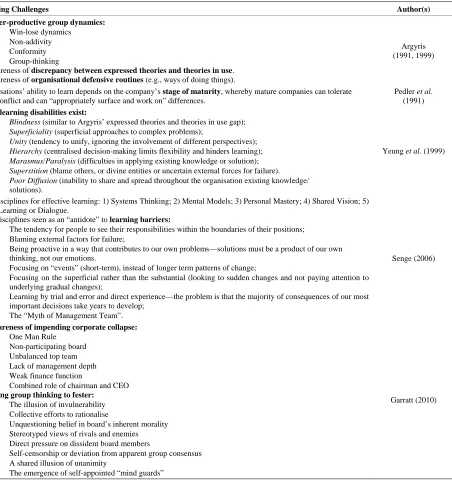
The second set of learning blockages is based on Irving Janis’ work on group thinking and includes factors “al-lowing group thinking to foster” [16] such as 1) illusion of vulnerability; 2) collective efforts to rationalise; 3) unquestioning belief in the board’s inherent morality; 4) stereotyped views of rivals and enemies; 5) director pressure on dissident board members; 6) self-censorship or deviations from group consensus; 7) a shared illusion of unanimity and 8) the emergence of self-appointed “mind guards”. Table 1 below highlights some of the most influential authors’ findings on barriers to organisa-tional/board learning.
According to this stream of literature, removing a number of learning challenges so as to facilitate collec-tive learning and arriving at “shared understanding” of organisational problems and solutions at any point in time would enhance a board’s learning capability. Hence, the presence and frequency of such learning challenges would form a part in determining a “board’s learning capability”.
5. The Chairman as Facilitator of Board
Learning
Researchers have increasingly acknowledged the impor- tance of context in understanding individual and board- room performance during the last decade. The “formative context” within which a board and its members operate is likely to vary substantially and each have their own spe- cific “peculiarities” [25,75,76] The complexity of an or- ganisational “formative context” (e.g. institutional ar- rangements, cultural values, ethnic tastes, training, back- ground and cognitive frames that shape the daily routines of individuals, ideology and objectives, relational prox- imity/interactivity), and the plethora of variables that can react with them, suggests that it is unlikely that organisa- tions could or should view boardroom performance in isolation.
Table 1. Challenges to organisational/board learning.
Learning Challenges Author(s)
Counter-productive group dynamics: Win-lose dynamics
Non-addivity Conformity Group-thinking
Unawareness of discrepancy between expressed theories and theories in use. Unawareness of organisational defensive routines (e.g., ways of doing things).
Argyris (1991, 1999)
Organisations’ ability to learn depends on the company’s stage of maturity, whereby mature companies can tolerate more conflict and can “appropriately surface and work on” differences.
Pedler et al. (1991) Seven learning disabilities exist:
Blindness (similar to Argyris’ expressed theories and theories in use gap);
Superficiality (superficial approaches to complex problems);
Unity (tendency to unify, ignoring the involvement of different perspectives);
Hierarchy (centralised decision-making limits flexibility and hinders learning);
Marasmus/Paralysis (difficulties inapplying existing knowledge or solution);
Superstition (blame others, or divine entities or uncertain external forces for failure).
Poor Diffusion (inability to share and spread throughout the organisation existing knowledge/
solutions).
Yeung et al. (1999)
Five disciplines for effective learning: 1) Systems Thinking; 2) Mental Models; 3) Personal Mastery; 4) Shared Vision; 5) Team Learning or Dialogue.
Five Disciplines seen as an “antidote” to learning barriers:
The tendency for people to see their responsibilities within the boundaries of their positions; Blaming external factors for failure;
Being proactive in a way that contributes to our own problems—solutions must be a product of our own thinking, not our emotions.
Focusing on “events” (short-term), instead of longer term patterns of change;
Focusing on the superficial rather than the substantial (looking to sudden changes and not paying attention to underlying gradual changes);
Learning by trial and error and direct experience—the problem is that the majority of consequences of our most important decisions take years to develop;
The “Myth of Management Team”.
Senge (2006)
Unawareness of impending corporate collapse: One Man Rule
Non-participating board Unbalanced top team Lack of management depth Weak finance function
Combined role of chairman and CEO Allowing group thinking to fester:
The illusion of invulnerability Collective efforts to rationalise
Unquestioning belief in board’s inherent morality Stereotyped views of rivals and enemies Direct pressure on dissident board members
Self-censorship or deviation from apparent group consensus A shared illusion of unanimity
The emergence of self-appointed “mind guards”
Garratt (2010)
Source: Compiled by the author.
cies necessary for board directors and produced a norma- tive model of effective NED.
The NED’s role is complex and dynamic, consisting of many potencies or aspects that may reveal themselves through role occupants’ interaction with other board members within the critical context [75]. The dynamic interaction between the board members comprises the intensely rich and often dramatic inner life of boards and its individual members. However, this dynamic relation- ship between a role occupant’s potential capabilities and manifested behaviour in relation to prescribed normative
tive and highly dynamic capability of synergy harmoni- sation is the processes of “unification of the board” and is a secret to, as well as a sacred quality of board effec- tiveness [21,22]. Although individuals outside of the board do not recognise easily this sacred quality, if a board does not attain it, it manifests itself as a “split board” and the majority or all stakeholders often experi-ence a consequent decline in the share price [21]. Be-cause this unique board quality is idiosyncratic to each board and reveals itself only through board members interaction, they do not lend themselves easily to the studies from the proxy measures.
Studies on NED/Chairman Characteristics have as a consequence been rather few and the list of skills and competencies necessary for fulfilling their roles varies across studies. Studies arrive at lists of competencies and skills for the NED/Chairmen that are more or less spe- cific and more or less comprehensive, according to the source—normative (Cadbury, 1992), consultancy-based [39,81] or academic studies, and the former depend on interview-based [22,38,75,82], questionnaire-based [83, 84], ethnographic [30] or conceptual [85] methods to collect data.
Taylor [86] argues that board members must possess due diligence abilities, strong industry and board experi- ence and corporate intangibles such as values, integrity, reputation and relationship skills to ensure that effective governance occurs. Despite the regulators and press in- creasingly emphasising boardroom members’ fiduciary duties, the qualitative study of NEDs’ role contribution reveals that they need to understand due diligence skills as only one set of tools, which they do not need to dis- play all the time and that more importantly, they need to have the conversation they value whilst equally they need to appreciate the needs and values of others in the boardroom [38]. Although, due diligence and rigour re- main a priority, NEDs increasingly need to interact on a higher level and philosophically debate where passion, excitement and hope are the driving dynamics in the boardroom rather than just business metrics [38]. This then requires self-awareness and reflexive interfacing skills based on a democratic dialogue and where there is no room for rigidity, defiance or getting ones’ own way [87].
An extensive interview based qualitative study with chairmen world-wide was undertaken by Kakabadse and Kakabadse [22]. The study concluded that world class chairmen need to master six disciplines in order to lead for boardroom effectiveness: 1) delineating boundaries (between chairman/CEO roles, distinct of board and management roles); 2) Sense making (concerning the mission, vision and values in the boardroom and the or- ganization); 3) interrogating the argument (questioning policy and strategy); 4) influencing outcomes; 5) living
the values (based on trust and integrity and paying atten- tion to the imbalances between espoused values and practiced values) and; 6) developing the board (which includes board evaluation, selection, development, coach- ing, etc.) [22].
More recently, researchers [88] interviewed company secretaries from some 39 large companies of the BEL20 and BEL mid (33 of which had separate chairman and CEO roles) using an interview protocol and the Decision Making Grid introduced by Hal et al. (1964) in order to enquire into (prevalent) board leadership styles. Chair- men were identified as exhibiting a highly heterogeneous leadership style which impacted on the quality of the decisions made on and the group’s commitment to those decisions. It is suggested that the chairman should be able to transform the boardroom into an effective collec- tive decision-making body, by removing “negative group dynamics” [88]. It is concluded that the use of particular board leadership styles calls for specific personal com- petencies and attributes of the chairman that go beyond the structural aspects of board leadership, and that in- clude creativity, criticality, preparedness and commit- ment [88]. The study concludes with a plea for the use of the “pluralistic theoretical lenses” so as to be able to ex- plain the behavioural dimensions of chairman leadership [88].
6. Proposed Model of Board Learning
Capability (BLC)
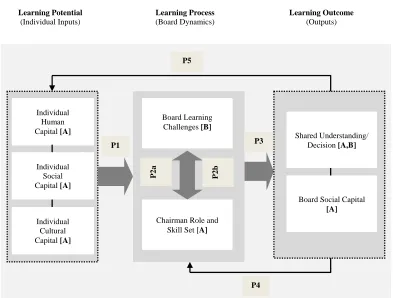
The literature seeking to identify what is the “ideal” pro- file of the chairman/NED often places the chairman at the heart of the board. He/she is responsible for creating an atmosphere for real learning and a truly systematic and shared understanding of the company’s problems and possible solutions, typically by encouraging dialogue and asking penetrating questions. This pivotal role awarded to the chairman is, of course, only possible in dual firms (i.e., the literature views non-duality as an impediment to effective board learning). Hence, we advocate that com- panies with a combined role of chairman-CEO have a diminished learning capability. For dual firms, the ability of the chairman to act as a “collective learning enabler” by indentifying and overcoming “learning challenges” will determine the ability of the board to transform indi- vidual inputs (human, social and cultural capital) into collective learning (i.e., shared understanding and deci- sion and improved “board collective social capital”). Fig- ure 1 presents the proposed model of Board Learning Capability (BLC).
Board Learning Challenges [B]
Chairman Role and Skill Set [A] Individual
Human Capital [A]
Individual Social Capital [A]
Individual Cultural Capital [A] Learning Potential
(Individual Inputs)
Learning Process (Board Dynamics)
Learning Outcome (Outputs)
Shared Understanding/ Decision [A,B]
Board Social Capital [A] P5
P4 P1
P
2a
P2
b
[image:10.595.102.495.78.376.2]P3
Figure 1. Board learning capability (BLC) model.
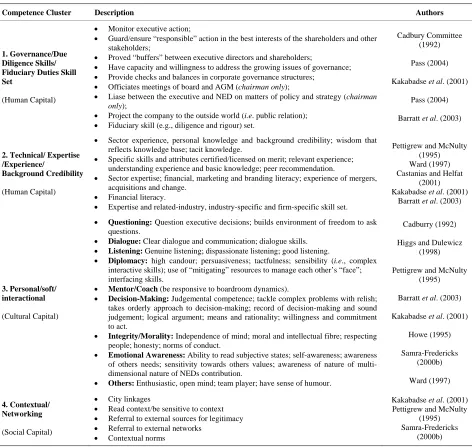
inputs of individual human, social and cultural capital [A] and to the component of “chairman role and skills set” and of “board social capital” [A] (see Table 2). We draw the “board learning challenges” [B] (see Table 1) from the literature on learning organisations [4,16-18,56,70] of which there is little record of research in the context of boards, despite some suggestions that we could apply earlier concepts of the Behavioural Theory of the Firm to boardroom dynamics [11]. Finally, literature focusing on learning organisations [4,16,17], but also literature on Chairman/NED’s role and skills [75] suggest that we can view “learning output” or the board process output pri- marily as a shared understanding or shared vision about a particular board issue. Hence, we argue that “shared un- derstanding/decision” is an output of the collective learn- ing process [A, B].
The model rests on a number of propositions (P), which we can empirically test:
P1—High/Low levels of individual board members human, social and cultural capital positively/nega- tively influence the interplay between the chairman’s role and skills and the board’s learning challenges. The ability of the chairman with his/her skills, knowl- edge and experience to identify and resolve existing board learning challenges on a particular issue will be influenced by the levels of individual human, social and cultural capital. For example, a board with members who
exhibit a high and diverse human, social and cultural capital will eventually introduce much more diversity of ideas into the board and probably will not face the learn- ing challenge of “unity” [18], but may be more prone to face challenges of “win-lose dynamics” [56], thus posing different challenges to and requiring different skills from the chairman.
P2a—The chairman’s “role and skills set” influ- ences the ability of the board to overcome learning challenges. The chairman role and skill set is pivotal for the correct functioning of the board so as to arrive at a shared understanding and decision on a particular organ-isational issue [21,22,79.80]. One can argue that the chairman’s ability (through his/her skills and experience) to identify and overcome prevalent “board learning chal-lenges” determines the board’s ability to overcome such challenges. We can view the chairman as a “collective learning enabler”.
Table 2. Chairman/NED competences (that facilitate learning at the boardroom).
Competence Cluster Description Authors
1. Governance/Due Diligence Skills/ Fiduciary Duties Skill Set
(Human Capital)
Monitor executive action;
Guard/ensure “responsible” action in the best interests of the shareholders and other stakeholders;
Proved “buffers” between executive directors and shareholders;
Have capacity and willingness to address the growing issues of governance; Provide checks and balances in corporate governance structures;
Officiates meetings of board and AGM (chairman only);
Liase between the executive and NED on matters of policy and strategy (chairman
only);
Project the company to the outside world (i.e. public relation); Fiduciary skill (e.g., diligence and rigour) set.
Cadbury Committee (1992)
Pass (2004)
Kakabadse et al. (2001)
Pass (2004)
Barratt et al. (2003)
2. Technical/ Expertise /Experience/
Background Credibility
(Human Capital)
Sector experience, personal knowledge and background credibility; wisdom that reflects knowledge base; tacit knowledge.
Specific skills and attributes certified/licensed on merit; relevant experience; understanding experience and basic knowledge; peer recommendation.
Sector expertise; financial, marketing and branding literacy; experience of mergers, acquisitions and change.
Financial literacy.
Expertise and related-industry, industry-specific and firm-specific skill set.
Pettigrew and McNulty (1995) Ward (1997) Castanias and Helfat
(2001) Kakabadse et al. (2001)
Barratt et al. (2003)
3. Personal/soft/ interactional
(Cultural Capital)
Questioning: Question executive decisions; builds environment of freedom to ask questions.
Dialogue: Clear dialogue and communication; dialogue skills. Listening: Genuine listening; dispassionate listening; good listening.
Diplomacy: high candour; persuasiveness; tactfulness; sensibility (i.e., complex interactive skills); use of “mitigating” resources to manage each other’s “face”; interfacing skills.
Mentor/Coach (be responsive to boardroom dynamics).
Decision-Making: Judgemental competence; tackle complex problems with relish; takes orderly approach to decision-making; record of decision-making and sound judgement; logical argument; means and rationality; willingness and commitment to act.
Integrity/Morality: Independence of mind; moral and intellectual fibre; respecting people; honesty; norms of conduct.
Emotional Awareness: Ability to read subjective states;self-awareness; awareness of others needs; sensitivity towards others values; awareness of nature of multi- dimensional nature of NEDs contribution.
Others: Enthusiastic, open mind; team player; have sense of humour.
Cadburry (1992)
Higgs and Dulewicz (1998)
Pettigrew and McNulty (1995)
Barratt et al. (2003)
Kakabadse et al. (2001)
Howe (1995)
Samra-Fredericks (2000b)
Ward (1997)
4. Contextual/ Networking
(Social Capital)
City linkages
Read context/be sensitive to context Referral to external sources for legitimacy Referral to external networks
Contextual norms
Kakabadse et al. (2001) Pettigrew and McNulty
(1995) Samra-Fredericks
(2000b)
Source: Compiled by the author.
require different skills and behaviours from the chair- man.
P3—The interplay between the “board learning challenges” and “chairman role and skill set” deter- mines levels of “shared understanding/decisions” and of “board collective social capital”. The outcome of the interplay between the chairman’s “role and skill set” and the “board learning challenges” for any particular issue is a “shared understanding/decision” and increases “board social capital”. As the chairman overcomes learning challenges it starts to form a true “shared understand-ing/decision” about a particular issue. If board members reach a “shared understanding/decision”, board social capital also increases with it. For example, a board with a
poor record or difficulties in achieving a true “shared understanding/decision” will have a poor “board social capital” which in turn will make it more difficult to ar-rive at a “shared understanding/decision”. It is a reinforc- ing cycle.
and external relationships) and, of course, cultural capital (their shared values and principles).
P5—Improved “board social capital” reinforces the chairman role and skills. Improved “board social capi-tal” will legitimise further (and improve) the way the chairman conducts the board as other board members will see it as effective. The chairman itself will also re-fine is role and skill set as he/she perceives it to be effec-tive.
7. Challenges, Future Research and Possible
Contributions
The first limitation of the model is that is only applicable to non-dual firms, having limited applicability in firms with a combined chairman and CEO role. It follows that our model implicitly assumes that non-dual firms have better “board learning capability” than dual firms. Sec-ond, the study of the interplay between the “chairman’s role and skill set” and “board learning challenges”, lends itself to the use of more qualitative and ethnographic methods of research which implies access to “live boards”, something that can be extremely difficult and time consuming. Third, there is a need to test the model and streamline it. It would be interesting to understand whether there is a particular set of “learning challenges” more prevalent or more important, and if certain chair-man skills are more helpful in enabling board collective learning. The literature also seems to suggest that share-holder models of governance (i.e., those resting on agency framework) face more difficulties in learning capability; hence, it could be interesting to test the model for shareholder and stakeholder cases to compare and contrast.
Finally, the testing of the model could provide a non- structural measure of corporate governance, contributing to resolve problems arising from the fact that corporate governance indices rely heavily on structural and com- position measures, despite the inconsistent empirical evi- dence.
8. Conclusions
The extant literature on corporate governance and board- room dynamics largely ignored the learning processes occurring in the boardroom and the elements that con- tribute for their effectiveness. Literature focusing on learning organisations, on the other hand, has produced a number of models and identified a number of learning challenges, but scholars have conducted little empirical research on whether these learning challenges also apply to the board, to what extent they influence board effec- tiveness and how board members can overcome them. There is room for improved dialogue between boardroom process research and learning organisations theory in
explaining boardroom dynamics and effectiveness. Our proposed model tries to enrich the research on boardroom dynamics by taking a “collective learning” perspective to the boardroom, whereby the chairman assumes a central role in managing the flow of individual human, social and cultural capital and the learning chal- lenges so as a to arrive at “shared understanding/deci- sion” and improved “board social capital”. We hope that organisations can test the model in the future should op- portunities arise and that such a test will help the board derive a learning capability measure to complement “good governance indices”.
REFERENCES
[1] L. A. Bebchuck and J. M. Fried, “Pay without Perform-ance: Overview of the Issues,” Discussion Paper No. 528, Harvard Law School, John M. Olin Center for Law, Eco-nomics and Business, 2006.
[2] T. Clarke, “A Critique of the Anglo-American Model of Corporate Governance,” Comparative Research in Law & Political Economy, Research Paper 15, Vol. 5, No. 3, 2009, pp. 1-30.
[3] T. Clarke, “Out of Control? The Impact of CEO Power and Reward on Economic Relationships and Inequality, Paper Presented at European Academy of Management (EURAM),” Rome, 2010, pp. 1-37.
[4] P. M. Senge, “The Fifth Discipline: The Art and Practice of the Learning Organization,” 2nd Edition, Random House, London, 2006.
[5] A. Pryce, N. K. Kakabadse and T. Lloyd, “Income Dif-ferentials and Corporate Performance. Corporate Gov-ernance, Vol. 11, No. 5, 2011, pp. 587-600.
http://dx.doi.org/10.1108/14720701111176993
[6] D. Rushe, “Occupy Wall Street: NYPD Attempt Media Blackout at Zuccotti Park: Journalists report Aggressive Treatment as Media Blocked from Protest Camp during Surprise,” The Guardian, 15th November 2011.
http://www.guardian.co.uk/world/2011/nov/15/occupy-jo urnalists-media-blackout
[7] M. C. Jensen and W. Meckling, “Theory of the Firm: Managerial Behavior, Agency Costs and Ownership Structure,” Journal of Financial Economics, Vol. 3, No. 4, 1999, pp. 305-360.
http://dx.doi.org/10.1016/0304-405X(76)90026-X
[8] J. Christopher, “Corporate Governance—A Multitheore- tical Approach to Recognizing the Wider Influencing For- ces Impacting on Organizations,” Critical Perspectives on Accounting, Vol. 21, No. 8, 2010, pp. 683-695.
http://dx.doi.org/10.1016/j.cpa.2010.05.002
[9] N. Kakabadse and A. Kakabadse, “Polylogue as a Plat- form for Governance: Integrating People, the Planet, Pro- fit and Prosperity,” Corporate Governance, Vol. 3, No. 1, 2003, pp. 5-38.
http://dx.doi.org/10.1108/14720700310459845
[11] H. Van Ees, J. Gabrielson and M. Huse, “Towards a Be- havioral Theory of Boards and Corporate Governance,”
Corporate Governance: An International Review, Vol. 17, No. 3, 2009, pp. 307-319.
http://dx.doi.org/10.1111/j.1467-8683.2009.00741.x
[12] C. Argyris and D. Schön, “Organizational Learning: A Theory of Action Perspective,” Addison-Wesley Pub-lishing, Reading, 1978.
[13] C. Argyris and D. Schön, “Participatory Action Research and Action Compared,” American Behavioral Scientist, Vol. 32, No. 5, 1989, pp. 612-623.
http://dx.doi.org/10.1177/0002764289032005008
[14] B. Garratt, “Creating the Learning Organization: A Guide to Leadership, Learning, and Development,” Simon & Schuster, Cambridge, 1990.
[15] B. Garratt, “The Learning Organization: And the Need for Directors Who Think,” Harper Collins, London, 1994.
[16] B. Garratt, “The Fish Rots from the Head: Developing Effective Board Directors,” 3rd edition, Profile Books Ltd., London, 2010.
[17] M. Pedler, J. Borgoyne and T. Boydell, “The Learning Company—A Strategy for Sustainable Development,” McGraw-Hill International, London, 1991.
[18] A. K. Yeung, D. Ulrich, S. W. Nason and M. A. V. Gli- now, “Organizational Learning Capability—Generating and Generalizing Ideas with Impact,” Oxford University Press, New York, 1999.
[19] G. J. Nicholson and G. C. Kiel, “A Framework for Diag- nosing Board Effectiveness,” Corporate Governance: An International Review, Vol. 12, No. 4, 2004, pp. 442-460.
http://dx.doi.org/10.1111/j.1467-8683.2004.00386.x
[20] F. Zona and A. Zattoni, “Beyond the Black Box of De- mography: Board Processes and Task Effectiveness with- in Italian Firms,” Corporate Governance: An Interna- tional Review, Vol. 15, No. 5, 2007, pp. 852-864.
http://dx.doi.org/10.1111/j.1467-8683.2007.00606.x
[21] A. Kakabadse and N. Kakabadse, “Essence of Leader- ship,” International Thomson Press, London, 1999.
[22] A. Kakabadse and N. Kakabadse, “Leading the Board: The Six Disciplines of World-Class Chairman,” Palgrave, London, 2008.
[23] T. Clarke, “Research on Corporate Governance,” Corpo- rate Governance: An International Review, Vol. 6, No. 1, 1998, pp. 57-66.
[24] R. Leblanc and M. S. Schwartz, “The Black Box of Board Process: Gaining Access to a Difficult Subject,” Corpo- rate Governance: An International Review, Vol. 15, No. 5, 2007, pp. 843-851.
http://dx.doi.org/10.1111/j.1467-8683.2007.00617.x
[25] A. Pettigrew, “On Studying Managerial Elites,” Strategic Management Journal, Winter Special Edition, No. 13, 1992, pp. 163-182.
[26] D. Finegold, G. S. Benson and D. Hecht, “Corporate Boards and Company Performance: Review of Research in Light of Recent Reforms,” Corporate Governance: An International Review, Vol. 5, No. 5, 2007, pp. 865-878.
http://dx.doi.org/10.1111/j.1467-8683.2007.00602.x
[27] M. Useem and A. Zelleke, “Oversight and Delegation in Corporate Governance: Deciding What the Board Should Decide,” Corporate Governance: An International Re-view, Vol. 14, No. 1, 2006, pp. 2-12.
http://dx.doi.org/10.1111/j.1467-8683.2006.00479.x
[28] R. G. G. Monks, “Creating Value through Corporate Go- vernance,” Corporate Governance: An International Re- view, Vol. 10, No. 3, 2002, pp. 116-123.
http://dx.doi.org/10.1111/1467-8683.00277
[29] L. A. Van den Berghe and A. Levrau, “Evaluating Boards of Directors: What Constitutes a Good Corporate Board?’”
Corporate Governance: An International Review, Vol. 12, No. 4, 2004, pp. 461-478.
http://dx.doi.org/10.1111/j.1467-8683.2004.00387.x
[30] D. Samra-Fredericks, “Doing ‘Boards-in-Action’ Research —An Ethnographic Approach for the Capture and Analy-sis of Directors’ and Senior Managers’ Interactive Rou-tines,” Corporate Governance: An International Review, Vol. 8, No. 3, 2000, pp. 244-257.
[31] D. Samra-Fredericks, “An Analysis of the Behavioural Dynamics of Corporate Governance—A Talk-Based Eth-nography of a UK Manufacturing ‘Board-in-Action’,”
Corporate Governance: An International Review, Vol. 8, No. 4, 2000, pp. 311-326.
[32] J. Habermas, “Communication and the Evolution of Soci- ety,” Beacon Press, Boston, 1979.
[33] J. Habermas, “The Theory of Communicative Action, Reason and the Rationalization of Society,” Vol. 1, Polity Press, Cambridge, 1984.
[34] H. Sacks, “Lectures on Conversation,” Vol. 1-2, Basil Blackwell, Oxford, 1992.
[35] C. Cornforth, “What Makes Boards Effective? An Ex- amination of the Relationships between Board Inputs, Structures, Processes and Effectiveness in Non-Profit Organizations,” Corporate Governance: An International Review, Vol. 9, No. 3, 2001, pp. 217-227.
http://dx.doi.org/10.1111/1467-8683.00249
[36] E. Brundin and M. Nordqvist, “Beyond Facts and Figures: The Role of Emotions in Boardroom Dynamics,” Corpo- rate Governance: An International Review, Vol. 16, No. 4, 2008, pp. 326-341.
http://dx.doi.org/10.1111/j.1467-8683.2008.00688.x
[37] R. French, “‘Negative Capability’: Managing the Con- fusing Uncertainties of Change,” Journal of Organiza- tional Change Management, Vol. 14, No. 5, 2001, pp. 480-492. http://dx.doi.org/10.1108/EUM0000000005876
[38] R. Barratt, N. Kakabadse A. Kakabadse and M. Barratt, “Corporate Social Responsibility in the Boardroom: The Need for a Coherent Business Case,” The Second Collo- quium of the European Academy of Business in Society
Conference, Copenhagen, 19-20 September 2003, pp.
19-20.
[39] M. J. A. Howe, “What Can We Learn from the Lives of Geniuses,” In: J. Freeman, P. Span and H. Wagner, Eds.,
Actualizing Talent: A Lifelong Challenge, Cassell, Lon- don, 1995, pp. 35-73.
Response to Low Firm Performance,” Administrative Sci- ence Quarterly, Vol. 50, No. 2, 2005, pp. 262-298.
[41] R. M. Cyert and J. G. March, “A Behavioral Theory of the Firm,” Prentice-Hall, Englewood Cliffs, 1963.
[42] A. Walther and M. Morner, “The Human Capital of Di- rectors Revisited: How Board Member Selection Foster the Emergence of Human Capital on Boards,” 13th An- nual Conference of the European Academy of Manage- ment, Istanbul, pp. 1-31.
[43] P. J. Bezemer, S. Peij, L. Okruijs and G. Maassen, “Boar- droom Dynamics of Two Tier Boards: How Non-Exe- cutive Directors Manage Working Relationships with Executives,” 13th Annual Conference of the European Academy of Management, Istanbul, pp. 1-26.
[44] V. E. Cangelosi and W.R. Dill, “Organizational Learning Observations: Toward a Theory,” Administrative Science Quarterly, Vol. 10, No. 2, 1965, pp. 175-203.
http://dx.doi.org/10.2307/2391412
[45] C. M. Fiol and M. A. Lyles, “Organizational Learning,”
The Academy of Management Review, Vol. 10, No. 4,
1985, pp. 803-813.
[46] H. Simon, “Bounded Rationality and Organizational Lear- ning,” Organization Science, Vol. 2, No. 1, 1991, pp. 125- 134. http://dx.doi.org/10.1287/orsc.2.1.125
[47] S. R. Fisher and M. A. White, “Downsizing in a Learning Organization: Are There Hidden Costs?” The Academy of Management Review, Vol. 25, No. 1, 2000, pp. 244-251. [48] E. W. K. Tsang, “Organizational Learning and Learning
Organization: A Dichotomy between Descriptive and Pre- scriptive Research,” Human Relations, Vol. 50, No. 1, 1997, pp. 73-89.
http://dx.doi.org/10.1177/001872679705000104
[49] E. Antonacopoulou, “The Relationship between Indivi- dual and Organizational Learning: New Evidence from Management Practices,” Management Learning, Vol. 37, No. 4, 2006, pp. 455-473.
[50] D. H. Kim, “The Link between Individual and Organiza- tional Learning,” Sloan Management Review, Vol. 35, No. 1, 1993, pp. 37-50.
[51] M. Schulz, “The Uncertain Relevance of Newness: Or- ganizational Learning and Knowledge Flows,” Academy of Management Journal, Vol. 44, No.4, 2001, pp. 661- 682. http://dx.doi.org/10.2307/3069409
[52] K. E. Weick and K. H. Roberts, “Collective Minds in Organizations: Heedful Interrelating on Flight Decks,”
Administrative Science Quarterly, Vol. 38, No. 3, 1993, pp. 357-381. http://dx.doi.org/10.2307/2393372
[53] B. Hedberg, “How Organizations Learn and Unlearn,” In: P. Nystrom and W. Starbuck, Eds., Handbook of Organi- zational Design: Adapting Organisations to Their Envi- ronment, Oxford University Press, Oxford, 1981, pp. 1-27.
[54] P. Pawlowski, “The Treatment of Organizational Learn- ing in Management Science,” In: M. Dierks, A. Antal, J. Child and I. Nonaka, Eds., Handbook of Organizational Learning and Knowledge, Oxford University Press, Ox- ford, 2001, pp. 61-88.
[55] C. Argyris and D. Schön, “Theory in Practice: Increasing
a Professional Effectiveness,” Jossey-Bass, San Francisco, 1974.
[56] C. Argyris, “On Organizational Learning,” 2nd Edition, Blackwell Publishing, Oxford, 1999.
[57] E. Antonacopoulou, M. Lyles, D. Simm and M. P. V. Easterby-Smith, “Constructing Contributions to Organi- zational Learning: Argyris and the Next Generation,”
Management Learning, Vol. 35, No. 4, 2004, pp. 371- 380. http://dx.doi.org/10.1177/1350507604048268
[58] C. Argyris and D. Schön, “Strategy, Change and Defen- sive Routines,” Ballinger, Cambridge, 1985.
[59] D. R. Gnyawali and A. C. Stewart, “A Contingency Pers- pective on Organizational Learning: Integrating Envi- ronmental Context, Organizational Learning Processes, and Types of Learning,” Management Learning, Vol. 3, No. 1, 2003, pp. 63-69.
http://dx.doi.org/10.1177/1350507603034001131
[60] D. Katz and R. L. Kahan, “The Social Psychology of Or- ganizations,” 2nd Edition, Wiley, New York, 1978.
[61] P. Lawrence and J. Lorsch, “Organization and Environ- ment,” Irwin, Homewood, 1967.
[62] W. M. Cohen and D. A. Levinthal, “Absorptive Capacity: A New Perspective on Learning and Innovation,” Admini- strative Science Quarterly, Vol. 35, No. 1, 1990, pp. 128- 152. http://dx.doi.org/10.2307/2393553
[63] H. Scarborough, M. Bresnen, L. F. Edelman, S. Laurent, S. Newell and J. Swan, “The Processes of Project-Based Learning: An Exploratory Study,” Management Learning, Vol. 35, No. 4, 2004, pp. 491-506.
http://dx.doi.org/10.1177/1350507604048275
[64] A. J. DiBella, “Developing Learning Organizations: A Matter of Perspective,” Academy of Management Best Paper Proceedings, pp. 287-290.
[65] M. Pedler, T. Boydell and J. Burgoyne, “Towards the Learning Company,” Management Education and Develop- ment, Vol. 20, No. 1, 1989, pp. 1-8.
[66] L. E. Greiner, “Evolutions and Revolution as Organiza- tions Grow,” Harvard Business Review, Vol. 50, No. 4, 1972, pp. 37-46.
[67] J. Kimberley, “Issues in the Creation of Organizations: Initiation, Innovation, and Institutionalization,” Academy of Management Journal, Vol. 22, No. 3, 1979, pp. 437- 457. http://dx.doi.org/10.2307/255737
[68] C. K. Prahalad and G. Hamel, “The Core Competencies of the Corporation,” Harvard Business Review, Vol. 68, No. 3, 1990, pp. 79-91.
[69] E. Schein, “The Corporate Culture Survival Guide,” Jos- sey-Bass, San Francisco, 1999.
[70] C. Argyris, “Teaching Smart People How to Learn,” In:
Hard Business Review on Knowledge Management,
Harvard Business Review Press, Boston, 1991, pp. 44-64.
[71] H. Simon, “The Sciences of the Artificial,” MIT Press, Cambridge, 1976.
[72] T. Peters and N. Austin, “A Passage for Excellence,” Random House, New York, 1985.
Warner, New York, 1984.
[74] H. A. Simon, “A Behavioral Model of Rational Choice,”
Quarterly Journal of Economics, Vol. 69, No. 1, 1955, pp. 99-118. http://dx.doi.org/10.2307/1884852
[75] A. Kakabadse, K. Ward, N. Kakabadse and C. Bowman, “Role and Contribution of Non-Executive Directors,” Cor- porate Governance, Vol. 1, No. 1, 2001, pp. 4-7.
http://dx.doi.org/10.1108/EUM0000000005455
[76] N. Korac-Kakabadse, A. Kakabadse and A. Kouzmin, “Board Governance and Company Performance: Any Cor- relations?” Corporate Governance, Vol. 1, No. 1, 2001, pp. 24-30.
http://dx.doi.org/10.1108/EUM0000000005457
[77] E. N. Veasey, “State-Federal Tension in Corporate Gover- nance and the Professional Responsibilities,” Journal of Corporation Law, Vol. 28, No. 3, 2003, pp. 441-454.
[78] A. P. Kakabadse, N. K. Kakabadse and R. Barratt, “Chair- man and Chief Executive Officer (CEO): That Sacred and Secret Relationship,” Journal of Management Develop- ment, Vol. 25, No. 2, 2006, pp. 134-150.
http://dx.doi.org/10.1108/02621710610645126
[79] N. K. Kakabadse and A. P. Kakabadse, “Chairman of the Board: Demographics Effects on Role Pursuit,” Journal of Management Development, Vol. 26, No. 2, 2007, pp. 169-192. http://dx.doi.org/10.1108/02621710710726071
[80] A. P. Kakabadse and N. K. Kakabadse, “The Return of the Chairman,” Business Strategy Review, Vol. 18, No. 4, 2007, pp. 62-65.
http://dx.doi.org/10.1111/j.1467-8616.2007.00501.x
[81] R. D. Ward, “21st Century Corporate Board,” John Wiley and Sons, New York, 1997.
[82] A. M. Pettigrew and T. McNulty, “Power and Influence in and around the Boardroom,” Human Relations, Vol. 48,
No. 6, 1995, pp. 845-873.
http://dx.doi.org/10.1177/001872679504800802
[83] M. Higgs and V. Dulewicz, “Top Team Processes: Does 6 + 2 = 10?” Journal of Managerial Psychology, Vol. 13, No. 1-2, 1998, pp. 47-62.
http://dx.doi.org/10.1108/02683949810369129
[84] C. Pass, “Corporate Governance and the Role of Non- Executive Directors in Large UK Companies: An Em- pirical Study,” Corporate Governance, Vol. 4, No. 2, 2004, pp. 52-63.
http://dx.doi.org/10.1108/14720700410534976
[85] R. P. Castanias and C. E. Helfat, “The Managerial Rents Model: Theory and Empirical Analysis,” Journal of Ma- nagement, Vol. 27, No. 6, 2001, pp. 661-678.
http://dx.doi.org/10.1177/014920630102700604
[86] D. Taylor, “Facts, Myths and Monsters: Understanding the Principles of Good Governance,” The International Journal of Public Sector Management, Vol. 13, No. 2-3, 2000, pp. 108-125.
http://dx.doi.org/10.1108/09513550010338755
[87] R. Barratt and N. Korac-Kakabadse, “Creating Socially Responsive Governance: A Need for Reflexive Practitio- ners,” Corporate Governance, Vol. 2, No. 3, 2002, pp. 32- 36. http://dx.doi.org/10.1108/14720700210440071
[88] A. Levrau and L. Van den Berghe, “Perspectives on the Decision-Making Style of the Board Chair,” International Journal of Disclosure and Governance, Vol. 10, No. 2, 2013, pp. 105-121. http://dx.doi.org/10.1057/jdg.2013.18