K A R L S R U H E
August 1967
KFK 620
EUR 3689 e
Institut für N e u t r o n e n p h y s i k μηα R e a k t o r t e c h n i k
The Calculation of L a r g e F a s t R e a c t o r s
D. B r a e s s , R. F r o e l i c h , A. J a n s e n , Η. K ü s t e r s , Κ. E . S c h r o e t e r
Als Manuskript vervielfältigt
Für diesen Bericht behalten wir uns alle Rechte vor
KERNFORSCHUNGSZENTRUM KARLSRUHE
August 1967 KFK 62O EUR 3689 e Institut für Neutronenphysik und Reaktortechnik
*) THE CALCULATION OF LARGE FAST REACTORS
von
D. Braess, R, Froelich, A· Jansen, H. Küsters, K.E. Schroeter
Gesellschaft für Kernforschung mbH., Karlsruhe
*)
THE CALCULATION OF LARGE FAST REACTORS "^
D. Braess. R. Froelich, A. Jansen, H» Küsters, K. E» Schroeter Institut für Neutronenphysik und Reaktortechnik
Kernforschungszentrum Karlsruhe
Introduction
The development of large fast power reactors is one of the major topics of the atomic energy program of several countries» As far as the predic-tion of the physical behaviour of a fast breeder is concerned, the re-sults presented at the Argonne Conference in 1965 showed no satisfactory agreement. In this paper the fundamental procedure used in Karlsruhe in calculating fast reactors is presented. The problems which arise with the preparation of multigroup constants, the determination of reactivity coefficients with the calculation of second criticality and the long-time behaviour of fast reactors are discussed in some detail. A comment to each topic is given on the necessity of further improvements. It should be possible to calculate fast reactors as accurate as thermal reactors in near future, say for instance to 1 % accuracy in k „„. As an important consequence the competition of safety characteristics and economy may then be judged in a more reliable way.
1. Cross Sections and Group Constants Microscopic Data
The basic nuclear data of the important materials for the calculation of fast and intermediate reactors are stored in the Kadsruhe nuclear data file KEDAK. The first KFK-120 [1] data have been revised and updated. A
2
-M)
second edition i s being prepared . The resonance data of the important
f i s s i l e and f e r t i l e materials have been determined by analysing t h e known
experiments and stored together with t h e important resonance data for
s t r u c t u r a l and coolant materials on KEDAK.
There are continuous improvements, updating and complements of the nuclear
data in Karlsruhe. Special i n t e r e s t should be given in general t o the
fission cross section of Pu 239, the absorption cross section of U 238,
Fe and Ni and the i n e l a s t i c data for Pu 239· Also data of the higher
Pu-isotopes are not up-to-date. Recommended data of t h e higher Pu-Pu-isotopes
are being prepared for the KEDAK-file by M. Segev, M. Caner and S. Yiftah
( I s r a e l ) in contract with the Fast Breeder Association Euratom - Karlsruhe.
In Karlsruhe j u s t a reinvestigation of fission product cross sections has
been carried out [2] for steam cooled r e a c t o r s . The influence of t h e
un-certainty of mentioned cross sections on integral fast reactor quantities
i s given in [3-^]· These data may influence the safety and breeding
fea-tures s i g n i f i c a n t l y .
Preparation of Group Constants
Taking the f i r s t revision of KFK-120 data ( s t a t u s June 1965) as a b a s i s ,
the f i r s t Karlsruhe group constants set KFK 26-10 was prepared with a
weighting spectrum typical for a 1000 MWe sodium cooled fast r e a c t o r .
Because we wanted to use the Russictn-26-group constants [5] for t h e l e s s
important m a t e r i a l s , we adopted the boundaries of t h e Russion s e t . The
procedure of preparation and some c h a r a c t e r i s t i c s of t h i s set are given
in [3] and [6]. The comparison of t h e o r e t i c a l predictions for some i n t e
-gral data with experimental r e s u l t s of c r i t i c a l assemblies (ZPR/III,
ZPR/VI) gives satisfactory agreement in c r i t i c a l mass and spectral i n
-dices [j] ·
The preparation of group constants is now being in t h e head program MIGROS
including the part RESI in which the resonance self-shielding factors are
determined.
Part I (Evaluation of Neutron Cross Sections for Fast Reactors) has
been published during publication of t h i s paper and contains the full
3
-Resonance Self-Shielding
From the Russian group set we adopted the definition of self-shielding factors f., following the concept of factorising the infinite dilute cross sections and f.-factors dependent on the temperature and material compo sition. The shielding factors are tabulated for certain temperatures and values of the cross section σ , dependent on the material composition. The shielding factors are determined before every reactor calculation by
a suitable interpolation formula (8], Different definitions of the "com position" cross section σ have been investigated, but they practically result in negligible changes of the criticality factor. The influence on the lower energy part of the spectrum with the feedback and neutron life time and Doppler coefficient is just being studied.
The assumption of narrow resonance theory for the self-shielding effects of the heavy elements is quite satisfactory jp]· The resonance overlap effect of the same series gives sometimes remarkable contributions to the effective cross sections. For resolved resonances the appropriate method is to produce the temperature-dependent cross section from reso
nance data and using numerical integration to get the f.-factor. In this energy region the J-function-method leads to difficulties. In the sta tistical region there is only a weak dependence of the f. on the statisti
cal parameters and this makes the use of f-factors very attractive because the infinite dilute values may be taken from the best known experimental results.
Elastic Moderation
l i
the blanket has increased by about
h %.
Compared with the procedure given
in [5] a better description of the anisotropic scattering in the centre
of mass system is now being investigated. Most of the angular distributions
are taken from [10] together with more recent data»
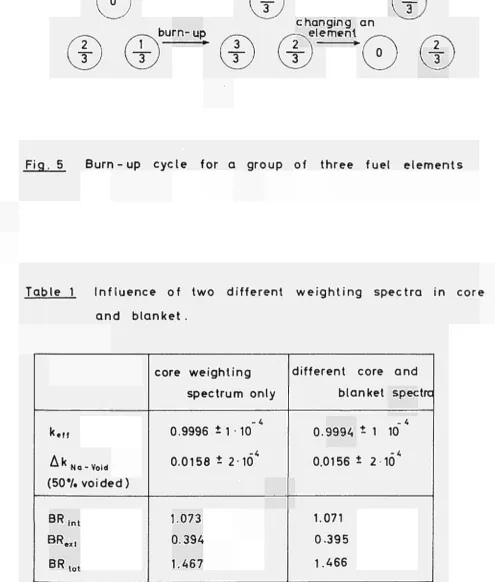
In conclusion one can say that the effect of different weighting spectra
(i.e. different group sets) in the zones of a multilayer fast reactor is
not negligible for a proper description of the power distribution and of
the blanket management and blanket optimization features. Also the radi
ation exposure to the steel vessel is influenced by using different sets.
This effect is confirmed by other methods, which will be discussed in
section 2» The results require special attention to the space dependency
of weighting spectra» Especially the use of fundamental mode calculations
with many energy groups as done in ELMOEtype codes have to be reinvesti
gated according to spacedependent problems» For routine calculations we
feel that the description of elastic slowing down as given in [3] is suffi
cient. For the reactor chosen to be built more refined methodes describing
elastic moderation have to be used. In contract with the Fast Breeder
Association Euratom Karlsruhe M« Segev in Israel is investigating a
semianalytical representation of the collision density in the Doppler
energy range for pure elastic downscattering. The more general space
dependent problem including absorption is being studied in Karlsruhe now.
Transport Cross Section
The problems related to the appropriate weighting and shielding of the
transport cross section are well known (j ï]» Here another effect is men
tioned which may be remarkable in some cores. If one considers the space
independent slowingdown mechanism in a consistent P.approximation, the
evaluation of the linear anisotropic scatteringdown integral
7 "κ (E',E)j(E')dE», results for α < 1 (say A > 10) in different transport
E
'
cross sections for different assumptions on the energy dependence of j(E)» It
2
2
is α ■ (A1) /(A+1) , j(E') = net current, Κ^Ε',Ε) = linear anisotropic
moment of the scattering kernel for neutrons scattered by atoms at rest.
Assuming for simplicity isotropic scattering in the centre of mass system
and a smooth variation of the scattering cross section Σ (E) we have for
s
one isotope A
5
Σ. » Σ. for j(E) as slowly varying function
P o
Σ ■ Σ + Σ (1 τ ) = Σ + Σ (1 u) for j(E)»E as slowly varying function
X* a S ¿Ά £L 8
In a fast sodium cooled reactor the current is roughly proportional to E up to 1 keV, then roughly constant up to some 100 keV. Because the assumpt ions made above are true in the range below 50 keV for C, 0, Na, Fe, Ni, we see that the leakage due to the light materials is reduced in the lower energy groups, where for instance the Doppler effect is important. The mentioned light materials contribute more than the 50 % to the total cross
section in this energy range.
We note that the transport cross section is very sensitive to the assumed energy dependence of the current. Especially for a steam cooled oxyde breeder the effect is important. In this case the transport cross section increases roughly proportional to 1//E when approaching lower energies. Again as in the preceding section and even more severely the space de pendency of weighting spectra plays a role.
2. Methodical Procedure for Neutronic Calculation Codes in Operation in Karlsruhe
Most of the codes used in Karlsruhe are combined in the "nuclear head system" NUSYS [l2j. The subcodes are compatible in their formats so that they can always be arranged for the special purpose wanted. NUSYS con tains the necessary codes requested for the calculation of fast reactors.
1x1 synthesis,Ή-2-dimensional diffusion, 1-dimensional S , perturbation, Doppler effect routine, reaction rates, breeding ratios, heterogeneity corrections for the calculation of critical assemblies, 0- and 1-dimen sional burn-up codes are in operation.
6
-Some Numerical Questions
In view of t h e discrepant r e s u l t s presented by the intercomparison in
Argonne [6] i t was f e l t t o prove the insensitiveness of t y p i c a l integral
fast reactor quantities on t h e number of meshpoints and accuracy of
source d i s t r i b u t i o n used in a reactor calculation. For t h i s i n v e s t i
-gation we used two different one-dimensional diffusion codes [12 , 1U],
In the MGP-code the diffusion equation i s solved by quadrature, in Diff
(NUSYS)-code difference techniques are used. For a sodium cooled fast
reactor (No. 9 of [6]) a reduction from 95 core points and 1+5 blanket
points to 30 and 15, respectively gives errors in breeding r a t i o and r e
-a c t i v i t y ch-ange for t o t -a l of N-a loss out of the core which -are l e s s th-an
. .
mk.
0,2
%»
(In a l l cases k __ was accurate to 10 ) .
e l r
In the cases of small numbers of meshpoints the fluxes in t h e soft part
of the spectrum (group 25 and 26) may become negative because of the
large removal cross sections. This i s a normal property of the used codes.
-2 - 5
Improving the accuracy of t h e source d i s t r i b u t i o n form 10 to 10 for
two consecutive i t e r a t i o n s p r a c t i c a l l y no change in local source and
fission density and breeding r a t i o was observed. For routine calculations
of fast sodium cooled reactors only a small number of mApoints i s required.
Comparison of One- and Two-Dimensional Methods in Calculating a
Cylindri-cal Reactor
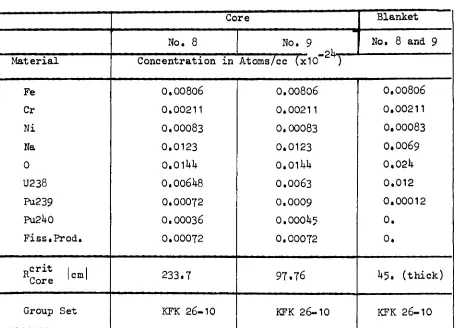
Reactor No. 9 of [6j was investigated. For a l l calculations we condensed
the Karlsruhe group set KFK 26-10 t o four groups always weighting with
the same spectrum, k and Ak„ . ( t o t a l sodium loss of core) have
been calculated with the two-dimensional diffusion code DIXY (NUSYS) [12]
(about 1500 meshpoints have been used).
7
-1-D. Diff. 2-D. Diff.
-k s -1+
k ._ 1.0073 ± 1·10 I.OO65 * 1·10
e li 1
k^ . . O.OU3O * 2·10 O.OU28 * 2*10
There i s a good agreement between t h e r e s u l t s of t h e one- and two-dimen s i o n a l methods. Also t h e breeding r a t i o s show small d i f f e r e n c e s o n l y : about 1 % i n BR. and 3 % i n BR . . The d e v i a t i o n s of " f l u x shape f a c t o r s " r e s u l t i n g from one- and two-dimensional methods do not exceed 5 %
[15].
A more convenient way i n s i m u l a t i n g c y l i n d r i c a l r e a c t o r s i s t h e use of flux s y n t h e s i s methods, e i t h e r u s i n g t h e R i t z - or t h e Kantorowitsch p r o c e d u r e . A method automatized by u s i n g a code for t h e simplest case ( s e p a r a t i o n of v a r i a b l e s ) i s j u s t completed [ l 6 j . For t h e 3-dimensional d i f fusion c a l c u l a t i o n for a r e a c t o r with i n s e r t e d c o n t r o l rods a Kantorowitsch v a r i a t i o n a l t e c h n i q u e i s b e i n g developed.
I n v e s t i g a t i o n of D i f f e r e n t Condensation Spectra and D i f f e r e n t Numbers of Condensed Groups
In c a l c u l a t i n g two-dimensional problems i t i s necessary i n almost a l l
c a s e s t o c o l l a p s e d r a s t i c a l l y t h e o r i g i n a l group s e t because of t h e l i m i t e d c a p a c i t y of t h e computer. Many problems a r i s e in f i n d i n g out t h e most
s u i t a b l e condensation s p e c t r a . In o r d e r t o get an e s t i m a t i o n of t h e e r r o r involved i n t h i s p r o c e d u r e , we used two d i f f e r e n t fundamental-mode s p e c t r a
2 2 —It
(spectrum 1 ; Β = 0 ; spectrum 2 : Β = 7,38 *10 ) c o l l a p s i n g t h e 2 6 -g r o u p - s e t t o 13, 10 and 5 -g r o u p s . The r e s u l t i n -g -group c r o s s s e c t i o n s were used t o c a l c u l a t e a s p h e r i c a l r e a c t o r , No, 9 of [ 6 ] , without changing t h e geometry.
k _ and t h e breeding r a t i o s (BR) a r e not very s e n s i t i v e t o group c o l l a p s i n g . The d e v i a t i o n s from t h e case of 26 groups a r e small (spectrum 1, maximal d e v i a t i o n s : Ak » 0 , 5 %t ABR. =» 1 % and ABR » 3 %)* The d e v i
-1 Π ι GXtr
8
-A greater sensitivity is given for the zero of the local sodium void co-efficient (variations up to 3 cm) and the power distributions mainly in the blanket. The deviations in the power distribution are positive and negative depending not only on the used spectrum for condensation but also on the manner of combining the groups.
That means that for a rough estimation of integral values it is possible to use condensed cross sections, however, for spatial-dependent values
(danger coefficients) one should be more carefully. These effects are more pronounced in multizoned reactors, especially in the investigation of blanket properties (i.e. external breeding ratios, breeding- and power distribution). To get reasonable accuracy in the blanket power distri-bution it is necessary to use two blanket condensation spectra [17J,
3. Reactivity Coefficients Coolant Loss
The reactivity change due to coolant loss is very sensitive to the used basic data and methods. In Karlsruhe we may use for routine calculations the same group-constant set for the two necessary criticality calculations
(but with changed shielding factors according to the different material compositions in the normal case and in the loss case) or two different group sets (different in the used weighting spectrum for the two cases), as described in [3],
For very specific determination of the coolant loss coefficients one has to describe the slowing-down process properly by using ELMOE-type or even
9
-Doppler Coefficient
In Karlsruhe a code for the c a l c u l a t i o n of the Doppler e f f e c t (DCP) has
been e s t a b l i s h e d on the b a s i s of p e r t u r b a t i o n theory [19]» The Doppler
c o e f f i c i e n t (DC) i s given by
DC
= iJKtr
Î..+ î „
γι f iφ.φΤχ. »Tv,
ri ιΛι *· k fk^kjϊ„
φ,
ìdV
Σ . i s t h e e f f e c t i v e group cross s e c t i o n of type χ in group i . The method
of c a l c u l a t i n g άΣ/dT i s derived i n such a way that i t c a l c u l a t e s in a short
time the correct df/dT for sodium cooled fast breeder reactors now under discussion»
The method of calculating
(,< Σ v fr. \ )
d fr _ α_ dT χ " dT!
is based in principle on R»B» Nicholson's paper [20], where only statisti cal parameters are used» For the determination of the integrals fl /Σ dE
X X
and /ΐ/Σ.(ίΕ, we have splitted the denominator Σ into two parts. The first t t part contains the main contributions to Σ » These are the large resonances
TjpoD t
of the f i r s t U-238-series (Σ ) and an energy-indipendent p a r t ,
represent-res
ing a kind of averaged cross section of all other materials (C )» The second part of Σ, describes the deviation Σ » Σ. - Σ - C » t t res χ
In the important energy regions of the discussed fast reactors the second part of Σ is nearly everywhere small compared with the first part so that the following expansion is allowed:
rrëst^ 7Ü23T7
T ^ C +Σ
res χ Σ '~+c res χ
zrest
ree χ
■*■ · ·» —« .» /
This expansion is inserted into the integrals ^REST
xi
EU238
Κ dE,
f¿
dE and I = dE
(Σ indicates the contribution of the first U238 series to Σ and Σ
indicates all other contributions to Σ ) . We get equations for the deter
mination of C by the condition that the integrals of the first expansion
10
-For
I.
and I t h e C are equal and have t h e form
while for I
^ » 3 = 1
f
( ΣU 2 3 8
) d EΔΕ J
t
r e s
FOREST REST
d Eh
J1 3 J
X ¿ r e S1
C =C
EREST d E ΔΕ χ
Σ
Κ Ε 8 ΤdE
r e s
Regarding t h e repulsion effect of resonances within t h e same s e r i e s , we
can carry out a second evaluation so t h a t we have one resonance i n t h e
TTOOfì
denominator of the expressions 1/(Σ +C ) only. The overlap effect of re s χ
resonances of the same series is so taken into account in the firstorder
term of this expansion. With these two evaluations we can express the
upper integrals and their temperature derivations by Jfunctions averaged over all possible neutron widths and terms of the form ΓΣ Σ dE and
*^ » χ res
their corresponding temperature derivations. The Jf unction J a /ψ/(β+ψ)(1χ
is available in form of a table. This procedure results in a relative
short computing time for the calculation of Doppler coefficients of fast
reactors.
As far as the validity of the assumptions is concerned, enough resonances
must be in a group, because statistical parameters are used only. This
is e.g. not the case in the Russian group constants [5] for energy groups
lower than 100 eV. But this region is not very important for the Doppler
coefficient of fast reactors, at least for the sodium cooled type. Besides
this another limitation exists, caused by the first type of evaluation.
This limitation expresses that no Doppiermaterial besides U 238 must have
such a nuclear concentration that the resonances of this material are
higher than the average total cross section. These two conditions are ful
filled in the presently discussed fast breeder reactors. Comparisons of
the results with other teams who calculated Doppler coefficients showed
no remarkable differences. These comparisons are described for dÊ/dT
11
-The overlap effect of resonances of different s e r i e s , which i s included
in our calculation method, shows no remarkable influence on the
Doppler-coefficient [22].
Besides the DCP-program there exists a f i r s t version of a program for
the i n t e r p r e t a t i o n of r e a c t i o n - r a t e measurements.
The influence of s o l i d - s t a t e properties on the DC ^23-2U] can be taken
into account by a correction factor
[2k]
· If more accurate measurements
of the cristal-frequency spectrum of Dolling et a l , [25] are used, the
r e s u l t is t h a t a f i c t i t i o u s Debye temperature of about 600 K can describe
the s o l i d - s t a t e influence on DC in t h e i n t e r e s t i n g temperature range.
Curve 1 of Fig. 1 shows the Debye temperature which gives the
temperature-dependent correction factor between DC with s o l i d - s t a t e properties and
DC without s o l i d - s t a t e p r o p e r t i e s . The curve 2 shows the Debye temperature
which describes the specific heat in a correct way. One recognises a
strong dependency of the Debye temperature on the temperature and the
way how i t i s calculated. Fig, 2 shows the magnitude of t h i s correction
„ /_,
nwit h ,_, „wit hout χ
factor (DC /DC ),
In conclusion we s t a t e that t h e calculation of the Doppler coefficient
gives satisfactory r e s u l t s . Differences mainly r e s u l t from the use of
different basic group s e t s . Assuming 1/T dependency of the DC, there i s
also good agreement between successive k calculations and the method
d e s c r i b e d above. Therefore, i t seems that a special DC code for the
resolved resonance region i s not necessary, as we have codes (RESI) for
the temperature-dependent group constants in t h i s range.
**· Investigation of Core Disassembly and Second C r i t i c a l i t y
General Remarks
The safety analysis of large reactors usually i s divided into two p a r t s :
1) As a model for the accident situation a time-dependent r e a c t i v i t y in
sertion e.g. r e a c t i v i t y ramp i s evaluated.
2) The energy release i s calculated according t o t h e r e a c t i v i t y input.
12
-is being investigated. We shall restrict our investigation to the se cond point.
Since the analysis of possible accident situation is widely based on unknown and hypothetical features, it is reasonable to study the effect of the following parameters.
1, Doppler coefficient (DC) 2, rate of reactivity ramp 3, primary flux
1+, delayed neutrons
Bethe-Tait Model Containing Doppler Feedback
Some investigations [26-293 bave been carried out in t h i s f i e l d , but i t i s necessary t o elaborate the model as we s h a l l see below. The s t a r t i n g point of our analysis |_30] i s a modified Bethe-Tait method for a s p h e r i cal symmetrical core. The separation into a time-dependent and a space-dependent function i s established and perturbation theory i s applied. Thus, the problem i s reduced t o a system of five non-linear, ordinary d i f f e r e n t i a l equations of the f i r s t order for the following v a r i a b l e s :
1. energy 2. flux
3. delayed neutron precursor k, feedback reactivity
5» first derivative of the feedback by expansion of the core The integrals over the space variables, which occur in the differential
13
-The Relative Maximum of Released Energy
The values for the released energy of ref. [28] do not show any monotony, and for this reason the DC was switched off temporarily in ref. [29]. But the latter approximation induces a large overestimation for the released
energy, Furthermore, the influence of delayed neutrons should be estimated.
Therefore, we have investigated the conditions for the occurrence of the relative maximum in the released energy [30J» A code named FAUN has been elaborated which incorporates this result. FAUN evaluates upper limits for the energy and the latter are also valid if the reactor parameters vary by some amount because of the uncertainty in the starting conditions.
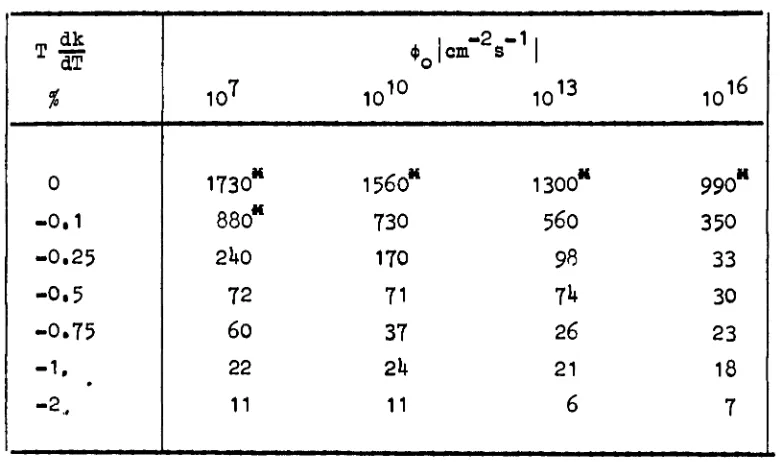
With this code the influence of the parameters was checked numerically for a meltdown accident of a sodium cooled fast reactor (Na-1) for seve-ral ramp rates. The results in table 2 and fig. 3 show the features pre-dicted by theory for a ramp rate of 100 #/sec. There we listed the ther-mal energy above the boiling point, which is an upper limit for the
de-structive energy. The energy decreases with increasing DC. The dependency of the reactivity ramp and primary flux is very similar to the case of vanishing DC.
In this context the effect of delayed neutrons is very interesting. In any case, they reduce the energy, but there are two different reasons for vanishing DC on the one hand and for large negative coefficients on the other hand. In the first case the reduction arises from the time difference between delayed critical and prompt critical and is of the order of some ten per cent. In the latter case the delayed neutrons damp the oscillations mentioned above (fig. h) and this effect leads to an essential reduction in energy (region below the intermediate line in table 2).
1U
-Equation of State
The equation for the saturation vapor pressure i s valid in the temperature
region below the c r i t i c a l point. From a temperature lying somewhat below
t h e c r i t i c a l temperature onwards the pressure increases more rapidly due
t o the incompressibility of fluids [28]. In the code FAUN only the vapor
pressure law is used up to now. Therefore, we get only upper l i m i t s for
the energy release in some cases. These have been marked by a s t e r i s k s
in the t a b l e . FAUN also takes into account t h a t a c e r t a i n amount of fuel
i s vaporized so t h a t the Doppler effect i s reduced by t h i s effect.
Up t o now, the equation of s t a t e has been derived using the p r i n c i p l e
of corresponding s t a t e s . An equation being more r e a l i s t i c w i l l be deduced
from a p a r t i t i o n function t h a t will be constructed according t o t h e model
of Eyring.
5» Long-Time Behaviour of Fast Power Reactors
General Remarks
The investigations of the longtime behaviour of fast power reactors i n
-clude the overall time behaviour caused by t h e fuel burn-up and the
fuel management. In t h i s connection we distinguish two sets of problems:
1. the time behaviour during one reloading cycle or only a few cycles,
which i s usually the object of fuel burn-up s t u d i e s , taking into
consider-ation Ak__, power d i s t r i b u t i o n , u t i l i z a t i o n of t h e fuel e t c .
2, the time behaviour of the isotopie composition of the fuel during a
very great number of reloading cycles caused by recycling the Pu
(exter-nally closed fuel-cycle).
Cyclic Loading Schema of the Fuel Elements
15
1) n fuel elements of the same radial region r, which are not necessarily
adjacent, are combined to a group»
2) In every reloading operation only one element of a group is changed.
3) The difference between the burnup of the single elements of a group
is 1/n of the maximal flux time, (these states should be realized or
approximated by appropriate fuel management before the steady operation
of the reactor)»
1+) The burnup of the n elements of a group after discharging one element
and restoring the "fresh" state of a group (i.e. the averaged burnup
of the group is a minimum) is approximately A.«0, A?» — A
,«.»,
A « — A
n
n
max*
, (A
max
= maximum fuel burnup in MWd/t)» Then the averaged
*
'
eburnup of a group is given by
Â
min
= A
max 2n
5=1
5) The burnup of the elements of a group before changing an element (the
group is "burnt out", i»e» the averaged burnup is a maximum) is appro
ximately A1 » Ì A
a a x, A2 = | A
m x. . . . , An » A ^ . Then the averagedburnup of a group is
Α —Α ι ι
max
max 2n
6) In a reloading operation alwaye this element must be exchanged which
has just reached the maximum burnup A
or which would exceed A
0
*
max
max
during the next burnup cycle.
The burnup cycle of the groups is shown in fig. 3 schematically for n«3.
(The circles symbolize the fuel elements of a group, the numbers denote
the burnup of the elements immediately after and before changing an ele
ment respectively.)
The real burnup state of the core varies between the two states A . and
m
min
A
» For calculating Ak _ between the two extreme states, only the
max
Θιχdifference
ΔΑ » A
η max
is important. Thus, by establishing groups of fuel elements in the speci
fied manner the influence of the burnup is reduced to 1/n of the maximum
16
-The maximum Ak . , and t h e reloading cycle At (corresponding t o A and
G i l mo» χ
the power of the reactor) are determined by t h e choice of n. At i s the
reloading cycle for the central group at the position of the maximum
neutron flux and hence for a l l groups in the whole core. At i s given by
Τ/η, Τ = life-time of the fuel element in the centre of t h e core.
The u t i l i z a t i o n of the fuel can be optimized by establishing several
radial reloading-zones with various values for n. The influence of
these space-dependent η on Ak _. and the u t i l i z a t i o n of t h e fuel i s
shown in t a b l e 3 for two reloading zones.
The r e s u l t s given in t h i s t a b l e are calculated for the sodium cooled
fast reactor study Na—1 with the Russian group s e t . The establishment
of a second zone with η =
k
has no influence on Ak _., but improves
the u t i l i z a t i o n of the fuel from 79 ?S up to 85
%%
The previous investigations of the time behaviour for one or a few
burn-up cycles are carried on and completed using a one-dimensional burn-burn-up
code [32] taking into consideration the internal fuel management of the
core and t h e blanket. In t h i s code the z-dependent burn-up i s regarded
by an appropriate approximation. The purpose of further investigations
i s t o find out appropriate design burn-up and operation data which op
timize the behaviour of fast r e a c t o r s .
Long-Time Behaviour of the Fuel Composition - The Steady State of
Pu-Composition
The long-time variations of the isotopie composition of t h e fuel in
fast reactors with externally closed fuel cycle are caused by t h e
burn-up of the fuel and the external fuel management. In the course of time
the isotopie composition of the fuel becomes stationary as i s shown in
[33j. The r e l a t i v e isotopie composition of the plutonium i s the so-called
Pu.
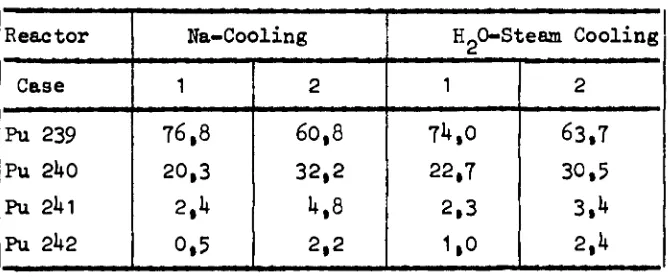
For t h e external fuel management.the following cases are considered:
Casei : Common reprocessing of the core and blanket elements and drawing
17
-Case 2: separate reprocessing of the core and blanket elements and
drawing off the breeding gain out of the blanket (Case Β in [33]).
00
For both cases there are different values for the Pu. Table
k
shows
the Pu for a sodium-cooled fast reactor and a steam-cooled reactor of
1000 MWe
[3k]
.
It was found that Pu values are not very s e n s i t i v e to the burn-up and the
loading scheme [35J.
18
-L i t e r a t u r
[ ï ] J . J . Schmidt, Neutron Cross S e c t i o n s f o r F a s t R e a c t o r M a t e r i a l s P a r t I I and I I I , KFK120
[2] R. Håkansson, p r i v a t e communication
[3] H. Küsters and M, M e t z e n r o t h , The I n f l u e n c e of Some I m p o r t a n t Group C o n s t a n t s on I n t e g r a l F a s t Reactor Q u a n t i t i e s , ANL7120, p . 1*23, I965
[1|] P . G r e e b l e r et a l . , C a l c u l a t e d P h y s i c s Parameters and T h e i r U n c e r t a i n t i e s i n a 1000 MWe F a s t Ceramic R e a c t o r , ANL7120, p . 2U 1 1965
[5] ßondarenko e t a l . , Gruppenkonstanten s c h n e l l e r und i n t e r m e d i ä r e r Neutronen für d i e Berechnung von K e r n r e a k t o r e n , K F K t r l M
|6] D. O k r e n t : Summary of I n t e r c o m p a r i s o n C a l c u l a t i o n s Performed i n Con j u n c t i o n w i t h Conference on S a f e t y , F u e l s , and Core Design i n Large F a s t Power R e a c t o r s , ANL7120, p . 3 2 3 , 1965
[7] R. A. DurandSmet: Comparison of t h e 26Group ABN and KFK Cross S e c t i o n S e t s i n View of t h e ANLExperiments on t h e ZPR VI Assemblies 2 and 3 , PSBBericht Nr. 190
M e t z e n r o t h : p r i v a t e communication
[δ] E. K i e f h a b e r , Κ. O t t , I n t e r p o l â t i o n s f o r m e l für S e l b s t a b s c h i r m u n g s f a k t o r e n , GroucoNotiz Nr, lU '
[9] R. N, Hwang: E f f e c t of t h e F l u c t u a t i o n s i n C o l l i s i o n D e n s i t y on F a s t r e a c t o r Doppler E f f e c t C a l c u l a t i o n s , ANL7120, p , J+l+9—1+61
[IOJ J» R, Stehn e t a l : Angular D i s t r i b u t i o n i n Neutron Induced R e a c t i o n s .
BNL UOO, 2nd Ed. I962
L11J G. C. Pomraning: T r a n s p o r t E f f e c t s i n D i f f u s i o n Theory, Nucl. S e i . Eng. 2 1 , I965
P . F . Zweifel and G.L. B a l l , Group Cross S e c t i o n s for F a s t R e a c t o r s . IAEA C o n f . , V i e n n a , Aug. I 9 6 1 , Vol. I
[ l 2 ] W. H o b e l , H. K r a e t s c h , D. S a n i t z e t a l . : NUSYS I , I I and I I I , PB 6 8 , PB 69 and PB 87 M'
[13] U. M ö l l e r : Lösung d e r T r a n s p o r t g l e i c h u n g mit H i l f e d e r Monte C a r l o Methode, KFK 2 9 7 ; Unterprogramme zur Lösung n e u t r o n e n p h y s i k a l i s c h e r Probleme mit H i l f e d e r Monte CarloMethode, KFK 298
[ 1U] W. Münzner, MGP Ein e i n d i m e n s i o n a l e s M u l t i g r u p p e n D i f f u s i o n s P r o g r a m m , PB 11 *>
19
Vi5] K«E. Schroeter, J» Wagner: Vergleich der Ergebnisse von ein und zwei dimensionalen Multigruppenrechnungen anhand von acht Einzonencore Reaktoren, PSBBericht Nr, 166/65.
[16] E» Kiefhaber, H* Küsters, D. Woll: Ein BucklingIterationsverfahren zur Bestimmung des Eigenwertes und zweidimensionaler Flußverteilungen aus aufeinander folgenden eindimensionalen Rechnungen, KFKReport, to be pub lished»
Í17] L» Mayer: Untersuchungen über das optimale BlanketManagement am Bei
spiel eines dampfgekühlten schnellen Brutreaktors, PSBBericht Nr. 21*1/66,
I18] D, Meneghetti, Calculations! Study of effects of thinslab heterogeneities upon spectral reactivity components of sodium voiding,
ANSMeeting, Washington, Nov. I965»
[19] R. Froelich: Theorie des Dopplerkoeffizienten schneller Reaktoren unter Berücksichtigung der gegenseitigen Abschirmung der Resonanzen,
KFKBericht Nr. 367.
[20] R. B. Nicholson: The Doppler Effect in Fast Neutron Reactors, APDA 139,1960,
[21] R. Froelich and K, Ott, G. Shaviv and S, Yiftah: Results of Doppler Coefficient Calculations for Fast Reactors and Comparison of Different Methods, ANL 7120, p. 1*1*0, I965.
I22] R. Froelich and K. Ott: About the Influence of Resonance Overlapping on Calculated Doppler Coefficients of Fast Reactors,
Nuc. Sei. Eng. 22, 1*90, I965.
[23] R. Froelich and Κ. Ott: Einfluß von Festkörpereigenschaften auf die Berechnung des DopplerKoeffizienten, Nukleonik 8, 137, 1966.
[2I+J Ε. A, Fischer: Einfluß der Gitterschwingungen des U02Kristalls auf die Interpretation von Messungen des Dopplerkoeffizienten in kritischen Anordnungen, private communication.
|25j G. Dolling et al,: The Crystal Dynamics of Uranium Dioxide, Cañad. Journ. of Phys. 1*3, I965.
I26 R, B» Nicholson, Methods for Determining the Energy Release in Hypothe tical Reactor Meltdown Accidents, APDA 150, I962,
1
27j H» Böhm: Parameter Dependence of AfterMeltdown Accidents, ANL6792, p. 193, 1963.
¡28 E. P, Hicks and D. C, Menzies: Theoretical Studies on the Faet Reactor Maximum Accident, ANL7120, p. 65^, I965.
|29j B. Wolfe, N. Friedman and R. Meyer: A Parameter Study of Large Fast Reactor Meltdown Accidents, ANL7120, p, 671,
20
-D» Braess and K» Thurnay: Analyse zweiter Exkursionen bei negativen Dopplerkoeffizienten, Nukleonik, to be published»
[31J A» Jansen, K» Ott and K.E. Schroeter: Zum Abbrandverhalten schneller Reaktoren, PSB-Bericht Nr. 121/6k t
132I L» Mayer: private communication»
33 A» Jansen and K» Ott: Seminar on Physics of Fast and Intermediate Reactors, Vienna I962, SM-18/2.
]3k\ A» Jansen and E» Kiefhaber: Gleichgewichtsplutonium (Pu») dampfgekühlter schneller Brutreaktoren mit einer Leistung von 1000 MWe, PSB-Notiz Nr,170» : Ί
35' A» Jansen and K» Ott: Langzeitverhalten des Brennstoffes in einem schnel
len Reaktor mit Pu-Rückführung und Brennstoffergänzung, PSB-Bericht Nr,119,
|36J A, Jansen: Das Langzeitverhalten schneller Reaktoren mit Plutoniumrück-führung, to be published»
2 1
-.
550°
500
e-550°·
e
D<-— Curve 1
^ ^ *Curve 2
Τ
200
400
600
800
!>κ]
Fig. 1 Debye temperature θ as a f u n c t i o n of temperature
Curve 1 : F i c t i t o u s Debye temperature used for calculating
a temperature - depending correction factor for DC
w i t h o u t s o l i d - s t a t e properties to get DC w i t h s o l i d - s t a t e
properties .
Curve 2 : Debye temperature which describes the
22
-1.0
0.5
200
2 3
-Energy E
ex[kg TNT]
F i g . 3 Destructive energy in kg TNT for excursions w i t h
r e a c t i v i t y input 100 $ / sec
,
<|
Delayed neutrons suppressed,
2 4
-Energy E
e[kg TNT]
2
-dk
dT
-17.
-2 7
F
' 9 -
Û
Destructive
energy in kg
TNT for excursions
w i t h
r e a c t i v i t y
input
100 $ / sec , φ
= 10
10sec"
1cm"
2.
25
-3
burn-up
_3_
changing an
element
2_
O
Ï
-F i g . 5
Burn - up c y c l e
for a group of
three f u e l
e l e m e n t s
Table 1
I n f l u e n c e of two d i f f e r e n t
w e i g h t i n g s p e c t r a in core
a n d b l a n k e t .
k«ff
A k No-Void
(50V. v o i d e d )
BR int
B Re x t
BR to,
core w e i g h t i n g
spectrum only
0.9996 i 1 ·1θ"
Α0.0158 i 2-1Ô*
1.073
0.394
1.467
different
core a n d
blanket spectre
0.9994 - 1 10~
0.0156 ± 2-1Õ*
1.071
0.395
[image:29.593.95.523.117.260.2] [image:29.593.43.538.168.750.2]26
-Table 2: Destructive energy in kg TNT for excursions with a reactivity input of 100 #/sec»
Effects of delayed neutrons included.
T ^ dT
%
0
-0.1 -0.25 -0.5 -0.75-1.
-2..10?
1730* 880*
2U0
72
6o
22
11
Λ I -2e-1 I
Φ0Ι«Α S I
1010 1013
1560* 1300* 730 56Ο
170 98
71
Ik
37 26
2k 21
11 6 IO16
990*
350
33
30
23
18
[image:30.593.119.509.276.507.2]27
-Table 3: The dependence of Ak __ and the utilization of the fuel on various reloading zones, n=3 means a variation of fuel burn-up betveen 33 000 and 66 000 MWd/to,
n
Zone I
T X n=3
Zone II
Zone I: n«3 Zone II: n<=k
Ak , eJ without fission products 0,76 0,7»+
,
f(50
with fission products
-2,5
Utilization of the fuel (%)
19
85
[image:31.593.60.533.215.365.2] [image:31.593.86.420.506.645.2]Reloading cycle At |d|
196
Table k\ Stationary Pu-Composition Pu" (atom %) for 1000 MWe Breeders
28
-Table 5> Properties of investigated Systems No. 8 and 9 of \6\
M a t e r i a l
Fe Cr Ni Na 0 U238 Pu239 Pu2l+0 F i s s . P r o d .
Rr.Core ' ' cm
Group Set Core No. 8 Concentration in 0.00806 0.00211 0.00083 0.0123 0.011+1+ 0.0061+8 0.00072 O.OOO36 O.OOO72 233.7 KFK 26-10 No. 9 Atoms/cc (xlO1"'")
O.OO8O6 0.00211 0.00083 0.0123 0.01H1+ O.OO63 O.OOO9 0.0001+5 O.OOO72
97.76
KFK 26-10 BlanketNo. 8 and 9
O.OO806 0.00211 0.00083 O.OO69 O.O2I+ 0.012 0.00012 0 . 0 .
1+5. ( t h i c k )
[image:32.593.81.536.185.513.2]