Munich Personal RePEc Archive
Current Features and Future Problems of
the Italian Pension System
Scopelliti, Alessandro Diego
University of Warwick, Department of Economics
June 2009
Current Features and Future Problems of the Italian Pension System
Alessandro D. Scopelliti*#
Abstract
The paper analyzes the issue of the financial sustainability of the Italian Pension System in
the long-run, by discussing the main reforms occurred in the last few years and by examining some
recent data: in particular, the data of the Italian Agency for the Evaluation of Social Security
Expenditure on the budget of specific funds of the Social Security System, like the Fund for Private
Employees and the Funds for Public Employees, and moreover the OECD data on the evolution of the
replacement rate between pension benefit and labour income. Observing the evolution over the period
1989-2006, we notice that the current deficit of the first pillar of the pension system is caused, much
more than in the past, by the deficit of the Funds for Public Employees, for the relevant difference
between the value of the benefits and of the contributions, which is not registered in the other funds.
JEL Classification: H53, H55, J26
Keywords: pay-as-you-go system, retirement age, defined contribution, financial sustainability, replacement rate, private pension funds
__________________________________________________________________________________________
* University of Warwick and University of Catania. Corresponding address: Department of
Economics, University of Warwick, CV4 7AL Coventry, United Kingdom. E-mail:
# I want to thank Georges de Menil and all the participants in the research seminars on « The
Macroeconomics of Social Security » at the Paris School of Economics for helpful comments. All the
1. Introduction
The present work aims at analyzing the current organization of the Italian pension
system, in particular by focusing on the issue of the financial sustainability, in the long run,
of its first pillar, at present based on a pay-as-you-go scheme with defined contribution. In
this framework, we will examine how the numerous reforms already implemented tried to
improve the sustainability of the pension system and whether other changes are required for
solving the problems due to the ageing of population. We will also investigate how the
transition of the unfunded system from a defined benefit scheme to a defined contribution
scheme, implying a substantial reduction in the replacement rate for the retirees, can increase
the incentives for the development of the second pillar, which currently has a very small
importance in the retirement income of the old population.
2. The current structure of the system and the reforms of the last years
The current structure of the Italian pension system is the complex result of a series of
reforms, which were adopted since the beginning of the nineties, with the objective to restore
the financial sustainability of the system in the long-run, in order to tackle the issues implied
by the demographic trend. Given this general aim, the means that were used for pursuing it
were various: firstly, the increase of the retirement age and the progressive abolition of the
seniority pensions, such to reduce the number of years for the payment of the pensions;
secondly, the change of the parameters for computing the pension benefit, such to decrease
the total amount of the expenditure.
Regarding the first point, we have to consider that the Italian pension system, before
the reforms adopted in the nineties, was characterized by two different types of pension: the
old-age pensions were paid to the workers who reached the retirement age, while the
seniority pensions were paid to the workers who decided to get retired before the standard
retirement age, but having some minimum contribution. The existence of these seniority
pensions was a huge problem for social security expenditure, because it implied the need to
pay such pension benefits for a longer period of time, given the standard life expectations. So
the increase of the retirement age for old-age pensions, as well as the restriction of the age
and contribution requirements for seniority pensions were common features of all the
subsequent reforms.
Firstly, the Amato reform, approved in 1992, fixed a retirement age, corresponding to
contributions of 20 years, in order to have the old-age pension; moreover, it established a
minimum of contributions of 35 years for the seniority pension. In 1995, the Dini Reform
abolished the seniority pension for all the entrants in the labour market from 1996 and revised
the criteria for the current workers: as a general criterion, fully applicable since 2008,
entitlement to the seniority pension could be acquired at age 57 with 35 years of
contributions, or at any age, with 40 years of contributions; in the meanwhile some transitory
rules, providing a gradual increase of the minimum required age and of the years of
contribution, were provided for gradually managing the transition until 2008.
Some years later, in 2004, the Maroni Reform established an immediate increase in
the minimum retirement age for seniority pensions, from 57 to 60 years old, to be applied
since 2008, but leaving unchanged the requirement of 35 years of contribution: such an
instantaneous rise in the age requirement for seniority pensions, even if it could sensibly
contribute to the reduction of the social security expenditure, was object of several critiques
because it penalized in a strong way some specific cohorts (in particular the ones born in the
years 1951-1955, corresponding to the demographic boom in the second post-war)1, suddenly
delaying their eligibility for the seniority pension by 4 or 5 years and then raising some issues
of intergenerational equity. At the end this element of the Maroni reform was changed by the
Prodi reform in 2007, just immediately before the new rules came into force: then the big step
was transformed in a gradual series of small steps, less effective in the reduction of the
pension expenditure, but more feasible from the political consent point of view. These steps
were organized according to a system of quotas, equal to the arithmetic sum of the retirement
age and of the number of years of contribution, with a slow and progressive increase of this
1
amount over the years, in such a way to allow also certain flexibility among the two
requirements to be fulfilled2.
The second - and more structural - way that was followed in order to ensure the
financial sustainability of the Italian pension system was to reform the mechanisms for the
computation of the pension benefit. For this purpose, we will focus mainly on the Dini
reform, which radically changed the parametric structure of the pay-as-you-go system, by
introducing the defined contribution principle. In order to identify the differences due to this
reform, we will compare the calculation of the pension benefit under the defined benefit
scheme, as it resulted from the Amato reform (1992), and the defined contribution scheme,
provided by the Dini Reform (1995).
The system designed by the Amato reform was an unfunded scheme with defined
benefit, where the measure of the pension was determined by the amount of wages earned by
the worker during her life. The benefit was computed by multiplying the pensionable
earnings by the rate of return. The pensionable earnings were defined as the average of the
gross earnings of all the years of contribution for the entire working life (with the exclusion,
at most for one fifth, of the annual earnings, in present discounted value, lower than the
average by 20%). In this computation, the earnings were made homogenous with respect to
time, through a capitalization process by a rate equal to the inflation augmented by 1% for
each year. The rate of return, that is the percentage by which to multiply the pensionable
earnings, was equal to 2% for each year of contribution. It could not be higher than 80%, as it
was for a worker with a contribution period of 40 years. In this way, for a given amount of
pensionable earnings, the pension benefit was higher for the workers with a longer
contribution period. But the incentives to stay at work after the achievement of 40 years of
contribution were totally absent under this defined benefit scheme. Moreover, a system like
this, since it guaranteed a very high - and substantially fixed - replacement rate, didn’t not
provide either any incentive to create a private funded pension, because of the generosity of
the public unfunded pension.
Moreover, in a pay-as-you-go system, when the life expectancy increases and the
number of workers decreases, there are not enough contributions for paying the pensions to
the retired workers. So, in order to avoid a financial crisis of the system, just 3 years after the
Amato reform, a profound change of the method for computing the pensions was required. In
2
the Dini reform, the new contributive system is a figurative one: each worker has a personal
figurative fund where her contributions are accrued during her working carrier; at the
retirement, the accumulated asset value is transformed into an annuity by applying a
conversion coefficient. So, the pension is computed by multiplying the value of accrued
lifetime contributions, capitalized at a rate equal to the 5-year moving average of nominal
GDP growth, by a transformation coefficient depending on the age of retirement. The rate of
contribution for determining the pensioner’s assets is equal to 33% of the earnings for
employee workers, which is slightly more than the actual rate, corresponding to the sum of
the contributions effectively paid by employer and employee, and equal to 32%.
The coefficients of transformation are determined in such a way to equalize the
capitalized amount of the contributions and the present value, at the time of the retirement, of
an annuity with constant payments, discounted at a rate equal to 1.5%. The payment of the
annuity is the annual real amount of the pension benefit, while the number of payments is
given by the life expectancy of the pensioner at the time of the retirement. The life
expectancy also explains why the coefficients of transformation are higher for the workers
who get retired at an elder age: depending on the retirement age, they are included in a range
between 4.72% and 6.13%. In this way, the coefficients of transformation can play a role of
penalization for the workers who decide to get retired earlier, also because they will receive
the pension for a longer period of time; at the same time, they can also offer some incentives
to stay at work, thanks to the perspective of a richer pension benefit3.
The Dini Reform, introducing a new defined contribution scheme for the old-age
pensions, also established the principle of the flexible retirement age within this framework,
for the workers beginning their employment from the 1stJanuary 1996: precisely, it provided
a retirement age between 57 and 65 years old, depending on the choice of the worker. This
flexibility criterion was consistent with the main idea of the defined contribution scheme:
given that the amount of the pension depends on the amount of the paid contributions, this
system should permit the worker to freely decide the retirement time, provided that the
pensioner can receive a relatively sufficient amount. In fact, the reform provides that the
pension benefit has to be at least 20% higher than the social allowance. Nevertheless, in 2004
3
the Maroni reform eliminated this flexibility criterion and reintroduced the principle of the
fixed retirement age, differentiated for men (65 years) and women (60 years), or in alternative
allowed retirement after 40 years of contribution, independently from the age4. And these
fixed-age requirements for the old-age pension, under the new contributive scheme, are still
valid since they were confirmed in 2007 by the Prodi reform implementing the Protocol on
Welfare between government and trade unions.
An important aspect of the Dini Reform, which also raised some problems in the
following years, inducing the need for some other changes in the pension legislation, was the
transition from the previous system to the new one. In fact, to the people with a contributory
record equal to or exceeding 18 years on 31stDecember 1995, the previously defined benefit
system applies. Workers with less than 18 years of contribution at the end of 1995 have their
pension calculated in part with the old and the new system, according to a pro-rata criterion,
based on the proportion of working life spent in both regimes. Finally, the new notional
defined-contribution scheme is fully applied to all the entrants in the labour market from
1996.
This structure of the transition has been considered too generous towards the elder
workers, because an extended interpretation of the principle of the acquired rights has
completely excluded them from the application of the new regime, even by a pro-rata
criterion, with two important consequences: substantially delaying the full implementation of
the reform and imposing the costs of the reform almost exclusively on the younger
generations. On the other hand, this is a frequent issue in the reforms of the Italian pension
system. Also the Amato reform, which had introduced a new method for computing the
pension under the defined benefit scheme, by extending the number of years on which to
compute the pensionable earnings, was not applicable to the workers having already 15 years
of contribution until 1992. But, especially in the case of the Dini reform, the decision to
exempt the workers with at least 18 years of contributions from the new defined contribution
4
scheme has limited the savings that could be obtained on the public expenditure for pensions
in the short and medium run.
On the contrary, the major savings in the expenditure for the short and medium run
have been collected in different ways, and then, as previously explained, by the increase of
the retirement age in the old-age pensions, as well as by the progressive abolition of the
seniority pensions. But, especially on this point, the reforms aimed at increasing the
minimum required age have created a quite confusing and contradictory framework, in some
cases with really paradoxical effects. Instead of favouring the decision to stay at work, the
persistent expectation of other reforms introducing stricter requirements for the retirement
age induced many workers, already fulfilling the existing criteria, to withdraw from the
labour force even some years before, with the consequence of further increasing the pension
expenditure in the short-run, because of the payment of the pension benefits to relatively
young pensioners with a still significant life expectancy.
3. The financial sustainability of the system
In order to discuss the future perspectives for the financial sustainability of the public
system, we will focus on two elements: the evolution of the deficit of the social security
system and the quota of public expenditures over GDP. For the first aspect, we consider the
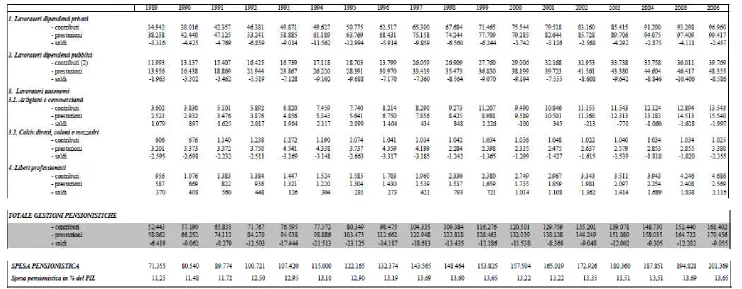
data from 1989 to 2006 (table 3), which are provided by the Agency for the Evaluation of
Social Security Expenditure in the 2007 report. Over this period, the balances between the
total amount of contributions and the total sum of paid benefits are always negative.
Nevertheless, if we compare the period 1991-2000 and the period 2001-2006, we can notice a
significant reduction of the social security deficit: in the first period, it is always higher than
10 billions of euros, and particularly in 2 years it also overcomes the threshold of 20 billions
of euros, while the average deficit is 15,282 millions of euros; in the second period, the
deficit is generally lower than 10 billions of euros and it reaches the level of 12 billions just
in 2 years, such that the average deficit is 10,010 millions of euros. Moreover, if we look at
the composition of this deficit, we notice that it is determined essentially by the pensions of
employed workers, rather than by the pensions of self-employed workers. And more
precisely, among the employed workers, we observe that from 1998 to 2006 the funds for
public employees show a higher deficit, in absolute and relative terms, than the fund for
private employees (FPLD, Fondo Pensioni Lavoratori Dipendenti), although the size of the
third of the size of the fund for private employees. So, the conclusions that we can get from
these data are two-sided: even if the social security system is still in deficit, we notice a slow
process of improvement towards a financial equilibrium as compared to the nineties. At the
same time, we still observe a very important problem for the pensions of public employees,
which is in any case a consequence of a very favourable treatment provided for them until the
mid-nineties: but, since the acknowledgement of the acquired rights implies the extension of
the financial effects for a quite long period, the high current deficit is essentially a
consequence of such previous differentiated regime.
The other indicator to be examined is the ratio of public expenditures for pensions
over GDP. In the data provided by the Ministry of Labour, this ratio has constantly increased
from 11.25% to 13.65% in 2006. Moreover, as the projections based on current demographic
trend predict, because of the effects of population ageing, the expenditure for pensions is
expected to further increase in the following years up to 16% in 2033, as we can see from
graph 1. After this year, also thanks to the definitive effects of the various reforms, and in
particular of the introduction of the new defined contribution scheme, this ratio should
decrease. This long-term dynamics with such peak, clearly determined by demographic
reasons, was however emphasized by the choice of a too long transition for the complete
implementation of the reforms of the nineties.
4. The adequacy of the public system and the development of private pensions
A final issue to be covered is the future development of supplementary social security
entitlements, through the creation of private funded schemes on voluntary basis. In the
nineties, under the pre-reform scenario private funds were crowded out by the high implicit
rates of return to social security. But the reforms adopted in that period have sensibly reduced
the replacement rate for the unfunded statutory scheme, so inducing many workers to take
some private pension arrangements in order to have a retirement income not so lower than the
earnings at the working time. In particular, the reduction of the amount of the pension
benefits can be explained on the basis of two elements: the introduction of the defined
contribution scheme and the provision of an index-linking of pension payments to prices
(rather than to wages).
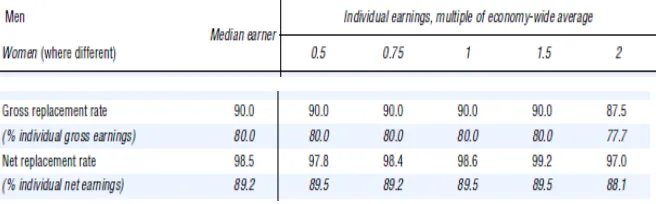
Some simulations of the OECD, based on pension modelling results (tables 1-2) and
published in 2007, allow to compare the replacement rates of the statutory pension system,
is the ratio between the value of the pension benefit and the amount of the last labour income
before the retirement. Such ratio can be a good indicator of the adequacy of the pension
treatment, as a means for guaranteeing after the retirement a similar standard of life quality.
In fact, for a worker with individual earnings equal to the economy-wide average, under the
pre-reform scenario, the gross replacement rate was equal to 90% while the net replacement
rate was equal to 98.6%; under the current system, the gross replacement rate is 67.9% and
the net replacement rate is 77.9%. So, for an average-income individual, the impact of the
social security reforms consists in a reduction of the replacement rate by 22%: even if we
consider the results of the pension modelling for workers with earnings lower or higher than
the economy-wide average, the loss in terms of replacement rate (both gross and net) is about
20%.
Some other relevant observations can be drawn from the data of the European
Commission, based on calculations of the Indicators Sub-Group (ISG) of the Social
Protection Committee (SPC) in 2006. Firstly, the results for the replacement rate strongly
depend on many aspects of individual choice, such as the retirement age and the number of
years of contribution at the time of the withdrawal, given that these elements determine the
amount of the pension benefit. For example, a current worker, on average earnings, retiring
today at age 65 after 40 years of contribution, can expect a gross replacement rate of 79% and
a net replacement rate of 88%. But the replacement rates for a worker, earning an average
labour income and retiring today at age 60 after 35 years of contributions, are about 10
percentage points lower. This is relevant because, still in 2004, the average age of retirement
was 61 years while the average number of years of contribution was 32.1 years.
Another useful indicator of the adequacy of the pension benefit, especially in the
comparison between different generations, is the aggregate replacement rate, which measures
individual pensions for a cohort of retired people relative to individual earnings of working
people (in percentage). In particular, the indicator provided by the ISG is computed as the
ratio between the median individual pension income of retirees aged 65-74 and the median
earnings of employed persons aged 50-59. It is interesting to notice the progressive reduction
in the aggregate replacement rate, over the retirement period, which is determined by the loss
of the productivity gains in the economy, because of the index-linking of pension payments
just to prices and not to wages. For a cohort of workers retiring at age 65, the aggregate
replacement rate at the time of retirement is equal to 79%, but after 10 years in retirement is
lower and it is equal to 68%. This measure gives an idea of the relative position of workers
pay-as-you-go system. Such a significant reduction in the aggregate replacement rate over 10 years
means a relevant differentiation in the welfare of the workers and of the pensioners.
All these data about the reduction in replacement rates clearly show that the pension
benefit as provided by the statutory system cannot be anymore sufficient in ensuring an
adequate retirement income, both compared to the labour income of the same individual at
the working time, and compared to the earnings of the working people at the same period.
Then the only way to increase the retirement income and then to keep in the long-run a
satisfactory replacement ratio is to adopt private pension arrangements. This solution has
been taken into account in some long-term projections of the European Commission,
comparing the situation in 2005 to future perspectives in 2030 and 2050. While the total gross
replacement rate seems to remain the same, being 79% in 2005 and 80% in 2030 and 2050,
its composition across the various pillars of the pension system tends to change significantly:
for the 1stpillar the gross replacement rate, equal to 79% in 2005, is expected to be 71% in
2030 and 64% in 2050; for the 2nd and the 3rd pillars it is equal to 0% in 2005 but it is
supposed to be 9% in 2030 and 16% in 2050. Clearly, the reliability of these projections
depends on the effective development of the private pension funds and of the individual
pension insurances; this also requires the existence of a specific legislation, able to
incentivate such choice among the workers, mainly through tax incentives.
The system of the occupational schemes, as it has been organized by the Amato
reform in 1993, is based on three options: closed funds regulated by collective agreements;
open funds managed by financial intermediaries that can be joined by workers individually or
in groups; individual pension insurance policies. An important step towards the institution of
a private funded system was taken in 2004, thanks to the provisions of the Maroni Reform
regarding the TFR (Trattamento di Fine Rapporto), that is the end-of-service allowance. This
is a part of the payments due to the workers, which was usually set aside by the employer and
then paid as a lump-sum at the end of the employment. In the meanwhile, it was managed by
the employer at a low but safe rate of return and it was an important source of financing for
the firms, until the end of the employment: this also explains why the firms opposed for a
long time any different usage of such funds. In 2004, the Maroni reform provided, through a
mechanism of silent-assent, the automatic transfer of such end-of-service allowance to
occupational schemes, negotiated but not managed by the employer: clearly, the worker can
refuse it and then allocate these resources to other pension funds. This rule, fully applied
since 2008, has effectively stimulated as expected an important growth of the closed funds
5. Conclusions
On the basis of our discussion, we can conclude that the main challenges for the
financial sustainability of the Italian pension system have been already tackled through the
reforms of the public unfunded scheme, even in a quite disorganized and fragmented way (4
major reforms in 14 years, plus a series of minor revisions every year at the time of the
approval of the budget law), then at present it would be reasonable to analyze the evolution of
the public expenditure for pensions in the following years before planning other changes. At
the same time, the social security system still requires some additional interventions in
another direction, that is towards the expansion of the second and of the third pillar. In
conclusion, both for the uncertainty related to the success of the reforms in the public
scheme, and for the need of a significant development of the private pensions, the transition
Appendix
Graph 1. Public Expenditure for Pensions in % over GDP
Source: Agency for the Evaluation of Social Security Expenditure, Ministry of Labour and Social Policies (2007)
Notes: - The continuous line refers to the pension legislation in force in September 2007
[image:13.595.76.368.138.283.2]- The broken line includes the effects of the measures implementing the Protocol on Welfare (23rdJuly 2007), as adopted in the subsequent Prodi reform.
Table 1. Pension Modelling Results: Pre-reform Scenario
Source: OECD (2007)
Table 2. Pension Modelling Results: Current Scenario
[image:13.595.74.402.440.542.2]Table 3. The financial situation of the statutory pension system in Italy (1989-2006)
Source: Agency for the Evaluation of Social Security Expenditure (2007). All the data are expressed in millions of euros.
Legenda:1) Private Employed Workers ; 2) Public Employed Workers ; 3) Self-employed Workers; 3.1) Artisans and Merchants; 3.2) Self-employed
Farmers, Farmers and Share Croppers; 4) Self-employed Persons in Intellectual Professions. For each category, the data show the total amount of
contributions (contributi), of pension benefits (prestazioni) and the balances between the two variables (saldi)
The part in grey (totale gestioni pensionistiche) presents the results for the total of all the public pension funds (including some minor funds that I did
not report for simplicity). These are the general results that I describe more carefully in the text.
References
- Agency for the Evaluation of Social Security Expenditure (2007), The Financial Evolution of the
Statutory Pension System, Ministry of Labour and social Policies
- Bosi P. (2006),Course on Public Finance, Il Mulino
- Brugiavini A. and Fornero E. (1998),A Pension System in Transition, mimeo
- D’Amato M. and Galasso V. (2002), Assessing the Political Sustainability of Parametric Social
Security Reforms: the Case of Italy, Giornale degli Economisti ed Annali di Economia
- Davis E. P. (1997), Pension Funds: Retirement-Income Security and Capital Markets. An
International Perspective, Clarendon Press, Oxford
- European Commission (2004), Adequate and Sustainable Pensions. Synthesis Report 2004,
Directorate-General for Employment, Social Affairs and Equal Opportunities
- European Commission (2006), Adequate and Sustainable Pensions. Synthesis Report 2006,
Directorate-General for Employment, Social Affairs and Equal Opportunities
- Franco D. (2003), Pension Reform: What Lessons from Italy?, in Tumpel-Gugerell G. and
Mooslechner P. (edited by) (2003), Structural Challenges for Europe, Edward Elgar Publishing,
pp.163-186
- Fornero E. (2008), Stop and go in the Italian process of reform of the social security system, in
Pirrone S. (edited by) (2008), Flessibilità e Sicurezze. Il nuovo Welfare dopo il protocollo del 23
Luglio, Il Mulino
- Hamann A. J. (1997), The Reform of the Pension System in Italy, European I Department,
International Monetary Fund, Working Paper no.18
- OECD (2007), Pensions at a Glance. Public Policies across OECD Countries, Employment,