© 2016, IRJET | Impact Factor value: 4.45 | ISO 9001:2008 Certified Journal
| Page 1017
Cloud Based Android Video Player for Dynamic Backlight Optimization
Ms. Bhavika Lahoti
1, Prof. Hanumant Pawar, MITCOE, PUNE
21
MS Bhavika Lahoti, dept. of Computer Engineering, MITCOE, Pune, India
2Prof. Hanumant Pawar, dept. of Computer Engineering MITCOE, Pune, India
---***---Abstract -
—In these few decades smart phone usage hasincreased greatly. As usage has increased people are trying to overcome the limitations of these phones. Battery consumption is one of the limitations of smart phone. This paper exactly works on the same issue. Paper explains basic concept needs to study before scaling down backlight, using critical backlight level scales down the backlight so that energy saving is maximum. Finally service of optimization is deployed on cloud server. An android video player application is been developed to connect user with the cloud server. Paper gives the comparison of different algorithm for optimization and has used efficient algorithm among those. Result shows nearly 20-30 % of energy saving
Key Words:Backlight optimization, Battery life, Cloud
Service, Distortion, User perception, Battery aware devices, Smart phone, battery Consumption, backlight level, Android video player, Energy saving
1. INTRODUCTION
Few decades ago mobile phones were one of the greatest inventions of human beings. They were used for easy remote communication. But as time had passed many inventions in mobile phone were done, from basic communicating medium, they are now used to solve basic life issues. This is the reason mobile phones are now known as smart phones. These smart phones help humans in every situation, whether it is contacting any person, finding any places, searching for something or even for entertainment. Smart phones are saviour.
As they have so many advantages there must be some limitations to these phones for example they need network to communicate, they need internet to find places, they need battery to keep on working etc. Battery consumption is the biggest problem while using smart phone, if its battery is dead its of no use. Also as smart phones screen size increases battery consumption increases and now-a-days everyone wants big screen phone that to with high resolution. So battery problem is obviously more in such phones.
Solution to this problem is to have extended batteries or to have power bank but these need to carry along with phone which sometimes get inconvenient. Rather than having external solution we can have something which will optimize battery consumption without carrying it externally. Some survey about consumption of battery has concluded that consumption of battery for different applications is different. If we have working device it will consume 16 % for CPU,
24 % for network, 28 % for display and 34 % for backlight. These results show that back-light consumes maximum precent of battery. Backlight is nothing but the display light and that is why we deemed it down when we are running out of battery. This is the first reason paper has backlight optimization algorithm. We have different applications installed for different purposes among those some are in built applications which like music player, camera, video player, gallery, sound recorder, etc. Battery drainage is maximum while playing video on the phone because it needs to have sound adjustment, backlight consumption and different frames adjustments. Also, usage of streaming applications has increased widely as videos are better to express anything. This is the second reason for this paper to work on video streaming application. Optimization of backlight is not a simple task because it can cause distortion in video frame, flickering effect and also has adverse effect on user perception, so before scaling down the backlight we should consider above factor so that user can not catch up difference between original video and optimized one. Video’s distortion generally defined as resemblance between the original video and the optimized one. Similarly, flickering effect is that when backlight level changes continuously per frame which may lead backlight change from dimmest level to its maximum level which will cause bad effects on users eye sight.
1.1 Outline of paper
Section 2 describes literature survey. Section 3 gives problem definition for system later section 4 describes System architecture and modules in system i.e. cloud service, video transformation engine and video optimization engine. Section 5 gives experimental results. Section 6 summarizes conclusion and future scope.
2. LITERATURE SURVEY
© 2016, IRJET | Impact Factor value: 4.45 | ISO 9001:2008 Certified Journal
| Page 1018
respond to the highly efficient hardware and does notrequire any information regarding the histogram of the displayed frame, which makes it compatible with video applications [3]. Limitation: It saves energy but there is some distortion which can be caught by human visual system.
Backlight Dimming in Power- Aware Mobile Displays: The video distortion comprises of (i) spatial (intra-frame) distortion component due to image-sensitive backlight scaling (ii) temporal (inter-frame) distortion component due to large backlight dimming through multiple frames and modulated by characteristics of the human visual system. In this technique, the spatial distortion i.e. intra-frame distortion is upper-bounded by a user specified maximum allowed value. The second cause of distortion is the change in the luminance of the backlight-optimized video compared to the original video, i.e. the temporal distortion [5].It proposes a temporally-aware backlight scaling scheme for video, based on a detailed video distortion metric, which account for the intra-frame distortion and uses power density of the average luminance of different frames to measure the flickering effect by the backlight optimization [5]. Limitation: Sudden backlight level switching causes inter frame brightness distortion, which can cause bad perception on human visual system.
Dynamic backlight optimization using Proxy server: The proxy server middleware dynamically accepts the streaming video content such that brightness and contrast compensation and communicates control information i.e. operating backlight levels through the communication manager module to the client middleware. The video stream request is sent by client through the control stream to send to the proxy, with the current backlight level and device specific information. The proxy server uses the control stream to direct the client mobile device to set a new backlight level while playing streaming video. The proxy server maintains a database which has the videos available at the server, along with information specific to handheld device types [6]. There are three middleware adaptation policies that use the compensation algorithm.1) Simple backlight compensation 2) Constant backlight with video luminosity compensation 3) Dual-compensation approach [6]. Algorithm has used third approach which has maximum control on operating system, which requires both proxy and operating system interfaces for optimal operation [6]. Limitation: To overcome previous limitation in implemented techniques the algorithm has grouped images to change the backlight levels for that particular group. Grouping is done frame-vise not scene-vise, so grouping images can have different backlight levels for two images belonging to same scene which can be predicted by user.
Quality Based Optimization: It defines induced distortion value which is closest to a specified threshold as the optimized backlight dimming factor. It replaces the factor with the real backlight level Alfa, Alfa = N (N is the number of
backlight levels) and the optimized backlight Dimmed level is represented as Alfa [2]. It illustrates quality distortion in terms of MSE (Mean Square Error) over different backlight levels. As Alfa increases, video quality distortion due to the brightness saturation decreases. Hence, for a given distortion threshold, it can find a unique Alfa for each image. In video applications, different frames may have distinct Alfa, it depends on the luminance of that particular frame. However, it is hard to design an accurate analytical representation of the quality distortion using Alfa as a parameter. Therefore it has adopted an optimized search based-approach, where it calculates the MSE (Mean Square Error) distortion with different Alfa values unless and until the specified distortion threshold is met [2]. Limitations: It does optimization without considering overall frames in the video, so there can be chance of having better optimization using improved technique.
3. PROBLEM DEFINITION
© 2016, IRJET | Impact Factor value: 4.45 | ISO 9001:2008 Certified Journal
| Page 1019
in mind some constraints before scale down the backlight 1)The backlight level applied to any image frame is not lower than the frames critical backlight level 2) The magnitude of a backlight change should not be greater than the product of current backlight level and differential ratio 3) The number of image frames between any two backlight changes is not less than a specified number [1].
4. SYSTEM ARCHITECTURE
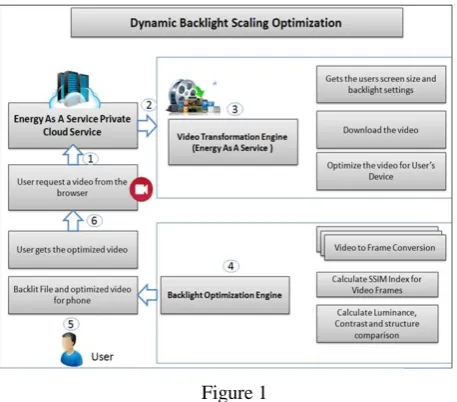
[image:3.595.51.280.289.490.2]This section presents a cloud-based energy saving service (EAAS), called the dynamic backlight scaling service, which minimizes the backlights energy consumption when displaying video streams on mobile devices.
Figure 1
A possible way to realize the service would be to develop this as a value-added service offered by Internet service providers. Which will do conversion part on behalf of mobile phone. The service is presented in a way that is easy for end users to understand. They do not need to know how the service is provided and where the system that delivers the service is located. User just needs to use it through an application; service is running at back end.
4.1 Algorithm
1) Video framer: calculate frame rate for video (frame rate i = no of frames/second).
2) RecordReader (FirstphaseofMapReduce method) conversion to (Key and value format).
3) FFMPEGFrameGrabber class has grapFrame() method which will access video frame by frame.
4) SSIM index between first frame (0) and last frame (i) of slot is calculated.
5) If SSIM index is greater than 0.6 Then apply same backlight level to each frame.
6) If else SSIM index between first frame (0) and (i/2) frame is greater than 0.6 Then apply same backlight level to frames from 0 to (i/2) and calculate backlight level for frames from (i/2+1) to (i).
7) Else calculate backlight level for frames from 0 to (i/2) and apply same backlight level to frames from (i/2+1) to (i) 8) New backlight file and video is sent to user
4.2 Calculations for SSIM
Index SSIM (Similarity Structure Index Matrix) index is measure of similarities between two image frames.
4.2.1 Luminance Calculations
Where µ(x) and µ(y) represent the means of the original and optimized frames, respectively
4.2.2 Contrast Calculations
Where σ(x) and σ(y) represent the standard deviations of each of the signals
© 2016, IRJET | Impact Factor value: 4.45 | ISO 9001:2008 Certified Journal
| Page 1020
σxy is the covariance of the two frames.4.2.4 SSIM Index
SSIM
(x,y) = [l(x,y)] * [c(x,y)] * [s(x,y)]
where α = β = γ = 1
5. EXPERIMENTAL RESULTS
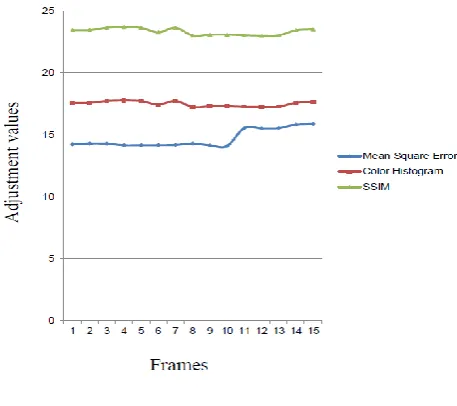
[image:4.595.261.560.80.520.2]We have done the comparative study of three algorithms viz. Mean square error, Color histogram and SSIM , after performing analysis, we found that SSIM Index gives the maximum backlight adjustment probabilities, so that P() (power model) can be reduced further. Figure 2 shows the comparative study of three algorithms.
Figure 2
Experimental results shows that energy consumption while playing video depends on the brightness of video, if video is bright energy saving is maximum, but if video is dark we can’t reduce its backlight greatly, so energy saving is minimum. We have three videos for experiment viz. Mortak Kombat X Official trailer: Animated movie, IBN Lokmat.mp4: news video, CABIN-FEVER.mp4: Hollywood movie which have different parameters as shown in figure 3. Figure 4 shows original brightness level of each frame.
Figure 3
Figure 4
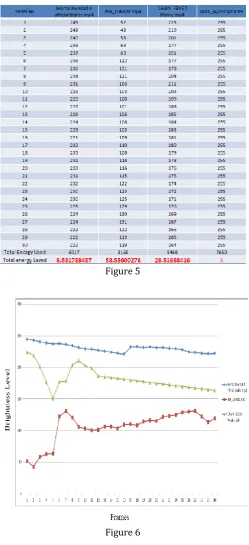
Figure 5 shows the backlight level after adjustments. These brightness values when compared to the brightest level we can calculate the optimization levels and energy saving by profit-loss formula. These results are given in figure 6.
6. CONCLUSION AND FUTURE WORK
[image:4.595.42.271.412.615.2]© 2016, IRJET | Impact Factor value: 4.45 | ISO 9001:2008 Certified Journal
| Page 1021
Figure 5Figure 6
REFERENCES
[1] Chun-Han Lin, Member, IEEE, Pi-Cheng Hsiu, Member, IEEE, and Cheng-Kang Hsieh, Student Member, IEEE, Dynamic Backlight Scaling Optimization: A Cloud-Based EnergySaving Service for Mobile Streaming Applications. IEEE Transaction on computers, VOL. 63, NO. 2, Feb 2014 [2] N. Chang, I. Choi, and H. Shim, DLS: Dynamic Backlight Luminance Scaling of Liquid Crystal Display. IEEE Trans. Very Large Scale Systems, vol. 12, no. 8, pp. 837-846, Aug. 2004.
[3] L. Cheng, S. Mohapatra, M.E. Zarki, N. Dutt, and N. Venkatasubramanian, Quality-Based Backlight Optimization for Video Playback on Handheld Devices. Advances in Multimedia, vol. 2007, p. 4, 2007.
[4] W.-C. Cheng and C.-F. Chao, Minimization for LED-backlit TFTLCDs. Proc. ACM/IEEE 43rd Design Automation Conf. (DAC), pp. 608-611, 2006.
[5] C.-W. Huang and S.-L. Tsao, Minimizing Energy Consumption of Embedded Systems via Optimal Code Layout. IEEE Trans. Computers, vol. 61, no. 8, pp. 1127-1139, Aug. 2012.
[6] A. Iranli, H. Fatemi, and M. Pedram, HEBS: Histogram Equalization for Backlight Scaling. Proc. ACM/IEEE Conf. Design, Automation and Test in Europe (DATE), pp. 346351, 2005.
[7] A. Iranli, W. Lee, and M. Pedram, Backlight Dimming in Power- Aware Mobile Displays. Proc. ACM/IEEE 43rd Ann. Design Automation Conf. (DAC), pp. 604-607, 2006. [8] A. lranli and M. Pedram, DTM: Dynamic Tone Mapping for Backlight Scaling. Proc. ACM/IEEE 42nd Ann. Design Automation Conf. (DAC), pp. 612-616, 2005.
[9] D. Niu, Y. Chen, and Y. Xie, Low-Power Dual-element Memristor Based Memory Design. Proc. ACM/IEEE Intl Symp. Low-Power Electronics and Design (ISLPED), pp. 25-30, 2010.
© 2016, IRJET | Impact Factor value: 4.45 | ISO 9001:2008 Certified Journal
| Page 1022
BIOGRAPHIES
Bhavika Lahoti currently pursuing ME Computer Engineering from MITCOE,Pune Graduated BE Computer Science from MIT pune in 2013.
Prof. Hanumant Pawar has completed his full-time M.E IT MIT, Pune and B.E. IT from MIT Pune, both under the S. P. University of Pune. He has eleven plus years’ experience of teaching. His area of interest is Artificial Intelligence.