© 2016, IRJET | Impact Factor value: 4.45 | ISO 9001:2008 Certified Journal
| Page 2874
INTERFERENCE SELF CANCELLATION IN SC-FDMA SYSTEMS
-A CAMPARATIVE STUDY
Ms Risona.v
1, Dr. Malini Suvarna
21
M.Tech Student, Department of Electronics and Communication Engineering, Mangalore Institute of Technology
and Engineering, Mangalore, Karnataka, India
2
Professor, Department of Electronics and Communication Engineering, Mangalore Institute of Technology and
Engineering, Mangalore, Karnataka, India
---***---Abstract
- Single Carrier Frequency Division Multiple Access (SC-FDMA) is currently accepted as a perfect alternative to Orthogonal Frequency Division Multiple Access (OFDMA). Due to the low peak to average power ratio they have offered, the system performance is drastically increased for SC-FDMA systems. Interference is a challenging factor for wireless communication. An interference self cancellation method have been specified which is less complex and effective. A detailed analysis of the specified interference cancellation scheme and its MATLAB simulation is being considered here. The simulation result shows that the system performance increases as the degree of modulation increases.Key Words:
SC-FDMA; BER; ISI; OFDMA; PAPR;1.INTRODUCTION
( Size 11 , cambria font)The multicarrier communication can improve the Bit Error Rate (BER) performance of a communication system. If the features of multiple access techniques are also added means the system performance can be increased to a great extent. To obtain better speed, higher data rate, and distortion less communication we prefer multicarrier transmission along with orthogonal signals. A widely used multicarrier access system is orthogonal frequency division multiple access (OFDMA) technique. It has proved to be a promising technology for future generation communication. However, high Peak-to average power ratio (PAPR) is a major drawback, which should be concerned.
As the transmission rate increased, the wireless channel became more and more frequency selective. At the same time the Inter Symbol Interference (ISI) introduced due to various delayed multipath signals became a serious issue to be concerned. Hence in ISI channels we started using multicarrier transmission.
Single carrier transmission technique posses lower PAPR compared to orthogonal transmission. Hence LTE uses single carrier frequency division multiple access (SC-FDMA) technique in uplink. Even though it is a single carrier technique, it can be referred as DFT pre-coded OFDM. Hence the low PAPR advantage as well as the robustness offered by orthogonal signals can be achieved.
Wireless transmission faces various major and minor issues commonly. The main transmissionissue faced by cellular communication is Inter Symbol interference (ISI). At the receiver various components of a signal representing a particular symbol of duration T seconds may reach with longer delays than desired one. There for these symbols get interfere with adjacent signals representing other symbols. This is known as Inter Symbol interference (ISI). Impact of ISI on transmission systems will increase with channel impulse response duration.
Many schemes have been proposed to reduce the interferences challenging SC-FDMA systems. The objective of this thesis is to analyse a proposed interference cancellation method for SC-FDMA system called self interference cancellation method. A plan to analyze the scheme thoroughly and make a comparative study with different modulation schemes for interference cancellation is also considered.
1.1RELATED WORKS
© 2016, IRJET | Impact Factor value: 4.45 | ISO 9001:2008 Certified Journal
| Page 2875
signals. Worldwide research program is being going on to improve the performance with Sc-FDMA in uplink. Interference is a major issue degrading the performance of SC-FDMA systems. Many schemes have been proposed for last few decades since SC-FDMA is considered as a promising technique for future generations.
Hyung G. Myung and David J. Goodman [1] published a book describing SC-FDMA. Book describes the frequency division modulation technique schemes used in wireless systems and its features. A comparison of SC-FDMA system with other techniques like frequency domain equalization, orthogonal frequency division modulation and orthogonal FDMA is also given. The time domain as well as frequency domain operation of SC-FDMA as well as signal processing is given in detail. The details regarding implementing SC-FDMA in 3GPP LTE like implementation standards are also mentioned.
Meng Ma [2] in his letter to IEEE mentioned a new interference self cancellation scheme for SC-FDMA signals. The objective was to reduce the ISI caused by frequency offset and Doppler shift in SC-FDMA signals. They have considered only the localised SC-FDMA signals. The author concluded like the first symbol that we are transmitting will cause a major interference and distortion for adjacent symbols. So to mitigate the interference the solution was to suppress the first symbol and use that free space for transmitting other symbols for synchronization or error correction. . With little bandwidth sacrifice the proposed scheme has improved the system performance to a very high extent. Also the system robustness against frequency offset. K. Raghunath and A. Chockalingam [3] conducted a detailed comparative study of SC-FDMA and OFDMA signals on sensitivity to CFO and TO is done by the author. He has concluded with the following ideas.
1) Considering zero CFO and TO, SC-FDMA with frequency domain equalizer is having a better BER performance than that of OFDMA.
2) In presence of large CFO and TO performance of SC-FDMA gets worse than that of OFDMA system.
In zero CFO and timing offset the SC-FDMA is having better performance that the inherent frequency diversity is possible with SC-FDMA. If low complexity interference cancellation technique is used along with MMSE equalizer, the SC-FDMA performance can be further improved. In presence of large CFO and TO, critical multiuser interference will get introduced. And hence the SC-FDMA performance gets degrade.
Hyung G. Myung [4] analyzed analytically and numerically the peak power characteristics of SC-FDMA signals. It also proposed a peak power reduction method that uses symbol amplitude clipping technique. The subcarrier mapping scheme and pulse shaping are significant factors that may affect the power characteristics. The symbol amplitude clipping method is an effective way to reduce the peak power without compromising with the link performance.
Jiayi Zhang [5] in his phd thesis shown that the OFDM is capable of reducing the effects of ISI with the aid of the CP. But OFDM signals results in high PAPR which is not desirable. But SC-FDMA is capable of eliminating PAPR problem. Hence they are suitable for high-rate uplink transmissions. IFDMA is capable of achieving maximum attainable frequency-diversity in multipath fading channels and LFDMA to achieve multi-user diversity.
1.2
METHODOLOGYFig -1:
Overview of the Research
The massage symbols to be transmitted are generated in binary form. Serial to parallel conversion before or after modulation can be done. Four types of modulation schemes are being used here. The further processing is being carried out in frequency domain to maintain the orthogonal characteristics of signals. A total of 16 subchannels are used for mapping the available information.For error correction at the receiver part the cyclic prefixes are being added. Starting as well as ending prefixes will be further removed at the receiving side.The modulated signal is transmitted through additive white Gaussian channel. Rayleigh fading is assumed with a maximum shift of 100.
[image:2.595.311.575.368.509.2]© 2016, IRJET | Impact Factor value: 4.45 | ISO 9001:2008 Certified Journal
| Page 2876
2. OPTIMIZATION AND INTERFERENCE
CANCELLATION
Interference self cancellation method for localized SC-FDMA signals are being considered here. A group of 512 symbols are considered at a time for simulation. The previous studies indicate that the first symbol being transmitted will cause maximum interference for other massage signals in neighboring resource blocks. The first symbol i.e., S0 exhibits some different characteristics than other symbols. This variation in characteristics causes interference for adjacent symbols. The studies conclude that S0 is the major interference contributor. Hence if the first symbol is suppressed to zero amplitude the interfering effect can be reduced. At the same time a new thought arise that the vacant first symbol space can be utilized for transmitting some useful characters.
If the transmitter is having a normalized frequency offset ε, the interference on lth subcarrier can be calculated as,
I(l,ε) =
(0 ) (1)
Where xk is the frequency domain signal and α is the inter-carrier interference coefficient between kth and lth subcarriers. And is defined as
(2)
It is shown that slowly varies with k i.e., . Hence we can say I(l,ε) also varies slowly with l. A slowly varying interference in frequency domain is characterized as an interference pulse at first symbol in time domain. And hence it is clear that the first symbol in time domain can be an interfering symbol. It may cause maximum disturbance for adjacent carriers and also it may suffer the more from others.
If we are considering N-1 symbols, it can be grouped as,
S = .
These information symbols are transmitted then. The compensation signal on the lth subcarrier can be yield as,
c(l,ε) = (3)
Interference self cancellation method cancels the interference caused by the side lobes of compensation signal. The optimal S0 value can be calculated based on least- square criterion as,
=argmin (4)
where 𝜙is the set of subcarriers.
If we substitute equations (1) and (3) in equation (4) the optimal S0 can be obtained as,
=- (5)
Since the optimal value weakly depends on ε a wide range of ε can be used. Also as the number of subcarriers increases and frequency offset ε decreases interference coefficient can be approximated to
exp
(6)
If we substitute for in equation (5) we may obtain the optimal S0 as follows
= (7)
The final equation shows the optimal value is almost independent of the frequency offset. Hence one can calculate the optimal S0 value even if the information regarding frequency offset is given.
3. RESULTS AND GRAPHS
© 2016, IRJET | Impact Factor value: 4.45 | ISO 9001:2008 Certified Journal
| Page 2877
0 5 10 15 20 25
10-4 10-3 10-2 10-1 100 SNR [dB] BER SC-FDMA BPSK QPSK 16-QAM 64-QAM
0 5 10 15 20 25 30 35 40 45 50
10-4 10-3 10-2 10-1 100 SNR [dB] P ro b a b ili ty o f E rr o r SC-FDMA BPSK QPSK 16-QAM 64-QAM
Fig -2: SC-FDMA signal IFFT output
The plot shows the first symbol is having different characteristics from other symbols. Hence this symbol is used for sending a cyclic prefix. The cyclic prefix is the exact replica of last symbol.
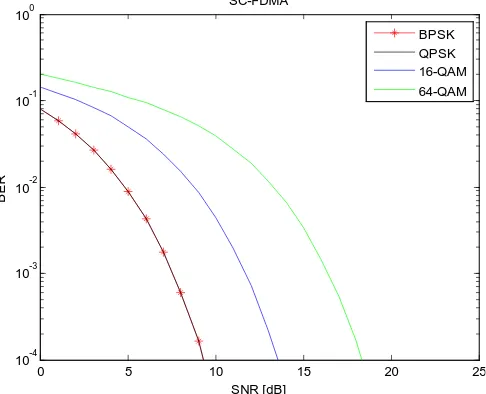
Fig -3: BER performance comparison
The SC-FDMA signals at receiver are first demapped using IFFT operation after cyclic prefix removal. The interference as well as channel state estimation are done for AWGN channel with Rayleigh fading.
The BER performance comparison for various modulation schemes are shown in Figure 3. It’s been observed that BPSK and QPSK signals obtained almost same bit error rate, while the QAM signal performance was drastically increased.
Fig- 4: Probability of Error for various modulation schemes
Same for the probability of error plot. Figure 4 shows the plot for probability of error for various modulation schemes. 64-QAM signal has the lowest probability of error among all. From above two plots it’s been concluded that as the degree of modulation increases, the SC-FDMA performance also increases. Also the interference self cancellation method, which is the subject of study, has also improved the performance for higher degree of modulations.
4. CONCLUSIONS
The proposed self interference cancellation method has been implemented using MATLAB successfully. The BER as well as probability of error for various modulation schemes are compared. Higher the degree of modulation performance of system improves. 64-QAM signal has the lowest probability of error among all. From the studies it’s been concluded that as the degree of modulation increases, the SC-FDMA performance also increases. Also the interference self cancellation method, which is the subject of study, has improved the performance for higher degree of modulation schemes.
ACKNOWLEDGEMENT
I am very thankful to my guide Dr. Malini Suvarna Professor, Department of Electronics and Communication Engineering, Mite for her cordial support, valuable information and constructive suggestions during the planning and development of this research work.
0 1 2 3 4 5 6 7 8 9
-450 -400 -350 -300 -250 -200 -150 -100 -50 0
Sampling Frequency (2×BW) in MHz
P o w e r S p e c tr a l D e n s it y [ d B m /H z ]
[image:4.595.40.275.102.284.2] [image:4.595.302.562.107.302.2] [image:4.595.42.285.384.581.2]© 2016, IRJET | Impact Factor value: 4.45 | ISO 9001:2008 Certified Journal
| Page 2878
REFERENCES
[1] ‘Single Carrier FDMA A New Air Interface For Long Term Evolution’- Hyung G. Myung Qualcomm/ Flarion Technologies, USA, David J. Goodman Polytechnic University, USA
[2] An Interference Self-Cancellation Technique for SC-FDMA Systems-Meng Ma, Xiaojing Huang, Member, IEEE, and Y. Jay Guo, Senior Member, IEEE- IEEE communications letters, vol. 14, no. 6, june 2010
[3] K. Raghunath and A. Chockalingam, "Sc-fdma versus ofdma: Sensitivity to large carrier frequency and timing offsets on the uplink," in Proc. IEEE Global Telecommunications Conference (GLOBECOM'09), Nov 2009, pp. 1-6
[4] Single carrier orthogonal multiple access technique for broadband wireless communications by Hyung G. Myung – For the Degree of Doctor of Philosophy, January 2007