© 2016, IRJET | Impact Factor value: 4.45 | ISO 9001:2008 Certified Journal
| Page 80
Comparison analysis of Green building materials and conventional
materials in energy efficiency performance
Srikant Misra
1, G.R.K.D. Satya Prasad
2, Navnit Kumar
3, Satish Kumar Sah
4,
Sanjeet Kumar
5, Radheshyam Maurya
61
Assistant Professor, Department of Electrical Engineering, GIET, Gunupur,
Orissa,INDIA2
Associate Professor, Department of Electrical Engineering, GIET, Gunupur,
Orissa,INDIA
3,4,5,6
Final Year UG student, Dept. of Electrical Engineering, GIET, Gunupur, Orissa, INDIA
---***---Abstract - In present senior energy consumption has increased a lot. The increase in energy consumption is due to increased in number of building that is being constructed these days. The material that is used to build a general building now days mostly consists of non-renewable materials which are neither long lasting nor Energy Efficient. These are health hazardous and less eco-friendly too. As far as economist is concern, though these material gives the low initial cost for making a building but leads to high energy consumption expenses and a high maintenance cost which results in increasing the overall cost of the building. In this paper we will observe the effect of some of the component of green building like roof, glass etc and its different kinds which is use to construct the green buildings. And also we will find how much extent this green glass reduces the overall power consumption of the building as compare to normal glass by using simulation process(Using ECO-nirman whole building performance tool software) and ultimately get the advantage of this Green house component over normal component.
Key Words: BEE, GRIHA, LEED, ECBC, IGBC, GREEN BUILDING, ECO-nirman
1. INTRODUCTION
Green building thought in broader terms is a building which is planned, built, operated, maintained or reused with objectives to defend inhabitant health, improve employee efficiency, use wisely natural resources and reduce the environmental impact. Green construction or sustainable building which complements the building plan with concerns of economy, utility, durability and comfort. In other words the green building procedure incorporates environmental considerations into every phase of the building structure. This process focuses on the design, construction, process and maintenance phases and takes into account the lot design and development effectiveness, energy and water effectiveness, resource efficiency, indoor environmental excellence, building-owner maintenance and the building‘s overall impact on the environment. A Green Building is one which utilizes fewer water, optimizes energy efficiency, conserves natural resources, generates less waste and provides healthier space for occupants as compared to conventional buildings.
2. OBJECTIVES OF GREEN BUILDING
The objective of the green buildings is to develop buildings which utilize the natural resources to the minimal at the time of construction and operational stage. Green buildings emphasize on the resource usage efficiency and also press upon the three R's - Reduce, Reuse and Recycle. Green Building is a team effort and the designing and construction includes consultants from architectures, landscaping, air conditioning, plumbing, energy and electrical field. These consultants assess the impact of the each and every design on the environmental condition, keeping in brain the capital involved. The final design needs to be practicable and should minimize the unconstructive impacts that the building would have on the environment.
Execution of the green building concept can lead to a decrease of carbon emission by thirty five percent, water handling by forty percent, solid waste decline by seventy percent and diminution in energy consumption by fifty percent. Green Building concept also calculates on the fact that an area with high bio-diversity should be avoided as a site for the construction of a building.
2.1 Different from conventional buildings
© 2016, IRJET | Impact Factor value: 4.45 | ISO 9001:2008 Certified Journal
| Page 81
increased wastage, increased operational and maintenance costs.
2.2 India’s Green Building Certification and Council
The ranking of the top 10 countries for LEED outside of the US is based on cumulative gross square meter (GSM) of space certified to LEED in each nation as of
April 2014. India has 11.64 million GSM of LEED-certified space, and in total, it has 1,657 LEEDcertified and -registered projects representing 66.22 million GSM. GRIHA Council, is an independent platform (registered as a society) for the interaction on scientific and administrative issues related to sustainable habitats in the Indian context It was founded by The Energy and Resources Institute (TERI) , New Delhi with support from the MNRE. Indian Green Building Council (IGBC) has launched IGBC Green New Buildings rating system to address the National priorities. This rating program is a tool which enables the designer to apply green concepts and reduce environmental impacts that
are measurable. The rating program covers methodologies to cover diverse climatic zones and changing lifestyles.
3. FEATURES OF GREEN BUILDING
Green building justify to both structure and the using of processes that are environmentally accountable and reserve efficient throughout a building's life cycle from identifying the location to design, construction, operation, maintenance, renovation, and demolition. Leadership in energy and environmental design (LEED) is a set of ranking systems for the design, construction, operation, and maintenance of green buildings which was urbanized by the U.S. Green building council. Although new technologies are continually being developed to complement current practices in creating greener structures, the common purpose is that green buildings are designed to reduce the on the entire impact of the built environment on human fitness and the natural environment by efficiently by means of energy, water and other resources, protecting occupant health and improving employee productivity, plummeting waste, pollution and environmental deprivation.
4. GRIHA
GRIHA was developed as a unique building rating system, mainly to address and assess non air conditioned or partly air conditioned buildings. GRIHA has been urbanized to rate industrial, institutional and housing buildings in India emphasizing national environmental concerns, local climatic conditions, and indigenous solutions.
GRIHA focus on passive solar techniques for optimizing optical and thermal comfort indoors which encourages the use of refrigeration based and energy challenging
air conditioning systems only in cases of extreme thermal discomfort
5. LEED
LEED is a ranking system which evaluates the environmental friendliness or greenness of a building. Hence the building with a advanced LEED points should be preferably more environment friendly than one with a less LEED point. The LCACS obtained for each group expresses the relative extent of environment friendliness or reservations of different sub categories. When LCACBS and LCADS are analysed for its fulfilment with the point allotment of LEED certification criteria, it is obvious that point allocation is not linearly proportional to the obtained scores as per this study.
6. GREN BUILDING MATERIALS
In present senior energy expenditure has increased a lot. The boost in energy consumption is due to increase in number of building that is being constructed these days. The materials that are used to build a general building now a days, mostly consists of non renewable materials. Which are neither durable nor energy competent. These are health dangerous and less eco friendly too. As far as economist is concern, though these material gives the low initial cost for making a building but leads to high energy expenditure and a high protection cost which results in increasing the overall cost of the building. Green building materials recommend specific benefits to the building owner and building occupants by reducing maintenance and replacement costs over the life of the building, energy conservation, improved occupant health and productivity, lower costs associated with changing space configurations.
6.1 Dimension stone
Dimension stone is the name specified to natural quarried stones that are cut to required dimensions and finished like granite, slate, limestone, sandstone, and marble. These materials can be used in building facades, indoor flooring and outdoor walkways, it is widely noted as one of the most durable and green types of building materials. Of particular note is the ease with which dimension stone can be recycled during old building destruction and used either in whole form or crushed into aggregates for use in concrete mixtures.
6.2 Concrete
© 2016, IRJET | Impact Factor value: 4.45 | ISO 9001:2008 Certified Journal
| Page 82
can be harvested during building demolition and recycled as filler or aggregate in future concrete products.
6.3 Wood/Engineering wood product
The sustainable aspects of wood as a green building material are complex. At the origin of the product is the Forest Stewardship Council (FSC), which is a certification industry that works with and monitors wood harvesters to ensure that sustainable growth and harvesting practices are been used. The actual uses of wood in green construction can vary from fine finished flooring to rough framing. Technological advances/automation of sawmill facilities has resulted in the increased efficiency of output compared to years prior; in addition, the production of wood itself in much more energy efficient per ton than comparable construction materials such as steel, aluminum, cement, and glass. Advances in engineered wood products have also allowed for the optimized use of harvested trees by minimizing defects and maximizing structural capacities.
6.4 Recycled steel
While the production of steel involves high emissions releases and large qualities of energy, the use of recycled material accounts for 2/3 of new steel production by weight in the United States. Additionally, the use of recycled materials reduces the necessary amount of energy needed to produce steel product compared to that needed when using virgin ore.
6.5 Insulated concrete form
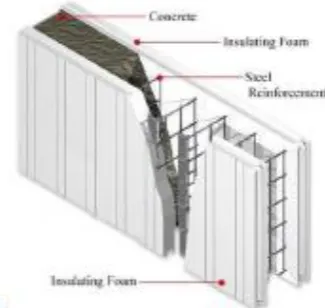
[image:3.595.39.202.569.723.2]Insulted Concrete Forms (ICFs) are interconnect expanded polystyrene blocks that are stacked in place, supported with reinforcing steel bars as needed, and filled with concrete to form the walls of a structure. The end result is a composite unit with high insulation properties.
Fig -1: Insulated concrete form
6.6 Green roof and reflective roofs
The roofs provide a number of settlements beyond urban heat island mitigation with reduced energy use. A cool roof transfers less heat to the building, so the building stays cooler and uses less energy for air conditioning, reduced air pollution and greenhouse gas emissions. By lowering energy use, cool roofs decrease the creation of associated air pollution and greenhouse gas emissions, improved human health and comfort. The roofs can reduce air temperatures inside buildings with and without air conditioning, helping to prevent heat related illnesses and deaths, roofs deflect some desired heat gain during the winter. In general, though, cool roofs result in net energy investments, especially in areas where electricity prices are high.
7. GLASS
Glass is a speculate material that combines more than a few advantages such as Transparency, Natural Day lighting, Blending of Exteriors with Interiors and acoustic control. Glass is a wholly recyclable material, supplies unobstructed occasions for architects as well as designers for the innovative applications in buildings. Glass plays a noteworthy role in accomplishing greater indoor environmental quality and energy efficiency and in so doing full fills numerous criteria for green buildings. The intention of a green building design is to curtail the demand on non-renewable resources, amplify utilization efficiency of these resources when in use, and augment the reuse, recycling, and consumption of renewable resources.
7.1 Green architecture and glass
The design and placement of glass is a fundamental constituent of Green architecture. It permits natural light and puts together the interior of office and residential buildings with the exterior. Natural light enhances productivity in the workplace and helps uphold a healthy environment. It is just as important that glass materials and design endorse energy efficiency.
7.2 Double glazed glass
Architects use high-performance double glazed glass, which is laminated or coated, to moderate interior temperatures by controlling heat loss and gain. The coating filters the heat-producing aspects of solar rays. The use of such glass in green buildings is used comprehensively in tropical climates as well as the Middle East.
7.3 Solar control glass
© 2016, IRJET | Impact Factor value: 4.45 | ISO 9001:2008 Certified Journal
| Page 83
efficiency. In temperate regions, it can be used to equalize solar control with high levels of natural light. In more serene climates, architects employ operable windows as a cost-saving substitute to air-conditioning.
8. ROOF
Green roofing products are many and varied, ranging from recycled-plastic shingles to recycled-metal roofs to sustainably harvested or reclaimed wood roofs. The best option for your home depends on the design of your home, local building codes, and price considerations.
8.1 Recycled Shingles
Among the most popular — and perhaps the ―greenest‖ — of all roofing products are shingles made from recycled waste materials, such as plastic, rubber, or wood fiber. Some products are made from clean post-consumer waste (waste from homes), others from post-industrial waste (factory waste). Recycled-content shingles are amazingly durable, and they look nice, too. You‘d never know they were made from ―waste‖ materials!
8.2 Wood Shingles and Shakes
In many parts of the country, wood shingles and shakes have long been a popular choice among builders and homeowners. Unfortunately, conventional wood shingles are made from old-growth western cedar. Although the amount of energy it takes to produce this product is relatively low, the harvest of old-growth trees is not sustainable in the long run.
8.3 Metal Roofing
Many metal roofing products include at least some recycled material, but one advantage of metal roofing is that it can be recycled at the end of its life. Because metal roofs can last up to 50 years, roofing replacement is less frequent, which means less waste in the long run? They offer exceptional durability and fire-resistance, and they‘re ideal for those who want to collect rainwater from their roofs to water gardens (or for household uses). You don‘t have to worry about chemicals that might leach from a conventional asphalt roof. Standing-seam metal roofs work nicely as the base for thin-film photovoltaic panels, too.
8.4 Rubber Roofing
[image:4.595.310.561.69.252.2]Another recycled roof material is reinforced rubber shingles made from old steelbelted radial tires. The material is coated with ground slate for texture and comes in a variety of colors. A big advantage to this material is a long life and a 50-year warranty, including against hail and other extreme weather.
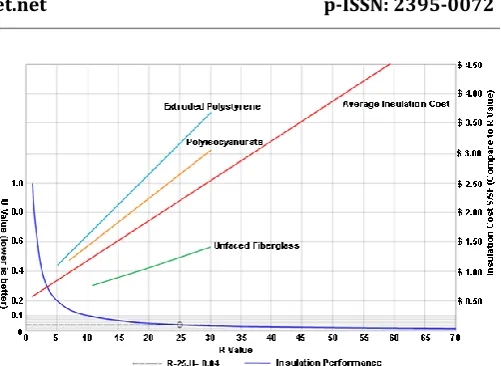
Fig -2: Roof insulation performance
9. ECONIRMAN
Econirman Whole Building Performance Tool is an online tool to assess conformance with the ECBC using the Whole Building Performance (WBP) method. It enables building developers and designers to test their building design using the energy simulation protocol
established in Appendix B of the code. The tool also predicts the performance of the building in terms of its annual energy consumption normalized to the building area. Being a webbased energy simulation tool, it can be made available to users over the Internet with minimal software requirements and building science or simulation expertise.
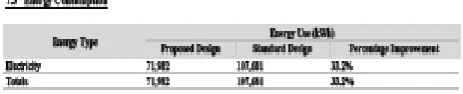
The tool runs the Standard Design (baseline parameters from the ECBC prescriptive requirements) and the Proposed Design (user specified inputs that allow the user to modify the ECBC prescriptive requirements) versions of the building and compares the Energy Performance Intensity (EPI) from the simulation results. A report that may be submitted to demonstrate conformance with the ECBC, can be generated.
9.1. Parameter Used
9.1.1 Thermal insulation
The effectiveness of bulk insulation is commonly evaluated by its R-value, of which there are two - metric (SI) and US customary, the former being 0.176 times the latter. For attics, it is recommended that it should be at least R-38 (US customary, R-6.7 metric). However, an R-value does not take into account the quality of construction or local environmental factors for each building. Construction quality issues include
inadequate vapor barriers, and problems with draft-proofing. In addition, the properties and density of the insulation material itself is critical.
9.1.2 Building Insulation Materials
© 2016, IRJET | Impact Factor value: 4.45 | ISO 9001:2008 Certified Journal
| Page 84
insulation system. The type of insulation used is matched to create maximum resistance to each of the three forms of building heat transfer - Conduction, Convection, and Radiation.
9.1.3 Window -Wall Ratio
This is the ratio of the vertical fenestration (window) area to gross exterior wall area. The gross exterior wall area is measured horizontally from the exterior surface; it is measured vertically from the top of the floor to the bottom of the roof.
9.1.4. R-VALUES:
In construction, the R-value is the measurement of a material's capacity to resist heat flow from one side to the other. In simple terms, R-values measure the effectiveness of insulation and a higher number represents more effective insulation.
9.1.5 U Factor:
Many energy modelling programs and code calculations require U-factors (sometimes called U-values) of assemblies. The U-factor is the heat transfer coefficient, which simply means that is is a measure of an assembly's capacity to transfer thermal energy across its thickness. The U-factor of an assembly is the reciprocal of the total R-value of the assembly. The equation is shown below.
[image:5.595.313.545.105.152.2]10. SIMULATION RESULT
Fig -3: Building conformance summary
Fig -4: Building simulation summary
Fig -5: energy Consumption
11. CONCLUSION
Here in this paper, we have figure out that how the green building materials is superior than the conventional materials in terms of overall energy saving criteria as well as eco-friendly nature of the material. And also by using ECOnirman whole building performance tool software we have virtually shown that by changing or taking care of some of the simple parameter likes window- wall ratio of the house, proper Vertical and Horizontal shading, proper window construction, seasonal schedule etc we can also minimize the Energy requirement of the building and make it more Efficient (As shown in the ECOnirman report). REFERENCE
1. G.R.K.D. Satya Prasad “Performance optimization of a Rooftop Hybridized Solar PV-AC grid assisted power system for peak load management” published in International Journal of Engineering Research and Applications, ISSN:2248-9622, vol-2,Issue No-3,May-june 2012
2. G.R.K.D. Satya Prasad “Design Of Standalone hybrid Biomass & PV system of an off grid house in a remote area” in International Journal of Engineering Research and Application, vol3,issue6,NovDec 2013 , pp433 -437
3. G.R.K.D. Satya Prasad “Energy and Comfort Management in Energy Efficient Buildings Using RETSCREEN Software-A Case Study Analysis” in International Journal of Engineering Research and Application ISSN: 2248-9622, Vol. 3, Issue 6, Nov-Dec 2013, pp.378-381
4. http://www.epa.gov/greenbuilding/pubs/about.html. 5. Yan Ji and Stellios Plainiotis (2006): Design for
Sustainability. Beijing: China Architecture and Building Press. ISBN 7112083907.
6. Hopkins, R. 2002. A Natural Way of Building. (http://transitionculture.org/articles/anaturalwayofb uilding2002/) Transition Culture. Retrieved: 20070330.
7. Allen & Iano, 2008[Allen, E, & Iano, J. (2008). Fundamentals of building construction: materials and methods. Hoboken, New Jersey: John Wiley & Sons Inc. 8. U.S. Environmental Protection Agency. (October 28,
[image:5.595.50.354.466.733.2]