Towards developing an industry led
educational framework using LEAN
approach
Bassanino, MN, Underwood, J, Allen, T, Khosrowshahi, F and Stokes, E
Title Towards developing an industry led educational framework using LEAN
approach
Authors Bassanino, MN, Underwood, J, Allen, T, Khosrowshahi, F and Stokes, E
Type Conference or Workshop Item
URL This version is available at: http://usir.salford.ac.uk/17813/
Published Date 2008
USIR is a digital collection of the research output of the University of Salford. Where copyright permits, full text material held in the repository is made freely available online and can be read, downloaded and copied for noncommercial private study or research purposes. Please check the manuscript for any further copyright restrictions.
TOWARDS DEVELOPING AN INDUSTRY LED
EDUCATIONAL FRAMEWORK USING
LEAN APPROACH
May Bassanino1, Jason Underwood2, Tom Allen3, Farzad Khosrowshahi4 and Eric Stokes5
ABSTRACT
The poor performance and inefficient manner in which the construction industry operates has been recognised through a variety of combined government and industry initiatives over the years. A major challenge towards improvement is recognised as lying with education and industry stakeholders actively creating closer and more effective relationships to facilitate a greater mutual understanding.
The application of Information Technology (IT) systems can well enhance „Lean‟ initiatives through improving process flow, reduction of the non-added value activities, better meet customers‟ requirements and adding value which will increase the performance of the industry.
This paper presents a project that is focused on developing an industry led framework for educational training programmes. The outcomes of two workshops organised with the industry that have resulted in a Continued Professional Development (CPD) training framework comprising of three distinct levels in terms of strategic, operational and technology aspects of that particular key area are discussed. The essence of this work is based on adopting the „Lean‟ approach and adding value by identifying the IT skills gaps recognised „by the industry‟ „for the industry‟ and addressing them in developing training programmes.
KEY WORDS
Educational training programme, lean approach, Strategic Operational Technical focus, People Process Technology Environment areas.
INTRODUCTION
Over the years, there has been a number of combined industry and government initiatives such as Latham (1994) and Egan (1998; 2002) that have focused on the performance of the construction industry. The results of all these initiatives have been
1 Researcher, School of the Built Environment, University of Salford; UK, T +44 161 2956563;
2 Lecturer, School of the Built Environment, University of Salford; UK, T +44 161 2956290;
3 Manager, Information, Comms and Media Division, Mott MacDonald, Brighton; UK T +44 1273
365029; [email protected]
4 Professor, School of the Built Environment, University of Salford; UK, T +44 1612956297;
5 Lecturer, School of the Built Environment, University of Salford; UK, T +44 161 2952168;
a continued call for dramatic improvements in the efficiency and effectiveness of the performance of the construction industry, in order to meet increased clients‟ expectations, improve business processes, encourage collaboration and a change in culture, deliver better value to the supply chain and stakeholders. In addition, industry engagement has been seen by successive governments as an important element in addressing the UK skills agenda to increase the performance of the sector. Both industry and higher education stand to gain by working together and through the contribution of each other (Williams 2005). The need for collaboration and closer working relationships is further highlighted in the Lambert Review of Business– University Collaboration (Lambert, 2003) and the White Papers (2003, 2005). Therefore a major responsibility lies with education providers contributing to meeting these challenges by actively working towards developing more effective links with industry to ensure a greater understanding of their needs/requirements towards addressing them. Such links require the engagement of education providers and industry working collaboratively.
Construct IT For Business (CIT) is an international industry-led not-for-profit making collaborative network comprising leading edge construction organisations whose aim is to improve industry performance through the innovative application of Information and Communications Technology (ICT) and to act as a catalyst for academic and industrial collaboration.
For over a decade, Construct IT for Business has responded to government and industry initiatives towards improving industry performance through the innovative application of ICT/innovation through such activities as networking, benchmarking, best practice, How to…..guidance in innovating with ICT, practical tools and frameworks to assist organisations manage their existing ICT resources more effectively. Since the mid-late 90s, the needs of industry have shifted from not only justifying the benefits to be realised through more effective application of ICT/innovation but to more „hands-on‟ of supporting this realisation.
Therefore, as part of aligning the activities of CIT to improve the industry‟s performance, an on going project is progressing towards developing „in conjunction with industry for industry‟ a set of Continuing Professional Development (CPD) training courses. These courses aim to directly address the IT skills gap/issues that the industry is facing and have emerged as the construction industry supply chain continues to embrace the advances in technology, new techniques, methods of working, etc.
This paper presents an ongoing project that has adopted a workshop method towards more effective CPD training course development to address the issues of relevance to the industry applying „Lean‟ principles at the necessary level.
IMPLEMENTING THE LEAN APPROACH
There is no doubt that IT has a major impact on performance of the construction industry as it plays a significant role in relation to communication, supporting processes, informing decisions when it is applied extensively in the construction industry (Turk, 2000) and (Betts, 2000).
„Lean‟ management is how the customer decides whether or not the provided service meets with their needs. In this work, we adopted the „Lean‟ approach to design an industry lead educational framework for a training programme based on the „Lean‟ fundamentals of focusing attention on adding value to a product which is the educational training programme in this case, eliminating waste (non value adding) activities from the process.
An example of how IT can be a robust element to enhance „Lean‟ activities, during the Construct IT Autumn Members Meeting last November, Mott Macdonald presented how they used the fundamental elements of lean (value, value stream, flow, pull and continuous improvement) to build their own generic approach towards a multidisciplinary system of bringing together „Lean‟ with the focus of Technology integrated with People and Process to add fresh dimensions when engaging with the client.
This work builds on the generic approach of Mott Macdonald and applies the principles of “Lean” as a theoretic frame in designing an educational framework tailored specifically for the construction industry and its community especially with no record of professional educational training of IT in construction to support lean business. Alves and Tsao (2007) identified in their review of the lean construction proceedings for the International Group for Lean Construction (IGLC) between 2000 and 2006, a number of research areas in which Information technology (IT) forms only 1.8 % of all the categories. However, research in this category covered topics including the use of IT to help implementation of lean construction in planning, design procurement and other disciplines in construction.
In our experience, we found that using „Lean‟ approach by significantly engaging the industry to identify their needs resulted in designing a better product that meets their requirements through addressing the issues that the industry needs to improve their performance.
THE CPD TRAINING PROGRAMME
Two workshops have been held using industry expertise so far to cast light on different approaches and aspects of the deployment and development of „Lean‟ in a CIT context. The first focused on exploring the industry-wide IT skills gap/issues with the aim of identifying those common issues that industry recognise as requiring to be addressed and prioritising those to initially take further CPD development.
years ago (Champion, 1967), information exchange still remains a problem of many projects (Turk, 2000) which in turn has significantly affected the performance of the industry. Gallaher et al. (2004) indicated that US$15.8 billion was lost in 2002 in the U.S capital facilities industry due to the lack of interoperability.
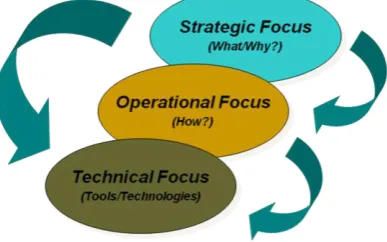
Based on the industry‟s requirements, discussion in the workshops addressed a number of issues which were then grouped into three distinct areas identified in the framework focusing on the strategic level (what/why?), operational level (how?) and technology level (supporting tools/technologies) towards the development of CPD courses (Figure 1.).
[image:5.595.200.394.262.383.2]It was also identified during the workshops that the CPD training programme should start with an introduction course focusing on the fundamentals of innovation in the construction industry.
Figure 1: CPD Framework (Focus Levels)
This is to be followed by a number of courses forming the training programme. Examples of areas of focus will provide a complete and complementary set of courses addressing the strategic, operational and technological aspects (Figure 2).
Figure 2: CPD training courses development framework.
[image:5.595.172.438.459.647.2]at all levels. The work clearly recognises that the industry is founded on building value through construction and uses the convergence of technology to enhance the ways this is achieved. The perspective driven by considering People-Process-Technology will bring the use of ICT into a context that can be clearly recognised by the industry as one that significantly adds value. Further discussion with the industry resulted in the Environment being a fourth theme in which the investment/implementation is taking place.
Based on the industry‟s requirements, the above identified issues were next taken forward through the industrial steering committee that has been established along with the CPD expertise to produce the necessary material and formulate this into the required delivery product.
DELIVERY OF THE TRAINING PROGRAMME
It is proposed that CIT will deliver these CPD courses to the industry, both in-house to individual construction organisations and through external events in conjunction with external professional bodies, organisations, etc. (e.g. CIRIA, CIOB) and also to compliment undergraduate/postgraduate programmes and other community-based projects/initiatives. The following highlight some of the beneficiaries from his programme:
Using the “Lean” principles, the CPD training programme is being developed „in conjunction with industry for industry‟ to address the industry‟s requirements in terms of the current ICT skills gap/issues being witnessed by the industry supply chain.
Addressing the educational needs of industry to drive change towards improved performance through a collaborative working culture/approach. Delivering the IT skills CPD/training programmes to both undergraduate and
postgraduate programmes will equip students with the necessary ICT skills/knowledge as identified/required by industry using „Lean‟ principles.
CONCLUSION
The designing of an educational framework led by the industry using the principles and approach of „Lean‟ to provide the industry with a training programme that satisfies their needs, better meet customer demands, and consequently enhance business performance was presented in this paper. The generic development framework that emerged from the workshops focused at three levels – strategic, operational and technological was discussed and then proposed to be taken forward towards developing courses to better meet the industry‟ needs.
ACKNOWLEDGEMENT
We would like to thank Mott Macdonald for sharing their experience. We would also like to thank the VCAE committee (Ref: PMCR9802) for funding the project.
REFERNCES
Betts, M. (1999) Strategic Management of I.T. in Construction. Blackwell Sciences. USA.
Champion, D. (1967). A proposed identified schema for AEC information vs. transaction-centered multi-schemas, Architectural Design.
DfES, (2003), White Paper on The Future of Higher Education, available online at http://www.dfes.gov.uk/hegateway/strategy/hestrategy/
DfES, (2005), White Paper on „Skills: Getting on in business, getting on at work‟ available online at http://www.dfes.gov.uk/publications/skillsgettingon/
Egan, J. (1998) Rethinking Construction, Department of Environment, Transport and Regions (DETR), UK.
Egan, J (2002) Accelerating Change: a report by the Strategic Forum for Construction (Chaired by Sir John Egan), Strategic Forum for Construction, London.
Gallaher, M. P. O‟Connor, A. C., Dettbarn Jr., J. L., Gilday, L. T. (2004) “Cost Analysis of Inadequate Interoperability in the U.S. Capital Facilities Industry” ,
NIST Publication, available online at:
http://fire.nist.gov/bfrlpubs/build04/art022.html
Lambert, R. (2003) Lambert Review of Business–University Collaboration, HMSO, UK. Available on line at: www.lambertreview.org.uk
Latham, M. (1994) Constructing the Team. Joint Review of the Procurement and Contractual Arrangements in the UK Construction Industry, Final Report, HMSO, London.
Turk, Z. (2000) Paradigmatic Framework for Construction Information Technology, in Gudnason, G. (ed.) Construction Information Technology, pp 948-958.