DEVELOPMENT OF PID VOLTAGECONTROL FOR DC MOTOR USING ARDUINO
NAWI BIN BERAHIM
A project report submitted in partial
fulfillment of the requirement for the award of the Degree of Master of Electrical Engineering
Faculty of Electrical and Electronic Engineering Universiti Tun Hussein Onn Malaysia
ABSTRACT
ABSTRAK
Projek ini memberi tumpuan kepada rekabentuk dan pelaksanaan PID kawalan voltan bagi motor arus terus (AT). Motor arus terus adalah mesin yang digunakan secara meluas kerana kawalan kelajuan untuk pecutan dan nyahpecutan yang cekap serta kawalan daya kilas yang mudah. Pengawal PID digunakan untuk mengawal voltan keluaran penerus terkawal tiga fasa untuk menjalankan motor DC sebagai beban. Fungsi pengawal PID ini adalah untuk membetulkan kesilapan bagi mencapai nilai sasaran voltan yang dikehendaki. Pemodelan, kawalan dan simulasi projek ini telah dilaksanakan menggunakan Perisian MATLAB / Simulink versi 2013a. Isyarat Pemodulatan Lebar Denyut (PWM) yang dijana daripada model MATLAB / Simulink akan dimasukkan ke dalam mikropengawal Arduino. Papan mikropengawal Arduino adalah satu antara muka antara model MATLAB/Simulink dan perkakasan sebenar. Isyarat PWM dari Arduino akan ditingkatkan menggunakan pemandu get dan kemudian akan dihantar ke get MOSFET kuasa untuk pemicuan penerus.. Keluaran yang dihasilkan dari penerus terkawal ini adalah dalam bentuk arus terus. Analisis simulasi gelung terbuka dan gelung tertutup untuk PID kawalan voltan telah dijalankan dengan jayanya. Keputusan menunjukkan bahawa ralat voltan untuk gelung tertutup adalah lebih rendah berbanding dengan gelung terbuka. Seterusnya, perkakasan dibangunkan untuk mengesahkan model MATLAB/Simulink. Daripada sini, kelajuan motor AT bertambah dengan pertambahan voltan yang dikawaltan. Projek ini menyumbang kepada kecekapan dan keteguhan mengawal voltan keluaran motor AT yang digunakan dalam industri berdasarkan kepada pengawal PID berbanding dengan menggunakan kaedah konvensional seperti reostat kawalan angker dan pemula dalam talian (DOL).
TABLE OF CONTENTS
TITLE i DECLARATION ii
DEDICATION iiii
ACKNOWLEDGEMENTS iv
ABSTRACT v
ABSTRAK vi
TABLE OF CONTENTS vii
LIST OF TABLES ix
LIST OF FIGURES x
LIST OF SYMBOLS AND ABBREVIATIONS xiii
LIST OF APPENDICES xiv
CHAPTER 1 INTRODUCTION 1
1.1 Background 1
1.2 Problem Statement 2
1.3 Objectives of the Project 2
1.4 Projet Scope 2
CHAPTER 2 LITERATURE REVIEW 4
2.1 DC Motor 4
2.2 Three-phase ControlledRectifier 7
2.3 Gate Driver 8
2.4 Controller 10
2.4.1 FuzzyLogicController(FLC) 10
2.4.2 Sliding Mode Controller(SMC) 12 2.4.3 ProportionalResonance(PR)
Controller 13
2.4.4 Proportional Integral Derivative (PID)
Controller 14
2.5 Proposed Controller (PID Controller) 15
2.7 Matlab Simulink Software 20
CHAPTER 3 METHODOLOGY 23
3.1 Block Diagram of the Project 23
3.2 Hardware Development Flowchart 26
3.2.1 Three Phase Controlled Rectifier Circuit 28
3.2.2 Gate Driver Circuit 30
3.2.3 Voltage Divider Circuit 33
3.3 Controller Development in Matlab 34
3.4 PID Controller Design for Control Voltage 37
3.5 Experimental Setup 40
CHAPTER 4 RESULTS AND ANALYSIS 41
4.1 Full Simulation Analysis 41
4.2 Open Loop Simulation and Results 44
4.3 Closed Loop Simulation and Results 48
4.4 Hardware Analysis 51
4.4.1 Gate Driver Analysis 52
4.4.2 Analysis of Rectifier 53
4.4.3 Open Loop Hardware and Results 55
4.4.4 Closed Loop Hardware and Results 62
CHAPTER 5 DISCUSSION AND CONCLUSION 67
5.1 Discussion and Conclusion 67
5.2 Future Recommendation 68
REFERENCES 69
LIST OF TABLES
3.1 List of Components for Three Phase Rectifier Circuit 28
3.2 Gate Driver Circuit Components 31
3.3 List of Components for Voltage Divider Circuit 34
4.1 Target Voltage and Actual Voltage Simulation Values for Open Loop 47 4.2 Target Value and Actual Output Value for Closed Loop Simulation 51
4.3 Data for Open Loop Test 62
LIST OF FIGURES
2.1 Equivalent Circuit of DC Motor 5
2.2 Block Diagram of DC Motor 6
2.3 Multi-function DC Motor 7
2.4 Three-phase Controlled Full-wave Rectifier 8
2.5 Generalize Layout of a Power Electronic System Showing the Situation of 9 2.6 (a) Fuzzy Logic Controller (b) Fuzzy Inference System 11
2.7 Boundary Layer Regulation[11] 13
2.8 General Block Diagram of PID Controller 17
2.9 Arduino Uno (Front) 20
2.10 Arduino Uno (Rear) 20
2.11 Matlab R2013a Environment 22
3.1 Block Diagram of the Project 25
3.2 Flow Chart of Hardware Development 27
3.3 Three Phase Rectifier Circuit 28
3.4 PCB Layout of Three Phase Controlled Rectifier Circuit 29 3.5 Actual Hardware of Three Phase Controlled Rectifier Circuit 29
3.6 Gate Driver Circuit 31
3.7 PCB Layout of Gate Driver Circuit 32
3.8 Actual Hardware of Gate Driver Circuit 32
3.9 Voltage Divider Circuit 33
3.10 Actual Hardware of Voltage Divider 34
3.11 Simulink Support Package for Arduino 35
3.12 PID Function Block in Simulink Library 35
3.13 Unity Feedback System 36
3.14 PID Controller Block in Matlab/Simulink 37
3.15 Unity Feedback PID Controller Block Diagram 38
3.16 Flowchart of PID Voltage Control 39
4.3 The Parameters that Contain in PID Block 43
4.4 Three Phase Signal from Incoming 44
4.5 Matlab Simulink Model for Open Loop (without feedback) 45
4.6 PID Setting 45
4.7 Output Voltage (V) vs time (s) for target voltage 30V for Open Loop System 46 4.8 Output Voltage (V) vs time (s) for target voltage 35V for Open Loop System 46 4.9 Output Voltage (V) vs time (s) for target voltage 40V for Open Loop System 47 4.10 Matlab Simulink Model for Closed Loop Analysis (with feedback) 48
4.11 PID Setting for Controller 49
4.12 Output Voltage (V) vs Time (s) for the Closed Loop Controller
for Target Voltage= 30V 49
4.13 Output Voltage (V) vs Time (s) for the Closed Loop Controller
for Target Voltage= 35V 50
4.14 Output Voltage (V) vs Time (s) for the Closed Loop Controller
for Target Voltage= 40V 50
4.15 Waveform from Arduino(yellow) and Gate Driver (green) 52
4.16 Output Signal from Gate Driver and Its Inverse 53
4.17 Uncontrolled Rectifier Circuit 54
4.18 Output Voltage of Uncontrolled Rectifier Model from Simulation Model 54 4.19 Output Voltage of Uncontrolled Rectifier Seen From Oscilloscope 55
4.20 Simulink Model for Open Loop Test 56
4.21 PWM Signal from Arduino for Constant Voltage Input 1V 56 4.22 PWM Signal from Arduino for Constant Voltage Input 3V 57 4.23 PWM Signal from Arduino for Constant Voltage Input 5V 58 4.24 Output Signal From Arduino(yellow) and Gate Driver(green)
for Analog Input 1V 59
4.25 Output Signal From Arduino(yellow) and Gate Driver(green)
for Analog Input 3V 59
4.26 Output Signal from Arduino(yellow) and Gate Driver(green)
for Analog Input 5V 60
4.27 Output Waveform from Rectifier for Direct Injected Voltage
1V, 3V and 5V (Open Loop Test) 61
4.30 DC Output Waveform for Target Voltage = 30V 64
4.31 DC Output Waveform for Target Voltage = 35V 65
LIST OF SYMBOLS AND ABBREVIATIONS
PID - Proportional Integral Derivative
DC - Direct Current
MOSFET - Metal Oxide Field Effect Transistor
KP - Proportional Gain
KI - Integral Gain
KD - Derivative Gain
Matlab - Matrix Laboratory
PCB - Printed Circuit
USB - Universal Board Seriel Bus
ICSP - In Circuit Seriel Programming
LIST OF APPENDICES
APPENDIX TITLE PAGE
A Power Mosfet IRF 840 86
B Heat Sink 87
C DC to DC Converter (IL0515S) 88
D Gate Drive Optocoupler (HCPL3120) 89
E Quad 2-input AND Gate (IC 4081) 90
INTRODUCTION
1.1 Background
From the definition, Direct Current (DC) motor is a machine that converts electrical energy into mechanical energy. It is a mechanically commutated electric motor powered from direct current. Two main parts of DC motor are rotor and stator. Stator is stationary part while rotor is rotating part. The most common types of DC motors are brush, brushless, series connection, shunt connection and compound connection. Nowadays, DC motor plays an important role in research and laboratory experiments because of its simplicity and low cost. Thus, fine speed control is one of the reasons for the strong competitive position of DC motors in the modem industrial applications. The speed of the DC motor can be controlled by changing the voltage applied to the armature (voltage control method) or by changing the field current (flux control method). The introduction of variable resistance in the armature circuit or field circuit allowed speed control. Modern DC motors are often controlled by power electronics systems called DC drives.
A control system is an interconnection of components forming a system that will provide a desired system response. Arduino hardware acts as the interface between the computer and the outside world (controlled DC motor). The user interface was developed in an Arduino environment. There are many types of controller such as P, PI, PD, PID and fuzzy logic controller (FLC) can be used to control the speed of DC motor. The important of control speed of DC motor is to overcome the problem in industry like high overshoot and slow rise time to avoid machine damages. In this project, Proportional Integral Derivative (PID) controller will be developed in Matlab Simulink environment for an application of DC motor speed control to overcome this problem. PID Controller will be created in Matlab Simulink software as a medium for controlling DC motor.
of a standard programming language compiler and a boot loader that executes on the microcontroller.
1.2 Problem Statement
DC motor widely used in speed control systems in industry which needs high control requirement in order to achieve good production. One of the most common methods to drive a DC motor is by using PWM signals respect to the motor input voltage. Manual controller using rheostat/variable resistor (VR) is also not practical because it can waste time and cost. By varying the applied voltage with a rheostat, the speed can be varied from zero to the maximum rotation per minute (RPM) of the motor. Making a controller based on computer can reduce cost and time. The low cost electronic devices can be designed to make a speed controller system.
The most issue discusses in speed controller is regarding their efficiency and reliability for DC motor. The efficiency factor is important in order to save cost. The efficiency of speed controller is depending on method of control system which is PID, p-resonant, repetitive, time delay, fuzzy logic control and etc.
1.3 Objectives of the Project
The objectives of this project are
i. to develop the PID voltage control for DC motor control. ii. to design three phase rectifier for DC motor control. iii. to design gate driver for three phase rectifier.
iv. to communicate between Arduino and Matlab Software
1.4 Project Scope
Three phase fully controlled rectifier circuit is used to convert 3- AC input to DC output for supplying DC voltage to DC Motor. The specification/rating of the available DC motor is 220V, 1.8A and 0.3kW. For rectifier rating, the absolute maximum rating for power MOSFET is Drain-Source Voltage, VDS=500V, Gate-Source Voltage, VGS= 20V and Continuous Drain Current, IDS=8A in order to drive the motor. The features of this power MOSFET is fast switching and simple drive requirements. The target of output voltage is ranging from 0 to 220V.
The gate driver that will be developed for rectifier contains six outputs. This is the combination of one input two outputs gate driver. Output pin (PWM) of Arduino Board is connected to the input of gate driver.
CHAPTER 2
LITERATURE REVIEW
2.1 DC Motor
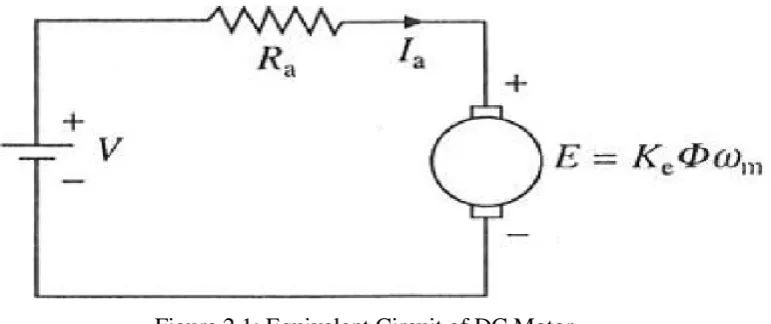
The DC motors have been popular in the industry control area for a long time, because they have many good characteristics, for example: high start torque characteristic, high response performance, easier to be linear control. The combination of proportional, integral and derivative control action is called PID control action. PID controllers are commonly used to regulate the time-domain behavior of many different types of dynamic plants. These controllers are extremely popular because they can usually provide good closed-loop response characteristics [1]. DC motors capable for control capabilities, which means that speed, torque and even direction of rotation can be changed. It is used in speed control applications because of their low cost, excellent drive performance and low maintenance. DC motors also can provide a high starting torque at low speed and it is possible to obtain speed control over a wide range. The equivalent electrical circuit of a DC motor is illustrated in Figure 2.1. It can be represented by a voltage source (V) across the coil of the armature. The induced voltage (E) is generated by the rotation of the electrical coil through the fixed flux lines of the permanent magnets. This voltage is often referred to as the back emf (electromotive force). The following equations are applicable for all DC motors
(2.1)
(2.2)
(2.3)
Figure 2.1: Equivalent Circuit of DC Motor
(Source, Gopal K. Dubey, Fundamental of Electric Drives, pg 61)
DC motors are seldom used in ordinary applications because all electric supply companies furnish alternating current. However for special applications such as in steel mills, mines and electric trains, it is advantageous to convert alternating current into direct current in order to use DC motors. The reason is that speed/torque characteristics of DC motors are much more superior to that of AC series-wound, shunt-wound and compound wound. The use of a particular DC motor depends upon the type of mechanical load it has to drive[2].
DC machines are characterized by their versatility. By means of various combinations of shunt, series, and separately-excited field windings they can be designed to display a wide variety of volt-ampere or speed-torque characteristics for both dynamic and steady-state operation. Because of the ease with which they can be controlled systems of DC machines have been frequently used in many applications requiring a wide range of motor speeds and a precise output motor control[3].
The block diagram of DC motor is represented in the Figure 2.2 as shown below. In a DC motor, the supply voltage, E and current, I is given to the electrical port (input port) and the mechanical output i.e. torque, T and speed, ω from the mechanical port (output).
Figure 2.2: Block Diagram of DC Motor
In a DC motor this power is supplied to the armature directly from a DC source, while in an induction motor this power is induced in the rotating device. Motors that operate from DC power sources have many applications where speed control is desirable. The most desirable characteristic of DC motors is their speed-control capability. By varying the applied voltage with a rheostat (variable resistor), speed can be varied from zero to the maximum rpm of the motor[5].
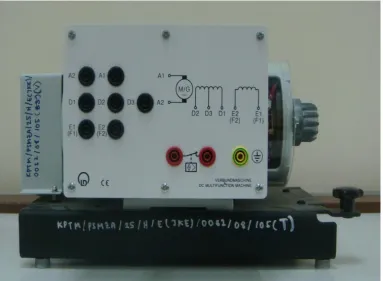
For this project, multi-function DC motor will be used as a load as shown in Figure 2.3. This multi-function DC motor can be used as shunt, series and compound wound machine with commuting. The ability of this motor can handle high peaks in torque and linearity of speed characteristics. For this project, the DC motor is operated via three phase controlled rectifier. The rating operations of this motor are as follows
i. Power = 0.3 kW ii. Voltage = 220V iii. Current = 1.8A iv. Speed = 2000 rpm
INPUT PORT OUTPUT PORT
Electrical Port
Voltage (E) & Current (I)
Mechanical Port Tork (T) & speed ( ) DC
Figure 2.3: Multi-function DC Motor
2.2 Three-phase Controlled Rectifier
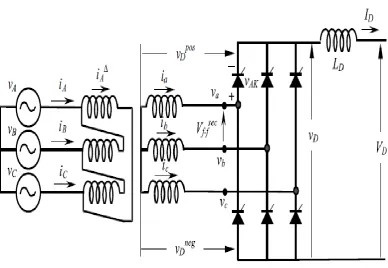
Three-phase controlled rectifiers have a wide range of applications, from small rectifiers to large high voltage direct current (HVDC) transmission systems. They are used for electrochemical processes, many kinds of motor drives, traction equipment, controlled power supplies, and many other applications [6].
Figure 2.4: Three-phase Controlled Full-wave Rectifier
2.3 Gate Driver
[image:20.595.112.527.156.218.2]
driver system[7]. Figure 2.5 shows the generalized block diagram of power electronic system whic h includes the gate driver circuit in the system.
Figure 2.5: Generalize Layout of a Power Electronic System Showing the Situation of the Gate Driver Circuit
(Source : Irshad Khan, Gate Driver for Power Converter, Power Electronic Handbook, 2011)
One of the main contributions of power MOSFET is that led to the growth of the power electronics field has been the unprecedented advancement in the semiconductor technology, especially with respect to switching speed and power handling capabilities. Unlike the lateral channel MOSFET devices used in many IC technology in which the gate, source, and drain terminals are located in the same surface of the silicon wafer, power MOSFET use vertical channel structure in order to increase the device power rating. The modern power MOSFET has an internal diode called a body diode connected between the source and the drain. Most of the MOSFET devices used in power electronics applications are of the n-channel, enhancement-type. Depending on the applications, the power range processed in power electronic range is very wide, from hundreds of milliwatts to hundreds of megawatts. Therefore, it is very difficult to find a single switching device type to cover all power electronic applications. Today's available power devices have tremendous power and frequency rating range as well as diversity[10].
A gate driver is a power amplifier that accepts a low-power input from a controller and produces a high-current drive input for the gate of a high-power transistor such as power MOSFET. Gate drivers can be provided either on-chip or as a discrete module. For this project, three ―one input two output‖ gate drivers will be used. Three inputs are connected to output port of Arduino board in the form of PWM while 6 outputs are connected to MOSFETs gates of three phase rectifier. The main purpose of gate driver is to drive the rectifier. The output of signal PWM from Arduino is about 5V could not be able to drive power MOSFETs of rectifier. In order to drive power MOSFETs that needs input around 15V to its gate, gate driver will be used.
2.4 Controller
There are many types of controllers had been developed by academician and researchers. A controller is a hardware device or a software program that manages or directs the flow of data between two entities. In computing, controllers may be cards, microchips or separate hardware devices for the control of a peripheral device. In a general sense, a controller can be thought of as something or someone that interfaces between two systems and manages communications between them. There are two types of controllers in power systems which are passive controller and adaptive controller. The examples for passive controllers are relay control, hysteresis and sliding mode control and for adaptive controllers are PID, PI Repetitive, P-Resonance and Fuzzy Logic Controller (FLC).
2.4.1 Fuzzy Logic Controller (FLC)
for multi variable control. Fuzzy Control System Design is based on empirical methods which approach to trial and error. The general process is as follows:
i. Document the system's operational specifications and inputs and outputs. ii. Document the fuzzy sets for the inputs.
iii. Document the rule set.
iv. Determine the defuzzification method.
v. Run through test suite to validate system, adjust details as required. vi. Complete document and release to production.
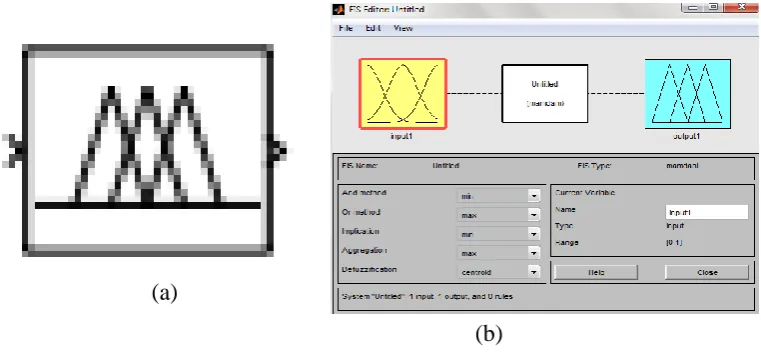
(a)
[image:22.595.97.478.263.439.2](b)
Figure 2.6: (a) Fuzzy Logic Controller (b) Fuzzy Inference System
The application of control algorithms based on the fuzzy logic theory has grown in recent years. This control method is one of adaptive control based on a linguistic process which is in turn based on the prior experience and heuristic rules used by human. The implementation of such control consists of translating the input variables to a language, like positive big zero, negative small and to establish control rules so that the decision process can produce the required outputs. If necessary, these linguistic outputs are transformed to numerical values[9].
The advantages of fuzzy logic controller includes
i. Easy computation. Widely available toolboxes and dedicated integrated circuits. ii. Convenience user interface. Easier end-user interpretation when the final user is not
a control engineer.
iv. Flexible, intuitive knowledge base design.
Some disadvantages or drawbacks of fuzzy logic controller are
i. Time consuming returning even if applied to another plant in other location. ii. Design does not clearly outperform well-tuned conventional controller. iii. The performance robustness is not usually taken into account.
iv. Many options (unclear). Thousands of different fuzzy system configuration may arise[10].
2.4.2 Sliding Mode Controller (SMC)
Based on previous research, the sliding mode control (SMC) is very attractive for its excellent performance for implementation with simple control algorithm. This approach is desirable to achieve very robust performance against external disturbances. The choices of proper switching functions for different control aims are important, in order for sliding mode to exist on surface so that the current and speed can be controlled exactly. The concept of this control system was proposed by mathematician from Russian, Lyapunov. He had discussed the theory about nonlinear systems.
The main arguments in favor of sliding mode control are order reduction, decoupling design procedure, disturbance rejection, insensitivity to parameter variations, and simple implementation by means of power converters. The control algorithms and data processing used in variable structure systems are analyzed. The potential of sliding mode control methodology is demonstrated for versatility of electric drives and functional goals of control[11].
Figure 2.7: Boundary Layer Regulation[11]
In paper [12] presented that the comparisons between SMC and PI Controller. Simulations were carried out using Matlab Simulink in order to make the performance comparisons between the sliding mode and the PI controllers. The PI controller was appropriately designed to provide zero steady state error, fast transient response with short settling time and minimum overshoot. It can be seen that the SMC speed response is faster, with less ripple in speed. From here, it can be concluded that the SMC DC drive gives a zero steady state error, without overshoot and very fast dynamic response.
2.4.3 Proportional Resonance (PR) Controller
This paper explained [13] that the dynamic characteristic is not enough when load changes abruptly and static error would be generated if the input signal in AC. This paper presents the PR controller transfer function by theoretical analysis. The modification of PI controller is called PR Controller by adding poles at the required frequency that will increase corresponding frequency gain to get steady state error. This PR controller is able to implement no-static error adjustment and satisfying dynamic performance when load changes and voltage sags abruptly. The expression for this transfer function as follows
(2.4) where
is proportional coefficient is resonance coefficient
This paper also describes the ability of a power supply system to regulate load changes, voltage sags abruptly and other emergencies is an important aspect to the performance of a switch power supply. This controller is capable to implement no static error adjustment and a satisfying dynamic performance when load change. Its effectiveness is verified by simulation and experiment.
2.4.4 Proportional Integral Derivative (PID) Controller
Proportional Integral Derivative (PID) control is the most common control algorithm used in
industry today. The popularity of PID controllers can be attributed to their effectiveness in a
wide range of operating conditions, their functional simplicity and how easily engineers can
implement them using current computer technology. This article discusses PID control and
practical implementations and provides a brief overview on how to tuning parameters of PID
controllers[14].
The main contribution the paper [14] is the algorithm of PID controller.
Proportional-Integral-Derivative (PID) controllers are widely used in industrial control systems. A PID
controller is a common closed loop component with feedback in industrial control systems.
This controller compares a measured value from a process (typically an industrial process or
output of the system) with a reference set point (desired value or target value by the operator).
The error signal is the difference between target value and measured value from process is
then used to calculate a new value for a manipulatable input to the process that brings the
measured value of the process back to its desired value by user/operator. The PID controller
can adjust process outputs based on the history and rate of change of the error signal, which
gives more precise/correct and stable condition. PID controllers can be easily adjusted or
tuned to the desired application. So, a PID controller can be considered to be the best
controller. By adjusting or tuning the three parameters (KP, KI and KD) in the PID controller
algorithm, the controller can provide control action for specific required process. The response
of the controller algorithm can be described in terms of the alertness of the controller to an
error, the degree to which the controller overshoots the set point and the degree of system
oscillation.
the requirement of the end users. Easy implementation of hardware and software has helped to gain its popularity. Several approaches have been documented in literatures for determining the PID parameters of such controllers which is first found by Ziegler- Nichols tuning[15].
Designing and tuning a proportional-integral-derivative (PID) controller appears to be conceptually intuitive, but can be hard in practice, if multiple (and often conflicting) objectives such as short transient and high stability are to be achieved. Usually, initial designs obtained by all means need to be adjusted repeatedly through computer simulations until the closed-loop system performs or compromises as desired. This stimulates the development of ―intelligent‖ tools that can assist engineers to achieve the best overall PID control for the entire operating envelope. This development has further led to the incorporation of some advanced tuning algorithms into PID hardware modules. Corresponding to these developments, this paper presents a modern overview of functionalities and tuning methods in patents, software packages and commercial hardware modules. It is seen that many PID variants have been developed in order to improve transient performance, but standardizing and modularizing PID control are desired, although challenging. The inclusion of system identification and ―intelligent‖ techniques in software based PID systems helps automate the entire design and tuning process to a useful degree. This should also assist future development of ―plug-and-play‖ PID controllers that are widely applicable and can be set up easily and operate optimally for enhanced productivity, improved quality and reduced maintenance requirements[16].
Matlab has evolved almost a decade with input from many users. In university environments it has become the standard tool for introduction courses in applied algebra as well as in common and real-time simulation in system control of all kinds of engineering applications. In industrial settings, MATLAB is used for research in practical engineering and system mathematical problems including general purpose numerical computations algorithm prototyping in control theory statistics, digital signal processing, motion control, robotics, electrical engineering or electric drives[17].
2.5 Proposed Controller (PID Controller)
Each of these terms can be determined by the user. These terms need to be adjusted to optimize the precision of control. The process of determining the values of these parameters is known as PID Tuning.
The PID controller includes a proportional term, integral term and derivative term, where the proportional term is to adjust the output of controller according to all of the magnitude of error, the integral term is used to remove the steady state error of control system and improve the steady state response, the derivative term is used to predict a trend of error and improve the transient response of the system. These functions have been enough to the most control processes. Because the structure of PID controller is simple, it is the most extensive control method to be used in industry so far. The PID controller is mainly to adjust an appropriate proportional gain (KP), integral gain (KI), and differential gain (KD) to achieve the optimal control performance[18].
Conventional PID control is widely used in motion control because of its simple algorithm and high reliability. However, some of the controlled object has no precise mathematical model in practice, which leads to set the PID parameters complexly, moreover, the parameters usually have poor performance and difficult to meet the high precision motion control of linear motor. If fuzzy algorithm is used to set the online PID parameters such as Kp, Ki, Kd, it can not only retain the merits of simple principles and convenient use of the conventional PID control system, but also own the characteristics such as flexibility and adaptability of the fuzzy control, which can enhance performance of the control system effectively[19].
A PID Controller consists of a proportional (P) element, integral (I) element and Derivative (D) element The PID algorithm is the most popular feedback controller widely used feedback control in industrial control system. The PID method is one of the most feedback control system that has been used more than 50 years ago. One of the earliest examples of a PID-type controller was developed by Elmer Sperry in 1911, while the first published theoretical analysis of a PID controller was by Russian American engineer Nicolas Minorsky in 1922. It is a robust easily understood algorithm that can provide excellent control performance despite the varied dynamic characteristics of process plant. This is a type of feedback controller whose output, a control variable (CV) is generally based on the error (e) between some user defined set point (SP) and some measured process variable (PV). Figure 2.8 shows the general block diagram of PID controller.
Figure 2.8: General Block Diagram of PID Controller
The proportional, integral, and derivative terms are summed to calculate the output of the PID controller. By defining u (t) as the controller output, the equation form of a PID controller as a continuos function of time is:
( ) ( ) ∫ ( ) ( ) ( ) (2.5)
where u(t) is a control signal (input to the plant) Set Point/
Input, r(t)
Process
Kp is a proportional gain (tuning parameter) Ki is an integral gain (tuning parameter) Kd is a derivatives gain (tuning parameter) e(t) is an error term
t0 d
e( ) is a summation of all past error over time
dt t de( )
is a rate of change of error term
For the basic control system, the controller compares the measured value to a set point or reference voltage to get the error value and then the error signal will take the appropriate corrective action. The parameters of PID controller, Kp, Ki and Kd can be manipulated to produce various response curves from a motor controller.
( ) ( ) ( ) (2.6)
where: r(t) is a set point (SP) or reference voltage y(t) is a measured value or process variable
2.6 Arduino Uno Microcontroller
data with computers in the local network. An extensive documentation about the hard- and software can be found[21].
Open hardware devices offer a convenient way to keep old hardware running because one can save time to develop a microcontroller system. The software development environment of the Arduino with a large number of available libraries eases the implementation of standard applications like handling input/output interfaces or controlling displays. The concept of open hardware is at the moment emerging, systems with 16- or even 32-bit processors are getting available, which are powerful enough to cope with complex tasks like fast signal processing[22].
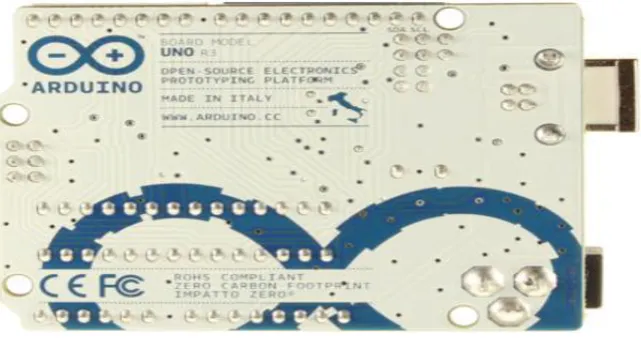
For this project, the Arduino Uno microcontroller board based on the ATmega328 will be used. It has 14 digital input/output pins (of which 6 can be used as PWM outputs), 6 analog inputs, a 16 MHz ceramic resonator, a USB connection, a power jack, an ICSP header, and a reset button. It contains everything needed to support the microcontroller; simply connect it to a computer with a USB cable or power it with a AC-to-DC adapter or battery to get started. The physical hardware of Arduino Microcontroller is shown in the Figure 2.9 for front view and Figure 2.10 for.rear view.
The advantages of the Arduino are as follows
Inexpensive - Arduino embedded devices are inexpensive compared to other
microcontroller embedded devices.
Cross-platform - Most microcontroller systems are limited to Windows. Different with
Arduino, it can runs on Windows, Macintosh OSX, and Linux operating systems.
Simple, clear programming environment - The Arduino programming environment is
easy to use for beginners.
Open source - The Arduino software is published as open source tools, so the user could
Figure 2.9: Arduino Uno (Front)
(Source http://Arduino.cc/en/Main/ArduinoBoardUno)
Figure 2.10: Arduino Uno (Rear)
(Source : http://Arduino.cc/en/Main/ArduinoBoardUno)
2.7 Matlab Simulink Software
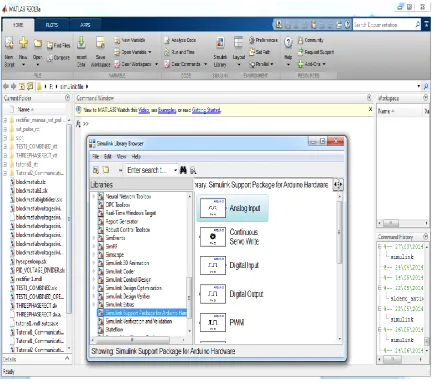
[image:31.595.162.483.328.497.2]
i. High-level language for numerical computation, visualization, and application development.
ii. Interactive environment for iterative exploration, design, and problem solving.
iii. Mathematical functions for linear algebra, statistics, Fourier analysis, filtering, optimization, numerical integration, and solving ordinary differential equations. iv. Built-in graphics for visualizing data and tools for creating custom plots.
v. Development tools for improving code quality and maintainability and maximizing performance.
vi. Tools for building applications with custom graphical interfaces.
vii. Functions for integrating MATLAB based algorithms with external applications and languages such as C, Java, .NET, and Microsoft Excel.
(Source : www.mathworks.com)
23
CHAPTER 3
METHODOLOGY
Methodology can be defined as a method used to develop the project as a whole. The first process of the project is to identify the problem. It consists of the concepts such as paradigm, theoretical model, phases and quantitative or qualitative techniques. A methodology does not set out to provide solutions but offers the theoretical for understanding which method, set of methods or best practices can be applied to a specific case.
This project is to develop PID voltage control for the purpose to control the speed of a DC motor. The main contribution is the algorithm of PID controller. PID controller will be developed in Matlab Simulink. An Arduino board is as an interfacing between Matlab Simulink and outside world (rectifier, gate driver and motor). This project is divided into two parts that consists of controller development in Matlab Simulink and hardware development for verification. The works include designing, modelling, simulation and verification. Three phase rectifier and gate driver are designed using Proteus Software. Modelling and simulation were conducted sing Matlab Simulink.
3.1 Block Diagram of the Project
software development and hardware development. Voltage sensor can detect the input voltage to the DC motor. Arduino can sense the environment by receiving input from sensor and can affect its surrounding by controlling motor. The chip on Arduino board is programmed using Matlab. For software development, PID controller algorithm is developed using Matlab Simulink. The effectiveness of controlling the speed is by changing the value of proportional gain, integral gain and derivative gain (KP, KI and KD). The output voltage of the rectifier will be compared with reference value and PID will process until minimum error obtained.
REFERENCES
[1] A. P. Singh, ―Speed Control of DC Motor using Pid Controller Based on Matlab,‖ vol. 4, no. 6, pp. 22–28, 2013.
[2] V. K. Mehta, ELEMENTS OF ELECTRONIC AND INSTRUMENTATION. S. CHAND & COMPANY LIMITED, 1996, p. 536.
[3] G. R. Capolino G.A., Cirrincione G., Cirrincione M., Henao H., ―Digital Signal Processing for Electrical Machines,‖ Aegan Int. Conf. Electr. Mach. Power Electron., pp. 211–219.
[4] M. George, ―SCI-PUBLICATIONS Author Manuscript Faculty of Engineering and Technology , Multimedia University Speed Control of Separately Excited DC Motor SCI-PUBLICATION Author Manuscript,‖ vol. 5, no. 3, pp. 227–233, 2008. [5] M. S. M. Aras, S. N. B. S. Salim, E. C. S. Hoo, I. A. B. W. A. Razak, and M. H. Bin
Hairi, ―Comparison of Fuzzy Control Rules Using MATLAB Toolbox and Simulink for DC Induction Motor-Speed Control,‖ 2009 Int. Conf. Soft Comput. Pattern Recognit., pp. 711–715, 2009.
[6] Juan W. Dixon, ―Three-Phase Controlled Rectifier,‖ in Power Electronics Handbook, Muhammad H. Rashid, Ed. Academic Press, 2001, p. 183.
[7] M. Rashid, Power Electronics Handbook. Butterworth-Heinemann, 2010, p. 1362. [8] B. L. Balogh, ―Design And Application Guide For High Speed MOSFET Gate
Drive Circuits.‖
[9] E. R. De Azevedo, S. Fernanda, M. Brandiio, J. Bosco, and D. Mota, ―A Fuzzy Logic Controller for dc Motor Position Control,‖ vol. 00, 1993.
[10] P. A. and A. Sala, ―C24ALCA98.pdf,‖ ANALES Vol 3, 1998.
[11] V. I. Utkin, ―Sliding mode control design principles and applications to electric drives,‖ IEEE Trans. Ind. Electron., vol. 40, no. 1, pp. 23–36, 1993.
[12] N. Rumzi, N. Idris, S. Member, and N. D. Muhamad, ―Principles and Application to DC Drives,‖ pp. 78–82, 2004.
[14] M. S. Microcontroller, ―Low-cost embedded solution for PID controllers of DC motors,‖ no. 15, pp. 1178–1183, 2009.
[15] R. G. Kanojiya and P. M. Meshram, ―Optimal tuning of PI controller for speed control of DC motor drive using particle swarm optimization,‖ 2012 Int. Conf. Adv. Power Convers. Energy Technol., no. Dc, pp. 1–6, Aug. 2012.
[16] K. H. Ang, G. Chong, S. Member, and Y. Li, ―PID Control System Analysis , Design , and Technology,‖ vol. 13, no. 4, pp. 559–576, 2005.
[17] T. Pana and M. Imecs, ―Matlab Toolbox For Speed Sensorless Vector-ControlledSynchronous And Induction Motor Drive System,‖ pp. 1–6.
[18] G. Huang and S. Lee, ―PC-based PID speed control in DC motor,‖ 2008 Int. Conf. Audio, Lang. Image Process., pp. 400–407, Jul. 2008.
[19] S. Fan and H. Zhu, ―Simulation of the fuzzy PID control system for brushless DC motors based on MATLAB,‖ Int. Conf. Autom. Control Artif. Intell. (ACAI 2012), no. V, pp. 1854–1857, 2012.
[20] F. Directions, ―PID Control Control System System Analysis and Design,‖ no. February 2006.
[21] H. Faugel and V. Bobkov, ―Open source hard- and software: Using Arduino boards to keep old hardware running,‖ Fusion Eng. Des., vol. 88, no. 6–8, pp. 1276–1279, Oct. 2013.
[22] ―Arduino Website.‖[Online]. http://arduino.cc/en/Main/ArduinoBoardDue. [23] ―Mathworks Webpage.‖ [Online]. http://www.mathworks.com.


![Figure 2.7: Boundary Layer Regulation[11]](https://thumb-us.123doks.com/thumbv2/123dok_us/8767257.897091/24.595.163.490.75.244/figure-boundary-layer-regulation.webp)