Fabrication of AA6061-0/RHA surface composite via friction stir
processing
S.S. Abdulmalik
1, a, R. Ahmad
1, b1Department of Manufacturing and Industrial Engineering,
Faculty of Mechanical and Manufacturing Engineering, Universiti Tun Hussein Onn Malaysia, 86400 Parit Raja, Batu Pahat, Johor, Malaysia
a[email protected], b[email protected]
Keywords: Friction stir processing, metal matrix composite, AA6061-0 alloy, Rice husk ash (RHA), microstructure, microhardness, annealing effect.
Abstract. Friction stir processing is a novel process evolved to fabricate surface metal matrix composites. Rice husk ash (RHA) is an agro-industrial waste and by product of rice husk. The feasibility of incorporating RHA powder into aluminium alloy AA6061-0 as reinforcement particles to make surface matrix composite via FSP is reported in this paper. The optical micrographs revealed a homogeneous distribution of RHA particles which were well bonded with the matrix in both first and fourth-passes of the FSP due to mechanical stirring. Microhardness of the stir zone SZ with the RHA particles of I-pass increased to about 106 HV, 40% higher than that of the base material 66 HV by dispersed RHA particles.
Introduction
Aluminium and its alloys continue to attract wide application in the industry due to their high strength to weight ratio. Especially aluminium based Metal Matrix Composites (MMC) [1]. The ceramic particles incorporated into aluminium metal to form the aluminum matrix composites (AMCs) contribute to high strength, improved resistance to wear, creep and fatigue compared to unreinforced metals which make AMCs promising structural materials for aerospace and automobile industries. However, non-deformable nature of the ceramic reinforcement particles in AMCs causes a great loss in ductility and toughness of the composite which limits their wide applications to some extent. The life of components in many applications depends on surface properties. Therefore, it is advantageous to reinforce the surface layer of components while the bulk material retains its ductility and toughness. Such modified surface layer is known as surface metal matrix composites (SMMCs) [2]. Production methods such as stir casting, squeeze casting, and powder metallurgy etc. are used to produce MMCs. But these techniques are associated with some drawbacks such as; difficulty to achieve uniform dispersion of reinforcement, and issue of interfacial reaction between reinforcement and metal matrix. Furthermore obtaining solidified microstructure in surface layer requires critical control of process parameters [3]. Friction stir processing (FSP) is a novel technique developed by Mishra et al. for modification of microstructures in materials based on the principle of Friction stir welding (FSW) invented at the Welding Institute (TWI) in the UK in 1991 as a solid state joining technique. In the process a non-consumable rotating tool consisting of pin and shoulder is inserted into a substrate and the interfacial friction between the rotating tool shoulder and the substrate generate a local and sufficient heat to produces a highly plastically deformed zone (stir zone) [3].
grains and higher level of hardness. R. Sathiskumar et al. [7] reinforced copper surface with B4C via FSP and they reported homogeneous distribution of B4C particles and well bonded with the
matrix and hardness of the processed zone was increased by 26%.
Nowadays the use of agro based waste as sole or supporting reinforcement to the conventional reinforcing material such as silicon carbide for the development of aluminum based composite is attracting many researchers attention [8]. Saravanana and Senthil [9] study the possibilities of reinforcing aluminium alloy (AlSi10Mg) with locally available inexpensive rice husk ash for developing a new material by stir casting process. They reveal that the percentage reinforcement of RHA will increase ultimate tensile strength, compressive strength and harness of the composite. As the processing of the surface composite during FSP is carried out at temperatures below the melting point of the substrate, problems seen in conventional techniques based on liquid phase processing at high temperatures can be avoided [4]. In the present study, for the first time FSP is used to fabricate and modified surface properties of AA6061-0 by mean of rice husk ash (RHA) particles. The experiment was design to evaluate the effect of FSP passes on the microstructures, powder distribution, and microhardness of the fabricated AA6061-0/RHA surface composite.
Research Methodology
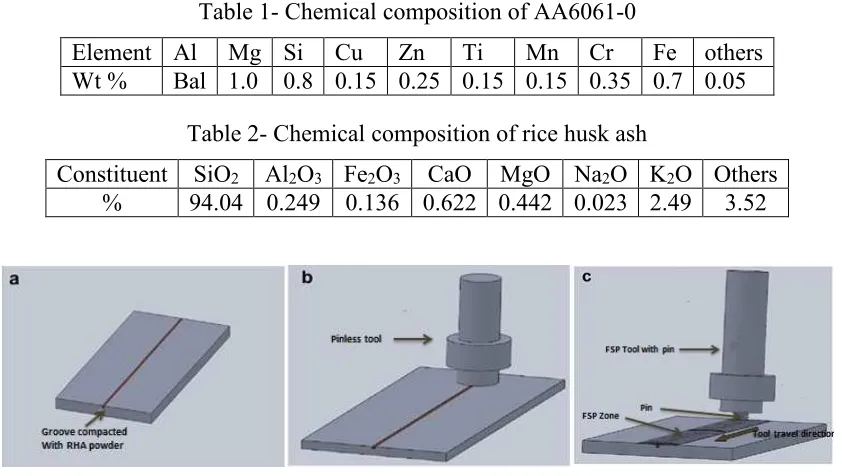
Commercial available aluminium alloy AA6061-0 rolled plate (thickness: 4mm), and rice husk ash powder (RHA: average size 50µm) were used to fabricate surface composite via FSP. The chemical composition of the plate and the powder are shown in Table 1and Table 2 respectively. For producing composite layer, groove of 2mm in width, 2mm in depth was made in the middle of the plate using a power saw then compacted with RHA as shown in (Fig 1a). A pinless tool was initially employed to cover the top of the groove after filling with the powder particles to prevent the particles from spattering during FSP (Fig. 1b). Finally, a tool with pin was plunged into the plate until the shoulder’s head face reached 0.20mm under the upper surface in order to produce the composite (Fig.1c). The tool used in this work was made from high carbon high chromium steel (HCHCr), with cylindrical shoulder diameter of 12mm, pin diameter 4mm, and pin length of 3.5mm. Friction stir processing (FSP) was carried out on a vertical milling machine at tool rotational speed of 1400rpm and traverse speed of 26mm/min. Single FSP pass was made on the specimen without RHA and up to four passes were made on the specimen with RHA powder to evaluate the effect of the FSP passes on the RHA powder homogeneity. In order to fix the workpiece they were clamped onto thick mild steel (backing plate) by using bolts. Transverse section of the processed specimens with and without RHA particles were cut, mechanically polished, and etched using Keller’s reagent (1mL hydrofluoric acid, 1.5mL hydrochloric acid, and 2.5mL nitric acid in 95mL distilled water) [4]. Microstructures changes were observed by employing optical microscope (OM) at the cross section perpendicular to the FSP direction. Vickers hardness test was carried out using 780.9mN load for 10 sec. The micro hardness was measured along the cross section of the processed samples surface.
Result and discussion
Table 1- Chemical composition of AA6061-0
Element Al Mg Si Cu Zn Ti Mn Cr Fe others
[image:3.595.89.510.72.310.2]Wt % Bal 1.0 0.8 0.15 0.25 0.15 0.15 0.35 0.7 0.05
Table 2- Chemical composition of rice husk ash
Constituent SiO2 Al2O3 Fe2O3 CaO MgO Na2O K2O Others
[image:3.595.217.379.338.463.2]% 94.04 0.249 0.136 0.622 0.442 0.023 2.49 3.52
Fig. 1: Schematic illustration of FSP process of AA6061-0 with RHA particles
Fig. 2 Cross section of the AA6061-0/RHA specimen showing bonding interface
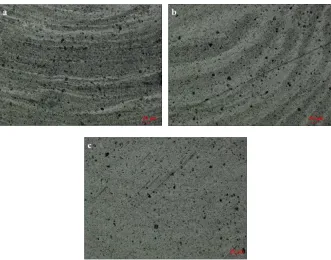
Comparing Fig 3a with b, it is noticed that single FSP pass had transformed the base metal microstructure with coarse precipitation into a structure consisting of fine equiaxed grains. This is because during FSP, fine equiaxed microstructure is formed in the stirred zone as a result of substantial increase of temperature and plastic deformation through the rotating tool pin and shoulder [10]. Optical micrographs of the stir zone (SZ) of AA6061-0/RHA composite layer are shown in Fig. 4a, b, and c. It is observed that RHA particles are distributed and bonded well with the AA6061-0 matrix. The distributions of the powder in the matrix keep improving after every FSP pass and this was due to the stirring action induced by the rotating tool in each pass. A more homogeneous powder distribution was achieved after four FSP passes.
[image:3.595.135.465.629.753.2]
Fig. 4 Optical micrographs the stir zone (SZ) of AA6061-0/RHA composite layer after; (a) 1- FSP pass (b) 2- FSP passes and (c) 4- FSP passes
Microhardness. The average hardness of the as received AA6061-0 is 66HV. Fig. 5 shows micro hardness test results of the friction stir processed (FSPed) specimens. In FSPed without powder, comparing with as received material, average hardness value decreased to 46.6HV in stirred zone. According to Mc Nelly et al. [11] during FSP, rise of temperature anneals material in the stir zone. Hence annealing can cause decrease in dislocation density and residual compressive stresses of initially rolled AA6061-0 sheet and as a result, hardness value decreases. In specimens FSPed with powder average hardness of the base metal was significantly improved to 106.5HV by 1- FSP pass. Two factors are involved in the hardness enhancement: presence of reinforcing RHA particles in aluminium matrix and quench hardening effect due to difference in thermal contraction coefficient of aluminium matrix and RHA particles. For the 2- FSP passes specimen hardness increased to 99HV, slightly less than that of 1- pass specimen. But in the 4- FSP passes specimen the hardness drop to 86HV, lower than in 1 & 2- FSP passes. The annealing effect may be attributed to the slight drop in hardness observed in the 4-passes specimen. Increased in hardness due to the presence of reinforcement particle in surface metal composites via FSP have been reported by many researchers [4-9].
[image:4.595.171.424.591.751.2]Conclusion
Fabricated composite material with rice husk ash particles in AA6061-0 were produced successfully by FSP. The microstructure and microhardness behavior was evaluated. The obtain results can be summarized as follows: (1) In the stir zone SZ, the original microstructure of the BM changed to a fine recrystallized grain structure. (2) The RHA particles were distributed uniformly in the stir zone in both first, second, and fourth- FSP passes with defect free. (3) The microhardness of the stir zone with RHA particles of 1-pass was increased by about 40% with respect to the original material 66 HV.
Reference
[1] A. Kurt, I. Uygur, E. Cete, “SurFace Modification Of Aluminium by Friction Stir Processing”, Journal of Materials Processing technology 211 (2011) 313-317
[2] Miracle D B, ‘Metal matrix composites – From science to technological significance’. Compos. Sci. Technol. 65 (2005) 2526-2540
[3] Rajiv S Mishra, ZY Ma, Indrajit Charit. ‘Friction stir processing: a novel technique for fabrication of surface Composite’, Materials Science and Engineering: A 341(2003) 307-310
[4] Don-Hyun CHOI1, Yong-II KIM2, DAE-Up KIM3, Seung-Boo JUNG1,2, ‘Effect of SiC
particles on microstructure and mechanical property of friction stir processed AA6061-T4’, Trans. Nonferrous Met. Soc. China 22(2012) s614−s618
[5] A. Dolatkhah, P. Golbabaei, M.K. Besharati Givi, F. Molaiekiya, ‘Investigating effects of process parameters on microstructural and mechanical properties of Al5052/SiC metal matrix composite fabricated via friction stir processing’ Materials and Design 37 (2012) 458–464
[6] Mehdi Zohoora, M.K. Besharati Givib, P. Salamia, ‘Effect of processing parameters on fabrication of Al–Mg/Cu composites via friction stir processing’, Materials and Design 39 (2012) 358–36
[7] R. Sathiskumar, N.Murugan, I.Dinaharan, S.J. Vijay, ‘Fabrication and characterization of Cu/B4C surface dispersion strengthened composite using friction stir processing,’ Archives of
metallurgy and materials, 10.2478/amm-(2014)-0014
[8] Alaneme KK, Akintunde IB, Olubambi PA, Adewale TM. ‘Fabrication characteristics and mechanical behaviour of rice husk ash–alumina reinforced Al–Mg–Si alloy matrix hybrid composites.’ J Mater Res Technol 2 (2013) 60–7
[9] S.D.Saravanana*, M.Senthil Kumarb, ‘Effect of Mechanical Properties on Rice Husk Ash Reinforced Aluminum alloy (AlSi10Mg) Matrix Composites’, Procedia Engineering 64 ( 2013 ) 1505 – 1513
[10] Ma ZY, Mishra RS, Mahoney MW, ‘Superplastic deformation behaviour of friction stir processed 7075Al alloy’, Acta Mater 50 (2002) 4419–30