Development and Characterization of SS316L Foam Prepared by
Powder Metallurgy Route
F. Mat Noor
1, a, K. R. Jamaludin
1, b, S. Ahmad
2, c, R. Ibrahim
3, d,
N. I. Mat Rosip
2, e 1UTM Razak School of Engineering & Advanced Technology, Universiti Teknologi Malaysia Kuala Lumpur, 54100 Jalan Semarak, Kuala Lumpur, Malaysia
2
Faculty of Mechanical & Manufacturing Engineering, Universiti Tun Hussein Onn Malaysia (UTHM) 86400 Parit Raja, Batu Pahat, Johor, Malaysia
3
Structural Materials Programme, Advanced Materials Centre (AMREC), SIRIMBerhad, Lot 34,
Jalan Hi-Tech 2/3, Kulim Hi-Tech Park, 09000, Kulim, Kedah, Malaysia
a
[email protected], [email protected], [email protected], [email protected],
e
Keywords: metal foam, foam replication method, SS316L
Abstract: Open cell foams, made on the basis of polyurethane foams replication method are well known and had been widely used since decades. The advantage of the network-like metal foams is it exhibits a natural bone-like structure which enables ingrowth of bone cells and blood vessels. The aim of the present study is to develop SS316L foam with an open cell structure by using powder metallurgy routes via foam replication method. The SS316L slurry was produced by mixing SS316L powder with Polyethylene Glycol (PEG), Methylcellulose (CMC) and distilled water. The composition of the SS316L powder in the slurry was varied from 40 to 60 wt. %. Then, polymeric foam template was impregnated in SS316L slurry and dried at room temperature. Sintering was carried out in a high temperature vacuum furnace at 1300°C. The microstructure of the SS316L foam produced was observed by Scanning Electron Microscope (SEM) and the elemental analysis was carried by Energy Dispersive X-ray (EDX). It was found that pore size are within 200-400µm and the average pore size is 293µ. The detected elements in the SS316L foam were C, Al, Ca, O, Cr, Fe, Mo, Ni and Si.
Introduction
Metal foams with open, connected cells are mainly used in applications where the continuous nature of the porosity is exploited, for example, vibration and sound absorption, filtration and catalysis, for heat exchange and in medical devices [1]. Metal foam has a unique combination of properties such as air and water permeability, impact energy absorption capacity, unusual acoustic properties, low thermal conductivity, good electrical insulating properties and high stiffness with very low specific weight [2].
Fabrication techniques for open-cell metal foam are including space holder method, replication method, combustion synthesis method, vapour deposition method and rapid prototyping [3]. The foam replication method has a number of advantages over other fabrication methods, such as the ability to produce foams with a highly porous structure with adjustable pore dimensions. Moreover the foam replication method does not involve the use of toxic chemicals and is more rapid and cost effective compared to other standard processing methods [4].
Foam replication method consists in the impregnation of a flexible polymeric sponge with a metal slurry, the removal of excess slip by squeezing, followed by drying, a burn-out step to eliminate the polymer template and high-temperature sintering [5]. The polymeric foam is usually made of polyurethane. The organic foam must possess reproducible and suitable properties, such as the ability to regain its shape after squeezing, limited tolerances for the cell size and size distribution and complete and clean burn-out during sintering.
In this work, SS316L was used to produce metal foam with an interconnected and open porosity with pore size in the range of 100-600µm which is suitable for biomedical applications. The suitable percentage of SS316L in the preparation of SS316L slurry for the foam replication method could be determined. Stainless steel 316L has been widely used due to its excellent fabrication properties, biocompatibility, lower cost, good corrosion resistance, and easy availability [6].
Materials and Methods
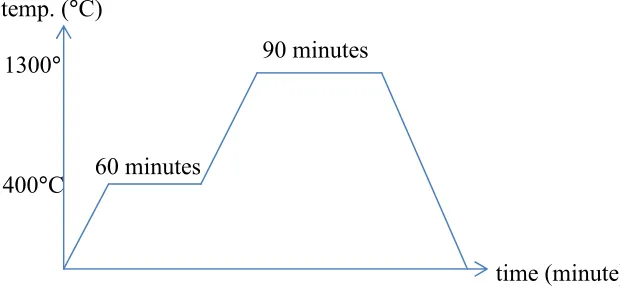
[image:2.595.137.447.409.555.2]In this study, the SS316L slurry was prepared by using three different composition of SS316L powder which was 40 wt%, 50 wt% and 60 wt%. The percentage of PEG and CMC were fixed to 2.5 wt% each while the balance of the composition was distilled water. The mixing process was carried out in a high energy ball milling for 2 hours. Polyurethane (PU) foam was obtained from Pexa Foam Sdn. Bhd. and cut into 15mm×15mm×15mm dimensions. The PU foam was immersed in the prepared slurry for 10 minutes. The foam pieces were manually retrieved from the suspension, and the excess slurry was completely squeezed out. The samples (green bodies) were then placed on a smooth surface and dried at ambient temperature for 24 hours. The green bodies were heated at 400°C for 1 hour before entry into the high temperature of sintering at 1300°C for 1 ½ hours as shown in the sintering profile in Figure 1 . The burning condition of the polyurethane foam was set at 400°C for 1 hour. The heating and cooling rates were set at 1°C/min. This sintering profile was set up based on the results of thermogravimetric analysis carried out on the PU foam templates. The microstructure of the sintered foams was characterized using scanning electron microscope (SEM) and Energy Dispersive X-ray (EDX).
Figure 1. Sintering profile for the fabrication of SS316L foams
Results and Discussions
TGA was used to determine at which temperature the PU foam evaporates. Figure 2 shows the weight change of the polyurethane foam versus temperature. It was observed that by 323.5°C, the PU foam becomes unstable and evaporates. Therefore, the SS316L samples were kept at 400° for 1 hour for the pyrolysis of the PU foam to occur. A. Muthutantri [7] and Q. Chen [4] used the same temperature of 400°C for the pyrolysis of the PU template before sintered to a maximum temperature in their work. Slow heating rate of 1°C/min was used during periods of rapid evaporation to avoid damage to the SS316L foam [8].
400°C 1300°
60 minutes
90 minutes temp. (°C)
Figure 2. TGA analysis of the polyurethane foam
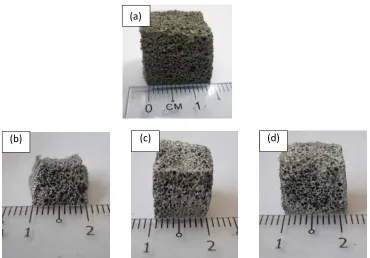
Figure 3 shows digital camera image of the samples with a particular focus on their surface before and after sintering for various composition. It can be seen clearly from the images that the SS316L foam with 40 wt% of SS316L experienced the most significant shrinkage after sintering. However, as the SS316L content was increased, the shrinkage was decreased. All the samples after sintering are shiny which shows that the samples had been succesfully sintered in a vacuum furnace. The large shrinkage occurred may be due to the high temperature sintering. According to German, higher temperatures induce sintering shrinkage, leading to less dimensional precision, but higher properties [8].
[image:3.595.122.492.402.660.2]
Figure 3. Digital camera images of (a) SS316L coated PU foam before sintering, (b) sintered 40 wt% SS316L foam, (c) sintered 50 wt. % SS316L foam, and (d) sintered 60 wt. % SS316L foam
Figure 4 shows the microstructure of the natural bone and metal foam with 60 wt% SS316L. The metal foam were fractured using diamond cutting wheel to observe its internal cross-section structure. Generally, the pore structure of the metal foam produced consists of open pore and closed pore. It is also possible to observe the open and interconnected macroposity in the structure. The measured pore size was found in the range of 200µm-400µm and the average pore size is 293µm.
(a)
The number of closed pore in the metal foam produced were increased with the increasing of SS316L composition. However, in order to have similar microstructure as natural bone, the number of closed pore should be minimized. From the observation, the closed pore was due to the formation of liquid films bridging the pore or cell struts. This is because, the slurry becomes thicker as the SS316L content increased to 60 wt%. This will result in unhomogeneous coating especially inside the PU foam structure.
[image:4.595.107.488.178.470.2]
Figure 4. Microstructure of (a) natural bone [8] (b) 60 wt% SS316L foam and (c) open and closed pores of 60 wt% SS316L foam at higher magnification
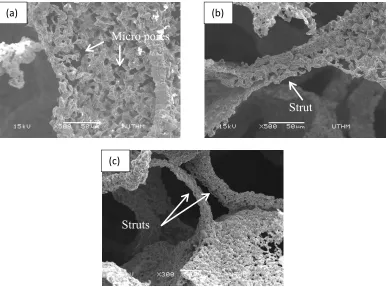
Figure 5 shows the microstructure of the struts for all composition of SS316L foam. More micropores were observed in the sample with 40 wt% SS316L. Typical strut defect is originated from incomplete covering of the PU foam. This could be due to the slurry with 40 wt% SS316L was too thin and unable to coat the polymeric foam effectively. In addition, the burning off of the interconnected PU foam networks also resulted in defects within the struts. These defects would affect the mechanical strength of the strut. For that reason, the viscosity of the slurry should be sufficient for slurry to enter, fill and uniformly coat the foam structure and retain in the foam under static condition [10].
Closed pore Open/ Macro pore
(a)
Figure 5. Microstructure of the struts for (a) 40 wt% SS316L foam, (b) 50 wt% SS316L foam, and (c) 60 wt% SS316L foam
[image:5.595.206.389.602.736.2]Figure 6 shows the microstructures of SS316L foam at higher magnification. The SS316L was sintered to liquid phase sintering stage. The original SS316L powder particles were melted after sintering at 1300°C. The transition from SS316L particle to grain occurs when the particles sinter-bond, forming a structure consisting of many grains. The powder particles fused together and forming metallurgical bonds. Almost all of the micropores were found at the grain boundaries. The advantage of this liquid formation during sintering is it gives improved sinter bonding. The growth of the interparticle bond will provide strength to the SS316L foam. The high rate of atomic motion during the high temperature sintering will progressively leads to growth of bonds between the particles termed interparticle necks. This atomic motion increase when the sintering temperature is increased. Because of the faster atomic motion, there is more dimensional change in liquid phase sintering than with solid state sintering. Thus, the amount of liquid phase, heating rate, and hold times at the peak temperature should be controlled to ensure proper sintering dimension [11].
Figure 6. Microstructure of the sintered 60 wt% SS316L foam
(a) (b)
(c)
Struts
Strut Micro pores
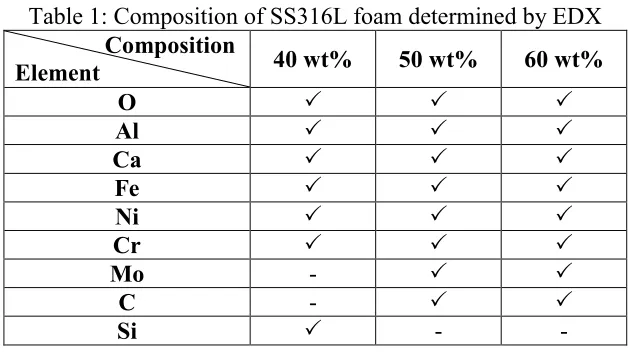
Table 1 shows the elemental analysis of the sintered 60 wt% SS316L foam using EDX technique. Generally, SS316L should consist of Fe, C, Cr, Ni, Mo, Mn, Si, P, and S. However, the EDX analysis performed in all samples with composition of 40 wt%, 50 wt% and 60 wt% SS316L show the presence of O, Al, Ca, Fe, Ni, Cr, Mo, C and Si. Al and O are the contaminate elements which came from alumina powder that was used as sample bed in the crucible during sintering in order to minimize contamination. On the other hand, the Ca element came from the ash of polyurethane foam [12]. The standard composition of the Mo, C, and Si in the SS316L are less than 3%, 0.03% and 1% respectively. Therefore, in certain composition of SS316L metal foam produced, the elements were not detected.
Table 1: Composition of SS316L foam determined by EDX
Composition
Element 40 wt% 50 wt% 60 wt%
O
Al
Ca
Fe
Ni
Cr
Mo -
C -
Si - -
Conclusions
Metal foam with 60 wt% of SS316L had been successfully produced without a significant shrinkage. The pore size of the metal foam is in the range of 200-400µn which is suitable for biomedical applications. However, the number of closed pore in the microstructure should be minimized. It is still a big challenge to produce stable i.e. non-agglomerated SS316L slurry especially with the increasing of SS316L content in the slurry. The rheological properties of the slurry play an important role in the impregnation process. The particle size and shape of the raw powder, the type and content of the binder, the ratio of solid and liquid content are among of the factors that affect the rheological properties of the slurry [3].
Acknowledgement
The authors would like to thank University Tun Hussein Onn Malaysia (UTHM) and University Teknologi Malaysia (UTM) for their experimental assistance and financial support.
References
[1] P. Quadbeck, K. Kummel, R. Hauser, G. Standke, J. Adler, G. Stephani and B. Kieback, Structural and material design of open-cell powder metallurgical foams, Advanced Engineering Materials, Vol.13. No.11 (2011) 1024-1030.
[2] S. Ahmad, N. Muhamad, A. Muchtar, J. Sahari, K. R. Jamaludin, M. H. I. Ibrahim, and N. H. Mohamad Nor, Taguchi method for determination of optimized sintering parameters of titanium alloy foams, The international Conference on Advances in Materials and processing Technologies, 26-28 October 2009. Kuala Lumpur, Malaysia
[4] Q. Chen, J. A. Roether and A. R. Boccaccini, Tissue engineering scaffolds from bioactive glass and composite materials, in: N. Ashammakhi, R Reis, and F Chiellini (Eds), Tissue Engineering, Vol. 4. 2008.
[5] Paolo Colombo, Conventional and novel processing methods for cellular ceramics, Philosophical Transactions of the Royal Society A. 364 (2006) 109–124
[6] R. Singh, and N. B. Dahotre, Corrosion degradation and prevention by surface modification of biometallic materials, J. Mater Sci: Mater Med 18. (2007) 725-751.
[7] Anushini Muthutantri, Jie Huang and Mohan Edirisinghe, Novel preparation of graded porous structures for medical engineering, Journal of the royal society interface 5, (2008)1459-1467.
[8] R. M. German, Powder Metallurgy of Iron and Steel, John Wiley & Sons, Inc.Canada, 1998.
[9] G. Stephani, T. Hipke, M. Scheffler and J. Adler (Eds.), Open Cell Titanium Foams for Bone Replacement, Proceedings CELLMAT 2010, (2010) 279-288.
[10] M. A. A. M. Nor, H. M. Akil, Z. A. Ahmad, The Effect of Polymeric Template Density and Solid Loading on the Properties of Ceramic Foam, Science of Sintering, 41 (2009) 319-327
[11] Andrew Kennedy, Porous Metals and Metal Foams Made from Powders, Powder Metallurgy, Dr. Katsuyoshi Kondoh (Ed.), ISBN: 978-953-51-0071-3, InTech, Available from: http://www.intechopen.com/books/powder-metallurgy/ the- manufacture- of- porous-and-cellular-metals-bypowder-metallurgy-processes, (2012).
![Figure 4. Microstructure of (a) natural bone [8] (b) 60 wt% SS316L foam and (c) open and closed pores of 60 wt% SS316L foam at higher magnification](https://thumb-us.123doks.com/thumbv2/123dok_us/8768751.897845/4.595.107.488.178.470/figure-microstructure-natural-closed-pores-foam-higher-magnification.webp)