Quantifying quality: a report on PFI and
the delivery of public services
Eaton, D and Akbiyikli, R
Title
Quantifying quality: a report on PFI and the delivery of public services
Authors
Eaton, D and Akbiyikli, R
Type
Monograph
URL
This version is available at: http://usir.salford.ac.uk/433/
Published Date
2005
USIR is a digital collection of the research output of the University of Salford. Where copyright
permits, full text material held in the repository is made freely available online and can be read,
downloaded and copied for noncommercial private study or research purposes. Please check the
manuscript for any further copyright restrictions.
A
report
on PFI and the delivery of public services
Acknowledgements
I would like to acknowledge the assistance of Rifat Akbiyikli in the preparation of this report. The project could not have been completed within the timescale without his support.
I would also like to acknowledge the assistance of Dr Teresa de Lemos of IST in Lisbon, Portugal,
Charmaine O’Connor of the Centre for Risk Management Research (CRMR), Anthony Jones, formerly of the School of Construction and Property Management, and Rifat Akbiyikli of BuHu (Built and Human Environment) Research Institute, all at the University of Salford, in preparing data for the case studies.
I also thank the un-named collaborators from industry who were interviewed during the preparation of the case studies.
I also acknowledge the assistance of Oliver Foster and Brian Berry of RICS in editing and formatting the content of this report. Their help has made the task of synthesising ‘academic knowledge’ and translating it into ‘practitioner-friendly’ language a relatively painless task for which I am grateful.
David Eaton University of Salford
Authors
Dr David Eaton PhD, MSc, BSc. MRICS. ILTM
David Eaton is currently senior lecturer in the School of Construction and Property Management at the University of Salford. He is a chartered quantity surveyor by
professional discipline and has degrees in quantity surveying and construction economics, construction project management with corporate strategy, and competitive advantage for the UK construction industry.
David is also the programme director for the EPSRC Master in Research Programme (MRes) for Innovation and Improvement in Construction and Property and was formerly programme director for the MERIT PhD distance learning programme and quantity surveying and building surveying undergraduate programmes. He is also the director of the Centre for Risk Management Research within SCPM.
David has been an adviser to national and regional governments in Turkey, the Czech Republic and Portugal on the introduction of PFI. He recently presented a proposal for the construction of a £3.5 billion ship-canal in Turkey. He is soon due to commence a multi-national European Union project to develop PFI guidance for new accession and prospective members of the EU. He has published over one hundred papers and articles on project management and project finance.
Rifat Akbiyikli MSc
Rifat studied civil engineering at the University of Science and Technology (NTNU) in Trondheim, Norway. He spent sixteen years as a structural designer and design manager in Norway before starting his career in civil engineering construction outside Norway. He was employed in Impregilo S.p.A. (Italian international construction company) in Turkey as technical manager and assistant project manager for Izmit – Sakarya Motorway construction (70 km) on the trans-European motorway project between 1990 – 1994. From 1994 – 2002 Rifat was employed as contract manager in Astaldi S.p.A. (Italian international construction company) in the Gümüsova – Gerede motorway construction (120 km) on the trans-European motorway project in Turkey.
Contents
A report
on PFI and the delivery of public services
1.
PFI and its role in the delivery of public services
01
2.
The current state of PFI in the UK and its place in the global market
07
3. Case
studies
14
The A55 Road
14
Victoria Dock Primary School
18
Vasco de Gama Bridge
22
HMP Altcourse
26
HMP Parc
31
Joint Services Command and Staff College
34
Newport Southern Distributor Road
40
The A92 upgrading between Dundee and Arbroath
44
4.
The stimulants and obstacles to success within PFI projects
51
5.
The emergent role of the quantity surveyor in PFI
58
6. Conclusions
65
7. Recommendations
71
Glossary
74
Bibliography
75
and it is now widely expected to continue expanding as a procurement instrument in the future. In the PFI
framework, the public sector becomes the procurer and regulator of services but not the provider. In the case of private provision of infrastructure services, the public sector only pays for the service received and only if the service meets the predetermined output specification.
The background of PFI in the UK
The PFI strategy arose in the context of the economic stagnation witnessed since the 1960s and the expanding deficits that concerned the incoming Thatcher government which came to power in 1979. The Conservatives championed leaner and smaller government and Thatcher stated that a primary aim of her government was to roll back the frontiers of the state and allow more direct private sector involvement in the provision of public services.
From 1979 onwards the UK Government introduced privatisation and compulsory competitive tendering for local authorities. The administration of John Major continued the policies of downsizing the public sector through deregulating and introducing market principles into public services, reorganising government functions into agencies, introducing the Citizen’s Charter and promoting market testing in which the private sector competes with public services. The underlying objective of these policies was to shift the paradigm of government from public administration to public management. PFI is an extension of this policy and its real aim is
administrative reform and to transfer much of the public sector’s role to the private sector.
The following timeline details the development of PFI since 1977:
1977: Prior to 1977, all the capital expenditure of nationalised industries and public corporations was accounted and recorded within total public expenditure and thus contributed towards the Public Sector Borrowing Requirement (PSBR) – the amount of money the government needs to borrow to meet its spending plans, even when wholly financed from internal resources derived from user charges . The 1977 paper on the redefinition of public expenditure and the 1978 White Paper on nationalised industries switched the focus of government to the External Financing Limit (EFL) – the cash limit of external financing.
Introduction
The private sector has always provided goods and services to the public sector. Private infrastructure provision is not a new idea. For instance, bridges have been privately owned for centuries.
However, a widespread feature of the last two decades has been the shift away from the in-house provision of services by the public sector towards the contracting out of services to be provided by the private sector. These services are both a contribution and an addition to the provision of services by the government to the public, but the services are supplied by the private sector. Toll collectors, prison officers, teachers, hospital administrators and cleaning staff are all examples of private employees providing virtually identical provisions to those provided traditionally via the public sector.
Growing anxiety over state budgetary deficits and concerns over the inability of the public sector to manage complex infrastructure efficiently in an increasingly competitive environment, has led to the reversal of state ownership as the norm for providing infrastructure to the public at large.
In the UK this process started in the 1980s. Between 1970-1996 large reductions in government investments were observed in OECD countries. Privatisation and public-sector expenditure constraints had given rise to a substantial reduction in private and public sector investment. So, in order to achieve infrastructure development and to reduce the associated burden of government debt the public authorities and national governments sought to involve private capital to implement design and build infrastructure projects and to provide infrastructure services previously in the domain of the public sector.
As part of this trend of using private capital for the provision of public services in infrastructure projects, the Private Finance Initiative (PFI) was launched in 1992, as a legal framework for concessions in the UK to encourage private capital investment in the construction industry. In the PFI framework the public sector defines the output specification for the services to be purchased from the private sector with a predefined payment mechanism. The public purchases a service not an asset.
After 1997 and the change of government from
Conservative to Labour, PFI gained momentum in the UK
PFI and its role in the delivery of public services
1989: In a speech to the Institute of Directors in May 1989, John Major, the then Chief Secretary to the Treasury, formally retired the Ryrie Rules on the grounds that they had outlived their usefulness, were seen as incomprehensible, and set impossible hurdles . This move was intended to further encourage ‘the private sector to bring forward schemes for privately financed projects, which offer value for money for the user and the taxpayer’. The Ryrie Rules were abolished in 1989 and were followed in 1992 by the launch of PFI.
The launch of PFI in the UK
1992: PFI was formally launched in the UK by Norman Lamont, then Chancellor of the Exchequer, who stated in his 1992 Budget Statement that: ‘…the government has too often in the past treated proposed projects as either wholly private or wholly public. In future, the government will actively encourage joint ventures with the private sector, where these involve a sensible transfer of risk to the private sector…Thirdly, we will allow greater use of leasing where it offers good value for money. As long as it can be shown that the risk stays with the private sector, public organisations will be able to enter into operating lease
agreements, with only the lease payments counting as expenditure and without their capital budgets being cut.’
The aim of introducing PFI was to achieve closer
partnering between the public and private sectors at both central and local government levels. The intention was to increase the flow of capital to projects against a
background of restraint on public expenditure by utilising private sector money and management skills. It was also intended to offer real benefits to the private sector in the form of increased business profit.
The guiding principles of PFI are similar to those
underlying the Ryrie Rules: ventures established under PFI need to achieve a genuine transfer of risk to the private sector and value for money in use of public resources. It is intended to transform government departments from being owners and operators of assets into the purchasers of services from the private sector. In PFI procurement the public sector specifies its services by way of an output specification covering the objectives, purpose, scope and performance requirements for the contract, with emphasis being on the ‘what’ and not the ‘how’ in relation to the service provision.
1979: The Conservative Party came to power in the UK and a strict policy of reducing public expenditure was put in place.
1981: During the recession of the early 1980s there was much public debate as to whether restrictive EFLs (designed to hold down the PSBR as a means of controlling monetary supply growth) were frustrating profitable nationalised industry investment and thus needlessly exacerbating the recession. In a review of the extensive debate on EFL, The National Economic Development Council (NEDC) formulated the Ryrie Rules. Under the chairmanship of Sir William Ryrie, the then second Permanent Secretary to the Treasury, the rules sought to establish criteria under which private finance could be introduced into the nationalised industries. The Ryrie Rules stated that:
• Decisions to provide funds for investment should be taken under conditions of fair competition with private sector borrowers; any links with the rest of the public sector, government guarantees or commitments, or monopoly power should not result in the schemes offering investors a degree of security significantly greater than available on private sector projects
• Such projects should yield benefits in terms of improved efficiency and profit from the additional investment commensurate with the cost of raising risk capital from financial markets (HM Treasury, 1988).
The Ryrie Rules were revised in February to take into account the privatisation of previously nationalised industries and the introduction of, for example, contracting out, mixed funding and partnership schemes.
The two fundamental principles of the guidelines were:
• Private finance could only be introduced where it offered cost-effectiveness (projects must be tested against the equivalent competitive price market)
Construction PPP (PFI) can be categorised as follows:
• Service contracts – where the private sector alone contributes to the service, without further government capital input. The contract arrangements are:
operation and maintenance; design and build; and turnkey contracts
• Service contract based on public facilities – this group is characteristic of the private sector operating the facilities. The procurement methods could be design-build-finance-operate (DBFO); and lease-develop-operate (LDO). This group also includes build-lease-develop-operate- build-operate-transfer (BOT) and build-own-operate-build-operate-transfer (BOOT)
• Private sector permanent provision – these include build-own-operate (BOO); buy-build-operate (BBO) or privatisation
• Special vehicles/joint ventures (JV) – these are equity JV, cooperatives and consortia. The private and public sectors share the liability and return from the same JV company.
From the perspective of risk allocation, PFI projects are classified into three types:
• The financially free-standing type where risk is fully transferred to the private sector (for example, toll bridges)
• The joint venture type where risk is fully transferred from the public sector with some public sector cash contribution (for example, urban regeneration schemes)
• The type of services sold to the public sector where risk is shared rather than fully transferred (for example, DBFO road projects).
There are two fundamental characteristics of PFI projects:
• There must be a genuine risk transfer to the private sector
• The project must provide value for money to the taxpayer.
The premise is that the transfer of risk to the private sector, coupled with the efficiencies in management skills will outweigh the higher costs of private funding, resulting in greater value for money to the taxpayers.
The 1992 Budget Statement contained ‘important changes’ to the rules governing the use of private finance by public sector organisations. In short, the issues identified as fundamental to policy evaluation were: modifications to the value for money criterion; ‘additionality’; measurement of efficiency gains and additional financing costs; and determining whether risk has been transferred.
HM Treasury noted in 1993 that, ‘PFI, unlike the earlier policies of privatisation and contracting out, is based on an enterprise and discipline [that] can bring gains in efficiency and reduction in costs and is stimulated by the government keeping inflation down and getting public finances back on the right track.’ Within this statement the Treasury claimed the following main issues:
• PFI can bring gains in efficiency
• PFI can bring inflation down
• PFI can limit public sector spending
• The public sector’s need for capital expenditure (private financing of capital projects).
PFI is not about borrowing money from the private sector. It is supposed to be about creating a structure in which improved value for money is achieved through private sector innovation and management skills delivering significant performance improvements and efficiency savings.
Under PFI, governments no longer build roads but purchase miles of maintained highway; governments no longer build prisons but buy custodial services. What makes PFI different is that the public sector retains a substantial role in PFI projects and the private sector provides capital assets as well as the services. Increasing levels of partnering with the private sector have evolved and, by this partnering agenda, the public sector receives the benefit to increase its efficiency through the
introduction of managerial change and expertise drawn from the private sector.
There is always confusion between PFI and PPP. PFI is a public service delivery type of PPP where responsibility for providing public services like transportation, sanitation, etc is transferred from the public to the private sector for a considerable period of time. PFI is therefore a generic classifier for all types of ‘construction’ PPP. The whole concept of PFI is a
The Treasury Taskforce was established in September 1997 as the focal point for PFI activity across government. It concentrated on a number of significant projects, helping departments to set priorities while trying to ease negotiations and gain value for money. The Taskforce published a series of guidance documents, policy statements, technical notes and case studies.
1999: The second review of PFI by Sir Malcolm Bates was published in July. Its recommendations concentrated on institutional change and government plans for taking the recommendations forward. It also pointed to the following areas of weakness:
• Strategic planning
• Project management
• Negotiation skills
• Financial disciplines
• Management of long-term contracts.
Bates also identified three alternative institutional arrangements following the expiry of the taskforce:
• Extend the life of the taskforce
• Create a public sector, fee-earning agency; or
• Set up a new Public Private Partnership.
Bates recommended that a permanent organisation, Partnerships UK, be formed to replace the Taskforce.
Peter Gershon was invited to review ‘civil procurement in central government’ in the light of the government’s objectives on efficiency, modernisation and competitiveness in the short and medium term. Gershon examined the whole process of acquisition from third parties by government. The acquisition process spans the whole life-cycle from initial inception through to the end of the useful life of the asset or the completion of the contract. In his July review, Gershon identified a number of weaknesses in government procurement which cover:
• Organisation
• Process
• People and skills
• Measurement
• Contribution of the centre of government.
The evolution of PFI in the UK
Changes introduced 1992-97
1993: The private sector showed little interest in the 1992 Budget Statement. The subsequent
Chancellor of the Exchequer, Kenneth Clarke, in his 1993 Budget Statement gave PFI a greater impetus by announcing that a new Private Finance Panel would be created and its role would be:
• To encourage greater participation in the initiative by both the public and private sectors
• To stimulate new ideas
• To identify new areas of public sector activity where the private sector could become involved
• To seek solutions to any problems that might impede progress.
1994: Kenneth Clarke ensured engagement with the private sector by making plain that the Treasury would not approve any capital project unless options to secure private finance had been explored. It became mandatory that all capital projects in the public sector that required Treasury approval would explore private-finance options.
1996: The 4Ps (Public Private Partnerships Programme) was established in April by the Local Authority Association of England and Wales to promote PFI in the local authority sector with the express aim of bringing about increased investment in local services through PFI and other public/private sector partnerships.
Changes introduced from 1997 onwards
1997: PFI was the Conservative Party’s approach to financing and managing an upgrade of Britain’s ‘social infrastructure’. With the election of Labour in 1997, the new government continued to back the concept under the PPP banner.
The strategic objective of Partnerships UK was to create a catalyst to achieve quicker and better value for money PFI and PPP deals which, by mobilising private sector skills in service of the public interest and easing the financial constraints on public sector procurers, would enhance the flow of investment into the nation’s infrastructure. Partnerships UK was supposed to work in close conjunction with the OGC, while the Taskforce would continue as a part of the OGC.
2001: In March, Partnerships UK became a Public Private Partnership in its own right following the sale to private investors of a 51% stake, with 49% being retained in public hands.
2002: In July, the second edition of Standardisation of PFI Contracts was produced as OGC Guidance. The revised second edition sought to clarify, enhance and re-balance the guidance in the light of the public and private sectors’ experience of the guidance over the past three years. The most critical changes were: refinancing, compensation on termination, and insurance issues.
2003: Until April 2003, the Private Finance Unit (PFU) within the OGC had responsibility for developing and promoting PFI policy for public bodies. In March 2003 Justin Slater, Head of Private Finance Policy and Practice at the OGC, announces that an ‘expanded HM Treasury PFU under the leadership of Geoffrey Spence will now carry out all those responsibilities presently carried out by the OGC PFU.’ The responsibilities transferred included:
• Ministerial and parliamentary business on generic PFI policy matters
• Ownership of standardisation of PFI contracts-written guidance for authorities on how to agree PFI contacts
• PFI statistics disclosed to Parliament
• Ownership of the Project Review Group Secretariat – the process by which projects are reviewed when there is a full business case to consider
• Single point responsibility for managing the government’s framework agreement with Partnerships UK.
In line with policy changes, Gus O’Donnell replaced Peter Gershon as the officer in charge of PFI policy.
Gershon’s proposals for dealing with these weaknesses led to the creation of a central organisation called Office of Government Commerce (OGC). The first edition of Standardisation of PFI Contracts was produced in July 1999 (SoPC, 1999). Its aims were to:
• Provide guidance on the key issues that arise in PFI projects in order to promote the achievement of commercially balanced contracts
• Enable public sector procurers to meet their requirements and deliver best value for money.
The three main objectives of the first edition were to:
• Promote a common understanding of the main risks encountered in a standard PFI project
• Allow a consistency of approach in pricing across a range of similar projects
• Reduce the time and costs of negotiation by enabling all parties concerned to agree a range of areas that can follow a standard approach without expanded negotiations.
2000: Gershon’s (and therefore the OGC’s) aim was to modernise procurement throughout
government, provide a greater sense of direction in procurement and promote best practice in the public sector. In his proposal, government departments would need to work more closely with the OGC and in some cases accept some loss of sovereignty in procurement matters, on the understanding that this would deliver better value for money for government.
2004: In April, the third edition of Standardisation of PFI Contracts was produced by HM Treasury. The following assumptions are implicit within the guidance:
• The party contracting with the public sector is a Special Purpose Vehicle (SPV) with
sub-contractors providing the actual performance on its behalf
• The project involves some development or a construction phase, followed by an operational phase during which the full service is provided
• The project is wholly or partly financed by limited recourse debt.
In July, a Local Government Supplement to Standardisation of PFI Contracts is produced by 4Ps as guidance to provide assistance to local authorities.
The current state of PFI in the UK
PFI has been widely developed in the UK. New facilities in schools, prisons and roads have delivered substantial benefits, but UK policy makers are continuing to learn lessons on how PFI can be delivered more effectively.
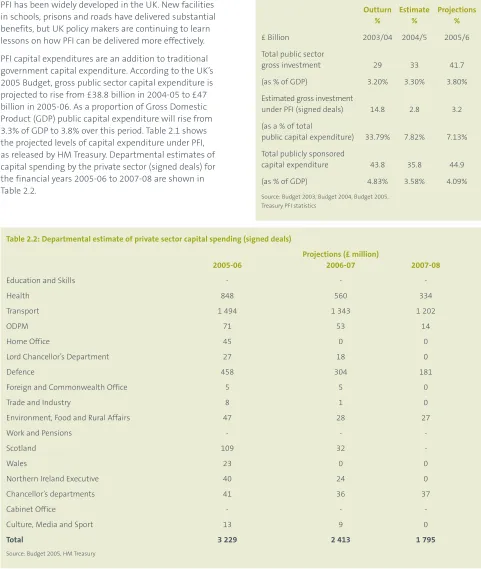
[image:12.595.56.537.217.786.2]PFI capital expenditures are an addition to traditional government capital expenditure. According to the UK’s 2005 Budget, gross public sector capital expenditure is projected to rise from £38.8 billion in 2004-05 to £47 billion in 2005-06. As a proportion of Gross Domestic Product (GDP) public capital expenditure will rise from 3.3% of GDP to 3.8% over this period. Table 2.1 shows the projected levels of capital expenditure under PFI, as released by HM Treasury. Departmental estimates of capital spending by the private sector (signed deals) for the financial years 2005-06 to 2007-08 are shown in Table 2.2.
The current state of PFI in the UK and its place
in the global market
chapter two
Table 2.1: Public sector gross investment
Outturn Estimate Projections
% % %
£ Billion 2003/04 2004/5 2005/6 Total public sector
gross investment 29 33 41.7 (as % of GDP) 3.20% 3.30% 3.80% Estimated gross investment
under PFI (signed deals) 14.8 2.8 3.2 (as a % of total
public capital expenditure) 33.79% 7.82% 7.13% Total publicly sponsored
capital expenditure 43.8 35.8 44.9 (as % of GDP) 4.83% 3.58% 4.09%
Source: Budget 2003, Budget 2004, Budget 2005, Treasury PFI statistics
Table 2.2: Departmental estimate of private sector capital spending (signed deals)
Projections (£ million)
2005-06 2006-07 2007-08
Education and Skills - -
-Health 848 560 334
Transport 1 494 1 343 1 202
ODPM 71 53 14
Home Office 45 0 0
Lord Chancellor’s Department 27 18 0
Defence 458 304 181
Foreign and Commonwealth Office 5 5 0
Trade and Industry 8 1 0
Environment, Food and Rural Affairs 47 28 27
Work and Pensions - -
-Scotland 109 32
-Wales 23 0 0
Northern Ireland Executive 40 24 0
Chancellor’s departments 41 36 37
Cabinet Office - -
-Culture, Media and Sport 13 9 0
Total 3 229 2 413 1 795
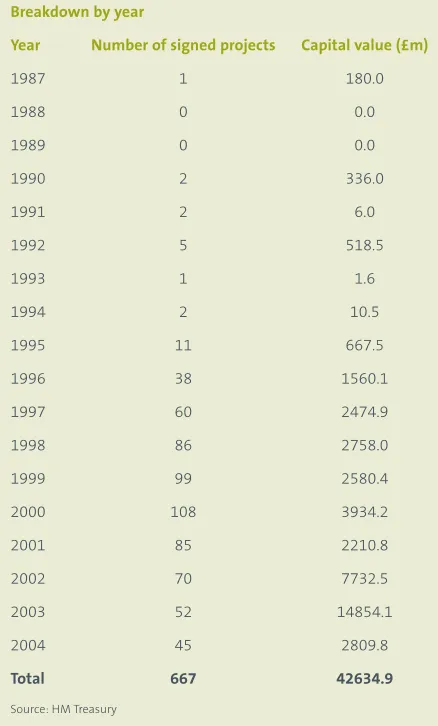
Between 1986 and 2004, 667 projects were signed under PFI with a capital value of over £42 billion. While there were a few projects in the early 1990s, including a large contract of £4 billion for the Channel Tunnel Rail Link in 1996, most have been signed since 1997 (see table 2.3).
Table 2.3: Signed PFI projects 1987-2004 Breakdown by year
Year Number of signed projects Capital value (£m)
1987 1 180.0
1988 0 0.0
1989 0 0.0
1990 2 336.0
1991 2 6.0
1992 5 518.5
1993 1 1.6
1994 2 10.5
1995 11 667.5
1996 38 1560.1
1997 60 2474.9
1998 86 2758.0
1999 99 2580.4
2000 108 3934.2
2001 85 2210.8
2002 70 7732.5
2003 52 14854.1
2004 45 2809.8
Total 667 42634.9
Source: HM Treasury
Table 2.4: PFI in government departments (cumulative total, 1990-2003)
Number £ m % share
Transport 44 37 972 66.9
Defence 59 4 011 7.1
Health 152 3 596 6.3
Scottish Executive 29 2 217 3.9 Education 102 2 028 3.6 Home Office 52 1 976 3.5 Work and Pensions 7 961 1.7 Welsh Assembly 17 508 0.9 Northern Ireland Executive 29 395 0.7 Environment 14 1 000 1.8
Others 112 2 060 3.6
Total 617 56 724 100.0
[image:13.595.57.276.150.513.2]Overall, PFI has accounted for between 12-15% of annual public sector capital investment since 1996, with the remainder being carried out through conventional forms of procurement. The annual number of contracts has fallen from a peak of 108 in 2000 to 45 in 2004 but this has been accompanied by an increase in the average size
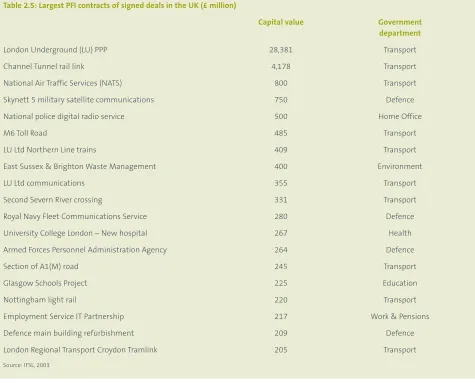
[image:14.595.59.534.216.599.2]of the contract, as procurement costs on smaller deals have come under greater scrutiny. PFI in government departments is shown in table 2.4 and the largest PFI contracts as a cumulative total between 1990-2003 are shown in table 2.5.
Table 2.5: Largest PFI contracts of signed deals in the UK (£ million)
Capital value Government department
London Underground (LU) PPP 28,381 Transport
Channel Tunnel rail link 4,178 Transport
National Air Traffic Services (NATS) 800 Transport Skynett 5 military satellite communications 750 Defence National police digital radio service 500 Home Office
M6 Toll Road 485 Transport
LU Ltd Northern Line trains 409 Transport
East Sussex & Brighton Waste Management 400 Environment
LU Ltd communications 355 Transport
Second Severn River crossing 331 Transport
Royal Navy Fleet Communications Service 280 Defence University College London – New hospital 267 Health Armed Forces Personnel Administration Agency 264 Defence
Section of A1(M) road 245 Transport
Glasgow Schools Project 225 Education
Nottingham light rail 220 Transport
Employment Service IT Partnership 217 Work & Pensions Defence main building refurbishment 209 Defence London Regional Transport Croydon Tramlink 205 Transport
PFI will no longer be used for IT projects or for projects costing less than £20 million because of the high
transaction costs. There is also to be increased investment in secondary schools through programmes such as the ‘Building Schools for the Future’ programme. New areas for the PFI will include social housing, urban regeneration, and waste recycling.
PFI construction performance in the UK
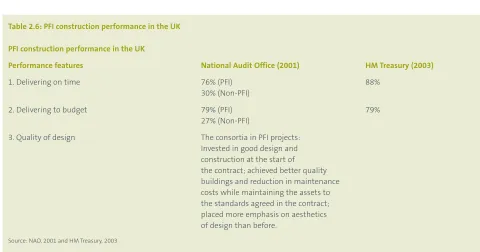
Evidence from two studies in the UK about PFI performance is shown in table 2.6.
The future prospects of PFI in the UK
[image:15.595.54.534.274.526.2]In ‘PFI: Meeting the Investment Challenge’, published by the Treasury on 15 July 2003, the progress of PFI in the UK is reviewed and concludes that the future of PFI in the UK seems certain. On a capital value basis, the UK Treasury expects the biggest increases to come in the health and defence sectors. The Department of Health projects 55 deals by the end of 2005 with an estimated capital value of £6.5 billion while the Ministry of Defence is expected to sign 14 deals with a similar capital value.
Table 2.6: PFI construction performance in the UK PFI construction performance in the UK
Performance features National Audit Office (2001) HM Treasury (2003)
1. Delivering on time 76% (PFI) 88%
30% (Non-PFI)
2. Delivering to budget 79% (PFI) 79%
27% (Non-PFI)
3. Quality of design The consortia in PFI projects: Invested in good design and construction at the start of the contract; achieved better quality buildings and reduction in maintenance costs while maintaining the assets to the standards agreed in the contract; placed more emphasis on aesthetics of design than before.
PFI operational performance in the UK
Evidence from the same studies in the UK about the PFI operational performance is shown in table 2.7. Full assessment of the operational performance of PFI will only be possible at a much later stage in the contracts. A National Audit Office study of 98 projects and HM Treasury study of 61 projects has provided initial indications of overall project performance through seeking the view of public sector PFI managers on achievement of expectations and VFM.
Table 2.7: PFI operational performance in the UK
Performance features National Audit Office (2001) HM Treasury (2003)
1. Achievement of expectations N/A 25% ‘far surpassing’ 35% ‘as expected’ 16% ‘surpassing’ 2. Value for Money 6% ‘excellent’
46% ‘good’
29% ‘satisfactory’ N/A 15% ‘marginal’
4% ‘poor’
3. Overall performance of the private sector matching N/A 25% ‘far surpassing’ up to expectation at the time of contract close ’51% ‘as expected’ or ‘better’
18% ‘less than expected’ 6% ‘much less than expected’
Source: NAO, 2001 and HM Treasury, 2003
PFI’s place in Europe and in the global market
PFI in Europe
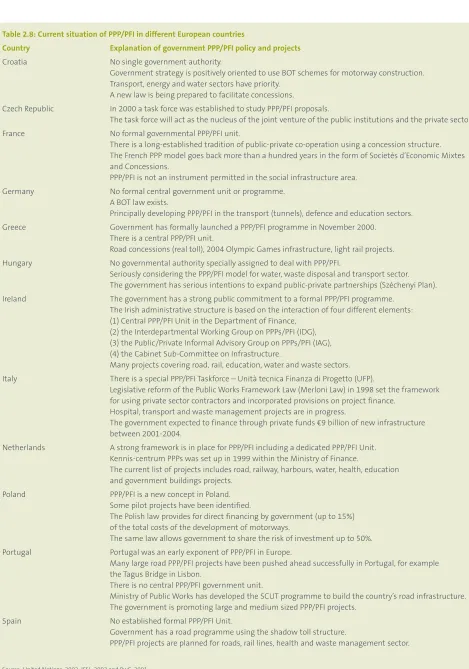
The United Nations has become an increasingly prominent advocate of PPP/PFI in Europe. The United Nations Economic Commission for Europe agreed to establish the Build, Operate, Transfer (BOT) Expert Group in January 1996, to provide information to its member states on new project finance techniques for countries in central and eastern Europe. Despite the enormous international interest at regional, national and
international levels there has been disappointment at the lack of successful PPP/PFI. One of the key barriers has been the lack of government skills in identifying and bringing forward projects into the market.
Table 2.8: Current situation of PPP/PFI in different European countries
Country Explanation of government PPP/PFI policy and projects
Croatia No single government authority.
Government strategy is positively oriented to use BOT schemes for motorway construction. Transport, energy and water sectors have priority.
A new law is being prepared to facilitate concessions.
Czech Republic In 2000 a task force was established to study PPP/PFI proposals.
The task force will act as the nucleus of the joint venture of the public institutions and the private sector. France No formal governmental PPP/PFI unit.
There is a long-established tradition of public-private co-operation using a concession structure. The French PPP model goes back more than a hundred years in the form of Societés d’Economic Mixtes and Concessions.
PPP/PFI is not an instrument permitted in the social infrastructure area. Germany No formal central government unit or programme.
A BOT law exists.
Principally developing PPP/PFI in the transport (tunnels), defence and education sectors. Greece Government has formally launched a PPP/PFI programme in November 2000.
There is a central PPP/PFI unit.
Road concessions (real toll), 2004 Olympic Games infrastructure, light rail projects. Hungary No governmental authority specially assigned to deal with PPP/PFI.
Seriously considering the PPP/PFI model for water, waste disposal and transport sector. The government has serious intentions to expand public-private partnerships (Széchenyi Plan). Ireland The government has a strong public commitment to a formal PPP/PFI programme.
The Irish administrative structure is based on the interaction of four different elements: (1) Central PPP/PFI Unit in the Department of Finance,
(2) the Interdepartmental Working Group on PPPs/PFI (IDG), (3) the Public/Private Informal Advisory Group on PPPs/PFI (IAG), (4) the Cabinet Sub-Committee on Infrastructure.
Many projects covering road, rail, education, water and waste sectors. Italy There is a special PPP/PFI Taskforce – Unità tecnica Finanza di Progetto (UFP).
Legislative reform of the Public Works Framework Law (Merloni Law) in 1998 set the framework for using private sector contractors and incorporated provisions on project finance.
Hospital, transport and waste management projects are in progress.
The government expected to finance through private funds €9 billion of new infrastructure between 2001-2004.
Netherlands A strong framework is in place for PPP/PFI including a dedicated PPP/PFI Unit. Kennis-centrum PPPs was set up in 1999 within the Ministry of Finance.
The current list of projects includes road, railway, harbours, water, health, education and government buildings projects.
Poland PPP/PFI is a new concept in Poland. Some pilot projects have been identified.
The Polish law provides for direct financing by government (up to 15%) of the total costs of the development of motorways.
The same law allows government to share the risk of investment up to 50%. Portugal Portugal was an early exponent of PPP/PFI in Europe.
Many large road PPP/PFI projects have been pushed ahead successfully in Portugal, for example the Tagus Bridge in Lisbon.
There is no central PPP/PFI government unit.
Ministry of Public Works has developed the SCUT programme to build the country’s road infrastructure. The government is promoting large and medium sized PPP/PFI projects.
Spain No established formal PPP/PFI Unit.
Government has a road programme using the shadow toll structure.
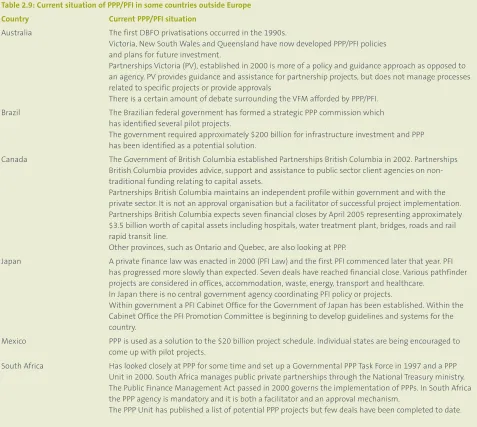
Table 2.9: Current situation of PPP/PFI in some countries outside Europe Country Current PPP/PFI situation
Australia The first DBFO privatisations occurred in the 1990s.
Victoria, New South Wales and Queensland have now developed PPP/PFI policies and plans for future investment.
Partnerships Victoria (PV), established in 2000 is more of a policy and guidance approach as opposed to an agency. PV provides guidance and assistance for partnership projects, but does not manage processes related to specific projects or provide approvals
There is a certain amount of debate surrounding the VFM afforded by PPP/PFI. Brazil The Brazilian federal government has formed a strategic PPP commission which
has identified several pilot projects.
The government required approximately $200 billion for infrastructure investment and PPP has been identified as a potential solution.
Canada The Government of British Columbia established Partnerships British Columbia in 2002. Partnerships British Columbia provides advice, support and assistance to public sector client agencies on non-traditional funding relating to capital assets.
Partnerships British Columbia maintains an independent profile within government and with the private sector. It is not an approval organisation but a facilitator of successful project implementation. Partnerships British Columbia expects seven financial closes by April 2005 representing approximately $3.5 billion worth of capital assets including hospitals, water treatment plant, bridges, roads and rail rapid transit line.
Other provinces, such as Ontario and Quebec, are also looking at PPP.
Japan A private finance law was enacted in 2000 (PFI Law) and the first PFI commenced later that year. PFI has progressed more slowly than expected. Seven deals have reached financial close. Various pathfinder projects are considered in offices, accommodation, waste, energy, transport and healthcare.
In Japan there is no central government agency coordinating PFI policy or projects.
Within government a PFI Cabinet Office for the Government of Japan has been established. Within the Cabinet Office the PFI Promotion Committee is beginning to develop guidelines and systems for the country.
Mexico PPP is used as a solution to the $20 billion project schedule. Individual states are being encouraged to come up with pilot projects.
South Africa Has looked closely at PPP for some time and set up a Governmental PPP Task Force in 1997 and a PPP Unit in 2000. South Africa manages public private partnerships through the National Treasury ministry. The Public Finance Management Act passed in 2000 governs the implementation of PPPs. In South Africa the PPP agency is mandatory and it is both a facilitator and an approval mechanism.
The PPP Unit has published a list of potential PPP projects but few deals have been completed to date.
Source: Partnerships British Columbia, 2004; IFSL, 2003; PwC, 2001
The situation of PPP/PFI in other countries outside Europe is summarised in table 2.9 below. It is also worth noting that there are three significant omissions, namely the United States of America, China and Russia. The US Government does not have a recent track record of Public Private Partnership (although the early railways were
Introduction
This chapter outlines eight PFI case studies in the UK and Portugal.
The A55 Road
Case studies
Chapter three
Location:North Wales, United Kingdom
Project cost:£101 million
Sector:Transport – Major road development – Llandegai to Holyhead - refurbishment and upgrading of existing and new build of interconnecting sections.
Status:Operational. Finance agreement closed in 16 December 1998. Construction completed 31 March 2001. Contract Permit to Use 24 March 2001.
Sponsors:Concessionaire/Lead Manager – UK Highways Plc/Carillion-Laing JV.
Purchaser:Authority: National Assembly for Wales; Highways Directorate
Contract package:Bespoke ‘PFI’ style agreement
Concession: Total 30 year concession
Background – history and objectives
The project had been a regional imperative for a number of years. The original A5 had been a notorious bottleneck for at least 25 years. The main objective was to improve the travel times. On 10 July 1996 the Welsh Office Transport Minister, Guinlyn Jones, announced that the new A55 dual carriageway across Anglesey, was to be built. The existing A55 across North Wales is part of the Trans-European Road Network, which has been upgraded to dual carriageway from the M56 motorway to the Llanfair PG bypass on Anglesey. The A55 DBFO Project extends the existing dual carriageway to Holyhead.
In December 1998 UK Highways was awarded the concession to design, build, finance and operate the A55 from Llandegai to Holyhead. UK Highways is a company consisting of Hyder, Carillion and Laing, who awarded the design and construct contract to a fully integrated joint venture between Carillion and Laing.
Bidding process – chronology of key events
A fairly protracted bidding process occurred between July 1996 and 16 December 1998.
Construction phase
The road comprises dual 7.3m wide carriageways with 1m hard strips and a design speed of 120km/hr. The route generally runs off line and parallel to the existing A5 through a rural environment. The last 1.2km is through the urban area of Holyhead where the design speed is 85km/hr.
Table 3.1: Construction work summary
Ecological work; archaeological work.
Site clearance; earthworks (3.5million m3); drainage (100 000 million).
Road construction: length approximately 25 miles; 300 000 tonnes of Bitmac; 47 000 m3 concrete; 11 000 tonnes of reinforcement; 1.5million tonnes of road aggregate.
Structures: 23 bridges, 10 underpasses, 9 major culverts, 7 major retaining walls.
Traffic signs,road markings, signals and lighting.
Time and cost – completed two years ahead of plan. Cheaper than traditional procurement, however fees are payable for 25 years. All maintenance at risk to concessionaire.
Quality – better than traditional - because concessionaire must maintain for 25 years.
Operational phase
Introduced two years earlier than anticipated. Working to an agreed shadow toll payment mechanism.
Risk transfer
As a very early project the risk transfer was predominantly to the concessionaire who passed the same risks on to the road constructor or the road operator company.
Value for money
The taxpayer, client and concessionaire all achieved VFM as a road has been constructed two years ahead of schedule. The almost total transfer of risk on to the private sector prevents escalation of costs and time and provides government with a more defined cash flow cycle. The private sector concessionaire is in a position to transfer a significant proportion of associated
construction risks to the contractor and the operational risks to the operational contractor which prevents any significant changes to their financial cost model.
Implications for the JV consortium: The contract did not permit increased payments by the authority to reflect increases in the contractor’s costs, but only in certain circumstances, such as department changes. The consortium had the flexibility to change the design and incorporate innovative ideas and used value engineering wherever possible, in order to minimise costs and hence provide VFM. The consortium’s financial gains were reliant on shadow tolls in conjunction with minimum
maintenance costs, making it necessary for the road to be completed on time and to a high standard.
Implications for the construction contractor: One problem with regards to VFM for the contractors was the
[image:20.595.61.539.404.781.2]protracted nature of the bidding process and its expense (estimated to be five times more expensive than traditional bids of a comparable cost). This puts primacy on how many construction firms can afford to risk this sum of money on potential non-starters. It has been suggested that there should be limitations to competition to three or four parties to reduce the number of failures.
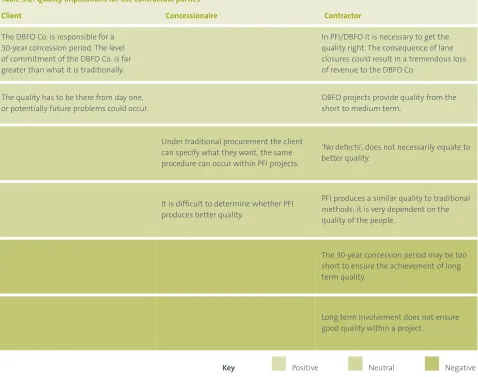
Table 3.2: Quality implications for the contractual parties
Client Concessionaire Contractor
The DBFO Co. is responsible for a 30-year concession period. The level of commitment of the DBFO Co. is far greater than what it is traditionally.
In PFI/DBFO it is necessary to get the quality right. The consequence of lane closures could result in a tremendous loss of revenue to the DBFO Co.
The quality has to be there from day one, or potentially future problems could occur.
DBFO projects provide quality from the short to medium term.
Under traditional procurement the client can specify what they want, the same procedure can occur within PFI projects.
‘No defects’, does not necessarily equate to better quality.
It is difficult to determine whether PFI produces better quality.
PFI produces a similar quality to traditional methods; it is very dependent on the quality of the people.
The 30-year concession period may be too short to ensure the achievement of long term quality.
Long term involvement does not ensure good quality within a project.
Positive
Key messages
The main obstacles
Time constraints:Unable to look at alternative methods of achieving these solutions. Lack of time to plan the project properly. Concession periods may be too short and therefore constrain the achievement of better quality in projects.
Risk:Better planning and a better understanding of what needs to be done. The earlier the team is brought together the better the understanding will be of the quality required. Risk is transferred onto the contractor and the contractor will not invest long term quality into the scheme.
Documentation: A lack of understanding about the complexity of the documentation and the contract conditions.
People:Quality is often dependent on the quality of people. It costs no more for operatives to carry out a good job as opposed to a poor job.
Knowledge: Lack of background and history of the project. Not being able to understand problems that the client may experience when taking the project through public scrutiny.
[image:21.595.58.537.327.652.2]Money:Constraints minimise the quality. The more money, the better the quality the project will be.
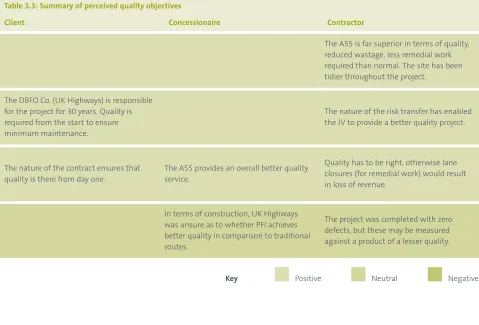
Table 3.3: Summary of perceived quality objectives
Client Concessionaire Contractor
The A55 is far superior in terms of quality, reduced wastage, less remedial work required than normal. The site has been tidier throughout the project.
The DBFO Co. (UK Highways) is responsible for the project for 30 years. Quality is required from the start to ensure minimum maintenance.
The nature of the risk transfer has enabled the JV to provide a better quality project.
The nature of the contract ensures that quality is there from day one.
The A55 provides an overall better quality service.
Quality has to be right, otherwise lane closures (for remedial work) would result in loss of revenue.
In terms of construction, UK Highways was unsure as to whether PFI achieves better quality in comparison to traditional routes.
The project was completed with zero defects, but these may be measured against a product of a lesser quality.
Positive
Conclusions
The project became operational two years before the anticipated operational date utilising traditional procurement techniques. Transfer times have improved and the travel volumes have also increased beyond the maximum forecast. A few quotes taken directly from the case study participants illustrate the benefits of the PFI approach for this project:
• ‘The level of commitment is far greater than
traditionally…this ensures that the quality is there from day one otherwise it could cause future problems.’
• ‘The A55 is far superior in terms of quality, reduced wastage, less remedial work required than what there would be traditionally.’
• ‘The project has been completed with zero defects.’
• ‘The A55 overall provides a better service.’
These statements highlight the widely accepted view that this PFI contract has provided VFM. However, it has been acknowledged that it is difficult to determine whether PFI provides better quality in comparison to traditional routes, as traditional routes generally have lower specifications and are simpler to construct. Due to the encouragement of lifecycle costing, it is likely that good quality materials will be used to provide quality long term – with life-cycle costing, better quality materials may be used to cut down on maintenance costs.
Further investigation: is required of the accuracy of the operation and maintenance forecasts and the whole-life cycle costs should be re-examined in view of the increased traffic flows to inform future predictions for road construction projects.
Ackowledgements
Victoria Dock Primary School
Case study 2
Location:Kingston-Upon-Hull, East Yorkshire, United Kingdom
Project cost:Total cost £1 million
Sector:Education
Status:Operational since January 1999
Sponsors:The Victoria Dock School PFI Limited owned by Sewell Construction
Purchaser:Kingston Upon Hull City Council Education Authority
Contractual package and concession period: The City Council contributed £200 000 covered by central government grants. The private partner applied £250 000 of their own funds and recurred to a traditional corporate finance bank loan over 10 years for financial leverage for the remainder of the financing. The land where the school was built has been leased to the Sewell group for 40 years, although the PFI contract is for 25 years only. For the 15 years following this period, the buildings and land can have alternative uses ranging from a school, disco, nursery, homecare, etc, each according to the needs of the local residents. The reason for opening up the possibility of an alternative use for the buildings is that in 25 years the demographics in the area may have changed and there may therefore no longer be a need for the school. Alternative uses could therefore be more beneficial in the longer term. The complete concession is due to end in 2039.
Special features: This was the first primary school in the UK to be built under a PFI scheme. The project was negotiated in 1998 between Hull City Council and Sewell Group and its success meant that an extension of facilities soon had to be contemplated. The new building was completed in January 2001.
Background – history and objectives
The Victoria Dock Primary School is located in Kingston-upon-Hull and serves the new estate
development of Victoria Dock. It is part of a revitalisation programme of neglected areas such as the docks. It was built due to public pressure because of a lack of educational facilities in the area. A PFI scheme was used because Hull City Council didn’t have sufficient funds to build a new school.
Bidding process - chronology of key events
The life cycle of this PFI project started with the Kingston Upon Hull City Council Education Authority establishing a ‘Service Need’ for the provision of local educational services. As the Council had insufficient funding to undertake construction it considered the then innovative PFI route in the education sector. The standard procedures in a PFI required the development of a business case and the Public Sector Comparator. This was followed by the Intention To Negotiate (ITN) and the nomination of Sewell Construction as the preferred bidder. It then took 12-15 months for the signing of the PFI contract and to achieve financial close to provide 25 years of educational services. Within this contract there is a further extension of 15 years for possible alternative use of the land and building.
The major delay was caused by the need to sort out the legal details – this took six months while in normal circumstances the average period would last around two months. The lengthy negotiations were worsened by an incomplete design. Only after being selected as the preferred bidder was the design refined and detailed by Sewell. The school was scheduled to start operating in January 1999, which made it necessary to reduce the construction stage from nine to six months. This was achieved successfully. A further extension of the school premises was completed in September 2001.
Construction phase
The construction was undertaken by Sewell Construction. The Sewell Group had past experience in school
construction and property development. The group had a great deal of involvement and expertise in building maintenance, refurbishment of schools and hospitals, etc. and this gave the group a sense of a long-term approach to business. As regards the construction and design sub-contract, no commercial details have been released.
Operational phase
The facilities management is provided by Sewell Facility Management. Payment is against square footage of class space availability and performance. In the case of a teacher’s absence, due for example to illness or other external cause that affects availability or performance, they lose their revenue. This loss is covered by insurance and the premium is built into the financial model. After 40 years the buildings and the land are to revert to the council. A possible extension of the contract is on an open book basis, ie, the concessionaire states all the costs which are verified by an auditor from the Authority.
The school began with 60 pupils in 1999, rising to 94 by 2000 (26 in kinder-garden) with ages ranging from three to eleven and distributed in three classes: three to five, six to seven and eight to 11. The school has been operating successfully and has earned a good reputation with growing demand from outside the estate development. The construction of a further building was completed in January 2001 and raised the total capacity of the school to 220 pupils. Sewell Facility Management undertakes the day to day maintenance and repair maintenance. Sewell Construction built the kitchens but doesn’t provide catering. The catering is contracted-out to the local authority, which already had this capacity and was keen to use it. Meals are prepared offsite and heated in the school.
Risk transfer
The essence of this PFI contract lies in the transfer of risk to the private sector. The underlying concept is that the risk is allocated to the party best able to manage it, and this results in cost reductions brought about through increases in efficiency and innovations introduced by the private sector. The Victoria Dock Primary School PFI Ltd takes all the risks inherent to the concession, such as the social, legal and regulatory, economic and financial, environmental, political, and technical (bidding, construction and design) risks.
In these risk categories the main issues were related to bidding costs as the legal costs were ten times the original estimate (ie £50 000 instead of £5 000). The construction and design risks were minimised by adopting conservative design and construction
techniques with which Sewell had ample experience. The constructor even supplied all the materials, taking special care to use only those whose reliability was well proven. As the contract is for availability of space there is no risk derived from any demographic changes in the area.
The school has an insurance policy (hotel type) that covers the whole range of services. The school was designed to have low maintenance costs, paying special attention on the need to reduce potential vandalism. For instance, use is made of external steel shutters (very uncommon in the UK) which, although more expensive (due to higher initial investment and maintenance every six months) prove in the long run to be a good investment by reducing (or stopping) the breakage of glass windows.
As the school pays for its own gas and electricity, great effort was made to design an energy efficient building (also not currently common in the UK). Some special features to reduce whole life cycle costs include: double glazed windows, large cavity walls with air pockets to improve insulation, less expensive roof tiles that are replaced every 15 years instead of 25 years for the traditional aluminium foil decking. In addition the concrete floor was not insulated as it was judged that little heat would escape this way. Doors are painted instead of varnished and are therefore easier to repair. To reduce vandalism and for added security, thick plywood decking has been installed beneath the roofing tiles as a way of preventing break-ins.
So far the only vandalism has been graffiti. The security system is sub-contracted to Prosegur. To reduce costs and increase efficiency in maintenance the school has a multi-skilled and flexible ‘caretaker’ to resolve simple tasks, such as fixing a plug. Training is also provided. For more complex maintenance problems, such as the breakdown of heating systems, an external contractor is used.
Value for money
In the original UK PFI model, the government only approved the PFI financing scheme if it demonstrated that it produced VFM when compared with the traditional methods of procurement, ie it generated savings to the public sector during the whole-life cycle of the
concession. This was done by comparing the contract costs with the Public Sector Comparator, which is calculated by costing what the public sector would have to pay to procure the construction as well as the
operation and maintenance of the school over the period of the concession. To render the PFI project viable the city council contributed £200 000 (20%), otherwise it would not have been possible to produce a favourable comparison with the PSC.
Key messages
For the private sector
The Sewell Group went into the PFI market following a long–term strategy of return on investment and regarding PFI as an opportunity for investment of their disposable cash. It invested £250 000 of its own money (25%) recurring to traditional bank loans for financial leverage (55%). The group tends to opt for low risk PFI projects (such as schools) and expects a return on investment of an average 12-15% instead of 5% in bank deposits. The group also sees PFI as a strategy to smooth the cycles in the construction industry (usually ten year cycles). In times of depression for the construction industry the company then has a secure revenue stream.
The Sewell Group’s involvement in PFI projects changed their attitude to business as they believe they are now more service rather than asset-oriented. Being held responsible for the school’s operation and maintenance forced the group to carefully consider whole life cycle costing. The group is a strong advocate of small PFI projects for small companies, such as a school which can cost up to £5 million. The group’s use of local labour even when constructing outside Hull promotes local
employment, which is so important in depressed areas, whether in Hull or elsewhere. This local involvement also helps to ensure good maintenance in non-centralised locations. For instance, a large facilities management company can take longer to replace parts.
A partnership approach is always beneficial as a way of promoting cooperation between all the parties involved. The decision taken by Sewell to promote a ‘community dividend’ from the profits of the SPV is a good example of this approach. Joint ventures are a viable solution when any of the partners do not have the financial strength to undertake the project. In this case, Kingston Upon Hull City Council contributed with £200 000, otherwise it would not have been possible to obtain a favourable comparison with the PSC.
Previous experience is equally important. The Sewell Group had previous experience of constructing schools as well as a great deal of involvement and expertise in building maintenance and refurbishment in schools and hospitals. As a result, when Sewell decided to enter the PFI market they built upon their previous expertise and core business, adjusting their approach to a long term perspective of operation and management. The focus on reducing maintenance and repair costs was a critical issue during the project’s development – Sewell was entirely responsible for building maintenance.
For the public sector
Small projects undertaken by municipalities are generally very sensitive to local social and economic environments. The primary lenders appointed a construction management consultancy to provide technical advice. This consulting company considered the Victoria Dock Primary School scheme as a ‘bad PFI’. However, following a concerted campaign by the headteacher and the formation of a ‘local’ partnership between a local contractor and owner of construction and facilities management companies, the technical consultants considered a big contractor would have been in a better position to achieve economies of scale and therefore reduce overall cost. Effectively it was necessary to obtain the public partner’s contribution to make possible a favourable comparison with the PSC.
A PFI contract in the education sector relieves education staff from administrative and managerial tasks. The role of the head teacher in premises management becomes one of a performance monitor. For example, if a lamp is not replaced within the pre-set period, a report is made and penalty points are given, potentially affecting the unit price of the service, and affecting the revenue of the concessionaire.
The legal complexities of the PFI regime caused the local authority in this case to incur increased legal costs. However, it is unclear whether this was a result of the size of the scheme or the novelty of the procurement method and lack of expertise.
It should, however, be remembered that without the PFI scheme a purpose-built local primary school would not have been built.
Conclusions
Based upon an evaluation of the stimulants and
impediments to successful implementation of PFI projects this school represents an exceptionally successful project. Despite the technical consultant’s declaration that this was a ‘bad PFI’, independent observation and critical analysis suggests otherwise. It could in fact act as an exemplar of SME involvement in PFI projects.
Further investigation: It would be beneficial to review the operations and maintenance financial model when compared to local authority maintained premises. A benchmark operation and maintenance model could be prepared to validate the benefits, or otherwise, of this PFI scheme. Such benchmark data would be useful for future PFI educational project appraisals.
The projected ‘social dividend’ should be evaluated over the entire concession life. This could have a significant impact on the project’s comparison with the original PSC.
The ‘local social benefit’ during the construction phase should also be evaluated and included in a recalculation of the scheme comparison with the PSC.
Acknowledgements
Vasco de Gama Bridge
Location:Lisbon, Portugal
Project cost:€850 million and €120 million refinancing in July 2000
Sector:Transport – Bridge Crossing – New Bridge. 17.2 km construction and refurbishment and upgrading of existing Abril 25th Bridge and new build of interconnecting sections.
Status:Operational. Finance agreement closed in 1994. Construction completed 31 March 2001. Contract Permit to Use 24 March 2001.
Sponsors:Concessionaire/Lead Manager – Lusoponte (consortia of UK, French and Portuguese contractors) and Gestiponte (toll operators under franchise from
Lusoponti).
Purchaser:Authority: GATTEL a Portuguese government agency.
Contractual package and concession period: Bespoke ‘PFI’ style agreement, including EU and World Bank finance and reversionary licence for traffic over original 25 de Abril crossing. Original end on 24 March 2028 (or 2250m vehicle crossings). Renegotiated within a global settlement for government changes to extend until 24 March 2030, with the removal of the traffic cap.
Background – history and objectives
In 1991 the ‘25 de Abril’ road bridge was the only connection between the north and south banks of the River Tagus within 40km of Lisbon’s city centre. A second crossing was urgently needed to reduce serious traffic congestion and to allow the development of the south bank of the Tagus for new industrial projects.
Bidding process – chronology of key events
Business case approved in 1991 EOI (OJEC) 1993
Contract and financial close agreed in 1994
Operation of original crossing commences 25 April 1996 New bridge operational in 1998
Concession ends in 2030.
Construction phase
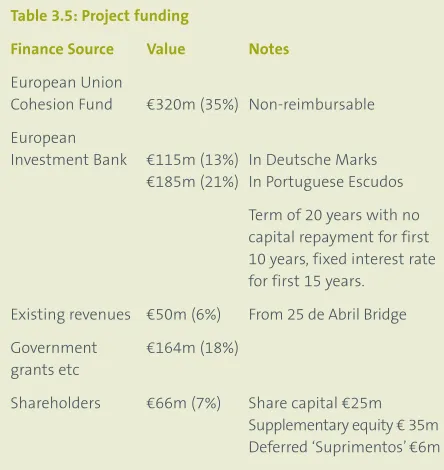
Of the original initial cost €645 million was for new construction work, the balance being associated with maintenance costs for both bridges and payments for expropriated land, re-housing and environmental relief
taken down to 100m rather than 60m. The increased depth and additional salt-corrosion measures meant that the marine piles were typically twice the diameter of corresponding land piles.
Due to legal delays in contract signing the contractors supported additional temporary site installations and commenced preparatory operations without any contractual protection. All such costs were totally at risk until contract signing. This was determined to be a more effective risk management strategy than awaiting contract execution and absorbing the delay within the concession programme.
Operational phase
The ‘new’ bridge operation commenced reasonably effectively. However, the ‘take-over’ of the existing bridge proved much more difficult than anticipated. Eventually, a completely revised toll collection system was installed on the ‘old’ bridge. This proved to be the only way to manage the control and monitoring of cash payments from toll booth to reconciliation at bank. Approximately 5% of all traffic attempted to avoid toll payment. The enforcement system relied upon video recording of vehicle registrations and manual follow up. It took four years for legislation to come into force giving powers to the SPV to clamp down on toll evasions.
Risk transfer
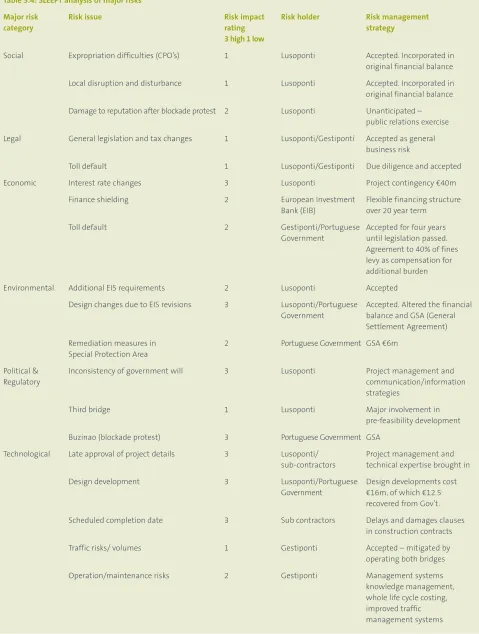
A detailed SLEEPT risk analysis is presented below. However, a number of unusual exogenous risks need to be identified. There was a lack of consistent government will. This resulted in a number of regulatory and technical changes. For example, the government was unable to implement contractual changes to the toll charges – local residents blockaded the bridges and refused to move until the proposed toll increases were cancelled. The government was forced to issue coupons for discount toll charges (10% discount for 20 tickets and 20% discount for more than 20 crossings per month). Environmental groups put concerted pressure on Lusoponte and the concessionaire faced enquiries for alleged violations of Environmental Impact Study requirements.
Environmental design changes meant a 4.5 km viaduct rather than an embankment, resulting in construction cost increases of €125 million. These and other enforced changes were negotiated within a global settlement, in 2001, to restore the original financial balance within the concession.
Table 3.4: SLEEPT analysis of major risks
Major risk Risk issue Risk impact Risk holder Risk management
category rating strategy
3 high 1 low
Social Expropriation difficulties (CPO’s) 1 Lusoponti Accepted. Incorporated in original financial balance Local disruption and disturbance 1 Lusoponti Accepted. Incorporated in
original financial balance Damage to reputation after blockade protest 2 Lusoponti Unanticipated –
public relations exercise Legal General legislation and tax changes 1 Lusoponti/Gestiponti Accepted as general
business risk
Toll default 1 Lusoponti/Gestiponti Due diligence and accepted Economic Interest rate changes 3 Lusoponti Project contingency €40m
Finance shielding 2 European Investment Flexible financing structure Bank (EIB) over 20 year term
Toll default 2 Gestiponti/Portuguese Accepted for four years Government until legislation passed.
Agreement to 40% of fines levy as compensation for additional burden Environmental Additional EIS requirements 2 Lusoponti Accepted
Design changes due to EIS revisions 3 Lusoponti/Portuguese Accepted. Altered the financial Government balance and GSA (General
Settlement Agreement) Remediation measures in 2 Portuguese Government GSA €6m
Special Protection Area
Political & Inconsistency of government will 3 Lusoponti Project management and
Regulatory communication/information
strategies
Third bridge 1 Lusoponti Major involvement in pre-feasibility development Buzinao (blockade protest) 3 Portuguese Government GSA
Technological Late approval of project details 3 Lusoponti/ Project management and sub-contractors technical expertise brought in Design development 3 Lusoponti/Portuguese Design developments cost
Government €16m, of which €12.5 recovered from Gov’t. Scheduled completion date 3 Sub contractors Delays and damages clauses
in construction contracts Traffic risks/ volumes 1 Gestiponti Accepted – mitigated by
operating both bridges Operation/maintenance risks 2 Gestiponti Management systems