Journal of Chemical and Pharmaceutical Research, 2014, 6(3):1059-1068
Research Article
CODEN(USA) : JCPRC5
ISSN : 0975-7384
Swimmer selection optimization strategy research based on SPSS
factor analysis
Mei Wei
1and Keyi Jin
21
Shenyang Sport University, Shenyang, Liaoning, China
2
Institute of Physical Education, Dalian University, Dalian, Liaoning, China
_____________________________________________________________________________________________
ABSTRACT
Swimming is a sport that lays equal stress on endurance and technique, sound technique is guarantee of scientific exertion that makes contribution to swimming technique rationality and improvement direction. Utilize factor analysis method and integer programming model method; make application of mathematical model into competitive swimming. In research process, it respectively from athlete perspective adopts factor analysis method providing swimming strategy for athlete, from coach perspective utilize integer programming finding out optimal athletes assignment scheme and competition best total score; Make improvement based on precedence algorithm, apply sensitivity analysis, on the condition that optimal solution not changing, get athletes assignment performance intervals. Through this paper’s research methods, analysis routes and research results, it provides reasonable suggestions and theoretical basis for swimming technique.
Key words: Factor Analysis Method, integer programming, sensitivity analysis, swimming competition
_____________________________________________________________________________________________
INTRODUCTION
Swimming develops up to today, with every country swimming theories and technical research increasing improvement, training ways become more and more scientific, every country excellent swimmers’ competitive levels has been widely improved, competition victory or failure tend to be a moment affair [1]. Modern swimming has already become not just athlete physical ability, speed and technical competition; its competition result has slightly great correlations with competition strategy to great extent. So-called competition strategy, its essence belongs to mathematical planning problem. Apply modern mathematical research method into competitive sports, it starts since 1970s; American mathematician T.B.keller has established a mathematical model in 1973 for medium and long distance runners training that achieved remarkable results [1, 2]. Meanwhile, Ayers has combined mathematics, mechanics and computer with discus and improved throwing technique. Optimal control theory has been developing after Second World War; its basis is state-space concept. In 1960s, with digital computer technique and space technique rapidly development, driving by dynamic system optimization theory, optimal control theory starts to take shape as an important science branch [3-5]. Develop up to today; it has already achieved remarkable results in systematical engineering, space technique, economic management and other multiple fields. Optimal control theory is according to targets features, on the specified permissible control condition, let it operate as requests and make targets arrive at optimal value [6, 7]. Its mathematical essence is a functional extreme value problem, is a variation problem under a group of constraint conditions.
For competitive swimming, lots of problems have also been emerged that waited to be solved [8-10].
Factor analysis refers to statistical technique that research extracts common factors from clusters of variations. It was first put forward by British psychologist C.E. Spearman. Integer programming was formed into an independent branch after R.E. Gomory proposed cutting plane method; it has been developed into many methods to solve all kind of problems in 30 more years. With social science theory continuously development, current relative theories are in urgent need of blending in natural science, modern information technology. This research applies factor analysis method and integer programming model in researching competitive swimming problems with expectation of deep solving relative problems, especially in sports field.
SWIMMING PERFORMANCE INFLUENCE FACTORS FACTOR ANALYSIS MODEL Factor analysis method principle
Factor analysis is a way that tries to organize original multiple certain correlated indicators (such as
p
indicators) again into a group of new mutual independent comprehensive indicators to substitute original indicator. Common factors generate variance structure, and special factors explain every variable variance. The purpose is to make reasonable explanation as much as possible of original variables correlations and use it for simplifying variables dimensions and structure.Factor analysis starting point is variable relative coefficient matrix, on the premise that less information loss, synthesize multiple variables (these variables are required to have strong correlations so as to ensure it can extract common factor from original variable) into a few comprehensive variables to research overall each aspect information multiple statistical method, and the few comprehensive variables represent information cannot overlap that variables are independent from each other, factor analysis dissolves original observation variables into common factor and special factor two parts. Factor model as following:
i M im i
i
i
a
F
a
F
a
F
X
=
1 1+
2 2+
....
+
ε
(
m
≤
p
)
(1)Among them i=1, 2, …, p, m that
X
=
AF
+
ε
F
1,
F
2,...
F
m is called common factor, is an unobservablevariable,
A
=
( )
a
ij p×m is called factor loading matrix,a
ij represents thei
variable loading in thej
factor,i
ε
is special factor that is a part that cannot be included by previousm
pieces of common factors, and meet( )
F,ε
=0Cov , F,
ε
are uncorrelated.Factor analysis is factor model focuses on a few unobservable potential variables (that is common factor) and
abandon special factor. If the first main common factor
F
1 cannot represent originalP
pieces of indicatorsinformation, then consider to select the second common factor
F
2 that is to select the second linear combination. Inorder to effective reflect original information,
F
1known information is unnecessary to appear inF
2, by thatanalogy, it can construct the third, fourth... the
p
common factor. General steps of factor analysis:(1) Similar to principal component analysis, calculate
x
k ands
k(
k
,
j
=
1
,
2
....,
m
)
, establish basic equations.(2) Use principal component analysis method to determine factor matrix
A
.(3) Varian orthogonal rotation, extreme variable coefficient (tend to 0 or 1 as much as possible) (4) Get factor score function, calculate sample factors scores.
Model establishment
Table 1: 2012 London Olympic Games every country athlete’s 1500 meter free stroke partial indicators data
\ 0-300 300-600 600-900 900-1200 1200-1500
China 172.63 175.52 176.17 176.32 170.38
Canada 174.12 176.72 177.7 177.69 173.4
Tunisia 175.61 177.85 177.32 177.07 172.46
South Korea 173.67 177.09 179.32 181.45 179.08
Italy 177.63 178.3 179.24 179.46 177.29
America 178.71 180.2 179.13 178.27 176.68
Poland 177.75 180.02 179.59 179.93 177.03
Britain 178.41 180.99 180.72 181.48 179.16
Factor analysis hypothesis: Each common factor is independent from each other, special factors are also independent from each other, common factors and special factors are independent from each other.
[image:3.595.194.418.299.349.2]Apply SPSS software Linear process in carrying out factor analysis of data, firstly make KMO test and Bartlett test on data, carry out factor analysis of observation sample data whether suitable or not, and then further get correlated coefficient matrix as well as its feature values, contribution rations as well as accumulation contribution ratios and so on.
Table 2: KMO and Bartlett test a
Sampling sufficient degrees Kaiser-Meyer-Olkin measurement .705
Bartlett sphericity degree test
approximate to chi-square 49.359
df 10
Sig. .000
a. Based on correlation
From Table 2, it is known that KMO value=0.705, Sig=0.00001. According to statistician professor Kaiser provided criterion, KMO=0.705>0.5 is relative proper for factor analysis; Sig=0.00001<0.05 indicates that through Bartlett spheroid test prove that its correlation matrix is not a unit matrix, factor model is suitable.
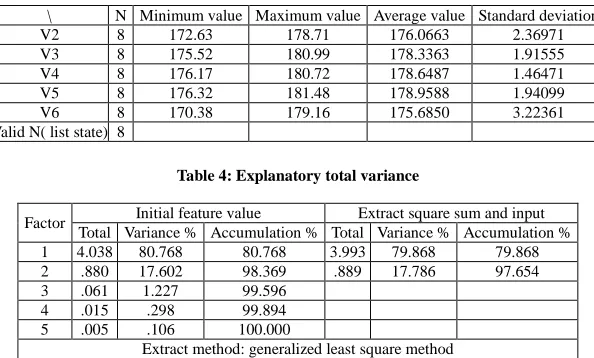
Reuse SPSS software making factor analysis of data, get following results that all original variables general
statistical description (Table 3), including average number
x
i, standard deviationσ
Xi and analytic case number, explanatory total variance refers to Table 4.Table 3: All original variables general statistical description information
\ N Minimum value Maximum value Average value Standard deviation
V2 8 172.63 178.71 176.0663 2.36971
V3 8 175.52 180.99 178.3363 1.91555
V4 8 176.17 180.72 178.6487 1.46471
V5 8 176.32 181.48 178.9588 1.94099
V6 8 170.38 179.16 175.6850 3.22361
[image:3.595.157.454.483.662.2]Valid N( list state) 8
Table 4: Explanatory total variance
Factor Initial feature value Extract square sum and input
Total Variance % Accumulation % Total Variance % Accumulation %
1 4.038 80.768 80.768 3.993 79.868 79.868
2 .880 17.602 98.369 .889 17.786 97.654
3 .061 1.227 99.596
4 .015 .298 99.894
5 .005 .106 100.000
Extract method: generalized least square method
factors (Table 5).
Table 5: Correlation coefficient matrix table
\ V2 V3 V4 V5 V6
V2
Pearson correlation 1 .943** .741* .402 .590
Significance(two sides) .000 .036 .324 .123
N 8 8 8 8 8
V3
Pearson correlation .943** 1 .829* .550 .677
Significance(two sides) .000 .011 .158 .065
N 8 8 8 8 8
V4
Pearson correlation .741* .829* 1 .906** .961**
Significance(two sides) .036 .011 .002 .000
N 8 8 8 8 8
V5
Pearson correlation .402 .550 .906** 1 .951**
Significance(two sides) .324 .158 .002 .000
N 8 8 8 8 8
V6
Pearson correlation .590 .677 .961**.951** 1
Significance(two sides) .123 .065 .000 .000
N 8 8 8 8 8
**. It is significant correlated in .01 horizontal(two sides). *. It is significant correlated in 0.05 horizontal(two sides).
According to above data, draw out feature root screen plot figure (as Figure 1), combining feature root curve inflection point and feature root value.
Figure1: Feature root screen plot
From Figure1, it can get first feature value and second feature value have larger change range, and can consider to take previous two factors as common factors to carry out factor analysis.
Common factor variance ratio (Table 6) evaluation indicator common degree is 0.85 bigger than all indicators that indicate model basically explains every evaluation indicator all variance and no need special factors.
Table 6: Common factor variancea
\ Initial Extract
V2 .963 .988
V3 .949 .966
V4 .993 .998
V5 .982 .990
V6 .972 .981
Extract method: generalized least square method
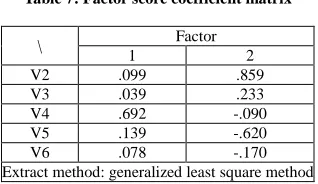
[image:4.595.80.534.681.751.2]Factor score coefficient matrix (Table 7) that is factor analysis final result. Through the coefficient matrix, it can express common factors as each evaluation indicator linear combination.
Table 7: Factor score coefficient matrix
\ Factor
1 2
V2 .099 .859
V3 .039 .233
V4 .692 -.090
V5 .139 -.620
V6 .078 -.170
Extract method: generalized least square method
From that, it can get the first and second common factors expressions:
5 4
3 2
1
1
0
.
099
*
stdx
0
.
039
*
stdx
0
.
692
*
stdx
0
.
139
*
stdx
0
.
078
stdx
Z
=
+
+
+
+
(2)5 4
3 2
1
2
0
.
859
*
stdx
0
.
233
*
stdx
0
.
09
*
stdx
0
.
62
*
stdx
0
.
17
stdx
Z
=
+
−
−
−
(3)Total score function:
(
79
.
868
Z
117
.
786
Z
2)
/
97
.
654
Z
=
+
(4)Among them,
stdx
i(
i
=
1
,
2
,
3
,
4
)
represents evaluation indicator variable after standardization: )4 , 3 , 2 , 1 ( / )
( − =
= x x i
stdx
i
x i i
i
σ
Total score function after simplifying:
1 2 3 4 5
0.2374 *
0.0743*
0.5496 *
0.0008*
0.0328
Z
=
stdx
+
stdx
+
stdx
+
stdx
+
stdx
(5)Due to factor analysis model coefficient matrix reflects correlation extent between original variable and common factors, according to score expressions after simplifying, it can get that the first phase and the third phase have larger coefficients, therefore athlete in 0---300m, 600m---900m such two swimming journey, it cannot loosen and speed cannot too slow, especially in 600---900m such phase swimming journey, athlete speed should be fast, impulse in other phases’ swimming journey doesn’t need to be so fiercely so that can improve athlete swimming performance.
INTEGER PROGRAMMING MODEL Integer programming
0-1 programming is a kind of special pure integer programming. Solve 0-1 programming implicit enumeration method has no need to use simplex method solving linear programming problems. Its basic thoughts start from all variables equal to 0, successively appoint some variables into 1 till get a feasible solution and regard it as current best feasible solution. Hereafter, successively test variables equal to 0 or 1 combination so that let current best feasible solution get continuously improvement, finally get optimal solution. Implicit enumeration method is different from exhaustion method, it don’t need to enumerate all feasible variables combinations one by one. Through analysis, judging, it eliminates lots of variables combinations as optimal solution possibility. So they are implicit enumerated. Implicit enumeration method essence is also branch and bound method.
Model establishment
Table 8: 7 athletes’ four swimming postures 100 meter average performance
\ A B C D E F G
Butterfly stroke 1’07”8 57”3 1’20’ 1’15” 1’08”6 1’18”6 1’10”6
Backstroke 1’16”6 1’07” 1’07”9 1’16”2 1’08” 1’15”6 1’06”6
Breaststroke 1’25” 1’08”4 1’24”6 1’09”6 1’23”8 1’25”6 1’06”6
Free stroke 57”6 55” 59”6 57”2 1’04”4 58’2 1’03”6
Record A, B, C, D, E, F, G respectively as i=1,2,3,4,5,6,7;Record butterfly stroke, backstroke, breaststroke, free stroke respectively as swimming postures, record athlete
i
thej
swimming posture 100meter best performanceas
c
ij( )
s
, then Table 8 can express as Table 9.Table 9: 7 athletes’ four swimming postures 100 meter average performance
ij
c
i
=
1
i=2i
=
3
i
=
4
i
=
5
i
=
6
i
=
7
1
=
j 67.8 57.3 80 75 68.6 78.6 70.6
2
=
j 76.6 67 67.9 76.2 68 75.6 66.6
3
=
j 85 68.4 84.6 69.6 83.8 85.6 66.6
4
=
j 57.6 55 59.6 57.2 64.4 58.2 63.6
Bring into 0-1variable
x
ij, if select athletei
to participant swimming posturej
competition, recordxij =1, or else recordx
ij=
0
.As following:
=
gposture m
tselectswi esn
athleteido
gposture lectsswim
athleteise xij
min '
, 0
min ,
1
.
With requests of organizing into relay team,
x
ijshould meet below conditions:Every athlete can only be selected one of four swimming postures (2) Every swimming posture can only have one athlete be selected.
Then it has:
(
)
∑
=
=
≤
4
1
7
,...
2
,
1
1
j
ij
i
x
(
)
∑
=
=
=
7
1
4
,...
2
,
1
1
i
ij
j
x
Therefore, when athlete
i
is selected with swimming posturej
, usec
ijx
ij showing its performance, relay team total performance can be expressed as :∑∑
= =
=
=
•
=
41 7
1
)
7
,...
2
,
1
,
4
,...
2
,
1
(
j i
ij
ij
x
i
j
c
z
To sum up, swimming team’s relay team athlete’s selection problem 0-1 programming model can be described as:
∑∑
= =
=
=
•
=
41 7
1
)
7
,...
2
,
1
,
4
,...
2
,
1
(
j i
ij
ij
x
i
j
(
)
(
)
{ }
=
=
=
=
≤
∑
∑
= =1
,
0
4
,...
2
,
1
1
7
,...
2
,
1
1
.
.
7 1 4 1 ij i ij j ijx
j
x
i
x
t
s
Establish target function as following:
74 73 72 71 64 63 62 61 54 53 52 51 44 43 42 41 34 33 32 31 24 23 22 21 14 13 12 11 6 . 63 6 . 66 6 . 66 6 . 70 2 . 58 6 . 85 6 . 75 6 . 78 4 . 64 8 . 83 68 6 . 68 2 . 57 6 . 69 2 . 76 75 6 . 59 6 . 84 9 . 67 80 55 4 . 68 67 3 . 57 6 . 57 85 6 . 76 8 . 67 min x x x x x x x x x x x x x x x x x x x x x x x x x x x x z + + + + + + + + + + + + + + + + + + + + + + + + + + + =
=
=
=
=
+
+
+
+
+
+
=
+
+
+
+
+
+
=
+
+
+
+
+
+
=
+
+
+
+
+
+
≤
+
+
+
≤
+
+
+
≤
+
+
+
≤
+
+
+
≤
+
+
+
≤
+
+
+
≤
+
+
+
)
4
,
3
,
2
,
1
.
7
,
6
,
5
,
4
,
3
,
2
,
1
(
1
0
1
1
1
1
1
1
1
1
1
1
1
47 46 45 44 43 42 41 37 36 35 34 33 32 31 27 26 25 24 23 22 21 17 16 15 14 13 12 11 74 73 72 71 64 63 62 61 54 53 52 51 44 43 42 41 34 33 32 31 24 23 22 21 14 13 12 11j
i
or
x
x
x
x
x
x
x
x
x
x
x
x
x
x
x
x
x
x
x
x
x
x
x
x
x
x
x
x
x
x
x
x
x
x
x
x
x
x
x
x
x
x
x
x
x
x
x
x
x
x
x
x
x
x
x
x
x
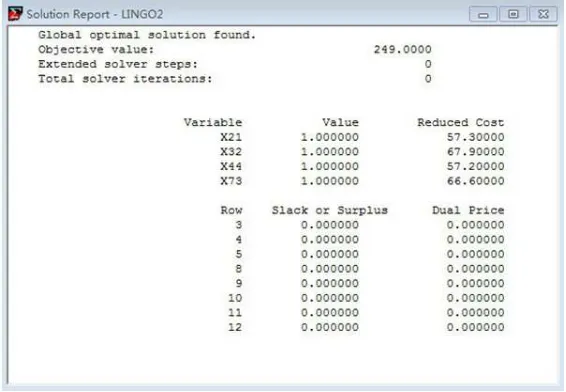
ij [image:7.595.165.448.500.696.2]Use LINGO program solving results as below Figure 2:
Figure 2: LINGO solution results
Apply LINGO software in calculating, it can get
x
21=
x
32=
x
44=
x
73=
1
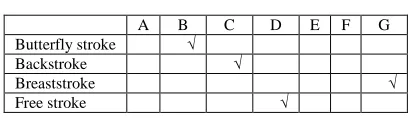
, therefore, selected athletes and correspondingTable 10: Selection scheme
A B C D E F G
Butterfly stroke √
Backstroke √
Breaststroke √
Free stroke √
That is a competition scheme that selects athlete B to take butterfly stroke→athlete C to take backstroke→athlete D to take breaststroke→athlete A to take free stroke. At that time, competition best total score is z=249s.
SENSITIVITY ANALYSIS Value coefficient
c
change analysis.(1)
c
r is non basic variablex
rcoefficientNow
c
r change only would influence on Nc
Nc
BB
N
1
−
−
=
σ
x
r check number, under requests to maintainoptimal value, then it only needs to
0
1
1
=
+
∆
−
=
+
∆
≤
−
′
=
′
− −r r r B r r r B r
r
c
c
B
P
c
c
c
B
P
σ
c
σ
That is when
∆
c
r≤
−
σ
r, it can maintain optimal basis without changing.(2)
c
ris basic variablex
rcoefficientNow due to
c
Bchanges, all non basic variables check numbers would change, under requests to maintain optimalvalue, then it needs to meet
0
1
≤
′
−
=
′
−j B j
j
c
c
B
P
σ
.Here record vector
∆
c
B=
(
0
,
0
,
L
,
∆
c
r,
0
,
L
,
0
)
, then it hasc
′
B=
c
B+
∆
c
B.From j
c
jc
BB
P
jc
jc
Bc
BB
P
j1
1
(
)
−−
=
−
+
∆
′
−
=
′
σ
=
−
−1−
∆
−1=
−
∆
−1≤
0
j B j j B j B
j
c
B
P
c
B
P
c
B
P
c
σ
It gets
(
,
x
var
)
1
iable
isnonbasic
and
j
P
B
c
B j≥
j∀
j∆
−σ
.
From that, it can get optimum basis unchangeable
∆
c
r value range.Record
(
)
1
ij
a
A
B
−=
′
, record basic variable
x
r code in base ass
, then∆
c
BB
P
j=
∆
c
ra
sj′
−1
, and
from
∆
c
BB
P
j=
∆
c
ra
sj′
≥
σ
j−1
, it can get.
If
a
′
sj>
0
then∆
c
r≥
σ
j/
a
′
sj;If
0
<
′
sj
a
then
∆
c
r≤
σ
j/
a
sj′
;If
0
=
′
sj
a
then obviously
∆
c
ra
sj′
≥
σ
jis true;
So that it gets optimal basis unchangeable
∆
c
rvalue range as: maxj{
σ
j/a′sj|asj′ >0}
≤∆cr≤minj{
σ
j/asj′|a′sj<0}
If value coefficientc
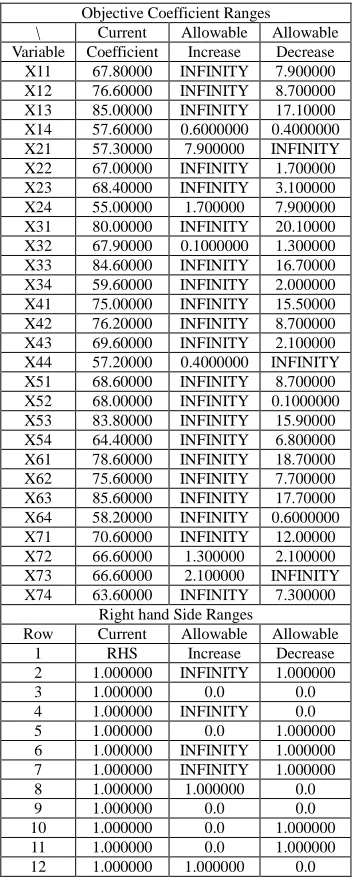
changes, then it not meet optimal condition any more (appear positive check number), then it needs to continue to make iteration solution by simplex method.Table 11: Sensitivity analysis
Objective Coefficient Ranges
\ Current Allowable Allowable
Variable Coefficient Increase Decrease
X11 67.80000 INFINITY 7.900000
X12 76.60000 INFINITY 8.700000
X13 85.00000 INFINITY 17.10000
X14 57.60000 0.6000000 0.4000000
X21 57.30000 7.900000 INFINITY
X22 67.00000 INFINITY 1.700000
X23 68.40000 INFINITY 3.100000
X24 55.00000 1.700000 7.900000
X31 80.00000 INFINITY 20.10000
X32 67.90000 0.1000000 1.300000
X33 84.60000 INFINITY 16.70000
X34 59.60000 INFINITY 2.000000
X41 75.00000 INFINITY 15.50000
X42 76.20000 INFINITY 8.700000
X43 69.60000 INFINITY 2.100000
X44 57.20000 0.4000000 INFINITY
X51 68.60000 INFINITY 8.700000
X52 68.00000 INFINITY 0.1000000
X53 83.80000 INFINITY 15.90000
X54 64.40000 INFINITY 6.800000
X61 78.60000 INFINITY 18.70000
X62 75.60000 INFINITY 7.700000
X63 85.60000 INFINITY 17.70000
X64 58.20000 INFINITY 0.6000000
X71 70.60000 INFINITY 12.00000
X72 66.60000 1.300000 2.100000
X73 66.60000 2.100000 INFINITY
X74 63.60000 INFINITY 7.300000
Right hand Side Ranges
Row Current Allowable Allowable
1 RHS Increase Decrease
2 1.000000 INFINITY 1.000000
3 1.000000 0.0 0.0
4 1.000000 INFINITY 0.0
5 1.000000 0.0 1.000000
6 1.000000 INFINITY 1.000000
7 1.000000 INFINITY 1.000000
8 1.000000 1.000000 0.0
9 1.000000 0.0 0.0
10 1.000000 0.0 1.000000
11 1.000000 0.0 1.000000
12 1.000000 1.000000 0.0
From Table 11 results , it is clear that when athlete A performance changes from 57.2s to 58.2s , selection that not participating any one sport is not changing, when athlete B performance changes from 47.1s to 56.7s , butterfly stroke participating selection would not change, when athlete C performance changes from 66.6s to 68.0s , backstroke participating selection would not change, when athlete G performance changes from 64.5s to 67.9s , breaststroke participating selection would not change.
CONCLUSION
Applied factor analysis method, it got total score expressions; finally put forward reasonable suggestions to athlete. Utilized integer programming model (0-1), it made suggestions about coaches athletes selection. Used sensitivity analysis in improving integer programming, let selecting athletes’ performance extending from single number to a performance interval, avoided athletes being missed in selection due to special status. Model generalization performance was also very strong, it not only could be applied into Olympic Games swimming selection, but also could promote to any selection competitions. This research combined swimming and optimization theory, it provided new thoughts for swimming strategy researching; its results have great significance in swimming training and strategy arrangements.
REFERENCES
[2] CHEN Jie. Journal of Guangzhou Physical Education Institute, 2009, 29(5).
[3] LIU Shu-rong, et al.. Journal of Changchun Institute of Technology(Natural Science Edition), 2006, 7(4), 81-84. [4] Zhuang Mingqian, Qi Shenghua. Journal of Jinan University(Science & Technology), 2002, 16(3), 289-291, 294. [5]Zhang Shu-xue. Journal of Nanjing Institute of Physical Education. 1995, 31(2), 25-27.
[6] Zhang B., Zhang S. and Lu G.. Journal of Chemical and Pharmaceutical Research, 2013, 5(9), 256-262. [7] Zhang B.. International Journal of Applied Mathematics and Statistics, 2013, 44(14), 422-430.