Journal of Chemical and Pharmaceutical Research, 2016, 8(12):139-143
Research Article
CODEN(USA) : JCPRC5ISSN : 0975-7384139
A Reduction of Chiral Amino Acids Based on Current Method
Yuqing Cao
*and Guangyu Yang
Department of Pharmacy, Hebei University, Baoding, China
___________________________________________________________________________________
ABSTRACT
This paper aims to introduce a simple and convenient method for the industrial production of chiral amino alcohols. Based on the current reduction of chiral amino acids , this work can efficiently simplify the experimental procedure by using Li as reducing agent and AlCl3 as auxiliary material to
activate the carboxyl group of amino acids . In order to show the practicability of our method, L-phenylalanine and other several kinds of chiral amino acids were applied to this reduction , and through suitable condition setting, the yield of our tests reached 74.8~91.4%.
Keywords: Chiral aminos alcohol; Chiral amino acids; optimized work; Li; AlCl3
___________________________________________________________________________________
INTRODUCTION
Chiral amino alcohols are a kind of important molecular compound with optical activity, diversified structures, and good selectivity [1]. They have been widely applied in the fields of materials, pharmaceutical, asymmetric synthesis, fine chemicals and so on [2-4].Therefore, it has practical significance on the study of high efficiency, low cost and large scale preparation of chiral amino alcohols. Chiral amino alcohols are generally prepared by the reduction of α-amino acids and LiAlH4, NaBH4 or H2 are commonly used reducing agents. For example,
Dickman et al [5] had accomplished the reduction of valine to valinol by LiAlH4, its yield was 73~75%. Quirk
et al [6]had used Pd/C as catalyst to hydrogenate C=N double bond to prepare serinol and the yield reached 81-83%. Mariappan et al [7]had used NaBH4/ I2 to reduce eight kinds of amino acids, and the yield reached
80~98%. Kenso Soai et al [8] had reported using NaBH4/CH3OH to reduce ester groups and also obtained a
good yield: 88%~94%.
As regards those methods, metal-hydride compounds that represented by LiAlH4 has a strong activity and can
directly reduce carboxyl groups to alcohols. But they are expensive in price, cumbersome in preservation and high risk in large-scale application. Therefore, they are more suitable to laboratory application. Catalytic hydrogenation reaction is a green and efficient route for the preparation of chiral amino alcohols with broad industrial prospect. But generally, this reaction is under high pressure and high temperature, which means it has a higher demand for the equipments. Moreover, a certain kind of catalyst only matches several similar structures. Therefore, this method is relatively costly and inconvenient. Recently, researches on NaBH4 associated with
auxiliary agents such as LiCl4 [9], H2SO4[10], I2, CH3OH, DDC[11] (N,N'-dicyclohexylcarbodiimide) and so
on, witch can extend its application and improve its reducing ability towards amino acids, have become a hotspot. But the operation of such reactions is cumbersome, and many by-products are also produced, it can increase the difficulty of their post-processing.
Compared with those methods above, our method is relatively simple and convenient. It is also suitable to the reduction of different kinds of amino acids and can be applied to large-scale industrial production. The preparation pathway is briefly showed in scheme 1, in this reduction, Li is used as reducing agent, AlCl3 is used
as auxiliary agent to activate the carboxyl group of amino acid and tert-butanol(Li/T-B) is used to donate H+.
EXPERIMENTAL SECTION
Materials
Sodium hydroxide and L-phenylalanine were obtained from Evonik Degussa Specialty Chemicals Co. Ltd (GER), other chemical reagents such as tert.-butyl alcohol, aluminum chloride, lithium, tetrahydrofuran, ethyl acetate, etc, were obtained from Heowns Chemicals Co. Ltd (USA).
Preparation of sodium L-phenylalanine
Sodium hydroxide solution (32 mL, 0.01mol/mL) was poured into a 100 mL beaker, and then L-phenylalanine (50.00 g, 0.30mol) was slowly added in. The temperature was maintained at 60 °C with stirred for 20 min. After that, cooling the solution for crystallization, and then the crystals was filtered and dried to obtain product.
Preparation of L-phenylalaninol
AlCl3 (1.80g, 13.48mmol) was added to anhydrous tetrahydrofuran (30 mL) and then Sodium L-phenylalanine
(2.50g, 13.37mmol) was slowly added in. The temperature was maintained at 55 °C with stirring for 1 hr. The pH was maintained at 3~4. After that, Li chips (0.56g, 80.00mmol) and tert-butanol (10 mL) were separately added in. The temperature was maintained at 65 °C with stirring for another 1.5 hr. Then the solvent was removed and the remaining solid residue was dissolved in 10% NaOH solution (30 mL,) for 3 hr of hydrolysis at room temperature. After that, dilute HCl liquid (5 mol/L) was dropped in for the solution’s acidification, and then the crude products were filtered, washed, dried and recrystallized from methanol. Finally 1.92 g product was obtained and the yield was 91.2%. m.p. is 93-94, 1H NMR (CDCl3) δ: 7.34 -7.18 (m, 5H, PhH); 3.64 (dd,
1H, CH2 OH), 3.36 (dd, 1H, CH2 OH), 3.12,(m, 1H, H2N C*H), 2.80 (dd, 1H, CH2 Ph), 2.53 (dd, 1H, CH2 Ph), 1.64 (br, 3H, NH2and OH), IR (KBr) ν: 3353, 3298, 3030, 2876, 2820, 1576, 1490, 1456, 1339, 1227, 1066 cm-1.
RESULTS AND DISCUSSION
Application of this method
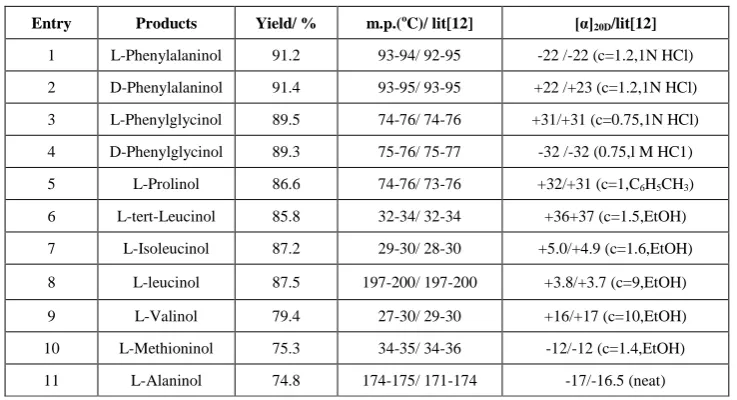
This method was applied to prepare L-phenylalaninol, D-phenylalaninol, L-phenylglycinol and other seven kinds of chiral amino a lcohols, the recorded data are showed in table 1.
Ta ble 1 : Yie ld a nd phy sical p r o per tie s of pro duc ts
Entry Products Yield/ % m.p.(oC)/ lit[12] [α]20D/lit[12]
1 L-Phenylalaninol 91.2 93-94/ 92-95 -22 /-22 (c=1.2,1N HCl)
2 D-Phenylalaninol 91.4 93-95/ 93-95 +22 /+23 (c=1.2,1N HCl)
3 L-Phenylglycinol 89.5 74-76/ 74-76 +31/+31 (c=0.75,1N HCl)
4 D-Phenylglycinol 89.3 75-76/ 75-77 -32 /-32 (0.75,l M HC1)
5 L-Prolinol 86.6 74-76/ 73-76 +32/+31 (c=1,C6H5CH3)
6 L-tert-Leucinol 85.8 32-34/ 32-34 +36+37 (c=1.5,EtOH)
7 L-Isoleucinol 87.2 29-30/ 28-30 +5.0/+4.9 (c=1.6,EtOH)
8 L-leucinol 87.5 197-200/ 197-200 +3.8/+3.7 (c=9,EtOH)
9 L-Valinol 79.4 27-30/ 29-30 +16/+17 (c=10,EtOH)
10 L-Methioninol 75.3 34-35/ 34-36 -12/-12 (c=1.4,EtOH)
11 L-Alaninol 74.8 174-175/ 171-174 -17/-16.5 (neat)
[image:2.595.114.483.453.653.2]141
The influences of reactants ratio, reaction temperature and time are also of vital importance. Around them, we had done a lot of researches. Theoretically, the reduction of 1 mole of amino acid needs 4 mole of Li, but in the real tests, the amount of Li needs to be excessive. The effect of reactants ratio on the yield is showed in figure 1 (other conditions are optimum).
0 20 40 60 80 100
0 3:1 4:1 5:1 6:1 7:1
yi
el
d(
%
[image:3.595.183.519.133.285.2])
[image:3.595.107.523.365.532.2]Figure 1: Effect of reactants ratio on the yield
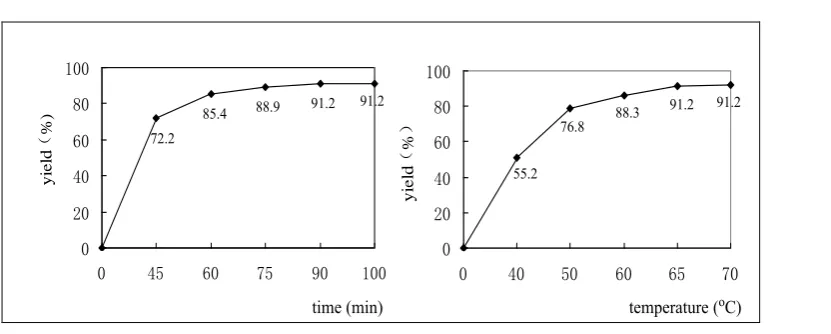
Figure 1 has shown that the yield of L-phenylalaninol is gradually increased when the material ratio of Li and L-phenylalanine is raised from 3: 1 to 7: 1 (mol/mol), but there is unobvious increase between 6:1 and 7:1 (mol/mol). Considering the material consumption, this method set reactants ratio to 6: 1 (mol/mol). The effect of time and temperature is showed in figure 2 (other conditions are optimum).
0 20 40 60 80 100
0 40 50 60 65 70
yi
e
ld
(%
)
0 20 40 60 80 100
0 45 60 75 90 100
yi
e
ld
(
%)
Figure 2: Effect of time and temperature on the yield
Figure 2 has shown that the highest yield 91.2% can be reached under the condition of time is 90 min and temperature is 65 oC, witch means this reduction is relatively fast and saving energy.
The condition setting of AlCl3 chelated with amino acids was also researched. As chelate reaction is reversible
and different material ratios form different structure [13], the material ratio of AlCl3 and L-Phenylalanine was
set to 1: 1, so that L- phenylalanine was fully involved in coordination. Dissolved Al3+ starts to precipitate at pH 3.3 and completely precipitates at pH 5.4, so the pH of chelate reaction was maintained at 3-4. The effect of time and temperature is showed in figure 3.
60 65 70 75 80 85
40 50 55 60 65
yi
el
d
(%
[image:4.595.126.523.316.511.2])
Figure 3: The effect of time and temperature on the yield
Principle and material selection
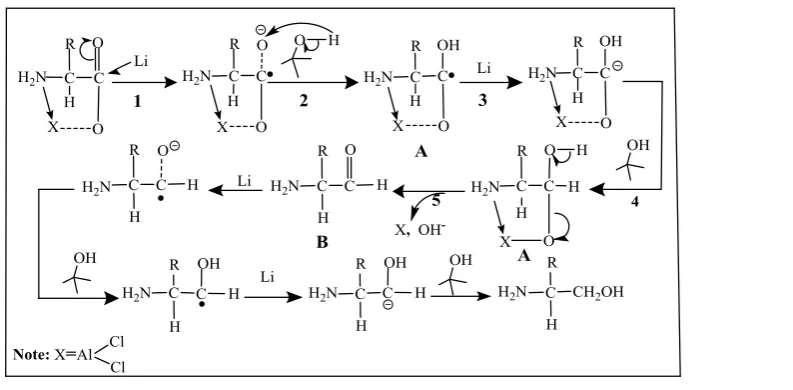
The principle [14-16] of this method is briefly showed in scheme 2. Under the condition of tert-butanol donating H+, the carbon atom of carbonyl group is successively attacked by two electrons from Li (step 1 and step 3) and then formed unstable intermediate A. In step 5, A takes off the groups in a form of OH- and X through electron transfer to form C, and then C repeated the steps of 1-4 to form amino alcohols.
Scheme 2: Principle of this method
According to the classic Bouveault-blanc reduction, Na associated ethanol (H+ donor) can reduce esters to alcohols. Although its yield is relatively lower, it provides a theoretical basis for our selection of Li as reducing agent. In the practical application, Li also has a certain reducing power, and compared with Na or LiAlH4, its
reaction is milder and easier to be controlled. Moreover, its by-products is fewer and post-processing is convenient. But using Li alone as reducing agent can not directly reduce amino acids, a kind of auxiliary agents should be added to activate the carboxyl group of amino acids. For its selection, our main consideration is the price and efficiency. Then AlCl3 was found more suitable, because it can chelate with amino acid and then
activate the carboxyl group through its electron-withdrawing effect[17-18]. It also has little influence on the reducing agent Li. As regarded the H+ donor, alcohol is a good choice, but low carbon alcohols such as ethanol or propanol can directly react with Li or AlCl3. So tert-butanol was chosen to weaken this influence.
Detailed research on the chelate reaction
143
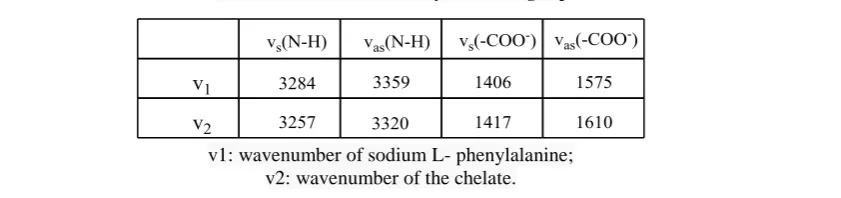
In this method, the sodium salt of amino acid was first prepared. The reason was to make the hydroxyl group ionization and facilitate its chelating with Al3+. We speculated that through the electron-withdrawing effect and steric effect, the chelated Al3+ can weaken the bond energy of carbonyl group and then facilitate it to be reduced. In order to demonstrate our speculation, L- phenylalanine was used as example to chelate with AlCl3, The
[image:5.595.102.523.149.248.2]recorded infrared data of its carboxyl and amino group are showed in table 2.
Table 2: Infrared data of carboxyl and amino group
v1: wavenumber of sodium L- phenylalanine; v2: wavenumber of the chelate.
Table 2 has showed that two absorption peaks of N-H move to low wavenumber (from 3284, 3359 to 3257, 3320) and two absorption peaks of –COO- move to high wavenumber (from 1406, 1575 to 1417, 1610). It proves that the amino and carboxyl group have been involved in the chelate reaction [20]. The changes of carboxyl’s infrared data also prove that the electron cloud density of C=O is weakened and its bonds energy is decreased.
ACKNOWLEDGMENTS
I would show my deepest gratitude to my tutor, A.P. Yuqing Cao , who has provided me with valuable guidance and financial support. I would also shall my thanks to Hebei University for providing me high quality laboratory, adequate chemical reagents, precision instruments, and free references.
REFERENCE
[1] EJ Corcy; CJ Hclal. J Angew Chem Int Ed, 1998, 37(15), 1986-2012. [2]MD Fryzuk; B Bosnich. J Am Chem Soc, 1978, 100(17), 5491-5494.
[3] Jordi Alsina; Francesc Rabanal; Cristina Chival. J Tetrahedron, 1998, 54, 10125-10152. [4] Mercedes Amat; Margalida Canto; Nuria Llor; J Org Chem, 2002, 67, 5343-5351. [5] DA Dickman; AI Meyers; GA Smith. J Org Syntheses, 1985, 63, 136-137. [6] JM Quirk; SG Harsy; CL Hakansson. P U S, 978793, 1990-12-18. [7] P. Mariappan; JV Kanth. J Org Chem, 1991, 56, 5946-5965.
[8] Kenso Soai; Hidekazu Oyamada; Masako Takase. J Synthesis, 1990, 299-301. [9] RC Anand. J. Tetrahedron Lett, 1998, 39, 917-918.
[10] MK. Ghorai; K Das; A Kumar. J Tetrahedron Letters, 2007, 48, 2471-2475.
[11] JM Herbert; AT Hewson; JE Peace. J Synthetic Communications, 1998, 28, 823-832. [12] ND Santis. P. U. S., 6262303, 2001-7-17.
[13] J Sanchiz; CT. Kremer. J Mol Str, 2006, 797, 179-183. [14] KP Suresh. J. Tetrahedron, 1986, 42, 6351-6388.
[15] L Bouveault; G Blanc. J Bull Soc Chim, 1904, 31, 666–672. [16] L Bouveault; G Blanc. J Compt Rend, 1903, 137, 60–62. [17] JH Eike, AF Palmer. J. Biotechnol. Prog., 2004, 20, 946-952. [18] GQ. Zeng. J. Chemical world, 1996, 37(6), 286.