International Journal of Emerging Technology and Advanced Engineering
Website: www.ijetae.com (ISSN 2250-2459, Volume 2, Issue 7, July 2012)220
Extended Schema Extraction and Evolution
Praveena Mandapati
1, U. Tulasi
21 Student, PVP Siddhartha Institute of Technology, Kanuru, Vijayawada (Dt), 2
Asst. professor, PVP Siddhartha Institute of Technology, Kanuru, Vijayawada (Dt)
Abstract - Everything ages including a deployed application, and with age often comes the desire to change things. One of the most painstaking aspects of updating a deployed application is transforming existing data. With traditional database persistence solutions, transforming existing databases is often done by first exporting the data using database tools or specialized exporter applications and then importing it into a new database schema, possibly converting data on the fly. Using explicit export and import steps can be tricky and time consuming. The export side often comes for free and easy, but the importer will need to reengineer the correct objects in the new schema knowing both the export format and the new schema. And these importers for RDBMS's are perfected for an optimized schema evolution analysis. Making such importers work reliably well for embedded databases with extended support for detecting complicated SMOs (Schema Modification Operators) such as DISTRIBUTE TABLE, PARTITION TABLE, MERGE TABLE, RENAME TABLE etc using version derivation graph (VDG) accumulated at random intervals of the application lifecycle. This happens to be the primary focus of this paper. Our work can be useful to dynamic updating and schema evolution researchers.
I. INTRODUCTION
Schema evolution is the ability to change deployed schemas, i.e., metadata structures formally describing complex artifacts such as databases, messages, application programs or workflows. Effective support for schema evolution is challenging since schema changes may have to be propagated, correctly and efficiently, to instance data,
views, applications and other dependent system
components. Schema evolution has been an active research area for a long time. Typical schemas thus include relational or object-oriented (OO) database schemas, conceptual ER or UML models, ontologies, XML schemas,
software interfaces and workflow specifications.
Obviously, the need for schema evolution occurs very often in order to deal with new or changed requirements, to correct deficiencies in the current schemas or to migrate to a new platform. Schema versioning, Modeling and mapping management is perfected for RDBMS's but not yet supportive to embedded databases.
As the reality of interest, usually captured by a database, changes over time, there is a need to be able to reflect these changes in the database. In this way, the requirements of new database applications can be facilitated and new applications are also able to access existing objects. Supporting consistent access to objects created under different schemas is a requirement also in the context of multi database systems. Here, component database schemas, possibly corresponding to different data models, need to evolve into a common, integrated, multi database schema that supports efficient and transparent data sharing among the component databases.
Develops a system that supports Schema evolution for embedded databases. It uses a common technique for making schema evolution adaptive to only additive schema changes. Old information is preserved, and the new code does the conversion either on the fly or in a separate conversion runs. This scheme leads to both clutter in the database and in the source code, and requires additional data cleanup steps to finalize the schema upgrade once the application has been migrated to the new code base. Substantial structural changes require more thought in this scheme, in particular if database side integrity constraints need to be considered. These integrity constraints range from issues in detecting complicated SMOs (Schema Modification Operators) such as DISTRIBUTE TABLE, PARTITION TABLE, MERGE TABLE, RENAME TABLE etc. Requires a better system for schema evolution analysis.
International Journal of Emerging Technology and Advanced Engineering
Website: www.ijetae.com (ISSN 2250-2459, Volume 2, Issue 7, July 2012)221
Using version derivation graph (VDG) accumulated at random intervals of the application lifecycle we intend to support complex SMOs (Schema Modification Operators) such as DISTRIBUTE TABLE, PARTITION TABLE, MERGE TABLE, RENAME TABLE etc while detecting relations.DIS ADVANTAGEGS OF EXISTING SYSTEM
It uses a common technique for making schema
evolution.
Adaptive to only additive schema changes.
Existing system leads to both clutters in the database and in the source code.
Requires additional data cleanup steps to finalize the schema upgrade.
Substantial structural changes require more thought in existing system.
ADVANTAGES OF PROPOSED SYSTEM
Maintain relationships among attributes, and the conditions for maintaining consistent views of programs.
Each schema version is expressed as a (database) view which constitutes actual interface to the application programs.
Schema changes are made transparent to the
application programs.
No need of extra data cleanup.
Proposed system lead to a cleaner and less clogged
visual specification.
II. RELATED WORK
Schema evolution has mainly been investigated as an aspect of OODBs. Broadly, approaches to schema evolution can be classified into schema modification, schema versioning and schema derivation, based on the external representation of the structure of the objects in the database (object schema) to application programs, and the internal representation of the objects in the underlying database.
Schema modification approaches always support a single schema and a single internal representation for each object. Hence, all objects must be converted to conform to the new schema. Because of this, the schema modification approach does not support the transparency of change for the existing application programs. The application programs that use the old schema may need to be modified.
Schema versioning approaches support multiple schemas and multiple internal object representations for an object.
The instantiation of objects to a schema version is performed at the time of the creation of the objects. In this approach, the objects belonging to a version of a schema always stays in that version. Thus, if the schema of the objects is subsequently augmented, it would not be possible for the objects to be updated by the programs associated with a later version without loss of information. In an old version, an augmented attribute may have insufficient storage.
Schema derivation approaches support multiple schemas for an object and a common internal object representation. Irrespective of whether objects are created under different schema versions, they are converted to a common representation. The instantiation of objects to a schema version is performed at runtime. That is, the objects are presented to the programs as views on objects in the
underlying database. Although existing derivation
approaches allow any schema version of an object to evolve, it is not clear how object consistency can be specified and maintained across schema versions derived from different paths.
Curino et al. have studied schema evolution for Wikipedia from April 2003 to November 2007. Their study provides both micro- and macro-classification of changes. The micro-classifications correspond to SMO syntax, which is a superset of the changes we investigate; in particular, we do not collect data on DISTRIBUTE TABLE, MERGE TABLE, COPY COLUMN, and MOVE COLUMN. Macro-classifications include changes to indexes, keys, types, syntax and engine; we decided to only consider changes to keys, types and initializers, as these have a direct impact on schema upgrade safety. They also compute the query success rate when running a query against preceding and following schema versions; we do not compute this, though we envision doing so in the future when we start analyzing queries for context information.
International Journal of Emerging Technology and Advanced Engineering
Website: www.ijetae.com (ISSN 2250-2459, Volume 2, Issue 7, July 2012)222
III. BASICS OF SCHEMA EVOLUTION
When a schema is changed, a new version of the schema (or new schema) is then created. We analyze the attribute relationships between two schema versions, and explicitly express these relationships in terms of functions.
A) Analysis of Attributes in Different Schema-Versions: When a schema evolves, the relationships between the attributes of the old and the new schema capture the semantics of installed changes. These relationships provide the crucial information for maintaining object consistency and reorganization of the objects in the underlying database. we classify the attributes between two schema versions based on the relationships of their names and their domains.
Common attributes: An attribute is said to be common to the two schemas, if the name and domain of the attribute in the two schemas is identical.
Domain-changed attributes: An attribute is said to be domain-changed if its name in the two schemas is the same but its domain is different.
Renamed attributes: An attribute is said to be renamed if the attribute in the two schemas has different names but exactly same domains.
Resumed attributes: An attribute is said to be resumed if the attribute was deleted from the old schema but it is added back to the new schema. Derived attributes: An attribute is said to be derived
if the value of the attribute can be derived from the values of other attributes not necessarily of the same schema version.
Dependent attributes: An attribute, let us say B, is said to be dependent if the value of the attribute is affected by changes to the values of attributes in other schema versions
Independent attributes: An attribute is said to be independent if its value neither affects, nor is affected by, the values of other attributes.
If the attribute is an attribute of the new schema, it is called new attribute. On the other hand, if the attribute is an attribute of the old schema, it is called an eliminated attribute.
B) Specification of Attribute Relationships
The relationships of each attribute group can be expressed with a help of functions. Our framework uses four kinds of functions:
Identity function. If attributes a and b are always identical, their relationship can be represented by using an identity function (I) a = I(b).
Derivation function. If an attribute a can be derived from b1, b2, …..bk, the relationship of a to attributes b1, b2, …. bk can be represented by a derivation function (f) a = f(b1, b2, ….. bk).
Prompt function. If an attribute a depends on attributes b1, b2, ….. bk but it cannot be derived solely from b1, b2, …..bk, (e.g., it may need additional information), the relationship of a to attributes b1, b2, …..bk, can be represented by using a prompt function (φ): a = φ(b1, b2, …..bk ), where φ represents the additional information. φ is possibly an interactive query against the whole database.
Default function. If the value of an attribute a in an object is unspecified but the value is required by an application program, then the value can be acquired by invoking a default function (default). By assigning a default value to an unspecified attribute value, the need of the application programs associated with different schema versions can be resolved.
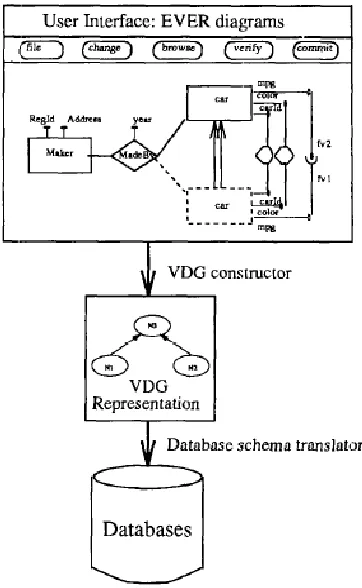
C) Evolutionary ER diagram (EVER) for Schema evolution An ER diagram is a graphical representation of an ER database schema. In order to support the specification of changes to ER diagrams, we extend the basic graphical constructs of ER diagrams to present the relationships of schemas before and after a change). We call this diagram EVER diagram. In an EVER diagram, a designer can express the following associations:
the derivation path of the new schema,
the relationships of attributes between the new schema and the old schema,
the participation of a new schema in relationship types (i.e., edges in an ERdiagram), and
the conditions for maintaining invariant program views.
IV. EXTENDED SCHEMA EXTRACTION AND EVOLUTION
International Journal of Emerging Technology and Advanced Engineering
Website: www.ijetae.com (ISSN 2250-2459, Volume 2, Issue 7, July 2012)223
The VDG representation captures the semantics of the EVER diagram and provides the storage requirements of objects for mapping the EVER diagram into the specific underlying data model. In the VDG representation there is a set of VDGs. Each VDG represents the derivation of a particular schema in an EVER diagram. [image:4.612.70.251.356.650.2]A VDG consists of a set of nodes and directed edges. A node captures the object structure (attributes) of a schema version and change relationships of the schema version to others. The objects created under a schema version are conceptually attached to the VDG node representing the schema version. A directed edge captures the object associations along the schema evolution course. There are two types of edges: derivation and inheritance edges. A derivation edge connects two VDG nodes corresponding to two schema versions (the old and the new) in an EVER diagram. Two kinds of nodes in a VDG are: virtual and non-virtual nodes.
Fig 1: Overview of Extended Schema Evolution
A non-virtual node corresponds to a schema version which is either the initial one or is augmented with attributes that cannot be derived from the old schema. That is, a non-virtual node contains base attributes.
A virtual node corresponds to a schema which does not contain any base attribute.
A VDG is currently designed to support schema derivation, it is geared toward a single internal object representation. The schema of an object is conceptually represented as the union of attributes of all the schema versions in a derivation lattice of the VDG (or the complete schema). Objects created under a new schema version that maps onto a non-virtual node cannot be stored in the underlying database described by the old schema versions. The underlying database needs to be re-organized in order to store objects created under the new schema version. On the other hand, the objects created from a schema version that maps onto virtual nodes can be completely stored in the underlying databases.
The presentation of the EVER diagrams thus far has been restricted to the evolution of database schemas for traditional database applications which can be modeled using classification and aggregation mechanisms. However, in some systems, such as object-oriented databases, there may exist inheritance relationships among entity types that
capture the generalization/specialization abstraction
between super classes and subclasses of entity types. Major steps performed by extended schema extraction and evolution as follows:
Step 1: Determine the complete schema of the VDG. Step 2: Determine the relations used to store the complete objects created by each schema version.
Step 3: Identify the objects created under a specific Schema version, and expand them into the complete objects. The objects created under a schema version may be stored in different relations.
Step 4: Construct a view for a schema version. Convert the complete objects created under a schema version to the objects viewed through the schema version, and then screen the objects that cannot satisfy the specified conditions out from the view of the programs and store in database.
A)The Mapping of an EVER Diagram onto VDGs
International Journal of Emerging Technology and Advanced Engineering
Website: www.ijetae.com (ISSN 2250-2459, Volume 2, Issue 7, July 2012)224
First, we compute the attribute set of each class in the new lattice, and then, compare it with that of its corresponding old class if there exists such one. If the new and old attribute sets are the same, both the old and new classes share the same VDG node. On the other hand, if the new class owns base attributes, then a non-virtual node is created for it; otherwise, a virtual node is created for that new class. Last, for each new node representing a class in the new lattice, establish an derivation path from a node corresponding to a class from which the new class has evolved.B)The Mapping of a VDG into an OODB
The mapping of a VDG into a relational database and the construction of views for each version of a class in an inheritance lattice In order to implement the Extended ER schema evolution in the context of an OODB, the primitive Augment() is introduced to augment an object structure in the underlying OODB database originally defined by an old class.
V. CONCLUSION
In this paper, We propose to derive a classification of attribute relationships between different schema versions. These relations are transformed into an internal database representation called a version derivation graph (VDG) which is subsequently mapped into the structures of the underlying database. we presented a schema derivation approach to schema evolution through changes to the ER schema of a database. The approach is supported by EVER, an Evolutionary ER diagram for specifying the derivation relationships between schema versions.
The VDG representation captures the semantics of the EVER diagram and provides the storage requirements of objects for mapping the EVER diagram into the specific underlying data model. With respect to the underlying database, each schema version is expressed as a (database) view. The view constitutes the actual interface to the application programs for accessing the objects in the database. Thus, views are reconstructed after a database reorganization so that schema changes are made transparent to the application programs while all objects in the database remain accessible to all the programs.
REFERENCES
[1 ] J. Banerjee et al. Semantics and Implementation of Schema
Evolution in Object- Oriented Databases. In Proc. of ACM SIGMOD, 1987.
[2 ] C. Yu and L. Popa, “Semantic adaptation of schema mappings when
schemas evolve,” in VLDB. VLDB Endowment, 2005, pp. 1006– 1017.
[3 ] Y. Velegrakis, R. J. Miller, and L. Popa, “Mapping adaptation under
evolving schemas,” in VLDB. VLDB Endowment, 2003, pp. 584– 595.
[4 ] S. M. Clamen. Schema Evolution and Integration. Journal of
Distributed and Parallel Databases, 1994.
[5 ] C. T. Liu, S. K. Chang, and P. K. Chrysanthis. Database Schema Evolution using EVER Diagrams. In Proc. of ntl. Workshop on Advanced Visual Interfaces, 1994.
[6 ] C.T. Liu, P.K. Chrysanthis, and S.K. Chang. Schema Evolution
through Changes to ER Diagrams. Journal of Computer and Information Sciences,, 9(4), 1994.
[7 ] S. B. Navathe and M. K. Pillalamarri. OOER: Toward Making the
E-R Approach Object-Oriented. In Proc. of the 8th Intl. Conference on Entity-Relationship Approach, 1989.
[8 ] R. Zicari. A Framework for Schema Updates in an Object-Oriented
International Journal of Emerging Technology and Advanced Engineering
Website: www.ijetae.com (ISSN 2250-2459, Volume 2, Issue 7, July 2012)225
About Authors
M.Praveena received M.Sc
computer science from
P.B.Siddhartha College,
Vijayawada, Andhra Pradesh. She is currently pursuing Post Graduation (M.Tech) in PVP Siddhartha Institute of Technology, in the Department of Computer Science and Engineering, Vijayawada, Andhra Pradesh. Her research interests include Data Engineering. She has five years of experience in teaching. She is the member of ACM.
U.Tulasi received her B. Tech
from Bapatla engineering
college and completed post graduation from KLCE college. She is currently working as Assistant Professor in PVP
Siddhartha Institute of