A Multi Intelligent Agent-based Approach for Optimizing
Commercial Recommendations
Chaimae Lamaakchaoui
Laboratory of Mathematics and Applications
Faculty of Sciences and Technologies (FST), Tangier,
Morocco
Abdellah Azmani
Laboratory of Computer Sciences, Computers and
Telecommunications (LIST) Faculty of Sciences and Technologies (FST), Tangier,
Morocco
Mustapha El Jarroudi
Laboratory of Mathematics and Applications
Faculty of Sciences and Technologies (FST), Tangier,
Morocco
ABSTRACT
In the present paper a model of a multi agent based system is presented, which helps marketers on the one hand to address its products to the best targets and in the another hand to generate relevant product recommendations for customers that best match their interests and needs. To achieve this, the system is based on six agents. Each one of them has a specified role but can also communicate with other agents to share knowledge and achieve common goals. In order to generate relevant recommendations and target the best customers, the system uses different types of parameters (the customer‟s parameters, product‟s parameters, parameters of the context and the constraints).
General Terms
Product recommendation, customer selection.
Keywords
Multi-agent; intelligent agent; customer satisfaction; recommendation, customer interest; customer need; customer profile.
1.
INTRODUCTION
During the last two decades, Internet has proven to be a successful channel for marketing goods and services since it has removed barriers of distance and turned the whole world into one small village [1]. Indeed, moving toward electronic commerce has forced companies to adopt new strategies that could not exist with the physical commerce[2]. Besides, it has helped them to target new markets and provide customers with more options. As a matter of fact, companies can today gather easily and more accurately a large amount of information about customers [3].
Unfortunately, information overload raises many problems. Firstly, choosing a product to purchase, an article to read or even a video to watch has become such a complicated task for customers, as there are many alternatives to check and compare before they can select the best ones [4]. Secondly, understanding customers‟ expectations and assigning to them appropriate suggestions are such big concerns for companies as there is a huge amount of available information on consumers that needs to be properly exploited so as to better understand them and ensure high satisfaction for them [5], [6]. One solution to these problems is the use of recommender systems. Recommender systems are systems that predict what the most suitable contents (product, service, web page, news, video,) are for one customer [7] according to his tastes and preferences.
The proposed approach in this paper aims to reach a better satisfaction of customers while the recommendations they will receive are highly relevant to their profiles. The
recommendations combine multiple attributes that are respectively related to the customer, the product and the context. Besides, they take into consideration the constraints of the customers and also their scheduling preferences for receiving recommendations.
The rest of the paper is organized as follows. In the next section, a state of the art is described, and then the third section includes an architecture of the system‟s approach is given and also a presentation of the technical structure as well as an overview on methods that will be implemented in each agent of the system.
2.
STATE OF THE ART
Recommender systems are decision support systems that help marketers tailor products, services and content to a customer depending on his personal interests and preferences [8]. They have been used in different domains: tourism [9], e-learning [10] (to Predict student performance), e-commerce [11] (recommend to customers items that may be of interest for them). In electronic commerce, many large e-commerce sites are implementing recommender systems to make personalized suggestions [12] for customers about products to purchase [13], movies to watch [14], music to listen to [15], news to read [16] and restaurants to visit [17]. In general, they collect information about customers‟ online behavior and feedback, and then provide suggestions based on their demographics, purchases history, features of items, preferences and tastes [17], [18].
Recommender systems are generally classified into three paradigms. The first one deals with the behavior of the users and is called Collaborative Filtering. The second either deals with the content‟s features (content-based filtering [19], [20]) or with the demographic of the user (demographic-based filtering [21], [22]). The third paradigm is called hybrid recommender systems [16] and consists of combining both content-based and collaborative filtering in order to improve the performance of the recommender system [23]. In [24], besides of the users and items attributes, the authors include in the recommendation process the contextual information so as to recommend items to users in certain circumstances.
list of top ranked items corresponding to his profile. Amazon.com uses recommendation algorithms to personalize the online store for each customer [25], [26]. Amazon uses an item-to-item collaborative filtering in order to personalize online catalogue for every customer. For each item purchased or rated a list of related items is generated to form recommendations. When a customer buys an item, he will receive recommendations from that list [27].
3.
PROPOSED APPROACH
3.1
Problem Positioning
In the marketing field, many recommender systems exist that help customers overcome information density over the Internet and finding relevant products and services to their profiles. These systems rely generally on five types of parameters: customer behavior, features of the product, customer demographics, context or the combination of each parameter with the other ones. Studying related constraints to a customer can ensure better results since it prevents addressing to him products with features that contradict with his profile. On the other hand, respecting one customer„s schedule preferences for recommendations receipt may increase his satisfaction and consequently his loyalty. While these two parameters have not been included in the existing recommendation processes, it is clear that there is still a need for recommender systems that not only relies on a customers‟ basic information (interests, preferences, tastes, likes/dislikes, demographics) but also includes in its analysis both customer constraints (products black list, refused brands,) and his/her temporal scheduling preferences.
3.2
Commercial Recommendations
The system generates recommendations for a given customer because of the following reasons:
Temporary need: The customer shows a particular need because he has searched for a specific product/service or category.
Cross-sell: The customer has already purchased a product and might be interested in related additional products.
Suggest similar products: The customer has purchased a product and may be interested in similar ones.
Profile match: Suggest to the customer products that match his interests, preferences and tastes.
The generated recommendations by the system must respond to the following requirements:
Avoid saturating customers with similar product suggestions;
Respect the current context;
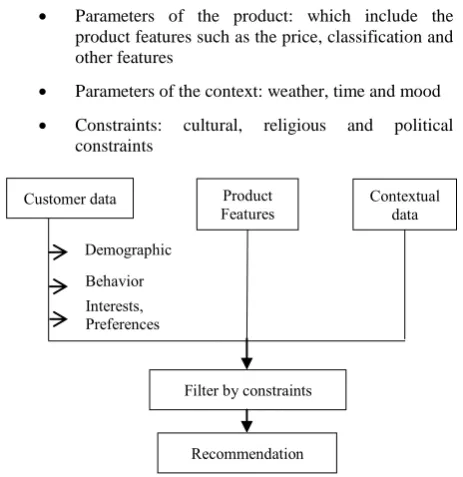
To make recommendations, the system will combine in its process different types of parameters (Fig. 1):
Parameters of the customer:
o Behavior history: searches, past purchases, feedback
o Demographic information: gender, age, profession
o Preferences and interests
Parameters of the product: which include the product features such as the price, classification and other features
Parameters of the context: weather, time and mood Constraints: cultural, religious and political
constraints
3.3
Architecture of the System
Intelligent agent based systems are systems composed of autonomous entities. Each entity acts independently, but can also interact with other entities to achieve common goals [28], [29]. These entities are called intelligent agents. Intelligent agent based systems are a continuously expanding area [28], especially in the recommendation systems field where many researches have been made to implement agent technology for the web search recommendations [30] and products recommendation [31].
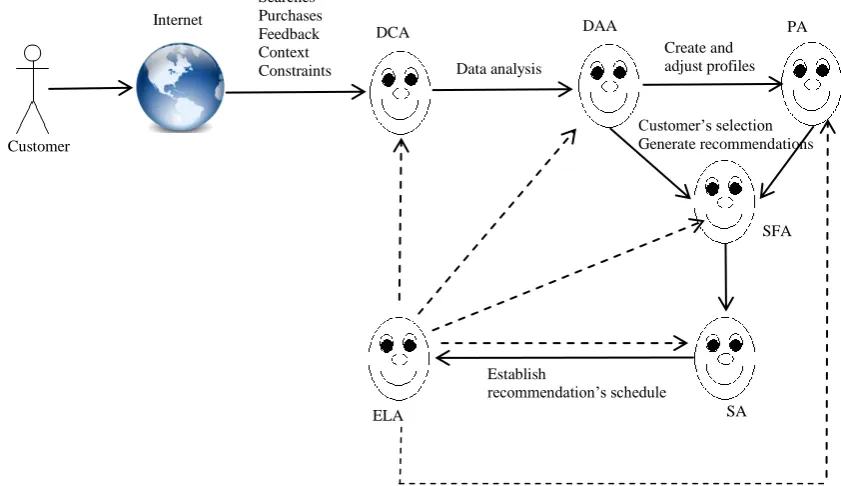
To generate recommendations for customers, the system follows a process that uses six intelligent agents; each agent is charged with specific tasks but can interact with other agents to achieve common goals. Fig. 2 shows the structure of the system and how agents are related to each other. Data collector agent (DCA) collects four types of information: Information about the customer, the product or service, the context and the constraints. Product‟s information means its classification, price and features. As for contextual information, it includes time, weather and location. Whereas customer‟s information is split into four categories: explicit data (ratings, purchased products, read news, visited sites and demographic information like age, gender and occupation), implicit data (interests and preferences). Constraints mean product categories one customer does not like or that contradict whether with his culture, religion or political position. The data analyzer agent (DAA) accesses the collected data, analyses it and extracts existing correlations between products, between customers and also existing correlations between both products and customers. Using the extracted correlations, the profiling agent (PA) then defines customers‟ profiles and modifies existing profiles according to new extracted knowledge. The selection and filtering agent (SFA) has two main tasks. It selects for a product target customers whose profiles best match the product‟s features. It also generates for each customer a list of recommended products that match his interests and tastes, respect his constraints and correspond to a given context. Both customers‟ selection and products‟ recommendation use a
Customer data Product
Features
Contextual data Demographic
Behavior Interests, Preferences
Filter by constraints
[image:2.595.314.546.70.309.2]Recommendation
filtering process that includes different parameters as described in Fig 2.
When the selection is done, the planning agent (PA) is charged with establishing suitable schedule for customers to receive recommendations. Schedules are established and adjusted according to the customers behavior for example one
customer may like to receive during week days clothes suggestions but when a holiday is coming, he prefers to receive suggestions about flights and hotels. The evaluation and learning agent (ELA) analyses recommendation results and extracts new rules to be integrated by other agents so as to improve future recommendations.
3.4
Technical Structure
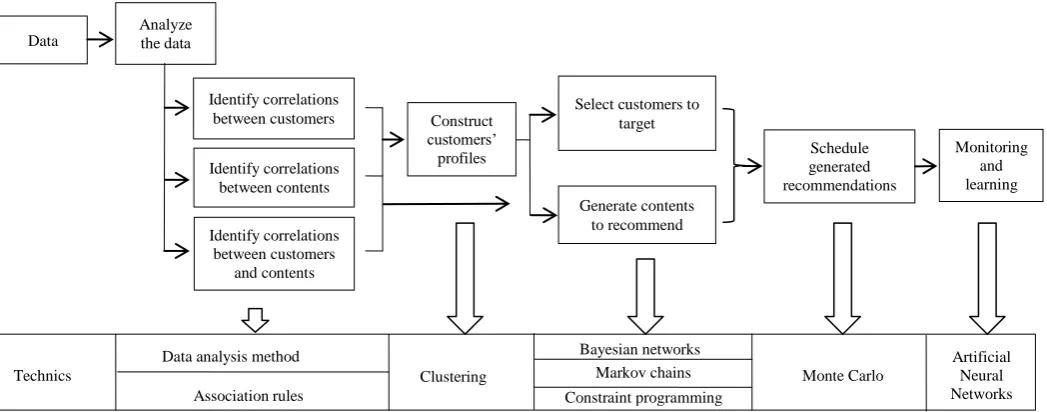
In order to achieve the desired results, every agent will implement one or more technics derived from artificial intelligence. Fig 3 shows the implemented methods in every step of the process.
- Data analysis: In this step voluminous, heterogeneous and multidimensional data need to be analyzed. That‟s why multidimensional data analysis technics like regression [32] will be used to identify the correlations between parameters. As for association rules, they will help identify which parameters are related to each other.
- Selection and filtering: At this level the agent has two functions: Generate content recommendations for customers; which is done through studying customers future needs and interests and select customer targets for active contents. Because of the probability aspect in the two functions, Bayesian Networks [33] and Markov Chains [34][ are suited for this kind of problems. As the selection of which contents to suggest for customers relies on some constraints, constraints programming will be helpful.
- Scheduling: In this step, the scheduling agent will use Monte Carlo [35] methods to choose best time slots for recommendations diffusion according to each customer.
- Monitoring and learning: The involved agent will monitor and validate the results. Neural Networks [36] will be used so as to learn from the results generated by each activity (whether it
is an established recommendation for one customer or customers selection for one product) and optimize future recommendations.
3.5
Results Discussion
Table 1 gives a comparison between the proposed approach and existing ones about the way recommendations are given, types of predictions provided and about the learning process each approach includes. All the three approaches rely on the item and user‟s attributes except that Amazon and Fab ignore the context and constraints parameters in terms of recommendations‟ personalization. Considering the purposes of each approach, both Amazon and Fab‟s predictions focus on defining items that customers are likely interested in, whereas our approach aims to select customers for a given product and also generate products or items that one customer may like. On the other hand the learning process is handled differently. In Fab, learning is performed through profiles by using the knowledge of existing profiles to create new ones, while Amazon and our approach implement machine learning for both profiles‟ management and recommendations‟ generation.
4.
CONCLUSION
[image:3.595.102.523.161.404.2]In this paper a recommender system approach has been described that helps ensure a better customer satisfaction since it takes into account different parameters (about the customer‟s information, the product, the context, the constraints and schedule preferences). The architecture of the Fig 2. Architecture of the system
Internet
DCA Searches
Purchases Feedback Context Constraints
DAA PA
SFA
SA ELA
Data analysis
Create and adjust profiles
Customer‟s selection Generate recommendations
Establish
recommendation‟s schedule Customer
proposed system as described in Fig. 2, which relies on multiple intelligent agents that interact with each other in order to select customers for a given product or service and also to generate recommendations for customers that better match their profiles. Future works will focus on implementing
[image:4.595.50.574.144.350.2]the proposed architecture and its agents and also on using artificial intelligence based technics showed in Fig. 3 such as Bayesian Networks and association rules to put into practice intelligent aspect for the involved agents.
Table 1: Comparison about the recommendations' generation in the three approaches
System Personalization Context Constraint Prediction Learning process
Fab Item attributes
User attributes
No No Items users may like Profiles
Amazon Item attributes
User attributes
No No Items users may be interested in Profiles
Items
Our approach Item attributes
User attributes
Yes Yes Items users may like
Select customer targets for items
Profiles
Items
5.
REFERENCES
[1] G. J. Avlonitis and D. A. Karayanni, “The Impact of Internet Use on Business-to-Business Marketing: Examples from American and European Companies,” Industrial Marketing Management, vol. 29, no. 5, pp. 441–459, Sep. 2000.
[2] J. B. Schafer, J. A. Konstan, and J. Riedl, “E-Commerce Recommendation Applications,” Data Min. Knowl. Discov., vol. 5, no. 1–2, pp. 115–153, Jan. 2001.
[3] Ronald D. Michman, Edward M. Mazze, and Alan J. Greco, Lifestyle Marketing: Reaching the New American Consumer. 2003.
[4] M. Dabrowski and T. Acton, “The performance of recommender systems in online shopping: A user-centric study,” Expert Systems with Applications, vol. 40, no. 14, pp. 5551–5562, Oct. 2013.
[5] Z. Huang, W. Chung, and H. Chen, “A Graph Model for E-Commerce Recommender Systems,” Journal of the American Society for Information Science and Technology, vol. 55, pp. 259–274, 2004.
[6] J. W. Kim, B. H. Lee, M. J. Shaw, H.-L. Chang, and M. Nelson, “Application of Decision-Tree Induction Techniques to Personalized Advertisements on Internet Storefronts,” Int. J. Electron. Commerce, vol. 5, no. 3, pp. 45–62, Mar. 2001.
[7] L. Rokach, Recommender Systems Handbook, 2011 edition. New York: Springer, 2010.
[8] T.-P. Liang, H.-J. Lai, and Y.-C. Ku, “Personalized Content Recommendation and User Satisfaction: Theoretical Synthesis and Empirical Findings,” Journal of Management Information Systems, vol. 23, no. 3, pp. 45–70, Jan. 2007.
[9] J. Borràs, A. Moreno, and A. Valls, “Intelligent tourism recommender systems: A survey,” Expert Systems with Applications, vol. 41, no. 16, pp. 7370–7389, Nov. 2014.
[10] N. Thai-Nghe, L. Drumond, A. Krohn-Grimberghe, and L. Schmidt-Thieme, “Recommender system for predicting student performance,” Procedia Computer Science, vol. 1, no. 2, pp. 2811–2819, 2010.
Analyze the data
Identify correlations between customers
Identify correlations between contents
Identify correlations between customers
and contents Data
Construct customers‟
profiles
Select customers to target
Generate contents to recommend
Schedule generated recommendations
Monitoring and learning
Technics
Data analysis method
Associationrules
Clustering
Bayesian networks Markov chains
Constraint programming
Monte Carlo
[image:4.595.49.550.399.526.2]Artificial Neural Networks
[11] Chih-Ping Wei, Michael J. Shaw, and Robert F. Easley, “A survey of recommendation systems in electronic commerce,” Nov. 2001.
[12] P. Melville and V. Sindhwani, “Recommender Systems,” in Encyclopedia of Machine Learning, C. Sammut and G. I. Webb, Eds. Springer US, 2010, pp. 829–838.
[13] J. B. Schafer, J. Konstan, and J. Riedl, “Recommender Systems in e-Commerce,” in Proceedings of the 1st ACM Conference on Electronic Commerce, New York, NY, USA, 1999, pp. 158–166.
[14] W. Carrer-Neto, M. L. Hernández-Alcaraz, R. Valencia-García, and F. García-Sánchez, “Social knowledge-based recommender system. Application to the movies domain,” Expert Systems with Applications, vol. 39, no. 12, pp. 10990–11000, Sep. 2012.
[15] S. K. Lee, Y. H. Cho, and S. H. Kim, “Collaborative filtering with ordinal scale-based implicit ratings for mobile music recommendations,” Information Sciences, vol. 180, no. 11, pp. 2142–2155, Jun. 2010.
[16] M. Claypool, A. Gokhale, T. Miranda, P. Murnikov, D. Netes, and M. Sartin, Combining Content-Based and Collaborative Filters in an Online Newspaper. 1999.
[17] R. T. Rust and P. K. Kannan, E-Service: New Directions in Theory and Practice. M.E. Sharpe, 2002.
[18] J. Buder and C. Schwind, “Learning with personalized recommender systems: A psychological view,” Computers in Human Behavior, vol. 28, no. 1, pp. 207– 216, Jan. 2012.
[19] M. J. Pazzani and D. Billsus, “The Adaptive Web,” P. Brusilovsky, A. Kobsa, and W. Nejdl, Eds. Berlin, Heidelberg: Springer-Verlag, 2007, pp. 325–341.
[20] P. Lops, M. de Gemmis, and G. Semeraro, “Content-based Recommender Systems: State of the Art and Trends,” in Recommender Systems Handbook, F. Ricci, L. Rokach, B. Shapira, and P. B. Kantor, Eds. Springer US, 2011, pp. 73–105.
[21] M. J. Pazzani, “A Framework for Collaborative, Content-Based and Demographic Filtering,” Artif. Intell. Rev., vol. 13, no. 5–6, pp. 393–408, Dec. 1999.
[22] Y. Wang, S. C.-F. Chan, and G. Ngai, “Applicability of Demographic Recommender System to Tourist Attractions: A Case Study on Trip Advisor,” in Proceedings of the The 2012 IEEE/WIC/ACM International Joint Conferences on Web Intelligence and Intelligent Agent Technology - Volume 03, Washington, DC, USA, 2012, pp. 97–101.
[23] R. Burke, “Hybrid Recommender Systems: Survey and Experiments,” User Modeling and User-Adapted Interaction, vol. 12, no. 4, pp. 331–370, Nov. 2002.
[24] G. Adomavicius and A. Tuzhilin, “Context-Aware Recommender Systems,” in Recommender Systems Handbook, F. Ricci, L. Rokach, B. Shapira, and P. B. Kantor, Eds. Springer US, 2011, pp. 217–253.
[25] M. Balabanović and Y. Shoham, “Fab: Content-based, Collaborative Recommendation,” Commun. ACM, vol. 40, no. 3, pp. 66–72, Mar. 1997.
[26] M. Balabanović, “An Adaptive Web Page Recommendation Service,” in Proceedings of the First International Conference on Autonomous Agents, New York, NY, USA, 1997, pp. 378–385.
[27] G. Linden, B. Smith, and J. York, “Amazon.Com Recommendations: Item-to-Item Collaborative Filtering,” IEEE Internet Computing, vol. 7, no. 1, pp. 76–80, Jan. 2003.
[28] Faisal Alkhateeb, Eslam Al Maghayreh, and Iyad Abu Doush, Multi-Agent Systems - Modeling, Control, Programming, Simulations and Applications. 2011.
[29] Ron Sun, Cognition and Multi-Agent Interaction: From Cognitive Modeling to Social Simulation. Cambridge University Press, 2006.
[30] A. Birukov, E. Blanzieri, and P. Giorgini, “Implicit: An Agent-based Recommendation System for Web Search,” in Proceedings of the Fourth International Joint Conference on Autonomous Agents and Multiagent Systems, New York, NY, USA, 2005, pp. 618–624.
[31] B. K. Mohanty and K. Passi, “Agent based e-commerce systems that react to buyers‟ feedbacks – A fuzzy approach,” International Journal of Approximate Reasoning, vol. 51, no. 8, pp. 948–963, Oct. 2010.
[32] A. O. Sykes, An Introduction to Regression Analysis. Law School, University of Chicago, 1993.
[33] P. Naïm, Réseaux bayésiens. Editions Eyrolles, 2007.
[34] S. M. Ross, Introduction to Probability Models. Academic Press, 2014.
[35] N. T. Thomopoulos, Essentials of Monte Carlo Simulation: Statistical Methods for Building Simulation Models. Springer Science & Business Media, 2012.