A Survey of Issues in Supporting QoS based
Multicast Routing Protocols over MANETs
Dinesh Chander
N.C.Institut of Computer Sciences, Israna(Panipat)
Rajneesh Kumar
MM University Mullana (Ambala)
ABSTRACT
Mobile Ad hoc Networks (MANETs) have been attracting significant attention due to their promising technology. A MANETs consists of wireless nodes communicating without the need for a centralized administration. With the expanding scope of applications of MANETs, the need to support Quality of Service (QoS) in these networks is becoming essential. The resource limitations and variability make QoS support a very complex process. Different applications have different QoS parameters in terms of end-to-end performance, such as bandwidth, delay, probability of packet loss, and delay variance (jitter). This paper provides a survey of issues in supporting QoS based multicast routing protocols in MANETs.
Keywords
MANET, QoS, Multicast routing, Delay, Jitter, Bandwidth.
1.
INTRODUCTION
Mobile ad hoc networks (MANET) have become an interestingly popular group communication system which is formed by wireless mobile hosts without an established infrastructure or centralized control [1]. This is related to their easy deployment and fast configuration. They can usually be set-up in environments where the deployment of a wired network is difficult or not economically feasible (e.g., disaster areas, training grounds, battlefields, conference sites, earthquake, terrorist activities, hotels etc). The MANET nodes do not provide reliable services and QoS (Quality of Service) guarantees as compared to other wireless networks such as WiFi, WiMAX, GSM and CDMA. The major reasons of unreliability in MANETs are due to high mobility of nodes, limited battery capacity, limited memory and processing power, varying channel conditions and less stability under unpredictable and mobile behaviour [2].QoS refers to a set of predefined service parameters that can be measured, including delay, packet loss rate, energy consumption, and service coverage [24]. QoS is one of the significant components to evaluate MANET performance since QoS restricts the bounds on bandwidth, delay, bandwidth delay product, jitter and packet loss. Ignorance of these parameters can degrade the overall performance of an application. The main objective of QoS based multicast routing involves finding a multicast tree rooted from the source node and spanning to all receiving nodes, with every internal path from the source to the destination satisfying the QoS requirements. Due to its limited bandwidth, a single multicast tree that meets the QoS requirements may not be available and, as a result, QoS multicast routing may be blocked. The notions of QoS (quality of service) are supposed to capture the qualitatively or quantitatively defined performance contract between the server and client. QoS metrics can be concave, additive or multiplicative [13]. QoS based
multicasting typically deals with multiple constraints on the selected routing tree (path). Assume m(u,v) is the performance metric for the link (u,v) connecting host u to host v, and a path (u, u1, u2,..., uk, v) is a sequence of links in the multicast tree. Three types of constraints on the path are given in [3, 4]:
1. Additive constraints: End-to-end delay between (u,v) is an additive constraint that is equivalent to the summation of delays at each link.
i.e. m(u, v) = m(u, u1) + m(u1, u2) + … + m(uk, v)
2.Multiplicative constraints: The probability prob(u,v) for a packet to reach v from u is the product of individual link probabilities.
i.e. m(u, v) = m(u, u1) × m(u1, u2) × … × m(uk, v)
3. Concave constraints: The bandwidth band (u,v) available along the path from u to v is the minimum bandwidth among the links on the path.
i.e. m(u, v) = min{m(u, u1), m(u1, u2), … ,m(uk, v)}.
The dynamic nature of mobile ad hoc networks makes QoS based multicasting a challenging and open issue for research community. Further QoS support parameters are different for different applications. For example, in multimedia applications, the bandwidth and delay are key parameters, whereas military applications security and reliability will be additional requirements. Multimedia applications require advance resource reservation for better delivery of packets, whereas real-time applications require a QoS guarantee in terms of bandwidth, delay, delay jitter and packet loss probability. For applications such as emergency search and rescue operations availability is the key parameter. In this paper a detailed survey of issues that restricts QoS support in multicast techniques will be done to motivate the researchers to work in this direction.
2.
RELATED WORK
other QoS requirement such as the packet delivery ratio. Hui Xia et al. [8] proposed a link stability estimation model based on received signal strength indication. They integrated this model into MAODV and present a stability-based multicast routing protocol termed as SMR. SMR can discover more available stable routes and better adapt to
network topology changes.SMR is an extension of MAODV protocol, thus the Multicast Routing Table, Route Request (RREQ), Route Reply (RREP) and Route Error packet formats are similar to those used in MAODV. Simulation results show the superiority of SMR
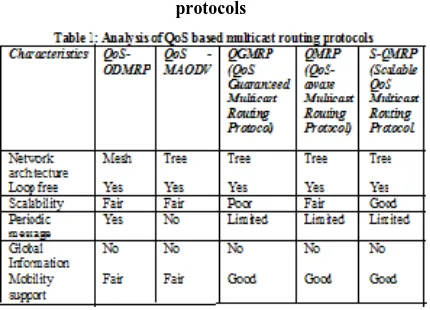
[image:2.595.79.294.483.638.2]over the existing methods in terms of packet delivery ratio, average end-to-end delay and routing packet overhead. G. Santhi et al. [9] propose an agent based Multi-Constrained QoS aware multicast routing scheme based on MAODV (MC_MAODV) which uses a set of static and mobile agent. It depicts QoS multicast model with multiple constraints which may deal with bandwidth reservation, delay constraint and packet loss to multicast session. Evgeny Khorov et al. [10] proposed an approach of using multiple metrics simultaneously, with one of the metrics which they call optimizable, reflecting consuming network resources, and other metrics which they call restrictive, reflecting QoS requirements. If a route length goes beyond a threshold in at least one of the restrictive metrics, the route shall not be chosen for packet delivery, to escape network resources waste. So, the best route is chosen in an optimizable metric, in the class of routes allowed by restrictive metrics. The approach is applicable for both unicast and multicast traffic in MANETs. Hua Chen et al. [11] proposed an entropy-based genetic algorithm (GA) to support QoS multicast routing in mobile ad hoc networks (EQMGA). They construct a new metric-entropy and select the long-life path with the help of entropy metric to reduce the number of route reconstruction so as to provide QoS guarantee in the ad hoc network. Golla Varaprasad [22] proposed a minimum-energy-broadcast tree. It performs based on Prim’s algorithm. The received-signal-power in the BIP model is r−∞, where r is the transmission range and ∞ is a parameter that typically takes value between 2 and 4. A brief analysis of different QoS based multicast routing and their characteristics has been as shown in table 1 [2, 13, 20, 21].
Table 1: Analysis of QoS based multicast routing protocols
Due to the dynamic nature of the network topology and restricted resources, quality of service (QoS) and multicast routing in MANET is a challenging task. It is observed from the literature that multicast routing with QoS support still needs lot of attention to make the routing scheme robust, to maximize packet delivery ratio and to adapt dynamic changes in MANET topology and environment. In this paper through review of issues involved in QoS based multicast has been done to find the future work in this direction.
3.
WHY QOS MULTICAST IN
MANETS?
As the most of the applications area of MANETs are very crucial, so multicast routing protocols requires a stringent quality of services. Issues like scarce bandwidth, highly dynamic network topology, mobile nodes, battery life and an unreliable communication medium pose special challenges on the design of multicast routing protocol. QoS multicast routing depends on the accurate availability of the current network state, which is expensive to maintain because of network dynamics and aggregation in large networks [4]. It is clear that there will be tradeoff between the design complexity of QoS multicast protocols and the resulting performance improvement, especially in large-scale networks. But the absence of QoS supported multicast will put a question mark on the application areas of MANETs. Therefore economical QoS supported multicast is an utmost requirement and a big challenge for research community.
4.
ISSUES IN SUPPORTING QOS
BASED MULTICAST
There are many issues of MANETs that makes QoS based multicast routing a challenging task for research community. Some of these issues are summarized as follows [13, 14, 18]:
i) Robustness: Link failures are very common issue in Ad hoc networks due to high mobility of nodes, which results in a low packet delivery ratio. Therefore a robust QoS supported multicast are required to maintain a high packet delivery ratio.
ii) Control overhead: In Ad hoc network, lot of control packets are exchanged to keep track of the members in multicast group. This consumes a considerable amount of bandwidth. So a QoS based multicast routing protocol must be designed to keep this overhead as minimum as possible.
iii) Efficient group management: In multicast a data packet is received by all the members of multicast group. Further in Ad hoc network, a node is free to join or leave a group at any instant of time. So efficient group management is required and is challenging issue for proper transmission of data packets in MANETs.
iv) Network size: Routing protocols are broadly classified in three categories namely Proactive, Reactive and Hybrid. Proactive or table driven becomes more problematic as QoS state gathered or disseminated in some way for routing decisions to be made. Problem become worse as the network size grows, in terms of update latency and message overhead.
varying, and also how it accelerates, for example, uniformly or exponentially with time. The pause time determines the length of time nodes remain stationary between each period of movement. Together with maximum and minimum speed, this parameter determines how often the network topology changes and thus how often network state information must be updated. Providing of robust QoS support in this highly mobile environment is a challenging task.
vi) Node transmission power: Multicast routing protocols for MANETs are designed for group communication among mobile devices. Some nodes may have the ability to vary their transmission power. This is important, since at a higher power, nodes have more direct neighbors and hence connectivity increases, but the interference between nodes does as well. Transmission power control can also result in unidirectional links between nodes, which can affect the performance of routing protocols.
vii) Channel characteristics: The broadcast and time varying characteristics of the radio channel poses a unique challenge in implementing QoS based multicast. There are many reasons like sharing, collision and error prone behaviour of wireless channel makes it unreliable, that is,
Many reasons why bits, and hence data packets, may not be delivered correctly. These all affect the network’s ability to provide QoS.
viii) Number, type and data rate of traffic sources:
Intuitively, a smaller number of traffic sources results in fewer routes being required and vice versa. Traffic sources can be constant bit rate (CBR) or may generate bits or packets at a rate that varies with time according to the Poisson distribution, or any other mathematical model. The maximum data rate affects the number of packets in the network and hence the network load.
ix) Lack of centralized Control: In the absence of central administrator, all network operations, including security related control, are on the self-configuration base and in a decentralized way. This generally increases an algorithm’s overhead and complexity, as QoS state information must be disseminated efficiently.
x) Hidden Terminal problem: The hidden terminal problem is inherent in Adhoc wireless networks. This problem occurs when packets originating from two or more sender node, which are not within the direct transmission range of each other, collide at a common receiver node. It necessitates the retransmission of the packet, which may not be acceptable for flow that has stringent QoS requirements.
5.
LAYERED QOS PARAMETERS OF
MANETS
In a MANET environment the problem of guaranteeing QoS to users or applications is more complex than in a wired communication environment. Furthermore, the characteristics of mobile ad hoc networks complicate QoS support: the communication medium is unreliable and error-prone, limited bandwidth which often limits the use of control messages, nodes are free to join, move or leave the network at any moment, making the topology entirely dynamic and unpredictable, battery energy as well processing power are generally low. Most of conventional multicast routing protocols are designed for minimizing data traffic in the network or minimizing the average hops
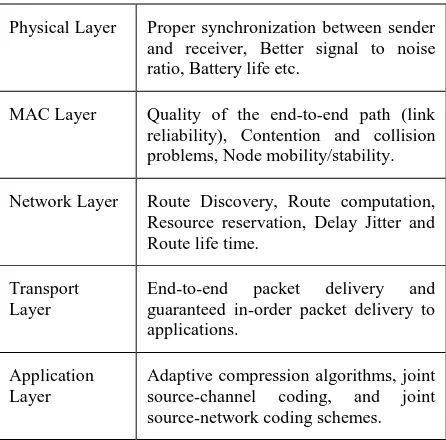
[image:3.595.323.546.258.478.2]for delivery a packet. When Quality of Service is considered, some protocols may be unsatisfactory or impractical due to the lack of resources, the excessive computation overhead, and the lack of knowledge about the global network state or the excessive message processing overhead. However, some multicast routing protocols, such as AMRIS, LGT and CAMP are designed without explicitly considering QoS [15]. QoS multicast routing not only requires finding a route from a source to a destination, but satisfying the end-to-end QoS requirement, often given in terms of bandwidth or delay. Moreover, for the MANET to retain its efficiency, the protocols at various layers may need to be robust enough to adjust the dynamic characteristics of MANETs. QoS parameter is different at different layers of the networking stack as given below in table 2 [3,5,12].
Table 2: QoS parameters at different network layer
Physical Layer Proper synchronization between sender and receiver, Better signal to noise ratio, Battery life etc.
MAC Layer Quality of the end-to-end path (link reliability), Contention and collision problems, Node mobility/stability.
Network Layer Route Discovery, Route computation, Resource reservation, Delay Jitter and Route life time.
Transport Layer
End-to-end packet delivery and guaranteed in-order packet delivery to applications.
Application Layer
Adaptive compression algorithms, joint source-channel coding, and joint source-network coding schemes.
Thus QoS is a collection of characteristics or constraints that a connection must guarantee to meet the requirements of an application.
6.
EVALUATION METRICS FOR
QOS ROUTING PROTOCOLS
As mentioned above different applications have different requirements, the services required by them and the associated QoS parameters differ from application to application. For example, in multimedia applications, the bandwidth and delay are key parameters, whereas military applications security and reliability will be additional requirements. Multimedia applications require advance resource reservation for better delivery of packets, whereas real-time applications require a QoS guarantee in terms of bandwidth, delay, delay jitter and packet loss probability. For applications such as emergency search and rescue operations availability is the key parameter. The following is a sample of the metrics commonly used by applications to specify QoS requirement to the routing protocol [16, 17, 18, 19].
ii) Minimum Throughput (bps) – Throughput is a quantitative measurement defined as the rate at which a computer or network sends or receives data.
iii) Stability- can be used for selecting routes to meet the bandwidth requirement of applications.
iv) Maximum Delay – Delay defined as the total latency experienced by a packet to traverse the network from the source to destination. Maximum delay refers tolerable end-to-end delay for data packets.
v) Maximum Delay Jitter – A packet's delay varies with its position in the queues of the routers along the path between source and destination and this position can vary unpredictably. This variation in delay is known as jitter and can seriously affect the quality of streaming audio and/or video. Maximum delay jitter measures the difference between the upper bound on end-to-end delay and the absolute minimum delay.
vi) Out-of-order delivery – When a collection of related packets is routed through a network, different packets may take different routes, each resulting in a different delay. This problem requires special attention for rearranging out-of-order packets to an ordered state once they reached at destination.
vii) Maximum Transmission Unit (MTU) – Maximum transfer unit of a communications protocol of a layer is the size (in bytes) of the largest protocol data unit that the layer can pass onwards. This again requires special attention for fragmentation and reassembly of transferred data packets.
viii) Bandwidth Delay Product – Bandwidth Delay Product refers to the product of a data link's capacity (in bits per second) and its end-to-end delay (in seconds). The result, an amount of data measured in bits (or bytes), is equivalent to the maximum amount of data on the network circuit at any given time, i.e. data that has been transmitted but not yet received.
ix) Resource Reservation – Resource Reservation is the capacity of protocol to reserve the resources like bandwidth, buffer, power etc. in advance for better delivery of packets, specifically in multimedia applications. The above mentioned QoS parameters are required to consider based on the application, as it is very difficult to embed all in one multicast routing protocol. In addition to above parameters, an in-depth re-analysis of all layers of the protocol stack are also required for cross-layer research protocols with special attention to energy efficiency, security, and cooperation [23].
7.
CONCLUSION
MANETs applications are expected to grow and become the future’s group communication technology. Therefore it is essential to embed QoS support in the multicast routing protocols for real time and non-real time applications. QoS support under the constraints like limited bandwidth, varying channel condition, limited battery power, high mobility and frequent path break up delay etc. although difficult, it is quite interesting and challenging to design and develop QoS provisioning techniques for MANETs. Further QoS support parameters are different for different applications. Researchers have proposed a variety of multicast routing techniques with improved QoS support. But the dynamic behaviour and variety of constraints poses many open challenges to work in this direction.
8.
REFERENCES
[1] Neng-Chung Wang et. al “A multi-path QoS multicast routing protocol with slot assignment for mobile ad hoc networks”, Information Sciences 208 (2012) 1– 13.
[2] Rajashekhar C. Biradar et al., “Review of multicast routing mechanisms in mobile ad hoc networks”, Journal of Network and Computer Applications 35 (2012) 221–239.
[3] Prasant Mohapatra et al., “QOS IN MOBILE AD
HOC NETWORKS”, IEEE Wireless
Communications, June 2003.
[4] Xiao Chen et al., “Multicasting Techniques in Mobile Ad Hoc Networks”, 2003 by CRC Press LLC.
[5] Marek Natkaniec et al., “A Survey of Medium Access Mechanisms for Providing QoS in Ad-Hoc Networks”, IEEE communications surveys & tutorials, vol. 15, no. 2, second quarter 2013 pp 592-620
[6] Zheng Sihai et al., “QoS-Based Multicast Routing Protocol in MANET” , International Conference on Industrial Control and Electronics Engineering 2012, pp 262-265.
[7] Ali Moussaoui et al., “A link-state QoS routing protocol based on link stability for Mobile Ad hoc Networks”, Journal of Network and Computer Applications 39(2014) 117–125.
[8] Hui Xia et al., “Applying link stability estimation mechanism to multicast routing in MANETs”, Journal of Systems Architecture 60 (2014) 467–480.
[9] G. Santhi et al., “Agent Based Adaptive Multi-constrained Multicast Routing with QoS Guarantees in MANETs”, Springer CCIS 90, 2010, 200–213.
[10] Evgeny Khorov et al., “Multiple Metrics in MANET with End-to-End QoS Support for Unicast and Multicast Traffic”, MACOM 2010, LNCS 6235, pp. 251–262, 2010.
[11] Hua Chen et al., “QoS Multicast Routing Algorithm in MANET:An Entropy-Based GA”, ICIC 2006, LNAI 4114, pp. 1279–1289, 2006.
[12] Gabriel Ioan Ivascu et al., “QoS routing with traffic distribution in mobile ad hoc networks”, Computer Communications 32 (2009) 305–316
[13] C. Siva Ram Murthy, B.S. Manoj “Ad hoc wireless networks architecture and protocols”, Pearsons Education, Fifteenth Impression.
[14] Lajos Hanzo Ii et al., “A Survey of Qos Routing Solutions for Mobile Ad Hoc Networks”, IEEE Communication Surveys, 2nd quarter 2007, volume 9, no. 2.
[15] Luo Junhai et al., “Research on multicast routing protocols for mobile ad-hoc networks”, Elsevier Computer networks 52(2008), pp. 988-997.
[17] Amandeep Kaur et al., “ Survey of QoS Based Routing Protocol for MANET’s”, Vol. 3, Issue 7, July 2013.
[18] Solomon Getahun Fentie et al., “A Comparative Analysis on QoS Multicast Routing Protocols in MANETs”, IJEATR, Vol. 1, Issue 2, October-December, 2013, pp. 60-67.
[19] Vishal Garg et al., “ A Survey of QoS parameters through reactive routing in MANETs”, IJCEM, Vol. 13, July 2011, 22-27.
[20] Vandana et al., “ A Review on QoS Multicast Routing Protocols for MANETs & Internet”, IJISME, Vol. 1, Issue-7, June 2013, 48-51.
[21] M. Vijaya Lakshmi et al., “ Comparative analysis of QoS routing protocols in MANETS: Unicast &Multicast”, Int. Journal of Emerging Technology and Advanced Engineering, Vol. 2, Isuue 4, April 2012, 242-250.
[22] Golla Varaprasad, “High Stable Power Aware Multicast Algorithm for Mobile Ad Hoc Networks”, IEEE SENSORS JOURNAL, VOL. 13, NO. 5, MAY 2013, 1442-1446.