Cutting a pie is not a piece of cake
Barbanel, Julius B. and Brams, Steven J. and Stromquist,
Walter
New York University
December 2008
Online at
https://mpra.ub.uni-muenchen.de/12772/
Cutting a Pie Is Not a Piece of Cake
Julius B. Barbanel, Steven J. Brams, and Walter Stromquist
We dedicate this paper to the memory of David Gale.
1. INTRODUCTION.
The general problem of fair division and the specific problem of cutting a cake fairly have received much attention in recent years (for overviews, see [1], [2], [3], [5], [6], [10]). Cutting a pie into wedge-shaped sectors has received far less attention, though it would seem that the connection between cake-cutting and pie-cutting is close ([4], [14]). Roughly speaking, if a cake is represented by a line segment, then it becomes a pie when its endpoints are connected to form a circle. Pie-cutting might be applied to the division of an island’s shoreline into connected lots, or of a daily cycle into “on-call” periods.
Suppose each of n players attributes values to pieces of cake or to sectors of pie. We ask
whether it is always possible to divide a cake into n connected pieces with parallel,
vertical cuts, or a pie into n sectors with radial cuts from the center, and assign one piece or one sector to each player in a way that is “envy-free,” whereby each player thinks he or she receives at least a tied-for-largest portion and so does not envy any other player. If so, can we arrange that the resulting envy-free allocation is “undominated,” meaning that there is no other allocation that is better for at least one player and not worse for the other players? These questions were posed by David Gale ([8]) about fifteen years ago. While he gave an affirmative answer for cakes (assuming a strong kind of continuity), he asked whether envy-free, undominated allocations are also possible for pies.
We begin by discussing cake-cutting in Section 2, where we present Gale’s result and then show that when there are three or more players, an envy-free allocation of a cake may fail to be undominated unless this strong version of continuity is assumed. (This assumption is implicit, but not explicit, in Gale’s result.) Even with this assumption, however, we show in Section 3 (again for three or more players) that there may be no such allocation for a pie, which makes pie-cutting harder—not a piece of cake. We extend our results for pie-cutting in Sections 4 and 5 and draw some conclusions in Section 6, ending with two open questions.
To make the questions we pose precise, we introduce some mathematical formalism. We represent a cake by the half-open interval [0, 1), and we represent pieces of the cake
by subintervals [α,β) with 0≤α≤β≤1. Let’s deem a pie mathematically equivalent to the
circle S1 = R / Z or, equivalently, to the interval [0,1] with its endpoints identified. (It will sometimes be more convenient for us to consider the pie to be some other interval.) We wish to introduce notation for sectors of the pie. For any α and β with 0≤α≤1 and
α≤β≤α+1, we let [a,β) denote the sector from α to β, with the value of β being interpreted mod 1. Thus, for example, [1/3,2/3) = {x∈S1: 1/3≤x<2/3} and [2/3,4/3) = {x∈S1: 2/3≤x<4/3} = {x∈S1: 2/3≤x<1}∪{x∈S1: 0≤x<1/3}. We note that for any α, [α,α)
sector [α,β) is the sector [β,α+1) if β≤1, and [β-1,α) if β>1. For ease of notation, we will always use [β,α+1) to denote the complement of [α,β), even if β>1.
In order to assess the values of pieces of cake or sectors of pie, let’s assume that player i
uses a finitely additive measure vi, so that vi(S) is the value of piece S to player i. If
S=[α,β), then we write vi(S)=vi(α,β). We always assume that every measure vi is
continuous as a function of α and β. This corresponds to the intuitive notion that, as one
endpoint of some sector moves continuously through the interval [0,1), each player views the value of that sector as changing continuously. We also assume that every measure assigns value 1 to the whole cake or to the whole pie. It is understood that different players may operate with different measures.
We say that players’ measures are absolutely continuous with respect to one another if,
whenever one player assigns value 0 to a particular piece of a cake or to a sector of a pie, all players do so. We do not always make this assumption, but when we do, we might as well contract to a point each piece or sector to which all the players assign value 0, so there is no piece or sector of positive length to which any player assigns value 0.
To state Gale’s question, let’s call an allocation of pieces of a cake or sectors of a pie among players
• envy-free if no player prefers another piece or sector to his or her own;
• undominated if no other allocation gives each player at least as much value according to his or her measure as he or she had in the original allocation, and gives one player strictly more value.
If the players’ measures are absolutely continuous with respect to one another, then we
can give a stronger definition of “undominated.” An allocation is undominated if and
only if no other allocation gives every player strictly more value according to his or her
measure than he or she had in the original allocation. (If one player receives strictly more value, the absolute continuity of the measures with respect to one another allows that player to “spread” some of its value to all the other players to make a new allocation that gives each player a slightly larger piece.) Without assuming that the measures are absolutely continuous with respect to one another, this strengthening does not work.
We emphasize that “undominated” here means “undominated with respect to other allocations into connected pieces (for cakes) or sectors (for pies), one per player,” which are the only types of allocations we consider in this paper. It is certainly possible that an allocation can be dominated by an allocation that assigns to some player disjoint pieces or sectors.
Gale’s query ([8]) is simple: Does there always exist an envy-free and undominated allocation of a cake or pie? We answer this question for cakes in Section 2 and for pies in later sections.
For three or more players, the answer to Gale’s question is:
• affirmative for cake, if the players’ measures are absolutely continuous with
respect to one another. This result follows from Gale’s result, and we present it in Section 2.
• negative for cake, if we do not require that the players’ measures be absolutely
continuous with respect to one another. We give examples in Section 2 for different cases with three or more players.
• negative for pie, regardless of any assumption about the absolute continuity of
the players’ measures with respect to one another. We give examples in Section 3 for all cases with three or more players.
While our main focus will be on the existence of allocations that are envy-free and undominated, we shall also consider the existence of allocations that are equitable: an
allocation is equitable if all players assign exactly the same value to the pieces or sectors
they receive (and so no player envies another’s “degree of happiness”).
Finding procedures, sometimes only approximate ([13]), for producing certain desirable allocations—as opposed to merely demonstrating that such allocations exist—is a central concern in the fair-division literature. In Section 5 we present two “moving-knife” procedures for pie-cutting.
2 CAKE-CUTTING.
In this section we cut cakes. Our starting point is Gale's theorem [8] that when players’
measures are absolutely continuous with respect to one another, every envy-free
allocation is also undominated. This result, combined with well-known existence results for envy-freeness, tells us that if the players’ measures are absolutely continuous with respect to one another, then there exists an allocation that is both envy free and undominated.
Theorem 2.1
a. (Gale [8]). Any envy-free allocation of a cake among two or more players whose measures are absolutely continuous with respect to one another is also
undominated.
b. For two or more players and any cake and corresponding measures, if the measures are absolutely continuous with respect to one another, then there exists an allocation that is envy-free and undominated.
Proof. For part a, let <S1,S2,…,Sn> be an envy-free allocation (where, for each
i=1,2,…,n, player i receives piece Si), and let <T1,T2,…,Tn> be any other allocation. If
<T1,T2,…,Tn> consists of the same intervals as <S1,S2,…,Sn> but allocated to different
measure). This is because Ti is identical to some Sj, and vi(Sj)≤ vi(Si) by envy-freeness.
Therefore <T1,T2,…,Tn> does not dominate <S1,S2,…,Sn>.
Now suppose that the intervals of <T1,T2,…,Tn> differ from the intervals of
<S1,S2,…,Sn>. In this case, some interval of <T1,T2,…,Tn> must be strictly contained in
some interval of <S1,S2,…,Sn>. (This statement is false for pies!) Suppose that Tj⊆Si
with Tj≠Si. Now vj(Tj)< vj(Si) by the absolute continuity of the measures with respect to
one another, and vj(Si)≤vj(Sj) by envy-freeness. It follows that vj(Tj)< vj(Sj), and hence the
allocation <T1,T2,…,Tn> does not dominate the allocation <S1,S2,…,Sn>.
Part b follows from part a and the well-known fact (see, for example [11], [13], and
references therein) that, in this context, envy-free allocations always exist.
The assumption that the players’ measures are absolutely continuous with respect to one another is necessary for Gale's theorem. Envy-free allocations exist in any case, but if the measures are not absolutely continuous with respect to one another, then they need not be undominated.
Theorem 2.2. For three or more players with measures that are not absolutely
continuous with respect to one another, there may not exist an allocation that is envy-free and undominated.
Proof. First suppose that there are three players, and let the cake be the interval [0,1). Consider measures for players A, B, C as follows (where we observe that the 0 entry for player A shows that players’ measures are not absolutely continuous with respect to one another):
[0,1/6) [1/6,1/3) [1/3,1) Player A 1
3
0 2
3
Player B 1 6
1 6
2 3
Player C 1 6
1 6
2 3
Each player's measure is uniform on each of the three segments shown. For example,
vA(0,1/12), vB(0,1/12), and vC(0,1/12) are 1/6, 1/12, and 1/12, respectively. Note that B’s
and C’s measures are uniform on the entire cake, and that all of the measures are the same on [1/3,1)
Consider an allocation <SA,SB,SC>. We will show that <SA,SB,SC> is not both envy-free
and undominated.
First note that for <SA,SB,SC> to be envy-free, we must have vi(Si)≥1/3 for each i=A,B,C.
That is, each player must receive at least 1/3 according to its own measure.
Now suppose that player A receives the leftmost piece: SA=[0,x) for some x. If x>1/3,
then B and C must divide the remainder of the cake equally in order that the allocation be envy-free; if, say, C receives the rightmost piece, then vA(SA)≤1/3, but vA(SC) = (1-x)/2
>1/3, again violating envy-freeness. If x=1/3, then the pieces are [0,1/3), [1/3,2/3), and [2/3,1). This allocation is envy-free, but it is dominated by the allocation <TA,TB,TC>
where TA=[0,1/6), TB=[1/6,7/12), and TC=[7/12,1), since vA(SA)=1/3, vB(SB)=1/3, and
vC(SC)=1/3, but vA(TA)=1/3, vB(TB)=5/12, and vC(TC)=5/12.
If some other player has the leftmost piece, then again envy-freeness requires that the pieces be [0,1/3), [1/3,2/3), and [2/3,1), and again the allocation is dominated by the one given above.
If there are n players for some n>3, the same approach works, with the players’ measures
given by the following table:
[0,1/2n) [1/2n,1/n) [1/n,1) Player A 1
n
0 n!1
n
All other players
1 2n
1 2n
n!1
n
The proof is analogous to that for three players.
The case of two players is excluded from the preceding theorem, and indeed it is special.
Theorem 2.3.For two players and any cake and corresponding measures,
a. there exists an allocation that is both envy-free and undominated;
b. there exists an allocation that is both envy-free and equitable; and
c. if the measures are absolutely continuous with respect to one another, then there exists such an allocation that is envy-free, undominated, and equitable.
Proof. Choose x so that vA(0,x) = vB(x,1). We can always find such an x, because when
x=0, vA(0,x) < vB(x,1), and when x=1, the reverse inequality holds. Continuity and the
intermediate value theorem then guarantee that for some x, vA(0,x) = vB(x,1). Giving one
of these pieces to each player (and denoting player A’s piece by SA and player B’s piece
by SB), we can assume that vA(SA) = vB(SB) ≥ 1/2, because if not we can simply exchange
pieces to make this true. This establishes part b. Part c then follows from Theorem 2.1a.
For part a, we note that if the allocation <SA,SB> above is not undominated, then Theorem
2.1a implies that the players’ measures are not absolutely continuous with respect to one another. In particular, if vA(SA) = vB(SB) > 1/2, then it must be possible to move x to the
left or to the right some positive distance and have one player’s valuation of its piece increase while the other player’s valuation of its piece does not change. If vA(SA) =
vB(SB) = 1/2, then either the move just described is possible, or else it is possible after the
players exchange pieces. In either case (after exchanging pieces if necessary), if we
move x from its original position so as to produce the greatest increase in one player’s
valuation of its piece while not changing the other player’s valuation of its piece, then the
For two players with measures that are not absolutely continuous with respect to one another, the methods used in the proof of Theorem 2.3 make it clear that
• an envy-free and undominated allocation may fail to be equitable,
• an envy-free and equitable allocation may fail to be undominated, and
• there may be no allocation that is both undominated and equitable.
3 PIE-CUTTING: THREE OR MORE PLAYERS.
In this section we show that when a pie is to be divided among three or more players, it may be impossible to find an allocation that is both envy-free and undominated, or one that is both envy-free and equitable. But one that is both equitable and undominated always exists. These results hold even if the players' measures are absolutely continuous with respect to one another.
Theorem 3.1. For three or more players, there exist a pie and corresponding measures
for which no allocation is envy-free and undominated.
Proof. We give an example involving measures that are nearly uniform, but with very fine adjustments. We show that with these measures, no envy-free, undominated allocation is possible.
Since the measures are nearly uniform, it is easy to find allocations of the pie that are
almost envy-free and almost undominated. We don’t know whether it is possible to find
examples in which the discrepancies are much larger. Another example for the case of n
= 3 is given in [12], but the measures are still nearly uniform and the discrepancies are still very small.
Fix n≥ 3 and label the players 1,2,…,n. For this proof, we represent the pie as the
interval [0,n], with its endpoints identified. We also relax the requirement that each
player’s valuation of the entire pie be 1. (The requirement could be restored, at the cost of complicating our calculations, by rescaling our valuations.) We specify two constants for use throughout this section: C = n-8, and ε = n-16.
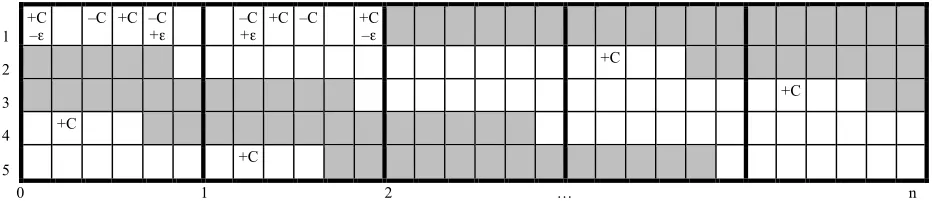
[image:7.612.94.560.563.668.2]0 1 2 … n
Figure 1. With these measures, no envy-free and undominated division is
possible.
1 +C
–ε
–C +C –C +ε
–C +ε
+C –C +C –ε
2 +C
3 +C
4 +C
Figure 1 illustrates the players’ measures. For i = 2, …, n, define the ith player’s
window to be the interval i!7
6,i+ 10
6
"#
)
. The endpoints are defined mod n, so the last twowindows actually end at 4
6 and
10
6 . Define the first player’s window to be [0,2). The
windows are the white spaces in Figure 1.
With certain exceptions, the value of a piece to a player is
• 1 per unit length inside the player’s window, and
• 1 – n-4 per unit length outside the player’s window.
The exceptions are as follows:
For i = 2,…,n, player i assigns an extra value of C = n-8 to the segment[i+ 7
6,i+ 8
6), spread uniformly over that interval. We call this interval the player’s bonuscell.
Player 1 has several positive and negative adjustments:
• +C-ε,, uniformly over [0,1 6)
• –C, uniformly over [2
6, 3 6)
• +C, uniformly over 3
6, 4 6 !"
)
• –C+ε, uniformly over 4
6, 5 6 !"
)
• –C+ε, uniformly over 7
6, 8 6
!"
)
• +C, uniformly over 8
6, 9 6
!"
)
• –C, uniformly over 9
6, 10
6
!"
)
• +C-ε,, uniformly over 11
6, 2
!"
)
The adjustments are in addition to the normal value of 1 per unit length. For example,
the actual value of the segment 0,1
6
!"
)
to player 1 is16+C!", uniformly spread over the
interval. We note that the players’ measures are absolutely continuous with respect to one another.
By way of contradiction, suppose we have found an allocation <S1,S2,…,Sn> that is both
envy-free and undominated. As usual, Si is the piece assigned to the ith player, and vi(Si)
is player i’s valuation of his or her own piece. By the values vector we mean the vector
<v1(S1), …, vn(Sn)>, and by the total value of an allocation we mean the sum
v1(S1)+…+vn(Sn). We write di for the length of Si.
We first show that the pieces must have a certain form. Each player’s piece must be (mostly) within the player’s window and have length (about) 1, and the pieces must be in order around the pie; that is, Si+1 is always immediately to the right of Si. We make this
Lemma 1. Each piece has both value and length greater than 1-n-4. That is, for each i, we have di > 1-n-4and vi(Si) > 1-n-4. It follows that the total length L of any k
consecutive pieces must satisfy k-n-3 < L < k+n-3.
Proof. Player 1’s valuation of the entire pie is v1([0,n]) = n–(n–2)(n-4) = n-n-3+2n-4.
Player 1’s piece must have value v1(S1) ≥
v 1[(0,n)]
n = 1-n
-4
+2n-5, or else some other player’s
piece would have greater value than S1 by player 1’s measure. No piece can have value
more than C=n-8 greater than its length, so both the value and the length must be greater
than 1-n-4. The same reasoning applies to players 2, …, n, whose valuations of the entire
pie are slightly larger.
Lemma 2. The total value satisfies v1(S1) + … + vn(Sn) ≥ n.
Proof: This follows from the assumption that the allocation is undominated. Suppose by way of contradiction that v1(S1)+…+vn(Sn) <n. Define a new allocation <T1,…,Tn> by
starting at 0 and making each piece Ti have length vi(Si):
T1 = [0, v1(S1) )
and
Ti = [v1(S1) + … + vi-1(Si-1), v1(S1) + … + vi(Si) )
for each i, except that to avoid wasting any of the pie we extend Tn to
Tn = [v1(S1) + … + vn-1(Sn-1), 1 ).
It follows from Lemma 1 that each Ti is within player i’s window and avoids bonus cells
(except for player 1, whose adjustments add to 0). So vi(Ti) is equal to the length of Ti,
and in each case that means that vi(Ti) = vi(Si), except that Tn is longer, so vn(Tn) > vn(Sn),
and <T1,T2,…,Tn> dominates <S1,S2,…,Sn>.
Lemma 3. If any players’ pieces include parts outside of the players’ windows, then the
total length of these parts cannot exceed n-3.
Proof. Define the excess value of each piece Si to be vi(Si) minus di, the length of Si.
From Lemma 2, the sum of the excess values must be at least 0. But no piece can contribute excess value greater than C = n-8. Parts outside the players’ windows
contribute an excess of –n-4 per unit length, so the total of all these lengths cannot exceed
n-3.
Lemma 4. The players’ pieces are in order, with Si+1 immediately to the right of Si for
each i.
Proof. The ordering is forced by the arrangement of the windows.
Lemma 5. For each i = 2, …,n, player i’s piece (i.e., Si) cannot include any part of
Proof. Lemma 1 implies that the pieces have length about 1, and hence they have about
the same relative position within the players’ windows. If player i’s piece includes a
bonus cell, then player 1’s piece is forced to extend too far outside player 1’s window.
We are now ready to isolate the possibilities for <S1, …, Sn> and to eliminate them one
by one. We do this in Lemmas 6 through 9. We recall that, by assumption, <S1,S2,…,Sn> is envy-free and undominated.
Lemma 6. S1 must have one of these forms:
• [0, x), or
• [y, 2), or
• 1 2 +x,
3 2+y
!"
)
, where |x| + |y| ≤ 1 3 n-8
.
Proof. From Lemma 5 we know that no other player’s piece has value greater than its length. From Lemma 2, the values must sum to at least n. This means that v1(S1) must be
at least equal to the length of S1. Equivalently, the sum of the adjustments that influence
v1(S1) must be at least 0. The cases listed are the only possibilities.
In the third case, the piece 1
2, 3 2
!"
)
has excess value +2ε, and moving either boundary byan amount t reduces that excess by 6tC = 6tn-8. Therefore, if the piece is to have excess at least 0, we must have 6tn-8≤ 2ε = 2n-16. Therefore t ≤ 1
3 n
-8
.
Lemma 7. S1≠ [0, 1) and S1≠ [1, 2).
Proof. If S1=[0,1) or S1=[1,2), then envy-freeness demands that each piece have length 1.
Then, the values vector is <v1(S1),…,vn(Sn)> = <1,1,…,1>, and the allocation is
dominated by the allocation in which T1 = [1/2, 3/2) and all pieces have length 1, which
has values vector <v1(T1),…,vn(Tn)> = < 1+2ε, 1, …, 1>. This contradicts our assumption
that <S1,S2,…,Sn> is undominated.
Lemma 8. S1≠ [0, x) for any x≠1 and S1≠ (y, 2] for any y≠1.
Proof. Let S1 = [0, x). (The other case is symmetrical.) As usual, let di denote the length
of piece Si. For each i = 2,…,n-1, both Si+1 and Si are within player i’s window, so the
envy-freeness requirement vi(Si+1) ≤ vi(Si) forces di+1≤di. The same reasoning for
player n shows that d1≤dn, so we have ultimately, d1≤dn≤ … ≤d2. Since x≠1, the
pieces are not all the same length, and hence we must have d1 < 1 < d2.
We will show that v1(S2) > v1(S1), contradicting the envy-freeness of <S1,S2,…,Sn>. It is
easy to check that v1(S1) = d1 < 1. But it is not necessarily the case that v1(S2) = d2, since
the right end of S2 might extend beyond player 1’s window, and even if it does not, the
value v1(S2) is affected by player 1’s adjustments. We must therefore do some
computing, using the fact that player 1’s value just to the left of 2 is 1+6(C-ε) per unit length. Therefore:
> v1( d1, d1+1 )
= v1( 0, 2 ) – v1( 0, d1 ) – v1( d1+1, 2 )
= 2 – d1 – (2 – (d1+1)) (1+6(C-ε))
= 1 + (1–d1) (6(C-ε))
> 1
> v1(S1).
Lemma 9. S1≠ 12 +x,
3 2+y
!"
)
for any x and y with |x| + |y| ≤ 13 n-8.Proof. Suppose S1= 12+x, 3 2+y
!"
)
where |x| + |y| ≤ 13n-8. For each i = 2, …,n-1, bothSi+1 and Si are within player i’s window, and Si+1 includes player i’s bonus cell.
Envy-freeness forces
di+1 + C≤di
for each such i, and the same reasoning for player n forces d1+C≤dn. We calculate:
d1 ≥ d1
dn ≥ d1 + C
dn-1≥ d1 + 2C
…
d2 ≥ d1 + (n-1) C.
The sum of the lengths is n, so adding these inequalities gives
n!nd
1+
n(n"1) 2
#
$ %&C,
or
d
1!1" (n"1)
2 C!1"C=1"n "8
.
But 1!n!8 <1!1
3n !8
"d
1, which implies that d1 < d1, a contradiction.
We have eliminated all of the possibilities for <S1, …, Sn>, and the theorem follows.
Theorem 3.2. For three or more players, there exists a pie and corresponding measures
for which no allocation is envy-free and equitable.
Proof. First suppose that there are three players, and let the pie be the interval [0,6], with its endpoints identified. Consider measures for players A, B, and C as follows:
[0,1) [1,2) [2,3) [3,4) [4,5) [5,6) Player A 1
6
1 6
1 6
1 6
1 6
Player B 7 36 1 36 7 36 7 36 7 36 7 36
Player C 7 36 7 36 7 36 7 36 1 36 7 36
Each player's measure is uniform on each of the six segments shown. Suppose, by way of contradiction, that <SA,SB,SC> is an allocation that is envy-free and equitable.
It will be convenient to refer to the zones of players B and C as the connected segments
of pie of length 5 to which that player assigns value 35/36. Thus, for example, Player B’s
zone is the segment [0,1)∪[2,6). (This is a connected segment, since the points 0 and 6
are identified.)
Consider Player A’s piece, SA. We claim that this piece cannot be a subset of the zone of
one of the other players. Suppose, for example, that SA is a subset of Player B’s zone.
Then vB(SA) > vA(SA). But equitability demands that vA(SA) = vB(SB). Hence, vB(SA) >
vB(SB). This contradicts the envy-freeness of the allocation, and thus SA cannot be a
subset of the zone of Player B or C. We note that any segment of length at most 2 is a
subset of the zone of Player B or C, so SA must have length greater than 2.
Any segment of length greater than 2 must include a segment of length at least 2 within either Player B’s zone or Player C’s zone (or both). Assume, without loss of generality, that SA includes a segment of length at least 2 within Player B’s zone. Then vB(SA) ≥
(2)(7/36) = 7/18. But envy-freeness implies that vB(SB) ≥ vB(SA), and hence vB(SB) ≥
7/18. The equitability of the allocation tells us that vC(SC) ≥ 7/18.
Finally, we observe that vB(SB) ≥ 7/18 implies that SB has length at least 2, and vC(SC) ≥
7/18 implies that SC has length at least 2. We have already shown that SA has length
greater than 2. This is a contradiction, since the pie has length 6. We conclude that there is no allocation of this pie that is envy-free and equitable.
This result generalizes to more than three players in a natural way. For n players, we let
the pie be the interval [0,n(n-1)], and assign measures to the players in a manner entirely analogous to the above. For four players, A, B, C, and D, the measures would be as follows:
[0,1) [1,2) [2,3) [3,4) [4,5) [5,6) [6,7) [7,8) [8,9) [9,10) [10,11) [11,12) Player A 1
12 1 12 1 12 1 12 1 12 1 12 1 12 1 12 1 12 1 12 1 12 1 12
Player B 13 144 1 144 13 144 13 144 13 144 13 144 13 144 13 144 13 144 13 144 13 144 13 144
Player C 13 144 13 144 13 144 13 144 13 144 1 144 13 144 13 144 13 144 13 144 13 144 13 144
Player D 13 144 13 144 13 144 13 144 13 144 13 144 13 144 13 144 13 144 1 144 13 144 13 144
We omit the details showing that there is no envy-free and equitable allocation of this pie,
and the details of generalizing to more than four players.
allocation that is both (i) envy-free and undominated and (ii) envy-free and equitable. However, for the third pair of properties, (iii) equitable and undominated, the story is different: there always is such an allocation for pie (as well as for cake; see [3]),
assuming thatthe measures are absolutely continuous with respect to one another. It is
not hard to see that there are many equitable allocations. To show that one of these equitable allocations must also be undominated, one can use the continuity of the
measures and the fact that the pie is a compact set to show that there is a “best” equitable allocation P (i.e., one in which the common value that players assign to their pieces in allocation P is at least as great as it is in any other equitable allocation). If some other allocation Q dominated P, then it would be possible (using the absolute continuity of the measures with respect to one another) to shift the boundaries in Q to find an equitable allocation that dominated P, thus obtaining an equitable allocation in which the common value to each player is bigger than in P, which is a contradiction.
To illustrate an equitable and undominated allocation in the example used to prove Theorem 3.2 for three players (it is not unique), give Player C the first segment and 17/19 of the second segment, Player A 2/19 of the second segment, the third and fourth
segments, and 2/19 of the fifth segment, and Player B 17/19 of the fifth segment and the sixth segment. Each player thereby obtains a value of 7/19, but this equitable allocation is not envy-free, because Players B and C think Player A has obtained 47/114 and so will envy Player A because they each perceive Player A to have (47/114) - (7/19) = 5/114 more than they do. By the same token, an envy-free and undominated allocation would be to give Player C the first two segments, Player A the next two, and Player B the last two (7/18 to A, 1/3 to B, 7/18 to C), but this allocation is obviously not equitable.
4 PIE-CUTTING: TWO PLAYERS.
We next analyze pie-cutting for two players, for which there are more positive results than we found for pie-cutting when there are three or more players. Consider two players A and B who receive pieces [α,β) and [β,α+1) and assign to them the values vA(α,β) and
vB(β,α+1), respectively. The pair (vA(α,β),vB(β,α+1)) is a point in the closed unit square
[0,1]x [0,1]. Let Ψ denote the set of points that arise this way. Thus,
Ψ = {(vA(α,β),vB(β,α+1)) : 0≤α≤1 and α≤β≤α+1}.
The points (1,0) and (0,1), for instance, are always points of Ψ. Let
Φ = { [α,β) | 0 ≤α≤ 1 and α≤β≤α+1 }
be the set of possible pieces for A; then Ψ is the continuous image of Φ under the map
[α,β) a(vA(α,β), vB(β,α+1)). Any point of Ψlying on the main diagonal of the square
corresponds to an equitable allocation, and any point in the upper-right closed quarter
[1/2,1]×[1/2,1] corresponds to an envy-free allocation. The construction of Ψ resembles
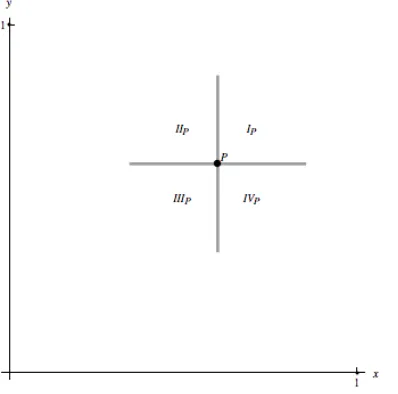
To determine whether a point P of Ψ corresponds to an undominated allocation, draw
horizontal and vertical axes centered at P and label the four (closed) quadrants
IP, IIP,
IIIP, andIVP, as illustrated is Figure 2. If the only point of Ψ contained in quadrant IP
is P, then P corresponds to an undominated allocation. Our goal is to determine whether
[image:14.612.211.410.161.358.2]points with some, or all, of these properties exist.
Figure 2. Quadrants used to determine whether an allocation is undominated.
The continuity of players’ measures shows that Ψ possesses four key features:
Lemma 10.
a. Ψ is closed.
b. Ψ is path connected.
c. Ψ is symmetric with respect to the point (1/2,1/2).
d. If P and Q are two points of Ψwith the same x-coordinate or the same y -coordinate, then line segment PQ lies in Ψ.
Proof. Parts a and b follow from the fact that Ψ is a continuous image of the compact,
path connected set Φ, and is therefore itself compact and path connected. Part c follows
from the fact that A and B can exchange pieces, and ( vA(α,β), vB(β,α+1) ) = ( 1 –
vA(β,α+1), 1 – vB(α,β) ).
To prove d, without loss of generality, suppose P and Q have the same x-coordinate a. Let (a,b) be any point on the segment PQ, and define U and V as follows:
U = {α∈[0,1] : for some β with α≤β≤α+1, vA(α,β) = a and vB(β,α+1)≥b }
V = {α∈[0,1] : for some β with α≤β≤α+1, vA(α,β) = a and vB(β,α+1)≤b}
For any α∈[0,1], vA(α,β) = a for some β with α≤β≤α+1, and thus either α∈U or α∈V. It
follows that U UV = [0,1].
Since P and Q are both in Ψ, we know that U≠∅ and V≠∅. The interval [0,1] cannot be
expressed as the union of two disjoint closed sets, and hence U IV≠∅. Choose any
α∈U IV. Then, for some β1,β2∈[0,1], vA(α,β1) = vA(α,β2) = a and
vB(β1,α+1)≤b≤vB(β2,α+1). If β1=β2, set βequal to this common value. If β1≠β2, then the
continuity of vB and the intermediate value theorem imply that for some β between β1 and
β2, vB(β,α+1)=b. In either case, we must have vA(α,β) = a. Thus, (a,b)∈Ψ. This
establishes that line segment PQ lies in Ψ.
Parts b, c, and d of Lemma 10 imply that (1/2,1/2) is always a point of Ψ. It is also not
difficult to see that (1,0) and (0,1) are the only points of Ψ that belong to the boundary of
the unit square if, and only if, the measures of the two players are absolutely continuous with respect to one another. In this case, each horizontal and each vertical cross-section
[image:15.612.210.418.421.641.2]of Ψaway from (1,0) and (0,1) has endpoints in the interior of the unit square.
Figure 3 illustrates four possibilities for the set Ψ. If the players’ measures are equal,
then Ψ consists only of the diagonal between (1,0) and (0,1), as shown in Figure 3a. The
Ψs in Figures 3a and 3b correspond to measures that are absolutely continuous with
respect to one another, while the Ψs in Figures 3c and 3d correspond to measures that are
not.
Figure 3. Some possibilities for the set Ψ.
Theorem 4.1.For two players and any pie and corresponding measures,
a. there exists an allocation that is both envy-free and undominated;
b. there exists an allocation that is both envy-free and equitable; and
c. if the measures are absolutely continuous with respect to one another, then there exists an allocation that is envy-free, undominated, and equitable.
Proof. For part a, let Ψur denote the intersection of Ψ with the closed upper-right quarter of the unit square (i.e., [1/2,1]×[1/2,1]). Then Ψur is a closed set. The function
F: (x,y) a x+ y is a continuous function from Ψ
ur
to R. By the extreme value theorem, there exists a point P in Ψur for which F attains a maximal value. Any allocation that corresponds to this point is envy-free and undominated.
We have already shown that (1/2,1/2) is in Ψ. This point corresponds to an allocation
that is envy-free and equitable, and this establishes part b.
Finally, for part c, assume that players’ measures are absolutely continuous with respect
to one another, and let P be the rightmost point of Ψ on the main diagonal of the unit
square. Clearly, any allocation that corresponds to P is envy-free and equitable. Our
goal is to show that any such allocation is also undominated.
Suppose, to the contrary, there is a point Q of Ψ different from P in quadrant IP. This
point does not lie on the main diagonal of the unit square. Assume, without loss of generality, that it lies above the main diagonal.
Now Q = (vA(α,β),vB(β,α+1)) for some sector [α,β). Using continuity, and the fact that
the measures are absolutely continuous with respect to one another, we can adjust the values of α and β to produce a second point lying in the interior of IP with x-coordinate
larger than the x-coordinate of Q (and y-coordinate necessarily smaller). Thus, without loss of generality, we can assume Q has x-coordinate larger than P’s.
Since Ψ is path connected, there is a path λ from (1/2,1/2) to (1,0) consisting of points from Ψ. As P is the rightmost point of Ψ on the diagonal, λ does not cross the main diagonal in IP. Consequently there is a point R on λ with the same x-coordinate as Q lying
below the main diagonal. That QR ⊆Ψ provides a contradiction to the choice of P.
This establishes part c and completes the proof of the theorem.
It follows from the theorem that Gale’s question has an affirmative answer for pie-cutting involving two players, regardless of whether the measures are absolutely continuous with respect to one another.
The final three paragraphs of this proof can be readily modified to show that when the measures are absolutely continuous measures with respect to one another, the rightmost
point along any horizontal cross-section of Ψ corresponds to an undominated allocation
of sectors, as does the topmost point of any vertical cross-section. Loosely speaking,
every point along the upper boundary of Ψ corresponds to an undominated allocation.
The assumption that the measures are absolutely continuous with respect to one another is necessary for the proof of part c of Theorem 4.1. Suppose, for example, that B’s measure is uniform (that is, vB(α,β) = β-α always) but that A’s measure is concentrated
uniformly on the subset [0, 1/4] ∪ [1/2, 3/4] (that is, vA(α,β) is twice the length of the
intersection of [α,β) with that set). These measures produce the set Ψ shown in Figure
3d, in which no point corresponds to an envy-free, equitable, and undominated allocation. In fact (again, precisely as is the case in two-player cake division), this example
illustrates that, in general, if the measures are not absolutely continuous with respect to one another, then there need not be an allocation that is both undominated and equitable.
We close this section by considering a special case of pie cutting for two players.
Suppose we insist that the two players, A and B, are allowed to cut only along a diameter of the pie. Construct the subset Ψd of the closed unit square given as the set of all points
of the form (vA(α,α+1/2), vB(α+1/2,α+1)) for α∈[0,1). Then Ψd is a (possibly
self-intersecting) loop within the closed unit square, symmetric about the center of the square. As before, one is guaranteed allocations that are envy-free and equitable, or envy-free and undominated, but not all three properties. Suppose, for example, that B’s measure is uniform but that A prefers the first half of the pie. Specifically, A assigns a value of 3/2 per unit length in the interval [0, 1/2), but only 1/2 per unit length in the interval [1/2, 1).
In this case, Ψd is the horizontal line segment between (1/4,1/2) and (3/4,1/2), and no
point of Ψd corresponds to an allocation that is simultaneously envy-free, equitable, and
undominated. Note, too, that these players’ measures are absolutely continuous with respect to one another.
5 PIE-CUTTING:PROCEDURAL RESULTS.
Establishing the existence of an allocation with certain properties is not the same as producing it. In this section we consider procedures, or algorithms, for finding desirable allocations of a pie. These procedures assume that players move knives continuously, whereas discrete procedures assume that players make choices at discrete times. For examples of each type of procedure, see [5], [10].
Moving-knife procedures were first applied to dividing a cake among n players using n –
1 parallel, vertical cuts (the minimal number). Two minimal-cut envy-free moving-knife procedures for three players have been found ([2], [10]), but no minimal-cut four-player envy-free procedure is known. An envy-free procedure for four players that requires up to five cuts—two more than the minimal number of three— is known, but it may
necessitate that players receive disconnected pieces [2].
For pie, as we have seen, there is always an envy-free, undominated allocation for two players, but for three players, we may have to settle for an envy-free allocation that is dominated. Next we address how to find allocations that are envy-free, undominated, or equitable.
equitable, and the three-player procedure will produce an allocation that is envy-free but need not be either undominated or equitable.
Two-player procedure
This procedure produces an envy-free and undominated allocation for two players. First assume that their measures are absolutely continuous with respect to one another. Call the two players player A and player B, whom we shall refer to as “she” and “he,” respectively. Player A holds two radial knives above the pie in such a way that, in her view, the two sectors of pie determined by these knives each have value 1/2. She then rotates these knives continuously, all the way around the pie, maintaining this 1/2 value of the sectors until the knives return to their original positions. After observing this process, player B identifies the position that, in his view, gives the maximum value to one of the two sectors so determined. (Ties can be broken randomly. The continuity of the players’ measures, along with the extreme value theorem, guarantees that there is such a maximum-value sector.) Player B takes this sector, and player A receives the other sector. Call this allocation P.
We claim that P is envy-free and undominated. To see that P is envy-free, we first
observe that player A certainly believes that her sector has value exactly 1/2, and so she will not envy player B. Player B does not envy player A since, if he does, then he must have picked the smaller sector, rather than the larger sector, at his chosen position. Thus,
P is envy-free.
Suppose, by way of contradiction, that some allocation Q dominates P. Then, both
players receive at least as much pie in allocation Q as in allocation P (in each’s own view), and at least one player receives strictly more. The absolute continuity of the
measures with respect to one another allows us to alter Q, if necessary, so as to give
player A less pie and player B more pie, and in this way to obtain an allocation R such
that player A receives the same value of pie (in her view) in allocation R as in allocation
P (i.e., value 1/2), and player B receives strictly more value of the pie (in his view) in
allocation R than in allocation P. Then the sector that player B obtains in allocation R is one of the sectors that he would have seen as player A rotated the knives around the pie. This contradicts the fact that player B chose the largest sector that he saw.
This establishes that the allocation is envy-free and undominated. It will be equitable if and only if any sector of pie that player A considers to be half of the pie is also
considered to be half of the pie by player B. In general, of course, this will not be the case.
before. Thus, one position of the first knife can correspond to two positions of the second knife, and the sectors so determined by each of these positions are possibilities from which player B can choose. If both of A’s knives reach zero-value sectors at the same time, A must reveal to B all four extreme possibilities before proceeding.
What happens if one or both players are not truthful? For example, player A could rotate the knives in such a way as to maintain a 1/3-2/3 balance in her view and, if player B then chooses the 1/3 sector, player A ends up with what she thinks is 2/3 of the pie instead of 1/2. But, of course, player A could also end up with 1/3 of the pie instead of 1/2. Thus, we see that players can do better, or worse, by not being truthful. What is true, however, is that by being truthful, each player is guaranteed a sector of size at least 1/2 (in each’s own view) and, hence, will not envy the other player, regardless of whether or not the other player is truthful. Players who are risk-averse will presumably like this procedure, because it maximizes the minimum-value sectors that players A and B can ensure for themselves.
To relate this procedure to the set Ψ in Section 4, note that the procedure moves along the
line segment that is the intersection of the line x = 1/2 and the set Ψ. In picking his largest sector, player B is identifying an allocation that corresponds to the point on the line segment with greatest y coordinate. (There is a largest such point, because Ψ is a closed set.)
We do not know whether or not there is a moving-knife procedure to produce an allocation that is envy-free, undominated, and equitable, even if we insist that the measures be absolutely continuous with respect to one another, in which case such an allocation is known to exist (see Theorem 4.1c).
Three-Player Procedure
This procedure produces an envy-free allocation for three players. We call the three players player A, player B, and player C and refer to them as “she,” “he,” and “it,” respectively. We assume that the three players’ measures are absolutely continuous with respect to one another.
Player A rotates three radial knives continuously around the pie, maintaining what she believes to be 1/3-1/3-1/3 sectors. Player B calls “stop” when he thinks two of the sectors are tied for largest, which must occur for at least one set of positions in the rotation (see below). The players then choose sectors in the order C first, B second, and A third.
We must show that at some point player B will think that two of the sectors are tied for most-valued, and that the allocation produced by this procedure is envy-free.
most-valued sector at the start of the rotation. If there is a tie, then we are done. If not, then player A begins rotating the three radial knives. We assume, without loss of generality, that player B’s most-valued sector at the start of the rotation is sector i, and that player A
rotates the three knives in such a way that sector i moves toward the original position of
sector ii. Because, in player A’s view, each of the three sectors is 1/3 of the pie, sector i
will eventually occupy the position of the original sector ii, which we make a requirement
of the procedure. At this point, sector iii occupies the original position of sector i, which
we also make a requirement, and hence player B must think that this new sector iii is the
largest sector. Because, in player B’s view, sector i starts out largest and another sector becomes largest as the rotation proceeds, it follows from the continuity of the players’ measures and the intermediate value theorem that there must be a position in the rotation when player B views two sectors as tied for largest.
To see that the procedure gives an envy-free allocation, note that the first player to
choose, playerC, can take a most-valued sector, so it will not be envious. If playerC
takes one of playerB’s tied-for-most-valued sectors, playerB can take the other one;
otherwise, playerB can choose either of his two tied-for-most-valued sectors. Because
playerA values all three sectors equally, it does not matter which sector she gets.
Finally, we make two observations. First, this procedure may fail to give an allocation that is either undominated or equitable, just as the two-player procedure may not give an allocation that is equitable. Also, like the two-player procedure, the three-player
procedure does not rely on the players’ being truthful. In other words, if any player misrepresents her or his or its valuations of sectors of pie (for example, if player A moves the knives in such a way that the sectors are not maintained at value 1/3-1/3-1/3 in her view, or if player B calls “stop” at some time other than when there is a tied-for-largest sector in his view), it is still the case that any player that is truthful will not envy any other player’s portion in the resulting allocation, regardless of the truthfulness of the other players.
6 CONCLUSIONS.
Our results are summarized in Table 1. In the table, “General Existence” means for any measures (i.e., with no assumption that the measures be absolutely continuous with respect to one another), and “Existence with Absolute Continuity” means that we require the measures be absolutely continuous with respect to one another. We note that this distinction is only needed for cake, not for pie.
Envy-Free and Undominated Allocation for
Cake Pie
Number of Players
General Existence
Existence with Abs. Cont.
Existence with or without Abs. Cont.
Two Yes
(Thm. 2.3a)
Yes (Thm. 2.1b)
Yes (Thm. 4.1a)
Three or More No
(Thm. 2.2)
Yes (Thm. 2.1b)
Table 1. Existence of Envy-Free and Undominated Allocations.
We close by posing two pie-cutting questions we were not able to answer.
Open Question 1. For two players with measures that are absolutely continuous with
respect to one another, is there a moving-knife procedure that produces an allocation that is envy-free, undominated, and equitable?
If we allow a “procedure” in which the players submit their measures to a referee, the referee can determine the cuts that give such an allocation, as shown in [4]. But we know not even an approximate procedure by which two players can, by themselves, equalize their shares, in each’s eyes, so as to render an envy-free and undominated allocation also equitable.
Finally, we recall that for any pie and any number of players with measures that are absolutely continuous with respect to each other, there is always an allocation that is equitable and undominated. (See the discussion following the proof of Theorem 3.2.) Must there be such an allocation that is also envy-free? Theorem 3.2 tells us that the answer is “no” when there are three or more players. On the other hand, there are examples where there is such an allocation. (One trivial example is when the measures are all the same.) So we close by asking the following question:
Open Question 2. For three or more players with measures that are absolutely
continuous with respect to each other, are there necessary and sufficient conditions that distinguish pies for which there is an envy-free, equitable, and undominated allocation from those in which there is not?
ACKNOWLEDGMENTS. The authors would like to thank Michael Jones, Christian
Klamler, Peter Landweber, James Tanton, and William Thomson for valuable comments, and the late David Gale, whose question inspired this research. We are grateful for the opportunity to discuss some of the issues analyzed in this article at a seminar on fair division in Dagstuhl, Germany, in June 2007 (see [12]).
REFERENCES
1. J. Barbanel, The Geometry of Efficient Fair Division, Cambridge University Press,
Cambridge, 2005.
2. J. Barbanel and S. Brams, Cake division with minimal cuts: Envy-free procedures for 3
persons, 4 persons, and beyond, Math. Social Sci.48 (2004) 251-270.
3. S. Brams, M. Jones, and C. Klamler, Better ways to cut a cake, Notices Amer. Math.
Soc.35 (2006) 1314-1321.
5. S. Brams and A. Taylor, Fair Division: From Cake-Cutting to Dispute Resolution, Cambridge University Press, New York, 1996.
6. S. Brams, A. Taylor, and W. Zwicker, Old and new moving-knife schemes, Math.
Intelligencer 17 (1995) 30-35.
7. ___, A moving-knife solution to the four-person envy-free cake division problem,
Proc. Amer. Math. Soc.125 (1997) 547-554.
8. D. Gale, Mathematical entertainments, Math. Intelligencer 15 (1993) 48-52.
9. M. Jones, Equitable, envy-free, and efficient cake cutting for two people and its application to divisible goods, Math. Mag. 75 (2002) 275-283.
10. J. Robertson and W. Webb, Cake-Cutting Algorithms: Be Fair If You Can, A K
Peters, Natick, MA, 1998.
11. W. Stromquist, How to cut a cake fairly, this MONTHLY87 (1980) 640-644.
12. ____, A pie that can't be cut fairly, in Dagstuhl Seminar Proceedings 07261, Seminar
on Fair Division, June 2007, available at
http://drops.dagstuhl.de/opus/frontdoor.php?source_opus=1219.
13. F. E. Su, Rental harmony: Sperner’s lemma in fair division, this MONTHLY106
(1999) 922-934.
14. W. Thomson, Children crying at birthday parties. Why?, Econom. Theory31 (2007)
501-521.
JULIUS B. BARBANEL received his B.S. from Case Western Reserve University in 1973 and his Ph.D. in mathematics from the State University of New York at Buffalo in 1979. He is a Professor of Mathematics at Union College, has published articles in both Set Theory and Fair Division, and has recently authored a book on Fair Division entitled
The Geometry of Efficient Fair Division (2005). He also has interests in ancient mathematics.
Department of Mathematics, Union College, Schenectady, NY 12308, [email protected]
STEVEN J. BRAMS received his B.S. from MIT and his Ph.D. in political science from Northwestern. He is currently Professor of Politics at NYU, where he has taught since
1969. He is the author or co-author of 14 books, the most recent being Mathematics and
Democracy: Designing Better Voting and Fair-Division Procedures (2008), and some 250 articles. He is a former president of the Peace Science Society (1990-91) and the Public Choice Society (2004-2006), a Fellow of the American Association for the Advancement of Science, a Guggenheim Fellow, and was a Visiting Scholar at the Russell Sage Foundation.
WALTER STROMQUIST has been teaching mathematics and statistics at Bryn Mawr College and Swarthmore College for the past six years. Previously he was employed as an analyst for the U.S. Treasury and as a mathematical consultant, primarily for Daniel H. Wagner Associates. His B.A. is from the University of Kansas and his Ph.D. from
Harvard, and he has also taught at Kansas, Harvard, the George Washington University, Temple University, Eastern University, and USMA (West Point).