Lancaster University Management School
Working Paper
2005/020
Knowledge within small and medium-sized firms: A
systematic review of the evidence
Luke Pittaway, Richard Thorpe, Robin Holt and
Allan Macpherson
Institute for Entrepreneurship and Enterprise Deve Lancaster University Management School
Lancaster LA1 4YX UK
© Luke Pittaway, Richard Thorpe, Robin Holt and Allan Macpherson All rights reserved. Short sections of text, not to exceed two paragraphs, may be quoted without explicit permission,
provided that full acknowledgement is given.
The LUMS Working Papers series can be accessed at http://www.lums.lancs.ac.uk/publications/
KNOWLEDGE WITHIN SMALL AND MEDIUM-SIZED FIRMS: A
SYSTEMATIC REVIEW OF THE EVIDENCE
Submitted to: Managing Editor
International Journal of Management Reviews
From: Richard Thorpe
Leeds University Business School Maurice Keysworth Building
Leeds, LS2 9JT
Robin Holt
Manchester Metropolitan Business School Aytoun Street
Manchester M1 3GH
Luke Pittaway
Adjunct Senior Lecturer (LUMS)
The University of Sheffield Management School 9 Mappin Street
Sheffield S1 4DT
Allan Macpherson
Manchester Metropolitan Business School Aytoun Street
Manchester M1 3GH
ABSTRACT
This paper provides a systematic review of the literature on how SMEs use and acquire knowledge. The review was undertaken as part of the Economic and Social Research Council’s Evolution of Business Knowledge Programme. The paper describes the systematic review protocol and provides a detailed explanation of the methods used. From the review it is evident that SME knowledge research primarily concentrates on the acquisition and use of knowledge, treating it as an asset that is transferred by routines. The findings suggest that research is focused in three main areas. First, focusing on the influence and abilities of the entrepreneur to extract, use and develop knowledge resources. Secondly, research that explores the firm-wide systems and human capital that facilitate knowledge exploration and exploitation. Thirdly, study that examines the institutional context and which is primarily focused on the effectiveness of Government policy. There are also a handful of studies reviewed that reflect a concern with the socially constructed nature of knowledge. From a practical perspective, the review concludes that regeneration policies need to be more flexible and sensitive to the often complex contexts within which knowledge is constructed. From a research perspective, and given the flexible, opportunity-oriented and often novel nature of SMEs identified in these studies, there is a need to consider the relational and embedded qualities of knowledge by which these characteristics are framed; qualities that resist conceptualisation as some form of separable, material asset.
INTRODUCTION
The systematic review reported in this paper was guided by a desire to understand how
small and medium enterprises (SMEs) acquire and use knowledge. The review was led by a
panel including the authors and was funded within the Economic and Social Research
Council’s (ESRC) Evolution of Business Knowledge Programme (EBK). The paper will
explain how the systematic review was conducted with reference to previous approaches in
management research (Tranfield, Denyer and Smart, 2003; Denyer and Neely, 2004; Leseure
et al. 2004; Pittaway et al. 2004) and it will highlight the results of the review.
The main focus of the review was informed by the title of the EBK Research project:
‘The Evolution of Knowledge in SMEs’. The specific aims of this project were to:
(1) Show how knowledge is acquired, generated, shared, absorbed, and challenged within
(2) Investigate the enablers and constraints that influence the effective use of knowledge
in SMEs within a regional context and taking into account: social; historical;
economic; and, sectoral factors.
(3) Understand how studies have conceptualised knowledge and the influence this has had
on findings, with specific reference to activity theory.
(4) Extract and synthesise literature providing an overview of the research conducted and
explore its implications.
The systematic review was undertaken to understand the research ‘landscape’ and
situate the study in the concerns and insights of previous research. The specific project aims
meant there was a natural division of the systematic review into three parts: studies looking at
uses of activity theory; theoretical and empirical studies developing new conceptions of
knowledge; and finally studies looking at knowledge use in SMEs. It was in this third part of
the review that much of the evidence-based research was located. We begin our discussion by
explaining the methodology used, following which we focus on the findings from the third
part of the review. The paper will, therefore, explore research conducted with SMEs,
exmining the ways in which entrepreneurs and SME managers have: transformed their
knowledge; used and stored knowledge; and, communicated knowledge to others.1
METHODOLOGY
Systematic reviews emerged from an identified need for better evidence-based
research amongst the UK medical profession. In the early nineties the UK Government
identified a research-practitioner gap, arguing that academics were driving a research agenda
of little perceived use (Tranfield, Denyer and Smart, 2003). To close the gap the UK
Government advised the profession to establish evidence networks with a remit to populate
evidence-based policy making and allow researchers to have a thorough appreciation of what
had been achieved already by previous researchers. The basic principles of systematic
reviews have spread across many sciences and social sciences in the UK and they have begun
to enter management research (Tranfield et al. 2003; Denyer and Neely, 2004). The basic
principles behind adopting such systematic and explicit methods are:
(1) Transparency – each search of the available research studies is recorded. This includes
making explicit the criteria of relevance against which retrieved lists of studies are
judged for inclusion. By describing each search string and the rationale behind its
selection the review can be repeated to test its rigour and update its findings (Denyer
and Neely, 2004).
(2) Clarity – a clear, stepped series of searches is presented, allowing any reader a full
‘audit trail’ of how the review arrived at a final list of studies on whose evidence it
reports (Tranfield et al., 2003)
(3) Focus – the review ensures there a close and persisting relationship between a clearly
formulated question and the identification of primary evidence that informs such a
question (Pittaway et al., 2004).
(4) Unifies research and practitioner communities – by broadening the scope of
dissemination, emphasising evidence and the form of the evidence, the review
methodology is designed to promote a policy and practitioner perspective (Leseure et
al, 2004).
(5) Equality – the review makes no distinction in principle between the type and nature of
journals and other publication outlets. Studies are reviewed on their own merits, and
the inductive, iterative methodology means reviewer bias is avoided where possible
(6) Accessibility - the reviews are made available outside of the specialist, academic
community in the form of reports and searchable databases.
(7) Broad coverage - the use of systematic strings and protocols within increasingly
sophisticated electronic databases allows reviewers to cover the plethora of places and
forms of publication.
In following these principles a systematic review is designed to help engender a sense of
collective endeavour, relevance and openness amongst research and practitioner communities
(Tranfield et al, 2003), while at the same time improving the methods used to collect and
synthesise previous empirical evidence. In the next part we outline how the systematic
review methodology was operationalised in this study.
Systematic Review Strategy
This systematic review followed the stages and phases as outlined by Tranfield, Denyer
and Smart (2003). In this respect it had three stages: planning the review; conducting the
review and reporting and dissemination, within which there were discrete phases of activity2.
The review panel was formed and was used to monitor the progress of the review. The use of
the panel was especially helpful for providing a narrative check on the methodology ensuring
the identification of gaps. These gaps appeared in some instances because the database of
articles started after the date of publication, in other instances because the citation lacked key
information, there were differences in spelling or because of genuine oversight. It was
concluded from this that systematic reviews do require the involvement of review panels who
can provide ‘narrative expertise’ and who can cross-check the quality of the review process.
The review was limited to published journal articles (peer reviewed); both practitioner
and academic3. A number of key bibliographical databases4 were searched using the root
coupled to functionality and full article access were ABI Proquest; Web of Science and
Ingenta (incorporating Science Direct)5. . In the next stage the review developed a series of
keywords and search strings (Appendix 1) based on the root concepts learning, knowledge
and SME. Other keywords identified were used selectively within search strings to further
refine the classification of relevant studies. The following steps were applied to the review
process during the assessment of citation databases.
(1) The search strings were developed according to the criteria for the study
(Appendix 2).
(2) Search strings were used within title, abstract and keyword searches.
(3) If the search retrieved more than 600 studies, a second search string was added
using the operators AND and/or NOT and the exclusion criteria (Appendix 3) were
used when searching within the title, abstract and keywords.
(4) If the number of citations was between 100 and 400 from the 1st search string the
scholars searched within the title of the articles only.
(5) If the number of studies was still between 100 and 400 the 2nd search string was set
within the title only.
(6) Individual studies were reviewed when the search retrieved less than 1506.
The scholars assessed citation retrievals according to their relevance to the review
criteria (Appendix 1 and 2) once they had been downloaded from the citation databases. The
citations were separated into A, B and C lists. ‘A’ was defined as studies that were definitely
relevant. ‘B’ was defined as studies where the relevance was not clear a priori. ‘C’ was
defined as studies that were less relevant or where the nature of the research work was
unclear. The relevance assessment was undertaken in Procite the bibliographical software
package. First, keyword searches were undertaken and secondly, the use of search strings
was used within abstracts. Following the use of search strings and keyword searches in
undertook a relevance assessment using the abstracts alone (see Appendix 4). This approach
has been recognised to have some weaknesses7 but is also thought to be useful when a
systematic review is faced with overwhelming list of citations to review in a short timeframe
(Pittaway et al., 2004)8. It should be stressed that the relevance assessment was relative, to
the extent that the judgements the authors formed were focused on aspects contained within
the review scope. If an article, for example, developed a theory of organisational knowledge
but within larger firms, or talked of small firm growth without explicit reference to
knowledge, then irrespective of its quality it would not have been included in the review9.
Following the development of an ‘A’ list of 209 articles, a descriptive and a thematic analysis
was carried out. The descriptive analysis developed tables that were designed to contain the
title, area of concern and possible implications of each study in the relevant list. The thematic
analysis analysed the abstracts using a form of inductive content analysis, where the abstracts
were coded within the Nvivo qualitative research software package (Pittaway et al., 2004),
and further analysed within Procite. The full-text versions of all of the 209 articles found
through this process were reviewed to build up a ‘landscape’ of emerging, current and past
research activity covering studies relevant to the research objectives outlined earlier.
Results of the Systematic Review
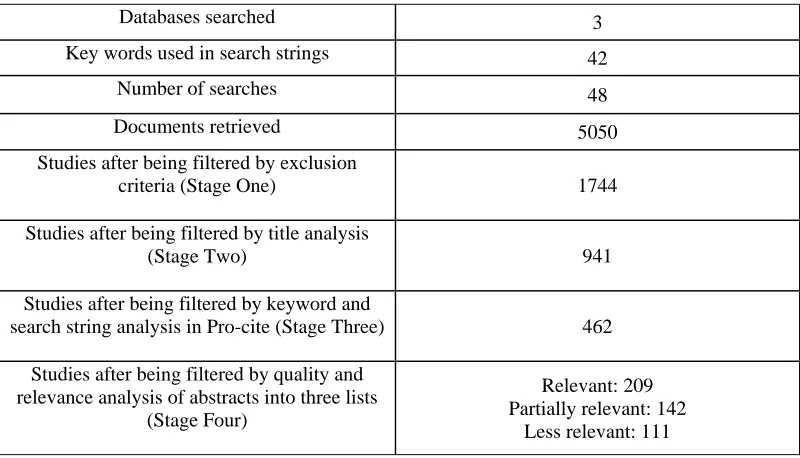
[Insert Table 1]
The results are presented in four stages. Table 1 provides an overview of the results. In
the first stage the scholars used search strings in the three identified databases this yielded
over 5000 citations, of which 174410 were left after filtering according to the exclusion
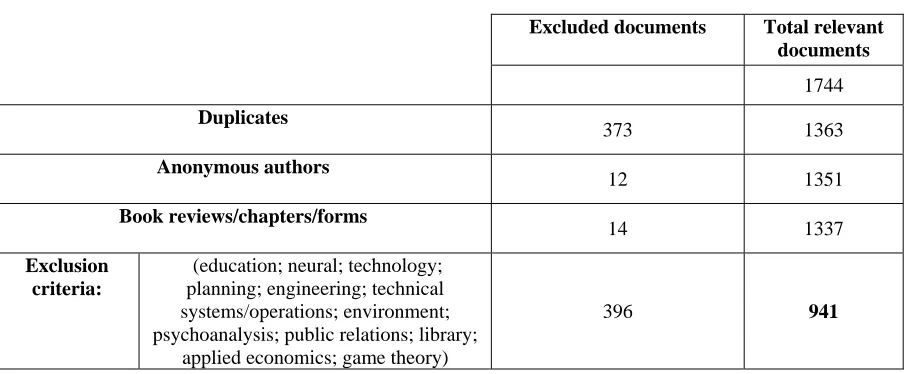
criteria (Appendix 3). In stage two the relevant citations were transferred into Procite11,
wherein nearly 400 citations were eliminated by further application of the inclusion and
identify and eliminate duplicate studies. At the end of this stage there were 941 relevant
studies (see Table 2).
[Insert Table 2]
In stage 3 the remaining 941 citations were searched using the keyword and search
string functions in Procite. The keywords were examined and those occurring as isolate or at
minimal levels of citation were identified. These acted as ‘flags’ highlighting a need to
explore the abstracts in more depth. For example, the search string economic* AND model*
produced 14 documents in Procite of which 8 were eliminated. Likewise keywords that led to
exclusions in Procite included, for example: benchmarking; commercialisation; computer
programming and these also led to exclusions. The final number of studies left after this
stage was 478. Of the excluded documents 157 were excluded using keywords and 313 were
excluded using search strings.
In the final stage the assessment criteria (Appendix 4) were used to assess relevance.
There were 111 less relevant articles, 142 partially relevant articles and 209 relevant articles.
The remaining 209 articles were directly relevant to the research question and were reviewed
using NVivo to realize thematic structures by which the evidence could be classified. The
overall process of the review is summarised by Figure 1.
[Insert Figure 1]
In the next part of the paper the detailed conclusions from the review examining the use
of knowledge in SMEs are explored.
STUDIES OF KNOWLEDGE USE IN SMES
Much of the literature on the use of knowledge in SMEs adopts a resource-based view
of the firm. Performance is related to the ability to integrate knowledge assets (understanding
of markets and technology) with the routines that govern everyday organisational activity. It
high for SMEs (Yli-Renko et al., 2001; Wiklund and Shepherd, 2003). This conclusion is
reached because:
(1) SMEs control fewer assets, and their lack of size and financial scope provides
little opportunity for strategic market control (Wiklund and Shepherd, 2003).
(2) Consequently, there is higher reliance on what ‘individuals’ know, particularly
the owner-managers (Wiklund and Shepherd, 2003).
(3) As these knowledge resources cannot be used to contain or channel market
activities this skews SMEs toward a concern with, ‘entrepreneurial orientation’
(Wiklund and Shepherd, 2003)12.
The implicit hypothesis in many studies, therefore, is that an SME that demonstrates a rich
array of knowledge resources and entrepreneurial orientation will outperform other firms
(Wiklund and Shepherd, 2003). Critical to this is what Yli-Renko et al (2001) identify as the
SME’s social capital or their ability to acquire and exploit knowledge arising from external
relationships. It is argued that social capital enables owner-managers to:
(1) Access greater amounts of information.
(2) Recognise information that is pertinent to their strategic aims.
(3) Achieve absorption of the essentially incommunicable elements of others’ skill
through relationships of prolonged familiarity.
(4) Benefit from swifter knowledge transfer because of the need for contiguous
expectations.
(5) Increase the potential for knowledge transformation where there is a preference
for dynamic critique above repetitive imitation.
(6) Become exposed to multiple perspectives where there is a broadening of
Given that this literature conceptualises knowledge as an asset and explores how it is
used, as well as exploring the role of social capital, the discussion that follows is organised
into three parts. The first describes studies emphasising the identity, role and influence of the
entrepreneur in this organisation of resources. The second part is confined to those studies
isolating the SME and its network as the location of knowledge creation and use. The third
part describes those studies where the focus is on knowledge resources held by SMEs,
including their social capital, that are seen to be enhanced or hindered by environmental
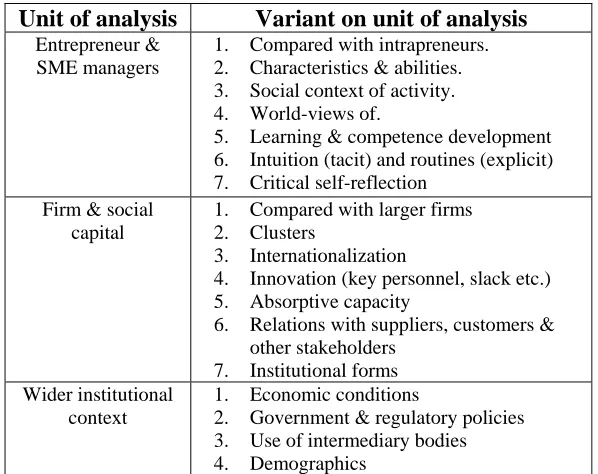
influences especially government policy. A summary of the themes emerging from Nvivo
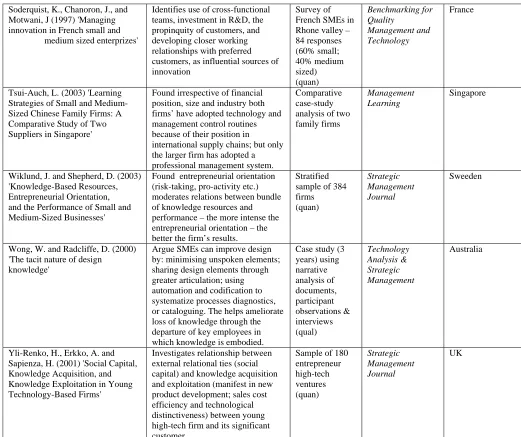
analaysis and upon which the discussion is based is given in Table 3
[Insert Table 3 here]
Knowledge, the managers and the entrepreneurs
Amongst many of the studies of knowledge use in SMEs there is a recognition that
knowledge is gained through the tacit experiences of specific individuals. For example,
Carson and Gilmore (2001) found decision taking to be heavilly reliant upon existing
knowledge and personal judgement and communication skills each of which is experienced in
what Wong and Radcliffe (2000) identify as processes of negotiation, revision and argument.
These authors imply that tacitness of what is known resides with: judgement; estimating
capacity; physical co-ordination; familiarity with techniques; image recognition; and,
personability. To reveal these knowledge resources Wong and Radcliffe (2000) recommend
the adoption of routines that:
(1) Minimize tacit components by highlighting the rationale behind the origin and
use of designs.
(3) Use structured decisional apparatus so that diagnostics or cataloguing can occur
automatically.
Despite making such recommendations Wong and Radcliffe (2000) acknowledge, however,
that much of what makes knowledge an important asset for SMEs is its non-replicability.
Lofstedt (2001) also concludes that repetition of rotuines – in this case training – tended to
focus attention on the development of generic skills for each employee rather than on the
varied needs of the organisation as a whole.
Making the tacit explicit is viewed as problematic by a number of studies (Filion, 1996;
Chaston et al., 2001; Honig, 2001). These authors associate a significant element of any
SME’s knowledge resource as being experiential and remaining so over time. For example,
when examining intrapreneurs13 and entrepreneurs in Sweden Honig (2001) found distinct
differences in learning strategies. Intrapreneurs favoured consensus seeking strategies that
favoured codified procedures, used internal networks and pre-existing knowledge.
Entrepreneurs tended towards using unstructured flexible processes, used external networks
and avoided established patterns of doing things. The contrast between knowledge
configured as certainty on the one hand, and as discovery, on the other hand, was associated
with individual characteristics and social influences that could not necessarily be taught. This
was a difference also identified by Filion (1996) where the management systems of
non-entrepreneurs were found to elicit or reflect activities of assigning, dividing, and adjusting,
whereas the systems of entrepreneurs encouraged animating, designing and learning. Chaston
et al’s (2001) study also found that entrepreneurs more willing to invoke double-loop, or
higher order learning styles than their non-entrepreneurial counterparts. In the study this
willingness to embrace problem-solving activities was seen as a function of having to create
and launch innovative products, as opposed to continuing to exploit existing knowledge under
mature stable markets (Chaston et al., 2001). Chaston et al. (2001) only found a weak
managerial competencies, such as marketing or financial skills. The finding suggests that
entrepreneurs are more alive to the need to adapt to contexts, to question practices, and to
consult a wider range of information sources. They are willing to correct mismatches in
experience by reflecting on their underlying values, as well as, on their technical solutions
(Argyris, 2003). This may not necessarily lead to the development of heightened levels of
internal managerial competence or skill; the understanding remains intuitive and linked to
individual competence (Chaston et al, 2001).
Ward (2004) argues, however, that because codification is relatively unusual in SMEs
there is a risk they loose ‘an edge’ over larger firms because these firms have the ability to
integrate and exploit knowledge that is codified via economies of scale, range and continuity.
This points to the need for balance by which SME managers use their ‘entrepreneurial
orientation’ to use knowledge, retaining skills to exploit loosely configured networks of
personal relations, rather than employ mechanistic formulas based on the codification of
knowledge (McAdam and Reid 2001). This viewpoint is supported by Sadler-Smith (1995)
who found that marketing, information management and human resource competence within
SMEs was positively related to the explicit adoption of a relational approach to marketing, as
opposed to a transactional one. Where effort was put into developing on-going relations and
the identification of customer needs the SME management experienced a sense of ‘learning’
because they introduced the voice of others (mainly customers) into decision making
(Sadler-Smith, 1995).
One way of intorducing this multi-voicedness, argue Choueke and Armstrong (1998), is
to use action learning sets that focus on encouraging owner-managers to actively reflect on
experience. Sullivan (2000) and Deakins and Freel (1998) take a similar tack when they argue
for entrepreneurial ‘mentors’ to assist start-up ventures14 (Sullivan, 2000). Here the collective
approach is important, because a consequence of depending too heavily on solitary reflection
their experience managers were overly optimistic, compared to their employees, when
assessing their environmental performance. There was a perceived gap between the
managers’ attitudes and their actions. This illustrates the limitations of ‘reflection’ divorced
from other actors’ knowledge and context, as well as, demonstrating the weaknesses of
‘knowledge’ when conceptualised separately from ‘action’ or ‘activity’. Likewise, Macri et
al. (2001) found in their case study that despite being initially enthusiastic about adopting
innovation the owner became quickly sceptical, realising how it made them dependent on an
employee (the systems manager). Having failed to judge the innovation in multiple contexts
of application, not least its potential impact upon leadership power and influence, the
entrepreneur drew attention and resources away from the innovatory system, foreclosing on
the potential benefits15 (Macri et al. 2001).
The empirical evidence to this point, therefore, suggests that small firms have to engage
in specific organising practices16 from different perspectives in order to fit in with the
prevailing conditions and routines of others (Korunka et al, 2003) and appreciate their
personal constructs17 (Wyer et al, 2000). For example, Keh et al (2002) found that even the
‘illusion’ of control influencing the evaluation of opportunities18 was framed in socially
embedded, subjective orientations picked up through experience; the ability to recognise
opportunity, therefore, was not a psychological trait but a publicly framed skill. Shane (2000)
provides further evidence for the point, identifying that opportunities are a function of the
availability of knowledge within local contexts of operation and are linked to the related
personal histories of the individual. Whilst knowledge tends to be within the influence of
people who favour novel decision taking, and who are willing to trust their own judgement,
this knowledge remains socially embedded (Keh et al, 2002; Shane and Venkataraman 2000).
As knowledge is dispersed across different people and communities the role of the individual
is to provide the nexus for relations and the development of ‘new combinations’ of knowledge
routines are being used, but these routines have a conditioning influence on the entrepreneur
whereby what constitutes an opportunity is configured by ordinary, everyday experience
(Deakins and Freal, 1998; Gibb, 2000; Cope, 2003). Here the criteria for success relate not
only to self-motivation and vision, but the entrepreneur’s ability to adapt creatively to the
influences of others (Gibb, 1997). For example, Floren (1996) identifies how
owner-managers learn by exposing themselves to opinions from outside of the enterprise. In the
study the opportunity to learn in this way was not always available because of the lack of
peers and the presumed omniscience of the ‘solitary’ entrepreneur (Floren, 1996).
Understanding how entrepreneurs learn from others, and how others learn from
entrepreneurs, has been examined in research exploring the cognitive framing of
‘entrepreneurial knowledge structures’19 by which opportunities are recognised, created and
pursued (Korunka et al, 2003; Mitchell et al, 2002; Keh et al, 2002). Ward (2004), for
example, analyses entrepreneurial ability as cognitive creativity. In the study entrepreneurs
are able to move beyond the constraints of old knowledge and are able to recognise and create
new products because of their cognitive creativity. A similar cognitive perspective is adopted
in Minniti and Bygrave’s (2001) entrepreneurial learning model. Rather than assume
entrepreneurs ‘always’ learn they provide a more complicated model and highlight the
tendency amongst entrepreneurs to become locked into previously successful patterns of
activity (Minniti and Bygrave, 2001). This condition of ‘myopic foresight’ is governed partly
by conditioning from previous experiences of success and failure, which create path
dependencies. They show that entrepreneurial learning is informed by direct knowledge of
existing market conditions and by the ‘general’ background knowledge of what it means to
‘be’ an entrepreneur. For both Ward (2004) and Minniti and Bygrave (2001) entrepreneurial
ability is not so much cognitively rooted as cognitively configured. As such, it is an aptitude
This move away from abstract rationalising is described by Saravathy’s (2003)
theoretical model as effectual entrepreneurial decision-making. Rather than choose optimally
amongst a range of distinct alternatives, entrepreneurs demonstrate an effectual willingness to
design alternatives influenced by:
(1) A tolerance for experiment governed by the logic of affordable loss, thereby
minimising investment in failures.
(2) The adoption of stakeholders in an enterprise, thereby increasing the knowledge
stock to avoid failures.
(3) The exploitation of absence, always working into blank spaces, thereby not
repeating failures. (Sarasvathy, 2003).
From an effectual perspective, then, knowledge is not so much something ‘gathered
in’as experienced in a willingness to create opportunities. Creativity comes from skills,
insight, technical knowledge and leadership strengths, but as Sarasvathy (2003)_and Hoffman
et al., 1998) argue, these are not confined to personalities or psychological profiles. Isolating
these as root causes of knowledge is itself too subjective and abstracted to be of much
explanatory use, and result as much from a fixation on the ‘heroic’ values (Gibb, 2000)
associated with entrepreneurs as they do on empirical analysis of phenomena. It would be far
better, Hoffman et al (1998) argue, to hone in on what encourages and frustrates innovation
itself; this means looking to the contexts in which entrepreneurial ideas are ‘enacted’. In
support of the view Corti and Storto (2000) observe that the two most significant influences
on the generation of knowledge were related to cognitive factors of felt ambiguity and context
uncertainty. Even at this overtly personal level they note how these were experiences
mediated by the context of application. Similarly, Cope (2003) recognised that the often
intimate link between business and personal success experienced by entrepreneurs was
intimately tied to the realisation of the business idea in terms of its being validated by
members of a wider community.
These studies begin, at least implicitly, to move analysis away from a resource-based
view. They regard the entrepreneur and their firm, less as a discrete bundle of characteristics
or assets and more as an entity whose identity is relaint upon the social relations by which it is
articulated, argued for and challenged. Rae and Carswell (2001) and Rae (2002) have
analysed such socially configured experiences of entrepreneurship by looking at discourse.
Narrative accounts were used to show how the creation of a business venture and developing
practical theories of action were themselves articulations of each entrepreneur’s personal life
stories. The authors argue that what informs the self-confidence that entrepreneurs associate
with achieving business success is their known experience and abilities, which are configured
as personal theories20. Pitt (1998) also uses narrative analysis of conversations with
entrepreneurs and their colleagues to understand the relational elements of the entrepreneur’s
venture including:
(1) How their basic world-views inform what they think it is to be an entrepreneur;
(2) The action templates that cover the entrepreneur’s understanding of the
possibilities for action (including contingent goals)
(3) Potential antagonisms;
(4) Metaphorical views of the entrepreneurial role.
In his analysis Pitt shows, how from similar entrepreneurial beginnings of founding a new
venture in a spirit of independence, the realities of individuals diverge. Rather than explain
this divergence as a distinction between different types of entrepreneur he argues that by
tracking action templates over time researchers can better understand the influence of
favoured dilemmas and roles on entrepreneurial activities.
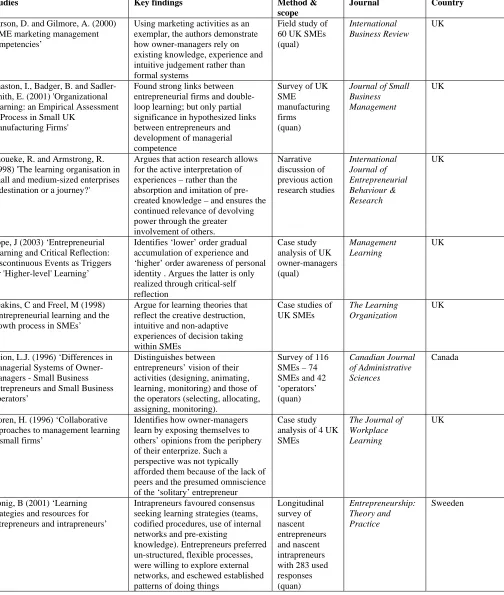
From the analysis in this part of the paper, summarised in Table 4, it is possible to
conclude:
(1) The knowledge developed and used by the entrepreneur is socially embedded
and is a function of personal constructs (Wyer et al., 2000), experience
(Honig, 2001), effectual reasoning (Sarasvathy, 2003) and wider social
contexts (Rae and Carswell, 2001).
(2) Entrepreneurs can have different learning strategies from the population in
general since they prefer unstructured, flexible processes that depend on
external networks (Filion, 1996; Chaston et al., 2001; Argyris, 2003; Cope,
2003).
(3) Knowledge can be derived from learning via reflection (Deakins and Freel,
1998; Sullivan, 2000).
(4) Routine knowledge used within SMEs in some contexts requires external
networks (mentors or learning sets) in order to be challenged to develop
innovation (Petts et al., 1998).
(5) The lack of codification of knowledge in SMEs brings with it limitations
based on a lack of economies of scale (Sadler-Smith, 1995; Ward, 2004).
In the following part of the paper we move away from studies that focus specifically on
entrepreneurs or owner-managers and begin to explore those studies that focus on the ‘firm’.
Knowledge and the firm
The previous part of the paper suggests that entrepreneurial knowledge is not only
dependent on individual personality and cognitive capacity but is also ‘situated’. For most
studies, the overriding ‘situation’ is the institution of the firm and its immediate network. For
example, Takur (1999) found that whilst management capability had a strong determining
case using resources to create space, or ‘slack’ needed by others to exploit opportunities. The
creation of slack was enabled:
(1) By the entrepreneur’s ability to stabilise the business venture by defining
organisational structures and boundaries
(2) By their ability to create enlarged strategic spaces using a reflexive management
of self as a form of empathetic leader (Thakur, 1999).
This concern with developing internal resources is also identified by Gray and Gonsalves’
(2002) who found that investment in and integration of information and communication
technology was positively correlated to expansive, growth-oriented business strategies.
Whilst these technologies were useful in terms of wider dissemination, however, their
indiscriminate use was cited as a risk, with too much or irrelevant information being
transferred. The conclusion chimes with Lefebvre et al’s (1995) survey which illustrated the
importance of technology resources for developing a wider market base (especially exporting)
but found no link between these ‘innovators’ and financial performance, possibly because in
the short run any gains in profitability were set against the cost of technology investment.
These warnings suggest a need for the judicious orgaization of resources, presuming a level of
what Bessant et al (2001) call ‘agility’, or the ability to continually re-configure problems,
solutions and routines rather than rely upon a fixed set of previously identified solutions.
Thet suggest this dynamic capability to marshal and re-organise a range of sources of
knowledge from within the firm21 and not to rely on habitual knowledge and experience is
what distinguishes sustained innovation. By way of illustration, Soderquist et al (1997) and
Irani et al (1997) identify the importance of integrating R&D activities into established
routines, as well as, promoting the use of cross-functional teams when seeking to innovate.
In terms of what constitutes a knowledge base for innovative SMEs, a critical and
overriding element of their intellectual capital seems to be those people they employ. Keogh
resource competence in nurturing and retaining their knowledge base. Without the people in
place, these firms recognised that their competitive future would be very short. Key people
were also important in Darby and Zucker’s (2003) work and they identify the significance of
maintaining close links with ‘star’ scientists. This was particularly relevant where
technological advances were metamorphic rather than incremental and where new knowledge
has not been developed or adapted by incumbents. New SMEs staffed by ‘star’ scientists can
play a vital role in creating new industrial activity, but can only do this because of the direct
influence of the scientists from whom the new knowledge originated (Darby and Zucker,
2003). Much of the scientists’ knowledge remains tacit and firm success is closely tied to the
ability to retain their services. Here Darby and Zucker (2003) show that where technology is
characterised by experience, the ability of the owner-manager to create and sustain links with
the science community is critical. Ravasi and Turati (2005) go further and argue that where
technology is transferred into an SME rather than developed ‘in-house’, the conditions of
ambiguity, asset scarcity and relational dependency are such that it is better for the
entrepreneur themselves to stay involved with the requisite technological platforms. This
intimacy with the knowledge base enables the entrepreneur to integrate tasks, to ensure
continued loyalty and commitment of key actors and to have a far clearer idea of potential
commercial applications (Ravasi and Turati, 2005).
This ability to integrate human and non-human resources is linked by Liao et al (2003)
to ‘absorptive capacity’22; the use of routines to gather, communicate and use knowledge from
the wider environment in ways that blend with accumulated experience (Liao et al., 2003).
What is known is both an issue of being exposed to new information and a willingness to act
upon it. The assumption is that the better the absorptive capacity of an SME, the more able it
is to recognise opportunities in proactive rather than reactive ways. The authors find that high
(1) A capacity for external knowledge acquisition and internal knowledge
dissemination;
(2) A pro-active strategy of new opportunity exploration as opposed to exploiting
existing ones.
(3) An ability to focus inwardly.
Each of these findings is relational, suggesting growth-oriented SMEs maintain a lucid and
extensive awareness of their environment (customers, suppliers, regulators, professions). This
is emphasized by Meeus et al (2001) who argue that because SMEs are too small to grow
through acquisition their absorptive capacity remains skewed to relational integration within
supply chains rather than internal focus. They found this to be especially the case where the
pressures to innovate are strong, in markets where heterogeneous skills23 can become
obsolete, and where the typical market response was to increase the rate of innovation. SMEs
absorptive capacity, therefore, is not so much a unit-based competency as that of a social
network (Meeus et al., 2001). It is argued that by developing external links (or social capital)
an SME can excel at developing resources and enhancing entrepreneurial skills (Meeus et al.,
2001; Liao et al. 2003).
Dallago (2000) continues this line of thought from a theoretical perspective by arguing
that SMEs can obviate transaction costs by using relational rather than formal contracts as by
fostering trust through frequency of contact and flexibility they are less likely to experience
costly opportunism or enforcement. Costello (1996) also recommends that SMEs build their
social captial as a matter of enhancing knowledge routines. Within the study ‘innovative ‘
SMEs were found to continually re-interpret routines, as what was known was
institutionalised as a routine, it remained under rapid notice to quit because of a recognition of
shifting and complex path dependencies (Costello, 1996).
As to which elements of social capital have the strongest influence, most studies
high-levels of interaction, especially with customers, assisting access to new knowledge,
technological competency, innovativeness and competitiveness. Lipparini and Sobrero
(1994) also support this view and in their study firms that were innovative and competitive
were run by owner-managers who demonstrated strong relational competence. Notably they
tended to enlist suppliers and customers in order to benefit from cross-fertilization of ideas,
particularly during product design. Perez and Sanchez’s (2002) study also agreed and argued
that finding networking solutions to production problems enabled ‘real’ product requirements
to emerge from interaction (Panizzolo, 1998). Simmie’s (2001) study explores links with
customers and suppliers and it was customers and their international distributors that exposed
SMEs to the novelty by which they might challenge existing routines. The supply-side,
conversely, was the source of embedded knowledge, with local networks providing the
knowledge spillovers through which uncertainties were resolved (Simmie, 2001). The
implication is of a virtuous cycle, albeit limited; between creating and using knowledge and
exposure to a wider customer base (Simmie, 2001).
Minguzzi and Passaro (2001) demonstrate the influence of these virtual cycles in terms
of their contribution to the development of entrepreneurial spirit. They were able to
distinguish between ‘learning entrepreneurs’ and ‘bounded entrepreneurs’. Proximity to final
customers provided ‘learning entrepreneurs’ with a stimulus for change, while ‘bounded
entrepreneurs’ tended to avoid and resist change in favour of focussing on the production of
existing commodities (Minguzzi and Passaro, 2001). Rather than accept the identification of
entrepreneurial spirit with a willingness to adapt and undergo renewal, Minguzzi and Passaro
(2001) identified, how the availability of regular, orthodox and mutually re-enforcing
knowledge in demographically knit market conditions encouraged entrepreneurs to resist
innovation and discontinuity. Where the final market is changeable entrepreneurs were
increasingly flexible but in other markets entrepreneurs preferred existing distributions of
the more direct the relations (the fewer the intermediaries) the more open and successful is the
entrepreneurial activity (Minguzzi and Passaro, 2001).
Yli-Renko et al’s (2001) exhaustive study, however, was less conclusive. They
investigate the importance of social capital to the acquisition and use of knowledge from the
perspective of the key customer relationships of young high-tech SMEs. Here, they propose
that acquisition and use is dependent upon:
(1) The availability of knowledge;
(2) The ability of the firms to recognise and use knowledge;
(3) The intensity and continuity of the relationship between the firms.
They found that where social interaction24 and wider network ties25 are related to knowledge
acquisition, the quality of those relations26 are negative. This suggests that whilst social
capital is vital SMEs must be wary of how closely they associate within one relationship
because such embededness may limit ‘entrepreneurial orientation’. Trust may smooth
transaction costs, therefore, but at the expense of exposure to new knowledge (Yli-Renko et
al., 2001). A similar ‘mixed-message’ is found by Beecham and Cordey-Hayes’s (1998) when
they found that SMEs working closely with much larger organisations through supply chains
did not often get the technological collaboration they hoped for. SMEs were obstructed, not
by the inability to develop innovative technical knowledge, but by a failure to recognise the
managerial difficulties of collaboration. Beecham and Cordey-Hayes (1998) identified that
‘islands’ of collaboration through the supply chain yielded knowledge benefits but that their
lifespan was dependent on the ability of each partner to keep abreast of rapidly changing
technologies. This included the capacity to divest themselves of already established routines
and aims when necessary.
Another influential aspect of social capital highlighted by the literature, and related to
the influence of customers and suppliers, is internationalization. This was identified by
internationalised nature of the SMEs client networks. Bell et al(2004), Kim et al (1993) and
Khan and Manopichetwattana (1989) also all found that product and process innovations of
innovative firms were linked to a broadening of markets and internationalisation. This is
confirmed by Burpitt and Rondinelli (2000) who found that even where the financial
incentives to widen customer exposure through exporting were unclear; many firms still
pursued the policy spurred on by an enthusiasm for new knowledge. Exposure to
international customer pressure becomes a good, or competence, in itself (Burpitt and
Roninelli, 2000; Bell et al., 2004).
In addition to increased proximity to markets or integration within supply chains,
another way smaller firms can develop knowledge resources through social capital is through
relations with larger firms (Rothwell, 1991). The association of smaller firms, larger firms
and innovation is in fact a frequent one in the empirical evidence (Pittaway et al., 2004).
From a theoretical perspective, Nooteboom (1994, 1999) argues that interactive relationships
between large firms and small firms should support innovation. Put simply, Nooteboom
(1994) argues that larger firms tend to be more effective at basic inventions, while smaller
firms have diversity, independence, personality and flexibility, which enable them to be adroit
at exploiting basic knowledge. Their complimentarity27 enables them to produce novel
combinations and isolate ‘mistaken forms of novelty’. What SMEs may be less good at, is in
delivering the scales of economy, production systems integration and specialisation of tasks
necessary to exploit the dominant innovations fully (Nooteboom, 1999). In terms of
empirical support for such a view King et al(2003) identify how smaller firms are less likely
to be dissuaded by uncertain growth prospects or pursuing untried technologies because they:
(1) Have the benefit of entrepreneurial commitment to an idea
(2) Have less structured routines that allow for the adoption of new technologies.
(3) Have greater exposure to these new technologies because of their mobility and
King et al (2003) argue that these specific knowledge characteristics compliment the financial
soundness, technological breadth and the marketing and sales resources of larger firms;
warranting the use of equity-based alliances (King et al., 2003). These enable the small firm
to benefit from robust resourcing to exploit their knowledge and from a formalised
common-destiny. The larger firm benefits from an avoidance of its often bureaucratic decision-making
structures and exposure to the development of new products, services and even new
industries.
Another related strategy identified by Sapienza et al (2004) is for the larger firm to
create smaller ‘spin-offs’ to innovate. They identified the most successful relationships to be
those in which there was sufficient overlap to ensure knowledge absorption and strategically
targeted activity but enough distance to explore ‘novel knowledge combinations’ (Sapienza et
al., 2004). The smaller firms benefited from sufficient flexibility to exploit innovations and
their parental ‘history’ kept the businesses stable. These observations echo previous studies
by Eden et al (1997) and Juliene et al(1996). The former cite the benefits to innovation of an
inherent flexibility and a willingness to act unconventionally. It is precisely where smaller
firms are weak, in terms of size and the cost of capital, that larger firms can step in and so
reduce the costs of technology production and transfer. It is this inability to source
cost-effective short-term capital that Juliene et al (1996) cite as the main barrier to SME
technological innovation.
A study of innovative SMEs by Rothwell (1991) identified how to overcome the
knowledge economies of scale in terms of R&D investment. Smaller firms had to be
assiduous in developing ‘dense networks’ with other firms, universities and private sector
research institutes. The lack of in-house expertise was not an insurmountable barrier to
innovation but had to be overcome by working with others. Rather than being a barrier, the
lack of in-house expertise might actually be a boon (Rothwell, 1991). For example, Jarillo’s
use external resources. Jarillo’s (1989) study suggests that smaller firms benefit from
retaining flexibility, using the resources of others such as venture capital or buying in experts
rather than growing by owning them ‘in house’; an empirical expression of Sarasvathy’s
(2003) model of ‘effectuation’. The more entrepreneurial systems tend to be the ones that
demonstrate an ability to decompose structurally, whereby elements remain detachable rather
than becoming wholly integrated. Such flexible systems allow for the re-working of the
network in response to change (Sarasvathy, 2003). System flexibility, however, erodes during
the accumulation of generic resources, or what Jarillo (1989) calls experiencing the second
entrepreneurial dilemma (where the first is locating knowledge). This viewpoint is supported
in part by Almeida et al (2003) who identify an offsetting influence. As firms grow so does
their exposure to sources of external knowledge but the concomitant increases in task-centred
formality and geographical fixity mean that their willingness to learn from informal, social
sources of knowledge is reduced (Almeida et al., 2003). It appears that these routine
interactions manifest themselves in the growth of internal information control systems that
weakens an organisation’s ability to renew itself (Floyd and Woolridge, 1999).
Perhaps the most frequently attested way that SMEs are able to use social capital to
develop knowledge is in building ties with one another, typically in geographically knit
clusters. The orthodox view is that by forming tight knit geographic clusters SMEs within a
similar industry can explore and exploit rapidly flowing knowledge. Lissoni’s (2001) study,
however, upsets this view by identifying highly codified, distinct and almost idiosyncratic
‘epistemic communities’ centred around specific mechanical engineers and other technicians
rather than on any specific organisation or cluster. The intimacy of the personal ‘know-who’
amongst such engineers can contribute to knowledge stickiness28. Similarly, Capello (1999)
finds in her study that innovative firms were characterised by stability and a close cultural
identification with their workforce (Capello, 1999). The emerging picture is far more
Capello (1999) finds that firms set within a regional milieu who did engage in collective
learning tended to be smaller firms innovating in new products (Capello, 1999). Where firms
innovated in processes, the emphasis was on the development of internal routines, and hence
growth occurred via improvements in efficiency and effectiveness (Capello, 1999). The
results of Capello’s study (1999) suggest that SMEs network in clusters for commercial
reasons rather than learning. This viewpoint is also highlighted in Hanna and Walsh’s (2002)
review of previous SME networking studies. They identify a preponderance of ‘clusters’ that
are vertically integrated, designed to improve their competitive position within supply chains.
Rather than horizontally integrated ‘clusters’ designed to promote collaboration amongst
peers in the pursuit of new products (Hanna and Walsh, 2002).
[Insert Table 4]
By drawing together the findings (see Table 4) from this part of the review it is possible
to conclude the following:
(1) The creation of ‘space’ within new ventures can enable entrepreneurs and
employees to be more agile than larger organisations, enabling them to configure
new problems and solutions in flexible ways (Thakur, 1999; Bessant et al. 2001).
(2) More innovative SMEs tend also to be growth-orientated but the relationship
between growth motives and innovation is not a simplistic one (Lefebvre et al.,
1995; Gray and Gonsalves, 2002).
(3) Internal consistency (teams and people employed) within SMEs plays an
important role in knowledge construction and consequently innovation. The
management of teams by entrepreneurs emerges as a key finding for the effective
use of knowledge (Irani et al., 1997; Soderquist et al., 1997; Keogh, 1999; Darby
(4) The absorptive capacity of individual firms, which is based on their social
networks, plays a role in their ability to act on opportunities (Meeus et al., 2001;
Liao et al., 2003).
(5) The flexibility that SMEs have enables them to reduce transaction costs through
relational contracts and trust thereby building knowledge symmetry (Gartner et
al. 1992; Costello, 1996; Dallago, 2000).
(6) The ability of firms to build social capital is, therefore, important because it
allows for the transfer of knowledge (Lipparini and Sobrero, 1994; Yli-Renko et
al., 2001).
(7) Likewise the ability of firms to actively manage knowledge and networks is
viewed as important in their competitive ‘success’ (Khan and
Manopichetwattana, 1989; Kim et al., 1993; Bell et al., 2004).
(8) Proximity to other firms and relationships with larger firms are important in
some SME contexts but not all and the relationship is a complex one (Jarillo,
1989; Rothwell, 1991; Juliene et al., 1996; Eden et al., 1997; King et al., 2003;
Sapienza et al., 2004).
In the next part of the paper we begin to explore the relationship between the firm and its
environment, exploring how knowledge is diffused. The section has a particular focus on
empirical studies exploring policy interventions.
Knowledge and the wider SME environment
The importance of configuring knowledge at firm and then network level extends
empirical concern to the wider institutional environment. It is the latter ‘space’ that concerns
Cooke and Wills’ (1999) survey of knowledge use and innovation. They examined the
institutional role of governments in facilitating the growth of networks through the European
to innovation as a result of having developed links with other firms and stakeholders from
outside their national economies. They show that SMEs come to value different forms of
social network as a method to advance know-how and exploit commercial opportunities
(Cooke and Wills, 1999).
Morrison and Bergin-Seers (2002) identified29 a policy need to attend to the creation of
a ‘learning architecture’ to better engage SMEs. Specifically, they argue that policy needs to
be sensitive to the experiential and practical ways in which owner-manager’s learn, requiring:
(1) Work-based rather than off-site learning to emphasise relevance.
(2) Maintaining an onus on owner-managers to direct their own learning.
(3) The use of mentors as advisors intimate with business problems;
(4) The encouragement of peer networks.
As to of what such an architecture consists, Mehra and Dhawan’s (2003) study identified
components which included:
(1) A base line of organisational financial ‘health’.
(2) A willingness to pursue innovation.
(3) An ability to interact with others and so build networks.
(4) An acceptance of risk.
(5) An ability to change direction should circumstances demand.
As Morrison and Bergin-Seers (2002) suspect, none of these require explicit, generic, formal,
off-the-peg advice. Rather the focus is on encouraging entrepreneurs to ensure both they and
others are provided with challenges, are exposed to a variety of tasks, used team-based
activity and are empowered to make decisions.
In contradiction to the need for ‘learning architecture’ Sikka (1999) argued that it was
not so much an entrepreneurial policy culture that was lacking, as a persistent gap between
SME activity and new technological innovation. The study suggests the use of government
innovation. As Platt and Wilson (1999) point out, it is not merely having the ‘learning
architecture’ in place but having the capability to use it. This capability varies across
socio-cultural contexts and local development of technologies is required to institutionalise the
innovation as a set of local routines (Platt and Wilson, 1999). It is the demographic aspects of
these different knowledge environments that concern Van Horn and Harvey (1998) who argue
that due to low set up and running costs, the availability of grants and advances in
telecommunications, rural entrepreneurship is viable, but would be significantly enhanced if it
also had:
(1) Expertise (finance, marketing; legal);
(2) Shared resources to reduce idle assets;
(3) Economies of scale to reduce the cost of supply;
(4) Institutionalised benefits of continuity and consistency.
In developing a model of an entrepreneurial ‘virtual mega-firm’, Van Horn and Harvey
(1998) suggest that much can be done by a collection of rural entrepreneurs held in a virtual
assembly by common goals. It is argued that given the right policy environment, and by
developing network and relationship skills, and adopting a learning outlook, entrepreneurs
would be able to form such a firm (Van Horn and Harvey, 1998).
The use of government policy to promote knowledge use, however, can be a somewhat
clumsy tool if it is applied across time to all conditions. In their study, Lagace and Bourgault
(2003) found indiscriminate public sponsorship for a raft of world-class manufacturing
practices meant that some of the sample firms ended up resenting rather than welcoming
public assistance. The authors argue that for competitiveness policies to work, account has to
be taken of each individual firm’s growth aspirations and its ability to grow. Similar findings
come from the earlier study of high-tech SMEs by Oakey and Cooper (1991). They found the
variance between technologies, notably in R&D lead times, to be so great as to produce
rather than assume the adoption of high technology will encourage rapid growth whatever its
nature, policy communities need a better scientific understanding of how different
technologies have different gestation periods. One way of ensuring policy remains less
generic to the economic conditions it aims to configure is indirectly via professional
associations as opposed to direct government intervention. For example, Swan and Newell
(1995) found the professional development advice and training offered by the association
responsible for product inventory and control had a positive effect upon disseminating
technology innovation. Due to a lack of resources and size the links between smaller firms
and the professional association were somewhat limited. This may suggest that targeted
investment in the development of professional bodies to promote SME exposure to
technology developments may be problematic because not all professional associations have
deep and widespread links with SMEs.
Another direction for governments to take is to accept the role of other intermediaries.
As Cook and Wills (1999) point out, what SMEs valued least about their participation in EU
programmes was the presumption of knowledge on the part of public bodies. It was found to
be far more productive to spend public resources on encouraging meetings between
knowledgeable SMEs, who act as agents for interaction and encourage the better exchange of
tacit knowledge.
In much of the policy literature explored in this part of the paper there is an implicit link
between innovation and growth. It should be noted that the assumption linking innovation to
growth in SMEs is a strong but not undisputed one. On the one hand, we have Yli-Renko et
al (2001) who found that where knowledge acquisition was strong amongst high-tech SMEs it
was positively related to knowledge exploitation, improving innovation, efficiency, technical
capability and reducing costs. On the other hand, Bagchi-Sen’s (2001) study of innovating
SMEs linked the ability to recognise and pursue new knowledge to stronger sales growth but
non-innovating firms and identified links between levels of product and service innovation
and turnover growth. Yet, positive correlations with productivity, profitability and
internationalisation were not found in the study. Sadler-Smith et al’s (2001) also had
conflicting findings, with a positive correlation between manufacturing SME growth and the
adoption of generative learning30 but no similar relationship for SMEs in the service sector31.
This suggests that though influential in terms of growth, the edict of ‘innovate or die’ is itself
a contentious one for the policy community to take up given that the links to profitable
outcomes are unclear (Freel, 2000; Sadler-Smith et al., 2001).
[Insert Table 6]
From this part of the review (see Table 6) it is possible to conclude the following:
(1) SMEs come to value social networks as they grow as a means to advance
know-how and exploit commercial opportunities (Cook and Wills, 1999).
(2) Policy designed to build ‘learning architectures’ for SMEs that enable them to
learn experientially is viewed as a useful role for Government but that this works
best when done indirectly through intermediaries (Swan and Newell, 1995;
Morrison and Bergin-Seers, 2002; Mehra and Dhawan, 2003; Pittaway et al.,
2004).
(3) Such policies need to be developed locally to encourage knowledge flow and
institutionalise innovation routines (Van Horn and Harvey, 1998; Platt and
Wilson, 1999; Sikka, 1999).
In the concluding part of this paper we bring together all the findings from this review,
making some conclusions about knowledge in SMEs, explaining the current state of research
on the subject and highlighting the implications for future research and policy.
Research of knowledge within an SME context can be broken down into three distinct fields:
(1) The knowledgeable SME manager or entrepreneur;
(2) The knowledge systems and routines embedded within the context of the firm
and their immediate networks;
(3) The institutional and policy framework that is intended to support knowledge
production within SMEs.
These fields are not discrete and inevitably overlap but they provide a useful heuristic through
which research can be examined. In addition, it is noteworthy that, apart from a handful of
studies which address entrepreneurial knowledge construction through narrative analysis,
knowledge is considered to exist as a configurable resource.
In the first of the knowledge fields, findings suggest that it is the use of flexible,
unstructured and socially-embedded experiences and relations that exemplify the
knowledgeable and knowledge-creating entrepreneur. The researchers reviewed have
typically concluded that these configurations should remain informal and flexible, since too
much structure creates a focus on knowledge exploitation rather than exploration, and reduces
entrepreneurs’ learning capacity (Filion, 1996; Chaston et al., 2001; Honig, 2001). When
structure becomes too rigid, it is suggested that opportunities for reflection are required
(Choueke and Armstrong, 1998). Access to alternative knowledge resources via networks,
may provide the social capital necessary for entrepreneurs to leverage resources and
re-conceptualise activities (Yli-Renko et al., 2001). There is a note of caution suggested by
some studies as it is this very informality that reduces the capacity to capitalise on economies
of scale (Macri et al., 2001).
In the second of the fields, it is recognised that while the entrepreneur’s knowledge
activities and identities are important for the firm, so are the systems and routines of wider
organisational activity, including the attraction and retention of human capital (Gray and
the capacity for knowledge acquisition (via external knowledge networks); and the capacity
for internal knowledge dissemination and sharing. The absorptive capacity of the firm,
therefore, is dependent on the routines of organising embedded in the firm by the entrepreneur
and how he or she encourages teams within the organisation to use knowledge effectively and
innovatively (Darby and Zucker, 2003). Consequently, social capital is not only dependent on
the entrepreneur but it is dependent on the management team and the system of interactions
and networks inside and outside the firm (Ravasi and Turati, 2005). Social capital allows the
transfer of knowledge and, as a result, the ability to manage networks may be a key factor in
SME success (Liao et al., 2003). The network relationship to knowledge flow is complex but
paradoxically, strong (and therefore fewer) relational ties may encourage knowledge flow,
while limiting the sources of that knowledge (Meeus et al., 2001). Alternatively, weaker and
more diverse networks may provide access to a wider range of knowledge, encouraging
reflection on and change to existing routines (Minguzzi and Passaro, 2001).
In the third of the knowledge fields, the SME environment, it is evident that policy
interventions have been targeted at building ‘learning architectures’. Government agencies,
however, were not necessarily seen by SME managers as providing relevant or credible
advice (Mehra and Dhawan, 2003). Rather than get involved in this role directly, the research
suggests that Governments should encourage peer to peer networks and professional networks
(Oakey and Cooper, 1991; Lagace and Bourgault, 2003). These policies, it is suggested, must
be local and sensitive to context (Cook and Wills, 1999). These elements of the review
suggest that generic solutions are not effective in encouraging the development of knowledge
resources within SMEs.
In terms of policy, the study conducted suggests that, in order to encourage the
development of SME knowledge resources, a flexible approach is required. This approach
needs to be sensitive to the entrepreneur’s capabilities, experience and identity, and also to the
aims, objectives and motivations of SME managers or entrepreneurs is important since they
have a significant influence on the firm’s activities. In such policy interventions
entrepreneurs would need to be engaged in the design of a ‘learning architecture’ and the
ability to help build social capital seems significant within such architecture. It would also
require the development of networking and team-building competencies, which assist the
development of skills linked to accessing resources and leveraging human capital. The role of
Government intervention, therefore, would be to support networking activity and the general
architecture but not to be involved directly in its delivery, as is currently the case (Pittaway et
al., 2004).
This study shows that the situated nature of entrepreneurial learning has a substantial
influence on the development and use of knowledge within SMEs. The studies reviewed
include statistical analyses using large samples and case studies and these have typically
focused on knowledge as a resource. It is, therefore, recommended that more studies
examining SMEs need to be conducted that conceptualise knowledge differently, which focus
on knowledge configuration, rather than knowledge creation. Such work should seek to
explore the way in which owner-managers and entrepreneurs make sense of their individual
and situated realities. Studying SMEs from this perspective may provide a useful way of
understanding how entrepreneurs develop, apply and negotiate their personal theories within
their firms. As such, this type of research would provide a richer picture allowing researchers
to have a more sophisticated understanding of knowledge use and ensuring that this