An Extensive Survey on different Routing Protocols and
Issue in VANETs
Rajeev Sharma
Vivekananda global university,Rajasthan
Anil Choudhry.
Ph.D.Swami Vivekananda institute of Technology, Rajasthan
ABSTRACT
Vehicular Ad Hoc Networks is a class of mobile Ad hoc Network. Vehicular Ad Hoc Networks (VANET) and mobile Ad hoc Network (MANET) are wireless networks which are points as automatic configured and self governing wireless ad-hoc networks. In VANET some terms of dynamic and high mobility are defined. Knowledge of routing in Vehicular Ad Hoc Networks becomes arduous and challenging due to changeable connectivity, high point mobility and network Distribution. The review paper tries to describe VANET and its routing protocols which focus on vehicle to vehicle (V2V) and vehicle to infrastructure (V2I). The objective of this study is to categorize protocols on the basis of routing information and comparing them using following parameters namely methodology used, advantage/power and limitations. The survey paper is located on routing protocols which are categorized as topology and position based routing protocols. This paper prescribes the comparison of reactive and proactive routing protocols based on their merits and demerits.
Keywords
VANET, Routing Protocols types, Reactive, Proactive.
1.
INTRODUCTION
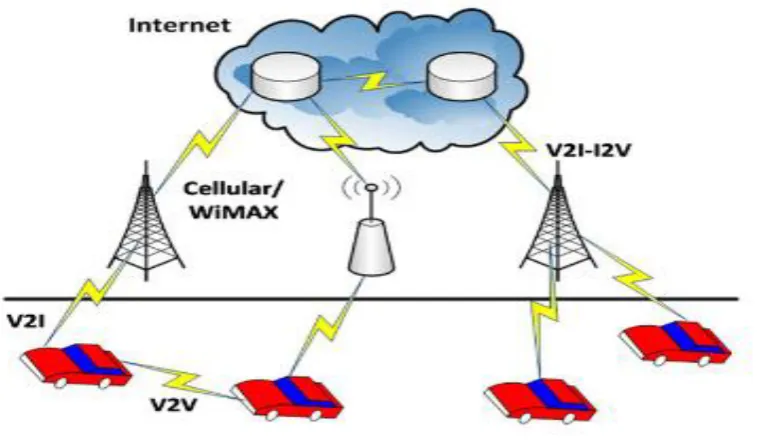
[image:1.595.106.485.437.661.2]VANET is a particular class of MANET.VANET has two types: V2R (vehicles to roadside infrastructure) and V2V (vehicles to vehicles). In VANET vehicles provide services same as mobile nodes. Road side infrastructures work as a distribution signal for the vehicles. There are two types of wireless communications VANET. V2V and V2R as stated in fig 1. VANET distinguishes MANET in terms of the following features: - high level mobility, mobility topology, oneself organized architecture, distributed communication, path reduction and elements network size. These features make the VANET environment difficult for evaluating dominant routing protocols. A massive number of applications exist in VANET namely traffic capacity, management, infotainment applications, but the two major applications are: passenger comfort and safety applications. VANET system designed and is implemented under the following tightness: security, solitude, connectivity and trait of services.
Figure 1 VANET
2.
LITERATURE REVIEW
Routing in ad-hoc networks is a critical issue .Routing is a procedure of sending data packets from source node to destination node. This paper focuses on the routing protocols of VANET between V2V and V2I. Today the routing protocol taxonomy and the related research in VANET routing are the foundation of various aspects such as characteristics, trait of services, techniques applied, routing algorithms, routing
3.
SECTIONS
This paper is divided into five sections where section 1 gives general VANET introduction and section 2 provides a brief introduction on the literature review of this paper and section 3 provides various types of routing protocols. Section 4 discusses on issues in VANETs. Section 5 emphasizes on comparative analysis of VANETs Section 6 provides conclusion of the paper and future scope of VANETs
.
4.
VARIOUS TYPES OF ROUTING
PROTOCOLS
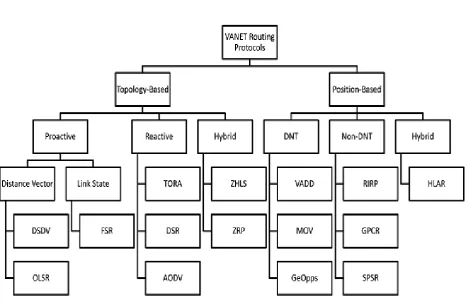
[image:2.595.67.535.229.530.2]Routing protocols are widely categorized as topology based and position based routing protocols. Topology routing protocols deal with the network layouts of the nodes that deal with the information used by the routing protocols in order to forward the data packets where as location of nodes should be known as position based routing network for packet forwarding.
Figure 2 Routing protocols classifications
4.1
Topology-based Routing Protocols
This type of routing evaluates the selection of route for sending the information between sender and receiver. Topology based routing protocols are further categorized into three types based on the network architecture Proactive, Reactive routing, & Hybrid protocols.
4.1.1
Proactive Routing Protocols
Proactive routing protocols allow every network node to maintain a routing table for storing the route information to all the other nodes, every next node that comes in the path towards the destination from the source is , entered in the table thus these protocols are also known as table-driven protocols. If any changes occur in network topology every
node automatically will updates routing table. Proactive routing protocols are examples of FSR and DSDV [1]. The heading for subsubsections should be in Times New Roman 11-point italic with initial letters capitalized and 6-points of white space above the subsubsection head.
4.1.1.1
Destination Sequenced Distance Vector
(DSDV) Routing Protocol
sequence number to every entry in the table. Frequent update does not allow in DSDV because some problems may occur such as cyclic routes, reduces control message overhead and excludes extra traffic. Instead of multipath DSDV chooses the best path i.e. the shortest path.DSDV is not suitable in controlling the networks congestion which decreases the routing efficiency [1], [8].
4.1.1.2
Fisheye State Routing (FSR) Protocol
FSR maintains a topology map for each node and updates its routing table thus provides the latest information from its neighboring nodes. FSR is also called table driven routing protocol. It is an emphasis on link state routing and improvement of Global State Routing. The main advantage of FSR is that it significantly decreases the consumed bandwidth as it exchanges fractional routing update information only with neighbours. If any link fails it updates the routing table every time and it will reduce routing overhead. The main disadvantages of FSR are very poor performance, insufficient information of another node [1].
4.1.2
Reactive Routing Protocols
RRP is also known as on-demand routing protocols. If there is no root from source node to destination node, the discovery of route can start, thus the network traffic reduces .This results will save of bandwidth. In this root discovery process a route request message is sent. Any node that exists on this route towards the destination, after receiving this request message sends back a route response message to the source node using unicast communication. These types of routing protocols are suitable for large sized mobile ad-hoc networks which are highly mobile & having frequently changing topology [1], [8].
4.1.2.1
Ad-hoc on-demand Distance vector
protocol (AODV)
AODV is a routing protocol made for ad hoc mobile network. This type of protocol reduces flooding in network AODV protocol gives low network overhead one more an advantage of these routing protocol is that it minimizes the routing table when a node sends information data packets to other nodes in the network it creates a route & thus it minimize the size of memory. The major difference between AODV and other on demand routing protocols is that it uses a destination sequence no. (Dest seq num) to determine the up-to-date part to the destination this technique enables dynamic up date for adapting route conditions. AODV is more suitable for large networks. The advantage of AODV is to create extra traffic for communication along existing links [1], [3].
(AODV + PGB) Today the most desirable issue is the consistency of routes this can be achieved easily by using AODV routing protocol with PGB (preferred group Broadcasting) this reduces control message overhead & provides route availability in VANET environment. When there are large no. of errors in the network & when the signals work from source node to destination node the performance of Ad-non network decreases as the hidden terminals the communicates between two nodes. Thus the PGB algorithm makes it possible for some nodes to again broadcast a route request data message. If on the process of this further broadcasting no nearest node to destination it may found there is a delay in route discovery process. If these two nodes broad-cast same data packet this protocol may cause packet duplication [1
].
4.1.2.2
Dynamic source Routing (DSR)
This is a type of reactive protocol in which routing process is implemented using low overhead. There is a successful packet delivery even if change in network occurs by decreasing periodic messages. This multi-hop routing protocol decreases the network traffic. Two Type of process are provided by DSV:
1. Route discovery mechanism 2.Route maintenance process During the discovery procedure, when the source nodes need non-current route, route request information is sent by it to all its near nodes. Every node during that receives the information and sends the information towards the destination node. Route saves the route reply message in the routing table of the source node for future use. If any abortiveness occurs, the source may indicated by the sending route error information back to the sender node. The main advantage is that there is no need of updation in DSR. Disadvantage is that in high mobility design it produces the worse results [1], [8].
4.1.2.3
Temporally Ordered Routing Algorithm
(TORA) Protocol
TORA uses multi -hop routes during routing procedure. TORA is a part of distributed routing protocol. This protocol decreases the communication overhead due to frequent network changes. Advantages of TORA is that it makes DAG.there is No need to rebroadcast the information. It executes well in mesh network. The main disadvantages it is not gauge able. TORA is based in tree structure in which packets should move from high node to low node [8].
4.2
Position-based Routing Protocols
This routing protocol depends on the position and location data. The source node sends message data packet to the destination making use of the packets location alternately of utilizing the network address. Every node decides its position and that of their neighboring nodes through help of Geographic Position System (GPS) during this protocol. The nodes complete the location of its neighbour within the radio range of the current node. The location of the destination in the header data packet saves with no requirement of route keeping, route discovery, or any awareness of topology. Position-based routing protocols are examined to be suitable and static for highly mobile VANET environments with topology-based routing protocols. Position-based routing protocols are examined to be suitable and static for highly mobile VANET environments with topology-based routing protocols. This protocol are classified as namely, DTN i.e. Delay Tolerant Network, Non-DTN i.e. Non Delay Tolerant Network and Hybrid protocols [1], [8], [3].
4.2.1
Delay Tolerant Network (DTN) Routing
Protocol
4.2.2
Non Delay Tolerant Network (Non DTN)
Protocols
The main advantages of non DTN protocol is that it does not take into account the disconnectivity problem instead assumes that a large amount of nodes exist to attain a successful wireless communication, which implies that the protocol the most appropriate for the dense networks. The source node sends the information to the nearest neighboring node to the destination node. The action plan can also fail if no such the closest neighboring node exists. Non-DTN routing protocols is controlled by other actions thus this link damages.
4.2.2.1
Greedy
Perimeter
Stateless
Routing
(GPSR)
GPSR is a method of greedy routing in VANETs every node sends a frame to destination node through intermediate nodes. It uses perimeter forwarding technique to identify the node through which the message should be delivered. gpsr increases the scalability of protocol over the shortest path ad hoc routing protocol GPSR is stateless routing protocol which maintains the information about its first hop neighbor position that growth sequence routing protocol over the shortest path ad-hoc routing protocol. GPSR takes a decision of dynamic forward packets which is the main advantages of GPSR .if any link failure occurs because of frequency change in network and because of large mobility the whole process is controlled by perimeter forwarding technique which cause bulk data losses, latency time is taken .packet header information does not updates time to time if detonation node may obtain a new position [1], [3].
4.2.2.2
Reliability
Improving
Position-based
Routing (RIPR)
RIRP protocol is based on position based routing which was developed to be used in VANET. Routing process causes link failure and the solution is provided by RIRP protocol. This type of protocol provides communication in vehicles which depends on vehicles speed and direction. Here the source determines the mobility for the medium nodes which sends the data to nearby node. The sender node makes a routing table storing positions with mobility speeds of closets node. RIRP selects the forwarding node, sends data to the intermediate node. Two techniques are used by RIPR protocol greedy and perimeter technique .Position of node is considered by the route features .In the RIPR protocol often an extensively encounters link failure problem occurs because of improper data storage in wrong mesne nodes. [3]
4.2.3
Hybrid Position-based Routing
This protocol is based on the position based routing that decreases handle, overhead /load and does not able to maintain the routing table since they provides location information about the closest nodes and destination nodes which make position-based routing more scalable. Hybrid location-based ad-hoc routing protocol is a part of Hybrid position based routing protocol. This protocol helps in
reduction of the routing control overhead and route discovery process. The process of hybrid location based protocol is to regularly update and transport until data from source to destination node is reached.
5.
DISCUSSIONS ON ISSUES IN
VANET
Various issues in VANETs like vehicular ad hoc networks in an attempt to supply an improvement to driver behavior, with the purpose of fatalities produce, by automobile accidents. Various issues and challenges are defined as follows:
5.1
Dynamic Topology and High Mobility
The disrupted communications in VANETs depends to network nodes is highly mobility and dynamic topology. A solution is to increase data exchange devices and wireless sensors which is stores the data after sending a data correct destination.
5.2
Bandwidth Limitations
Other issues in the VANETs do not present the central system in communications, the authority of leading bandwidth and argument operation. The bounded range of bandwidth (10-20 MHz) is significantly applied for VANETs.
5.3
Fault Tolerance and Connectivity
If during the data exchange a node moves through the network, a network route should be produced by the routing protocol to the network. These issues can be solved this requirement of various update in the routing tables. This is the large mobility and changing topology, which is lead to a frequent disconnection in networks.
5.4
Delay Constraints and Real-time
Transmission
To allocate emergent occurring situations, drivers do not have enough time to responds. Information is allocated in the real time. If message is received in time the accidents can be avoided. The routes are to be maintained and manufactured for real time applications.
5.5
Security
Security and privacy are the main issues of future research area. If no protection is available in routing protocols, a malicious node can enter the network and thus causes harm. The misleading of messages may be used by hijacker, to trap guiltless, person as dead and underpass.
6.
COMPARATIVE ANALYSIS OF
VANET
Table: 1 Merit and demerits of topological routing protocols
Table: 2 comparison of position based and topology based routing protocols.
VANET Routing Protocols
Topology-Based Routing Protocols Position-based Routing Protocols
method 1. Use shortest path algorithms based on distance vector strategy.
2. Routing table stored the data. 3.every node is updated timely
1. Position /location decide service is used. 2. Vehicle position is decided based on forward data packets.
3. The data packets use a store, carry and forward strategy.
Merits 1.Route discovery mechanisms is required
2. Applicable for unicast, multicast and broadcast routing.
1.Route discovery mechanism is not required 2. Maintenance high mobile environment
Demerits 1. Use large overhead.
2. Route discovery and latency restriction Protection or maintains.
3. Link Failure in discovering full path due to frequent network topology changes.
1. Give low overhead.
2. Position and location finding services. 3. Stalemate may occur in location server.
7.
CONCLUSION
The paper provides an essence of VANETs. Vehicular ad hoc networks which is discussing their features and an impellent with the study of VANETs routing protocols that target vehicle to vehicle (v2v) and vehicle to infrastructure (v2I) communication. This discipline paper has given differences into major categorization, of routing protocols. This paper provides two classification of VANET routing, topology based routing protocol and position based routing protocol. This gives a summary Conversation of the protocol working and their important merits and demerits along with its limitations. The study on several, VANETs routing protocols, the issues and challenges, security are represented more effectively.
8.
REFERENCES
[1] Shilpi Dhankhar , Shilpy Agrawal ,,“VANETs: A Survey on Routing Protocols and Issues” International Journal of Innovative Research in Science, Engineering and Technology. Vol. 3, Issue 6, June 2014.
[2] Al-Sultan S, et al. “A comprehensive survey on vehicular Ad Hoc network “, Journal of Network and Computer Applications (2013),
[3] Hemlata Chaudhary “A Review of Topology based Routing Protocols for Vehicular Ad Hoc Networks” International Journal of Advanced Research in Computer Science and Software Engineering. Volume 4, Issue 2, February 2014.
[4] Md. Humayun Kabir “Research Issues on Vehicular Ad hoc Network” International Journal of Engineering Trends and Technology(IJETT) –Volume 6,Number 4-Dec. 2013
[5] Rahul Raut , Parag Thakare ,“Conspectus of Various Routing Protocols in VANET” , International Journal of Advent Research in Computer & Electronics, Vol.1, No.2, April 2014 E-ISSN: 2348-5523 .
[6] Bijan Paul, Mohammed J. Islam, “Survey over VANET Routing Protocols for Vehicle to Vehicle Communication”.., IOSR Journal of Computer Engineering (IOSRJCE),ISSN: 2278-0661, ISBN: 2278-8727Volume 7, Issue 5(Nov-Dec. 2012), PP 01-09
[7] Kumar, R., and Dave, M., "A Comparative Study of Various Routing Protocols in VANET," International Journal of Computer Science Issues (IJCSI), Vol.8, Issue 4, 2011. [8] Paul, B., Ibrahim, Md., and Bikas, Md., “VANET Routing
Protocols: Pros and Cons.”, International Journal of Computer Applications, Vol.20, No.3, April 2011.
[9] Kumar, Y., Kumar, P., and Kadian, A., “A Survey on Routing Mechanism and Techniques in vehicle to vehicle communication (VANET)”, International Journal of Computer Science & Engineering Survey, Vol.2, No.1, Feb 2011. [10] Perkins, C. E., and Royer, E. M., “Ad-hoc on-demand distance
vector routing”, 2nd IEEE Workshop on Mobile Computing Topology-based Routing
Protocols
Reactive Routing Protocols Proactive routing protocols
Merits 1. Decrease s the network traffic and saves bandwidth.
2. Route from sender to receiver is updated and maintained by routing table.
1. Route Discovery is not mandatory.
2. The routing table of every node earns updated
Demerits 1. Searching latency is high for route.
2.In communication exceeding flooding of the network causes dissolution of nodes
Systems and Applications,WMCSA’99, 1999.
[11] Jain, S., and Sahu, S., "Topology vs. Position based Routing Protocols in Mobile Ad hoc Networks: A Survey," International Journal of Engineering Research & Technology (IJERT), Vol.1, Issue 3, 2012
[12] Abolhasan, M., Wysocki, T., and Dutkiewicz, E., “A review of routing protocols for mobile ad hoc networks”, Ad Hoc Networks 2, Elsevier, pp.1–22, 2004.
[13] Kumar, R., and Dave, M., "A Comparative Study of Various Routing Protocols in VANET," International Journal of Computer Science Issues (IJCSI), Vol.8, Issue 4, 2011.
[14] Mor, A., "A Study of improved AODV routing protocol in VANET," International Journal of Computer Applications & Information Technology, Vol.2, Issue I, 2013.
[15] Husain, A., Raw, R. S., Kumar, B., and Doegar, A., "Performance Comparison of Topology and Position Based Routing Protocols in Vehicular Network Environments", International Journal of Wireless & Mobile Networks, Vol.3, No.4, 2011.
[16] Kohli, S., Kaur, B., and Bindra, S., "A comparative study of Routing Protocols in VANET”, International Journal of Computer Science, Issues-IJCSI, Proceedings of ISCET, 2010. [17] Walia, G. K., "A Survey on Reactive Routing Protocols of the
Mobile Ad hoc Networks," International Journal of Computer Applications, Vol.64, No.22, pp.45-51, 2013.