Video Watermarking Techniques – A Review
N Leelavathy
Professor & HOD
Department of CSE
Pragati Engineering College,
Surampalem. India
E V Prasad
Professor & Director
Department of CSE
Lakkireddy Bali Reddy College
of Engg., Mylavaram. India
S Srinivas Kumar
Professor & Director ( R & D)
Department of ECE
UCEK, JNTUK, Kakinada
India.
ABSTRACT
Present era shows a rapid growth in the progress of digitization and creation of digital multimedia content. Image and Video makes up the majority component in digital multimedia content. The potential solution for protection and prohibiting copyright infringement of multimedia is only using digital watermarks. The characteristic of robustness, i.e., sustainable capability to withstand against various attacks, influences the applications and its performance in protection of copyright and authentication. This paper reviews importance of watermarking, design requirements for various applications, and focus on classification of video watermarking algorithms for copyright protection.
General Terms
Video Watermarking, Security, Algorithms, Robustness
Keywords
Attacks, Copyright Protection, Intellectual Property Rights, Robustness, Authentication
1.
INTRODUCTION
With the advent of digital computers and digital signal processing in the late 1960s, the unsolved and tedious analogue processing is simplified. The benefits of usage of digital signals are higher than that of their corresponding analogue signals. Digitization of signals results in less bandwidth usage with minimal electromagnetic interference. Digital signals can be encrypted for security and higher data rate transmission is possible. Digital system has fast processing speeds with less power consumption than compared to analog system with the growth of VLSI. Hence, digitization has contributed for the development of information exchange through common information systems platform such as World Wide Web (WWW) or Internet.
The interconnection of various networks, viz., Internet has contributed to exchange of digital information with an ease. This led to copying, distributing and exchanging of information globally within a short time. The ease of regenerating digital information in its faithful original form is likely to promote violation of copyright, information misappropriation and resulting in fraud. It is a great challenge that, the knowledge of digital intellectual property must be made available in internet. At the same time, it should also guarantee tenure of the intellectual rights by its owner and others must be able to access the information freely. Lot of research is being carried out in this field. Copyright protection of information in security systems can be attained by three interlinked methods- (a) Cryptography, (b) Steganography, and (c) Watermarking.
Cryptography [1] is an art or science of developing various algorithms and techniques that are used to convert plain text to cipher text which is not readable to unauthorised users.
However, encryption algorithms cannot completely solve the problem, as once it is decrypted at the receiver end, intellectual property rights are not protected and copyright information may be modified by various intentional attacks. Another issue is that, a licensed user may obtain the data and may illegally redistribute the data. It may ruin the revenue of the owner.
Steganography [2] can be treated as a science or art of data hiding in another object where the existence of the embedded secret message is not distinguished. The object can be a text, an audio, an image, or a video.
Watermarking [3] helps to identify the true owner of the digital information. This technology is one of the possible methods to protect digital information.
Contrasting to steganography, the embedded information that is used in digital watermarking is usually related to the cover media, and the size of secret (embedded) information is small compared to cover media. Digital watermarking techniques mainly focus on imperceptibility of the embedded information, while attaining excellent robustness to various attacks on watermarked image / video.
2.
PHASES OF WATERMARKING
SYSTEM
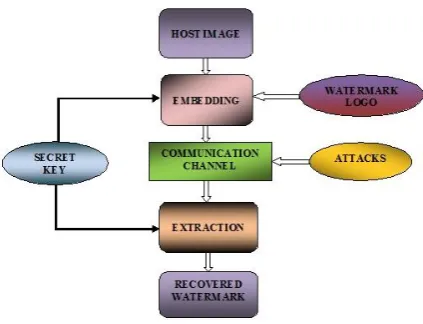
All Watermarking is the procedure of embedding the owner's identification or information (to detect tamper) within digital image, audio, video, and texts, by considering various features of the digital media like the limitations of the human perception, histogram shifting, etc. The overview of different phases of watermarking system is shown in Figure 1. A watermark is designed and embedded to exist in the host media permanently. The watermark can be a sequence of pseudo random number, copyright logos / messages, ownership identifiers marks, gray or binary images or any other digital information formats. After watermarking is performed on an original digital media data, it can be distributed in internet and may undergo certain manipulations like unintentional or intentional attacks, so as to degrade the watermark to disappear. Ideally, the watermark must remain intact or safely detectable after the digital data has undergone some attacks. Only when there is a question of ownership or as a proof of intellectual property rights, the embedded information from the host is extracted. There are two different types of watermarking systems by considering the embedded watermark at the detection or extraction stage.
Known watermark
Unknown unique watermark
Fig 1: Different phases of watermarking system
Reference of watermark may be used to retrieve the embedded watermark from the watermarked image / video resulting as non-blind watermarking algorithms [4, 5]. Without the knowing the watermark, if it is retrieved, then it is known as blind watermarking algorithm [6, 7]. As there is no prior information about the embedding information, retrieving is more difficult in blind watermarking.
The effective watermarking techniques require several properties in designing a watermarking system. Watermarking algorithms [8] can be classified as fragile, semi-fragile, and robust based the sustainability against attacks.
The basic requirements of watermarking algorithms are summarised as follows.
i. Imperceptibility
Imperceptibility or invisibility is the perceptual similarity between the watermarked cover data and the original one. The quantitative measurement of the perceptual quality of the watermarked images or frames is measured by using quality metric called the Peak Signal-to-Noise Ratio (PSNR) or Structural Similarity (SSIM) index [10].
Let and be the gray level of the pixels at the
row and column of two images of size , respectively. The PSNR is defined in Eq. (1).
(1)
The SSIM index between two images and is defined in Eq. (2)
(2)
where, , , and denote average, variance, and covariance, respectively, and and are constants.
ii. Robustness
The watermark that is embedded into the cover media is supposed to be detected although it would have been distorted with intentional or unintentional attacks. Robustness is a property that, it must survive even after the modifications are done to the original content using common signal processing operations like, lossy compression, filtering, translation, rotation operations, etc. Normalized Cross Correlation (NCC) or Bit Error Rate (BER) of embedded watermark and retrieved watermark is another performance measure of
watermarking algorithm, which may use to verify the robustness of the algorithm.
iii. Information or Payload Capacity
Information or payload capacity is the amount of information that can be inserted into the original cover media without corrupting the visual quality and can be retrieved without an error. Important feature regarding watermark payload is watermark granularity.
iv. Complexity
Implementation of watermarking algorithms must be at a reasonable cost of computation and is expected to be done in real time. The watermarking performance, i.e., the rapidity of embedding and extraction processes is attracting the system designers.
v. Security
The watermarking technique’s security is stated in the same way as the security provided in encryption techniques. The algorithm for embedding and extraction of watermark may not help an unauthorized intruder to detect or destroy the watermark. The complete security lies in the choice of a secret key.
From the aspect of algorithm designing, the most important requirements are (a) imperceptibility or transparency, (b) robustness to image processing attacks either intentional or unintentional, and (c) information capacity or payload capacity. All the three are crucial but they conflict with each other. Hence, an application specific trade-off must be compromised to achieve good watermarking system.
3.
DESIGN ISSUES OF VIDEO
WATERMARKING
Design of video watermarking algorithms introduces certain issues which are not considered while designing the image watermarking algorithms. Unlike image watermarking, video presents a unique challenge to the designer. The following are the problems that must be addressed:
i. Embedding of watermark is done in several domains: spatial, frequency, and time domain. Imperceptibility of the watermark is an important characteristic to be considered.
ii. Video has higher degree of perceptual redundancy and irrelevancy that can be utilized by both attacker and designer.
iii. Unlike image, video has many compression and encryption standards. It must be handled separately as per the CODEC (e.g. MPEG2, MPEG4, H.263). For real time video streaming the watermarking algorithm must be adapted to the video type. For example, MPEG4 watermarking methods handle objects while MPEG2 schemes typically operate in the DCT domain.
iv. Video Watermarks should sustain common video editing operations like frame resizing, frame swapping, frame dropping, cropping, geometric modifications of frames, frame rate changes, format conversions, as well as attacks on individual.
v. Algorithms must embed large amounts of information as watermark (more than 60 bits per second).
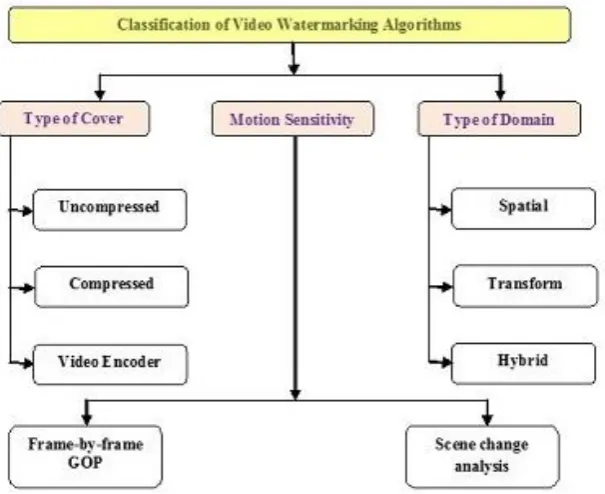
Fig 2: Classification of Video Watermarking Algorithms
4.
CLASSIFICATION OF VIDEO
WATERMARKING ALGORITHMS
The important feature of a watermark is that, its strength should be low enough that, it is insensitive to human vision and at the same time it should be high enough that it is extremely difficult to attempt to remove or alter the watermark from the cover video without degrading the original quality of the cover video [9]. This robustness of the watermark embedding algorithm is needed.The important issues in the design of video watermarking algorithm is to identify the location in the cover video, strength of the watermark, and what is to be embedded. The watermark is embedded to every frame, at the same position of a video sequence independently. As long as the same scene, i.e., the background remains stationary the watermark remains stationary. But when the scene changes, i.e., the frame has dynamics with some moving objects, the watermark appears as a noise pattern distorting the quality of the frame and in turn video [10].
To optimize the watermarking embedding technology for reasonably high picture quality,
i. It is necessary rather imperative in the digital broadcasting environment that it should not create any artefacts in the motion video.
ii. The strength of the watermark to make absolutely invisible can be high at activity regions (like edges and textures), and weak at regions with little activity (like uniform backgrounds).
The digital watermarking schemes designed for video watermarking are classified as shown in Figure 2. Classification of video watermarking algorithms can be done in three ways. One way is to classify the algorithms according to the type of the cover video, i.e., based on the carrier, taking sensitivity of the motion video, and another way is to classify
the algorithms according to the type of embedding domain of the carrier video.
4.1
Classification of video watermarking
algorithms based on the type of cover
Classification of video watermarking algorithms can be done in three different ways.
4.1.1
Video
watermarking
algorithms
in
uncompressed domain
4.1.2 Video watermarking algorithms in
compressed
domainThe watermarking algorithms of this category [14-20] embeds the watermark into the compressed domain of the cover video. The advantage of this category is that it has lower computational complexity compared to other types, but the disadvantage is that the size of the watermark data is restricted and the transcoding, which causes new challenges as it performs more complex operations on the video which may eliminate the embedded watermark.
In [14], a robust video watermarking technique was proposed which has shown robustness against video transcoding [15, 16] and certain frame based attacks. The algorithm uses QIM technique with adaptive step size. This step size is calculated using HVS, a motion threshold, and visually important regions. Many watermarking algorithms based on MPEG technology are proposed in the literature. The digital broadcasting technology is based on an international standard MPEG-2. In [17], a video watermarking scheme based on MPEG-2 compression for copyright protection is proposed. The embedding process applies watermark into DC coefficients of DPCM (Differential Pulse Code Modulation) process. For the extraction process entropy decoding is sufficient. This scheme is simple to use and also sustains temporal synchronization attacks.
In [18], a digital video watermarking scheme along with error correcting code for MPEG2 video was proposed. However, addition of redundant error correction bits has increased the complexity. In [19], the algorithm uses the differential energy watermarking (DEW) for MPEG. The DEW algorithm embeds bits in selective regions of low frequency DCT. However, improved DEW algorithms are based on Watson visual model to improve the performance. The compressed video information is generally stored as blocks of DCT coefficients (e.g., in MPEG2 and MPEG4) and also in its motion vectors. Any geometric manipulations on usual block based watermarking techniques are susceptible to geometric attacks. Therefore, this problem is addressed in [20] and a robust localized feature-based algorithm with Harris-Affine detector is proposed which is invariant to affine distortions in compressed video.
Compressed domain watermarking algorithms faces certain drawbacks as well. Most of the algorithms proposed in literature till date are attacked by format conversion, change in compression rate and also do not withstand for A/D and D/A conversions which can be neglected while designing uncompressed watermarking algorithms.
4.1.3 Video watermarking algorithms in the video
encoder
There are various video compression standards available in the market, like MPEG or H.263. Video watermarking of this category embeds and detects watermark at the encoder and decoder stages of compression. The advantage of this type is that, the data bit rate of video stream is not increased and simple methods are used for embedding watermark in transform domain. The disadvantage is that, the motion vectors or coefficients available in the transform domain for embedding are less and thereby, the payload capacity of the algorithm is less [21, 22].
4.2
Classification of video watermarking
algorithms based on the domain
The classification of video watermarking techniques is done using different domains. They are spatial domain and transform domain. Another approach is hybrid methods which combine both the spatial and transform domain and are proposed by recent researchers.
4.2.1
Spatial domain video watermarking
In spatial domain techniques, the pixels of the frames are modified by simple addition or replacement of bits in the selected region according to the watermark. The features of the domain are its simplicity in design and implementation, less time complexity where no transformation of the cover video is needed and hence, real time implementation is possible.
Quite a lot of methods of watermarking in spatial domains are proposed [23-26]. In [23], Wu et al. have proposed an embedding technique by considering the difference between two adjacent pixels and quantizing it according to the watermark bit for achieving perceptual invisibility. In [24], the scheme proposes a blind extraction method which compares the spatial and transforms domain video watermarking techniques using combined spread spectrum and QIM. Experimentally, it is been observed that spatial domain method described above have suffered from brightening attack. In [25], Hartung and Girod have proposed a spread spectrum watermarking which has high resistance to narrow-band interference and eavesdropping. Kalker has proposed Just Another Watermarking System (JAWS) which is a 2D spread spectrum model [26]. JAWS is a scheme that it exploits shift invariance for achieving high payload and reliability in detection. However, this method is not resistant to scaling and rotation attacks.
Most of the spatial domain techniques are not resistant to simple image cropping, i.e., watermark is easily removed by image cropping.
4.2.2
Transform domain watermarks
In this domain, the embedding of watermark is done in the transform domain of the original video. For example, DFT, DCT, DWT, etc., are most popular domains used for video watermarking. The transform domain watermarking is similar to the spatial domain watermarking except for that, instead of pixels the values of selected frequencies is varied. For any scaling or compression technique applied on the host signal, the higher frequencies are lost. Hence, lower or mid band frequencies are used for embedding. After the inverse transform is applied, the watermark is seen to spread over the entire host signal, i.e., the changes due to embedding are distributed to all the pixels in the domain. Hence, these algorithms can easily sustain cropping effects. There is always a trade-off between perceptibility and robustness.
The video watermarking algorithms which use DCT are very prominent in literature. Many digital video watermarking algorithms embed the watermark into DCT domain as most of the video compression standards are based on DCT transforms and these algorithms show good sustainability against compression. DCT was considered in many watermarking algorithms [29, 30] where some added the DCT coefficients of watermark to the DCT coefficients of host video and / or some algorithms modified video DCT coefficients according to watermark or features of the HVS can be integrated into the embedding process.
Present research is concentrated in DWT domain. A multi resolution approximation can be obtained with perfect reconstruction using DWT. Most of the algorithms [31-33] divide the video into time frames and perform discrete wavelet transform on those frames. The proposed methods utilized various features like texture, edges, motion, etc. for finding the embedding strength and a spread spectrum or quantization techniques are incorporating for embedding the watermark into the feature or non-feature blocks.
A very few papers have reported the use of multiwavelet transform for video watermarking. The multiwavelet transform proposed by Vasily Strela in [34] shows that construction of a multiwavelet is a nontrivial design problem. It is a natural generalization of scalar wavelets with additional characteristics like orthogonality, short support, vanishing moments, and symmetry simultaneous. These characteristics are properly utilized to design robust watermarking algorithms [35-39].
4.2.3
Hybrid domain watermarking
Hybrid domain video watermarking can be differentiated from hybrid domain image watermarking algorithms. The combination of audio and video can be considered to develop a hybrid domain video watermarking algorithm for better performance and robustness [40-43]. In [40], Chan et al. have proposed an audio-video watermarking algorithm where error correction code is developed from the watermark and is embedded into the audio channel of the video. This provides error detection and correction capability. These hybrid techniques also provide video synchronization which enhances the security against cropping and rotation attacks. In [43], Qiu et al. have proposed using a combination of DCT transform and motion vectors to provide copyright protection in addition to authentication. However, the complexity of the hybrid domain techniques is increased to achieve better performance.
4.3
Classification of video watermarking
algorithms based on motion sensitivity
Many factors have to be considered to differentiate video from an image. There are several peculiarities that contribute in the design of an video watermarking algorithm. Early algorithms were just an extension of image watermarking which used frame by frame analysis to embed the watermark robustly. But due to following reasons, video watermarking algorithms have shifted towards Group Of Pictures (GOP) and scene based algorithms. Some aspects are-i. The content viewed in the video is dynamic. The human attention cannot be focused on each and every area of the video played simultaneously. Generally, the foreground object attracts and more focus is on foreground than background.
ii. The same watermark placed in each frame may lead to difficulty of maintaining statistical and perceptual
invisibility. Nevertheless applying different watermarks in each frame also presents a invisibility problem where there is little or no motion area in the video. These regions can be statistically compared and averaged to remove the watermark [44].
iii. There are more possible attacks than compared to still images like both hostile and non-hostile processing where frame averaging, frame dropping, frame swapping, transcoding, frame rate changes, lossy compression, re-sampling, video editing, etc. have to be considered [45].
iv. As the cover video has lot of embedding capacity more information can be embedded without compromising on its quality.
Hence, a scene analysis is done to choose motion objects or scenes where the HVS is less sensitive to achieve perceptual invisibility. The other way, the common compression algorithms remove the motionless area of the video to achieve higher compression rates, therefore, the embedding of the watermark is done in the motion area to resist various attacks. The various schemes proposed in the literature are [44, 46-52].
5.
CONCLUSION AND FUTURE
DIRECTIONS
In the present scenario, a very wide range of watermarking algorithms has been proposed. The research on current robust watermarking techniques concludes that the choice of location either in spatial domain or frequency domain where the watermark is embedded is a primary requirement. Further, it must use the human visual system to optimise the location and strength of embedding. The signal embedding techniques employed are either adaptive or non-adaptive and moreover, redundancy must be involved. Inclusions of error detection and correction methods are also expected. The watermark detection or extraction methods in blind retrieval are more challenging.
6.
REFERENCES
[1] Rivest, Ronald L. "Cryptology". In J. Van Leeuwen. Handbook of Theoretical Computer Science:Algorithms and complexity, (1990) Volume 1.
[2] Bender, Walter, Daniel Gruhl, Norishige Morimoto, and Anthony Lu. "Techniques for data hiding." IBM systems journal 35, no. 3.4 (1996): 313-336.
[3] Yeung, Minerva M., and Fred Mintzer. "An invisible watermarking technique for image verification." In Image Processing, 1997. Proceedings., International Conference on, vol. 2, pp. 680-683. IEEE, (1997). [4] Joo, Sanghyun, Youngho Suh, Jaeho Shin, and Hisakazu
Kikuchi. "A new robust watermark embedding into wavelet DC components." ETRI journal 24, no. 5 (2002): 401-404.
[5] El-Taweel, G. S., H. M. Onsi, M. Samy, and M. G. Darwish. "Secure and non-blind watermarking scheme for color images based on DWT." GVIP Journal 5, no. 4 (2005): 1-5.
[7] Eggers, Joachim J., and Bernd Girod. "Blind watermarking applied to image authentication." In Acoustics, Speech, and Signal Processing, 2001. Proceedings.(ICASSP'01). 2001 IEEE International Conference on, vol. 3, pp. 1977-1980. IEEE, 2001. [8] Cox, Ingemar J., and Matt L. Miller. "Electronic
watermarking: the first 50 years." In Multimedia Signal Processing, 2001 IEEE Fourth Workshop on, pp. 225-230. IEEE, 2001.
[9] Wang, Zhou, Alan C. Bovik, Hamid R. Sheikh, and Eero P. Simoncelli. "Image quality assessment: from error visibility to structural similarity." Image Processing, IEEE Transactions on 13, no. 4 (2004): 600-612. [10]Schimmel, Steven. "Motion Sensitive Video
Watermarking." Notlab, Philips, Tech. Rep (2001).
[11]Wolfgang, Raymond B., Christine I. Podilchuk, and Edward J. Delp. "Perceptual watermarks for digital images and video." Proceedings of the IEEE 87, no. 7 (1999): 1108-1126.
[12]Jung, Han-Seung, Young-Yoon Lee, and Sang Uk Lee. "RST-resilient video watermarking using scene-based feature extraction." EURASIP Journal on Advances in Signal Processing 2004, no. 14 (1900): 2113-2131. [13]Goel, Bhavna, and Charu Agarwal. "A Novel
Un-compressed Video Watermarking in Wavelet Domain Using Fuzzy Inference System." In Advanced Computing, Networking and Informatics-Volume 2, pp. 295-305. Springer International Publishing, 2014.
[14]Cedillo-Hernandez, Antonio, Manuel Cedillo-Hernandez, Mireya Garcia-Vazquez, Mariko Nakano-Miyatake, Hector Perez-Meana, and Alejandro Ramirez-Acosta. "Transcoding resilient video watermarking scheme based on spatio-temporal HVS and DCT." Signal Processing 97 (2014): 40-54.
[15]Zhu, Hongliu, Rangding Wang, Dawen Xu, and Xingxing Zhou. "Information Hiding Algorithm for H. 264 Based on the predition difference of Intra_4× 4." InImage and Signal Processing (CISP), 2010 3rd International Congress on, vol. 1, pp. 487-490. IEEE, 2010.
[16]Alattar, Adnan M., Eugene T. Lin, and Mehmet Utku Celik. "Digital watermarking of low bit-rate advanced simple profile MPEG-4 compressed video." Circuits and Systems for Video Technology, IEEE Transactions on 13, no. 8 (2003): 787-800.
[17]Jiang, Ming, Zhao-feng Ma, Xin-xin Niu, and Yi-xian Yang. "Video watermarking scheme based on MPEG-2 for copyright protection." Procedia Environmental Sciences 10 (2011): 843-848.
[18]Chung, Yuk Ying, and Fang Fei Xu. "A secure digital watermarking scheme for MPEG-2 video copyright protection." In Video and Signal Based Surveillance, 2006. AVSS'06. IEEE International Conference on, pp. 84-84. IEEE, 2006.
[19]Langelaar, Gerrit C., and Reginald L. Lagendijk. "Optimal differential energy watermarking of DCT encoded images and video." Image Processing, IEEE Transactions on 10, no. 1 (2001): 148-158.
[20]Ling, Hefei, Liyun Wang, Fuhao Zou, Zhengding Lu, and Ping Li. "Robust video watermarking based on affine invariant regions in the compressed domain."Signal Processing 91, no. 8 (2011): 1863-1875.
[21]Liu, Zina, Huaqing Liang, Xinxin Niu, and Yixian Yang. "A robust video watermarking in motion vectors." In Signal Processing, 2004. Proceedings. ICSP'04. 2004 7th International Conference on, vol. 3, pp. 2358-2361. IEEE, 2004.
[22]Noorkami, Maneli, and Russell M. Mersereau. "Improving Perceptual Quality in Video watermarking using motion estimation." In Image Processing, 2006 IEEE International Conference on, pp. 1389-1392. IEEE, 2006.
[23]Wu, Da-Chun, and Wen-Hsiang Tsai. "A steganographic method for images by pixel-value differencing." Pattern Recognition Letters 24, no. 9 (2003): 1613-1626 [24]Preda, Radu Ovidiu, Cristina Oprea, Ionuţ Pirnog, and
Lucian Andrei Perişoară. "Robust Digital Video Watermarking in the Spatial and Wavelet Domain." InICDT 2012, The Seventh International Conference on Digital Telecommunications, pp. 78-83. 2012.
[25]Hartung, Frank, and Bernd Girod. "Watermarking of uncompressed and compressed video." Signal processing 66, no. 3 (1998): 283-301.
[26]Kalker, Ton, Geert Depovere, Jaap Haitsma, and Maurice J. Maes. "Video watermarking system for broadcast monitoring." In Electronic Imaging'99, pp. 103-112. International Society for Optics and Photonics, 1999.
[27]Cappellini, V., A. de Rosa, A. Piva, F. Bartolini, R. Caldelli, and M. Barni. "Robust Frame-Based Watermarking for Digital Video." In 12th International Workshop on Database and Expert Systems Applications, p. 0825. Published by the IEEE Computer Society, 2001.
[28]Deguillaume, Frederic, Gabriela Csurka, Joseph J. O'Ruanaidh, and Thierry Pun. "Robust 3D DFT video watermarking." In Electronic Imaging'99, pp. 113-124. International Society for Optics and Photonics, 1999.
[29]Cox, Ingemar J., Joe Kilian, F. Thomson Leighton, and Talal Shamoon. "Secure spread spectrum watermarking for multimedia." Image Processing, IEEE Transactions on 6, no. 12 (1997): 1673-1687.
[30]Koch, Eckhard, and Jian Zhao. "Towards robust and hidden image copyright labeling." In IEEE Workshop on Nonlinear Signal and Image Processing, pp. 452-455. Neos Marmaras, Greece, 1995.
[31]Agarwal, Charu, Anurag Mishra, Arpita Sharma, and Girija Chetty. "A Novel Scene Based Robust Video Watermarking Scheme in DWT Domain Using Extreme Learning Machine." In Extreme Learning Machines 2013: Algorithms and Applications, pp. 209-225. Springer International Publishing, 2014.
[33]Wassermann, Jakob. "New Robust Video Watermarking Techniques Based on DWT Transform and Spread Spectrum of Basis Images of 2D Hadamard Transform." In Multimedia Communications, Services and Security, pp. 298-308. Springer Berlin Heidelberg, 2013.
[34]Strela, Vasily. "Multiwavelets: theory and applications." PhD diss., Massachusetts Institute of Technology, 1996.
[35]Ghouti, Lahouari, Ahmed Bouridane, Mohammad K. Ibrahim, and Said Boussakta. "Digital image watermarking using balanced multiwavelets." Signal Processing, IEEE Transactions on 54, no. 4 (2006): 1519-1536.
[36]Kwon, Ki R., and Ahmed H. Tewfik. "Adaptive watermarking using successive subband quantization and perceptual model based on multiwavelet transform." In Electronic Imaging 2002, pp. 334-348. International Society for Optics and Photonics, 2002.
[37]Isac, Bibi, and V. Santhi. "A Study on Digital Image and Video Watermarking Schemes using Neural Networks." International Journal of Computer Applications 12, no. 9 (2011): 1-6.
[38]Leelavathy, N., Prasad, E. V., and Srinivas Kumar, S. "A Scene Based Video Watermarking in Discrete Multiwavelet Domain." International Journal of Multidisciplinary Sciences and Engineering 3, no. 7 (2012).
[39]Ketcham, Mahasak, and Thittaporn Ganokratanaa. "The Evolutionary Computation Video Watermarking Using Quick Response Code Based on Discrete Multiwavelet Transformation." In Recent Advances in Information and Communication Technology, pp. 113-123. Springer International Publishing, 2014.
[40]Chan, Pik Wah, Michael R. Lyu, and Roland T. Chin. "A novel scheme for hybrid digital video watermarking: approach, evaluation and experimentation."Circuits and Systems for Video Technology, IEEE Transactions on 15, no. 12 (2005): 1638-1649.
[41]Dittmann, Jana, Martin Steinebach, Ivica Rimac, Stephan Fischer, and Ralf Steinmetz. "Combined video and audio watermarking: Embedding content information in multimedia data." In Electronic Imaging, pp. 455-464. International Society for Optics and Photonics, 2000.
[42]Linnartz, Johan PMG. "Marking a digitally encoded video and/or audio signal." U.S. Patent 6,131,161, issued October 10, 2000.
[43]Qiu, Gang, Pina Marziliano, Anthony TS Ho, Dajun He, and Qibin Sun. "A hybrid watermarking scheme for H.
264/AVC video." In Pattern Recognition, 2004. ICPR 2004. Proceedings of the 17th International Conference on, vol. 4, pp. 865-868. IEEE, 2004.
[44]Swanson, Mitchell D., Bin Zhu, and Ahmed H. Tewfik. "Multiresolution scene-based video watermarking using perceptual models." Selected Areas in Communications, IEEE Journal on 16, no. 4 (1998): 540-550.
[45]Carli, Marco, Patrizio Campisi, and Alessandro Neri. "Perceptual aspects in data hiding." Telecommunication Systems 33, no. 1-3 (2006): 117-129.
[46]Masoumi, Majid, and Shervin Amiri. "A blind scene-based watermarking for video copyright protection." AEU-International Journal of Electronics and Communications 67, no. 6 (2013): 528-535.
[47]Singh, Th Rupachandra, Kh Manglem Singh, and Sudipta Roy. "Video watermarking scheme based on visual cryptography and scene change detection." AEU-International Journal of Electronics and Communications 67, no. 8 (2013): 645-651.
[48]Geetamma, T., and K. Padma Raju. "Multiresolution Scene Based Digital Video Watermarking." In Proceedings of the International Conference on Frontiers of Intelligent Computing: Theory and Applications (FICTA), pp. 659-666. Springer Berlin Heidelberg, 2013.
[49]Tiwari, Dinesh, K. V. Arya, and Mukesh Saraswat. "Digital Video Watermarking Using Scene Detection." In Proceedings of Seventh International Conference on Bio-Inspired Computing: Theories and Applications (BIC-TA 2012), pp. 315-323. Springer India, 2013. [50]Singh, Th Rupachandra, Kh Manglem Singh, and
Sudipta Roy. "Video watermarking scheme based on visual cryptography and scene change detection." AEU-International Journal of Electronics and Communications 67, no. 8 (2013): 645-651.
[51]Venugopala, P. S., H. Sarojadevi, Niranjan N. Chiplunkar, and Vani Bhat. "Video Watermarking by Adjusting the Pixel Values and Using Scene Change Detection." In Signal and Image Processing (ICSIP), 2014 Fifth International Conference on, pp. 259-264. IEEE, 2014.