http://dx.doi.org/10.4236/psych.2014.55050
How to cite this paper: Kira, I. A. et al. (2014). Advances in Systemic Trauma Theory: Traumatogenic Dynamics and Conse- quences of Backlash as a Multi-Systemic Trauma on Iraqi Refugee Muslim Adolescents. Psychology, 5, 389-412.
http://dx.doi.org/10.4236/psych.2014.55050
Advances in Systemic Trauma Theory:
Traumatogenic Dynamics and Consequences
of Backlash as a Multi-Systemic Trauma on
Iraqi Refugee Muslim Adolescents
*
Ibrahim A. Kira
1, Linda Lewandowski
2, Lisa Chiodo
2, Arwa Ibrahim
31Center for Cumulative Trauma Studies, Stone Mountain, USA 2University of Massachusetts, Amherst, USA
3Drexel University, Philadelphia, USA Email: [email protected]
Received 20 February 2014; revised 21 March 2014; accepted 12 April 2014
Copyright © 2014 by authors and Scientific Research Publishing Inc.
This work is licensed under the Creative Commons Attribution International License (CC BY). http://creativecommons.org/licenses/by/4.0/
Abstract
Development in adolescence puts youth in direct contact with social systems, thereby increasing exposure to systemic traumas. The present article aims to advance systemic trauma theory as part of a new development-based trauma framework (DBTF). It examines discrimination and backlash against Muslim Americans as an example of a multi-systemic trauma to investigate its mental health ramifications. Measures of cumulative trauma, backlash trauma, post-traumatic stress dis- order, Adolescent Psychopathy Scales (APS), annihilation anxiety, and cumulative trauma disord- ers were administered to 224 Iraqi refugee adolescents. Partial correlation and hierarchical mul- tiple regression results indicated that backlash was associated with the most negative mental health outcomes as compared to other trauma type seven after controlling for overall life trauma. The validity and utility of the proposed theoretical framework and the clinical implications of negative mental health effects of multi-systemic traumas on refugee adolescents were discussed.
Keywords
Systemic Traumas, Multi-Systemic Traumas, Developmental-Based Trauma Framework (DBTF), Muslim American, Arab Americans, Iraq Refugees, Backlash Trauma
*
1. Introduction
One of the potential problems with the current status of stress and trauma theory is its individualistic bias that tends to ignore the traumatogenic dynamics of systemic intergroup conflict and of social structural and institu- tional traumas. Individualistic bias may contribute to a lack of clear understanding of this relationship between an individual’s mental health, socio-political movements, and social pathology. Individualistic bias has limited current efforts to understand and address group violence, political uprisings and social pathology. Dominant stress and trauma theory approaches are additionally problematic in their focus on past traumatic events, and common disregard for present and continuous traumas that may not cease in one’s lifespan (e.g. discrimination, slavery, poverty, and cast systems). Substantial theoretical, empirical, and clinical work tends to examine trauma as it is perpetrated by an individual targeting another individual (van der Kolk, Weisaeth, & van der Hart, 1996), while systemic traumas perpetrated by groups, or institutions against their and other groups members, did not receive much attention, until recently.
An individual cannot exist alone. He/she is impeded within dynamic and fluid systems of familial, social and ecological forces. The power and centrality of systemic traumatogenic and salutogenic dynamics configure an individual’s emotional, cognitive and behavioral systems (e.g., Speed, 1999). Individual switches, in the deve- lopmental path, from attachment to parents to attachment to friends, other significant others, and then to the de- veloping social networks and interdependent interpersonal and social systems. The new technologies enhanced the connections and communication between such networks. While attachment, individuation and identity are important stages of development, individuation and identity development takes shape within such networks of social and ecological systems. Systemic, indirect or secondary traumas are major class of events that shape indi- vidual’s development and structure his/her suffering and or growth in the interdependence developmental path
(e.g., Figley, 1995; Kira, 2004; Klarić, Kvesić, Mandić, Petrov, & Frančišković, 2013). Research has linked so- cietal non-targeted macro-systemic adversities (e.g., recessions and economic downturns) to negative mental health outcomes (McLaughlin et al., 2011) and increases in violence, aggression and hostility (e.g., Barlett & Anderson, 2013; Catalano, Snowden, Shumway, & Kessell, 2007; Fischer, Greitemeyer, & Frey, 2008; Rosen-
feld, 2009). However, research on the targeted and micro-systems’ traumatogenic dynamics (e.g., backlash
against minorities, genocide, racism, discrimination, holocaust) on individuals and groups is still in its inception and lacks comprehensive theoretical formulation that strengthens its advance and explains its dynamics. Devel- oping plausible theoretical framework will generate more testable hypotheses and enrich our knowledge of these serious traumas that are in play world-wide. The dynamics of such systemic traumas (ST) are poorly understood and their mental health effects are understudied. Further, there is a need for new testable para-digms that integrate individual and systemic traumas and explicate their differential and joint cumulative namics in real time. We aim to develop an organizing testable framework that helps us understand such dy-namics.
A relatively recent developmentally-based bi-dimensional trauma framework (DBTF) integrated the theories of stress and traumatic stress and its main paradigms including systemic and non-systemic traumas (Kira, 2001, 2004, 2010; Kira et al., 2008a, 2011; Kira, Fawzi, & Fawzi, 2012d; Kira et al., 2013; Kira, Omidy, & Ashby, in
Press). DBTF framework is based on the assumption that adversities either impede or enhance individual devel-
opment across the life span. Enhancing individual development is one of the main foci of clinical and psycho- logical sciences. Another assumption is that stress and trauma can moderate (facilitate or impede) development
(Aldwin, 1994). Another assumption related to DBTF is the importance of integrating an individual’s develop-
mental experiences and their cumulative dynamics, as focusing on single traumas can be misleading. Another assumption is that globalization changed the dynamics of individual development and placed technological ca- pacities and mass communication in the center of an individual’s experience and trauma theory and created new individual’s virtual identities.
DBTF framework defines traumatization as “a process that can be triggered by stressors with different levels of intensities that can range from chronic hassles to severe traumatic stressors, such as Hiroshima bombing, ho- locaust, and oppression and have potential to trigger post-trauma spectrum disorders, and/or yield post-trauma spectrum developmental competencies and growth” (Kira, 2001; Kira, Ashby, Lewandowski et al., 2013: p. 397).
ing body, his/her secure attachment, his/her growing personal and collective identities, his achieved role identity, his/her interdependence capacities within the social networks and allegiances and belonging capacities and competencies. These challenges may facilitate (or delay) the emergence of more developmental assets/capacities or harm his/her acquired ones.Traumatization takes different manifestations and trajectories depending on their sources. For example entrapment, uprootedness/ estrangement, oppression, betrayal, and identity annihilation threats are different valid scenarios, among other potential trajectories of traumatization.
In DBTF framework, the individual’s developmental assets facilitate his/her best use of other different, inter- nal, interpersonal, cultural and environmental resources to respond to adversities. Developmental assets include (but not limited to) will to survive and/or thrive, secure attachment, the developed/ developing personal auton- omy and feeling of and having an executive control (personal identity), role identity and related personal achievements and identity related personal and collective self-efficacy and self-esteem, his/her developing val- ues and belief systems, his social competence, psychosocial maturity, and his ability to interdepend being inte- grated part of social networks that may include seeking, providing and receiving social and material support. Such developmental assets include his/her able body’s functioning organs that develop across life span together with his/her brain, related neurological and physiological systems as well as associated cognitive and emotional processing and behavior. Developmental assets facilitate the development and use of internal, environmental and cultural resources. Developmental assets are fluid as they emerge, grow and, or decline with challenges and across the natural course of life span and development (c.f., Baltes, 1987). Such developmental assets, when areintact, help the individual to optimally utilize the available internal and environmental resources relevant to specific challenges and adversities (for review of different resource theories see Hobfoll, 2002). Developmental assets are, as such, prerequisites to optimal resources utilization process. The interplay between genetics, stress- sors, trauma types, its cumulative dynamics and resulted epigenetics unfolds over time to produce varieties and patterns of individual’s developmental assets and/or losses. Individual’s resiliency, distress tolerance and abili- ty to cope with adversities are determined by the status of his/her developmental assets. The importance of col- lective interdependence developmental assets is especially evident in the case of systemic and multi-systemic traumas. The individual is an intricate part of such systems that he/she belongs to and is part of his/her emerging developmental assets that are crucial to coping. Systemic traumas may deprive the individual of important de- velopmental assets and deactivate this important part of his/her social development.
The first dimension of DBTF is horizontal (vs. vertical) and development-focused and includes attachment (for example attachment disruptions; Bowlby, 1973), individuation (personal and social identities; Erikson, 1968), interdependence (secondary andtertiary; Figley, 1995; Kira, 2004), and self-actualization (or role identity)
(Maslow, 1987) related traumas. Its vertical or severity dimension identifies four types of traumas: type I (single episode), type II (repeated similar episodes in the past), type III (chronic traumatic and non-traumatic stress), and type IV (cumulative trauma across life) (e.g., Kira, Fawzi, & Fawzi, 2012d; Kira, 2004; Terr, 1991). The new paradigm contributes to moving the field forward out of the limited psychiatric perimeter of the DSM with its emphasis on single individual traumas (criterion 1 for PTSD) to the wider operating poly-traumatization and cumulative trauma model. Kira et al., 2008, Kira, Fawzi, & Fawzi, 2013, found that none of the traumatic events or types made an independent contribution to the prediction of PTSD, depression or anxiety, once cumulative trauma was considered. Similar results were found in poly-victimization research (Cyr, Clément, & Chamber- land, 2103).
The authors regard this trauma typology as a heuristic device for assessment, analysis, and interpretation of data collected in this study. The interdependence dynamics, in this trauma typology, highlight the effects of sys- temic and multi-systemic trauma (the focus of current study). In this paper, we will further develop the interde- pendence element of this typology as it may advance our understanding of systemic traumas. We will utilize the developed framework in an empirical study to test its utility and validity through investigating some of its as- sumptions.
subsequent cascades of related traumas (e.g., job loss, vanishing opportunities, and bullying; Kira et al., 2013;
Pearlin, Aneshensel, & LeBlanc, 1997). Depending on the implicit or explicit goals of perpetration, ST can
range in its severity from systemic betrayal (e.g., discrimination, stereotyping, loss of support) to domination and/or subjugation (e.g., oppression, occupation, slavery and caste systems), to reactive global oppression in in- tergroup conflict (e.g., backlash against Japanese Americans after Pearl Harbor and against Muslims and Arab Americans after September 11), to annihilation and elimination attempts or threats (e.g., holocaust and geno- cide).
Backlash trauma (BT) against minorities, the empirical focus of this paper, is one example on the continuum of such multi-systemic traumas. BT is defined as “an intensified reactive discrimination or micro and macro ag- gressions toward a minority group as a response to an act of aggression by individuals or sub-groups perceived to be associated with that group” (Kira et al., 2010). The goal of this article is to explore the theoretical basis of this line of traumas, its dynamics, and examine empirically the mental health impact of one of its variants: the backlash trauma (BT) against Muslims and Arab Americans after the events of September 11, 2001. Investigat- ing the mental health impact of BT on Muslim Iraqi refugee adolescents provides a case example that may apply to other victims of such traumas.
1.1. The Theoretical Basis of Systemic Traumas: Its Sources and Dynamics
1) Sources of Systemic Traumas:
There are at least four potential sources of systemic traumatic processes that sometimes overlap. They involve threats to a collective (social) identity and include: institutional-based, intergroup conflict based, and social structural violence-based and globalization-based traumas. We will discuss each of these sources before dis-cussing their dynamics.
a) Institutions-Based Trauma:
Abandonment and neglect is a fundamental betrayal of trust in primary relationships of the child. Emerging trauma literature started to expand betrayal theory to adults as practiced by institutions, cultures, and communi- ties that contribute to psychological and physical health and to emerging social movements (Freyd, DePrince, & Gleaves, 2007; Platt, Barton, & Freyd, 2009). Institutions such as schools and universities, religious institutions, the military, work environments, hospitals, jails and prisons; agencies such as police, foster care, immigration, federal assistance, disaster management, and the media; motivated by their corporate cultures, can have a posi- tive or negative role for supporting, ignoring, betraying and/or directly targeting and traumatizing victims (Kira, et al., 2013).
b) Inter-Group Conflict Based Traumas
Inter group conflicts can involve war, oppression, torture, terrorism and forced refuge (Sidanius & Pratto,
1999; Tajfel & Turner, 1979). Chronic racism, sexism, discrimination, homophobia and genocide are tools asso-
ciated with intergroup aggressions that sometimes are initiated to dominate, subjugate, denigrate, exclude or an- nihilate the targeted group. Such traumatic conditions can fluctuate and may escalate after an event in an overall backlash against the targeted group(s), setting off annihilation anxieties.
c) Social Structural Violence-based Traumas
Influential majorities, or dominant social structures, with their chronic control can accept or set extreme dif- ferential boundaries between social classes and categories that can be transmitted cross-generationally (Smith, Pettigrew, Pippin, & Bialosiewicz, 2012). Such powers can be perceived by the impacted individual or the group as sources of traumatic threats of injustice that may limit the chances of survival, development and advancement. Such conditions and perceptions leave the individual victim feeling helpless, lacking self-efficacy, with lower self-esteem and feelings of betrayal by dominant affiliated structures that were assumed to protect and enact fairness and inclusion. Extreme gender discrimination (Kira et al., 2012c; Kira, Smith, Lewandowski, & Tem-
plin, 2010a), extreme poverty and relative deprivation (Cassiman, 2005; Smith, Pettigrew, Pippin, & Bialosie-
wicz, 2012), and caste systems (e.g., Berreman, 1972), are examples of chronic traumatic stress processes that
set off feelings of betrayal and annihilation or subjugation anxieties. Some demographics (for example SES and gender) have been used, in research, as proxies to structural inequalities that represent social structural violence (e.g. gender discrimination and poverty).
ties and castes. They shape, enforce, reproduce and legitimize their prejudices and discriminations by manipu- lating the grid of individuals’ perception and establishing a perceptual matrix, and cultures that influences and perpetuates their systems of thinking, severe inequalities, prejudices, dominant behavior and values, that make them unquestionable and acceptable by even the victimized groups. This involves the creation of a symbolic culture through education, religion, social value systems, media, and recent tools of globalization such as the in- ternet which serve as tools for perpetuating, reproducing, rationalizing and legitimizing their unfair dominance. Symbolic or indirect systemic violence consists of institutions enforcing unequal standards of oppression and injustice upon members of a particular group or minority (for example in the cases of slavery, cast systems, ex- treme gender and other discriminations, dictatorships). The debasing of such minorities became socially accept- able and as such concealed the actual dominant systems of power operations (Bourdieu & Passeron, 1990).
d) Globalization-Based Systemic Traumas
The emergence of globalization generated a cascade of rapid changes of macro and micro social and socio-eco- nomic stressors precipitating global interdependence dynamics and expanding inequalities (Daly, Duncan, Kap-
lan, & Lynch, 1998). The real-time virtual transmission of relevant and important news for individuals and
groups has its gradient effects that range from uplifting to traumatic (Huesmann, Dubow, Boxer, Souweidane, & Ginges, 2012; Kira et al., 2008b; Silver et al., 2013). Globalization re-structured the systemic negative and posi- tive influences. The Great Recession, the massive economic meltdown, and global climate change with devas- tating earthquakes and storms have increased the direct and indirect (secondary) and virtual systemic influences. For many, such virtual traumatic events proliferate with increased suicides, family violence, stress-related dis- eases, and mental disorders (Pearlin, Aneshensel, & Leblanc, 1997). The Pearl Harbor attacks, Hiroshima atom-ic bombing, and September 11 events are also virtual traumas transmitted through the media. Such events, not only affect those who are directly impacted, but also the listeners/viewers of such events that are relevant and important to their collective or personal identity (Kira et al., 2008b; Silver et al., 2013). Thus, globalization is closely related to identity and interdependence development especially for adolescents and refugees (Carolissen,
2012). Further new virtual or cyber identities have been created by electronic media that can be subject to new
identity theft crimes and their potential stress or traumatic effects (e.g., Roberts, Indermaur, & Spiranovic, 2013). Other globalization-based systemic traumas, such as cyber-bullying (e.g., Bonanno & Hymel, 2013) are emerg-ing.
Studies have documented the negative effects of viewing the September 11 attacks on Americans’ mental health (Silver et al., 2006; Silver et al., 2013; Neria & Sullivan, 2011). Listening to and watching the news of war in Iraq by Iraqi refugees in the US has been found to be a virtual trauma that was highly predictive of PTSD, complex PTSD, and poor health after controlling for the effects of previous cumulative traumas and demo- graphics (Kira et al., 2008b; Silver et al., 2013).
2) The Dynamics of Systemic Traumas: Systemic traumas entail distinctive dynamics that can include serious chronic and acute threats to the rooted individual’s social inclusion and belonging and to his existential identity, personal and collective. Such threats from different systemic trauma can intersect, amplifying each other, trig- gering linear and non-linear cumulative dynamics that can trigger existential annihilation/ subjugation anxieties and potential post-traumatic trauma spectrum disorders or post-traumatic developmental growth. The followings are some of its observed dynamics:
A) Social exclusion and rejection dynamics
Social networks connote complex sets of relationships between members of social systems at all scales, from interpersonal to international, and from bounded groups (e.g., tribes, families) to social categories (e.g., gender, ethnicity) (e.g., Kadushin, 2012). Social networks and systems are highly dynamic and fluid. Dynamical systems theory posits that such continuous mutual exchanges between such temporal traumatogenic systemic interactions give rise to linear and non-linear relations, loops and dynamics (e.g., Spivey & Dale, 2006; Beer, 1995). One of such central operating dynamics of systemic traumatization is the mechanisms and outcome of social inclu- sion/exclusion (Baumeister & Leary, 1995). Implied threats to collective identity of the individual and related anxieties are additional central mechanisms that range from denigration to subjugation to threats of annihilation and the reactions to such threats.
a) The Importance of Social Inclusion in Systemic Trauma
The individual develops from being dependent and attached to parents, to being an autonomous interdependent agent with emerging feelings of belonging, security and rootedness in different systems and groups (Begen &
terdependence defines the status of existence and identity development in adolescence and adulthood. At the core of the concept of interdependence are relationships, connections and networks. Interdependence allows the person to seek, receive, perceive and give social and other material and non-material support from others, as well as exchanging of important and relevant information that help in taking appropriate life decisions. Globali- zation leads to an ever-increasing interdependence through different direct and indirect social networks of be- longing. Direct or explicit social networks include personal, friendship, family, coworkers or neighbors net- works, while indirect or implicit social networks include the larger groups (categories) that a person identifies with, for example gender, ethnic, religious and even sport teams fans (e.g., Wann, Waddill, Polk, & Weaver,
2011; Cornil & Chandon, 2013). Interdependence is a relationship in which each member or unit of analysis is
mutually dependent on the others. What affects one individual or unit in this system, negatively or positively, can affect all the other individuals or units through such systemic, secondary and tertiary dynamics. The con- cepts of secondary trauma, vicarious trauma, joint and shared trauma, compassion fatigue (e.g., Figley, 1995;
Kira, 2004), systemic trauma and related concepts emanate from such salient systemic dynamics.
Belonging and social identity are central aspects of an individual’s social meaningful existence. The desire for inclusion and belonging to groups (e.g., institutions and social systems) is a fundamental human motivation and a core human need (Baumeister & Leary, 1995). Inclusion and general and social connections across many do- mains (e.g., with friends, intimate partners and even strangers, and nature) typically predict well-being and other positive outcomes (Aron, Aron, & Smollan, 1992; Leary et al., 2008; Malone, Pillow, & Osman, 2011; Waugh & Fredrickson, 2006). Holt-Lunstad, Smith and Layton’s (2010). Meta-analysis concluded that social isolation is as deadly as excessive alcohol consumption and smoking, and is associated with increased mortality and mor- bidity. Both feeling lonely and being socially isolated were found to raise the mortality risk (Wrzus, Hanel,
Wagner, & Neyer, 2013) and are associated with negative mental and physical health and well-being, while
feeling socially connected and having high social capital (social capital may include social networks involve- ment, social participation, social support, mutual aid and reciprocity) is strong source of resilience, well-being, longevity and positive mental and physical health (e.g., De Silva, McKenzie, Harpham, & Huttly, 2005; Chu, Saucier, & Hafner, 2010; Gilbert, 2010; Haber, Cohen, Lucas, & Baltes, 2007; Murayama, Fujiwara, & Kawachi, 2012; Nyqvist, Pape, Pellfolk, Forsman, & Wahlbeck, 2013; Poortinga, 2006; Prati & Pietrantoni, 2009). Lone- liness can make you feel chronically threatened, an emotion that can wear on the immune system (Cacioppo & Patrick, 2008) and negatively affects physical and mental health.
b) Chronic Social Exclusion/Rejection and Its Consequences
Chronic social exclusion is a basic traumatogenic mechanism in refugees’ involuntary up rootedness in ex-communication, solitary imprisonment, internment, and in discrimination and backlash against minorities. Os-tracism, social rejection and betrayal threaten the primary human needs of belonging, control, self-esteem, and a meaningful existence (Williams, 2009; Freyd, DePrince, & Gleaves, 2007).
Social exclusion plays a salient role in the health and resilience (e.g., Begen & Turner-Cobb, 2012). Accord- ing to the Schmitt & Branscombe (2002) rejection-identification model, pervasive discrimination an in-group experiencing implies rejection of the group from the broader network in general and from those who have posi- tions of power and status in particular.
There is evidence that the negative effects of exclusion are higher among adolescents (Kloep, 1999) as they experience social identity development. Adolescent rejection by peers is associated with depression, lower self-esteem, poor academic achievement and dropping out of school, suicide (Kim & Leventhal, 2008), school shootings(Leary, Kowalski, Smith, & Phillips, 2003), and higher levels of aggression (Reijntjes et al., 2010; for a meta-analysis of the effects of exclusion see Gerber & Wheeler, 2009).
Rejection, (Baumeister, Twenge, & Nuss, 2002), and forced uprootedness (Holtz, 1998) can have serious negative effects on cognitive functioning and on physical and mental health. Interpersonal exclusion was found to be associated with internalizing disorders (e.g., depression) (Brendgen, Wanner, Morin, & Vitaro, 2005; Sandstrom, 2004), externalizing disorders (e.g., conduct disorders) (Laird, Jordan, Dodge, Pettit, & Bates, 2001),
and gang membership (Dishion, Nelson, &Yasui, 2005). Baumeister, Twenge, & Nuss (2002) found that social exclusion is associated with a significant reduction in logic and reasoning ability and decrements in intelligent thought (including suppressed IQ and lower Graduate Record Examination test scores) as well as a decline in both speed and accuracy of processing. In a longitudinal study, social rejection during adolescence was linked to changes in the immune system that could result in negative physical health outcomes down the road (Murphy,
adolescents and up-regulate pro-inflammatory signaling molecules, increasing risk for a variety of inflamma- tion-related diseases including depression, obesity, diabetes, cardiovascular disease, and cancer (Murphy, Sla- vich, Rohleder, & Miller, 2013).
B) Linear and Non-Linear Cumulative Dynamics
Because most of systemic traumas are especially chronic, their cumulative trauma load is unique and can have serious physical and mental health consequences especially when they interact with or added to other non-syste- mic stress and traumas. When enough stress and trauma load accumulates, outweighing the protective factors and crossing the threshold of an individuals’ distress tolerance, cumulative trauma disorders develop. Different trauma profiles yield different outcome profiles (different profiles of physical and mental health comorbidities). For example, internalizing, externalizing, cumulative trauma disorders or different configurations of co-morbid- ities may occur.
While a dose-response model (the change in effect caused by differing levels of exposure) describes linear traumatogenic dynamics (e.g., Altshuler, 1981), the cumulative trauma model proposes, additionally, different cumulative non-linear dynamics inherent in the threshold model. This implies a threshold value at which the behavior varies significantly (Kira, Smith et al., 2010; Kira Templin et al., 2006). This model presumes that hu- mans may have breaking points at which they may experience a psychiatric casualty (for example, decompensa- tion or suicide) or criminal activity (for example mass killing), or both. Such non-linear dynamics of cumulative trauma are present in multiply traumatized individuals (Kira, Amer, & Wrobel, 2014; Kira, Templin, Lewan-dowski, & Ashby, 2012).
Such non-linear dynamics are sometimes ignored, though are important in predicting unpredictable individual and group behavior. tolerance (DT) is defined as the ability to persist in goal-directed behavior while experienc-ing affective distress. The notion of a threshold of toleratexperienc-ing distress (e.g., Zvolensky, Bernstein, & Vujanovic, 2011), is especially relevant to understanding cumulative trauma dynamics in victims of chronic systemic trau-mas. Research results indicated that distress tolerance is temporally stable for the individual, with little mean- or individual-level change (e.g., Cummings et al., 2013). Distress tolerance is related to different dynamics of af-fect dysregulation and contributes to the onset and maintenance of psychopathology including suicide (e.g.,
Anestis, Pennings, Lavender, Tull, & Gratz, 2013; Capron, Norr, Macatee, & Schmidt, 2013). Even for those higher in distress tolerance, chronic and continuous stress and cumulative dynamics of traumatic and nontrau-matic events can cause the victim to snap (Kira, Amer, & Wrobel, 2014).
Karam et al., 2013, in large-scale cross-national database study of adults, found a risk threshold wherein cases with four or more traumas presented a more “complex” clinical picture with substantially greater functional im- pairment and greater morbidity than other cases. However, while such threshold of four or more can be helpful, we have to caution against it as it applies to the group not to the individual. Additionally the trauma scale they use did not include most systemic traumas (e.g., gender discrimination, ethnic discrimination) which are chronic, or attachment disruptions which are crucial for child and adult development.
C) Intersectionality of Systemic Traumas
Of special attention, in these cumulative dynamics is the intersection of different systemic traumas that target identity (e.g., discrimination and oppression). The effects of interlocking systems of oppression on an individual’s life transcend the added experiences of each. DBTF proposes that a systemic trauma is amplified by such intersec- tions and interactions and their linear and non-linear cumulative dynamics. Intersectionality is a term used to describe the intersecting effects of traumas with marginalizing characteristics that contribute to social identity. Different discrimination types intersect, reinforce and amplify each other (e.g.,Seng, Lopez, Sperlich, Hamama,
& Meldrum, 2012). The combined effects of multiple systemic traumas that target individual’s social identities
or taxing.
D) Identity Annihilation Anxiety Related to Systemic and Identity Traumas
Another dynamic involved in systemic trauma (ST) is collective annihilation anxiety (AA). Because, systemic traumas are existential identity-based traumas, they may further elicit identity-related annihilation anxiety (AA). AA is a unique existential anxiety which is especially triggered by such collective and personal identity traumas
(Winnicott, 1974; Hurvich, 2003; Kira et al., 2012a). Annihilation Anxiety AA was introduced in psychoanalyt-
ic, ego, self-psychology, and object relations psychology literature (e.g., Hurvich, 1989, 2003) and the construct goes back to existential philosophies of Sartre and Heidegger (e.g., Petot, 1976). Little or no attention in the psychoanalytic literature has been given to AA related to collective survival threats and its mental health effects
(Kira et al., 2012a). There is evidence of the importance of such collective identity threats to mental health out- comes. For example, Nickerson, Bryant, Brooks, Steel, & Silove, 2009, found that past trauma and symptoms of PTSD predicted fear of cultural extinction in a group of Iraqi refugee Mandaean minority in Australia. AA is re- defined by Kira et al., 2012a, as a chronic terror of losing personal or/and social self or selves as a result of iden- tity, personal or/and collective/group’s survival threats. AA emerges from fears that one or more of the self-sa- lient identities will be subsumed, devoured, dissolved or fused, penetrated, fragmented, destroyed, disappeared or subjugated, due to real or perceived threats to such salient identities’ existence. According to DBTF, systemic trauma as an identity trauma can pose existential identity threats that may trigger AA.
1.2. Backlash (Intense Targeted Multi-Systemic Discrimination and Oppression)
Backlash trauma is special case of multi-systemic trauma and includes at least three sub-types of the four sys- temic traumas discussed earlier: intergroup (for example, verbal or non-verbal insults from neighbors or ac- quaintances and hate crimes because of group membership), institutional (for example, using security pretext to discriminate in employment, or harass by frequent pointless interviewing), and negative portrayals in the media (the effect of globalization). The involvement of some formal or informal agencies that promote the perceived discrimination is one of the characteristics of the backlash trauma (Kira et al., 2010b). Because of the intense multi-systemic discrimination perpetrated by such dominant institutions, it plausibly has more serious mental health consequences on exposed minorities than most other trauma types. While the mental health effects of BT on Japanese Americans have rarely been empirically assessed, their mental and physical health effects on adult Muslim mental health were found to be significant (Abu-Ras & Suarez, 2009; Kira et al., 2010b).
1.3. The Potential Mental Health Effects of MST and BT
The negative effects of ST and MST on health are well documented (Major, Mendes, & Dovidio, 2013). Wide- ranging systemic and social structural factors lead to devaluation of the lower strata via different mechanisms such as negative stereotypes, stigmatization, prejudice, discrimination, social identity threat and lowered expec- tations. Feelings of devaluation that accumulate, translate into lower self-esteem, self-efficacy, and associated negative psychophysiological processes, and ultimately into poor physical and mental health. BT is plausibly more severe with potentially more critical mental health outcomes, as it involves serious social exclusion and potential identity subjugation/annihilation threats.
Ki-ra, 2010b; Kira et al., 2012b). Internalizing and externalizing disorders are other co-morbid trans-diagnostics that have been more evident in child refugees (Bronstein & Montgomery, 2011).
There is growing literature on exposure to ethnic-political violence and discrimination in different populations that can certainly be qualified as systemic trauma (e.g., Dubow et al., 2012; Canetti et al., 2010; Greene, Way, &
Pahl, 2006; Williams & Mohammed, 2009). Further, much of this literature follows a social-cognitive-ecolo-
gical framework that also accounts for traumatic experiences across ecological levels. However, most of such important research lacks a clear trauma framework that can frame its outcome accurately.
Previous studies that measured the effects of discrimination after September 11, 2001 on Arab and Muslim Americans using different measurement tools found that discrimination is generally associated with psychologi- cal distress without detailed assessment of its impact (Abdulrahim, James, Yamout, & Baker, 2012; Abu-Ras, & Suarez, 2009; Moradi & Hasan, 2004; Rousseau, Hassan, & Moreau, 2011; Padela, & Heisler, 2010; for review, see: Amer & Bagasra, 2013). Exceptions are few adult studies that assessed in more details its mental and phys- ical health impact (Abu-Ras & Suarez, 2009; Kira et al., 2010).
1.4. The Effects of Backlash on Iraqi Refugee Muslim Adolescents in the US
Iraqi refugee families have experienced high doses of violence, oppression, and torture in their own country of origin before arriving to the US. They have been displaced and sent to refugee camps. They have had multiple losses of family members and friends many “disappearing” without a trace (Kira et al., 2006, 2007). As they travel to the US, Iraqi families face acculturation stresses, learning a new language and culture. Once in the US they have been confronted with discrimination and the international war on terrorism (Kira et al., 2007, 2008a).
Iraqi refugee adolescents in the US endured both primary and secondary traumas. They endured secondary trauma of their tortured, oppressed and uprooted parents (Kira et al., 2006, 2007), as well as the primary trauma of backlash and discrimination. They are in the phase of identity development and such collective identity trau- mas of backlash that mostly target identity and have potentially more negative effects on their identity develop- ment (Sirin & Fine, 2007) and mental and physical health. However, the effects of BT on Iraqi and Muslim ado- lescents’ mental health have never been empirically investigated. Studying the effects of backlash on Iraqi ado- lescents will elucide the potential effects on similar other Muslim and Middle Eastern adolescents in gener- al.
1.5. Study Goals
The goal of the current research is to study the differential effects of multi-systemic backlash trauma that emerged after the September 11 attacks, compared to other trauma types on a group of Iraqi refugee Muslim adolescents in the US, utilizing the DBTF framework that includes both systemic and non-systemic based trau- mas. The goal is to better understand the nature and the effects of such trauma types on mental health and test the utility and validity of the basic assumptions of DBTF on systemic traumas.
1.6. Hypotheses
Hypothesis 1: Because BT is a chronic collective identity trauma related to interdependence dynamics, it was predicted to be more strongly associated with other identity traumas, secondary traumas, chronic (non-traumatic) stress and less strongly associated with attachment and family related traumas (intersectionality hypothesis).
Hypothesis 2: In accordance with the severity/chronicity hypotheses implied in DTBF (BT is traumatic and chronic), BT was predicted to be associated of PTSD, CTD, AA, internalizing and externalizing disorders after controlling for previous life time traumas and the demographic variables of age, gender, and socioeconomic sta- tus (SES). The negative mental health effects of BT were predicted to be relatively more severe compared to other non-systemic trauma types.
2. Method
belong to “a very poor family” that “had multiple hardships”, 12.3% indicated they were “somehow poor”, 45.5% indicated that they are “not very poor” (in the middle), while 31.6% indicated that their families are “financially sound”.
2.1. Measures
2.1.1. Predictor Variables Measures
Cumulative Trauma Scale-Long Version (CTS-L-A)-(Adolescent Version) includes 61 items and is based on the DBTF (Kira, 2001; Kira et al., 2008a). Each item describes an extremely stressful event that belongs to 6 different types of traumas: attachment (e.g., abandonment by mother), personal identity (for example rape), col- lective identity (for example discrimination and oppression), secondary (interdependence) (for example wit- nessing, watching, or listening to, compassion fatigue), survival (physical identity) (attacked by a weapon, hur- ricane), and role identity or achievement traumas (for example loss of job or failed business, or failed in school). The items were focused on lifetime occurrence of each trauma. Example items are “I was led to sexual contact by one of my caregiver/parents” and “my mother has abandoned or left/or was separated from me when I was a child”. The measure includes a single item for chronic non-traumatic stress (hassles): “I experienced a nervous breakdown or felt like I was about to have one (e.g., about to lose control) due to seemingly small but recurrent or continuous chronic stresses or hassles”. On each item, the participant is asked to report if he/she has expe- rienced the stressor, how many times he/she experienced the event on a 5-point Likert scale (0 = never, 4 = many times), the age when he/she first experienced the stressor, and then to indicate, how much it affected him or her either positively or negatively on a scale from 1 (extremely positive) to 7 (extremely negative). In the analysis, the appraisal scale was divided into two sub-scales: positive appraisal (1 - 4) and negative appraisal (5 - 7). The measure provides us with two scales for trauma dose: occurrence (happened or not happened) and fre- quency of happenings (if it happened, how many times), two appraisal sub-scales: negative and positive apprais- als for each trauma. This scoring enables us to obtain four sub-scales for each traumatic event, for each trauma type and for cumulative trauma (total score). The measure had been used previously with different clinical and community populations of adults and children to measure trauma types, cumulative trauma and appraisal. It proved to have adequate reliability (Alpha of .80 - .90), good construct and predictive validity (Kira et al., 2008a,
2008b; Kira et al., 2011). We used the occurrence sub-scale in the current study. The reliability of the CTS oc-
currence measure was found adequate in the current study (alpha = .88). While the collective identity sub-scale measures systemic traumas in general, it does not measure the particular specific multi-systemic backlash tar- geting Muslim Americans after the September 11, 2011 attacks.
Revised Race Related Stressors Scale (Backlash Trauma, BT)—RRSS. RRSS was developed by Loo and
associates (2001) and has proved to be reliable and valid (alpha = .97) with Asian American veterans. This
18-items scale was modified (for adults and adolescents) to measure the degree of exposure, in the last year, to specific situations that indicate intensified discrimination and racism against Muslim Americans (Kira et al.,
2010b). Examples of the items are: I or my children (or a parent) have been called racial slurs like camel Jockey
or, some American institutions and media treated Arabs and Muslims as if their lives were of lesser value than American lives; authorities questioned me because of being Arab or Muslim American. The participants were asked to rate each situation according to a five point scale with 1 indicating that the situation does not exist and 5 indicating that it is very much happening. The BT Scale has been found to have high reliability (alpha of .95) and strong evidence for construct, convergent, divergent, and predictive validity in a previous study on Iraqi refugee adults (Kira et al., 2010b). It was found to have three sub-scales: Interpersonal backlash (intergroup), media backlash, and institutional/governmental backlash (Kira et al., 2010b). The sub-scales represented three of the four systemic traumas: Inter-group, institutional and globalization-based systemic traumas. In the current study, the scale’s alpha is .91, while alphas for its sub-scales are .90, .89 and .83 respectively.
2.1.2. Dependent Variables Measures
this study, we used the frequency sub-scale of CAPS-2 that is currently widely used in psychiatric literature. El-
hai et al. (2006) found that the two symptom formats were highly intercorrelated (from .86 to .93) and were not
differentially related to summed PTSD severity scores or PTSD diagnoses. In addition, Betemps, Smith, Baker,
and Rounds-Kugler (2003) discovered that the frequency format was associated with both greater reliability and
item discrimination than the intensity format. It has high reliability with an alpha of .97 in current data. We pre- viously piloted it in a focus group of Arab American Adolescents and found to be appropriate for this group. We used the total score to indicate PTSD symptoms severity.
Annihilation Anxiety Scale (AA) (Kira et al., 2012c) is based on the assumption that there are at least three main sources of the emergence of annihilation threats: personal identity, collective identity and threats from se- vere societal structural inequalities. Three items that represent the three components were used, for example, “because of what has happened to me personally or is happening to me personally, I sometimes worry that I just lose my sense of self (I worry that I will cease to exist as an individual person).” The answer was structured on a 5 point-Likert-scale (5. Strongly Agree; 4. Agree; 3. Not Sure; 2. Disagree; 1. Strongly Disagree). The 3-item scale has been previously used on Iraqi refugees in Michigan and on three samples of Palestinians adults and adolescents, as well on the initial validation study on mental health clients (N = 399). In the initial validation study, and following studies, its alpha reliability ranged between .90 - .95, and its convergent, discriminant and predictive validity was adequate (Kira et al., 2012c). In the validation study, using multiple regression, while all trauma types predicted AA, collective identity trauma was the highest predictor (β = .74***). Negative appraisal of different survival and identity traumas was a stronger predictor of AA than just the occurrence of the traumas. AA was found to be a significant predictor of PTSD (β = .46***), cumulative trauma disorder (CTD) (β = .43***), general anxiety (β = .40***
), depression (β = .38***), and poor self-rated health (β = .14**). AA mediated the ef- fects of cumulative negative appraisal on mental and physical health. AA was highly associated with CTD- Dissociation/Psychosis Sub-scale. Similar strong results were found in subsequent studies on Palestinian ado- lescents and adults (Kira et al., 2013). It has an alpha of .93 in the current study.
Cumulative Trauma Related Disorders Measure (CTD) (or complex PTSD) (Kira et al., 2012b): This 15 item measure has been developed on five community and clinic samples of adults, adolescent Arab and African Americans. It is an index measure that covers 13 symptom categories: depression, anxiety, somatization, dissoc- iation, auditory and visual hallucinations, avoidance of being with people, paranoid ideations, concentration and memory deficits, loss of self-control, feeling suicidal, and feeling like hurting self. Exploratory and confirmatory factor analysis found four factors (four sub-scales): Executive function deficits and loss of control, suicidality, dissociation/psychosis, and depression/ anxiety/somatization comorbidity (Kira et al., 2012b). It has good relia- bility (ranged from .85 and .98). Test-retest reliability in a 6 week-interval was .76. The measure has good concurrent, discriminant and predictive validity. Different kinds of traumas, and cumulative trauma “in general” accounted for significant variance as predictors of CTD symptoms. In previous studies, it was highly associated with comorbidity of mental disorders. In the current data, its alpha was .91 and .95, .97, .98, and .96 respectively for its sub-scales.
The Adolescent Psychopathology Scale—Short Form (APS-SF) (Reynolds, 2000) is 115 items and was developed to assess the indicators of psychological disorders in adolescents. The APS-SF examines domains of psychopathology and psychosocial problems. It is made up of 12 clinical sub-scales and 2 validity scales (defen- siveness and inconsistency). Six scales are correlated with DSM-IV stipulations which include: General Anxiety Disorder, Conduct Disorder, Major Depression, Post Traumatic Stress Disorder, Oppositional Defiant Disorder, and Substance Abuse Disorder. These scales provide an indication of possible disorders, not a formal diagnosis. The other six APS-SF clinical sub-scales which are not associated with specific DSM-IV disorders include: an- ger/violence proneness, academic problems, suicide, interpersonal problems, self-concept, and eating disorders. All sub-scales were found to have good validity. The internal consistency for the sub-scales in standardized sam- ple ranged from 80 to 91, with test-retest reliability ranging from 76 to 91 (14 day interval). APS-SF has two dimensional index scales: internalizing disorders (generalized anxiety disorder, PTSD, major depression, eating disorder, suicide, self-concept and interpersonal problems) and externalizing disorders (conduct disorders, oppo- sitional defiant disorder, substance abuse disorder, anger/violence, and academic problems).
2.2. Procedure
and Iraqi refugee adolescents (Kira et al., 2012e), and were all English speaking. Approval to conduct human subjects’ investigations for this study was obtained from the principal investigator’s designated Institutional Re- view Board prior to data collection. Written informed consents from parents and assents from adolescents were obtained. Iraqi adolescents were recruited through local Arab community centers, utilizing their lists of phone numbers of Iraqi families. The Snowballing sampling technique was utilized in the recruitment process which took place over four weekends between the months of September and November in 2006. Face-to-face inter- views were conducted individually in private rooms located in the libraries and offices of a university campus. Interviews were conducted by licensed mental health professionals in four weekend testing days. Between 100 - 120 students on each of the four testing and retreat days were divided, for cultural reasons, into five girl groups and five boy groups for a total of 10 groups. These 10 groups rotated between five testing stations for a five hour a day of data collection period as part of an entire day of retreat activities. (Additional measures not reported in this article were also administered). A gift certificate of 25 dollars and a magic show during lunch were provided as incentives for participation.
2.3. Analysis
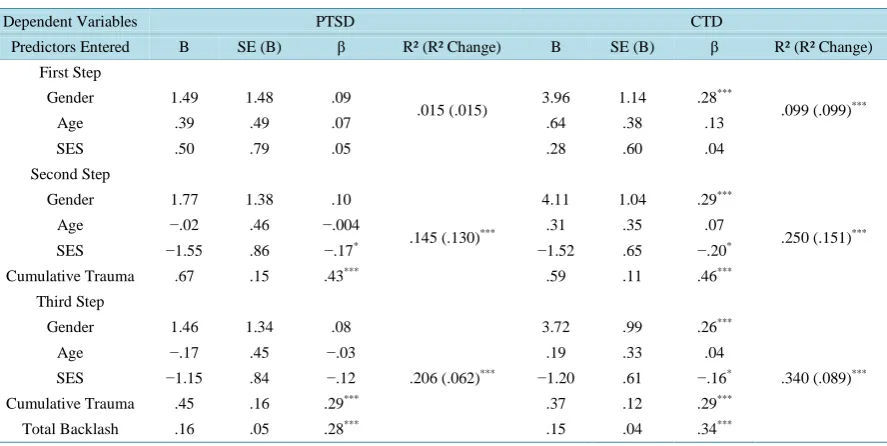
To explore the associations between BT and other trauma types and with post-trauma spectrum disorders and to determine which trauma had relatively more of a mental health impact, we conducted partial correlations be- tween BT, all trauma types, PTSD, CTD, AA, and internalizing and externalizing disorders. We controlled for gender, age and level of poverty. Further, to measure the effects of backlash trauma (BT) and its types on PTSD and CTD, we conducted hierarchical multiple regression analyses. In the hierarchical regression model, we en- tered age, gender, and level of poverty (SES) in the first block to control for their effects. We added cumulative life traumas in the second block to measure and control for their effects, and backlash trauma (BT) or one of its types in the third block, to unpack the link between BT, as well as each of its types and PTSD and CTD after isolating the effects of other trauma types and demographics. We used IBM-SPSS 20 statistical package to con- duct the analyses. We tested for multi-colinearity. VIF (variance inflation factor) for all predictor variables ranged between less than 1.00 and 1.50which indicated low colinearity (O’Brien, 2007).
3. Results
3.1. Descriptive Results
Participants were multiply traumatized (mean types of traumas occurrence [SD] is 8.35[3.34], and 13.95[6.19] for trauma frequency). Only one participant did not report any trauma occurrence, while the rest reported between 5 and 26 trauma types. While 50% reported different levels of cumulative negative appraisal of their traumas (M = 9.58, SD = 32.02), 83.5% reported different degrees of cumulative positive appraisal (M
= 9.13, SD = 20.96). Participants seem to be relatively more positive in appraising the effects of their trau- mas.
Their highest exposure was to secondary traumas (e.g. parents torture) (M = 1.86, SD = 1.64), followed by survival traumas (M = .40, SD = .78), personal identity traumas (M = .32, SD = .61), collective identity trauma (M = .28, SD = .68), abandonment or separation from parents (M = .13, SD = .38), and achievement traumas (M
= .12, SD = .32). The least trauma types that was suffered was family traumas (M = .10, SD = .32).
For backlash traumas, Iraqi refugee adolescents in this sample have been exposed to a relatively high load of discrimination related to backlash (M = 27.67, SD = 16.92). The highest exposure was to interpersonal backlash (M = 13.51, SD = 5.98), followed by media backlash (M = 7.80, SD = 5.19), and active government institution backlash (M = 4.90, SD = 2.41). While over 58% reported at least 21 total microaggression incidents (21 - 133), 65.5% reported 11, and the rest reported 12 to 52 interpersonal microaggression incidents. All participants re- ported 5 to 42 media microaggression incidents, and 3 to 20 institutional microaggressions.
3.2. Correlational Results
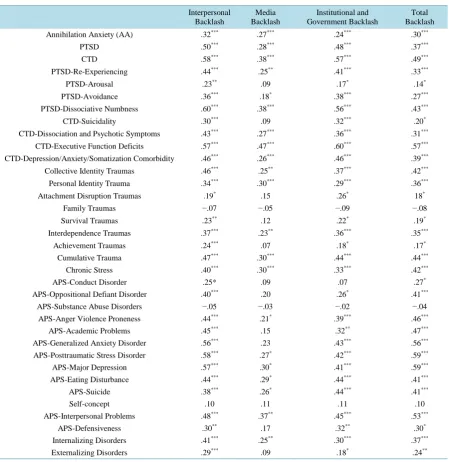
BT and its sub-scales were highly associated with identity traumas (r = .42, p < .001, with collective identity), (.36, p < .001, with personal identity), with chronic stress (r = .42***, p < .001), as well as with interdependence (secondary) traumas (r = .35, p < .001). BT was less associated with survival (r = .19, p < .05), and attachment traumas (r = .18, p < .05), and to some degree with role identity (achievement) traumas (r = .17, p < .05) and not significantly associated with family traumas (Table 1).
Hypothesis 2: In accordance with the severity/chronicity hypotheses implied in DTBF (BT is traumatic and chronic), BT was predicted to be associated with PTSD, CTD, AA, internalizing and externalizing disorders af- ter controlling for other previous life time traumas and the demographic variables of age, gender, and SES. The negative mental health effects of BT were predicted to be relatively more severe compared to other non-syste- mic trauma types.
Partial correlations, controlling for age, gender and SES, indicated that Backlash Trauma (BT) and different backlash types were significantly associated with PTSD, especially interpersonal (inter group) (r = .50, p
< .001), and institutional/ governmental backlash (r = .48, p < .001). Dissociation/ emotional numbness seems to be the highest symptom cluster of PTSD that is associated with the interpersonal backlash (r = .60, p < .001), and institutional backlash (r = .56, p < .001). Similar results were found for CTD and its syndromes. The most CTD associated syndromes were: executive function deficits with total BT (r = .57, p < .001), institutional BT (r
= .60, p < .001), and media BT(r = .57, p < .001). Depression/anxiety/somatization comorbidity was associated with interpersonal BT (r = .46, p < .001), as well as with institutional BT. Dissociation/ psychosis comorbidity was strongly associated with interpersonal (intergroup) BT (r = .43, p < .001). The same pattern was found for the association with annihilation anxiety (AA). While media BT associations, in general, were less strong, BT was significantly associated with PTSD (r = .28, p < .001), CTD (r = .38, p < .001), executive function deficits (r = .47, p < .001) and AA (r = .24, p < .01).
For APS scales, interpersonal (intergroup) problems were highly associated with PTSD (r = .58, p < .001), major depression (MDD) (r = .57, p < .001), and generalized anxiety disorder (GAD) (r = .56, p < .001), fol- lowed by eating disturbances (r = .44, p < .001), suicide (r = .38, p < .001), academic problems (r = .45, p
< .001), anger violence proneness (r = .44, p < .001), oppositional defiant symptoms (r = .40, p < .001), and conduct disorder (r = .25, p < .05). PTSD, MDD and GAD were also highly associated with institutional/govern- mental backlash (r = .42, p < .001, r = .41, p < .001, r = .43, p < .001 respectively), followed by eating distur- bances (r = .44, p < .001), suicide (r = .44, p < .001), academic problems (r = .32, p < .01), anger violence proneness (r = .39, p < .001), and oppositional defiant symptoms (r = .26, p < .01). Media backlash was special- ly associated with interpersonal problems (r = .37, p < .001), followed by major depression (r = .30, p
< .01),eating disorders (r = .29, p < .01), PTSD (r = .27, p < .01), suicide (r = .26, p < .01), and anger violence proneness (r = .21, p < .05). The cumulative effects of the total backlash trauma covered all disorders except self-concept and substance abuse disorders (Table 1). Cultural and religious reasons may be factors, as the Mus- lim religion and Muslim cultures prohibit substance abuse.
Total BT, interpersonal BT and institutional BT were significantly associated with internalizing (r = .37, p < .001) (r = .41, p < .001), (r = .30, p < .001) and externalizing disorders (r = .24, p < .01) (r = .29, p < .01) (r = .18, p < .05) respectively. Media BT was significantly associated with internalizing disorders only (r = .25, p < .01) (Table 1).
Results of a hierarchical regression indicated that after controlling for demographics and all cumulative life traumas measured, total backlash highly predicted PTSD (β = .28, p < .001) and especially the more complex syndromes of CTD (β = .34, p < .001) (Table 2). Governmental (institutional) and interpersonal (intergroup) backlash seem to be the most instrumental of the suffering compared to media backlash that was still signifi- cantly associated with PTSD and CTD (Table 3).
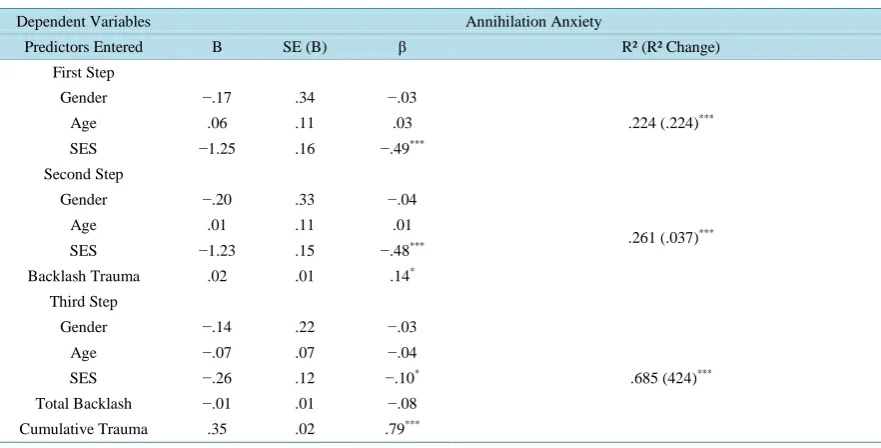
While BT was significantly correlated with annihilation anxiety (AA; .30, p < .001) and predicted AA before introducing cumulative life trauma in the hierarchical regression equation, contrary to the study hypothesis, BT did not predict AA after controlling for cumulative life trauma and demographics. Cumulative life trauma was the robust predictor of such existential anxiety (β = .85, p < .0001) (Table 4).
While most of these trauma types had serious mental health effects as expected, BT compared to those other trauma types (collective identity, personal identity, attachment, family survival, and achievement and interde- pendence traumas) was the most strongly correlated with PTSD (.37, p < .001), CTD (.48, p < .001) and AA (.30,
p< .001), as well as to other sub-measures of APS. Only cumulative trauma occurrence was correlated the most strongly with AA (.75, p < .001), and PTSD (.38, p < .001) (Table 3).The only comparable stress variable con- cerning BT severity is chronic (non-traumatic) stress. Chronic stress was significantly associated with PTSD (.39, p < .001), CTD (.41, p < .001) and AA (.40, p < .001).
4. Discussion
[image:14.595.90.540.245.708.2]The primary purpose of this study was to test the utility and validity of systemic type III trauma and its assumptions
Table 1. Partial correlations (controlling for gender, age and SES) between backlash multi-systemic traumas, other trauma types and mental health variables in Iraqi refugee adolescents.
Interpersonal Backlash
Media Backlash
Institutional and Government Backlash
Total Backlash
Annihilation Anxiety (AA) .32*** .27*** .24*** .30***
PTSD .50*** .28*** .48*** .37***
CTD .58*** .38*** .57*** .49***
PTSD-Re-Experiencing .44*** .25** .41*** .33***
PTSD-Arousal .23** .09 .17* .14*
PTSD-Avoidance .36*** .18* .38*** .27***
PTSD-Dissociative Numbness .60*** .38*** .56*** .43***
CTD-Suicidality .30*** .09 .32*** .20*
CTD-Dissociation and Psychotic Symptoms .43*** .27*** .36*** .31***
CTD-Executive Function Deficits .57*** .47*** .60*** .57***
CTD-Depression/Anxiety/Somatization Comorbidity .46*** .26*** .46*** .39***
Collective Identity Traumas .46*** .25** .37*** .42***
Personal Identity Trauma .34*** .30*** .29*** .36***
Attachment Disruption Traumas .19* .15 .26* 18*
Family Traumas −.07 −.05 −.09 −.08
Survival Traumas .23** .12 .22* .19*
Interdependence Traumas .37*** .23** .36*** .35***
Achievement Traumas .24*** .07 .18* .17*
Cumulative Trauma .47*** .30*** .44*** .44***
Chronic Stress .40*** .30*** .33*** .42***
APS-Conduct Disorder .25* .09 .07 .27*
APS-Oppositional Defiant Disorder .40*** .20 .26* .41***
APS-Substance Abuse Disorders −.05 −.03 −.02 −.04
APS-Anger Violence Proneness .44*** .21* .39*** .46***
APS-Academic Problems .45*** .15 .32** .47***
APS-Generalized Anxiety Disorder .56*** .23 .43*** .56***
APS-Posttraumatic Stress Disorder .58*** .27* .42*** .59***
APS-Major Depression .57*** .30* .41*** .59***
APS-Eating Disturbance .44*** .29* .44*** .41***
APS-Suicide .38*** .26* .44*** .41***
Self-concept .10 .11 .11 .10
APS-Interpersonal Problems .48*** .37** .45*** .53***
APS-Defensiveness .30** .17 .32** .30*
Internalizing Disorders .41*** .25** .30*** .37***
Externalizing Disorders .29*** .09 .18* .24**
Table 2. Hierarchical regression summary with PTSD, CTD as dependent variables and age, socio-economic status (SES) and gender, in the first block, added cumulative trauma in the second block and added backlash (B) in the third block (N = 224).
Dependent Variables PTSD CTD
Predictors Entered B SE (B) β R² (R² Change) B SE (B) β R² (R² Change)
First Step
Gender 1.49 1.48 .09
.015 (.015) 3.96 1.14 .28
***
.099 (.099)***
Age .39 .49 .07 .64 .38 .13
SES .50 .79 .05 .28 .60 .04
Second Step
Gender 1.77 1.38 .10
.145 (.130)***
4.11 1.04 .29***
.250 (.151)***
Age −.02 .46 −.004 .31 .35 .07
SES −1.55 .86 −.17* −1.52 .65 −.20*
Cumulative Trauma .67 .15 .43*** .59 .11 .46***
Third Step
Gender 1.46 1.34 .08
.206 (.062)***
3.72 .99 .26***
.340 (.089)***
Age −.17 .45 −.03 .19 .33 .04
SES −1.15 .84 −.12 −1.20 .61 −.16*
Cumulative Trauma .45 .16 .29*** .37 .12 .29***
Total Backlash .16 .05 .28*** .15 .04 .34***
Note*p < .05;**p < .01; ***p < .001(two-tailed).
Table 3. Partial correlations between different trauma types, PTSD, CTD and annihilation anxiety (controlling for gender, age and SES).
Trauma Types PTSD CTD Annihilation Anxiety
Collective Identity Traumas .17* .27*** .24**
Personal Identity Traumas .22** .23** .23**
Interdependence (Secondary) Traumas .28*** .26** .22**
Survival Traumas .22** .28*** .08
Attachment Traumas .13 .08 .08
Family Traumas .09 .01 .13
Achievement Traumas (Role Identity traumas) .14 .19* .04
Chronic Stress .39*** .41*** .40***
Cumulative Traumas Occurrence .38*** .40*** .75***
Note: *p < .05; **p < .01; ***p < .001 (two-tailed).
on a sample of Muslim Iraqi refugee adolescents who suffered from backlash (a multi-systemic trauma) against Mus lim Americans after the September 11, 2001, attacks. The current study was one of the first to examine the mental health effects of discrimination and backlash (that involved some government systems participation) against minori-ties from a systemic trauma perspective. The current study is the first to highlight the extent of potential suffering that minorities endured in history and in present from this type of backlash such as in the case of Japanese Americans after Pearl Harbor (Daniels, Taylor, & Kitano, 1991), as well as other unfortunate examples in history and in contempo- rary societies where such backlash against minorities may exist.
Most of the previous studies that measured the effects of discrimination after September 11, 2001 on adoles- cents were limited in scope (e.g., did not measure official systems participation in the backlash), and the out- come variables measured did not represent the spectrum of post-trauma disorders (for review see Amer & Baga-
sra, 2013). In the current study, multi-systemic chronic type III backlash trauma was not only associated with a
[image:15.595.90.538.389.524.2]Table 4. Hierarchical regression summary with annihilation anxiety as dependent variable and age, socio-economic status (SES) and gender, in the first block, added total backlash in the second block and cumulative trauma in the third block (N = 224).
Dependent Variables Annihilation Anxiety
Predictors Entered B SE (B) β R² (R² Change)
First Step
Gender −.17 .34 −.03
.224 (.224)***
Age .06 .11 .03
SES −1.25 .16 −.49***
Second Step
Gender −.20 .33 −.04
.261 (.037)***
Age .01 .11 .01
SES −1.23 .15 −.48***
Backlash Trauma .02 .01 .14*
Third Step
Gender −.14 .22 −.03
.685 (424)***
Age −.07 .07 −.04
SES −.26 .12 −.10*
Total Backlash −.01 .01 −.08
Cumulative Trauma .35 .02 .79***
Note:*p < .05;**p < .01;***p < .001(two-tailed).
spectrum disorders compared to their relationships with attachment and family traumas. Only cumulative life trauma occurrence (type IV trauma) was more strongly correlated with AA as compared to backlash. BT is atype III identity trauma, perpetrated by influential dominant social institutions. It is continuous, on-going and tends to proliferate. It threatens the social inclusion of the victims and their identity. Because of all these characteristics, it may present more significant and negative mental health outcomes as compared to types I and II traumas that have occurred in the past, cease to occur, and do not tend to involve such serious social and group identity threats.
While the BT scale used in the current study included only three of the four components of systemic traumas identified in the introduction—intergroup, institutional, and globalization—the fourth component, social struc- tural violence (e.g., SES or poverty), was introduced, partly, in the hierarchical regression model as one of the demographic variables. Some demographic characteristics, such as SES, were used in research as proxies for so- cial structural violence “inequalities”. SES was also found to be predictive of PTSD, CTD and AA after control- ling for other demographics and cumulative traumas. That lends support to the assumption that social structural violence, the fourth component of systemic traumas discussed in our model, has extremely negative mental health effects.
Additionally, the study detailed the differential negative effects of different systemic traumas in this popula- tion. Intergroup, institutional and social-structure systemic traumas were found to have stronger negative re-la-tionships with mental health disorders as compared to media (globalization) effects. Media BT had a pattern of weak but significant negative relationships with mental health. However, the media-related BT seems to im-pact and exacerbate the existing interpersonal problems in adolescents, as it was highly associated with such problems.
[image:16.595.93.534.118.342.2]