http://dx.doi.org/10.4236/ojrad.2015.54028
Evaluation of BSc Radiologic Sciences and
Medical Imaging Technology
Programmes in Sudanese Universities
from Students’ Perspective
Awad Mohamed Elkhadir
Diagnostic Radiology Department, Faculty of Applied Medical Sciences (FAMS), King Abdulaziz University, Jeddah, Saudi Arabia
Received 8 August 2015; accepted 7 December 2015; published 10 December 2015
Copyright © 2015 by author and Scientific Research Publishing Inc.
This work is licensed under the Creative Commons Attribution International License (CC BY).
http://creativecommons.org/licenses/by/4.0/
Abstract
This study sets the objective to involve undergraduate students in the evaluation of radiologic sciences and medical imaging technology programmes in Sudanese universities. Based on the analysis of survey results in which the participants (BSc students undertaking radiologic sciences and medical imaging technology programmes at university level) are asked to answer both closed and open-ended questions, the study seeks to reveal the participants’ perceptions and introspec-tions about the radiologic sciences and medical imaging technology programmes in Sudan. It also attempts to explore the participants’ suggestions and recommendations as to enhance the quality of these programmes with an eye to helping syllabus designers to improve these programmes, thereby bettering healthcare services for the larger good to the community. A brief cross-sectional survey is completed by a total of 105 radiologic sciences and medical imaging technology students, i.e. 39 (37.1%) third-year students and 66 (62.9%) fourth-year students. The majority of partici-pants is satisfied with the programmes, indicating that they are up-to-date and ran abreast with the latest developments in the field. Very few suggest that the programmes should be reviewed for revision, implying that there is room for improvement. Some participants recommend that more training hours in modern imaging modalities (e.g. MRI, CT and U/S) should be introduced. Only one participant recommends the introduction of advanced training centres.
Keywords
1. Introduction
Medical Radiology Science is one of the most important spheres in medical care providing students to wide range of knowledge such as physics, human anatomy and physiology to become qualified (radiologic technolo-gists) in two tracks Radiographic Technology or Radiation Therapy Technology. Radiologic Technology pro-grammes include several subtypes including: x-rays, mammograms, CT or CAT scans, and MRI.
Radiologic sciences and medical imaging technology education in Sudan dated back to 1932 [1]. In 1995, there was a curriculum change towards bachelor’s degree (BSc) [1]. Sudan is the first country in the region to commence BSc, Master’s and PhD programmes in imaging technology and this has availed a critical mass of trainers helping other countries as well [2].
The present study is designed to obtain Radiologic Technology students’ opinions about the BSc programmes to detect if it keeps pace with rapid development or not and to get their suggestions for the development of the programmes.
Radiologic Technology Programmes Overview
Radiologic Technology schools in the Sudan, whether public or private, adopt a modern systematic educational strategies and methods. The National University (NUSU), for example, embraces the semester system and fol-lows different methods in the daily program of activities; 1) problem-based learning (PBL); 2) seminars and small group discussions; 3) field practice in rural and primary health care settings and societies; 4) practical ses-sions (hospitals, health centers, laboratory, technical); 5) laboratorial skills; 6) lectures; and 7) educational as-signments, reports and research activities. The duration of study for BSc (Honors) is four years, divided into eight semesters covering a total of 160 credit hours (hrs) [2]. Generally speaking, radiography and imaging pro-grammes at BSc level include different general and specialised courses. During the first and second year of study, programmes focus on general subjects and basic sciences of medical imaging. The final two levels of programmes are concentrated mostly towards the clinical practice, in which students are trained on the prin-ciples of radiographic techniques using the available equipment in their colleges. After graduation, the students are distributed to hospitals to put theory to practice under the supervision of supervisors from the colleges and hospitals.
2. Methodology
NUSU. Prior permissions for access were obtained from the two universities. To help overcome any reluctance to participate, participants were assured that the survey was only for research purposes and that confidentiality and anonymity would strictly be observed. This work was conducted in compliance with Institutional Review Board/Human Subjects Research Committee requirements.
The main purpose of this study was to disclose the views of finalist undergraduate radiologic sciences and medical imaging technology students in two Sudanese universities regarding the quality of BSc radiology and imaging technology programmes. The study also aimed to extract suggestions and recommendations from the participants regarding ways to improve these programmes. It was believed that the students, along with syllabus designers, held the key to providing a better understanding of the research problem.
The study sought to explore the following:
The participants’ views about the radiologic sciences and medical imaging technology programmes in their faculties i.e. whether they keep pace with the latest developments;
The participants’ views about the clinical practice in their faculties;
The participants’ suggestions regarding ways of improving the radiology and medical imaging technology programmes in the Sudanese universities;
The participants’ suggestions about ways of improving the clinical practice in the Sudanese universities. To address the above issues, a brief survey requiring answering four questions (two closed questions and two open-ended questions). The questions were as follows:
Do you think that the radiologic sciences and medical imaging programme in your faculty keeps pace with the latest developments in the field?
Do you think that the clinical practice you have received is quite enough to achieve its set objectives? How do you think the radiologic sciences and medical imaging programmes can be improved? How do you think the clinical practice can be improved?
3. Results
[image:3.595.88.539.652.721.2]3.1. Demographic Characteristics of the Participants
Table 1 presents the frequency distributions (counts and percentages) of the demographic characteristics of the 105 students who participated in this study; most of which 85 (81.0%) were female and the remainder 20 (19.0%) were male. Over half of the participants 66 (62.9%) were in their fourth year of study, whereas the remained 39 (37.1%) were in their third year of study.
3.2. Quantitative Findings of the Research Questions
This section describes the quantitative findings of the responses of the 105 participants to the survey questions. The findings are summarised in order of the research questions stated in section.
3.2.1. Participants’ Views Regarding Radiologic Sciences and Medical Imaging Technology Programmes in Their Faculties
Do you think that the radiologic sciences and medical imaging programme in your faculty keeps pace with the latest developments in the field? This was an exploratory closed research question with a quantitative answer that did not involve the testing of a hypothesis. Table 2 shows that the majority of participants 67 (63.8%) re-ported that their program kept pace with the latest developments in the field, while 27 (25.7%) stated that the program were not up-to-date and 11 (10.5%) had no comment. Based on student level 28 (82.4%) from third level showed their program kept pace with the latest developments in the field, while 6 (17.6%) stated that the program were not up-to-date and students from fourth level 39 (65.0%) of them confirmed their program
Table 1. Demographic characteristics of the participants.
Characteristic Group Count %
Gender Male
Female
20 85
19.0% 81.0%
Educational Level Third Year
Fourth Year
39 66
keep pace with development, while 21 (35.0%) of tem stated that the program were not up-to-date Table 3.
3.2.2. Participants’ Views Regarding the Quality of Clinical Practice
Do you think that the clinical practice you have received is quite enough to achieve its set objectives? This was another exploratory closed research question with a quantitative answer that did not involve the testing of a hy-pothesis. Table 4 shows that over half of the participants 61 (57.6%) agreed that the clinical practice they had received was enough to achieve the set objectives of the programmes, while 39 (37.1%) did not agree. Five par-ticipants 5 (4.8%) opted not to answer this question.
3.2.3. Respondents’ Suggestions Regarding Ways to Improve the Programmes
How do you think the radiologic sciences and medical imaging programmes can be improved? This was an ex-ploratory research question with a qualitative answer that did not involve the testing of a hypothesis. Table 5
shows that 6 (80.0%) suggested that the programmes needed revision for improvement and only one participant
Table 2. (a) Participants’ views regarding radiologic sciences and medical imaging technology programmes in their faculties
based on gender; (b) Chi-Square tests.
(a)
Do you think that the radiologic sciences and medical imaging programme in your faculty
keeps pace with the latest developments in the field? Total
yes No No comment
Gender
Male
12 6 2 20
60.0% 30.0% 10.0% 100.0%
Female
55 21 9 85
64.7% 24.7% 10.6% 100.0%
Total
67 27 11 105
63.8% 25.7% 10.5% 100.0%
(b)
Value df Asymp. Sig. (2-Sided)
Pearson Chi-Square 0.238 2 0.888
Table 3. (a) Participants answers about the curriculum based on student level; (b) Chi-Square tests.
(a)
Student level
Do you think that the radiologic sciences and medical imaging programme in
your faculty keeps pace with the latest developments in the field? Total
Yes No
3rd year
28 6 34
82.4% 17.6% 100.0%
4th year
39 21 60
65.0% 35.0% 100.0%
Total
67 27 94
71.3% 28.7% 100.0%
(b)
Value df Asymp. Sig. (2-Sided)
Table 4. (a) Participants’ views regarding the quality of clinical practice; (b) Chi-Square tests.
(a)
Do you think that the clinical practice you have received is quite
enough to achieve its set objectives? Total
Yes No No comment
Gender
Male
12 7 1 20
60.0% 35.0% 5.0% 100.0%
Female
49 32 4 85
57.6% 37.6% 4.7% 100.0%
Total
61 39 5 105
58.1% 37.1% 4.8% 100.0%
(b)
Value df Asymp. Sig. (2-Sided)
Pearson Chi-Square 0.049 2 0.976
Table 5. (a) Respondents’ suggestions regarding ways to improve the programmes; (b) Chi-Square tests.
(a)
Respondents’Suggestions to improve the programmes
Total Review Curriculum Add advanced imaging modalities
Gender Male 2 0 2
100.0% 0.0% 100.0%
Female 4 1 5
80.0% 20.0% 100.0%
Total 6 1 7
85.7% 14.3% 100.0%
(b)
Value df Asymp. Sig. (2-Sided)
Pearson Chi-Square 0.467 1 0.495
Continuity Correction 0.000 1 1.000
1 (14.3%) suggested the introduction of advanced imaging modalities.
3.2.4. Respondents’ Views Regarding Ways of Improving the Clinical Practice
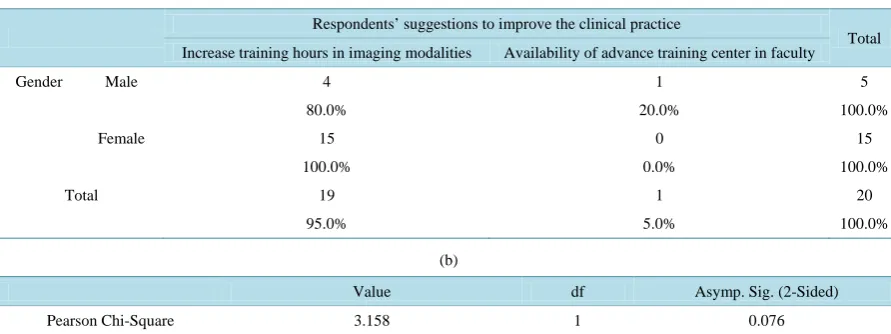
How do you think the clinical practice can be improved? This was another exploratory research question with a qualitative answer that did not involve the testing of a hypothesis. Table 6 shows that 19 (95.0%) respondents suggested that more training hours in imaging modalities should be introduced, while 1 (5.0%) respondents suggested the introduction of advanced training centres in their faculties.
4. Summary, Discussion and Conclusions
Table 6. (a) Respondents’ views regarding ways of improving the clinical practice; (b) Chi-Square tests.
(a)
Respondents’ suggestions to improve the clinical practice
Total Increase training hours in imaging modalities Availability of advance training center in faculty
Gender Male 4 1 5
80.0% 20.0% 100.0%
Female 15 0 15
100.0% 0.0% 100.0%
Total 19 1 20
95.0% 5.0% 100.0%
(b)
Value df Asymp. Sig. (2-Sided)
Pearson Chi-Square 3.158 1 0.076
The participants’ views about the radiologic sciences and medical imaging technology programmes in their faculties i.e. whether they kept pace with the latest developments;
The participants’ views about the clinical practice in their faculties;
The participants’ suggestions regarding ways of improving the radiologic sciences and imaging technology programmes in the Sudanese universities;
The participants’ suggestions about ways of improving the clinical practice in the Sudanese universities. The research highlighted the following findings:
The majority of participants 67 (63.8%) reported that the programmes kept pace with the latest developments in the field, while 27 (25.7%) stated that the programmes were not up-to-date;
6 (85.7%) respondents suggested that the programmes needed revision and that there was room for im-provement;
Only one respondent 1 (14.3%) suggested the introduction of advanced imaging modalities;
Over half of the participants 61 (58.1%) agreed that the clinical practice they had received was enough to achieve the set objectives of the programmes, while 39 (37.1%) did not agree. Five participants 5 (4.8%) opted not to answer this question;
19 (95.0%) respondents suggested that more training hours in imaging modalities should be introduced; 1 (5.0%) respondents suggested the introduction of advanced training centres in their faculties.
Needless to say, involving the students in the process of evaluating the programmes they study and taking their views, suggestions and recommendations into consideration were very important to ensure improved qual-ity of education. Thus, the main purpose of this paper had been planning, designing and focusing on perspec-tives of students using KAP survey method, which it is the most popular and widely used being the knowledge, attitude, and practice [5].
To the best of my knowledge, this study was the first to seek to explore the views of medical imaging students in Sudan. The various benefits of considering students feedback in evaluating the curriculum had been demon-strated by several authors. Roff et al., for example reported about students’ perceptions of their educational en-vironment, his paper reported a body of research in health professions institutions around the world [6]. Another paper by Ostojic et al. confirmed that including the student in the assessment of the curriculum enabled faculty to gain more insight into students’ opinions about their programme which provided valuable feedback for further program improvements [7].
the learner as its central focus and showed positive results when students were included in the curriculum plan-ning process [11]. I chose the open-ended questions to allow participants to come up with their own responses to document the opinions of the respondent in his or her own words. Moreover, it helped record all the information and avoid losing it [12]. This was why I chose this type of survey methodology. However, a significant number participant failed to answer some questions, probably because of the tense atmosphere of examinations, as the survey was conducted during examination period.
5. Recommendations
Based on the findings obtained, the following recommendations can be made:
It is recommended that different research methods (qualitative methods) be used to evaluate the quality of the programmes under investigation;
Given that the current study was conducted during the examination period, the present researcher recom-mends that further studies should be conducted out of the examination period to ensure a broader participa-tion;
Radiologic sciences and medical imaging technology programmes should be evaluated regularly by experi-enced interdisciplinary teams using the latest evaluation models to ensure coping with the rapid develop-ments in this vital discipline;
It is also highly recommended that laboratories and clinics be furnished with the state-of-the-art medicale- quipment to allow for better training opportunities ;
The clinical practice objectives shouldbereviewedregualrly to covering best training in all modern imaging- modalities.
Acknowledgements
I would like to thank (Dr. AlsafiBalla, Dr. Caroline Ayad and Mr. Salah Fadlalla—Staff members , College of Medical Radiologic Sciences-Sudan University of Science and Technology), Dr. Abdelmoneim Saeed, Faculty of Radiography and Diagnostic Medical Imaging-National University-Sudan and Dr. Mohamed Siddig Abdalla, King Abdulaziz University for their strongly supporting to help me during preparation of this manuscript, al-though any errors are my own and should not tarnish the reputations of these esteemed professionals.
References
[1] Website of Medical Radiologic Sciences, Sudan University of Science & Technology.
http://radiologic.sustech.edu/index.php/College_of_Medical_Radiologic_Sciences/coll_about/?lang=en [2] Radiography College, National University Website. http://www.nu.edu.sd/radiography.html#
[3] (2010) Knowledge, Attitudes and Practices (KAP) Studies for Water Resources Projects.
[4] Launiala, A. (2010) How Much Can a KAP Survey Tell Us about People’s Knowledge, Attitudes and Practices? Some Observations from Medical Anthropology Research on Malaria in Pregnancy in Malawi. Anthropology Matters. [5] Unite Forsight Website, Survey Methodologies.
http://www.uniteforsight.org/global-health-university/survey-methodologies#_ftnref13
[6] The Dundee Ready Educational Environment Measure (DREEM) (2005) A Generic Instrument for Measuring Students’ Perceptions of Undergraduate Health Professions Curricula. Medical Teacher, 27, 322-325.
[7] Mechatronic Education at the Faculty of Technical Sciences Novi SAD. By: Ostojic etl. Tehnicki Vjesnik-Technical Gazetteissn 1330-3651(Print), ISSN 1848-6339 (Online). Vol. 22, 805-812.
http://www.researchgate.net/publication/267752052_Mechatronic_Education_at_Faculty_of_Technical_Sciences_Nov i_Sad
[8] (2012) Assessment of Radiology Technology Students’ Internship with Objective Structured Clinical Examination. Ar-ticle 5, Future of Medical Education Journal, 2, 19-23. http://fmej.mums.ac.ir/article_344_0.html
[9] (2011) Empowering Students as Active Participants in Curriculum Design and Implementation. John Jagersma Park-land Immanuel Christian School, Edmonton, Alberta, Canada, New Zealand Journal of Teachers’ Work, 8, 114-121. [10] (2010) Module 10B: Design of Research Instruments; Interview Guides and Interview Skills.