Munich Personal RePEc Archive
Performance Measurement in Multi-Task
Agencies
Thiele, Veikko
University of British Columbia
31 March 2007
Performance Measurement in Multi-Task Agencies
∗
Veikko Thiele
†Sauder School of Business
University of British Columbia
March 31, 2007
Abstract
This paper analyzes a multi-task agency model with a risk-neutral and financially constrained
agent. The agent’s performance evaluation is thereby incongruent, i.e. it does not perfectly
reflect the relative contribution of the agent’s multi-dimensional effort to firm’s profit. This
paper elaborates on the improvement of the agent’s performance evaluation through the costly
acquisition of additional performance measures aimed at inducing the agent to implement a
more efficient effort allocation across tasks. It contrasts two alternatives for the principal: (i)
to centrally invest in the information acquisition; or(ii), to delegate this task to a supervisor.
This paper demonstrates that the principal generally favors delegation for a sufficiently
incon-gruent measurement of the agent’s performance, and a centralized investment, otherwise.
Keywords: Multi-task agencies, performance measurement, distortion, congruity, limited
lia-bility, incentives.
JEL classification: D23, D82, M52
∗I would like to thank Dominique Demougin, Gerald Feltham, Sandra Chamberlain, Carsten Helm, Christian
Hof-mann, Kay Mitusch, Anja Schöttner, Chee-Wee Tan, Louis-Philippe Sirois, Ralph Winter, participants of the 5th Symposium of the German Economic Association of Business Administration in Bonn and participants of the research workshop of the University of British Columbia for valuable comments and suggestions. Financial support by the Konrad-Adenauer Foundation is gratefully acknowledged and appreciated.
†Address: 2053 Main Mall, Vancouver, BC, Canada V6T 1Z2, phone: +1 604 822-3605, fax: +1 604 822-3163,
1
Introduction
Many employees are charged with performing multiple tasks which may differently contribute to
firms’ objectives. Employees can therefore not only decide on their effort intensity, but also on
how to allocate their effort across all relevant tasks. If effort is non-contractible, firms face a
two-dimensional incentive problem: they need not only to induce a sufficient effort intensity, but
also to motivate an efficient effort allocation across tasks. The latter objective could be achieved
if firms are able to identify each employee’s individual contribution and apply this information
in incentive contracts. However, company structures are often too complex for accrediting the
respective contribution to each employee. As a consequence, firms are compelled to employ other
potential incentive mechanisms.
One alternative is the application of objective performance measures in incentive contracts, as
extensively analyzed in agency literature.1 However, the application of performance measures in
incentive contracts can motivate employees to focus on activities which suitably enhance their
per-formance evaluation, but have possibly little or even negative effects on firm value. The behavioral
literature provides illustrative examples of such dysfunctional behavior. For instance, Prendergast
[1999] reported that AT&T rewarded their software engineers for the quantity of lines they wrote
for their programs. It was soon discovered that the programs consisted of more lines than necessary.
Even if all relevant activities contribute to firm value, the relative effort allocation across those
tasks can be inefficient. This occurs, when firms apply performance measures to provide their
em-ployees’ with incentives, which do not perfectly reflect their individual contribution to firm value.
The provision of incentives based on such incongruentperformance measures leads therefore to a
suboptimal effort allocation across tasks [Feltham and Xie, 1994]. For example, faculties at
uni-versities are primarily responsible for two tasks: teaching and conducting research. Since teaching
is harder to quantify than the output from research, promotion decisions are generally made on the
basis of research accomplishments. This in turn motivates particularly younger faculties to
con-centrate on research at the expense of teaching.2 Nevertheless, schools can modify their incentive
schemes in order to improve the quality of teaching. Brickley and Zimmerman [2001] considered
the incentive scheme adapted by the William E. Simon Graduate School of Business
Administra-1For a review of agency literature refer e.g. to Prendergast [1999], Lambert [2001], Gibbons [2005], and
Chris-tensen and Feltham [2005].
2See Kerr [1975] for a discussion of this and further examples. Additional illustrative examples are summarized by
tion, University of Rochester. After adjusting the performance evaluation and the reward system
during the early 90’s, teaching quality improved significantly, but at the same time, research output
declined.
If organizations do not have access to performance evaluations that are suitable to induce an
efficient effort allocation, they need to apply alternative mechanisms that act to mitigate effort
dis-tortion. Recent multi-task agency literature analyzes and discusses some alternatives to improve
agents’ effort allocations. For instance, Feltham and Xie [1994], Banker and Thevaranjan [2000],
and Datar, Kulp, and Lambert [2001] analyze, how multiple performance measures can be
aggre-gated to mitigate effort distortion besides alleviating incentive risk.3 As demonstrated in Thiele
[2006], the principal can even motivate the agent to implement non-distorted effort if she has
ac-cess to a sufficient quantity of appropriate performance measures. A second stream of the multi-task
agency literature focuses on the optimal design of jobs as a device to restrict effort distortion by
allowing independent tasks to be split among multiple agents, see e.g. Holmström and Milgrom
[1991], Schöttner [2005], Corts [2005], and Hughes, Zhang, and Xie [2005]. Finally, Holmström
[1999] and Baker, Gibbons, and Murphy [2002] emphasize that transferring asset ownership to
the agent can mitigate her effort distortion because asset ownership internalizes the consequences
of her effort allocation. Nevertheless, such an approach compromises the objective of efficient
risk-sharing if the agent is risk-averse and the principal is risk-neutral.
The ability to improve employees’ performance evaluations in order to mitigate their effort
distortion can be crucial for the efficiency of firms. To understand the provision of incentives in
multi-task agency relations, it is essential to investigate whether and how organizations respond
to the lack of perfectly congruent performance measures, and consequently, to the imposed
ineffi-ciencies due to effort distortion. Surprisingly, previous multi-task literature remains virtually silent
about costly performance measurement with the objective of improving the agent’s effort
alloca-tion. This paper thus focuses on costly performance measurement in order to glean new insights
into the improvement of information systems aimed at mitigating effort distortion.
Specifically, I analyze a multi-task agency framework with risk-neutral parties, where the agent
faces a liability limit constraint. Similar to Baker [2002], I adopt geometric representations for
performance measure congruity, which eventually form the foundation for the considered
measure-ment technology. The main emphasis lies in understanding the principal’s preference for either
3For an empirical investigation on how performance measures are combined, refer to Gibbs, Merchant, Van der
investing centrally in assets which provides a viable means of measuring the agent’s performance,
or delegating the information acquisition to a supervisor. However, employing a supervisor
in-duces a second moral hazard problem since the principal cannot contract over her effort to acquire
information.
The analysis in this paper indicates that recruiting a supervisor for measuring the agent’s
per-formance can only be beneficial if she provides a sufficient relative measurement efficiency, which
countervails the additionally imposed agency costs. More precisely, the principal’s decision on
whether to delegate the information acquisition to the supervisor is contingent on three factors: (i)
the precision of the supervisor’s evaluation system, (ii) the supervisor’s comparative cost
advan-tage in obtaining the required information; and (iii), the congruence of the costless available in-formation system about the agent’s effort. If the supervisor’s performance evaluation is sufficiently
precise, an adequately incongruent costless information system generally favors delegation. The
rationale for this observation is that a less congruent costless information system imposes lower
re-quirements on the supervisor’s relative measurement efficiency, which is more likely to be satisfied
by a potential supervisor. In contrast, a more congruent information system would impose higher
requirements on the supervisor’s comparative cost advantage, which is less likely to be achieved by
a potential supervisor. In this case, a centralized investment is presumably to be observable. If the
supervisor’s performance evaluation is sufficiently imprecise, the contrary implications apply.
This paper is closely related to the multi-task agency literature analyzing the efficiency of
in-duced effort allocations, especially to Holmström and Milgrom [1991], Feltham and Xie [1994],
Datar et al. [2001], and Baker [2002]. However, it deviates in two main directions. First, it utilizes
a framework with a risk-neutral and financially constrained agent, i.e. payments from the agent
to the principal are not feasible. This allows to abstract from risk considerations in order to focus
exclusively on the induced effort allocation. Second, the analyzed incentive contract is one of the
bonus type similar to the ones applied by Park [1995], Kim [1997], Pitchford [1998] and Demougin
and Fluet [2001] for single-task agency relations.
This paper contributes to the previous multi-task agency literature in two important ways. First,
it extends their work by investigating a costly mechanism aimed at improving the agent’s
perfor-mance evaluation and hence, the efficiency of her motivated effort allocation. Second, this paper
provides preliminary insights into the relationship between the properties of available information
systems and the optimal design of organizations aimed at efficiently improving these information
The paper proceeds as follows. I introduce the basic model in section 2 and provide the
first-best solution in section 3. In section 4, I derive and discuss the second-first-best contract and
elabo-rate on a ranking criteria for information systems in multi-task agencies with risk-neutral parties.
Subsequently, I analyze in section 5 the principal’s investment decision for generating additional
measures about the agent’s performance. Section 6 focuses on the contractual arrangement, when
the principal employs a supervisor who is charged with the acquisition of the required performance
measures. Both considered alternatives for improving the underlying information system are
com-pared in section 7. Section 8 summarizes the main results and concludes.
2
The Model
Consider a single-period agency relationship between a principal and an agent. Both parties are
risk-neutral and the agent faces a liability limit constraint, i.e. payment from the agent to the
principal are not feasible. The agent is assigned to perform n > 2 tasks which cannot be split among different agents. Therefore, she needs to implement a vector of effort e = (e1, ..., en)t,
e ∈ E ⊆ Rn+, where e
i is the agent’s effort allocated to task i.4 Effort is non-verifiable and all
activities ei ∈ Eare measured in the same unit. The agent’s disutility of effortC(e)is quadratic
and separable in the different activities:
C(e) =
n
X
i=1
1 2e
2 i =
1 2e
t
e. (1)
By implementing effort e, the agent can affect the firm valueV, which can be either high or low. Formally, letV ∈ {0,1}, whereas the probability for realizing the high firm value conditional one is
Prob{V = 1|e}= min{µte,1}. (2)
Vector µ = (µ1, ..., µn)t, µ ∈ Rn+, represents the sensitivity of the expected firm value in
the agent’s effort. Accordingly, the agent can not only influence the expected firm value by
her effort intensity, but also by her relative effort allocation across relevant tasks. To ensure an
interior solution for the first-best effort vector ef b, I assume that µ is characterized such that
Prob{V = 1|ef b}=µtef b <1.5
4
All vectors are column vectors where ‘t’ denotes the transpose.
5
The realized firm value is non-contractible, and therefore, cannot be used to provide the agent
with explicit incentives. Nevertheless, the principal receives a binary and verifiable signal S¯ ∈ {0,1}, whereS¯ = 1 is the favorable signal in the sense of Milgrom [1981]. The probability of
realizing the favorable signal is conditional on the agent’s effort and takes the form
Prob{S¯= 1|e}= min{ω¯te,1}, (3)
whereω¯ = (¯ω1, ...,ω¯n)t, ω¯ ∈ Rn+, represents the sensitivity of the expected signal in the agent’s
effort. This binary statistic potentially represents several costless performance measures which are
summarized in the most efficient way. Henceforth, I refer toS¯as the costless information system. To ensure interior solutions, I shall assume thatω¯ is characterized such thatProb{S¯ = 1|e∗
} = ¯
ωte∗
<1for the second-best effort vectore∗ .6
Since the realized value ofS¯is verifiable, the principal can exploit this information in a bonus contract to provide the agent with incentives to implement effort. Particulary, the agent obtains a
bonusβAin addition to a fixed transferαAif the favorable signalS¯ = 1is realized. Accordingly,
the agent’s binary wagewAtakes the form
wA=
αA+βA, if S¯= 1,
αA, if S¯= 0. (4)
As a result of the agent’s liability limit, all transfers have to be non-negative for any realization of
¯
S. If the agent accepts this bonus contract on the basis ofS¯, it provides her with the expected utility
UA(e) = αA+βAω¯te− 1
2e
te.
(5)
For parsimony, the agent’s reservation utility is normalized to zero.
3
The First-Best Contract
Before investigating the second-best contract, it is useful to derive the first-best solution of this
problem as a benchmark for the subsequent analysis. Suppose the principal can directly contract
over e. Then, she appoints the effort vector ef b which maximizes the difference between the expected firm valueE[V|e]and wage payment wA = C(e). Formally, the first-best effort vector
ef bsolves
max e
Π(e)≡µte− 1
2e
t
e. (6)
The first-order condition leads toef b =µ. The principal assigns each activitye
i in accordance to
its marginal effectµi on the expected firm value. To exemplify the relative effort allocation across
tasks, consider the relation between two arbitrary activitiesef bi andef bj ,i6=j:
ef bi ef bj =
µi
µj
i, j = 1, ..., n , i 6=j. (7)
Supposeµi > µj. In this case, it is optimal to assign more effort on taskirelative to taskj since
the former task contributes more to the expected firm value than the latter.7 This implies that an
implemented effort allocation is efficient if it reflects the relative marginal contribution of each task
to the expected firm value. The conducted effort allocation is thus deemed to benon-distorted. In
contrast, if an implemented effort allocation deviates from the one assigned under first-best, it is
distorted. Formally, implemented effort is distorted if there exists no constant λ > 0 satisfying e=λef b.
Finally, substitutingef bin the principal’s objective function leads to
Πf b = 1 2µ
tµ
. (8)
The principal’s expected first-best profit is therefore only characterized by the vector productµtµ, whereµrepresents the sensitivity of the expected firm value in the agent’s effort.
4
The Second-Best Contract
If the principal cannot directly contract overe, she faces an incentive problem. Since the firm value
V is non-contractible, she is compelled to use the information systemS¯to provide the agent with
incentives. However, the application ofS¯in an incentive contract can motivate the agent to imple-ment an inefficient effort allocation across tasks ifE[ ¯S]does not perfectly reflect her contribution to the expected firm value E[V]. In this case, the information system S¯ is deemed to be
incon-gruent with the expected firm value, and its application in the agent’s incentive contract imposes
incongruent incentives.
In a second-best environment, the principal’s problem is to find a bonus contract (αA∗
, βA∗
)
aimed at maximizing her expected profitΠ≡E[V−wA|e]while ensuring the agent’s participation.
7Note that this observation applies because marginal effort costs are assumed to be identical across relevant tasks. If
Formally, the optimal bonus contract solves
max
αA,βA,eΠ≡µ
te−αA−βAω¯te (9)
s.t.
αA+βAω¯te− 1
2e
te
≥0 (10)
e= arg max
˜
e
αA+βAω¯te˜− 1
2e˜
t˜e
(11)
αA+βA ≥0 (12)
αA≥0. (13)
Condition (10) is the agent’s participation constraint and ensures that it is in her interest to enter
into this relationship. Moreover, (11) is the agent’s incentive condition. Finally, (12) and (13)
guarantee that the optimal bonus contract is compatible with the agent’s liability limit.
We can directly infer from the agent’s incentive constraint that she implements
e∗
=βAω¯.
(14)
The second-best effort vector consists of two components: the scalar βA and the vector µ. The
bonusβAdetermines the overall effort intensity, whereas the relative effort allocation across tasks
is characterized by ω. To exemplify the effort allocation under second-best, consider again the¯
relation between two arbitrary activitiese∗
i ande
∗
j,i6=j:
e∗
i
e∗
j
= ω¯i ¯
ωj
i, j = 1, ..., n , i 6=j. (15)
The agent places relatively more emphasis on tasks with a higher contribution to her performance
evaluation in order to maximize the likelihood of obtaining the contracted bonus. From the
prin-cipal’s perspective, however, the motivated effort allocation is inefficient if it deviates from that
implemented under first-best. Recall that the agent’s effort allocation is distorted if there exists no
constant λ > 0satisfying e∗
= λef b. Substituting e∗
and ef b leads to ω¯β = λµ. Apparently,
effort distortion is rooted in the misalignment of the agent’s performance evaluation with respect
to firm value. To put it differently, effort distortion occurs if the agent’s performance evaluation is
incongruent, i.e. does not perfectly capture her contribution to firm value. In contrast, if the
prin-cipal has access to a congruent information system, the agent can be motivated to implement the
there exists a constantξ > 0satisfyingµ=ξω. Otherwise, the agent’s performance evaluation is¯
incongruent and—when applied in an incentive contract—motivates her to implement an inefficient
effort allocation across relevant tasks.
To exemplify the preceding observations, suppose the agent can implement two activitiese1
and e2, where e2 does not contribute to firm value (µ2 = 0). Nonetheless,e2 is suitable to
posi-tively influence her performance evaluation (ω¯2 >0).8 Accordingly, it would be desirable from the
principal’s perspective to excludee2 from the performance measurement. However, since the
per-formance evaluation is non-separable in the different activities, the principal is compelled to accept
the implementation of e2. This suggests two inefficiencies: First, the principal eventually rewards
non-valuable activities (e2), and second, she needs to compensate the agent for the implementation
of these activities in order to ensure her participation. However, even ife2 contributes little to firm
value relative to e1 (µ1 > µ2) but the expected signal is relatively more sensitive ine2 than ine1
(ω¯1 <ω¯2), the induced effort allocation is distorted as the agent inefficiently places more emphasis
on tasks2than on task1.
Proposition 1 The optimal bonus contract is characterized byαA∗
= 0and
βA∗
= µ
tω¯
2 ¯ωtω¯. (16)
The principal’s expected second-best profit is
Π∗
= (µ
tω¯)2
4 ¯ωtω¯ . (17)
Proof First observe that the principal needs to setβA > 0in order to ensure that the agent
imple-mentsei >0for at least onei∈ {1, ..., n}. As a consequence, (12) is satisfied as long as (13) holds
and therefore omits. Recall thate∗
=βAω. Thus, the Lagrangian becomes¯
L(αA, βA) = µtω¯βA−αA−(βA)2ω¯tω¯ +λ
αA+ 1
2(β
A)2ω¯tω¯
+ξαA.
(18)
The corresponding first-order conditions are
−1 +λ+ξ = 0, (19)
µtω¯ +βAω¯tω¯(λ−2) = 0, (20)
8Feltham and Xie [1994] analyze a similar example in a setting, where the agent is risk-averse. They refer to this
and the complementary slackness conditions,
λ
αA+1
2(β
A)2ω¯tω¯
= 0, (21)
ξαA= 0. (22)
There are two cases to consider: (i) λ > 0, and (ii)λ = 0. First, suppose λ > 0. In this case,
αA+ (βA)2ω¯tω¯/2 = 0due to (21). Since it is required thatαA ≥0, this would imply thatαA∗
= 0,
βA∗
= 0, and consequently,e∗
= (0, ...,0)t. Therefore,λ >0cannot be a solution of this problem.
Thus,λ= 0. Then, the second complementary slackness condition additionally implies thatξ = 1.
Consequently,αA∗
= 0due to (22). Solving (20) forβAwithλ = 0leads to
βA∗
= µ
tω¯
2 ¯ωtω¯. (23)
Finally, the principal’s expected profit can be obtained by substitutingαA∗
andβA∗
in the principal’s
objective function.
Q.E.D.
Observe that the optimal bonusβA∗
—and as a consequence the principal expected profitΠ∗ —
depends on the relation between vectorµand vectorω. We can infer from preceding observations¯
that the agent implements an inefficient effort allocation if µ and ω¯ are linearly independent.9
Baker [2002] demonstrated that performance measure congruity can be characterized by the angle
between these two vectors. To provide a measure of the induced effort distortion and the
corre-sponding efficiency loss, I subsequently adapt Baker’s geometric interpretation to the underlying
setting with a risk-neutral and financially constrained agent. This eventually provides the analytical
foundation for the subsequently analyzed costly improvement of the agent’s performance
evalua-tion aimed at motivating a more efficient effort allocaevalua-tion.
Lemma 1 The angle ϕ¯ ∈ [0, π/2] between vector µ and vector ω¯ measures the induced effort distortion and associated efficiency loss if the bonus contract is dependent onS¯.10
ProofSee appendix.
This lemma indicates that the angleϕ¯between the vector of the expected firm value sensitiv-ities µand the vector of the expected signal sensitivitiesω¯ measures not only the congruity of a
performance measure as emphasized by Baker [2002], but also the induced effort distortion and
the corresponding efficiency loss.11 The relation of these two vectors in the n-dimensional space
is sufficient to characterize the inefficiency provoked by the application of an incongruent
perfor-mance evaluation in the agent’s incentive contract. Observe that the measureϕ¯is negatively related to effort distortion and the corresponding efficiency loss. A smaller angleϕ¯characterizes a more congruent information system, and therefore, induces less effort distortion. The provision of more
congruent incentives is also desirable from the principal’s perspective because it leads to a higher
expected profit, as emphasized by lemma 1. To observe this, one can use the relations for vector
products and re-write the principal’s expected profit as
Π( ¯ϕ) = 1 4kµk
2cos2ϕ,¯ (24)
wherekµkis the length of vector µ. Observe that the principal’s expected profit is decreasing in
¯
ϕ. The rationale for this observation is that a less congruent performance evaluation (higher ϕ¯)
motivates the agent to implement a less efficient effort allocation. This entails two inefficiencies:
(i) the expected firm value is less than it would have been under the implementation of less
dis-torted effort; and(ii), the principal has to compensate the agent even for inefficiently chosen effort allocations in order to ensure her participation. Both effects deteriorate the efficiency of the bonus
contract, and consequently, diminish the principal’s expected profit.
Previous research dealing with single-task agency relations proposed several criteria to rank
information systems with respect to their contract efficiency.12 However, these ranking criteria are
in general not applicable when the agent’s effort is multi-dimensional. If the agent is risk-averse,
I have shown in Thiele [2006] that the relative value of information systems is determined by
their respective congruency relative to their precision. In this framework, however, the agent is
risk-neutral and uncertainty in her performance evaluation does not effect the contract efficiency.
Accordingly, an information system is weakly superior to any other information system from the
principal’s perspective if it motivates a weakly more efficient effort allocation, and consequently,
results in a weakly higher expected profit.
11
The scaling ofE[ ¯S|e]characterized bykω¯kdoes not affect the efficiency of the bonus contract since the agent is risk-neutral. With risk-averse agents, however, the scaling is crucial since it affects the precision of performance measures and hence, the agent’s required risk-premium, see e.g. Baker et al. [2002], Gibbons [2005], or Thiele [2006] for further discussions.
12For ranking of information systems in single-task agency relations with risk-averse agents, see e.g. Kim and Suh
Proposition 2 Suppose there exists a non-empty set of information systems I with S¯i ∈ {0,1},
i∈I. Then, information systemkgeneratingS¯k,k ∈I, is weakly superior to any other information
system if and only if,
¯
ϕk ≤ϕ¯l, ∀l∈I, l6=k, (25)
whereϕ¯i denotes the congruity measure for information systemi∈I.
The emphasized measure ϕ¯ for the congruity of an information system and the induced effort
distortion additionally allows us to rank information systems in multi-task agencies if all involved
parties are risk-neutral. The superior information system—when applied in an incentive contract—
induces the least effort distortion, and therefore, minimizes the efficiency loss for the principal.
Next, consider the congruity ofS¯and its effect on the agent’s expected utility. Substitutinge∗ with the optimal bonus contract(αA∗
, βA∗
)in (5) gives
UA( ¯ϕ) = 1
8kµk
2cos2ϕ.¯ (26)
Obviously, the congruity measureϕ¯additionally influences the agent’s expected utility. The ratio-nale for this observation is that the optimal bonus contract reflects the congruity ofS¯ in order to adjust the provision of incentives appropriately.
Proposition 3 The agent extracts a rent for allϕ¯∈[0, π/2). The rent is maximized for a congruent expected signal withϕ¯= 0, and decreasing inϕ¯.
ProofThe first derivative ofUA( ¯ϕ)with respect toϕ¯gives
∂UA( ¯ϕ)
∂ϕ¯ =− 1 4kµk
2sin ¯ϕcos ¯ϕ. (27)
Since2 sin ¯ϕcos ¯ϕ= sin(2 ¯ϕ), this is equivalent to
∂UA( ¯ϕ)
∂ϕ¯ =− 1 8kµk
2sin(2 ¯ϕ), (28)
which is strictly negative for allϕ¯∈(0, π/2)due to the definition of the sine. Furthermore,UA( ¯ϕ)
is maximized forϕ¯= 0, which impliesUA(0) =kµk2/8. In contrast,UA(π/2) = 0.
Since the agent’s liability limit is always binding (see proof of proposition 1), the principal must
leave her a rent. More interestingly, however, is the observation that the agent extracts a higher
rent, the more congruent the underlying information system is. This can be observed because
providing the agent with more congruent incentives (lowerϕ¯) leads to the implementation of less distorted effort. Then, it is beneficial from the principal’s perspective to enhance the bonus aimed
at motivating a higher effort intensity. To see this, one can re-write the optimal bonus as
βA∗
( ¯ϕ) = kµk
2kω¯kcos ¯ϕ. (29)
First observe that βA∗
( ¯ϕ) is increasing in the performance measure congruity, i.e. ϕ¯ decreases.
As a result of the agent’s liability limit, enhancing βA∗
( ¯ϕ) contemporaneously leads to a higher
rent extraction. However, ifϕ¯ = π/2, the principal setsβA∗
(π/2) = 0, thereby implying that the
agent does not extract a rent. This observation is due to the fact that the application of S¯ with
¯
ϕ = π/2 in a bonus contract would motivate the agent to implement an effort allocation which
does not contribute to firm value. To see this, note that Prob{V = 1|e∗
} = βAkµkkω¯kcos ¯ϕ.
Consequently,Prob{V = 1|e∗
}= 0ifϕ¯=π/2.
5
Costly Performance Measurement
As the observations in preceding sections indicate, the contract efficiency in multi-task agencies
is directly determined by the congruity of an available information system if all parties are
risk-neutral. Accordingly, the principal is better off if she has access to an information system that
better reflects the agent’s contribution to firm value, and can therefore be utilized to generate a
more efficient effort allocation.
Feltham and Xie [1994] and Datar et al. [2001] have shown that the principal can mitigate
ef-fort distortion by combing multiple performance measures appropriately. Since they restricted their
analysis to the aggregation of costless available performance measures, it is intuitive to expand on
their initial theoretical foundation to focus on the next logical step of investigating investment
decisions with the objective of improving the congruity of an information system. Suppose the
principal centrally invests in assets which are suitable to generate additional measures about the
agent’s performance. The principal can therefore improve the congruity of the information system
by incorporating the additionally acquired measures appropriately. The more measures generated,
available performance measures. The principal’s investment into the improvement of the
informa-tion system is henceforth referred to ascentralization.
To exemplify the underlying idea of costly performance measurement, consider a worker who
is employed for producing goods. Suppose these goods achieve a higher price on the market, the
better their quality is. The previous analysis indicates that the worker’s incentive contract should
in-corporate certain quality measures to ensure the achievement of a desired quality level. In contrast
to the produced quantity, however, verifying the quality is costly. If the firm wants to maintain a
cer-tain quality standard, it is necessary to invest in a quality verification mechanism, e.g. by acquiring
a machine suitable to verify whether the quality of produced items is within a specified tolerance
level. Both performance measures—produced quantity and achievement of a desired quality—can
be appropriately combined and used to provide the worker with incentives. Particularly, the firm
can commit to pay only a bonus if the produced quantity of items satisfying a desired quality
ex-ceeds a predefined number. This incentive scheme eventually ensures that the worker implements
a more efficient effort allocation. Roughly speaking, the worker is now motivated to place more
emphasis on the achievement of a certain quality standard besides producing a sufficient quantity.
Consider the principal’s investment into the improvement of the agent’s performance evaluation
aimed at providing her with more congruent incentives. Letm∈R+be the measurement intensity, where a higher intensity generates a more congruent information system. The principal commits
to a certain intensitymby investing in the measurement system prior to negotiating with the agent about her incentive contract.
Assumption 1 The implementation of m ∈ R+ generates a new verifiable and binary statistic
S(m)∈ {0,1}characterized by
(i): Prob{S = 1|m,ϕ,¯ e}= min{ω(ϕ(m,ϕ¯))te,1},
(ii): ϕ(m,ϕ¯)<ϕ¯ ∀m >0.
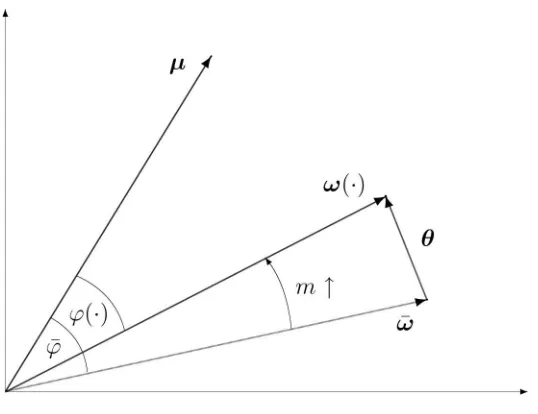
Figure 1: The Measurement Technology
information systemS¯. The final condition ensures that implementing a strictly positive intensitym
leads eventually to a more congruent information system.13
The underlying measurement technology is illustrated in figure 1. The more intense the costly
information acquisitionmis, the smaller becomes the angle between the vector of the expected firm
value sensitivities µand the new vector of the expected signal sensitivitiesω(·). Note thatω(·)is not necessarily on the plane spanned byµandω. It is only required that¯ ω(·)is characterized by a smaller angle to µthan vectorω, i.e¯ ϕ(m,ϕ¯) < ϕ¯. Observe further that geometrically the new vector ω(·)is the sum of vector ω¯ and vector θ, whereθ represents all information additionally acquired through costly performance measurement.
Recall that the optimal bonusβA∗
is normalized bykω¯kin order to exclude potential effects by different lengths of ω. The same will be true if the length of¯ ω(·)varies withm. For parsimony purposes and without loss of generality, I normalize the length of every new generated vectorω(·)
tokω(·)k=kω¯k.14
Assumption 2 The generated information system withϕ(m,ϕ¯)as its congruity measure is char-acterized by
(i): ϕm <0andϕmm >0 ∀m≥0,
(ii): ϕϕ¯>0andϕmϕ¯ <0 ∀m≥0,
13Technically, the last condition requires that new generated performance measures are not sufficient statistics of
other available measures.
(iii): ϕ(0,ϕ¯) = ¯ϕandϕ(m,0) = 0, (iv): ϕ¯∈[0, π/4],
whereϕi denotes the first, andϕiithe second derivative ofϕ(·)with respect toi,i=m,ϕ¯.15
Condition (i) implies that a higher measurement intensity menhances the congruity of the
gener-ated information system (smallerϕ(·)), whereas the marginal effect of reducingϕ(·)is decreasing in m. Condition (ii) states that the new generated information systemS(m)is less congruent for a given measurement intensity m, the less congruent the costless information systemS¯is.
More-over, the marginal effect of reducing ϕ(·)by implementing an arbitrary intensity mis higher, the less congruent the costless information system is, i.e. the higher ϕ¯is. Condition (iii) emphasizes that without costly performance measurement, only the costless information system is available.
Additionally, a perfectly congruent information system cannot be improved. To understand the last
condition, observe from (24) that the expected gross benefit contingent on an arbitrary measurement
intensitymbecomes
b
V(m) = 1 4kµk
2cos2ϕ(m,ϕ¯). (30)
It can be verified that Vb(m)is strictly concave increasing in m forϕ(·) ∈ (0, π/4), whereas the shape of Vb(m) is ambiguous for ϕ(·) ∈ [π/4, π/2) and depends on the particular behavior of
ϕ(·) in m. Consequently, condition (iv) guarantees that the first-order approach is sufficient for
identifying the optimal measurement intensity.
Assumption 3 The implementation ofm∈R+imposes costsC(m)characterized by
(i): C′
(m)>0,C′′
(m)>0, andC′′′
(m)≥0,
(ii): C(0) =C′
(0) = 0,
(iii): limm→∞C ′
(m) =∞.
The first condition emphasizes that the investment costs for improving the agent’s performance
evaluation are strictly convex increasing in the conducted measurement intensity. The assumption
about the third derivative is for technical reasons only. Condition(ii)states that the principal bears no additional costs when she does not improve the information system. The final condition ensures
15For parsimony purposes, I suppress the arguments for the respective derivative, unless it is necessary for specific
an interior solution since the generation of a perfectly congruent information system is prohibitively
costly.16
As explained earlier, the principal commits to a particular measurement intensitymby investing
C(m)prior to negotiating with the agent about her bonus contracts. As a consequence, the agent’s
bonus contract is now on the basis ofS(m)and therefore, depends onϕ(m,ϕ¯), but everything else remains identical. Hence, we can directly turn to the principal’s problem for identifying the optimal
measurement intensity m∗
. The adjustment of (24) with respect to the introduced measurement
technology implies that the optimal intensitym∗
solves
max
m Π
C(m,ϕ¯) = 1
4kµk
2cos2ϕ(m,ϕ¯)−C(m). (31)
Since2 sinϕ(·) cosϕ(·) = sin (2ϕ(·)), the first-order condition gives
1 4kµk
2sin (2ϕ(m∗
,ϕ¯)) (−ϕm) =C
′
(m∗
). (32)
The principal enhances the measurement intensity m until the expected marginal gross benefit is equal to marginal costs. Since the expected gross benefit is concave, and investment costs are
convex increasing inm, the first-order approach is also sufficient.17 Observe that the optimal mea-surement intensity m∗
depends implicitly on the congruity measureϕ¯of the costless information systemS¯. The effect ofϕ¯on the optimal measurement intensity m∗
and the principal’s expected
profitΠC(·)is clarified by the subsequent proposition.
Proposition 4 The optimal measurement intensitym∗
( ¯ϕ)is increasing inϕ¯. Overall, the
princi-pal’s expected profitΠC(m∗
( ¯ϕ),ϕ¯)decreases inϕ¯.
16This condition implicitly requires that the quantity of relevant tasks is strictly greater than the number of available
performance measures that provide different information about the agent’s effort allocation. For a formal analysis refer to Thiele [2006].
17To prove this analytically, observe that the second-order condition gives
∂2ΠC
(·) ∂m2 =
1 4kµk
2[2 cos(2ϕ(·))ϕ
m(−ϕm) + sin (2ϕ(·)) (−ϕmm)]−C′′(m), (33)
which is equivalent to
∂2ΠC(·)
∂m2 =−
1 4kµk
22 cos(2ϕ(·))(ϕ
m)2+ sin (2ϕ(·))ϕmm
−C′′(m). (34)
ProofSee appendix.
The less congruent the costless available information systemS¯is (higherϕ¯), the more distorted would be the motivated effort allocation if the principal usesS¯to provide the agent with incentives.
Since this diminishes the principal’s expected profit, it is optimal from her perspective to invest
more in the improvement of the information system aimed at mitigating effort distortion. However,
improving the information system imposes strictly convex increasing costs. Consequently, the
additional inefficiency due to an increases ofϕ¯cannot be compensated by enhancingm∗
(·). As a
result,ΠC(·)decreases inϕ¯.
By committing to the optimal measurement intensity m∗
(·), the principal ensures that the
agent’s performance evaluation is eventually characterized by a desired congruity measureϕ(m∗
(·),ϕ¯).
This in turn motivates the agent to choose a more efficient effort allocation in comparison to the
application ofS¯. The preceding analysis indicates that the agent’s bonus contract reflects the
con-gruity of her performance evaluation. To illustrate the effect of improving the incentive concon-gruity
on the agent’s expected utility, observe thatUA(·)changes to
UA(m∗
( ¯ϕ),ϕ¯) = 1 8kµk
2cos2ϕ(m∗
( ¯ϕ),ϕ¯). (35)
Recall that2 sin(·) cos(·) = sin(2(·)). Consequently, the first derivative ofUA(·)with respect tom
is
∂UA(·)
∂m =
1 8kµk
2sin(2ϕ(·))(−ϕ
m), (36)
which is strictly positive for all ϕ(·) ∈ (0, π/2) since ϕm(·) < 0. Accordingly, improving the
information system contemporaneously implies a higher rent extraction by the agent. This in turn
constitutes indirect costs for mitigating effort distortion if the agent faces a liability limit constraint.
6
Delegation
Instead of centrally investing in the improvement of the agent’s performance evaluation, the
princi-pal can alternatively delegate the information acquisition to a supervisor. This can be favored by the
principal if the supervisor is able to measure the agent’s performance more efficiently than a
cen-tralized regime. However, employing a supervisor with the objective of improving the information
system imposes a second moral hazard problem. Thus, the principal needs to provide the
super-visor with appropriate incentives in order to ensure the implementation of a desired measurement
Suppose the principal recruits a risk-neutral supervisor who also faces a liability limit
straint. For parsimony, her reservation utility is normalized to zero. The supervisor can
con-duct a performance measurement with the intensitymS ∈ R+ satisfying assumptions 1 and 2. A
strictly positive measurement intensity therefore generates additional measures about the agent’s
performance, which can be used to enhance the congruence of her performance evaluation. The
supervisor’s performance measurement is therefore objective rather than subjective.18 Recall the
quantity/quality example from section 5. Instead of purchasing a machine verifying the
achieve-ment of a quality standard, the supervisor may verify and docuachieve-ment the quality characteristics of
produced items. Both information—the produced quantity and achieved quality—can be
appropri-ately combined to provide the agent with more congruent incentives. Finally, the manipulation of
generated performance measures is assumed to be prohibitively costly for the supervisor.
For the sake of comparability, the supervisor’s disutility of conducting an arbitrary measurement
intensitymS isCS(mS) = ηC(mS), where C(mS)is identical to the principal’s investment costs
for allmS =m. Potential differences in the measurement efficiency are characterized byη∈ R+. The ratio 1/η thereby measures the supervisor’s comparative advantage in generating the same
performance measures relative to the principal’s central investment.
The principal observes the realization of the binary statisticS(mS)∈ {0,1}but cannot directly
contract overmS. Suppose the unfavorable signalS(mS) = 0is realized. This can occur because
either the agent indeed failed to meet her performance objective, or the supervisor did not generate
the required information such that there exists no evidence about the implementation of the desired
effort allocation. Consequently, the principal needs to provide the supervisor with incentives to
motivate a desired measurement intensity mS > 0. The principal, however, receives several
bi-ased information about the conducted measurement intensity, which are summarized by the binary
statisticM ∈ {0,1}.19
Assumption 4 LetPr[M = 1|mS] = ρ(mS) ∈ [0,1), where the probability ρ(mS)to realize the
favorable signalM = 1satisfies
(i): ρ(0) = 0,
18
Subjective evaluations imply additional problems since implicit promises to reward favorable behavior needs to be self-enforcing in repeated games [Baker, Gibbons, and Murphy, 1994], or induce favoritism by the evaluator [Prender-gast and Topel, 1996].
19See Demougin and Fluet [2001] for a formal derivation that verifiable information about one-dimensional effort
(ii): ρ(mS)is twice-continuously differentiable withρ′
(mS)>0and
ρ′′
(mS)≤0∀mS ≥0,
(iii): limmS→∞ρ(mS) = 1andlimmS→0ρ′(mS) = ∞.
Condition (i) emphasizes that without improving the information system, the binary statistic M
can never be favorable. The second and third conditions are standard and guarantee an interior and
unique solution for the optimal measurement intensity.
In order to induce a desired measurement intensity, the principal provides the supervisor with a
bonus contractwS on the basis of the verifiable statisticM. In particular, let
wS =
αS +βS, if M = 1,
αS, if M = 0, (37)
where αS denotes the fixed transfer andβS the bonus payment. The supervisor can increase the
probabilityρ(mS)to realize the favorable signalM = 1, and consequently, the likelihood to obtain
the contracted bonus βS, when she enhances her measurement intensitymS. Since the supervisor
is risk-neutral, the bonus contract provides her with the expected utility
US(mS) = αS+ρ(mS)βS−ηC(mS). (38)
Before deriving the optimal bonus contract for the supervisor, it is essential to briefly consider the
timing of this problem. First, the principal offers the supervisor a bonus contractwS. If she accepts
the contract and participates, it provides her with incentives to implement a desired measurement
intensitymS∗
. Afterwards, the principal provides the agent with a bonus contract on the basis of her
anticipated performance evaluation represented by the binary statisticS(mS∗
). Then, the agent
im-plements effort and the supervisor subsequently generates the additional performance measure(s).
Afterwards, the agent’s and supervisor’s performance evaluationsS(mS∗
)andM are realized and
become public knowledge. Finally, all contracted payments take place.
The agent’s bonus contract depends now on the supervisor’s induced measurement intensity
mS∗
, but remains qualitatively the same as in section 5. Therefore, we can directly turn to the
derivation of the supervisor’s contract, which is aimed at maximizing the principal’s expected profit
while guaranteeing the supervisor’s participation. Formally, the supervisor’s optimal bonus contract
max
αS,βS,mSΠ D
≡ 1
4kµk
2cos2ϕ mS
,ϕ¯−αS−ρ(mS)βS (39)
s.t.
αS+ρ(mS)βS−ηC(mS)≥0 (40)
mS = arg max
˜ mS α
S
+ρ( ˜mS)βS−ηC( ˜mS) (41)
αS+βS ≥0 (42)
αS ≥0. (43)
Condition (40) is the supervisor’s participation constraint and guarantees that it is in her interest
to enter into this relationship. Additionally, (41) is the supervisor’s incentive constraint. Finally,
conditions (42) and (43) ensure that the bonus contract is compatible with the supervisor’s liability
limit.
Proposition 5 The supervisor’s optimal bonus contract is characterized by the fixed transferαS∗
=
0and the expected bonus
B(mS∗
, η) = ηC
′
(mS∗
)ρ(mS∗
)
ρ′(mS∗) . (44)
The optimal measurement intensitymS∗
thereby solves
1 4kµk
2sin 2ϕ mS∗
,ϕ¯(−ϕm) =
∂B(mS∗
, η)
∂mS . (45)
Then, the principal receives
ΠD(mS∗
,ϕ, η¯ ) = 1 4kµk
2cos2ϕ mS∗
,ϕ¯−B(mS∗
, η). (46)
ProofSee appendix.
Consider first the supervisor’s expected bonusB(mS∗
, η) which comprises the optimal
align-ment to induce mS∗
. Observe that the expected bonus is characterized by the likelihood ratio
ρ′
(mS)/ρ(mS)which, according to Holmström [1979], measures the principal’s propensity to
ex-pect that the supervisor has not implemented the anticipated measurement intensity mS∗
when the
favorable signal M = 1 is realized. The likelihood ratio therefore measures the precision of the supervisor’s performance evaluation. Finally observe that B(mS∗
, η)consists of the supervisor’s
Proposition 6 The supervisor extracts a rent formS∗
>0, which is increasing inmS∗
.
ProofThe supervisor obtains a rent ifR(mS∗
, η)≡B(mS∗
, η)−ηC(mS∗
)>0. Suppose first that
mS = 0. Sinceρ(0) = 0, this implies thatB(0, η) = 0, and consequently,R(0, η) = 0. In order to
demonstrate thatR(mS∗
, η) > 0formS∗
>0, we can use the first derivative ofR(·)with respect
tomS, which leads after re-arranging to
∂R(·)
∂mS =
ρ(mS)ηC′′
(mS)
ρ′
(mS) +
ρ(mS)ηC′
(mS)(−ρ′′
(mS))
[ρ′
(mS)]2 . (47)
Observe that ∂R(·)/∂mS > 0for allmS >0. SinceR(0, η) = 0and∂R(·)/∂mS >0, it follows
thatR(·)>0for allmS∗
>0.
Q.E.D.
Since her liability limit constraint (43) is binding, the supervisor extracts a rent. This is because
the principal cannot impose negative transfers to expropriate the supervisor’s rent. However,
de-spite the supervisor’s rent extraction, it cannot be inferred that delegation is always less beneficial
from the principal’s perspective than a centralized investment. In particular, this depends on the
supervisor’s cost parameterη, which characterizes her comparative advantage in acquiring the de-sired measures about the agent’s performance. If this relative advantage is sufficiently high (lowη),
the expected bonus for inducing an arbitrary measurement intensity can be eventually less than the
principal’s required investment. In contrast, employing a supervisor with only a slight comparative
advantage can impose higher costs for an arbitrary measurement intensity due to her rent extraction.
Next, consider the optimality condition for mS∗
emphasized by proposition 5. The optimal
measurement intensity mS∗
implicitly depends on two parameters: (i) the congruity measure ϕ¯
of the costless information system S¯; and (ii), the supervisor’s relative measurement efficiency
η. Since both parameters determine the optimal measurement intensitymS∗
, they implicitly affect
the congruity of the agent’s performance evaluation, and consequently, the efficiency of her effort
allocation across tasks.
Proposition 7 The optimal measurement intensitymS∗
( ¯ϕ, η)is increasing inϕ¯and decreasing in
η. Overall, the principal’s expected profitΠD(mS∗
( ¯ϕ, η),ϕ, η¯ )is decreasing inϕ¯and inη.
The first part of this result is obvious because a less congruent costless information system
induces more distortion in the agent’s effort allocation. In order to restrict this inefficiency, it
is optimal to provide the supervisor with more powerful incentives aimed at motivating the
im-plementation of a higher measurement intensitymS∗
. Note that this directly leads to a higher rent
extraction by the supervisor and by the agent. However, improving the congruity of the information
system imposes convex increasing costsB(·). Thus, the additional inefficiency of an increasingϕ¯
cannot be perfectly compensated by inducing a higher intensitymS∗
(·). As a consequence,ΠD(·)
decreases in ϕ¯. Moreover, it is more costly for the principal to motivate an arbitrary measurement intensity if the supervisor provides a less relative measurement efficiency (higherη). In this case, it
is optimal to induce a lower measurement intensity, contemporaneously implying that the principal
receives a lower expected profit.
7
When is Delegation Profitable?
According to previous observations, one crucial factor for the principal’s preference in term of
centralizing or delegating the information acquisition is the supervisor’s relative measurement
effi-ciencyη. Ifηis sufficiently low, one can expect that the principal favors delegation, and vice versa. However, it is not obvious how the congruity of the costless information systemϕ¯affects the
prof-itability of delegation relative to a centralized investment. The purpose of this section is therefore
to investigate, how the relationship between the congruity of the costless information systemϕ¯and the supervisor’s relative measurement efficiencyηaffect the optimal organizational design.
Before turning to the principal’s preference for a particular organizational design aimed at
effi-ciently improving the information system, it is first necessary to compare the optimal measurement
intensities for both considered alternatives. Intuitively, one could expect that the supervisor
es-tablishes a more congruent information system if delegation is more profitable than centralization.
Note, however, this is not in general true. It particularly depends on the shape of the supervisor’s
expected bonus B(·) characterized by the inverted likelihood ratio ρ(mS)/ρ′
(mS). To identify
whether or not mS∗
(·) > m∗
(·), suppose the supervisor would implement the same measurement
intensity as the principal does in the optimum, i.e. mS = m∗
(·). Then, the supervisor’s optimal
measurement intensitymS∗
(·)is higher than the principal’s optimal intensitym∗
(·)if her expected
bonus is less increasing in the point mS = m∗
mS∗
(·)> m∗
(·)if
∂B(m∗
(·), η)
∂mS < C
′
(m∗
(·)). (48)
I demonstrate in the appendix that this is equivalent to
ρ(m∗
)
ρ′
(m∗
)
C′′
(m∗
)
C′
(m∗
) −
ρ′′
(m∗
)
ρ′
(m∗
)
< 1−η
η , (49)
where m∗
≡ m∗
(·). If the inverted likelihood ratio ρ(·)/ρ′
(·) is sufficiently low in m∗
and the
supervisor provides an adequate relative measurement efficiency (low η), it is optimal from the principal’s perspective to motivate a higher measurement intensity under delegation than it would
be optimal for a centralized investment. In this case, delegation leads to the provision of more
congruent incentives than centralization, thereby motivating the agent to implement less distorted
effort. In general, the principal’s decision on whether to centralize or to delegate the information
ac-quisition depends, besides the precision of the supervisor’s performance evaluationρ(mS)/ρ′
(mS),
on the congruity of the costless information systemϕ¯, and on the supervisor’s relative measurement efficiencyη.
Proposition 8 There exists a cut off cost parameter η∗
∈ (0,1) implying that the principal is
indifferent between centralization and delegation. Moreover, η∗
is strictly increasing (decreasing)
inϕ¯ifmS∗
(·)>(≤)m∗
(·).
ProofSee appendix.
Delegating the information acquisition to the supervisor is only favored by the principal if
the supervisor provides a sufficient comparative advantage in measuring the agent’s performance,
which countervails her rent extraction. More interestingly, however, is the observation that the
supervisor’s minimum required measurement efficiency is lower (higher η∗
), the less congruent
the costless information system is (higher ϕ¯). This applies when the supervisor’s performance evaluation is sufficiently precise such that delegation leads to a higher measurement intensity than
centralization. If in contrast the supervisor’s performance evaluation is sufficiently imprecise such
thatmS∗
(·)≤m∗
(·), the reversed observation obtains.
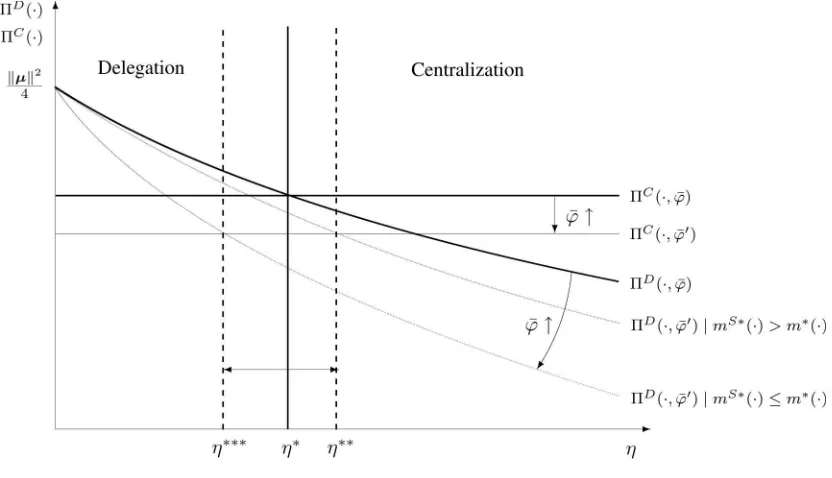
The preceding observations are illustrated in figure 2, where the supervisor’s relative
measure-ment efficiencyηis depicted on the horizontal axis, and the principal expected profits for
central-ization and delegation are represented on the vertical axis. Since ΠC(·) is independent of η, its
Figure 2: The Optimal Organizational Design
intersection of both curves characterizes the cut off η∗
, where the principal is indifferent between
centralization and delegation. For everyη < η∗
, the principal delegates the information acquisition
to the supervisor, and centralizes, otherwise. Now suppose that the costless information system
becomes more incongruent, i.e. ϕ¯increases to ϕ¯′
. As a result, it is optimal to conduct a higher
measurement intensity under centralization and delegation in order to mitigate the agent’s effort
distortion, see proposition 4 and 7. However, enhancing the measurement intensity imposes
con-vex increasing costs, thereby implying thatΠC(·)andΠD(·)decrease. Observe that the decline of
ΠD(·)inϕ¯particularly depends on the value ofη, and on whether or notmS∗
(·)> m∗
(·). Suppose
for a moment that mS∗
(·) > m∗
(·). If η ≤ η∗
, the marginal costs for enhancing the
measure-ment intensity are lower for delegation than for centralization. As a consequence, ΠD(·) is less
decreasing inϕ¯thanΠC(·)forη≤η∗
. Graphically, this implies thatη∗
increases toη∗∗
. Generally
speaking, the supervisor’s minimum required relative measurement efficiency for delegation to be
superior, is lower, the less congruent the costless information system is. In contrast, a more
con-gruent information system imposes higher requirements on the supervisor’s relative measurement
efficiency for delegation to be favored by the principal. However, ifmS∗
(·)≤m∗
(·), the reverse is
true such thatη∗
decreases toη∗∗∗ .
To illustrate the relevance of the preceding observations for the design of organizations,
employ-ees’ effort allocation is assumed to be more congruent in department A than in B. For example, departmentAcan be the sales department andB the human resources department. For simplicity, assume that there is only one costless performance measure in each department available: (i) the
achieved sales in the sales department; and (ii), the office-hours in the human resources department. The achieved sales can thereby be inferred to be a more congruent performance measure than the
office-hours in the human resources department. Suppose the supervisor’s performance evaluation
is sufficiently precise in both departments, thereby implyingmS∗
(·) > m∗
(·). The reversed
argu-mentation applies for mS∗
(·) ≤ m∗
(·). According to previous results, it is optimal to conduct a
higher measurement intensity in department B than in department A aimed at improving the
re-spective information system and hence, mitigating effort distortion. Furthermore, the minimum
required measurement efficiency a potential supervisor has to provide, is higher for department A
than for departmentB. This eventually leads to the conclusion that delegation for departmentB
(human resources department) is more likely than for department A (sales department) since po-tential supervisors presumably meet the requirements with respect to their measurement efficiency
for departmentB, rather than for departmentA.
The previous analysis reveals that job characteristics, particulary the congruity of costless
per-formance measures, determine how costly perper-formance measurement will be organized.
Particu-larly, if the supervisor’s performance evaluation is adequately precise, the previous analysis
pro-vides two crucial implications to explain why we can observe different practises for costly
perfor-mance measurement even within the same organization. First, a sufficiently incongruent costless
information system generally leads to delegation as the superior alternative. The rationale for this
observation is that delegation—to be preferred by the principal—requires only a low relative
mea-surement efficiency which is more likely to be provided by a potential supervisor. Second, the more
congruent the costless information system is, the more likely is a centralized investment in the
in-formation acquisition. This can be observed because delegation—in order to be the more profitable
alternative—would impose high requirements on the supervisor’s relative measurement efficiency,
which is less likely to be achieved by a potential supervisor. The reverse inference applies if the
8
Conclusion
In economic relationships that are subject to moral hazard, objective performance measurement is
frequently utilized to provide agents with incentives. However, applying performance measures in
incentive contracts may motivate agents to implement inefficient effort allocations across relevant
tasks. This occurs if an available performance evaluation does not perfectly reflect the agent’s
con-tribution to firm value. Then, it is desirable from the perspective of firms to use mechanisms which
are suitable to mitigate this inefficiency. This paper investigates the costly acquisition of additional
performance measures as one mechanism to alleviate effort distortion. The main emphasis is on
the principal’s preference for either centrally investing in assets that can be utilized to measure the
agent’s performance, or delegating the acquisition of additional measures to a supervisor.
This paper demonstrates that the less congruent the costless information system is, the greater
is the investment in its improvement aimed at restricting effort distortion. This applies for both
considered alternatives, i.e. for the centralized investment and for the delegation of the performance
measurement to the supervisor. However, enhancing the congruity of the agent’s performance
evaluation does not only improve her effort allocation, but also provides her with a higher rent due
to her liability limit.
The analysis indicates that employing a financially constrained supervisor for measuring the
agent’s performance can only be beneficial if she provides a sufficient relative measurement
ef-ficiency, which countervails her rent extraction. This paper illustrates that the profitability of
delegation depends on three factors: (i) the precision of the supervisor’s evaluation system, (ii)
the supervisor’s comparative cost advantage in obtaining the required information; and (iii), the congruence of the costless available information system about the agent’s effort. Particularly, if
the supervisor’s performance evaluation is sufficiently precise, this investigation leads to the
subse-quent two implications. First, the principal generally prefers to delegate the information acquisition
to the supervisor if the costless information system is sufficiently incongruent. This is because a
less congruent costless information system imposes lower requirements on the supervisor’s relative
measurement efficiency, which is more likely to be satisfied by a potential supervisor. Second, the
principal favors in general a centralized investment if the costless information system is sufficiently
congruent. This can be observed because delegation—in order to be the superior strategy—imposes
a high requirement on the supervisor’s relative measurement efficiency, which is less likely to be