A PERSPECTIVE ON TEXT HIDING METHODS
Raka Adinugraha, Tito Waluyo Purboyo and Randy Erfa Saputra
Computer Engineering, Faculty of Electrical Engineering, Telkom University, Bandung, Indonesia E-Mail: [email protected]
ABSTRACT
Steganography is the art of hiding data within another data. Is a useful technique for hiding data such as image, audio, text etc behind cover files? There are exists various techniques for text Steganography, and all of them have their own respective strong and weak points. For each text Steganography used, they have different requirements and rules on how they applied. Many Text Steganography techniques are proposed, all of them have something in common that was to increase embedding rate of the secret data within the cover files and to rises suspicion as little as possible from an unintended observer. Steganography is a promising technique as a supplement to Cryptography, because the chiper text will certainly raise suspicion because it forms, and there is where Steganography comes in to hide those encrypted message to some cover files thus reducing risk the secret message get revealed. This paper provides a general overview and a brief idea of Text Steganography techniques.
Keywords: steganography, hiding, text, cover, suspicion.
INTRODUCTION
At the recent time, security is a must have requirement on communication through an online network. In a casual conversation between colleague within SNS or Social Networking Service, of course, we don’t want an unintended party to eavesdrop because it could be a private matter, that’s where the security system comes in. However, sometimes the security system even could be penetrated and thus privacy became a concern. So, it’s necessary to hide the real secret message using Steganography.
Steganography is the art of hiding information. The secret information hides in such a way that no one will not notice nor revealed it but the sender and intended recipient. The main goal is to hiding without raising any unnecessary suspicion. Steganography derived from Greek word origin meaning “concealed writing” a Greek words steganos means “covered”, and graphein means “to write”. As the name suggests, the secret messages were hidden within a cover that could something else, start from image to video or some other cover text. Steganography is different with Cryptography, the Cryptography used to prevent the unintended parties to eavesdrop while Steganography focus to hide the secret messages from unintended observer. So, despite the presence of the cover text was compromise, the secret messages somehow could manage to remain uncovered. Both Steganography and Cryptography can be combined to ensure more robust security in the communication process
STEGANOGRAPHY CLASSIFICATION
Chaudhary et al. [3] listed 5 categories of Steganography based on their respective cover file as shown in figure 1. In the next sub section, we will discuss them briefly one by one.
Figure-1. Types of Steganography based on the cover file.
Text steganography
The secret message embedded into a cover text. It uses any possible feature and properties to hide the secret message. Text steganography is hardest of type of Steganography, because it rarely to hide secret message in form of text into the other cover text. Usually, cover file will be in the form of video, image or audio. [2].
Text Steganography not only can be applied to the text in a document such as books or printed paper. Text that is assigned in digital media such e-book can be secure by Steganography thus make a copyright mark (also known as the watermark) for a digital text made possible. This watermark doesn’t need to show itself because it embedded within the other text that only an intended party could extract that if needed.
Video steganography
The secret message was hidden in a video file. Multiple formats of video file can be used, Mp4, AVI, MPEG etc. The changes that happen in cover video was insignificant by the human eye as the change of a pixel color in negligible [2]. Various methods is useable in video Steganography such as substitution technique, transform domain technique, spread spectrum technique, a statistical technique, and distortion technique [3].
capacity. Video steganography is a combination of image and audio Steganography [4].
Audio steganography
The secret message was hidden beneath an audio format cover file. The cover audio file has the same attributes before applying Steganography and after thestego message has generated. The common methods for audio Steganography are LSB coding, parity coding, Phase coding, Spread coding, and echo hiding [5].
Image steganography
The most common used steganography due to the limitation of human visual capability. There is a limit in human perception about colors, and thus make them hard to see an insignificant change due to the result of Steganography.
Cover file can be in any format of image file (JPEG, GIF, etc). Alter the pixel values to hide secret information. Hiding the secret message in the “noisy” part of the image where is the area where a lot of color variation to draw less attention. Common approaches include LSB insertion, masking, and filtering, redundant pattern encoding, encrypt and scatter, algorithms and transformations [5].
Network or protocol steganography
Secret information hides through network protocols as CP, TCP, UDP, ICMP, IP etc. For instance, there are some least used fields available in TCP/IP headers; these can used to send the secret message [3].
Another Steganography technique that can be used in the networking system called PadSteg or Padding Steganography [6]. Its utilize relation between protocols to start hidden communication.
BASIC FEATURES
This section discusses the few features of data hiding.
Embedding capacity
The secret message is embedded in a cover file that is larger than the payload itself. The amount of data that can be hidden, compared to a size of the cover is known as Embedding Capacity (also known as payload. This can be measured in unit bit-per-bit.
Invisibility
The effect of hiding data in the cover file cause it to be modified. Invisibility term is used to measure the amount of distortion in the cover after payload has been embedded. Have a large embedding capacity is useless if it causes large distortion to the cover. Because invisibility is a qualitative feature thus it cannot measure by a number. The best way to measure it is to give several observers with the cover file before and after embedding process.
Undetectability
It is different from invisibility because it doesn’t depend on human perception. Because an attacker may be
able to do computing certain statistical properties to detect the presence of a secret message.
Robustness
The measure of the ability of an algorithm to retain data embedded in the cover is termed as robustness [8]. A process such as compressing and decompressing could destroy the data that embed in the cover, that’s why robustness is important especially if it related to copyright or ownership information (watermark).
TEXT STEGANOGRAPHY
In text steganography the secret message was hidden in the cover text, in other word the cover file was a text. It is important not to make a notable change to the text that appears in the document after applying Steganography because it could rise suspicion. There are three classifications of text steganography, random and statistical generation, format based, and linguistic method.
Figure-2. Types of text steganography.
TEXT STEGANOGRAPHY TECHNIQUES
Line shifting
In these techniques, hiding the secret message can be done through change the line alignment by moving it vertically up and down to represent a hidden data [6]. The assigned data that want to hide in a certain cover text will determine the lines that will be moved in the cover text. The text line have to moved up if it is bit 0 and the text line have to moved down if it is bit 1 or otherwise.
The secret message that has been encoded to cover text may be extracted from the format file or bitmap image [7].
In Figure-3 the second line has been shifted up 1/300 inch.
Figure-3. Example of Line Shifting.
Word shifting
right to represent bit 1 or otherwise. If the text has a varying distance between words, this technique will be really suitable. Also, this technique is less recognizable because the distance between words are looked natural to the human eyes.
Figure-4. Example of Word Shifting [16].
In Figure-4 (a) shows that a different spacing between top text and the bottom text. In (b) it shows again the exact same text without vertical lines, to demonstrate the natural appearance from the different spacing.
Syntactic
Use the punctuation marks such as full stop (.) and comma (,) to hide bits 0 and 1 respectively. The difficult part of this technique is that required a careful identification of correct places for the punctuation mark.
Feature coding
With feature coding, the secret message is hidden by altering a feature that available on the cover text. For example, vertical lines in characters such as b, d, h can be shortened or extended to conceal hidden messages, or by displacing point in letters i and j.
Figure-5. Example of Feature Coding [16].
Altering font color of the invisible characters
This technique was proposed by Khairullah [9]; this technique is simple yet effective. Invisible characters colors were used as media to embed the payloads in Microsoft Word Document. Invisible characters such as normal space and tabulation space can be recolor as well as any other visible characters by changing their RGB values. Even though the RGB values have been changed the color of those invisible character won’t surface thus
making it have a low risk of exposure. Below are bits stream example as in [9] to show how the technique does, 10101101011110101000110101001100111010010011100 1010011100101010110001010
Groups of 8 bits are represented by alteration of italic and bold. Thus the RGB value of the three invisible characters should be (173, 117, 141), (76, 233, 57), (78, 85, 138).
Listega: List-based steganography methodology
Listega uses a textual list to camouflage data by using itemized data to conceal messages. An encoded messages assigned to an item list to generate a cover text in form of a textual list. Each party that involved communicated each other through a covert channel with a justifiable reason in order to achieve unsuspicious transmission of generated covers [10] [11].
The example that written in, show that both parties have established a justifiable reasons before starting to communicate to send secret messages. The list that are sent between them still may raise suspicion, but the hidden messages could remain safe because only respective parties could extract them.
White steg
In this technique, white spaces are utilized to hiding the payloads [12]. There are three respective spaces available to use for data hiding, word spaces, inter-sentence spaces, and end of line spaces.
In the inter-word spacing, bit 0 could represented by single space after a word and bit 1 could be represented by a couple space after a word. In inter-sentence spacing, to hide bit 0 a single space characters are used and to hide bit 1 two space characters are placed at the end of the last letter. In end of line spaces, a few spaces are inserted at the end of each line. For example, to encode one bit need two spaces, to encode two bits need four spaces and so on.
New synonym text
This technique was based on word spelling method. But, in New Synonym technique, a different word will be used for the same payloads [9]. Each selected word will represent a sequence of a bit stream. In English, some words have a different term in US and UK. For example, “rubber” was a US term for “Eraser” in the UK. This method used different terms of words thus make it harder to detect [1].
UniSpaCh
This technique [13] utilizes Unicode Space Characters to conceal payloads in the white space that are present in the document. The white space here is inter-word space, inter-sentence space, and End of Line spacing.
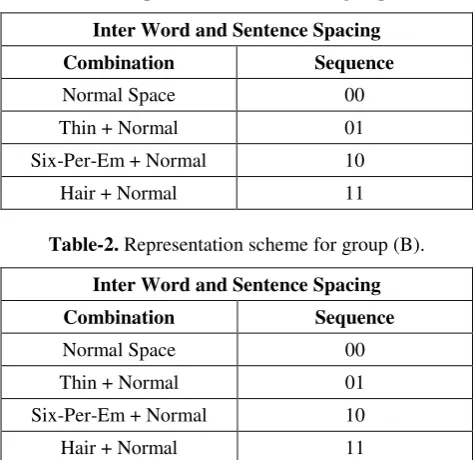
From 18 Unicode Space Characters available, below are 8 Unicode space characters that suitable for data hiding:
3. Three-Per-Em 4. Six-Per-Em 5. Figure 6. Punctuation 7. Thin 8. Hair
[image:4.595.313.548.95.236.2]The rest of it will appear as square or degree symbol when ‘Show/Hide Formatting Marks’ Feature are being use in Microsoft Word. Those 8 that are suitable for data hiding are separated into two groups for use with each respective rule. Group (A), for inter-word spacing and sentence spacing. Group (B), end of line and inter-paragraph spacing.
Table-1. Representasion scheme for group (A).
Inter Word and Sentence Spacing Combination Sequence
Normal Space 00
Thin + Normal 01
Six-Per-Em + Normal 10
Hair + Normal 11
Table-2. Representation scheme for group (B).
Inter Word and Sentence Spacing Combination Sequence
Normal Space 00
Thin + Normal 01
Six-Per-Em + Normal 10
Hair + Normal 11
UniSpaCh offers high values of embedding rate and also the payload that can embed not only text but also video file and image.
Mixed-case font
In this technique, each letter can become a carrier of a secret message. Within every 7 letters, one character will be inserted for data hiding [14]. Thus, make this method have a high embedding capacity.
Figure-6. Mixed-Case Font [8].
HTML documents based text steganography
This technique utilizes the HTML tags and attributes to hide a secret message. This technique has three main components that were generating the key file, hiding and extracting. Key file generation would be the essential one. The key combination would be placed in the form of rows and columns, this combination are created by scanning through the HTML documents. There is two types of attributes contains in the key file:
a) Primary Attribute b) Secondary Attribute
The encoding process scans each attribute of each HTML tags, and checks to see if the corresponding attribute were available in the key file of primary attribute field [15]. The order of attributes in the attributes combination will determine the bit that will be hidden. Bit 1 can be hidden if primary attributes are followed by secondary attributes; else it can hide a bit 0.
When extracting, identifying an attribute combination that hides a bit and followed by finding the correct order of those attributes. If the primary attribute is followed by secondary attribute, a bit 1 has been detected, else a bit 0 has been detected.
Cascading style sheet (CSS)
CSS is utilized as a place where the chipper text is embedded after the secret message encrypted using RSA (Rivest-Shamir-Adleman) public keycryptosystem. In the end of line on CSS after a semicolon (;) bit 0 is hidden by placing a space while bit 1 is hidden by placing a tab.
Steganography technique by creating a matrix of location
The idea of this technique [18, 19] is to convert both the cover text and secret text into binary format to create a matrix. Thus, the matrix sequence will result as an output of embedding process.
This sequence of the matrix where created by matching bits in the secret text and cover text after both converted into binary format.
[image:4.595.50.287.287.517.2]matching with the bits from the cover text to create another sequence of the matrix. The newly created sequence of matrix will be converted to binary then ASCII format then to character format so the secret will be revealed.
A modified approach to data hiding in Microsoft word documents by change-tacking technique
The main idea of this [17] technique is to redesign Huffman code generating method instead of using the original one.
Track Changes is a feature where Microsoft Word will trace the history of word change by its user. Is also known as redlines because some industries draws a vertical red line to show changed text.
Figure-7. Screenshot of Track Changes features active in Microsoft Word.
Table-3. Comparison of Various Text Steganography Technique.
No Steganography Technique Cover Text Embedding Technique
1 Line Shifting Any document Shifting text line horizontally to represent the hidden data
2 Word Shifting Any document Shifting spacing line between words to
represent the hidden data
3 Syntatic Any document Use punctuation mark full stop (.) and
comma (,) to represent bit 0 and 1
4 Feature Coding Any document Alter text features such as vertical line in character h, b, d, etc to hide data
5 Altering font color of invisible character
Any Microsoft Word document
Use RGB color value as representation of hidden data
6 Listega Textual list of something Secret message assigned to an item in the list
7 White Steg Any Microsoft Word
Document
Using white space in the document to hide data
8 New Synonym Text Any Document Each selected word represents a bit stream sequence
9 UniSpaCh Any Microsoft Word
Document
Using Unicode Space Character to represent hidden data and place it between spacing in
document.
10 Mixed-Case Font Unique cover text Using a single characters to hide data every several characters
11 HTML Document Based
Technique HTML documents Using HTML tags and attributes to hide data
12 CSS Technique CSS file Using space and tab at the end of line of CSS
properties to hide bits 0 or 1
13 Matrix Technique Any Document Convert both cover and secret text to matrix to create Stego file by matching bits
14 Hiding Data in Paragraph Any Text Using start and end letters of a word to hide data
15 Change-Tacking Technique Any Microsoft Word Document
Using synonyms of word and Huffman code of each synonym word to encode the
message
Future work
As the time moves forward, more new Text Steganography technique is proposed. But that doesn’t mean the techniques that already proposed earlier were left behind. Most of them still can be improved with future research.
In example is UniSpaCh technique, such aspect as embedding efficiency want to be improved. Also, the
robustness against a statistical attack that targeting on Unicode Characters still need future research to be optimized.
hidden information get destroyed if a technique that utilizes space and invisible character such as UniSpaCh are being use.
CONCLUSIONS
Steganography has a goal to hide information yet at the same time to raise suspicion as little as possible from the unintended observer. It is intended to be a supplement to Cryptography. This paper has provided a brief general idea of existing text steganography technique. This paper mainly discusses a technique that is under the wing of Format Based Method Steganography.
REFERENCES
[1] Swati Gupta, Deepti Gupta. 2011. Text-Steganography: Review Study & Comparative Analysis. International Journal of Computer Science and Information Technologies. 2(5): 2060-2062.
[2] Nitesh Rao M., Lavanya Pamulaparty. Text Steganography: Review. 2016. International Journal of Computer Science and Information Technology & Security. 6(4).
[3] Sunita Chaudhary, Dr. Meenu Dave, Dr. Amit Sanghi. Review of Lingusitic Text Steganographic Methods, 2011.International Journal on Recent and Innovation Trends in Computing and Communication. 4(7): 377-381.
[4] Kiah E., Zaidan B. B. and Zaidan A. A. 2009. High rate Video streaming steganography. International Conference on Information Management and Engineering. 550-554.
[5] Samir K. Bandyopadhyay, Debnath Bhattacharyya, Debashis Ganguly, Swarnendu Mukherjee, Poulami Das. 2008. A Tutorial Review on Steganography. University of Calcutta, India. 105-114.
[6] Ms. Dhanashri Dhobale, Dr. Vijay R. Ghorpade. An overview of advanced network protocol steganography. 2013. International Journal of Advanced Research in Computer and Communication Engineering.2(9).
[7] J. T. Brassil, L, S. H. Low, N. F. Maxemchuk. 1995. Electronic Marking and Identification Techniques to Discourage Document Copying. IEEE Journal on Selected Areas in Communications. 13(8).
[8] K. Aditya Kumar, Dr. Suresh Pabboju, Neela Megha Shyam Desai. 2014. Advance Text Steganography Algorithms: An Overview. International Journal of Research and Applications. 1(1): 31-35.
[9] Md Khairullah. 2009. A Novel Text Steganography System Using Font Color of the Invisible Characters in Microsoft Word Documents. Second International Conference on Computer and Electrical Engineering.
[10]Abdelrahman Desoky. 2009. Listega: list-based steganography methodology. Int. J. Inf. Secur. 247-261.
[11]Esra Satir, HakanIsik. 2012. A Compression-based text steganography method. The Journal of System and Software.85: 2385-2394.
[12]L. Y. Por, T. F. Ang, B. Delina. 2014. WhiteSteg: A New Scheme in Information Hiding Using Text Steganography. WSEAS. 7(6): 735-745.
[13]Lip Yee Por, KokSheik Wong, Kok Onn Chee. 2012. UniSpaCh A text based data hiding method using Unicode space characters. The Journal of System and Software. 85: 1075-1082
[14]Abdelmgeid Amin Ali and Al - Hussien Seddik Saad. 2013. New text steganographic technique by using mixed case font. International Journal of Computer Applications. 62(3).
[15]Mohit Garg. 2011. A Novel Text Steganography Technique Based on Html Documents. International Journal of Advanced Science and Technology. Vol. 35.
[16]WidAkeel Awadh. 2016. A Novel Approach for Hiding Information in Steganography. International Journal of Scientific & Engineering Research. 7(12).