Scholarly Research Journal for Interdisciplinary Studies, Online ISSN 2278-8808, SJIF 2016 = 6.17, www.srjis.com UGC Approved Sr. No.49366, JULY-AUG 2017, VOL- 4/35
Copyright © 2017, Scholarly Research Journal for Interdisciplinary Studies
ACTIVITY BASED LEARNING PROGRAMME FOR SPEAKING SKILL
DEVELOPMENT
Chandrakant Sakharam Lonkar, Ph. D.
Sou. NirmalataiThopte College of Education & Research Centre, Bhor, Pune.
Speaking is one of the basic skills of English language. It is a productive skill. Effective communication is depend upon how you speak the target language. Speaking skill is very important skill for academic and career success. Speaking is also a complex skill. It is used to communicate with speech to others. Activity based learning is useful to enhance English speaking skills. We can develop and implement various activities. We can also assess the improvement of the speaking sub skills. Keywords: Speaking Skill, Activity Based Learning, English Speaking Club, Speaking sub skills.
Introduction: Speaking skill is the hallmark of knowledge in the society or in the
employment demand market industry. A person who speaks English fluently impresses
others. He communicates effectively his ideas or thoughts. Speaking is a productive skill in
English language. Listening and speaking are interdependent skills one helps the other. In the
Marathi medium schools, most of the students ask one question. Sir what can I do for
speaking English? I can understand your spoken English. I can write in English but I can‟t
speak in English. This is because there is not properly examination of English speaking skill.
Physiology of Speaking Skill:
Scott,T.(2005) in his book „How to Teach Speaking‟ has given physiology of
speaking skill. He said about that what happens “inside the head” of a language speaker. It is
a thought process to become utterances. He has given three stages of speaking skill
physiology. They are as follows: 1) conceptualization 2) formulation 3) articulation and in
between the process, speakers maintain self-monitoring. There are various sub-skills of
speaking skill.
Teaching Speaking Skill:
Goh, C. C. M. and Burns Anne (2012: 158-168) in their book „Teaching Speaking: A
Holistic Approach‟ have given a model for teaching speaking skill as follows: They have
given it in a cyclical form. These stages are correlated by a round cycle and they are as 1)
Dr. Chandrakant Sakharam Lonkar
(Pg. 6693-6697) 6694
Copyright © 2017, Scholarly Research Journal for Interdisciplinary Studies
focus learners attention speaking 2) provide input and guide planning 3) conduct speaking
tasks 4) focus on language discourse/skills/strategies 5) repeat speaking tasks 6) direct
learners reflection on learning 7) facilitate feedback on learning.To develop speaking sub
skills, the developed following program is helpful.
Development of Activity Based Learning Programme for Speaking Skill:
Establishment of English Speaking Club (ESC)
Objectives:
1. To establish „English Speaking Club‟.
2. To develop team feeling among students with the help of English Speaking activities.
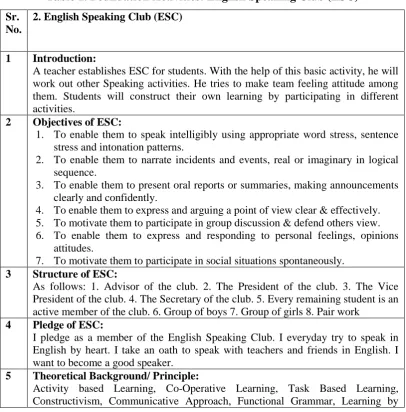
3. To use 15 core speaking activities by using some model videos on YouTube on everyday
useful situations for students with the help of psychological learning theories and language
[image:2.595.95.502.352.765.2]learning theories/principles.
Table 1. Foundation Activities: English Speaking Club (ESC)
Sr. No.
2. English Speaking Club (ESC)
1 Introduction:
A teacher establishes ESC for students. With the help of this basic activity, he will work out other Speaking activities. He tries to make team feeling attitude among them. Students will construct their own learning by participating in different activities.
2 Objectives of ESC:
1. To enable them to speak intelligibly using appropriate word stress, sentence stress and intonation patterns.
2. To enable them to narrate incidents and events, real or imaginary in logical sequence.
3. To enable them to present oral reports or summaries, making announcements clearly and confidently.
4. To enable them to express and arguing a point of view clear & effectively. 5. To motivate them to participate in group discussion & defend others view. 6. To enable them to express and responding to personal feelings, opinions
attitudes.
7. To motivate them to participate in social situations spontaneously. 3 Structure of ESC:
As follows: 1. Advisor of the club. 2. The President of the club. 3. The Vice President of the club. 4. The Secretary of the club. 5. Every remaining student is an active member of the club. 6. Group of boys 7. Group of girls 8. Pair work
4 Pledge of ESC:
I pledge as a member of the English Speaking Club. I everyday try to speak in English by heart. I take an oath to speak with teachers and friends in English. I want to become a good speaker.
5 Theoretical Background/ Principle:
Dr. Chandrakant Sakharam Lonkar
(Pg. 6693-6697) 6695
Copyright © 2017, Scholarly Research Journal for Interdisciplinary Studies
Doing, Piaget, Blooms Cognitive development, Skinners Law of Readiness, Practice, Naturalness, Habit Formation etc.
6 Teacher Activities:
The teacher is as a guide, friend, facilitator, controller, & director of the ESC. He sets speaking activities for the club. He motivates them to participate actively. 7 Students Activities:
He is an active member of the club. He pledges every day to speak in English. He participates in the clubs Pre-While- & Post speaking activities by heart.
8 Expected Outcomes:
To inculcate language utility values among students. To enhance speaking skills. To develop teamwork culture feeling for contextual language learning among them. Be a good speaker.
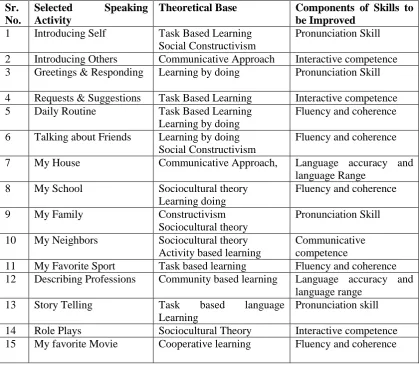
The above ESC will implement the following activities to enhance English speaking sub
[image:3.595.88.508.356.721.2]skills.
Table 2. Theoretical base of activity based learning program for: Speaking Skill
Activities
Sr. No.
Selected Speaking Activity
Theoretical Base Components of Skills to be Improved
1 Introducing Self Task Based Learning Social Constructivism
Pronunciation Skill 2 Introducing Others Communicative Approach Interactive competence 3 Greetings & Responding Learning by doing Pronunciation Skill 4 Requests & Suggestions Task Based Learning Interactive competence 5 Daily Routine Task Based Learning
Learning by doing
Fluency and coherence 6 Talking about Friends Learning by doing
Social Constructivism
Fluency and coherence 7 My House Communicative Approach, Language accuracy and
language Range
8 My School Sociocultural theory
Learning doing
Fluency and coherence
9 My Family Constructivism
Sociocultural theory
Pronunciation Skill 10 My Neighbors Sociocultural theory
Activity based learning
Communicative competence
11 My Favorite Sport Task based learning Fluency and coherence 12 Describing Professions Community based learning Language accuracy and
language range
13 Story Telling Task based language
Learning
Dr. Chandrakant Sakharam Lonkar
(Pg. 6693-6697) 6696
Copyright © 2017, Scholarly Research Journal for Interdisciplinary Studies One sub skill and three activities implementation procedure is as follows:
Plan, Procedure and Manual for the Sub Skill ‘Pronunciation skill’
Objective: To develop listening clear, natural pronunciation with proper stress and intonation.
Table3.ABLP activities for ‘pronunciation skill’ on LCD Projector’
Component of
ABLP
Sr.
No.
ABLP Speaking Activities
1.Pronunciation
I.) Clear, natural
pronunciation
II.) Proper stress
and intonation.
1. 1.1 Greetings and
responding
1. 2Introducing others
2 Objective:
1. To develop pronunciation
skills.
Objective:
1. To develop pronunciation
skills.
3. Nature of Activity:
Greeting & Responding
activity for each student.
Discussion on performances.
Practice of activities.
Nature of Activity:
Introducing Others activity for
each student. Discussion on
performances. Practice of
activities.
4. Theoretical Base:
Social Constructivism, Task
Based Learning,
Theoretical Base:
Learning by doing,
Communicative Approach
5. Teacher Activity:
He asks them to greet &
respond their friends. He
motivates, guides them to
speak correctly using proper
stress and intonation.
Teacher Activity:
He asks them to introduce your
friends. He motivates, guides
them to speak correctly using
proper stress and intonation.
6. Student Activity:
They try to greet & respond
with proper stress &
intonation. They speak
confidently with logical
sequence.
Student Activity:
They try to introduce their
friends with proper stress &
intonation. They speak
confidently with logical
sequence.
Dr. Chandrakant Sakharam Lonkar
(Pg. 6693-6697) 6697
Copyright © 2017, Scholarly Research Journal for Interdisciplinary Studies
Images, Video Clips, Laptop Images, Video Clips, Laptop
8. Time:
30 Minutes 10+10+10 Two
Days
Time:
30 Minutes 10+10+10 Two
Days
We can use the same strategy for other speaking sub skills development. Those are available
on the following link in chapter III https://shodhganga.inflibnet.ac.in/handle/10603/175039.
After implementing these activities, we can assess the speaking sub skills enhancement.
Assessing Speaking Skill:
Luoma, S. (2004: 59-95) in her book „Assessing Speaking‟ has given various types of
speaking skill assessment scales. These scales/tests measure that how well the speaker speaks
the target language. They are in a form of numbers. Some are also in a form of descriptions
and words like the speaker (examinee) speaks as “excellent”, “fair”, “and poor” etc.
Reference
Activity Based Learning in India. (2011). In Wikipedia, the Free encyclopedia.
Retrieved from http://www.en.wikipedia.org/wiki/Activity-based learning in India Cajkler, W. &Addleman, R. (2000).The Practice of Foreign Language Teaching(repr: 2001,
2002). David Fulton Publishers, p.33, London.
Goh, C. C. M. and Burns, A. (2012).Teaching Speaking: A Holistic Approach. Cambridge University Press, Cambridge CB2 2RU, UK.
Lonkar, C. S. (2017). “Development of Activity Based Learning Programme to Enhance Basic Skills in English and its Effectiveness.”Ph. D. Thesis.
Luoma, S. (2004).Assessing Speaking.Cambridge University Press, Cambridge CB2 2RU, UK. Sconda, S. D. (2008, Agust 4).Greetings Vocab & Phrases - English Meeting ESL Lesson
Retrieved From https://www.youtube.com/watch?v=cQnD3qJiJPo
Twominute English. (2012, Nov. 5). Introducing Yourself in English - Learn to speak English Sharma, P. (2008). Teaching of English Language.Shipra Publications, Delhi.