ISSN 2250-3153
Difficulties Encountered In Mathematical Word Problem
Solving Of The Grade Six Learners
Girley P. Mingke, *Dr. Emybel M. Alegre
Bachelor of Elementary Education, Caraga State University, Ampayon, Butuan City *College of Education, Caraga State University, Ampayon, Butuan City
DOI: 10.29322/IJSRP.9.06.2019.p9053
http://dx.doi.org/10.29322/IJSRP.9.06.2019.p9053
Abstract
The study was conducted to determine the difficulties encountered in mathematical word problem solving in Butuan Central Elementary School. Descriptive type of research through survey questionnaire was used in the study. The researchers used quota sampling with a random selection in order to limit researcher’s choice of sample. Each selection of Grade 6 class had the number of respondents that were randomly selected with the help of corresponding teachers. The researchers had 100 respondents as a sample size. The difficulties encountered by the pupils were categorized into children’s attitude towards problem solving in Mathematics, teaching skills among teachers and instructional materials used by the teacher. Based on the data gathered, the overall mean for the children’s attitude towards word problem solving is 3.44 showed that the children should develop a positive attitude in dealing word problem solving. The overall mean of the level of teaching skills among teachers was 2.41and it was found out that the teacher executed teaching skills in teaching word problem solving. For the instructional materials, it obtained the mean of 3.03 which showed that the most instructional materials used by the teachers were the textbooks, worksheets, chalk, and board. In answering word problem solving, the pupils got the correct answer when it was already given in the problem but most of them got the wrong answer when they had to translate word problem into mathematical symbol. Furthermore, it implied that the problem was not with the teaching skills and the instructional materials used, but with the attitude of the pupils towards mathematical word problem solving.
Keyword: Mathematical word problem, teaching skills , attitude , instructional materials
1.0
Introduction
Mathematics plays a big role in developing human thoughts, bringing strategic, systematic reasoning processes used in problem analysis and solving. It helps people to be able to anticipate, plan, decide, and properly solve each problem in daily life. Mathematics is also a tool to study technological sciences and such. Thus Mathematics is useful to our living, helping to improve the quality of life. However, in 2012, the National Council Teachers of Mathematics stated that problem solving skills are the main expectation of Mathematics subject. On the other hand, the main purpose of Mathematics teaching is to enable students to solve daily life problems. Hence, it can be said that Mathematics is a tool to train students to be able to solve problems, and to build thinking processes that lead to further ability to solve non-mathematical problems (Prathana Phonapichat et al., 2014).
Mathematics anxiety is the result of the student's negative attitude or embarrassing experience with their Mathematics teachers in previous years. Such experience can leave a student believing him or her deficient in Mathematics ability. This belief results in poor performance, which serves as a confirming evidence to the student. This phenomenon is known as the "self-fulfilling prophecy". Mathematics anxiety results in poor performance rather than the reverse (Ganal, et.al., 2014). It is in this context that the present study was conceived, to identify the difficulties encountered in mathematical problem solving of Butuan Central Elementary School.
ISSN 2250-3153
improved performance. As other researchers had pointed out, the teachers were the primary cause of students' failure in Mathematics. It is apparent that teachers can make and unmake a learner. Poor performance in Mathematics can be traced back to teachers' failure to impart the necessary knowledge, skills, attitudes, and values to students. Anything a teacher does and fails to do in the classroom affects the learner. In addition, Sin Son (2003 in Mateo, 2011) confirmed that the teacher is the most critical factor in attaining quality education and the single most potent element in the complete structure of an effective mathematical program. Hence, the teachers should be aware of the problems and difficulties that affect the performance of their students.
2.0
Conceptual Framework
This study was anchored on Cognitivist Theory of Jean Piaget which states the factors that affect learning and teaching Mathematics. Reading comprehension skills and the ability to solve mathematical problems could be the difficulties of pupils to solve mathematical word problem.
In relation to the study, pupils find difficulty in Mathematics. For instance, solving word problems require mental representation of the problem and simple arithmetic to transform the word problem into a mathematical equation. As a result, students who are not skilled in formulating a mathematical equation will not be able to solve the word problem which will lead the pupils to the unfavorable attitudes towards Mathematics.
The theory of Cognitive Psychology Approach stressed that pupils need to apply cognitive strategies of goal and sequences of mental operation in order to learn and solved worded problems. Teachers should adjust their instructional practices according to the different pre-skills that the students have because these pre-skills play a big part in solving mathematical problems. When students gain more conceptual and procedural skills in Mathematics, they become more competent and efficient in learning mathematics.
The above mentioned theories serve as the framework which directed to the conduct of the study. The pupils’ attitude and the teachers learning resources or the teaching skills were considered as difficulties factors encountered by the pupils in solving mathematical word problem solving (Bruning, et. al., (2011). Cognitive Psychology and Instruction (5th ed.). Boston: Pearson Education.)
3.0
Research Methodology
The descriptive research method through the questionnaire as the data gathering instrument was utilized in order to seek answers to the problems which were imposed in the study. This research method was used to determine the difficulties encountered in mathematical word problem solving of Butuan Central Elementary School.
In the conduct of the study, there are one hundred (100) pupils in Grade VI who were randomly selected in every section who enrolled in school year 2016-2017.
This study was conducted in Butuan Central Elementary School, Division of Butuan City. This is a public elementary school located at A.D. Curato Street, Butuan City. Multicabs and tricycles can be used to reach the area of the study from the heart of the city.
The respondents of the study were the three sections of Grade VI students in Butuan Central Elementary School, Butuan City as presented in Table 1.
Table 1 Distribution of Population
SECTION Population (N) Sample Size (n) %
1. Agoncillo 50 42 84
2. Bonifacio 48 40 83
ISSN 2250-3153
Total 142 100 70.42
In theselection of participants of thisstudy, the researchers used quota sampling with a random selection in order to limit researcher’s choice of sample. Each selection of Grade VI class had the number of respondents/participants that were randomly selected with the help of the corresponding teachers.
A survey questionnaire was the research instrument used in gathering the data. The researchers distributed the questionnaire used to collect data from the pupils. This data included the parts of the questionnaire: Part 1. This part contains in determining the attitudes of the pupils towards mathematical word problem solving, which contains ten items. Part 2. This part is employed to determine the level of teaching skills among teachers, which contains 10 items. Part 3. This part accommodates the instructional materials used for instruction, which contains 10 items. Part 4. This part contains the problem solving to determine the reading comprehension of the pupils, which contains 15 items.
The researchers asked permission from the principal of Butuan Central Elementary School, Butuan City through a letter to conduct a study in their school and to distribute questionnaires for data gathering. After the approval, the researcher had a brief orientation among the participants for the accurate responses. The researcher collected, tallied and tabulated for statistical analysis.
The researcher recorded and tallied the collected data for statistical analysis.
The test questionnaires used in this study were validated by the statistician. The pilot testing was given to Grade VI pupils in J.T Domingo Elementary School. Right after the pilot-testing was conducted, the data were subjected to reliability testing.
The following quantification scales were utilized in scoring and in the quantification of data.
Table 2 Attitudes of Pupils towards Mathematics, Teaching Skills and Instructional Materials.
Scale Interpretation
5 Always
4 Frequent
3 Sometimes
2 Seldom
1 Never
Table 3 Scale for Word Problem Solving
Scale Interpretation
0 No Answer
1 Correct Answer
2 Wrong Answer
The weighted mean was utilized to determine the attitudes of pupils towards Mathematics, level of teaching skills among teachers, instructional materials used for teaching, and difficulties encountered in word problem solving towards the academic performance of Grade VI pupils in Butuan Central Elementary School. The frequency percentage was used to determine the reading comprehension of the pupils in solving word mathematical problems.
4.0
Results and Discussion
ISSN 2250-3153
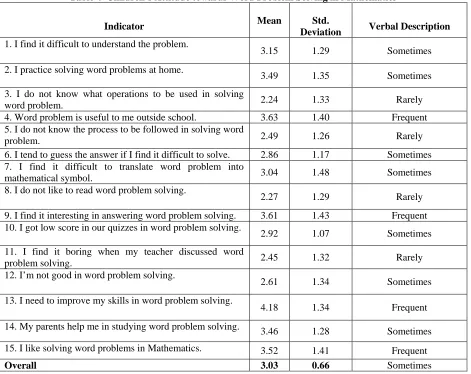
Table 4 Children’s Attitude towards Word Problem Solving in Mathematics
Indicator Mean Std.
Deviation Verbal Description
1. I find it difficult to understand the problem.
3.15 1.29 Sometimes
2. I practice solving word problems at home.
3.49 1.35 Sometimes
3. I do not know what operations to be used in solving
word problem. 2.24 1.33 Rarely
4. Word problem is useful to me outside school. 3.63 1.40 Frequent 5. I do not know the process to be followed in solving word
problem. 2.49 1.26 Rarely
6. I tend to guess the answer if I find it difficult to solve. 2.86 1.17 Sometimes 7. I find it difficult to translate word problem into
mathematical symbol. 3.04 1.48 Sometimes
8. I do not like to read word problem solving.
2.27 1.29 Rarely
9. I find it interesting in answering word problem solving. 3.61 1.43 Frequent 10. I got low score in our quizzes in word problem solving.
2.92 1.07 Sometimes
11. I find it boring when my teacher discussed word
problem solving. 2.45 1.32 Rarely
12. I’m not good in word problem solving.
2.61 1.34 Sometimes
13. I need to improve my skills in word problem solving.
4.18 1.34 Frequent
14. My parents help me in studying word problem solving. 3.46 1.28 Sometimes
15. I like solving word problems in Mathematics. 3.52 1.41 Frequent
Overall 3.03 0.66 Sometimes
Table 4 shows the children’s attitude towards word problem solving in Mathematics. This implies that the pupils rarely do not know what operations to be used in solving word problem, do not know the process to be followed, do not like to read word problem solving, and find it boring when the teacher discussed. However, the pupils sometimes find it difficult to understand the problem and to translate word problem into mathematical symbol. They tend to guess the answer if they find it difficult to solve which results them to get low score in quizzes. Sometimes, they believe that they are not good in word problem solving and practice solving at home with the help of their parents. The data also implies that they frequently find interest in answering and solving word problems and believe that they need to improve their skills in word problem solving because it is useful for them even outside the school.
Overall, this means that the children do not like solving word problems because they find it difficult and they believe that they need to improve their skills in word problem solving. This result was anchored on Cognitivist Theory of Jean Piaget which reveals the factors that affects learning and teaching Mathematics. Students who are not skilled at formulating a mathematical equation will not be able to solve the word problem that will lead the pupils to the unfavorable attitudes towards Mathematics.
ISSN 2250-3153
mathematical problem. This implies that pupils continually find problem solving in Mathematics difficult for they have no appropriate attitude to deal with the subject.
[image:5.612.86.541.139.414.2]Problem 2: What are the difficulties encountered in mathematical problem solving in Butuan Central Elementary School in terms of Teaching Skills.
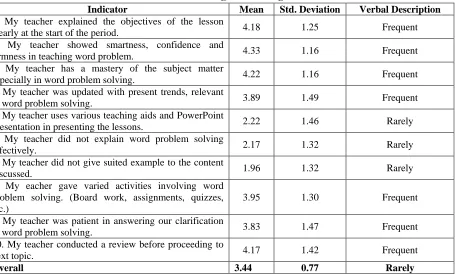
Table 5 Level of Teaching Skills among Teachers
Indicator Mean Std. Deviation Verbal Description
1. My teacher explained the objectives of the lesson
clearly at the start of the period. 4.18 1.25 Frequent
2. My teacher showed smartness, confidence and
firmness in teaching word problem. 4.33 1.16 Frequent
3. My teacher has a mastery of the subject matter
especially in word problem solving. 4.22 1.16 Frequent
4. My teacher was updated with present trends, relevant
to word problem solving. 3.89 1.49 Frequent
5. My teacher uses various teaching aids and PowerPoint
presentation in presenting the lessons. 2.22 1.46 Rarely
6. My teacher did not explain word problem solving
effectively. 2.17 1.32 Rarely
7. My teacher did not give suited example to the content
discussed. 1.96 1.32 Rarely
8. My eacher gave varied activities involving word problem solving. (Board work, assignments, quizzes, etc.)
3.95 1.30 Frequent
9. My teacher was patient in answering our clarification
in word problem solving. 3.83 1.47 Frequent
10. My teacher conducted a review before proceeding to
next topic. 4.17 1.42 Frequent
Overall 3.44 0.77 Rarely
Table 5 shows the level of teaching skills among teachers. This means that according to the pupils, the teacher rarely uses various teaching aids and PowerPoint presentation in presenting the lessons, does not explain word problem solving effectively, and does not give suited examples to the content being discussed. It also shows the teacher frequently explains the objectives of the lesson clearly at the start of the period, shows smartness, confidence, and firmness in teaching word problem, patient in answering clarifications, has a mastery of the subject matter, and is updated with present trends relevant to word problem solving. The teacher also frequently gives varied activities involving word problem solving, and conducts a review before proceeding to the next topic.
Overall, this result was anchored on the theory of Cognitive Psychology Approach which stressed that pupils need to apply cognitive strategies of goal and sequences of mental operation in order to learn and solved worded problems. Teachers should adjust their instructional practices according to the different pre-skills that the students have because these pre-skills play a big part in solving mathematical problems. When students gain more conceptual and procedural skills in Mathematics, they become more competent and efficient in learning Mathematics.
It was supported in our related study that while evaluating problem solving skills, the steps followed by the student to reach a solution, as well as the critical behaviors expected to be exhibited while following these steps should be considered altogether, as there is no certain way of solving a problem and students may develop their own problem solving strategies (Baykul, 2009).
ISSN 2250-3153
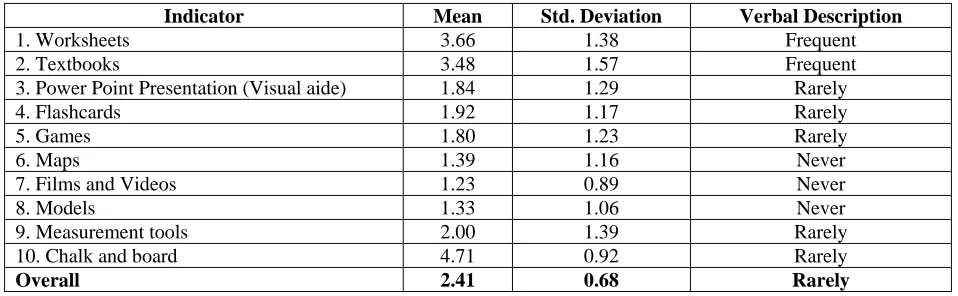
Table 6 Instructional Materials Used in Word Problem Solving
Indicator Mean Std. Deviation Verbal Description
1. Worksheets 3.66 1.38 Frequent
2. Textbooks 3.48 1.57 Frequent
3. Power Point Presentation (Visual aide) 1.84 1.29 Rarely
4. Flashcards 1.92 1.17 Rarely
5. Games 1.80 1.23 Rarely
6. Maps 1.39 1.16 Never
7. Films and Videos 1.23 0.89 Never
8. Models 1.33 1.06 Never
9. Measurement tools 2.00 1.39 Rarely
10. Chalk and board 4.71 0.92 Rarely
Overall 2.41 0.68 Rarely
Table 6 shows the instructional materials used in word problem solving. It means that the teacher never used maps, films and videos, and models. The teacher rarely uses power point presentations, flashcards, games, measurement tools, chalk and board. However, the table shows that the most used instructional materials are textbooks and worksheets.
Overall, this implies that the teacher does not use various instructional materials in teaching word problem solving and use the traditional teaching method.
Problem 4: What are the the difficulties encountered in mathematical problem solving in Butuan Central Elementary School in terms of Level of Difficulties?
Table 7 Pupils Ability in Mathematical Word Problem Solving
No Answer Correct Answer Wrong Answer
Frequency Percent Frequency Percent Frequency Percent
a. What is asked in the problem? 1 1 74 74 25 25
b. What are given? 2 2 64 64 34 34
c. What operation to be used? 2 2 65 65 33 33
d. What is the answer to the problem? 2 2 65 65 33 33
[image:6.612.68.545.646.726.2]Table 7 shows the level of difficulties in answering word problem solving. It means that most of the pupils can identify the answer in the question what is asked and what are the given in the problem. Some of the pupils have difficulties in answering what is the operation to be used and what is the answer to the problem.
Table 8 Pupils Ability in Mathematical Word Problem Solving
No Answer Correct Answer Wrong Answer
Frequency Percent Frequency Percent Frequency Percent
a. What is asked in the problem? 3 3 72 72 25 25
b. What is the number sentence in the
ISSN 2250-3153
c.What operations to be used? 3 3 45 45 52 52
d. What is the answer to the problem? 6 6 37 37 57 57
Table 8 shows the level of difficulties in answering word problem solving. It implies that in this word problem solving, many pupils get the correct answer in what is asked in the problem and they have difficulties in answering the questions what is the number sentence, what operations to be used, and what is the answer to the problem.
Tables 9 Pupils Ability in Mathematical Word Problem Solving
No Answer Correct Answer Wrong Answer
Frequency Percent Frequency Percent Frequency Percent
a. What is asked in the problem? 5 5 73 73 22 22
b. What is the number sentence in the problem?
5 5 27 21.25 68 68
c. What operations to be used? 8 8 52 52 40 40
d. What is the answer to the problem? 8 8 31 31 61 61
Table 9 shows the level of difficulties in answering word problem solving. It implies that in this word problem solving, many pupils get the wrong answer in what is the number sentence and what is the answer to the problem.
[image:7.612.70.543.445.556.2]Overall, the level of difficulties in word problem solving shows that most of the pupils can answer if it is already given in the problem, like what is asked and what is given. But most of them got the wrong answer when they have to translate word problem into mathematical symbol, like what is the number sentence in the problem, which results them to find it difficult to know what operations to be used and what is the answer to the problem.
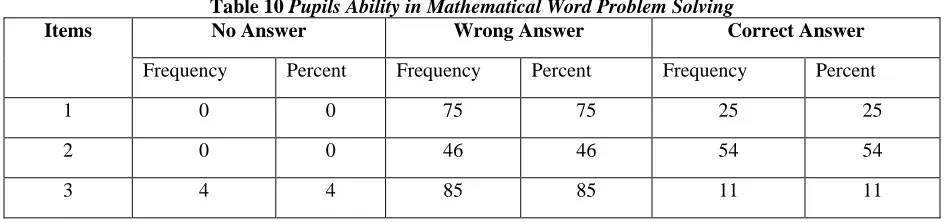
Table 10 Pupils Ability in Mathematical Word Problem Solving
Items No Answer Wrong Answer Correct Answer
Frequency Percent Frequency Percent Frequency Percent
1 0 0 75 75 25 25
2 0 0 46 46 54 54
3 4 4 85 85 11 11
Table 10 shows the level of difficulties in reading comprehension in answering word problem solving. It implies that the pupils have difficulties in comprehending and solving word problem involving distance and multiplication operation, solving word problem involving two operations, and solving word problem involving ratio.
5.0
Conclusion
Based on the findings of the study, the following conclusions were drawn:
ISSN 2250-3153
teacher discussed about word problem solving, thus they had low interest, and they only practiced solving at home sometimes. This resulted them to guess the answer and got low scores in their quizzes and exams. They also believed that sometimes they were not good at solving mathematical word problems. The parents helped their children sometimes in studying word problem solving. They frequently liked solving word problem solving, believed that word problem solving is useful in their everyday life and that they needed to improve their skills in word problem solving.
On the level of teaching skills among teachers, it had been found out that the teacher frequently executed teaching skills in teaching word problem solving. While on the instructional materials used by the teacher, it had been found out that the most instructional materials used by the teacher were the textbooks, worksheets, and chalk and board. It implies that the problem is not with the teaching skills and the instructional materials used, but with the attitude of the pupils towards mathematical word problem solving.
References
Aclon, Ramirez, & Ramos, (2013). Problem solving skills among grade 5 pupils at Ong Yui Central Elementary School. An undergraduate thesis. College of Science Education, Caraga State University.
Bal, A. P. (2015). Examination of the mathematical problem-solving beliefs and success levels of primary school teacher candidates through the variables of mathematical success and gender. KuramVeUygulamadaEgitim Bilimleri,15(5), 1373-1390. doi:http://dx.doi.org/10.12738/estp.2015.5.2573
Baykul, Y. (2009).İlköğretimde matematik öğretimi. Ankara: Pegem.
Boonen A. J. H., Van der Schoot M., Van Wesel F., De Vries M. H., Jolles J. (2013). What underlies successful word problem solving? A path analysis in sixth grade students. Contemp. Educ. Psychol. 38271–279. 10.1016/j.cedpsych.2013.05.001 [Cross Ref]
Bruning, Schraw, & Norby, (2011). Cognitive Psychology and instruction (5th ed.). Boston: Pearson Education
Depaepe, F., De Corte, E., and Verschaffel, L. (2010). Teachers’ metacognitive and heuristic approaches to word problem solving: analysis and impact on students’ beliefs and performance. ZDM Math. Educ. 42, 205–218. doi: 10.1007/s11858- 009-0221-5
Desoete, A., &Roeyers, H. (2005). Cognitive skills in mathematical problem solving in grade 3. British Journal of
Educational Psychology, 75, 119-138. Retrieved from
http://search.proquest.com/docview/216959733?accountid=141440
Dowker, A. (2005). Individual Differencess in Arithmetic: Implications for Psychology,
Ganal, N. N., &Guiab, M. R. (2014). Problems and difficulties encountered by students towards mastering learning competencies in Mathematics. Researchers World, 5(4), 25-37. Retrieved from
http://search.proquest.com/docview/1624953075?accountid=141440
Grauberg, E. (1998). Elementary Mathematics and language difficulties. London: Whurr.
Griffin, C. C., &Jitendra, A. K. (2009).Word problem-solving instruction in inclusive third-grade mathematics
classrooms. The Journal of Educational Research,102(3), 187-201.Retrieved from http://search.proquest.com/docview/204264753?accountid=141440
ISSN 2250-3153
Hickendorff, M. (2011). Explanatory Latent Variable Modeling of Mathematical Ability in Primary School: Crossing the Border Between Psychometrics and Psychology. Doctoral dissertation, Leiden University, Leiden
Hugar, Danielle. (2011). The Role of Problem Solving in the Mathematics Classroom. A Research Paper Methods. Extracted from http://www.lhup.edu/swillia6/MATH%20200/Documen ts
_and_Files/Research_Papers_2011/Danielle
Jitendra A. H., Star J. R. (2012). An exploratory study contrasting high– and low achieving students’ percent word problem solving. Learn. Individ. Differ. 22 151– 158. 10.1016/j.lindif.2011.11.003 [Cross Ref]
Jitendra, A. K., Griffin, C. C., Deatline-Buchman, A., & Sczesniak, E. (2007). Mathematical Word Problem Solving in Third-Grade Classrooms. The Journal of Educational Research, 100(5), 283-302, DOI: 10.3200/JOER.100.5.283-302
Lee K., Ng E. L., Ng S. F. (2009). The contributions of working memory and executive functioning to problem representation and solution generation in algebraic word problems. J. Educ. Psychol. 101 373–387. 10.1037/a0013843 [Cross Ref]
Mancl, D. B. (2011). Investigating the effects of a combined problem-solving strategy for students with learning difficulties in mathematics (Order No. 3460006).Available from ProQuest Central. (876194235). Retrieved from http://search.proquest.com/docview/876194235?accountid=141440
Mateo,A. (2011). Teachers’ Strategies and Social Support: Their Influence onAchievement, Attitudes and Social Behavior of Students. Master’s Thesis. Cavite: Adventist University
Mathematical symbol.(n.d.) WordNet 3.0, Farlex clipart collection. (2003-2008). Retrieved December 20 2016
Moreno, R., Ozogul, G., and Reisslein, M. (2011). Teaching with concrete and abstract visual representations: effects on students’ problem solving, problem representations, and learning perceptions. J. Educ. Psychol. 103, 32–47. doi: 10.1037/a0021995 Neuroscience and Education. NewYork: Psychology Press.
Nieuwoudt, S. (2015). Developing a model for problem-solving in a grade 4 mathematics classroom. Pythagoras, 36(2), 1-7. doi:http://dx.doi.org/10.4102/pythagoras.]Oxford University Press 2017
Özsoy, G., Kuruyer, H. G., &Çakiroglu, A. (2015).Evaluation of students' mathematical problem solving skills in relation to their reading levels.International Electronic Journal of Elementary Education, 8(1), 113-131.
Retrieved from http://search.proquest.com/docview/1726720622?accountid=141440
Prathana Phonapichat et al.,Procedia - Social and Behavioral Sciences, 2014
Reikerås, E. (2006) (forthcoming) A comparison of performance in solving arithmetical word problems bychildren with different levels of achievement in mathematics and reading.
Soylu, Y., & Soylu, C. (2006). Matematik derslerinde başarıya giden yolda problem çözmenin rolü.Dicle
Üniversitesi Ziya Gökalp Eğitim Fakültesi Dergisi, 7(11), 97- 111.
ISSN 2250-3153
Thevenot C. (2010). Arithmetic word problem solving: evidence for the construction of a mental model. Acta Psychol. 133 90–95. 10.1016/j.actpsy.2009.10.004 [PubMed] [Cross Ref]
Timmermans R. E., Van Lieshout E. D. C. M., Verhoeven L. (2007). Gender related effects of contemporary math instruction for low performers on problem-solving behavior. Learn. Instr. 17 42–54. 10.1016/j.learninstruc.2006.11.005 [Cross Ref]
Van de Walle, Karp, S. K., & Bay-Williams, (2014). İlkokul ve ortaokul matematiği: Gelişimselyaklaşımla öğretim.
(Soner Durmuş, Trans. Ed.). Ankara: Nobel.
Van der Schoot M., Bakker Arkema A. H., Horsley T. M., Van Lieshout E. D. C. M. (2009). The consistency effect depends on markedness in less successful but not successful problem solvers: an eye movement study in primary school children. Contemp. Educ. Psychol. 34 58–66. 10.1016/j.cedpsych.2008.07.002 [Cross Ref]
Wongwanich, S., Piromsombat, C., & Khaikleng, P. (2012). Policy-driving strategies for Thailand education reform: A mixed-methods synthesis. Paper presented at the conference of the Comparative Education Society of Asia, Bangkok, Thailand.