ISSN 2250-3153
THE INFLUENCE MODEL OF
DISCOVERY LEARNING BY MAKING USE
OF THE ENVIRONMENT AS A SOURCE OF
LEARNING TOWARDS A LEARNING
OUTCOMES ON THE FOURTH GRADE OF
ELEMENTARY SCHOOL
Sri Undiyani1, Suhanadji2, Raden Roro Nanik Setyowati2
1Postgraduate Student in Elementary Program, State University of Surabaya, Indonesia 2Lecturers of Elementary Program, State University of Surabaya, Indonesia 3Lecturers of Elementary Program, State University of Surabaya, Indonesia
1Email: [email protected]
DOI: 10.29322/IJSRP.9.06.2019.p9099 http://dx.doi.org/10.29322/IJSRP.9.06.2019.p9099
Abstract: This research aims to improve student learning outcomes through the use of a model of Discovery Learning. Location of research in SDN Pajaran O5 Madiun. The study was a Quasi-Experimental. The population is all fourth-grade students at SDN Pajaran O5 Madiun. The data collection technique using achievement test. The results showed that learners with different initial capabilities have learning outcomes that learned with discovery learning model of learning that are in both categories with a value of 84.62. Implementation of discovery learning
model learning significantly influences the learning outcomes of students with grades (sig 0,000 ˃ α = 0.05). It can
be concluded that there is a significant effect of using discovery learning model of learning to the learning outcomes of fourth-grade students between before treatment and after treatment.
Keywords: Model, Discovery Learning, Learning outcomes
INTRODUCTION
Education is a conscious and deliberate effort to create an atmosphere of learning and the learning process so that learners are actively developing the potential for him to have the spiritual power of religion, self-control, personality, intelligence, and noble character, and skills necessary for him to have the power of spiritual religious, self-control, personality, intelligence, and noble character, and skills needed him, society, nation, and state (Sanjaya, 2007). Education holds a very important role in preparing for the development of quality human State. Humans will grow and develop as a whole person with their education.
Learning is a process that occurs in a person as a result of efforts done so as to obtain changes in knowledge, skills, new experiences as a result of interaction with the environment. The learning result is a change in behavior on students that can be observed and measured in terms of changes in knowledge, attitudes, and skills. Is a culmination of learning outcomes and learning process (Dimyati, 2013). In learning in school a teacher must create a fun atmosphere for their students, how to choose creative innovation and effective learning. One innovation is
effective learning using the learning model, then the model is appropriate learningDiscovery Learning as a learning
resource that can provide more meaningful learning experiences to learners.
Meaningful learning in question is learning not just memorize theories alone but it is expected that learners can understand what she learned and can motivate learners to follow the learning process so the impact on learning outcomes. In addition to the motivation of learning outcomes are also influenced by the ability of early learners because the initial capability has an important role as a consideration in choosing a learning model that will be applied.
ISSN 2250-3153
In general, the environment is defined as the unity of the object space, power, state, and living creatures, including human beings and behavior that affect the survival and welfare of human beings and other living creatures (Musfiqon, 2012).
Utilization of the school environment as a learning resource has several advantages, namely: 1) overcome the boredom in learning. Learning to use the environment as a learning resource will relieve or eliminate boredom learners in the study, because they are directly confronted with the object being studied, 2) provide a fun learning environment for students. In a variant that is used for learning between inside and outside the classroom will provide more atmosphere and fun for students, 3) learners to learn by themselves. Learning outside the classroom can provide opportunities for students to learn more independently, so that learners are not dependent on the teacher, 4) the opportunity to apply the theory. Not only do room narrow class if the facilities and inadequate learning resources in addition to noting the various theories of disciplines. By utilizing the environment, learners can test the theory obtained by direct practice in a real environment, 5) expand the thinking of learners. Using the environment as a learning resource will broaden think the students about the natural, social, environmental and indeed, 6) improving learning achievement of learners will be improved optimally when utilizing learning resources support, including the natural environment, social, and cultural (Sudjana 2014). Good learning outcomes is a process of encouragement, direction, and persistence of behavior. That is, the motivated behavior is behavior that is full of energy, purposeful and long-lasting (Santrock, 2015). This is in line with that proposed by Ormrod (2009) is the result of learning affects cognitive processes. Furthermore, he said that when we were exploring a wide range of cognitive elements in motivation, we will often see that cognition and motivation interact in affecting learning and behavior. Teaching and learning process aimed at developing the potential of learners optimally, allowing learners to achieve the expected goals. Good teacher knowledge about the subject matter, the learners and the learning process as a whole, is to determine the learning outcomes of students (Daryanto, 2013). Furthermore, he said that when we were exploring a wide range of cognitive elements in motivation, we will often see that cognition and motivation interact in affecting learning and behavior. Teaching and learning process aimed at developing the potential of learners optimally, allowing learners to achieve the expected goals. Good teacher knowledge about the subject matter, the learners and the learning process as a whole, is to determine the learning outcomes of students (Daryanto, 2013). Furthermore, he said that when we were exploring a wide range of cognitive elements in motivation, we will often see that cognition and motivation interact in affecting learning and behavior. Teaching and learning process aimed at developing the potential of learners optimally, allowing learners to achieve the expected goals. Good teacher knowledge about the subject matter, the learners and the learning process as a whole, is to determine the learning outcomes of students (Daryanto, 2013). Teaching and learning process aimed at developing the potential of learners optimally, allowing learners to achieve the expected goals. Good teacher knowledge about the subject matter, the learners and the learning process as a whole, is to determine the learning outcomes of students (Daryanto, 2013). Teaching and learning process aimed at developing the potential of learners optimally, allowing learners to achieve the expected goals. Good teacher knowledge about the subject matter, the learners and the learning process as a whole, is to determine the learning outcomes of students (Daryanto, 2013).
Based on early observations, there are still many teachers at SDN Pajaran 05 Madiun who has yet to apply the model of learning in teaching their students, so that the learning process is still running with the monotony and the interest of the students is still very passive, and not draw attention of students in learning in class, then the student learning outcomes by decreasing the value of the previous semester report still below standard. With respect to the above issue, one of the efforts to improve student learning outcomes is by applying a model of learning discovery learning. Teachers can develop a model to teach as an effort to instill good character to the students.
Learning by using learning model discovery learning can be used as an alternative to learning in primary schools in an effort to improve student learning outcomes. However, in applying this learning need to pay close attention to the steps of learning so that the implementation of learning can be done well. Learning implementations would do well if supported by a learning model and teacher in teaching. Therefore, prepare well and matured so that students can be actively involved in learning. In addition, teachers also need to keep the class in order to keep a good condition, so that all students can follow the learning well.
The learning model discovery learning can facilitate students to communicate, workgroups and can put forward his opinion. Reviewed from psychological aspects, the model of learning this discovery learning psychology cognitive assume that learning is a process of change in behavior due to knowledge gained through experience. Learning is not just memorizing some facts, but it is a conscious effort that individual done with its environment by constructing their own knowledge. This discovery learning model is particularly suited to be implemented because the learning process starts from the immediate environment with students that is used as the entrance to study social science.
Based on the explanation above researchers are interested in hosting research titled "Influence Model Of Discovery Learning By Making Use Of The Environment As A Source Of Learning Towards A Learning Outcomes On The Fourth Grade Of Elementary School”.
METHOD
ISSN 2250-3153
learn and learning outcomes biology learners in the learning process by using model Discovery Learning to use the environment as an experimental class and control class using model Discovery Learning without using the environment. The population in this study were all class groups fourth-grade SDN Pajaran 05 Madiun second semester of academic year 2017/2018. The sampling technique used is purposive sampling with each grade 29 learners. The data in this study were collected through an achievement test.
RESULTS AND DISCUSSION Research result
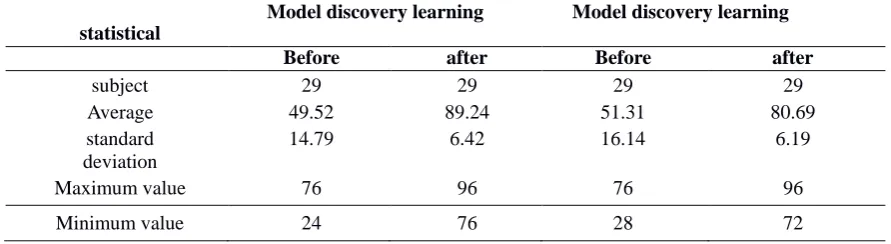
[image:3.595.83.529.212.334.2]Exposure data from learners before and after application of the discovery learning model of learning by utilizing as a source of learning and discovery learning without using the environment as a learning resource, then the results can be seen below:
Table 1. Descriptive Analysis Values Learning Outcomes Learners before and after
statistical
Model discovery learning Model discovery learning
Before after Before after
subject 29 29 29 29
Average 49.52 89.24 51.31 80.69
standard deviation
14.79 6.42 16.14 6.19
Maximum value 76 96 76 96
Minimum value 24 76 28 72
Table 2. Frequency Distribution and categories of Learning Outcomes Learners in the learning model Discovery Learning
interval Category Frequency percentage (%)
Before after before After
85-100 Very high 0 23 0 79
65-84 High 4 6 14 21
55-64 enough 7 0 24 0
35-54 Low 15 0 52 0
Table 3. Frequency Distribution and categories of learning outcomes of students in the learning model Discovery Learning
interval Category BeforeFrequencyafter Beforepercentage (%)after
85-100 Very high 0 7 0 24
65-84 High 9 22 31 76
55-64 moderate 3 0 10 0
35-54 Low 12 0 41 0
0-34 Very low 5 0 17 0
Table 4. Distribution of Frequency, and Category N Percentage Gain Score Value of Learning Outcomes of Students Before and After the Implementation of Learning Model Discovery Learning
interval Scores
Model Discovery Learning Model Discovery Learning
Category
Frequency Percentage
(%) Frequency
Percentage (%)
0 ≤ g <0.3 0 0 1 3 Low
≤ 0.3 g <0.7 4 14 20 69 Moderate
≤ 0.7 g <1.0 25 86 8 28 High
Average 0,80 0,6
Discussion
ISSN 2250-3153
learning to use the environment as a source of learners active in the study, search for information or find your own concepts so that students more easily understand the material social science. According to the research conducted by the researchers, the study results in showed the significant effect on the fourth-grade SDN 05 Pajaran discovery learning model of learning by using the environment as a learning resource.
The results of both these treatments indicate that the discovery learning model of learning by using the environment as a source of learning can improve student learning outcomes. Among other reasons: 1) to overcome boredom in learning. Learning to use the environment as a learning resource will relieve or eliminate boredom learners in the study because they are directly confronted with the object being studied; 2) provide a fun learning environment for students. In a variant that is used for learning between inside and outside the classroom will provide more atmosphere and fun for students, expand the thinking of learners. Using the environment as a learning resource will broaden learners think about the natural, social,
Other findings that support this research undertaken by Mudasih in 2018 entitled comparison of student learning outcomes through media learning video with PowerPoint, while research conducted by Qomariyah in
2018 entitled effect of problem-based learning models to improve student learning outcomes, Both studies
shows that as described above, an effective learning model suitable to improve student learning outcomes Elementary School.
Then observations of researchers for conducting research, it appears that the spirit and understanding of the students taught by Discovery Learning learning model are better when compared to students taught using conventional learning models. The difference can be seen from the results of student learning and student activity during the learning process takes place ((Kadri, M, & Rahmawati, 2015).
CONCLUSION
The learning model used discovery learning. Based on the results of this study concluded that students with different initial capabilities have learning outcomes that learned with discovery learning model of learning that are in both categories with a value of 84.62. Implementation of discovery learning model learning significantly
influences the learning outcomes of students with grades (sig 0,000 ˃ α = 0.05). It can be concluded that there is a
significant effect of using discovery learning model of learning to the learning outcomes of fourth-grade students between before treatment and after treatment.
We recommend that teachers implement instructional model Discovery Learning attention to the efficiency of time for each phase in the model of discovery learning in particular, the division of the group to experiment on the data collection phase.
REFERENCES
Andari, T. (2012). Efektifitas Pembelajaran Matematika Menggunakan Pendekatan Kontekstual terhadap Prestasi
Belajar Matematika Ditinjau dari Kemampuan Awal Siswa Kelas V SD sekecamatan Bangunrejo
Kabupaten Lampung Tengah. JIPM (Jurnal Ilmiah Pendidikan Matematika), 1(1), 75-79.
Daryanto. (2013). Belajar dan Mengajar. Bandung: CV. Yrama Widya.
Dimyati, dan M. (2013). Belajar dan Pembelajaran (Pertama). Jakarta: Rineka Cipta.
Erasmus, P. (2010). Relationship Between Motivation And Interns, Study Orientation In Maths NDA Maths
Achievement Of Middle Adolescent Boys And Girls.Use Journal Of Education: Northwest University.
Hendarwati, E. (2013). Pengaruh Pemanfaatan Lingkungan Sebagai Sumber Belajar Melalui Inkuiri Terhadap
Hasil Belajar Pada Pelajaran IPS. Pedagogia. Jurnal Ilmu Pendidikan, (Online), 2(1), 47-50.
Hosnan. (2014). Pendekatan Saintifik dan Kontekstual dalam Pembelajaran Abad 21. (Cet 1). Bogor: Ghalia
Indonesia.
Kadri, M, & Rahmawati, M. (2015). Pengaruh Model Pembelajaran Discovery Learning Terhadap Hasil Belajar
Siswa pada Materi Pokok Suhu dan Kalor. Jurnal Ikatan Alumni Fisika Universitas Negeri Medan. 2(1),
35-42.
Kyriasis, A., Psycharis, S. & Korres, K. (2009). Discovery Learning and the Computational Experiment in Higher
Mathematics and Science Education: A Combined Approach. International Journal of Emerging
Technologies in Learning, 4(4), 25-34.
ISSN 2250-3153
Sebagai Sumber Belajar dalam Meningkatkan Hasil Belajar IPA Siswa Kelas III SDN 10 Gadung. Jurnal
Kreatif Tadulako Online, 5(3), 235-240.
Mudasih, I., Subroto, W. (2018). Comparison Of Student Learning Outcomes Through Video Learning Media
With Powerpoint. International Journal of Educational Research Review, 4(2), 63-69.
Musfiqon, HM. (2012). Pengembangan Media dan Sumber Pembelajaran. Jakarta: Prestasi Pustakarya.
Ormrod, J. E. (2009). Psikologi Pendidikan: Membantu Siswa dan Berkembang Jilid 2. Jakarta: Erlangga.
Putrayasa, M., Syahruddin. H. & Margunayasa, I. G.. (2014). Pengaruh Model Pembelajaran Discovery Learning
dan Minat Belajar Terhadap Hasil Belajar Ipa Peserta didik. Jurnal MIMBAR PGSD Universitas
Pendidikan Ganesha Jurusan PGSD, 2(1), 607-615.
Safitri, D., Maryam, M. & Mustami, M. K. (2016). Pengaruh Strategi Pembelajaran ARIAS Setting Model
Pembelajaran Kooperatif Tipe NHT terhadap Motivasi dan Hasil Belajar Biologi. Makassar. Jurnal
BIOTEK, 4(2), 181–191.
Salmiah. (2015). Perbandingan Motivasi Hasil Belajar Kognitif Biologi Siswa yang Dibelajarkan Menggunakan
Model Problem Based learning (PBL) Dan Model Discovery Learning (DL) Pada Kelas X MIA SMA
Negeri 3 Takalar. Tesis. Tidak Diterbitkan. Program Pascasarjana UNM.
Sanjaya, W. (2007). Strategi Pembelajaran Berorientasi Standar Proses Pendidikan. Jakarta: Kencana.
Santrock, J. W. (2015). Psikologi Pendidikan Edisi Kedua. Jakarta: Kencana Prenada Media Group.
Sudjana, N. (2009). Penilaian Hasil Proses Belajar Mengajar. Bandung: PT. Remaja Rosdakarya.
Qomariyah, S, N. (2018). Effect Of Problem Based Learning Learning Model To Improve Student Learning