http://dx.doi.org/10.4236/ns.2014.611087
On the Physics inside a Closed, Static,
Rotating Einsteinian Hypersphere in
Due Consideration of the Galaxy
Ernst Karl Kunst
Im Spicher Garten 5, Königswinter, Germany Email: [email protected]
Received 16 May 2014; revised 20 June 2014; accepted 2 July 2014 Copyright © 2014 by author and Scientific Research Publishing Inc.
This work is licensed under the Creative Commons Attribution International License (CC BY). http://creativecommons.org/licenses/by/4.0/
Abstract
Einstein’s weak equivalence principle suggests that gravity and acceleration (centrifugal force) are indistinguishable from each other and, therefore, equivalent. We maintain that they are not only equivalent, but even identical, or to rephrase the main statement of this work: A gravitational force does not exist. Rather, gravity is a fictitious force, or, more pointedly: Gravity is the centrifu-gal force which acts upon material bodies within the rotating S3-hypersphere of the Universe. These in turn warp the adjacent space-fabric, shaping it to the well-known field geometry of gen-eral relativity.
Keywords
Cosmology, Hypersphere, Cosmological Redshift, Redshift by Deflection, Redshift “Anomalies” of the Supernova Data, “Dark Energy”, CMB ≡ Enthropic Planck Radiation, Gravity ≡ Diverted
Centrifugal Force; Time, Mass and “Dark Matter”, Foucault’s Law Raises Kicks of Gyros, The Galaxy’s Former Position and Present Drift
1. Introduction
summary the picture that emerges from imposition of the Einstein equations on this metric is of the Universe expanding away from an initial singularity of infinite density (big bang). However, between the predictions of the expansion hypothesis and the observations made by astronomers especially in the last decades are fatal con-tradictions. These only partially could be evaded through the recourse to new hypothetical things, as e.g. the so called dark energy, an enigmatic negative pressure in the expanding Universe which presumingly dominates and accelerates the latter at late times. This hypothetical energy component has been invented solely to adjust theory to observational results, i.e. direct luminosity measurements of very distant type Ia supernovae in comparison to distance calculations of the latter from their redshift on the grounds of big bang theory (e.g. Riess et al., 2001 [3]). Other recent observations strongly hind at further incostencies in current big bang paradigm, e.g.:
1) Red galaxies are clustered more strongly than blue galaxies, with both the brightest and faintest red galax-ies showing the strongest clustering. Furthermore, red and blue galaxgalax-ies tend to occupy different regions of space (Swanson, 2008 [4]). 2) The evidence is overwhelming that the vicinity of the Galaxy is the domain of relative small star-forming galaxies, while farther away (in earlier epochs according to big bang theory) giant galaxies exist(ed) and preveil(ed). This phenomenon, which is dubbed down-sizing, is obviously at odds with the basic premise of hierarchical structure formation paradigm of big bang theory (see e.g. Renzini and Daddi, 2008 [5]). 3) High-z UV surface brightness data for galaxies from the Hubble Ultra Deep Field (HUDF) and low-z data from the Galaxy Evolution Explorer (GALEX) have been used to test predictions of a Friedmann- Robertson-Walker expanding Universe and a non-expanding Universe up to z = 6. The data from HUDF as well as from GALEX are clearly compatible with a non-expanding Universe and incompatible with the expansion hypothesis (Lerner, 2005 [6]). 4) Full-sky temperature maps of the CMB at very low temperature from the “Wilkinson Microwave Anisotropy Probe” (WMPA) exhibit some statistically significant anomalies compared to standard inflationary cosmology (e.g. Craig, 2005 [7]).
It is well known that from a purely mathematical point of view it is indemonstrable whether the spatial section M of the spacetime manifold M4 = R × M of the Universe we happen to live in is Euclidian (E3), spherical (S3) or
hyperbolic (H3). Or, to rephrase this within in the framework of standard cosmology, whether the Gaussian cur-vature of M is k = 0, 1, or, −1, respectively. Here we demand k = 1 and maintain and will show in the following that:
1) The Universe is a closed, static, self-containing three-sphere S3 rotating steadily in four-dimensional space spatially with Euclidian E4 metric geometrically (locally) and neither expanding nor retracting;
2) The Hubble (Cosmological) redshift is due to the four-dimensional orthogonal displacement spatially of the emitter from the receiver’s tangential Minkowski space in the three-sphere S3, being equivalent to the bending of the light’s trajectory in the curved space of the latter and not to its expansion;
3) The deviations of distance calculations on the grounds of supernova data from the standard expansion model, which currently are ascribed to the mentioned putative dark energy, correctly reflect the light’s redshift due to curvature of the hypersphere and, thus, are no deviations at all;
4) Gravity is a fictitious force caused by the S3-latitude dependent centrifugal force within the rotating hyper-sphere in association with the warping of the local space fabric around material bodies and not a special attract-ing force of nature;
5) The cosmic microwave background radiation (CMB) is the enthropic (Planckian) radiation in the closed, static three-sphere S3 and not relic radiation of the big bang;
6) The large-angle “anomalies” in the CMB are imprints of the Universe’s four-dimensional shape and of the floating Milky-Way Galaxy’s location in the latter in ever more distant past and no anomalies at all. The same applies to the recently detected very regular tiny temperature fluctuations of the CMB, which falsely have been interpreted as gravitational waves in the very beginning of the putative expanding Universe;
7) Rest mass and energy of the protron are equivalent to quantum of rest time, being the physical projection of minor four-dimensional warpings spatially of three-dimensional flat space locally of the three-sphere S3 into lo-cal four-dimensional space and are not associated with a special field of nature;
8) Mass of celestial bodies results from their four-dimensional height cubed spatially and is calculable from the latter;
9) The so-called Dark matter is the calculable gravitational mass of the S3-latitude dependent energy content of a cosmic body’s exterior and interior Schwarzschild field—Schwarzschild mass—and not a form of whatever matter;
gyro in a rotating system tend to come in coincidence with the respective parameters of the latter by the shortest way, a fast rotator will warp its local S3-space and divert the universal centrifugal force within the rotating S3- hypersphere with the physical consequence that its state of motion in and outside of gravitational fields can be calculably altered.
The proposed physical notion of the Universe explains all contradictions and constraints of current cosmo-logical theory, as will be shown below, especially delivers the redshift by bending of lightpath the correct data of the supernova observations (e.g. of SN 1997ff) and, thus, reveals the “deviations” from standard big bang theory being an illusionary effect. A hypothetical dark energy to explain the deviations of distance calculations on the grounds of supernova data from the standard model is not needed in the correct cosmological theory. Fur- thermore, among others delivers the novel cosmologigal notion a convincing explanation of the origin of mass and time, and, in connection with this, of “dark matter”.
However, the greatest preference of the emerging novel picture of the Universe’s true geometry and the asso-ciated physics doubtlessly is the possibility of testing it in accordance with the above No. 10) in the Earthly laboratory by relative unsophisticated experiments—aside from the mentioned observational support—, as will be shown in chapters 10 and 11 (see also Appendix 4 and Appendix 5).
The implications are also of major technological importance in the widest sense.
In a first step we explicitly take recourse to Einstein’s static cosmological model of 1917, but without the fa-mous constant Λ [8]. Thus, relying on and in accord with the latter, we assume the metric of the Universe to be one of a perfect static, but time-independent and spinning three-sphere S3 with a fixed volume 2π2Ρ3 (as a first step for convenience and reasons of simplicity; later on it will be shown that the observed “anomalies” in the CMB suggest an ellipsodial Universe as a more realistic approach), where Ρ (capital RHO) denotes constant ra-dius of the Universe, i.e. the metric induced on the set of fixed points at unit distance from the origin in a geo-metrically four-dimensional space with (locally) Euclidian E4 metric with the coordinate differences squared:
2 2 2 2 2
X +Y +Z +W =P
.
2. Heuristic Arguments in Favor of Reddening of Deflected Light
In order to underlay the latter assumption and the above thesis 2), respectively, obviously first and foremost convincingly has to be shown that redshift of light also necessarily follows from the light’s curved trajectory owing to the curvature of the S3-sphere embedded in flat four-dimensional Euclidian space besides the known relativistic causes: Translational motion, acceleration and gravity in four-dimensional spacetime. This for, in the following the heuristic-physical arguments in favour of redshift by bending of light-path will be discussed be-fore we turn to the relativistic derivation further below. In general relativity the ratio of the frequencies at the receiver S2 to the emitter S1 in a weak uniform gravitational field is of value
( ) ( )
44 2 1
2 44 1
1 ,
g
z g
ν
ν
= = + (1)where 2
44 2
g = − a c of the approximate Minkowskian metric gnm =
η
nm+ fnm, z denotes the red shift at point S2 and the acceleration of the observer in accord with Newtonian gravity. Therefore, the red shift of light due tothe gravitational field is not regarded as a unique characteristic and, therewith, not as a direct test of general relativity.
The geodesic equations in the Schwarzschild solution deliver for the deflection of light the well known value
2
4 ,
GM c R
φ
= (2)which is considered to be one of the classical tests of general relativity. If the radius of the Sun is taken as R, this gives, expressed in units of arc, the experimentally confirmed deflection ϕ = 1.75'. Note that a Newtonian deri-vation delivers halve this [9]. From the properties of the Schwarzschild solution
(
)
1
2 2 2 2 2 2 2 2 2
ds 1 GM dt 1 GM dr r d sin d ,
r r
θ
θ φ
−
= − − − − +
which otherwise lead to all known general relativistic effects in the slow motion approximation, the redshift due to bending of light cannot be derived right forwardly. But the following equivalence considerations show that analogously to redshift by gravity from bending of lightpath a redshift has to be expected, too, whereby in both cases (‒g44)1/2 being the very cause. The—not quite correct—physical notion underlying the gravitational effect,
that light loses energy in climbing out of a gravitational potential well, is quite the same in the case of light de-flection, although with the alteration that the light ray moves tangentially with respect to the potential well. The basic premise in the latter case is that (in the slow motion approximation) by deviation gnm =
η
nm+ fnm from the time-like geodesic of the Minkowski metric ηnm (the non deflected path) light loses energy as well (seebe-low).
On condition that d
τ
= −(
1 2M r)
1 2dt= −(
g44)
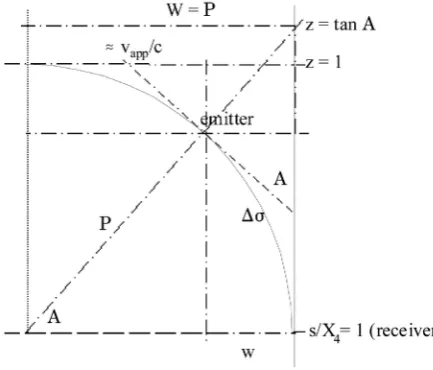
1 2dt and the coordinate time interval ∆ =t1 S S c1 2 (of the undeflected path; see Figure 1), on the grounds of general relativity one can write the following approximate Pythagorean expression for the deflection as well as for the associated reddening of light:( )
2 2 2 21 1 1 1
2 2
2 1
2 2 2 2
44 44 44 44
1 1
d d d d d d
1 1
,
S S S S
S S S S
g x x x x l l
g g
c t c t
α β α β
αβ ηαβ
ν φ
η η
∆ = − − − = − − −
∆
∫
∫
∆ ∫
∫
(4)where g44= − + Φ
(
1 2 c2)
(see Figure 1). From the preceding Schwarzschild formula we take2 2 2
2 2
2 2
ds 1 dt 1 dt
c c
Φ Φ
= + − −
and, thus, if Φ c21, Equation (4) becomes to
( )
2 22 2
1 1
2 2 2
1
2 2 1
1 2
1 1,
2 1
c
l l
c t c
c
ν φ φ
Φ
+
Φ
∆ = − = + −
∆ −
(5)
where from eventually is deduced:
( )
2 2
2 4
1 1 , .
2 c c
ν φ
ν φ
∆ Φ Φ
+ = + ∆ = = (6)
From Equations (4) to (6) it is obvious that the receiver S2 “observes” the emitter S1 lifted up to a less negative
gravitational potential, the difference being exactly proportinal to the deflection 4Φ/c2 and, therewith, to a cor-responding loss of energy and redshift of the same order of magnitude (see Figure 1).
However, it is clear that this is the classical approach to our result, whereas the real meaning of (6) must be that the redshift of the light is solely due to the curvature of its path, or, deflection Δν = 4Φ/c2 from pseudo- Euclidian (Minkowskian) geodesics (see below).
The previous considerations have been leading to the result that reddening of light by deflection and by grav-ity are both of origin (‒g44)1/2, i.e. they are equivalent. This implies redshift due to the gravitational field being a
special case of Equation (6), thus, taking the form
π π 2 2
2 2
GM c c R
ν
θ
Φ∆ = ∆ = = (6a)
if the total redshift is restricted to θ = 1/2π, the highest possible deflection which light, travelling from out a gravitational potential well, can experience—as observed from flat Minkowski metric ηnm “outside” the
gravita-tional field. This point of view necessarily follows because, as widely known, the simplest metric of the Schwar- zschild field requires t = const and θ = 1/2π and thus, if the coordinate r → ∞, Δθ becomes small in accord with Equation (6a).
Therefore, redshift according to Equation (6) as well as (6a) in neither case is caused by gravity alone, but also by the curvature of light path due to the metric of the gravitational field.
Figure 1. Redshift of light by deflection: the undeflected paths are shown dashed.
3. Relativistic Derivation of the Redshift of Deflected Light and of the
Equivalence of Kinematics, Metric, or, Acceleration as Its Cause;
Conservation of Photon Energy in the Closed Universe
3.1. Kinematical Deflection of Light and Associated Redshift
Suppose, the light emitted from a far distant inertially and reversely to the line of sight moving emitter with re-gard to the resting receiver be aberrationally deflected according to the special relativistic formula
cos
cos .
1 cos
v c v c
ϕ ϕ
ϕ − ′ =
−
We require φ = 1/2π such that the above equation becomes to 1
cos v and sin ,
c
ϕ′= − ϕ γ′= − (7)
where
2
2 1
. 1 v
c γ =
−
(7a)
Thus, it follows that
(
)
2 22 2
2 2
1 sin cos 1 1 vapp vapp 0,
c c
ϕ
′ϕ
′ − + = − − + =
(7b)
where vappdenotes apparent velocity.
Evidently fulfills relation (7b) the equation of the circle: 1−
(
x2+y2)
=0. This implies that light released from the emitter moving with any velocity reversely to the line of sight for the receiver seems to be emitted from a point of a circle defined by the above relations. i.e. all points cos2ϕ′+sin2ϕ′, with angleϕ
′ ranging from angular dimension 1/2π to zero, apparently must lay on a quarter circle 1/2πr such that the velocity of the emitter be cosϕ
′ and summing with higher velocities must satisfy the rule:tan tan
1,
1 tan tan 1
z z z z
ϕ ϕ
ϕ ϕ
ϕ ϕ
ϕ ϕ
′
′
+ ′
+ = =
′
− − (7c) where φ= 0 → 1/4π and
ϕ
′ =1 4π –ϕ
(see below). Here r = 1 is chosen such that the apparent distance from point cos2ϕ′ =0, sin2ϕ′ =1 to any other point be simply arccos 1 2π 90 arccos 1 2π 90app
v c
ϕ
′⋅ = ⋅ . The(-) sign of velocity vapp is neglectable because it denotes the above pointed out withdrawel of the emitter from
the receiver (see Figure 2).
Note that the receiver’s line of sight extends tangentially into the direction of the tangent vector to the appar-ently curved light path rΑ with the consequence that the former generally will observe all emitters deflected by some angle
ϕ
=1 2π−ϕ
′, or, with other words, projected into the tangential pseudo four-dimensional Euclidian (Minkowski) space2 2 2 2 2
1 2 3 4
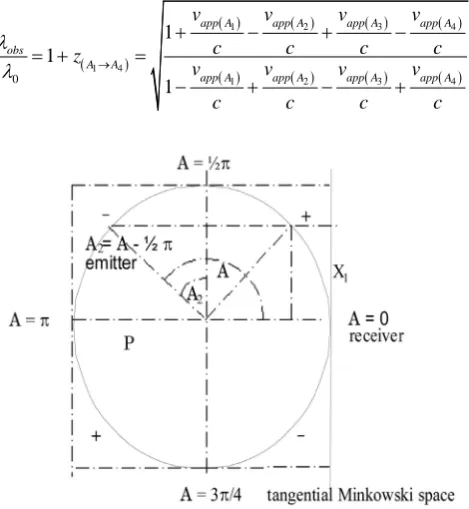
Figure 2. Appearent circular deflection of moving emitter.
It follows in the case cos
ϕ
′ = −vapp c→0 the vector of the emitter’s motion to be parallel to the line of sight and if cosϕ
′ = −vapp c→1 to be rectangularly directed off the latter line and in all cases in between by angle φ (see Figure 2). i.e. the Minkowski projection of the ingoing light under those conditions is the very cause of the above apparent circular order of velocity in dependence on its magnitude. This implies that all light ingoing from emitters moving in accord with the above discussed requirements relative to the receiver’s Min-kowski projection at reception to be red shifted relativistically in the order of0
1
1 ,
1
obs
v c z
v c
λ
λ
+ = + =
−
(8)
where λobsand λ0 denote observed wavelength of the emitter and the standard wavelength as measured in the
re-ceiver’s rest frame, respectively. It should be underlined that no direct measurements of velocity are possible but only derivation of the latter due to changes of wavelength through Equation (8) squared with the result:
(
)
(
)
2
2
1 1
.
1 1
z v
c z
+ −
=
+ + (8a)
The red shift of light expressed in the apparent circular units of Equation (7b) takes the simple form tan
z= ϕ (8b) and the sum of two redshifts z and, therewith according to Equation (8a) of two velocities, the value:
tan tan , 1 tan tan
zϕ ϕ
ϕ
ϕ
ϕ
ϕ
′′ +
′′ + =
′′
− (8c) where
ϕ ϕ
′′ + ≤1 2π.It follows, the emitter’s time in comparison to the receiver’s rest time to be dilated by the factor
(
)
(
)
(
)
(
)
1 1
1 2 2 2 2
2 2
2 2
2 2 2
1 tan 1 1 1
1 1 1 .
1 tan 1 1 1
z v
c z
ϕ ϕ
− −
−
+ − + −
− = − = −
+ + + +
(8d)
of the quarter circle, intersects the vector of the emitter’s motion with dimensionless velocity → 1 orthogonal to the receiver’s tangential Minkowski space at z = 1 (see Figure 2).
In conclusion it is indistinguishable for the receiver, whether the redshift of the light ingoing from the emitter in accord with the preceding or, equivalently, time dilation of the latter is dependent on the former’s dimen-sionless velocity v/c or his orthogonal displacement from the receiver’s tangential Minkowski space.
3.2. Equivalence of Kinematical and Spatial Deflection of Light and the Associated
Redshift
It arises the question, whether the red shift of the released light associated with the apparent curvature of its path due to the emitter’s movement relative to the resting receiver directly off the latter might also occur if the ap-parent curvature of the light path from the emitter is a real one, enforced through the metric of the three-sphere S3.With other words: Arekinematics and metric equivalently associated with red shift of bended light paths?
From the above Euclidian E4-metric the three-sphere is given by
2 2 2 2 2
X +Y +Z +W =P
with curvature Ρ‒2. It is clear that photons released from a resting emitter and travelling in such an Universe will indeed follow curved paths, i.e. geodesics, and that the full circle in the three-sphere S3of volume 2π2Ρ3 can be described as
(
) ( )
2 2(
)
( )
2(
)
2 2 2 2 2 2 2
2πP 2π X Y Z W 2π X W ,
σ
= = + + + = +Y and Z neglected. For the time being we restrict to geodesics ∆ ≤
σ
1 4σ
=1 2π(
X2+W2)
1 2 from the emitter to the receiver, both resting.From the preceding it is clear that the emitter’s position must be deflected by value
(
2 2)
1 22A π= ∆
σ
1 2π X +W →1 from the receiver’s line of sight in tangentially projected Minkowski space, which is orthogonal to Ρ (see Figure 3), i.e., equivalently to the kinematically induced light deflection also the bending of light path through the warped space of the S3-hypersphere causes the receiver to observe pseudo four-dimensional Euclidian projections (Minkowski space) of all ingoing geodesics Δσ in the direction of the tangent vector to the latter (see Figure 3).
Now, our hypothesis is that the dimensionless space-like difference w W ≡w P of the general coordinate differences of the three-sphere in four dimensional Euclidian E4-space of all ingoing geodesics Δσ becomes quasi space-like coordinate difference of time in their pseudo Euclidian E4-projection (Minkowski space).Since in the latter a real fourth spatial dimension W ≡P does not exist must the left-hand side of the above Equation of the hypersphere for every receiver inside the spheretake the form
2 2 2 2
4, X +Y +Z −X
where the four-dimensional coordinate difference W necessarily is replaced by X4 of tangential spacetime. This
implies that any receiver at any point of the three-sphere will perceive the emitter’s time be apparently dilated
by factor
1
2 2
2 1 vapp
c −
− and, thus, the ingoing light red shifted in the order of
0
1
1 .
1
app obs
app
v c z
v c
λ λ
+ = + =
−
(9)
Figure 3. Deflection of emitter inside the three-sphere into local tangential Minkowski space.
such that in association with the above equations applies:
2
2 2 2
2
2
1 1
tan 1,
1
app
app
v w
P w P c
z A
w
w v
P c
− +
−
= = = = −
−
(9a)
(
)
(
)
(
)
(
)
(
)
(
)
2
1 2 2
2 2
2 2 2
1 2 2
1 1
1 1 1 tan 1
.
1 1 1 tan 1 1 1
app w P w
v z A
c z A
w P w
−
−
+ − −
+ − + −
= = =
+ + + + + − + (9b)
In this way fixed four-dimensional distance w of the emitter’s position within the three-sphere from pseudo four-dimensional Minkowski projection of the ingoing light at the receiver in the latter is transformed into the simulacrum of the emitter’s apparent recession velocity.
Consequently every receiver within the sphere can the spatial four-dimensional coordinate difference w in accord with Equation (8d) also perceive as pseudo four-dimensional (Minkowskian) in the form of dilation of the emitter’s time through the Lorentz factor:
(
)
(
)
(
(
)
)
1
2 2 1
2 2 1
1 2 2 2 2 2 2
2 2 2
1 2 2
1 1 1 tan 1
1 1 1
1 tan
1 1
. 1
app
w P w A v
c A
w P w
−
−
− −
−
+ − −
+ −
− = − = −
+ +
+ − +
(9c)
It is obvious that all other previously derivated equations for the kinematical case are also directly applicable to light propagating inside the curved hypersphere with the only modifications to be considered: Angles
ϕ
′ and φ have to be replaced by angles A′ and Α, respectively, furthermore, velocity v by apparent velocity vapp.Es-pecially is the dimensionless velocity vapp/c now the point of the four-dimensional projection effect where the
tangent referring to angle A, or, point
4
arctan π π
2 2
90 90
D
z P A P
r = ° = ° (9d)
of the quarter circle 1/2Ρπ pretty though not quite exactly intersects radius Ρ orthogonally to the receiver’s tan-gential Minkowski space at z = 1, where r4D denotes “real” four-dimensional distance between emitter and
From Equation (9a) can be derived
2 2
2
2 1
1 . 1
app
app v
P w w c
c c v
c
+
− = −
−
(10)
It is clear that the right-hand expression w/c vanishes if vapp/c = 1. But if not, such that applies
(
)
2 2
2
2
1
1 ,
1
app c
app c
v
P w dw c
c c
v c
→
→
+
− = −
−
(10a)
this results in P2−w2=dw and the further requirement vappdtv≡cdtw. i.e. we assume that a real fixed
minimum distance or quantum of length dw in real E4-space projected orthogonally into Minkowskian pseudo E4-space of every observer transforms in the latter space to a quantum of time dtw in the observer’s rest frame.
Although, for this rest time generating effect one also simply can write ,
W P dw
c c
− =
(10b)
implying that W > Ρ by the very tiny four-dimensional coordinate difference dw ≡ cdtw which according to the
preceding in three-dimensional space be perceivable as rest time only (see below).
In conclusion, apparent bending of light path by inertial motion and real bending of the latter path by four- dimensional metric, respectively, are associated with the redshift of the ingoing light. In either case this is due to projection into quasi Euclidic Minkowski space, every receiver naturally will observe as the tangential projec-tion of all ingoing geodesics. The difference is that real inertial moprojec-tion in spacetime with three spatial dimen-sions generates redshift associated with apparent bending of light path, whereas distance w of four-dimensional Euclidian space, embedding the three-dimensional warped space of the three-sphere, in the receiver’s tangential Minkowski pseudo E4-space is transformed into apparent time dilation and redshift of the ingoing light associ-ated with apparent recession velocity. It is obvious that in the receiver’s tangential Minkowski projection of all ingoing geodesics both cases are indistinguishable from each other, i.e. they are equivalent. It needs not to bestressed, this result also to be valid in the case of acceleration, as has been extensively shown above. And it is clear, now, that the heuristically derivated redshift according to Equations (4), (6) and (6a), respectively, also must be due to this basic physical projection effect of geodesics.
3.3. Conservation of Photon Energy in the Closed Universe
Equation (9) predicts light which has been released within the three-sphere S3 at distance 1/4σ = 1/2πΡ from the receiver to be redshifted up to the highest possible value (1 + z) → ∞, independently of direction which, by the way, implies that in the static Universe a light horizon at distance 1/2πΡ from any observer rather than a time horizon exists. Furthermore, this novel physical notion of the Universe’s true topography implies that cosmic reionization and the associated early phase of galaxy formation in the sense of the big bang hypothesis never ex-isted and, thus, also predicts that even at the highest red shifts accessible to astronomical observation still galax-ies will be found. At present this observational border lgalax-ies already at z ≈ 8.6 (Lehnert et al., 2010 [10]) and, therewith, very near to the very limit where big bang paradigm will break down observationally.
On the other hand does the energy conservation law not allow vanishing of the photon energy. After circling the sphere on the great circle σ= 2πΡ without any interaction, it should arrive at the emitter’s position exhibiting the same energy it previously had been emitted with. Does this requirement contradict the preceding?
beyond Δσ = 1/2πΡ implying angle A≥1 2π and beyond vapp/c = 1, respectively, for the outgoing geodesics
the signs are switched to (−), because the light’s vector of velocity reverses (seeFigure 4). With respect to posi-tion Α = 0 (receiver) the signs remain switched (−) for all outgoing geodesics up to angle Α = π in order to switch back to (+) with regard to point Α = 1/2π from π ≤ Α≥ 3/4π and again to (−) with respect to point Α = 3/4π from 3/4π ≤ Α≥ 2π (see Figure 4). Thus, it follows:
[ ]
(
) (
)
1 2[ ]
0< ≤A 1 2π→2A π→vapp c: 0,1 →1+vapp c 1−vapp c : 1,∞ ,
(
)
[ ]
(
) (
)
1 2[ ]
1 2π< ≤ → −A π 2 A−1 2π π→ −vapp c: 1, 0 →1+vapp c 1−vapp c : ∞,1 ,
(
)
[ ]
(
) (
)
1 2[ ]
π< ≤A 3π 2→2 A−3π 2 π→vapp c: 0,1 →1+vapp c 1−vapp c : 1,∞ ,
(
)
[ ]
(
) (
)
1 2[ ]
3π 2< ≤A 2π 2→− A−2π π→ −vapp c: 1, 0 →1+vapp c 1−vapp c : ∞,1 ,
This is valid for all points of the three-sphere with respect to all radially ingoing geodesics. It implies that the photons of all ingoing great circle geodesics σ repeatedly loose and fully regain their energy after a respective quarter circle 1/4σ, in order to arrive at the receiver (emitter) with the original energy. For this during the course of σ occuring cyclic red, blue, red and again blueshift and the associated apparent recession velocity according to the preceding can be defined
( )1
1
0
1 2
π :
app AA
> →
v
( )2
2
1 2
π
π :
app AA
>
→
v
( )3
3
π 3π 2:
app AA
> →
v
( )4
4
3π 2 2π :
app AA
>
→
v
so that the cyclic red and blueshift of the light following the great circle geodesics σ of the three-sphere succes-sively from Α1 to Α4 in extension of (9) takes the form:
( )
( ) ( ) ( ) ( )
( ) ( ) ( ) ( )
1 2 3 4
1 4
1 2 3 4
0
1
1 .
1
app A app A app A app A obs
A A
app A app A app A app A
v v v v
c c c c
z
v v v v
c c c c
λ
λ →
+ − + −
= + =
− + − +
[image:10.595.198.433.439.694.2](11)
It is clear that according to the preceding any dimensionless velocity referring to one of the angles Α1 to Α4 of
the succeeding fractions of Equation (11) also can be expressed through the tangent of the respective angle by:
( )
(
( ))
( )
(
1 4)
1 4
1 4
2
2
1 tan 1
.
1 tan 1
A A app A A
A A A v
c A
→ →
→
+ −
=
+ +
(11a)
4. Reddening of Light Owing to the Universe’s Four-Dimensional Curvature
Explains the Observed Redshift Anomalies of the Supernova Data, Hitherto
Interpreted as Due to “Dark Energy”
The immediate consequence of the preceding evidently is that to gain information about the emitter’s correct distance up to light horizon (1 + z) → ∞ one just needs to consider the geodesic path Δσ = rΑ≤ 1/2πΡ of the light travelling in S3 between the emitter and the receiver, without taking any recurrence to the metric of the three-sphere itself. From Equation (9b) in connection with (7) follows vice versa
(
)
(
)
2
2
1 1 2
cos ,
π
1 1
app
app v
z r
A
c P
z
Α
+ −
= = =
+ + (12)
where rΑ denotes apparent distance in tangential Minkowski projection of r4D according to Equation (10) on the
grounds of the dimensionless apparent velocity vapp/c.
One should note that Equation (12) delivers the constant value vapp/rΑ = 2c/(πΡ) = const. The latter enables
one to equate radius Ρ and, therewith, the circumference of the three-sphere S3 by considering that, to mention it again, vapp denotes apparent recession velocity per distance r of 1/4σ = 1/2πΡ, which is identified as the Hubble
constant H≡vapp rA=2c
( )
πP =const. Thus, we can write0 2
. π
c P
H
= (13)
With
H
0v
appr
A75 km s
1Mpc
1− −
=
=
⋅
⋅
we calculate Ρ = 2.6 × 10³ Mpc = 8.4 × 10⁹ ly and the circumference of S3 to amount to 16.34 × 10³ Mpc, whereas the light horizon being 4.08 × 10³ Mpc away from any observer within the three-sphere. But it is obvious that rΑ = ΡΑ, implying that curvature radius Ρ in relation (12) can take any given value. In the case of the Universe it is gauched through the empirical value H0 with the above result(see also below).
Clearly in the closed, static three-sphere S3 the meaning of the Hubble constant is restricted to its definition as empirical value of vapp/rΑ = const for any distance r and the associated apparent recession velocity. A Hubble
law in the sense of expansion theory does not exist. From Equation (12) in connection with the above Hubble relation we receive the distance formula in dependence on observed (comological) redshift of very distant as-tronomical objects of value
(
)
(
)
2
2 0
1 1
.
1 1
A
z c r
H z
+ −
=
+ + (14)
Comparision with the distance formula (14a) of the Einstein-de Sitter standard model (empty space)
0 0
2 1
1 ,
1
c r
H z
= −
+
(14a) at once reveals that with growing cosmological distance rΑ, i.e. redshift, calculated distances r0 on the grounds of
the latter Equation must considerably deviate from cosmological reality expressed by the former distance for-mula (14).
Indeed is rΑ > r0 up to about z ≈ 1.3 and vice versa after this, thus, faking an extra acceleration within
(14a) coincide, is, of course, given by
(
)
(
)
2
0 2
0
1 1 1
2 1 0
1
1 1
z c r r
H z z
Α
+ −
− = − − =
+
+ +
(14b)
Where from is calculated: ( )
0
1.314585
A
r r
z
==
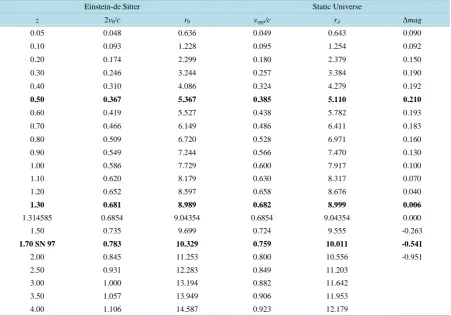
. The transition point, i.e. the point of transition from apparent de- celerating to apparent accelerating expansion, is computed to beat z = 0.50, in good accord with astronomical findings (see e.g. Cunha and Lima, 2008 [11]).The following table I compares distance calculations of rΑ and r0 in light years, respectively, on the grounds
of the same redshift from z = 0.05 to z = 4 and a Hubble constant H0 = 75 km⋅s‒1⋅Mpc‒1. The calculated distances
as well as the apparent crossing point rΑ = r0 and the apparent transition point at z = 0.50 depend on the chosen
value of H0, i.e. distances become smaller if H0 > 75 km⋅s‒1⋅Mpc‒1 and vice versa if H0 takes a smaller value and,
furthermore, the Universe to be a perfect three-sphere S3. Clearly with growing redshift after the apparent transi-tion point at distance rΑ = r0 with z = 1.314585 the divergance between rΑ and r0 increases. The last column
lists results of magnitude calculations according to Equations (14d) and (14e) from rΑ/r0 = up to 0 ≤ z ≤ 2, which
are also visualized in Figure 5.
As already mentioned, introduces current expansion (big bang) hypothesis an acceleration phase of the Uni-verse, propelled by a putative “dark energy”, as the cause of the observed faintness of supernovae of the type Ia between ≈0.5 > z ≳ 1.0, whereas the rather unexpected brightness of the supernova SN 1997ff at z ≈ 1.7 has been explained as the decelerating phase of the early and smaller cosmos due to gravity of the then denser dark matter and baryonic matter, but predominately of the former (Riess et al., 2001 [3]; on the physical cause of “dark matter” see below).
It is obvious that the ratio of flux fΑ/f0 from the “standard candles” Sne Ia in dependence on apparent distance
rΑ and faked distance r0 according to (14a), respectively, can be expressed in the form
(
)
2(
)
2 22
0 0 0
A A app
f f = r r ≈ v v
so that the relative magnitude above the coasting line with value zero (Einstein-de Sitter) takes the form
2 2 0 0 2.5 log 2 .
above
app
v mag
v
∆ = ⋅
(14c) One should note that this ratio delivers at crossing point z =1.314585, of course, the result ‒2.5 × log(vapp/v0)4
= 0. Thus, at crossing the coasting line at z =1.314585 the scalar
(
)
(
)
2
2 2
2
0 A 0 app 0
f f = r r ≈ v v
itself be- comes the ratio wherefrom the relative magnitude below the former of the then apparently nearer Sne Ia has to be computed in the form
4 2 2 0
0 2.5 log 2 .
below
app
v mag
v
∆ = ⋅
(14d)
In Figure 5 the full points are magnitude deviations from 0 < z < 2 according to Equations (14c) and (14d) from what is expected on the grounds of an Einstein-de Sitter (empty) Universe of the expansion theory (coast-ing = 0) as also listed in Table 1.
The magnitude points Δmag of table I andFigure 5 also have been transfered into Figure 11 of reference [3] from Riess et al. (here not shown) and they show that the astronomer’s direct magnitude measurements of very distant supernovae nearly exactly comply with results of magnitude calculations on the grounds of Equations (14d) and (14e) and, thus, fully explain those deviations from standard big bang theory as apparent ones. The. apparent transition point at z = 0.50 and Δmag = ‒0.541 of SN 1997ff at z ≈ 1.7 according to (14e) neatly com-ply with modeling of the authors.
Figure 5. Measured redshift coincides with theory (dotted line) deviating from prediction of big bang (zero line).
Table 1. Evolution of 2v0/c in big bang theory (Einstein-de Sitter) vs. vapp/c of pseudo four-dimensional tangential Minkows-
ki-space (static universe) in dependence on redshift z from z = 0 to z = 4 in light years × 109. Apparent transition (i.e.v app /(2v0) = max), crossing (i.e.vapp = 2v0) and redshift z = 1.70 of sn 1997ff are indicated by fat type.
Einstein-de Sitter Static Universe
z 2v0/c r0 vapp/c rΑ Δmag
0.05 0.048 0.636 0.049 0.643 0.090
0.10 0.093 1.228 0.095 1.254 0.092
0.20 0.174 2.299 0.180 2.379 0.150
0.30 0.246 3.244 0.257 3.384 0.190
0.40 0.310 4.086 0.324 4.279 0.192
0.50 0.367 5.367 0.385 5.110 0.210
0.60 0.419 5.527 0.438 5.782 0.193
0.70 0.466 6.149 0.486 6.411 0.183
0.80 0.509 6.720 0.528 6.971 0.160
0.90 0.549 7.244 0.566 7.470 0.130
1.00 0.586 7.729 0.600 7.917 0.100
1.10 0.620 8.179 0.630 8.317 0.070
1.20 0.652 8.597 0.658 8.676 0.040
1.30 0.681 8.989 0.682 8.999 0.006
1.314585 0.6854 9.04354 0.6854 9.04354 0.000
1.50 0.735 9.699 0.724 9.555 -0.263
1.70 SN 97 0.783 10.329 0.759 10.011 -0.541
2.00 0.845 11.253 0.800 10.556 -0.951
2.50 0.931 12.283 0.849 11.203
3.00 1.000 13.194 0.882 11.642
3.50 1.057 13.949 0.906 11.953
4.00 1.106 14.587 0.923 12.179
ical notion, obviously correctly expressed through distance Equation (14), are reflected.
[image:13.595.88.540.326.642.2]occur within the closed, static three-sphere S3. Thereby it is obvious that the expansion concept to explain the nearly uniform cosmic microwace background (CMB) radiation of 2.725 Kelvin (K) can analogously be adapted for the enthropic radiation within the closed, static three-sphere with fixed radius Ρ≈ 2.6 × 10³ Mpc, although more in the sense of a thought experiment and not as physical reality as in the frame work of big bang theory.
As widely known traces the latter the Planckian distribution of CMB radiation back to interactions of photons with stable particles in the earliest epoch of the presumed cosmic expansion, whereby a (otherwise unmotivated and unexplained) short extra acceleration or boost is introduced to explain isotropy and homogeneity of the CMB (horizon problem). With the decoupling of photons and remnant matter at T ≈ 3000 K the radiation is thought to have reached its final Planckian distribution, but to be cooled down to current CMB temperature 2.725 K in the course of further cosmic expansion.
However, according to the above the three-sphere with constant volume 2π2Ρ3 a hot epochin the sense of big bang theory never underwent. Therefore, the CMB, especially its spectral distribution in thermal equilibrium, must be of other origin. As already previously remarked, offers the closed, static Universe such one as the sum of all ever emitted and not absorbed light. According to equation (11) will these photons on their repeated tra- vels on great circle geodesics σ around the entire Universe undergo cyclic red, blue, red and again blueshift after every respective quarter circle 1/4σ. This results in the observed equilibrium of radiation energy, i.e. perfect thermal emission (black-body) spectrum for every observer in the three-sphere. From its energy density be- ing equivalent to mass density, which in the literature is given with
E
photc
2≈
4.4 10
×
−34g cm
⋅
−3 [12], accord- ingto this theory the temperature of the universal black-body radiation (CMB) right forwardly can be computed. The relations2 4
const
phot
m
c
=
T
(Stefan-Boltzmann law) and
2 4
const
phot
m
c P
=
,
expressing the density of the “rest mass” of a photon gas, are also valid in the case of the electromagnetic radia-tion filling the three-sphere S3 in accord with the preceding and, thus, also the relation
1
T= P
without restrictions. From the latter equation is given
(
)
1 42
1 phot
TP= = E T c ,
which also reflects the definition of T as the basic temperature of the “empty” static three-sphere S3. Therefrom is taken
(
)
1 42
phot
T+TS=T E T c P,
whereby T = 1 in the Kelvin scala. If now TS > 1 and
(
) (
)
1 4 1 4
2 2
phot phot
E c > E T c , respectively, then for the relation between temperature of the enthropy radiation TS of all ever emitted and not absorbed electromagnetic
radiation of the three-sphere and T simply is applied
4
3 9
2
4
9 24
9 24 14
4.5799 10
1 1 gr cm
4.5799 10 10
1 AMU 1.66
4.5799 10 10 10
1 K 2.72 K, 1.66 9.25
phot S
E
T c
T P P
P
P
− −
−
−
×
= − = − ⋅
× ×
= −
×
× × ×
= − =
× ×
(15)
× 10‒27 kgr = 6.68‒1 × 1024 K, respectively. The remarkable result (15) in units T = K is fairly exactly the meas-ured temperature of the CMB.
One should note that expansion hypothesis does not allow a derivation of this result so right forwardly, be-cause the above pointed out correlations, but especially the constant radius Ρ of the three-sphere S3, are com-pletely unknown to the former. The interpretation of the CMB as enthropic (Planckian) radiation in the closed, static Universe easily explains the observed isotropy and homogeneity of the latter. A “horizon problem” as in big bang theory does not exist.
Nevertheless, it is clear that fluctuations on small and large scale as well in the CMB must occur owing to the previously discussed redshift associated with the deflection of CMB photons passing either nearby or more dis-tantly large scale structures in the closed, static three-sphere S3 (see above and also Appendix 1). For the latter neither the integrated nor the non-integrated Sachse-Wolf effect of Big Bang hypothesis can be accepted as ap-propriate physical explanations of fluctuations of the enthropic (Planckian) radiation on any scale, because in a steady state Universe such an effect does not exist physically.
Furthermore, this novel physical notion—CMB being the Planckian radiation in the closed, static but spinning Universe—delivers a convincing physical explanation of the recently observed and most recently confirmed sta-tistically significant anomalies in the CMB, including those which have been ascribed to gravitational waves in the putative early phase of the Universe (see paragraph 11.2).
6. The Physical Cause of the Gravitational Field, of Gravity and of the Definite,
Limited Velocity of Light
In the preceding we considered physical implications solely following from the curvature of the static, self- contained three-sphere S3, whereas its rotation could be fully neglected. Mathematically the three-sphere in-cluding its four-dimensional rotation has been thoroughly investigated so that its geometric, topological and group structure properties are well known (see the numerous literature to these points). Thus, we can concentrate on the physical effects which are to expect owing to the rotation of the hypersphere on local as well as on global scale.
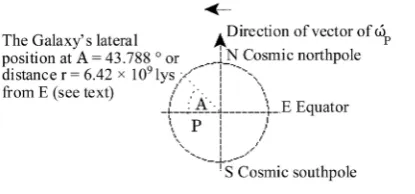
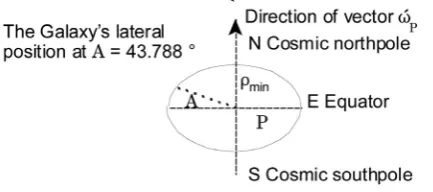
Considering our home galaxy’s age and advanced evolution it seems highly reasonable to assume its present lateral position in the three-sphere being somewhere between one of the rotation poles (which we denote arbi-trarily the “northern” one) and the equatorial plane, and, likewise arbiarbi-trarily, the three-sphere to spin clockwise about the former.
The Galaxy’s distance from the cosmic equator region would then, as a first guess, be ≈1/4πΡ, or, latitude ΑG
≈ 45˚ (analogously to the Galaxy’s coordinate system). The more exact value of ΑG is derivated below.
It is clear that the rotation of the self-contained three-sphere, i.e. of its curved three-dimensional space-fabric (not space-time; see below), gives rise to internal centrifugal forces, which act upon all matter in the equatorial zone and beyond, causing it to oscillate between the cosmic hemispheres and thereby regularly to cross the cos-mic equatorial zone (in due course of billions of years). Also should moving bodies in the rotating three-sphere experience a fictitious Coriolis force. This global inertial force, which also will give rise to gravity, is the cen-tripedal acceleration
2 2
,
A S A A
c
a P
P
ω
= − = (16)
arising from the rotation of the three-sphere S3, considered to be perfectly elastical, about its axis in flat E4-space locally, where aΑdenotes centripedal acceleration and ΡΑ rotation radius at latitude Α, respectively, ωS angular
velocity of the sphere and c rotation velocity. As a certain geometric consequence this rotation in four-dimen- sional space is about a two-dimensional plane, which we nevertheless will further on refer to as the axis.
The absolute value of the rotation velocity c = ωSΡ can be derived by considering an emitter resting relative to
the space fabric of the three-sphere, i.e. a fixed metric connected with the latter, at the sphere’s equator, where c = max. From the emitter shall be released simultaneous signals parallel and antiparallel to the vector of c, which for we demand 1) that the velocity of the antiparallel signal’s carrier shall suffice to cancel the angular velocity ωS so that the velocity of the carrier relative to E4 equals to zero, 2) that the signals arrive simultaneously at the
the photon with ωS = 0 the emitter (point of emittance in coordinates of the three-sphere) arrives at the point of
emittance in coordinates of the embedding Euclidian E4 after time 2πΡ/c and the counter directed photon also after time 4πΡ/2c = 2πΡ/c (on the probable physical cause of the coincidence of light speed and rotation velocity c = ωSΡ, see below).
Now, suppose the above light signals be emitted perpendicularly to the vector of c in direction of the sphere’s poles. In Euclidian space they would withdraw from the emitter with velocity c. But the metric of the three-sphere S3constrains the geodesic trajectory Δσ or the great circle σ, respectively. Therefore, if ∆σ P with the result that it can be considered as nearly Euclidian, then, as observed from the emitter on latitude Ρ, the light reaching latitude ΡcosdΑ must have slower velocity 2
(
2)
1 sin cos
dA
c = c − dA =c dA, where dΑ denotes the infinitely small angle between Ρ and ΡcosdΑ. But anyhow, because rotation radius varies in dependence on latitude it is clear that according to the preceding the velocity of light must be dependable on latitude as well. Furthermore, it is clear that, other than the light travelling parallelly to the cosmic equator, both counter parallel pole-crossing light signals must arrive at the point of emittance after completion of a great circle σ. This requires the above two demands to be extended, namely: Every point of emittance at any latitude in coordinates of the three-sphere shall depart with latitude dependent velocity c from the respective point of emittance at rest relative to the embedding E4such that the transversality of the light’s polarization vector always points towards the Uni-verse’s rotation axis. From this follows that the light propagating off the point of emittance into the general di-rection of the sphere’s rotation till meeting the counter directed signal at the former point of emittance will cover distance
(
1 cos+ A)
⋅2πP in time(
1 cos+ A)
⋅2πP c(
1 cos+ A)
. Also note that due to the trans- versality of the light’s polarization vector the latter inside the three-sphere seems to be swirled in the order of 2π during one complete revolution. Thereby those vector turbulences should be centered at the rotation poles and somewhat broader distributed at the cosmic equator. This phenomenon has very recently been observed but wrongly interpreted as a proof for gravitational waves in the early phase of the expanding Universe (see below chapter 10). Furthermore, if the velocity of light at the three-sphere’s equator is denoted cE, and, cA at a certainlatitude 0 ≤ Α≤ 1/2π, where angle Α will be given in degrees counting from the equator to the rotation pole (see below), than PcosA
ω
S =cEcosA=cA. This implies that the eigentimes tE and tA associated to cE and cA,re-spectively, must be inversely proportional to the latter ratio, i.e. tA/tE = (cosΑ)‒1 such that be valid tE = tAcosΑ and
eventually
cos const.
cos
E
A A E E E
t
c t c A c t
A
= = = (17)
Taken together follows for all observers in the Universe that all released light will need same time σ/c (as measured locally) for a full great circle geodesics of the three-sphere, independently of the latitudenal position of the emitter. Thus, the very origin of the limited velocity of light in vacuum as we know it, is its above corre-lation with the rotation velocity c = ωSΡ of the three-sphere S3, also implying its variation with the sphere’s
lati-tude.
As a further consequence must the photon energy Ephot vary with latitude as well, because cA = λAνA= λνEcosΑ.
Because, furtheron, frequency is inversely proportional to time, especially 1 1
cos cos
A E
A t At A E
ν = − = − = ν , it must be valid λA = λE = const such that the photon energy takes the form
( ) A E
cos ,
phot A
in-crease of density of galaxies, i.e. also increase of probability of merger (see below). This predicted increase of IR galaxy concentration has also recently been observed [14].
An observer resting at the equator of the rotating sphere will on himself and all material objects ascertain the centrifugal force
2 2
P P
mc F m P
P
ω
= = − (19)
as the respective counter force, which leads to a bending of the elastic S3space-fabric and its metric, respectively, directed radially “outwards” off the rotational axis in E4. This warping of S3space through the action of the cen-trifugal force FΡ upon mass is described by the well known field equations of general relativity as deviation from the locally flat metric ηnm, where the energy-momentum tensor Tmn represents distribution of matter and the
Ricci tensor Rmn curvature of spacetime (see below). Note that from the cosmic equator up to the polar regions,
FΡmust decrease in the order ‒mc2cos2Α/(ΡcosΑ) such that applies
( )
2
cos ,
P A
mc A F
P
−
= (20)
where FΡ(Α) denotes FΡ at latitude Α.
Every observer within the three-sphere S3 on principle cannot measure the kinematical status of an isolated single material object, but only in relation to another object, e.g. the collision of two bodies with different mass but equal oppositely directed velocity, i.e.
( )
( ) . P Mv
P mv
F Mv
F ′ mv
=
′ (21)
Hence, the existence of the universal centrifugal force FΡ remains hidden to him and he must arrive at the in-terpretion of mass as always being associated with inertia. In addition to this generates the rotation of the S3-sphere (assumed to be at rest in E4) the centrifugal energy
[
]
2 1 2,
2 2
P P
m
E =
ω
P = mc (22)being proportional to the quadradic product of the angular velocity ω and the sphere’s radius ΡcosΑ at latitude Α, where ωΡ × ΡcosΑ = cΑ, according to the previous derivation of velocity of light within the sphere.
Obviously is the centrifugal energy E, every material body owing to the rotation of the hypersphere will ob-tain, the very origin of the Poisson potential U of the gravitational field
2
. 2
P
E mc U
r r
= = (23)
Since also in this case the direct effect of the centrifugal energy is not perceptible within the sphere and again only comparison of different potentials is possible, an observer must this only in steadily rotating systems oc-curing additional potential energy interpret as a rest energy
[
]
2[
]
22 2
, ,
P P P
E k m P M P
E k mc Mc
ω ω
= ⋅ =
= ⋅ = (24)
falling to every material body’s share in the sphere. The S3-observer thus comes to the conclusion that every material body must have “rest mass” m = E/c2.
warping of space and dilation of time in dependence on rest energy of the gravitating body. This dependence is described by the Einsteinian field equation
1 2
mn mn mn
T =R − Rg
in the well known manner: The energy-momentum tensor Tmn, whose dependence on latitude Α for now we
ne-glect, represents the distribution of matter (energy), and the Ricci tensor Rmn the respective symmetric warping
of space [15].
We replace constant ϰ of the left-hand side of the Einsteinian field equation through the respective Newtonian value ϰ = 8πG/c2, whereas Tmn = T44 = ϱc2, i.e. the density of energy, is the essential well of the gravitational
field, and all other components of the energy-momentum tensor are considered to be neglectably small. Now, we introduce the Poisson potential U = 4πGϱ of the Newtonian theory so that with Tmn = T44 = ϱc2 eventually ϰTmn =
2U. If we replace the Poisson potential U by the centrifugal energy E according to the above equation, then the left-hand side of the Einsteinian field equation takes the form
[
]
2 22 .
mn P
T = U=m
ω
P =mc (25)
Therewith, it is shown that the centrifugal energy E be the decisive factor which governs the geometry 1 2
mn mn
R − Rg of the gravitational field, furthermore, that Einsteinian general relativity naturally emerges from the physics of the static, self-contained, rotating three-sphere S3 as the correct Riemannian description of the lo-cal warping of the space-fabric and dilation of time caused by the impact of FΡ on material bodies.
7. Origin and Equivalence of Rest Mass (
m
0) and Energy (E
0) of the Protron,
Quantum of Rest Time (
τ
0) and Four-Dimensional Elementary Length (
λ
w);Derivation of the Milky Way’s Latitude within the Rotating Three-Sphere S
3Above an association between four-dimensional spatial extent dw orthogonally to Minkowski space and time t in
the latter in the order
,
w v app
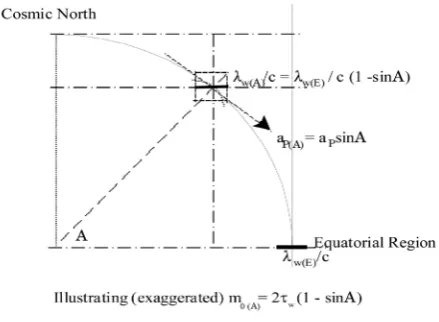
dw=dt c=dt v (26) has been assumed., or, with other words, that a quantum of rest time τw and minimum length dw≡ λw = cτw
possi-bly exists. To prove this, consider the de Broglie wave of a fast moving stable baryon with smallest known mass, say, protron, of wavelength λ which for we require λ = λw≡ cτw:
2 2
0
1 ,
w
v h
c m v
λ λ= = −
where m0 denotes rest mass and h Planck’s constant. Obviously must be valid 0<
λ
w∞, excluding v = 0 andv = c, respectively, whereas from the foregoing we know that centrifugal energy EΡ = 1/2m0c2, irrespectively of
the sign. We identify E0(Ρ)/c as λw and demand velocity v to be of a value which results in the equality γm0v = mv
= 1/2m0c2, where m denotes dynamical mass and γ Lorentzfactor. Obviously this is the case if
( )
1 5
v c= − so that the previous de Broglie formula takes the form
0 0
2 2
5 ,
1 5 w
h
h h
mv m c m c
λ = = = (27)
whereof is derivated:
2
0 0
.
2 2
w w
m m
c c h
λ
⋅ ⋅ =τ
⋅ ⋅ = (28)The same result follows from 2 0
phot phot
E =m c =hc λ in association with the demand Λphot = λw, where Ephot