
An Unique Solution for N queen Problem
Vishal Kesri
School of Computer Engineering KIIT University, India
Vaibhav Kesri
Department of Electrical
Engineering
NIT Kurukshetra, IndiaPrasant Ku. Pattnaik
School of Computer EngineeringKIIT University, India
ABSTRACT
The N-queens problem is a popular classic puzzle where numbers of queen were to be placed on an n x n matrix such that no queen can attack any other queen. The Branching Factor grows in a roughly linear way, which is an important consideration for the researchers. However, many researchers have cited the issues with help of artificial intelligence search patterns say DFS, BFS and backtracking algorithms. We have conducted an extensive study on this problem and realized that no algorithms so far designed with simple formula based. This paper includes a new paradigm which able to compute one unique solutions to the N-queens problem. Again our experimental study brings out a significant outcome.
General Terms
N-queen , Knight move, NP-hard
Keywords
first half, second half-A, second half-B, change queen,
1.
INTRODUCTION
The N-queen problem is a generalized form of 8-queen problem, proposed by the chess player Max Bezzel. In 8-queen problem, 8 8-queens are required to be placed on a 8x8 chess board in such a way that no queen attacks any other queen. [1]A queen can move in horizontal (in the same row), vertical (in the same column) and diagonal direction. Also a N-queen problem must follow the following rules [4]:
1. There is at most one queen in each column. 2. There is at most one queen in each row. 3. There is at most one queen in each diagonal.
The 8-queen problem is computationally very expensive since the total number of possible arrangements queen is 64!/(56! x 8!) ~ 4:4 x 10⁹ and the total number of possible solutions is
92. [1] We can consider two solutions to be the same and can obtain one from the other by rotation or symmetry. So there exists only 12 different solutions and it becomes very hard to obtain an unique solution out of these.
The N-queen problem follows the same rules as in 8-queen problem with N queens and an NxN chessboard. This problem falls in a special class of problems (NP hard) whose solution cannot be found out in polynomial time. In this paper, i present an unique solution for every value of N which can be found in polynomial time without performing iterations.
1.1
Brief History
In 1848 chess player Max Bezzel proposed the 8-queen problem and since then many mathematicians,
including Gauss, have worked on this problem and it‟s generalized form i.e. N-queen problem. The first solution to the 8-queen problem was found out by Franz Nauck in 1850. Nauk later extended this problem to N-queen (placing N queens on an NxN chessboard such that no queen attacks any other queen using the standard moves). In 1874 S. Günther proposed a method of finding solutions by using determinants and J.W.L. Glaisher refined this approach. [2]Alternatively, search-based algorithms have been developed. For example, a backtracking search, algorithm generate all possible solution of a given n×n board (Bitner and Reingold, 1975 and Purdom and Brown, 1983)
1.2 Applications
The N-queen problem is used in many practical solutions like parallel memory storage schemes, VLSI testing, traffic control and deadlock prevention. This problem is also used to find out solutions to more practical problems which requires permutation like travelling salesman problem.
2.
TERMINOLOGIES
In this work consider the following terminologies and calculations:
2.1
Distinct Solution
We can get distinct solution of N-queen by performing rotation on chess board. Here we can perform 90, 180, 270 degree clock wise rotation or anti-clock wise and 180 degree back side rotation than 90, 180, 270 degree clock wise rotation or anti-clock wise.
2.2
Move in chess
Let see how queen move. When we place queen in any cell of chess, queen acquire entire row, entire column and entire diagonal of that cell.
Fig-1
\ | /
\ | /
-- -- Q -- --
/ | \
/ | \
The cell occupied by the queen as per eq (1) given below:
)
.
…
…
.
…
…
…
7
6,
5,
(4,
=
n
The eq(1) indicate that how many cell is capture by queen, where „n‟ denote chess board size and „i‟ denote column number. And add one for cell which queen place
2.3
Moves in chess board
Our consideration based on all 6 piece (King, Queen, Knight, Rock, Bishop, Pawn), except knight move all other piece move is subset move of queen move.
[image:2.595.47.277.177.321.2]Fig-2
Fig-2 show that venn diagram of all 6 piece move in chess
3.
SOLUTION STRATEGY
The type of solution of N-queen problem is an important issue. However, the solution to N-queen problem may provide two type solution i.e. unique solution and distinct solution. This work i able to achieve an unique solution.
3.1
Unique Solution
This N-queen problem, finds a pattern which provide an unique solution without iteration. Subsequently when n= 2 or 3, so we don‟t get solution due to capture cell by queen. So this pattern start working when “n>3” and „n‟ = ( 4, 5, 6………∞). So first solution is in this pattern when „n‟ are 4. That is below in fig-3.
Fig 3
Q
Q
Q
[image:2.595.343.487.298.437.2]Q
Fig 3- Using this solution pattern, it possible to achieve desire solution for any ‘n’ (n is show chess board size) value. For initial solution we identify the six different series of natural number as A, B, C, D, E, F (describe in
section 3.2).
3.2
Some Rules
Our experiment is based on Three rules, ie Rule-1, Rule-2, Rule-3. Such description of rule are mention below.
And get 0 on cell after analyzer operation, so just place queen on that place.
Fig-4
Q
Q
Q
Q
Fig-4 is shows initial solution of first series-A, Where queen is place at location (row1 column2), (row2 column4)
, (row3 column1), (row4 column3) of chess board. Fig-5
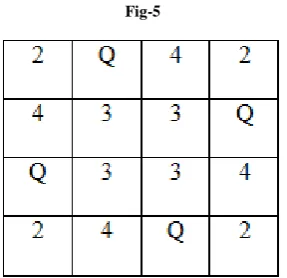
After analyzer function, fig-5 show that how many queen is attack on a cell, ie in row 2 and column 2 the value is 3, its mean that that cell (row 2, column 2) is attack by 3 these queen(row1, column2), queen(row2, column 4), queen(row3, column1).
Fig-6
By adding add one row and one column into 4x4 chess board,
Queen
Knight
King
Rock
Bishop
[image:2.595.317.518.528.714.2].eq(2)
…
…
1
+
size
*
2
=
add
cell
new
total
board
chess
of
size
=
size
Fig-7
Fig-7, call analyzer function again , and found that, there is one cell with zero at first row 5 column 1. then put queen on that place.
Fig-8
Fig-8 show that how many queen is attack on a cell. by calling analyzer function after placing fifth queen.
Rule one is also apply on Series-F. To get solution of series-F, do following step:
Step-1: Take solution of Series-E. Step-2: Add one row above of chess board.
Step-3: Add on column to left. On other hand Series-B we add column to right.
Step-4: Apply rule-1, than we get 2 cell with zero.
Rule-2: Consider initial solution of series-C than add one row and column for next chess board (n+1) that is belong to series-D.
[image:3.595.105.229.121.252.2]Fig-9
Fig-9 show the first solution of series-C. Than call Analyzer function. Analyzer function show how many queen attack on a cell
[image:3.595.317.513.125.335.2]Fig-10
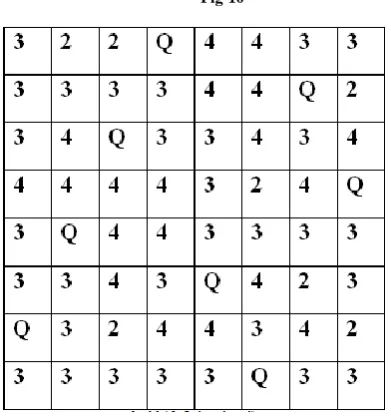
Fig-10 represent the value of each cell after Analyzer function.
[image:3.595.104.231.318.445.2]Fig-11
Fig-11 show that adding of one new row and one new column and total number of 17 cell is added using eq-2.
After removing one queen(8 row, 1 column) on chess board, we get two cell with 0, first 0 in first row and second 0 on last column of that queen. but question is which queen we should remove? , so answer for that question is choose those queen where queen corresponding value of “first row value and last column value is equal to 1 with one condition i≠ ((n+1)-j). shown in fig-12
[image:3.595.318.522.374.567.2] [image:3.595.106.228.623.756.2]Fig-12
fig-13 show value of each cell after removed queen from cell[8][1] and putting queen cell[1][1] and cell[8][9].
Fig-13
3.2 Series
Divide series of natural number into 6 parts for starting solution which show in fig-3. Every series you have to take different strategy for placing queen. Some of these series are given below.
Series-A
{4, 6, 10, 12, 16 ……∞}
f(n) = { 3x+1 , for odd
3x, for even} Series-B
{5, 7, 11, 13, 17 ……∞}
f(n) = { 3x+2 , for odd
3x+1, for even }
3.3
Strategy
There is different strategy for every series. Strategy divided into three parts. These parts are following:
1. First half
2. Second half
3. Change queen
First Half→ Find the first place for put first queen, first place depend on series. eg if series-A so first place is row =1 and column= n/2. Then for next queen, row =row+2 and column= column-1. These processes run until columns ==0.
n= chess board size
Second Half→ Second half is further divided into two parts, second half-A and second half-B. For placing queen into second half-A. Find the first place for put the first queen into second half, first place depend on series. eg if series-A so first place is row=n and column= (n/2)+1. Then for next queen, row=row-2 and column=column+1. This process run until column = = n.
n= chess board size
Change queen→ After placing queen into first half and second half. then perform third part of strategy. Change queen part in not require for every series. eg it is not require for series-A. Change queen part is base on Rule, which describe in section-3.1.1
Strategy for Series-A
Step-1: Find starting point. That row=1 and column=n/2 Step-2: Apply first half.
Step-3: Apply Second half-A.
Step-4: Apply Change queen. But this is series-A so it not require step-4.
4.
OUTCOMES
We experimented this using c language, the output of this shown below :
[image:4.595.78.257.329.519.2]4.2
Enter chess board size
4.3
Solution
4.4
Analyzer
5.
THE ALGORITHM
The complexity of this algorithm linear time, and the source code of main function attached appendix-1. And algorithm for that program given below
:
5.1
Algorithm
main function ( ) {
n← chess board size
ptr= pattern (n)
if ptr == series-A
than str← start_point(ptr) strategy (str);
. . . . .
if ptr == series-F
than str← start_point(ptr) strategy (str);
}
The measure function of algorithm based on linear time,
Function Name Complexity
First_half n/2+c
Second_half-A n/2+c
Second_half-B n/2+c
6.
Conclusions and Future Work
The N-queens problem is a classic puzzle problem where n queens are to be placed on nxn “chessboard” such that no queen can attack any other queen.
AT max 4 queen attack on cell, and minimum 1 (here 1 mean, where queen place) queen in solution, if violet this condition so that is not solution. For one unique solution we find a pattern, which give us one unique solution forany “n” value. For future research work related to find another pattern and also new rule.
Suppose our starting solution is different, so our series of natural number is also different, like is our starting solution is 5x5 chess board is given below
7.
APENDIX-1
main (){ int n;
prinf (“\n Enter chess board size”); scanf (“%d”, &n);
fill(n);
ptrn=pattern(n); if (ptrn ==1) {
str=start point(ptrn); first_half(str); second_half-A(str); }
if (ptrn ==2) {
str=start point(ptrn); first_half(str); second_half-A(str); }
if (ptrn ==3) {
str=start point(ptrn); first_half(str); second_half-B(str); }
if (ptrn ==4) {
str=start point(ptrn); first_half(str); second_half-B(str); change_queen(ptrn); }
if (ptrn ==5) {
str=start point(ptrn); first_half(str); second_half-B(str); change_queen(ptrn); }
if (ptrn ==6) {
str=start point(ptrn); first_half(str); second_half-B(str); change_queen(ptrn); }
}
8.
REFERENCES
[1] Gutiérrez-Naranjo, Miguel A., Martínez-del-Amor Miguel A. , Pérez-Hurtado Ignacio, and Pérez-Jiménez Mario J. February 02, 2009. “Solving the N-Queens Puzzle with P Systems”, 7th Brainstorming Week on Membrane Computing, volume 1, pp199-210.
[2] Letavec, C. and Ruggiero, J. 2002. “The n-queen problem”, Informs Transaction on Education, volume 2 number 3, May 2002.
[3] Uninformed Search Analysis of the N-queens Problem, Ben Sauerwine, September 20, 2003. Available at: http://www.andrew.cmu.edu/user/bsauerwi/research/P1.p df
[4] Russell, S. and Norvig, P. “Artificial Intelligence A Modern Approach”, Second Edition, pp 139-140. [5] Martinjak, I. and Golub, M. 2007. Comparison of
Heuristic Algorithms for the N-Queen Problem, “Proceedings of the ITI 2007 29th Int. Conf. on Information Technology Interfaces June 25-28”, Cavtat, Croatia.
[6] Hynek, J. Genetic Algorithms for the N-Queens Problem. Available at:
http://nguyendangbinh.org/Proceedings/IPCV08/Papers/ GEM4444.pdf
[7] Ahrabian, H., Mirzaei, A. and Nowzari-dalini, A. A dna sticker algorithm for solving N-Queen problem, “International Journal of Computer Science and Applications”, Vol. 5, No. 2, pp 12 – 22.
[8] Horowitz, E., Sahni, S, and Rajasekaran, S. “Fundamental of Computer Algorithm (pp-339-355)”
![fig-13 show value of each cell after removed queen from cell[8][1] and putting queen cell[1][1] and cell[8][9]](https://thumb-us.123doks.com/thumbv2/123dok_us/8119233.793646/4.595.55.259.72.286/value-cell-removed-queen-cell-putting-queen-cell.webp)
