http://dx.doi.org/10.4236/ajibm.2015.56044
China’s Food Security Evaluation Based on
Factor Analysis
Jie Zou, Shiqin Guo
School of Economics and Management, Southwest Jiaotong University, Chengdu, China Email: [email protected]
Received 28 May 2015; accepted 26 June 2015; published 29 June 2015
Copyright © 2015 by authors and Scientific Research Publishing Inc.
This work is licensed under the Creative Commons Attribution International License (CC BY). http://creativecommons.org/licenses/by/4.0/
Abstract
China’s food security has been a hot issue of social concern. Based on existing studies, this paper chose 12 factors to establish comprehensive evaluation system of good security, including the ar-able land area per capital, the fluctuation rate of grain yield, the grain price rising rate, the degree of agricultural mechanization, etc. Comprehensive evaluation of China’s food security over the years by factor analysis shows that China’s food security is in a tense balance state, the sources of which are the supportability factor slowdown and the score of stability factor decrease. Base on the analy-sis, we proposed to strengthen financial support to agriculture, improve the land protection me-chanism, and improve the utilization rate of grain and other countermeasures to ensure China’s food security in the future.
Keywords
Food Security, Analysis System, Factor Analysis, Structural Contradiction
1. Introduction
Food security is related to national social stability and economic development; it’s the foundation of national security. Ensuring food security was always one of the basic national polices in China. Since in 2004 Chinese government changed the food subsidy mechanism from indirect subsidy to direct subsidy, China has obtained ten years’ continuous increase of grain production. However, series of unstable elements are hidden behind: re-duction of cultivated land resources, continuous rise of international food prices, shortage of water resources, and rigid growth in food demand, which are severely affecting China’s food security. Therefore, researching food security problem contributes to grasping the development trends of China’s food security situation, and has practical significance to make national policies, dissolve risk and guarantee food security.
differ-ent cognitions. Brown (1995) [1] thought that in the process of industrialization, accompanied by increased de-mand for food and cultivated land reduction, China would inevitably import large amounts of grain from the in-ternational market where there was not enough grain supply. Therefore, China would be confronted with serious grain shortage. Ma et al. (2005) [2] thought that no food security problem existed in China, but grain shortage would appear in a long-term development view. Yu et al. (2003) [3] and Fu (2001) [4] studied China’s food se-curity problem from point of view of the resource constraints. The results showed that subject to a decline in the quantity and quality of cultivated land, water resources shortage and other factors, China’s food security situa-tion was hard in the future. Chen (2005) [5] and Yang (2010) [6] predicted China’s future food producsitua-tion and demand using prediction model. The results showed that China would face food gap in long time. However, some of scholars held the opposite view. Mao (2004) [7] believed that the overall situation of world grain was oversupply. As long as the market mechanism was brought into full play, there would be no food security prob-lem. He et al. (2004) [8] and others have made empirical analysis on China’s macroscopic food security from the points of view of grain production, grain supply and international comparison. The results show that China’s food security is on a high-level. Wu et al. (2010) [9] and other scholars used EPIC model and IFPS IM space model to evaluate China’s food security with factors of per capita grain occupancy and GDP. The conclusion was that there was no food security problem in China. Ma et al. (2001) [10] and Liu (2004) [11] have made em-pirical research on China’s food security situation by constructing a comprehensive evaluation system. The con-clusion is that the food security situation in China is good. In response to the different views above, this paper proposes and explores the following questions: how are China’s food security situation and the development trend, what’s the major factor influencing China’s food security, and how to ensure the food security in the fu-ture.
2. Construction of Food Security Evaluation Index System
In 1996, FAO defined food security in the world grain leadership conference as that all people can access to suf-ficient, safe, and nutritious food at any time. Thus, the connotation of food security mainly includes plenty of grain supply, grain acquisition ability and nutritious grain, covering the macroscopic food security in national level and microscopic food security in family and individual levels. Food security relates to food production link, circulation link and consumption links.’
Building an objective, reasonable, and scientific index system is the premise for quantitative analysis and ob-jective evaluation of China’s food security. According to the connotation of food security, and based on the re-lated researches of Liu (2004) [11], NBS (2005) [12] and other scholars, and on the basis of factor measurability, data availability, measure comprehensiveness and other principles, this paper selected 12 indexes covering grain production, circulation and consumption link to construct food security evaluation system, including the arable land area per capita, the ratio of grain sown area to crops sown area, the degree of agricultural mechanization, the grain gap per capita, the fluctuation rate of grain yield, per unit area yield of grain, agricultural labor force, inflation rate of grain price, per capita occupancy of grain , Engel’s Coefficient of city and countryside.
2.1. Grain Production Index
1) Arable land area per capita (I1).
The arable land area per capita is a macroscopic index to reflect food security, because it is the foundation of grain production. Under a certain technical condition, the upper limit of grain yield is determined by the arable land area per capita. Therefore, guaranteeing certain amount of arable land is the premise of food security. With the development of China's industrialization and urbanization, arable land area per capita continuous decline, the contradictions between people and land are more and more sharp; cultivated land resources have become re-source constraints restricting China’s food security.
2) Grain gap per capita (I2).
The grain gap per capita is the most direct index to judge food security level; this index reflects whether the increasing speed of grain yield can meet the increasing speed of grain consumption. In 2012, our grain yield per capita was less than 437 kg, while the grain consumption per capita was close to 500 kg; the grain gap per capita was up to 12%. In pace with economic development and improvement of consumption level, the transfer of grain consumption structure is accelerating, which will enlarge the grain gap per capita in China.
Agricultural production in China is still in a traditional stage, the transfer of agricultural labor to non-agri- cultural industries have profound effects on China’s food security, embodying in two aspects: First, the conti-nuous decline of agricultural labor force will cause a decline in China’s grain production; Second, in the transfer process of agricultural labor to non-agricultural industries, their role also change from the food producers to food consumers, this change increase the gap between grain supply and demand (Fan, 2005) [13].
4) Fluctuation rate of grain yield (I4).
The country’s fluctuation rate of grain yield has direct impact on stability of the per capita share of grain, thus affect the balance of grain supply and demand, and national food security. Valdes variation coefficient is used to measure the fluctuation rate of China’s grain output (Liu, 2004) [14]:
1factor1 2factor2 3factor3
t t t t
E =
β
+β
+β
(1)Gt means grain yield, Gt means grain trend yield, calculated from regression analysis of grain yields of five consecutive years.
5) Ratio of grain sown area to crop sown area (I5).
The ratio of grain sown area to crop sown area reflects farmer’s initiative to plant grain; a bigger ratio means a higher wish of farmer to plant grain and a higher food security level.
6) Degree of agricultural mechanization (I6).
In this paper, we use the ratio of total power of agricultural machinery to grain planting area in China to re-flect the degree of agricultural mechanization. In the process of urbanization, with the decline of agricultural la-bor population, development of mechanized grain production is inevitably required.
7) Per unit area yield of grain (I7).
Increasing grain production capacity is the fundament to guarantee food security; the basic indicator of grain production capacity is the total grain yield that depends on the sown area and per unit area yield of grain. The raod to substantially increase arable land to increase grain production is not in conformity with the basic national condition of arable land resources which is “one more and three less”. Therefore, increasing per unit area yield of grain plays a vital role to ensure China’s food security in the future. So in this paper, we take the per unit area yield of grain as an indicator of food security in China.
2.2. Grain Circulation Index
The template is used to format your paper and style the text. All margins, column widths, line spaces, and text fonts are prescribed; please do not alter them. You may note peculiarities. For example, the head margin in this template measures proportionately more than is customary. This measurement and others are deliberate, using specifications that anticipate your paper as one part of the entire journals, and not as an independent document. Please do not revise any of the current designations.
1) Grain trade dependency (I8).
Grain production in China does not only undertake market function like other production industries, but also undertakes a lot of “political” function (Huang, 2000) [15]; this feature determines that our food security prob-lem must be solved independently. In addition, China’s grain demand exceeded 50% of the global grain trade in 2011, means that all the world’s exchangeable grain cannot feed China. Therefore, grain trade dependency (I8) is one of the important indices for evaluation of Food security in China, calculated as follows:
(
)
100%R= I O D− × (2)
R means grain trade dependency, I means grain import quantity, O means grain export quantity, D means total grain demand.
2) Inflation rate of grain price (I9).
On the one hand, grain price limits the consumer’s ability to access grain through economic measures, it is a index to measure food security level in circulation; on the other hand, grain price is the direct reflection of the structure of grain supply and demand. Therefore, the inflation rate of grain price (I9) is an important indicator to measure food security.
2.3. Grain Consumption Index
1) Per capita occupancy of grain (I10).
consumer’s grain consumption level (Hu, 2000) [16]. One person requires at least 249 kg of grain to maintain minimum survival. If less than this standard, individual survival cannot be guaranteed, which would lead to a nationwide famine. Therefore, this paper takes the per capita occupancy of grain as index I10.
2) Engel’s Coefficient (I11, I12).
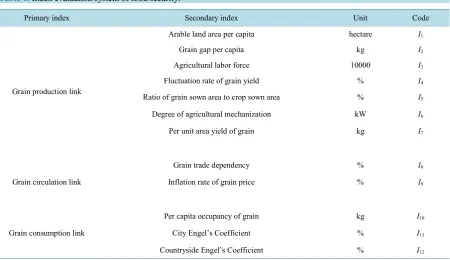
In grain consumption link, consumer’s payment ability is an important factor to measure food security level (Du, 2013) [17]. Grain consumption is closely related to food consumption, the close relationship of them is re-flected in two aspects: first, consuming grain as food directly; second, indirect consumption that transfer grain to meat, egg, milk and other foods. The FAO divided food consumption into five levels according to the bigness of Engel’s Coefficient, 0 - 0.29 belongs to the richest level, 0.30 - 0.39 belongs to the rich level, 0.40 - 0.49 be-longs to the well-off level, 0.50 - 0.59 bebe-longs to warm and feed level, and 0.60 - 1 bebe-longs to poor level. Al-though consumption structure differences exist between different counties and districts, the Engel’s Coefficient provides us a perspective to judge consumer’s consumption level and payment ability from economical point of view. This paper takes city Engel’s Coefficient and countryside Engel’s Coefficient as index I11 and I12 (shown in Table 1).
3. Empirical Analysis of Food Security in China
3.1. Data Source
[image:4.595.88.539.456.716.2]1) The arable land area per capita, fluctuation rate of grain yield, degree of agricultural mechanization and other indexes mainly come from statistical yearbooks. 2) The grain import and export data of year 1978-1984 comes from the book “Who Will Feed Us” of Mr. Xiangzhi Kong; the grain trade dependency data are mainly from “Chinese Agriculture Development Report” 2002 and 2012; the data of year 2013 is calculated from the national statistical bulletin. 3) The Engel’s Coefficients in city and countryside from 1978-2012 are from the “China Civ-il Affairs’ Statistical Yearbook” over the years (the data of 1979 is missing, calculated by method of linear in-terpolation). Among the 12 indexes affecting food security, index I1, I3, I5, I6, I7 and I10 are positive index, a bigger numerical value of which represents a higher level of food security; index I2, I4, I8, I9, I11 and I12 are re-verse index, a higher numerical value of which represents a lower level of food security. In order to compare and analyze the indexes owning different dimensions and directions, this paper takes min-max standardization me-thod to do normalizing processing of each index; the specific formula is as follows:
Table 1.Index evaluation system of food security.
Primary index Secondary index Unit Code
Grain production link
Arable land area per capita hectare I1
Grain gap per capita kg I2
Agricultural labor force 10000 I3 Fluctuation rate of grain yield % I4 Ratio of grain sown area to crop sown area % I5 Degree of agricultural mechanization kW I6 Per unit area yield of grain kg I7
Grain circulation link
Grain trade dependency % I8 Inflation rate of grain price % I9
Grain consumption link
Formula of positive index:
* I MinIi I
MaxI MinI − =
− (3) Formula of reverse index:
* MaxI Ii I
MaxI MinI − =
− (4) Through above formulas, the standardized numerical matrix of each food security index from year 1978-2013 is calculated out.
3.2. Factor Analysis
The weight of each evaluation index is a significant element for final evaluation results of China food security. There are subjective method and objective method to determine the weight of each index. As the indexes are numerous, and one evaluation index is closely related to each other, there are overlapping among them. Subjec-tive weight determining method can’t be used to evaluate food security because it cannot reflect the inner link, which will affect the accuracy and objectivity of evaluation results (Fu, 2011) [18]. In order to eliminate the in-terference caused by the correlation between the evaluation indexes, and objectively reflect food security situa-tion in China, this paper uses factor analysis method.
Factor analysis is one kind of statistical method to extract few representative public factors from numerous variables, explain and analyze the relationship between variables, by means of dimension reduction. Correlation and public factor must exist between the original variables; it is the precondition of factor analysis. Therefore, we need to test the correlation between variables before factor analysis.
3.2.1. Statistical Test
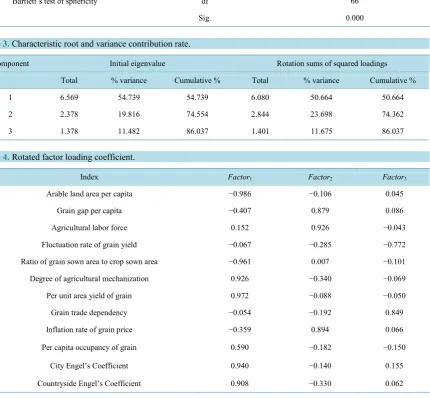
There are Bartlett Test of Sphericity and KMO (Kaiser-Meyer-Olkin) Test to judge whether the variables are suitable for factor analysis. Test results are illustrated in Table 2. The value of KMO test is 0.627. Value range of KMO test given by Kaiser (1974) [19] is (0, 1); the value is more close to 1, it is more suitable to do factor analysis; when KMO > 0.6, factor analysis feasible. The P value of Bartlett test is 0.000, passing the test.
3.2.2. Factor Selecting and Naming
We select factor from variables by using main ingredient analysis method to do factor analysis, and combining the principle that the cumulative contribution rate of main ingredient variance exceeding 85% and the characte-ristic root is greater than 1. Table 3 shows that the characteristic roots of first three factors are all bigger than 1, the cumulative contribution rates of variance is 86.03%, which means the three main factors could well replace the original 12 indexes to describe and explain food security problem in China. The three main factors ab-stracted are named as factor 1, factor 2, and factor 3.
In order to better observe load relation between the public factors and variables, the maximum variance me-thod is used to do orthogonal rotation for the factor-loading matrix. Changing the contribution rate of each factor while the cumulative variance contribution rate remains unchanged to make the factor loading coefficient values differentiating to 0 or 1.
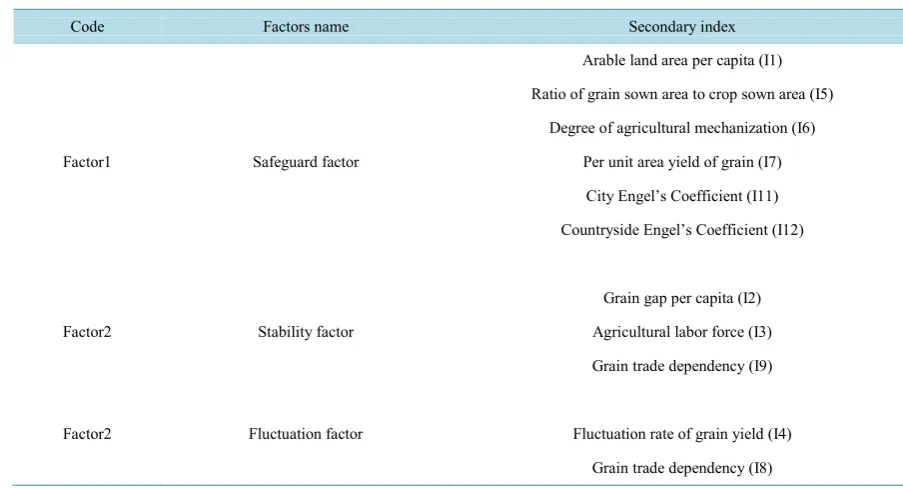
Illustrated in Table 4, the arable land area per capita, city Engel’s Coefficient, countryside Engel’s Coeffi-cient, ratio of grain sown area to crop sown area, degree of agricultural mechanization, per unit area yield of grain and other variables mainly represent grain supply ability and access ability, undertake safeguarding func-tion in food security, and have higher loading coefficients in factor 1. Therefore, the first main factor is named as safeguarding factor. The factor 2 has higher loading coefficients in the grain trade dependency, grain gap per capita, agricultural labor force and other variables that influence the stability of food security, thus is named as stability factor. At last, the factor 3 has higher loading coefficients in the inflation rate of grain price, fluctuation rate of grain yield and other variables, thus is named as fluctuation factor.
3.2.3. Food Security Score
Table 2.KMO and bartlett’s test.
Kaiser-Meyer-Olkin (KMO) measure of sampling adequacy 0.627
Bartlett’s test of sphericity
Approx chi-square 850.791
df 66
[image:6.595.108.539.143.541.2]Sig. 0.000
Table 3. Characteristic root and variance contribution rate.
Component Initial eigenvalue Rotation sums of squared loadings Total % variance Cumulative % Total % variance Cumulative %
1 6.569 54.739 54.739 6.080 50.664 50.664
2 2.378 19.816 74.554 2.844 23.698 74.362
3 1.378 11.482 86.037 1.401 11.675 86.037
Table 4.Rotated factor loading coefficient.
Index Factor1 Factor2 Factor3
Arable land area per capita −0.986 −0.106 0.045 Grain gap per capita −0.407 0.879 0.086 Agricultural labor force 0.152 0.926 −0.043 Fluctuation rate of grain yield −0.067 −0.285 −0.772 Ratio of grain sown area to crop sown area −0.961 0.007 −0.101 Degree of agricultural mechanization 0.926 −0.340 −0.069 Per unit area yield of grain 0.972 −0.088 −0.050 Grain trade dependency −0.054 −0.192 0.849 Inflation rate of grain price −0.359 0.894 0.066 Per capita occupancy of grain 0.590 −0.182 −0.150
City Engel’s Coefficient 0.940 −0.140 0.155 Countryside Engel’s Coefficient 0.908 −0.330 0.062
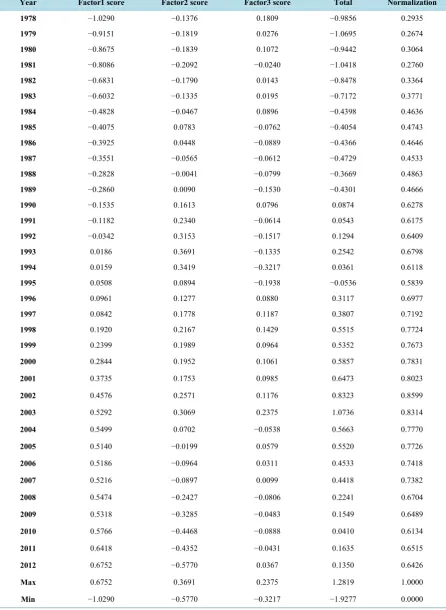
to multiply the score of the each factor, and then add them together, we can get the comprehensive score of China’s food security level from 1978 to 2012. The weight of each factor is explained by their variance contri-bution. The formula is as follow:
1factor1 2factor2 3factor3
t t t t
E =
β
+β
+β
(5) E means comprehensive score of food security, t means year (t = 1978…2012), β means weight. After calcu-lation, the food security score of each factor and the comprehensive score of food security in China over the past years are illustrated inTable 5.3.3. Empirical Result Analysis
Table 5. Factor analysis result of food security.
Year Factor1 score Factor2 score Factor3 score Total Normalization
1978 −1.0290 −0.1376 0.1809 −0.9856 0.2935
1979 −0.9151 −0.1819 0.0276 −1.0695 0.2674
1980 −0.8675 −0.1839 0.1072 −0.9442 0.3064
1981 −0.8086 −0.2092 −0.0240 −1.0418 0.2760
1982 −0.6831 −0.1790 0.0143 −0.8478 0.3364
1983 −0.6032 −0.1335 0.0195 −0.7172 0.3771
1984 −0.4828 −0.0467 0.0896 −0.4398 0.4636
1985 −0.4075 0.0783 −0.0762 −0.4054 0.4743
1986 −0.3925 0.0448 −0.0889 −0.4366 0.4646
1987 −0.3551 −0.0565 −0.0612 −0.4729 0.4533
1988 −0.2828 −0.0041 −0.0799 −0.3669 0.4863
1989 −0.2860 0.0090 −0.1530 −0.4301 0.4666
1990 −0.1535 0.1613 0.0796 0.0874 0.6278
1991 −0.1182 0.2340 −0.0614 0.0543 0.6175
1992 −0.0342 0.3153 −0.1517 0.1294 0.6409
1993 0.0186 0.3691 −0.1335 0.2542 0.6798
1994 0.0159 0.3419 −0.3217 0.0361 0.6118
1995 0.0508 0.0894 −0.1938 −0.0536 0.5839
1996 0.0961 0.1277 0.0880 0.3117 0.6977
1997 0.0842 0.1778 0.1187 0.3807 0.7192
1998 0.1920 0.2167 0.1429 0.5515 0.7724
1999 0.2399 0.1989 0.0964 0.5352 0.7673
2000 0.2844 0.1952 0.1061 0.5857 0.7831
2001 0.3735 0.1753 0.0985 0.6473 0.8023
2002 0.4576 0.2571 0.1176 0.8323 0.8599
2003 0.5292 0.3069 0.2375 1.0736 0.8314
2004 0.5499 0.0702 −0.0538 0.5663 0.7770
2005 0.5140 −0.0199 0.0579 0.5520 0.7726
2006 0.5186 −0.0964 0.0311 0.4533 0.7418
2007 0.5216 −0.0897 0.0099 0.4418 0.7382
2008 0.5474 −0.2427 −0.0806 0.2241 0.6704
2009 0.5318 −0.3285 −0.0483 0.1549 0.6489
2010 0.5766 −0.4468 −0.0888 0.0410 0.6134
2011 0.6418 −0.4352 −0.0431 0.1635 0.6515
2012 0.6752 −0.5770 0.0367 0.1350 0.6426
Max 0.6752 0.3691 0.2375 1.2819 1.0000
Table 6. Index component of factor.
Code Factors name Secondary index
Arable land area per capita (I1) Ratio of grain sown area to crop sown area (I5)
Degree of agricultural mechanization (I6) Factor1 Safeguard factor Per unit area yield of grain (I7)
City Engel’s Coefficient (I11) Countryside Engel’s Coefficient (I12)
Grain gap per capita (I2) Factor2 Stability factor Agricultural labor force (I3)
Grain trade dependency (I9)
Factor2 Fluctuation factor Fluctuation rate of grain yield (I4) Grain trade dependency (I8)
the average annual growth rate is up to 4.5%, and even more higher in years 1995 to 2002. The second phase is from 2002 to 2012, in these ten years, the scores of food security in China represent a downward trend, except 2011.
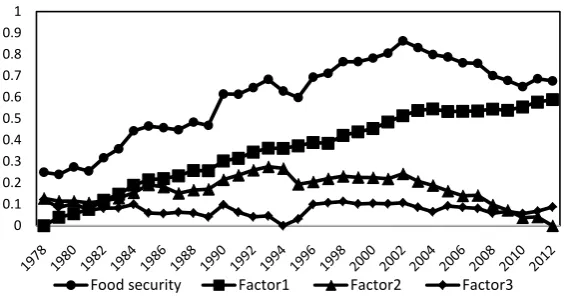
In order to explore the reason why the scores change, and find the key elements that restrict China’s food se-curity, we made further analysis of the factors influencing food security. Table 3 shows that the first main in-gredient, the safeguarding factor, has a largest variance contribution rate, the second factor and third factor de-crease accordingly, thus we can make preliminary judgment that the safeguarding factor has a largest impact on improving food security level, the stability factor has a relative large impact, and the fluctuation factor has a small impact. The score of each factor over the years can further explain the determinants affecting food security. Figure 1 shows that the food security situation represents an upward trend when the safeguarding factor score stay in rapid raising phase, which means China’s food security situation largely depends on growth rate of the safeguarding factor score. The scores of stability factor have a large fluctuation before 2002, and have almost the same change trend with the food security situation, a decline trend, which means the stability factor is re-stricting food security level. The score of fluctuation factor maintains a stable trend; the factor score weight is low, generally remaining at around 10%, showing the fluctuation factor has a small impact on food security.
4. Countermeasures and Suggestions
Figure 1. The variability in food security and each factor score. The data are standar-dized by the min-max normalization.
In order to eliminate the structural contradiction between grain production and demand, and secure China’s food security, this paper proposed the following policy suggestions:
Firstly, it is necessary to increase financial supporting strength to agriculture, improving grain production ability. The fragility and quasi-public goods properties of grain industry determine that the improvement of grain production ability needs the increasing of financial supporting. In total, it is improving the share of agri-culture supporting financial expenditure in total financial expenditure to promote the development of grain in-dustry. On the structure of agriculture financial expenditure, it is necessary to increase finance to the basic agri-cultural construction, improve agriagri-cultural production conditions, and improve the efficiency of grain production. It is also vital to strengthen financial investment in agricultural science and technology, and promote the devel-opment of agricultural science and technology to realize the modernization of grain production. Continuously, it is necessary to strengthen the grain subsidies, increase the income of grain farmers and improve their enthusiasm to expand grain crops planting area and increase grain production effectively.
Secondly, we need to establish long-term effective mechanism to protect cultivated land, and reduce the con-straints of cultivated land resource on food security. In terms of total cultivated land, we need to insist on the red line of 1.8 billion mu of arable land, and put an end to occupation of cultivated land, developing and reforming land to improve the utilization of land resources and increase arable land area effectively, in terms of cultivated land quality, strictly implementing the “high standard basic farmland construction specification”. It is vital to reform land, improve the land quality and increase the proportion of high quality cultivated land.
Thirdly, under the perspective of grain consumption, we need to improve the utilization rate of grain and re-duce the increasing rate in grain demand, to ease the structural contradictions of China’s food security. In grain production and processing link, for example, we can put stress on supporting grain second processing and fi-nishing processing enterprises and improve the conversion rate from grain into meat, eggs and milk. In the grain circulation link, we can establish modern grain purchase and storage system and transportation system, and re-duce the loss of grain in circulation. In grain consumption link, advocate healthy and green food consumption idea, set up consumption consciousness of “love grain, treasure grain and save grain”, and change the unreason-able consumption idea that pursuit of “bright, white and fine”. To ensure China’s food security, we not only need to open up the source, but also need to regulate the flow.
References
[1] Brown, L.R. (1995) Who Will Feed China? Wake-Up Call for a Small Planet. WW Norton & Company.
[2] Ma, X.H., Lan, H.T. and Huang, H.Q. (2005) International Experience of Industry Nurturing Agriculture and Influen-cing on Choice of Agricultural Policy in China. Management World, 21, 55-63.
[3] Yu, Z.G. and Hu, X.P. (2003) Research on the Relation of Food Security and Cultivated Land’s Quantity and Quality in China. Geography and Territorial Research, 19, 45-49. http://dx.doi.org/10.3969/j.issn.1672-0504.2003.03.013 [4] Fu, Z.Q., Cai, Y.L. and Yong, Y.X. (2001) Research on the Relationship of Cultivated Land Change and Food Security
in China. Journal of Natural Resources, 16, 313-319. http://dx.doi.org/10.3321/j.issn:1000-3037.2001.04.003 [5] Chen, Y.F. (2005) Supply and Demand of Grain in China: A Projection. Problem of Agricultural Economy, 4, 8-14.
0 0.1 0.2 0.3 0.4 0.5 0.6 0.7 0.8 0.9 1
http://dx.doi.org/10.3969%2fj.issn.1000-6389.2005.04.002
[6] Yang, X.L. and Zhang, S.J. (2010) The Present Situation of China Food Security and the Countermeasure of Solving the Question. Economic Reviews, 25, 46-49.
[7] Mao, Y.S. (2004) On Food Security in China Again. Journal of Shanghai University of Finance and Economics, 6, 3-6.
http://dx.doi.org/10.3969%2fj.issn.1009-0150.2004.04.001
[8] He, X.R., Xaio, H.F., Zhu, Q.R. and Li, P. (2004) Estimation of China’s Food Security. China Rural Survey, 25, 14-21. [9] Wu, W.B, Yang, P., Tang, H.J., Zhou, Q., Chen, Z.X. and Shibasaki, R. (2010) A New Method of Food Safety
As-sessment. Chinese Journal of Agricultural Resources and Regional Planning, 31, 16-21.
[10] Ma, J.J., Zhang, X.S. and Gui, H.B. (2001) A Study on Assessment Indexes for the Alert System of Food Security. Management World, 17, 154-162.
[11] Liu, X.M. (2004) A Discussion on Systematic Evaluation Indicators for Food Security. Finance &Trade Economics, 25, 56-61.
[12] NBS (2005) Researching Group of Rural Survey Organization of the Research of System of Indicators to Evaluate Food Supply Security of China. Statistical Research, 22, 3-9.
[13] Fan, D.J. (2013) On the Sustainable Effect of Outflow of Rural Labor Force on Grain Production—An Analysis Based on Provincial Panel Data in Different Areas. Modern Finance and Economics—Journal of Tianjin University of Finance and Economics, 33, 57-69.
[14] Liu, J.H., Li, L.J. and Wang, Z.M. (2004) Study on Food Security Index of China. Journal of Agricultural Science and Technology, 5, 10-16.
[15] Huang, J.K. and Hu, R.F. (2000) Government-Major Funding Source of Agricultural S&T. Forum on Science and Te- chnology in China, 20, 59-62.
[16] Hu, J. (2000) China’s Grains Security: The Nature of Public Goods and Long Term Policy Focus. China Rural Survey,
21, 24-30.
[17] Du, Y.N. (2013) China’s Food Security Problem under the National Industrialization Urbanization and Agricultural Modernization. Doctor Thesis, University of Science and Technology of China, Hefei.
[18] Fu, Y.H., Wang, Z.X. (2011) An Evaluation of Quality of Utilizing FDI in High-Technology Industry. Finance & Tra- de Economics, 32, 74-80.