Munich Personal RePEc Archive
Forecasting performance of Logistic
STAR exchange rate model: The original
and reparameterised versions
Liew, Venus Khim-Sen and Baharumshah, Ahmad Zubaidi
and Lau, Sie-Hoe
September 2002
Online at
https://mpra.ub.uni-muenchen.de/511/
Forecasting Performance of Logistic STAR Exchange Rate Model: The Original and Reparameterised Versions
Venus Khim-Sen Liewa, Ahmad Zubaidi Baharumshahb, and Sie-Hoe Lauc,*
a
Labuan School of International Business and Finance, Universiti Malaysia Sabah.
b
Department of Economics, Faculty of Economics and Management, Universiti Putra Malaysia.
c
Faculty of Information Technology and Quantitative Science, Universiti Teknologi MARA, Sarawak Campus.
Abstract
Exponential Smooth Transition Autoregressive (ESTAR) model is widely adopted in the exchange rate study as its symmetrical distribution matches that of the symmetrical exchange rate adjustment behaviour. In contrast, another specification of STAR model,
namely the LSTAR (logistic STAR) model is discarded by most researchers in priori in
their exchange rate modeling exercises due to its undesired property of being asymmetry. This study is the first of its kind in examining the validity of this hypothesis that the ESTAR exchange rate model is superior to LSTAR exchange rate model on the basis of forecasting accuracy. Based on the experience of the adjustment process of two nominal exchange rates, we find that the hypothesis is merely theoretical since we fail to provide consistent empirical evidence in favour of the null hypothesis. This warrants us that we need not be too pessimistic on the usage of LSTAR model in exchange rate study. In our effort to rekindle the usage of LSTAR model, we further reparameterized the original version into the so-called absolute version, which has symmetrical distribution properties, in accordance with the well-known symmetrical adjustment process of exchange rate. The resulting ALSTAR model has proven to be a more promising model in the sense that it has improved significantly from its original version as well as the ESTAR model, which has thus far been deemed the most appropriate nonlinear exchange rate model.
JEL Classification: F31, C53
Keywords: LSTAR, ESTAR, forecasting accuracy, nonlinear, exchange rate
Forecasting Performance of Logistic STAR Exchange Rate Model: The Original
and Reparameterised Versions
1. Introduction
A number of empirical studies have documented that exchange rate behavior may be well
characterized by the Smooth Transition Autoregressive (STAR) process (Taylor and
Sarno, 1998; Sarantis, 1999; Taylor and Peel, 2000; Sarno, 2000; Baum et al., 2001;
Guerra, 2001; Liew et al., 2004). STAR model is a nonlinear econometric model that is
able to capture the movement of exchange rate, which adjusts every moment but the
speed of adjustment varies with the size of exchange rate deviations. The STAR model
for a mean corrected variable of interest, zt−d may be parameterized as:
t
z = ∑
= − p
1 i i t i
z
β + (∑
= − p
1 i i t i
z *
β )F(zt−d) + εt (1)
whereβi and
*
i
β , i = 1, …, p are autoregressive parameters, F(·) is the transition
function depending on the lagged level, zt−d where d is known as the delay length or
delay parameter, and εt is a white noise with zero mean and constant variance.
Two forms of transition function given in Teräsvirta (1994) are the logistic function
and the exponential function
F(zt−d) = 1 – exp[–γ 2(zt−d)2] (3)
where γ2stands for the transition parameter, which measures the speed of adjustment.
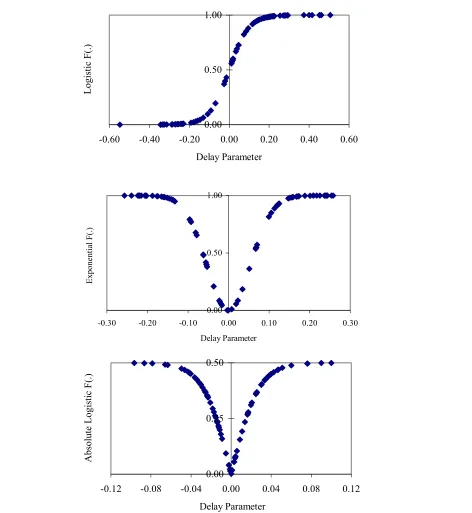
A plot of these typical transition functions with respect to the delay parameter is depicted
in Figure 1. It is clear from the Figure 1 that logistic transition function has a S shape
distribution (top panel), while exponential transition function has symmetrical
inverted-bell shape distribution (middle panel). Note that values of these functions lie between 0
and 1; see Teräsvirta (1994) for theoretical issues on these functions.
STAR model (1) with specification (2) is known as ESTAR or exponential STAR model,
whereas with specification (3) is termed LSTAR or logistic STAR model. These two
models have quite different empirical implication of dynamic exchange rate behaviour.
The LSTAR model describes the asymmetrical nonlinear adjustment process, while the
ESTAR model suggests symmetrical nonlinear adjustment process (Sarantis, 1999).
LSTAR is a monotonic increasing function of zt−dand yields asymmetric adjustment
towards equilibrium (top panel, Figure 1). However, the theoretically assumption that
exchange rate adjustment is symmetric implies LSTAR model as inappropriate for
ESTAR model as the correct represent of exchange rate (for instance, Taylor and Peel;
2000 and Sarno, 2000)1. In order to revitalize the use of LSTAR model, we propose to
reparameterize LSTAR model, with logistic function specified as
F(zt−d) = [1 + exp(-γ 2|zt−d|)]-1-½ (4)
where | · | implies absolute value.
We refer to the resulting model as ALSTAR (absolute LSTAR) to differentiate it from
the original specification (2). The absolute logistic transition function (4) allows a
V-shaped (similar to inverted bell-V-shaped, but with sharp vertex) symmetry adjustment
process of the exchange rate towards the mean of zt that is zero in our case. This logistic
F(·) is bounded between zero and one-half, with F(·) → 0 when γ 2→ 0 and F(·) → ½
when γ 2→∞. The plot of our proposed absolute transition function is given in the lower
panel of Figure 1. The V shape distribution, with values between 0 and 0.5 are explicitly
shown in Figure 1. We will show later, that this specification of LSTAR is also capable
of describing the symmetrical behavior in exchange rates.
1
0.00 0.50 1.00
-0.60 -0.40 -0.20 0.00 0.20 0.40 0.60
Delay Parameter
Logistic F(.)
0.00 0.50 1.00
-0.30 -0.20 -0.10 0.00 0.10 0.20 0.30
Delay Parameter
Exponential F(.)
[image:6.612.98.570.93.606.2]Note: Values in the plots are hypothetical.
Figure 1: Theoretical shapes of various transition functions 0.00
0.25 0.50
-0.12 -0.08 -0.04 0.00 0.04 0.08 0.12
Delay Parameter
The objectives of this paper are: First, to evaluate the forecasting performance of LSTAR
model with respect to the ESTAR model. With this approach, effectively we are
providing a platform to examine how far the hypothesis that ESTAR model is more
relevant in characterizing the exchange rate adjustment process than the LSTAR model
could be justified. Second, to evaluate our proposed ALSTAR model using linear
autoregressive (AR) model, LSTAR model and ESTAR model as benchmark. These
objectives could be accomplished based on the mean square error (MSE) and the
robustness of this criterion is subjected to Meese and Rogoff (1988) test.
This paper proceeds as follows. Our research methodology is described in Section 2,
whereas results of this study and discussions are presented in Section 3. Our conclusions
are given in the final section.
2. Methodology
Data
The data employed in this study includes yen-based nominal exchange rates (domestic
price of foreign money) and relative prices (proxied by the ratio consumer price indices).
Quarterly data series from two ASEAN neighboring countries, namely Malaysia and
Thailand are collected from the International Financial Statistics, published by
International Monetary Fund. Our sample period ranges from 1980:1 to 2001:2. The
for model estimation, while the rest are kept for assessing the out-sample forecast
performance of the studied models.
Standard augmented Dickey Fuller unit root has been performed on these data and results
(available upon request) reveal that they are all integrated of order one. In addition, the
exchange rates involved are found cointegrated with their respectively relative prices
(ratio of domestic price to foreign price) based on the commonly used Johensen and
Juselius procedure (available upon request). This is supportive of the long run purchasing
power parity hypothesis, which implies that exchange rates adjust towards their
equilibrium Purchasing Power Parity (PPP) values in the long run, although deviations
may occur due to transaction costs in the short run (Dumas, 1992). The theoretical
no-arbitrage model of Dumas that exchange rates adjustment are nonlinear in nature may be
tested by performing the linearity test of as described in Luukkonen et al. (1988) on the
deviations (in this study, zt) of exchange rate, from the equilibrium level.
Linearity Test
We employ auxiliary regression of the following specification
t
z = α0 + p( * t i t d i* t t2d)
1
i i t d i
z z z
z
z − − −
= − + +
∑ α α δ + *τ zt3−d+ωt (5)
The null hypothesis to be tested is that
0
H : * *
i i δ
where the optimal lag length, p and the delay parameter, d have to be determined in
advance2. This null hypothesis may be tested using the Lagrange Multiplier (LM) type
test statistic as described in Luukkonen et al. (1988); see Teräsvirta (1994) also.
Rejection of null hypothesis (6) implies exchange rate adjusts nonlinearly as
characterized by the STAR. One may proceed on a subset of tests if the objective is to
check whether LSTAR or ESTAR is the correct specification. Nonetheless, there is a
possibility that both models are appropriate. In such case, Escribano and Jorda (2001)
suggest to choose the one with smaller marginal significance value of LM statistic.
However, the selection may be postponed to the final stage of model evaluation via
certain criteria (Teräsvirta, 1994). This study focuses on forecasting performance; hence,
the chose of model specification is not our concern here.
Forecasting performance criteria
The overall in-sample (65 quarterly observations) and out-sample performance of the
estimated absolute LSTAR model over the forecast horizon of n =14 over the period
1997:3 to 2000:4 are evaluated by taking the linear AR (p) and ESTAR models as the
benchmark3. The criterion involved is the ratio of forecast error measured in mean square
error (MSE), with the forecast error of benchmark model as denominator. We compute
the Meese and Rogoff (1988) MR statistic to check the statistical significance of the MSE
criteria. MR for finite sample is given by
2
Following Liew et al. (2004), p is determined by AICC, the Akaike information criterion (biased
corrected version) and for 1≤d≤12, the optimal value is the one that provides the smallest marginal
significance value of the LM test statistic.
3
MR =
∑
= n 1 j 2 j 2 j 2 UV v u n 1 s∼
asyN (0, 1) (7)
where U and V are transformed functions of forecast errors of two rival models; sUV is
the sample covariance of means of U and V and is approximated by
) ( )
(u u v v
n 1 j n 1 j
j − −
∑
=
where
∑
= = n 1 j j u n 1
u and
∑
= = n 1 j j v n 1
v with uj =e1j−e2jand
j 2 j 1 j e e
v = + in which eij, i = 1, 2 is the jth forecast error of model i; and n is the number
of forecasts.
The null hypothesis of MR statistic, which states that cov (U, V) = 0 implies evaluating
whether MSE1 = MSE2. If MR statistics is significantly different from the critical values
(from Z table if n is large enough, t table otherwise), the improving in forecasting
accuracy in model 1 over model 2 in the MSE ratio will then be statistically significant.
3. Results and Discussions
Linearity Test
The results of linearity tests suggest that the null of linearity has been rejected, at
standard significance levels, in favor of both the LSTAR and ESTAR specifications.4
4
Thus LSTAR model with p = 1 and d = 4 is an appropriate representation of the ringgit
adjustment process. One the other hand, this series could be characterized by ESTAR
model with p = 1 and d = 2 as well. As for the adjustment of the baht, it is described by
both LSTAR model with p = 3 and d = 1 and ESTAR model with p = 3 and d = 5.
Residual diagnostic by the Ljung Box portmanteau Q statistic shows that all models are
free from serial correlation, which is normally associated with autoregressive model.
[image:11.612.95.544.360.420.2]These results are summarized in Table 1.
Table 1
Linearity Test Results
Marginal Significance Values Exchange Rate
Deviations
p
dLS LMLS Test Q (20) dES LMESTest Q (20)
MYR/JPY 1 4 0.056 0.219 2 0.025 0.445
THB/JPY 3 1 0.016 0.579 5 0.001 0.995
Notes: Lagrange Multiplier (LM) test tests for the null hypothesis of H0: Linear model is
correct. Rejection of H0 by the LMLS (LMES Test) test implies the presence of nonlinearity
in favour of LSTAR (ESTAR) model. dLS(dLS) stands for optimal delay lag length that
minimizes the marginal significance value of LMLS (LMES) test. Ljung-Box Q statistic [Q
(20)] detects the presence of serial correlation in the model’s residuals up to 20 lags, if any.
Estimated Models
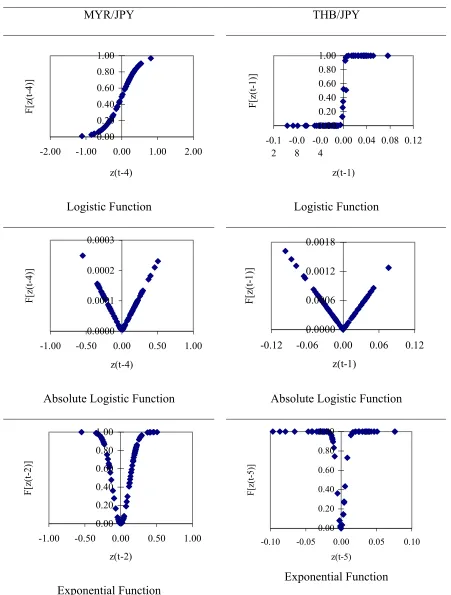
The estimated models are tabulated in Table 2. As serial correlation is a major problem in
any time series model, we include the Ljung Box Portmanteau (Q) test to detect the
presence of serial correlation. The p-values of these Q statistics indicate that all estimated
characterizing the adjustment process of MYR/JPY and THB/JPY towards the long-run
PPP equilibrium. As a measure to check whether the nonlinear specification is correct,
we employ the overall significance F test. The null hypothesis of this F test is that the
linear specification is correct. Results show that the joint effect of the nonlinear
parameters and the transition parameter in each model is significance at standard levels,
indicating that the linear specification has been rejected in favour of the STAR
specification. In addition, we find that STAR model yields smaller variance than their
linear counterpart, indicating that it potential to produce smaller forecast error than the
AR model (Teräsvirta and Anderson, 1993). The last two finding confirms that the
adjustment process of MYR/JPY and THB/JPY towards the long-run PPP equilibrium is
of nonlinear nature. Thus, this study has provided further empirical evidence on the
existence of the nonlinear dynamic in the context of ASEAN foreign exchange market, in
accordance to Lim et al. (2002).
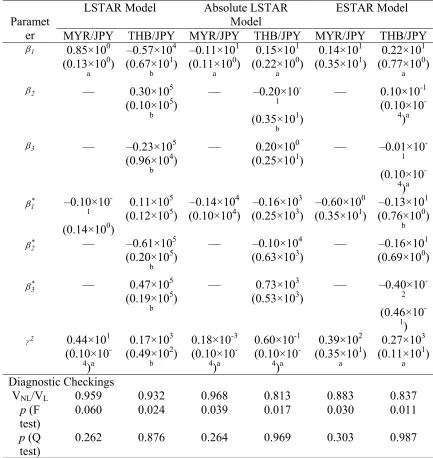
The empirical distributions of various transition functions are given in Figure 2. The top
panel depicts the logistic functions for the MYR/JPY (left) and THB/JPY (right) rates.
This function is a monotonic increasing function of exchange rate deviations as expected,
with speed of transition varies across exchange rates. In particular, the MYR/JPY
adjustment is a smooth and steady process, whereas the THB/JPY adjustment is speedy
and abrupt. The V shape distribution of absolute transition function is plotted at the
middle panel of Figure 2. This figure shows that there are satisfactorily equal amount of
negative and positive adjustments around the equilibrium level (indicated by the zero
process of exchange rates could be well characterized by the absolute LSTAR model.
Finally, the empirical distributions of exponential functions, which are in line with most
related studies, are given in the bottom panel of Figure 2. This is not surprising, as it has
been well documented that this function fitted the symmetrical adjustment of exchange
Table 2
Estimated STAR Models
LSTAR Model Absolute LSTAR
Model
ESTAR Model Paramet
er MYR/JPY THB/JPY MYR/JPY THB/JPY MYR/JPY THB/JPY
1
β 0.85×100
(0.13×100)
a
–0.57×10⁴
(0.67×101)
b
–0.11×101
(0.11×100)
a
0.15×101
(0.22×100)
a
0.14×101
(0.35×101)
0.22×101
(0.77×100)
a
2
β –– 0.30×10⁵
(0.10×10⁵)
b
–– –0.20×10
-1
(0.35×101)
b
–– 0.10×10⁻¹
(0.10×10
-4
)a
3
β –– –0.23×10⁵
(0.96×10⁴)
b
–– 0.20×100
(0.25×101)
–– –0.01×10
-1 (0.10×10 -4 )a * 1
β –0.10×10
-1
(0.14×100)
0.11×10⁵
(0.12×10⁵)
–0.14×10⁴
(0.10×10⁴)
–0.16×10³
(0.25×10³)
–0.60×100
(0.35×101)
–0.13×101
(0.76×100)
b
*
2
β –– –0.61×10⁵
(0.20×10⁵)
b
–– –0.10×10⁴
(0.63×10³)
–– –0.16×101
(0.69×100)
*
3
β –– 0.47×10⁵
(0.19×10⁵)
b
–– 0.73×10³
(0.53×10³)
–– –0.40×10
-2
(0.46×10
-1
)
2
γ 0.44×101
(0.10×10
-4
)a
0.17×10³
(0.49×10²)
b 0.18×10⁻³ (0.10×10 -4 )a 0.60×10⁻¹ (0.10×10 -4 )a 0.39×10²
(0.35×101)
a
0.27×10³
(0.11×101)
a
Diagnostic Checkings
VNL/VL 0.959 0.932 0.968 0.813 0.883 0.837
p (F test)
0.060 0.024 0.039 0.017 0.030 0.011
p (Q test)
0.262 0.876 0.264 0.969 0.303 0.987
Notes: Figures in parentheses are standard errors of estimated parameters. Superscript a
and b imply significant at 5% and 10% respectively. VNL/VL stands for ratio of residual
variance of nonlinear model to that of linear model. p (·) stands for p-value of the implied
MYR/JPY THB/JPY 0.00 0.20 0.40 0.60 0.80 1.00
-2.00 -1.00 0.00 1.00 2.00
z(t-4) F[z(t-4)] Logistic Function 0.00 0.20 0.40 0.60 0.80 1.00 -0.1 2 -0.0 8 -0.0 4
0.00 0.04 0.08 0.12
z(t-1) F[z(t-1)] Logistic Function 0.0000 0.0001 0.0002 0.0003
-1.00 -0.50 0.00 0.50 1.00
z(t-4)
F[z(t-4)]
Absolute Logistic Function
0.0000 0.0006 0.0012 0.0018
-0.12 -0.06 0.00 0.06 0.12
z(t-1)
F[z(t-1)]
Absolute Logistic Function
0.00 0.20 0.40 0.60 0.80 1.00
-1.00 -0.50 0.00 0.50 1.00
z(t-2)
F[z(t-2)]
Exponential Function
[image:15.612.99.550.65.660.2]Exponential Function
Figure 2: Plots of estimated transition functions
0.00 0.20 0.40 0.60 0.80 1.00
-0.10 -0.05 0.00 0.05 0.10
z(t-5)
Forecast Accuracy
Our first forecasting accuracy comparison exercise is done using AR model as
benchmark. By observing the MSE ratio, it is clear that all the nonlinear STAR models
have out-predicted the linear AR models in the context of in-sample forecasting (Table
3). This finding is not by chance as the MR statistic has verified that it is significant at
10% or better. One implication of this finding is that STAR model, rather than the
conventional AR model could better explain the past exchange rate behavior. We note
here that apart form being able to explain the past, a good model should also have the
ability to predict the future with satisfactory accuracy. This scenario is observed in a
number of related studies and is once again experienced in this current study5. More
specifically, we find that none of the outstanding performance of LSTAR models (for
MYR/JPY and THB/JPY) can be extended to the out-sample horizon6. As for the ESTAR
model, results are mixed: The ESTAR MYR/JPY model does continue to be more
excellence than its linear counterpart, but the ESTAR THB/JPY model shows reverse
result. Meanwhile, the ALSTAR model seems to be the only promising model that carries
over its outstanding forecasting ability from the in-sample horizon to the out-sample
horizon. This conclusion is drawn from the fact that ALSTAR model remains the only
model that out-predicted its linear counterpart significantly in predicting both the future
behavior of MYR/JPY and THB/JPY adjustments. Hence, while LSTAR model has been
5
For instance, Choo and Ahmad 1999; Tashman, 2000; Liew and Shitan, 2002 documented that models that explained the past best need not necessarily be the best forecasting model.
6
discarded, in the past, due to its inabilities to characterize the symmetrical exchange rate
adjustment behavior, this study has provided an improved version, namely the absolute
LSTAR model, which forecasting performance has been proven promising. This claim
will be more obvious by conducting the next exercise.
Table 3
Overall Forecasting Accuracy with AR as Benchmark
MSE Ratio (MR Test Statistics)
Exchange Rate
LSTAR / AR ALSTAR / AR ESTAR / AR
In-Sample (65 quarters)
MYR/JPY 0.929 (1.978)b 0.146 (1.845)b 0.429 (1.541)b
THB/JPY 0.399 (1.520)a 0.381 (1.477)a 0.523 (1.569)b
Out-Sample (14 quarters)
MYR/JPY 1.008 (4.132)b 0.382 (6.707)b 1.562 (5.561)b
THB/JPY 1.104 (7.721)b 0.438 (6.466)b 0.588 (6.385)b
Notes: MR tests the null hypothesis of “equal accuracy” against two-sided alternative of
“unequal accuracy” in terms of MSE ratio. The 10%, 5% and 1% critical values are
2.326, 1.645 and 1.282 respectively.Superscripts a and b denote significant at 10% and
5% level or better, respectively.
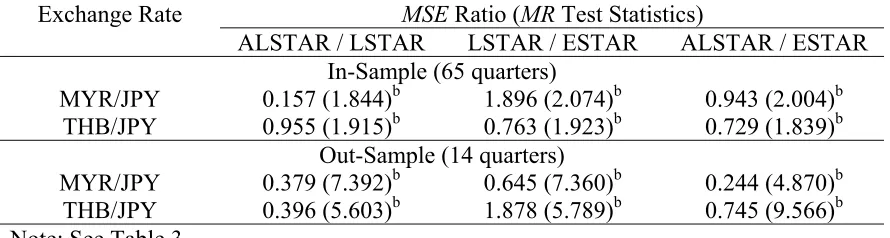
The second forecasting accuracy comparison exercise aims is done within the context of
various STAR models. The results of comparison are tabulated in Table 4. From Table 4,
the original version of LSTAR model is at most comparable to the ESTAR model in both
the in- and out-sample forecasting horizons. Table 4 also reveals that absolute version of
LSTAR has significantly improved over its original version, in all forecasting horizons.
This finding is not surprising since the former, but not the latter could account for
well-documented symmetrical exchange rate adjustment. Our most striking result is that
model in the sense that ALSTAR model has shown its potential in predicting the future
exchange rate adjustment behavior (as far as MYR/JPY and THB/JPY is concerned) with
better accuracy than the ESTAR model, apart from giving better explanation for the past
[image:18.612.103.548.252.371.2]adjustment.
Table 4
Comparison of Overall Forecasting Accuracy among STAR Models
MSE Ratio (MR Test Statistics)
Exchange Rate
ALSTAR / LSTAR LSTAR / ESTAR ALSTAR / ESTAR
In-Sample (65 quarters)
MYR/JPY 0.157 (1.844)b 1.896 (2.074)b 0.943 (2.004)b
THB/JPY 0.955 (1.915)b 0.763 (1.923)b 0.729 (1.839)b
Out-Sample (14 quarters)
MYR/JPY 0.379 (7.392)b 0.645 (7.360)b 0.244 (4.870)b
THB/JPY 0.396 (5.603)b 1.878 (5.789)b 0.745 (9.566)b
Note: See Table 3.
4. Conclusions
The advanced econometric STAR model has been widely applied in the exchange rate
study due to its capability in characterizing the nonlinear exchange rate adjustment
behaviour. To date, two specifications, namely the LSTAR (logistic STAR) and the
ESTAR (exponential STAR) have thus far been proposed. The latter is preferable since
its symmetrical distribution matches that of the symmetrical exchange rate adjustment
behaviour. In contrast, most researchers discard the former in priori in their exchange
rate modeling exercises due to its undesired property of being asymmetry. Nevertheless,
to date, not a single published article has provided empirical evidence on the hypothesis
the basis of forecasting accuracy. Based on the experience of the adjustment process of
two nominal exchange rates, we fail to provide consistent results in favour of the null
hypothesis. This warrants us that we need not be too pessimistic on the usage of LSTAR
model in exchange rate study. In our effort to rekindle the usage of LSTAR model, we
further reparameterized the original version into the so-called absolute version, which has
symmetrical distribution properties, in accordance with the well-known symmetrical
adjustment process of exchange rate. The resulting ALSTAR model has proven to be a
more promising model in the sense that it has improved significantly from its original
version as well as the ESTAR model, which has thus far been deemed the most
appropriate nonlinear exchange rate model.
References
Baum, C. F., Barkoulas, J. T. and Caglayan, M., 2001. Nonlinear adjustment to
Purcahsing Power Parity in the Post-Bretton Woods era. Journal of International
Money and Finance. 20: 379–399.
Choo, W. C. and Ahmad, I. M. 1999. Performance of GARCH models in Forecasting
Stock Market Volality. Journal of Forecasting. 18: 333 – 343.
Dumas, B. 1992. Dynamic equilibrium and the real exchange rate in a spatially seperated
Escribano, A and Jorda, O. 2001. Testing Nonlinearity: Decision Rules for Selecting
between Logistic and Exponential STAR models. Spanish Economic Review. 3: 193 –
209.
Guerra, R. 2001. Nonlinear Adjustment towards Purchasing Power Parity: The Swiss
Franc – German Case. Working Paper. Department of Economics, University of
Geneva, Geneva.
Luukkonen, R. Saikkonen, P. and Teräsvirta, T. 1988. Testing linearity against Smooth
Transition Autoregressive Models. Biometrika. 75: 491– 499.
Meese, R. A. and Rogoff, K. 1988. Was Is Real? The Exchange Rate-Interest Differential
Relation over the Modern Floating Rate Period. Journal of Finance. 43: 933 – 948.
Liew, V. K. S., Baharumshah, A. Z. and Lau, E. 2004. Nonlinear Adjustment to
Purchasing Power Parity in ASEAN Exchange Rates. ICFAI Journal of Applied
Economics. 3(6): 7 – 18.
Liew, K. S. and Shitan, M. 2002. The Performance of AICC as Order Determination
Criterion in the Selection of ARMA Time Series Models. Pertanika Journal of
Science and Technology. 10(1): 25 – 33.
Lim, K. P. , Mohamed, A. and Habibullah, M. S. 2002. Non-linear Dependence in
ASEAN-5 Foreign Exchange Rates. Proceeding of Asian Pacific Economics and
Business Conference, 2nd – 4th October, 2002, Kuching, Sarawak, Malaysia.
Sarantis, N. 1997. Modeling Non-linearities in Real Effective Exchange Rates. Journal of
International Money and Finance. 18: 27 – 45.
Sarno, L. 2000. Real exchange rate behaviour in high inflation countries: empirical
Tashman, L. J. 2000. Out-of-sample Tests of Forcasting Accuracy: An Analysis and
Review. International Journal of Forecasting. 16: 437 – 450.
Taylor, M. P. and Peel, D. A. 2000. Nonlinear adjustment, long-run equilibrium and
exchange rate fundamentals. Journal of International Money and Finance. 19: 33 –
53.
Taylor, M. P. and Sarno, L. 1998. The behaviour of real exchange rates during the
post-Bretton Wood period, Journal of International Economics, 46, 261 – 312.
Teräsvirta, T. 1994. Specification, estimation, and evaluation of Smooth Transition
Autoregressive Models. Journal of the American Statistical Association. 89(425):
208–218.
Teräsvirta, T. and Anderson, H. M. 1993. Characterizing nonlinearities in business
cycles using Smooth Transition Autoregressive Models. In in M. H. Pesaran & S.
M. Potter (eds.) Nonlinear Dynamics, Choas and Econometrics. US: John Wiley.
pp. 111–128.
Tong, H. and Lim. K. S. 1980. Threshold Autoregression, limit cycles and cyclical data.