Online Payment – Innovation in Split Tender Payment
R Nagasubramanian
Research Scholar, Vels University, Plot 2A, Andavar Street, Ganapathy Puram, Chrompet,
Chennai – 600 034
S.P.Rajagopalan,
PhD.GKM College of Engineering & Technology,
Chennai- 600 063, India
ABSTRACT
Online Payment is the fastest and secured way of making payments for various purposes like making utility payments, transferring funds and making purchases online. This paper will help to uncover few important value adding features in Split tender payment method which will increase the utility and make it user friendly.
General Terms
This paper talks about a very niche area – online payment gateway and the improvement in existing features which will make it more efficient and user friendly.
Keywords
Online Payment, Split Tender Payment, Multi source Payment, Privacy, performance, vulnerability, PCI DSS.
1.
INTRODUCTION
Online payment portals, though a powerful tool to make our life simple and gives the luxury to make all required payment transactions around any part of the world without leaving the room where you are. Though we can make the payment within few seconds, it involves lots of well defined steps for processing this payment. There are lots of challenges in terms of many systems to be interacted, different security measures to be handled, different protocols to be followed to make this payment to happen. There are increasing concerns about privacy, security and other issues in making online payments which are taken care when the online payment card industries major players comply with PCI-DSS[1]. PCI DSS provides the stamp of security and instills the sense of confidence to the users. In this paper we will discuss few online payment features and various modes of making payment. We will then bring out some additional features in Split Tender payment which will increase the utility, user friendliness of payment gateway systems.
2.
SALIENT FEATURES OF ONLINE
PAYMENT GATEWAY
Key Application features of any online payment gateway includes but not limited to Single Payment Options, Multiple Payment Options, Split Tender Payment Options, Single Sign On(SSO), API Payment Options, Scheduled Payment Options, Recurring Payment Options, Payment Refund, Tiered Convenience Fee Options, Customer Data Import, Bill Data Import, IVR Payment Options, CSR Payment Options, Various Reports.
Key Security Features of online payment portal includes Distributed Application, PCI Compliance System and Tokenization Features.
The [2] Payment Card Industry (PCI) Data Security Standard (DSS) was developed to encourage and enhance cardholder data security [3] and facilitate the broad adoption of consistent data security measures globally. PCI DSS provides a baseline
of technical and operational requirements designed to protect cardholder data. PCI DSS applies to all entities involved in payment card processing – including merchants, processors, acquirers, issuers, and service providers, as well as all other entities that store, process or transmit cardholder data . PCI DSS comprises a minimum set of requirements for protecting cardholder data, and may be enhanced by additional controls and practices to further mitigate risks. Below is a high-level overview of the 12 PCI DSS requirements grouped under the following categories namely Build and Maintain a Secure Network, Protect Cardholder Data, Maintain a Vulnerability Management Program, Implement Strong Access Control Measures, Regularly Monitor and Test Networks, Maintain an Information Security Policy.
3.
INNOVATIONS IN SPLIT TENDER
PAYMENT
3.1
Electronic Payment ( Ecommerce)
Gone are the days when people used to go and do shopping or pay bills in person. Nowadays almost all items can be purchased online by making payment online. Users infact can view the things either as picture or video and can make decisions very quickly. They also have the luxury of making purchase anywhere in the world and getting it delivered right into the place of their choice in a short time. Users can make payment using any one of the payment modes provided by suppliers like credit card, debit card, net banking (savings account) and etc. While making online payment, there are chances that even if you have multiple credit / debit cards also, you cannot use more than one card at a time in a single transaction due to the restrictions provided by the supplier or payment gateway providers for the scenario in which you may want to use more than one card to pay for an item due to insufficient fund in single card. Split tender payment is introduced to alleviate this problem.3.2
Split Tender Payment
Split Tender payment is the option to make payment for the purchase or to pay the fee using more than one mode of payment.
3.3
Options available in existing Split
Tender Payment feature
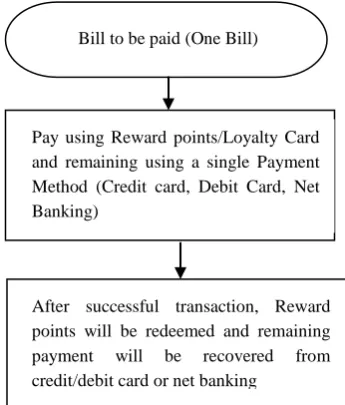
credit card which has the limit of only Rs.6000 and if he has debit card or access to bank account online (net banking), user cannot make the payment as the current systems allow only one type of payment other than reward points. Most of the online merchants who receive payment does not allow the payment from multiple payment processors like Master/Amex/Visa at a time (more than one payment processor in a split tender payment) due to the multiple transactions involved with various processors, ability to track each request and result, charges involved due to more than one payment transactions actually triggered here [5]. The limitation is forced due to various reasons like the ability to interact with more than one bank or service providers and ability of existing system to send request for multiple service providers, get each requests validated, get each request approved and track each responses which may incur more operation cost and technical challenges. Above all it also involves transactions with various payment processors for a single item/invoice which may incur more cost to the merchants concerned which sometimes can be charged from customers and sometimes not due to various business reasons. The possibilities of making split payments is also discussed by few systems in US patent site describing the payment split with royalty card or reward card and making use of one more payment system like credit card/ debit card or by cash [6]. Refer Figure 1 given below which depicts the general overview of existing Split Tender system.
Fig 1: Traditional Split Tender Payment Feature
[image:2.595.94.267.356.559.2]Another important feature is to allow the payment to be made from various payment provider type like Master, Visa and Amex. The bill can be paid using more than one credit or debit card each of which can be from various provider type lie Master/Visa/Amex. For example, a bill of Rs.10000 can be paid using credit card itself by selecting payment method as “Credit card”. Then the payment can be made from more than one credit card. One payment of Rs.5000 can be made from a Master Credit card, another Rs.2000 can be paid using a Visa credit card and another Rs.3000 can be made using a Amex credit card or can use existing Reward points to make this last part of payment.
Fig 2: Proposed Split Tender Payment Feature
Table 1. Comparison between Split Payment Option mode used in Existing and Proposed Online Payment Gateway
Sl. Existing Online Payment Proposed Online Payment
Pay a partial amount using Credit card and/or pay partial amount using Debit card and/or partial payment using net banking and if required
Pay using Reward points/Loyalty Card and remaining using a single Payment Method (Credit card, Debit Card, Net Banking)
Bill to be paid (One Bill)
After successful transaction, Reward points will be redeemed and remaining payment will be recovered from credit/debit card or net banking
Bill to be paid (One Bill)
Select two or more Payment Methods (Credit Card and/or Debit card and/or Net banking and if required use Reward points/Loyalty points
[image:2.595.309.547.578.749.2]3.5
Screens depicting suggested steps of
implementing proposed Split Tender
Feature
Given below the screens which will depict the various steps involved in implementing the proposed Split Tender Feature taking a sample invoice to be paid using multiple payment modes. The sequence of the screens and comment below each screen will guide to understand the proposed Split Tender Payment feature very clearly.
Refer Figure 3 : The screen shows the list of Merchants (Billers available within each Merchant), their invoice number and amount. User need to be registered with the Merchants to avail this facility. A Merchant can have multiple Billers. For example Merchant 1 can be TATA industries and can have multiple billers like Tata Docomo, Tata Motors, Telco and etc.
Refer Figure 4: This screen shows the list of payment modes available in the application through which user can make payment to the billers. There are many options that are configurable from the admin (back end) tool and couple of them are split tender payment, multiple payment, recurring payment and etc. Now in the application, as the split tender payment is enabled, user can choose more than one mode of payment to pay a single bill. Through this screen, user is selecting “Savings” payment mode to pay bill.
Refer Figure 5: This screen shows the details of making payment using Savings mode. Asks for specific information required to make payment here. This is the extension of Figure 4. User also has option to save the information so that it can be re-used when he makes payment using “savings” mode next time and this will make his task easy.
Refer Figure 6: This screen helps to make payment using credit card. Here use is making payment using multiple modes for a single bill. First scheduled partially through “Savings” mode and now scheduling payment through credit card payment mode here. User also has option to save the information so that it can be re-used when he makes payment using “Credit Card” mode next time reducing many information which he needs to enter the next time.
Refer Figure 7: This screen helps to make payment using Check. Here we are using a single bill and making payment using savings, credit card and check payment mode. User also has option to save the information so that it can be re-used when he makes payment using “Check” mode next time reducing many information to be keyed in again.
Refer Figure 8: This screen captures the information like date of making payment using which user can schedule payment. User can also choose to pay the convenience fee which needs to be paid to Merchant to facilitate the payment and this can also be paid using any of the payment mode selected. User can also split the convenience fee and pay using various payment modes selected or can make payment using single payment mode as shown in the figure 7.
Refer Figure 9: This screen shows the summary of schedules made to make payment. It shows the invoice number, biller information, mode of payment opted, amount to be paid for the particular bill , status of the payment (shows “Pending” for scheduled payments that are to be processed, “Paid” for payments made, “New” for new record created for the partial payment made with outstanding amount to be paid) and with Action column that has options like “Void” to stop the payment processing which is scheduled where the status will be “pending”, “selected” to select specific scheduled bills or split tender payment to be made using multiple modes of payment, “pay” to select an invoice to schedule the payment. This screen also shows the payment method selected like split tender payment or single payment and etc with the amount to be paid, amount scheduled in this process to be paid and balance amount to be paid if the payment method opted is split tender payment.
Refer Figure 10: This screen shows the Payment confirmation made with all comprehensive details about Biller, invoice, mode(s) of payment made and convenience paid details. User can take print of this page for his record.
4.
CONCLUSION
Generally most of the existing systems make use of split payment with two payment modes and in those also most of them use reward/loyalty cards as one of the two payment modes. The system suggested here in will definitely help more merchants to receive payment using more than two payment modes and also to overcome the handicap of using only one type of payment processor at a time like Master/Visa/Amex or Discovery. On the other hand this will make the life of the customers easy and will allow them to make payment in a most flexible way that is made possible by this suggestion. This will definitely increase volume and frequency of transactions as customers are encouraged to do in most flexible way they want to and which in turn will benefit Merchants to achieve more volume and growth.
5.
REFERENCES
[1] Why Comply with PCI Security Standards?,
https://www.pcisecuritystandards.org/security_standards/ why_comply.php
[2] Requirements and Security Assessment Procedures, https://www.pcisecuritystandards.org/documents/pci_dss _v2.pdf.
[3] Protecting Credit Card Data: How to Achieve PCI Compliance,
http://www.motorola.com/web/Business/_Documents/sta tic%20files/PCI_New.pdf
[4] Systems And Methods For Split Tender Transaction Processing,
http://www.faqs.org/patents/app/20090265249#b
[5] Prepaid Trends,
https://www.obopay.com/corporate/en_US/PDFs/Prepaid _Trends_7_21_08.pdf.