www.impactjournals.com/oncotarget/ Oncotarget, Vol. 6, No. 14
Meta-analysis of organ-specific differences in the structure of
the immune infiltrate in major malignancies
Gautier Stoll1,2,3,4, Gabriela Bindea1,3,4, Bernhard Mlecnik1,3,4, Jérôme Galon1,3,4,
Laurence Zitvogel5,6,7,8,9 and Guido Kroemer1,2,3,4,5,10
1 Université Paris Descartes, Sorbonne Paris Cité, Paris, France
2 Equipe 11 labellisée Ligue Nationale contre le Cancer, Centre de Recherche des Cordeliers, Paris, France 3 Institut National de la Santé et de la Recherche Médicale, Paris, France
4 Université Pierre et Marie Curie, Paris, France
5 Metabolomics and Cell Biology Platforms, Gustave Roussy Cancer Campus, Villejuif, France
6 Institut National de la Santé et de la Recherche Médicale, Equipe labellisée Ligue Nationale Contre le Cancer, Villejuif, France 7 Institut Gustave Roussy Cancer Campus, Villejuif, France
8 Faculty of Medicine, University of Paris Sud, Kremlin-Bicêtre, France
9 Center of Clinical Investigations in Biotherapies of Cancer (CICBT), Villejuif, France 10 Pôle de Biologie, Hôpital Européen Georges Pompidou, AP-HP, Paris, France
Correspondence to: Guido Kroemer, email: [email protected]
Keywords: meta-analysis of microarrays, breast cancer, colorectal carcinoma, melanoma, non-small cell lung cancer Received: April 30, 2015 Accepted: May 09, 2015 Published: May 19, 2015
This is an open-access article distributed under the terms of the Creative Commons Attribution License, which permits unrestricted use, distribution, and reproduction in any medium, provided the original author and source are credited.
AbstrAct
Anticancer immunosurveillance is one of the major endogenous breaks of tumor progression. Here, we analyzed gene expression pattern indicative of the presence of distinct leukocyte subtypes within four cancer types (breast cancer, colorectal carcinoma, melanoma, and non-small cell lung cancer) and 20 different microarray datasets corresponding to a total of 3471 patients. Multiple metagenes reflecting the presence of such immune cell subtypes were highly reproducible across distinct cohorts. Nonetheless, there were sizable differences in the correlation patterns among such immune-relevant metagenes across distinct malignancies. The reproducibility of the correlations among immune-relevant metagenes was highest in breast cancer (followed by colorectal cancer, non-small cell lung cancer and melanoma), reflecting the fact that mammary carcinoma has an intrinsically better prognosis than the three other malignancies. Among breast cancer patients, we found that the expression of a lysosomal enzyme-related metagene centered around ASAH1 (which codes for N-acylsphingosine amidohydrolase-1, also called acid ceramidase) exhibited a higher correlation with multiple immune-relevant metagenes in patients that responded to neoadjuvant chemotherapy than in non-responders. Altogether, this meta-analysis revealed novel organ-specific features of the immune infiltrate in distinct cancer types, as well as a strategy for defining new prognostic biomarkers.
IntroductIon
Ever accumulating preclinical and clinical evidence indicates that anticancer immunosurveillance is (one of) the most important factor(s) that naturally (i.e., in the absence of therapy) limits tumor progression and
that determines the efficacy of conventional therapeutic
interventions including chemotherapy with cytotoxic drugs and radiotherapy. This general rule applies to most if not all cancers including, but not limited to, breast cancer [1], colorectal carcinoma [2, 3], melanoma [4] and non-small cell lung cancer [5, 6].
memory effector T cell phenotype [7-9], as well as that of conventional dendritic cells, has a positive prognostic impact on cancer patients, in particular if such cells are found within tumor nodules instead of the surrounding stroma [10]. Moreover, the intratumoral presence of tertiary lymphoid organs, which are elaborate micro-anatomical structures for mounting immune response, has a favorable prognostic value [5, 11]. In contrast, a series
of other tumor-infiltrating leukocyte subpopulations has
a negative impact. This applies to myeloid-derived suppressor cells, macrophages, M2 macrophages, Th2 helper T cells, and regulatory T cells in several major cancer types [12, 13]. However, in exceptional cases such
as renal cell carcinoma [14], head and neck cancer [15] and lymphomas [10], the infiltration by CD8+ cytotoxic T lymphocytes may constitute a negative prognostic feature, underscoring different relationships between immunosurveillance and neoplasia in different cancer types.
There are two major technologies to retrieve
information on the immune infiltrate. The first technique consists in performing immunophenotyping of infiltrating leukocytes either in situ (by immunohistochemistry or in situ immunofluorescence staining) or on cell suspensions
that are generated by mechanic disruption and enzymatic digestion of fresh tumors. Immunophenotyping yields
quantitative information on leukocyte subpopulations
(and even information on their spatial distribution, if determined in situ), yet is limited to only a few antigens
and is poorly standardized [10]. The second technique
consists in analyzing the presence of distinct mRNA species within the tumor, usually by microarray or
RNAseq technology [16]. This approach, which has
the advantage of being highly standardized, yields
information on the abundance of different leukocyte subpopulation-specific mRNA species. These results can be ‘deconvoluted’ by specific techniques, for instance by
the analysis of certain groups of genes whose co-regulated
expression is characteristic of specific leukocyte subtypes, hence constituting a ‘metagene’. More than 30 leukocyte
subtypes, each corresponding to a distinct metagene, have
been identified in microarray analyses of colon cancers
[11, 17].
Recently, we have started the meta-analysis of distinct collections of breast cancer microarrays, observing the existence of immune-relevant metagenes that impact on the therapeutic response to neo-adjuvant chemotherapy
[18], although microarrays data do not provide any direct information on the density of the immune infiltrate. Driven
by these encouraging results, we decided to perform a systematic analysis of 20 cohorts representing 4 distinct major cancer types with the scope of comparatively
determining the composition of the immune infiltrate, as well as the internal correlations among distinct leukocyte subtype-specific metagenes within each cohort. These
analyses revealed that the robustness of the ‘structure’ of
the immune infiltrate varies in different cancer types and that it likely reflects the efficacy of immunosurveillance.
results And dIscussIon
reproducibility of metagenes corresponding
to distinct tumor-infiltrating leukocyte
subpopulations
A collection of metagenes that correspond to distinct
tumor-infiltrating leukocyte subtypes [11] was analyzed
for their reproducibility across distinct cohorts of cancers. For each cancer type (breast cancer, colorectal carcinoma, melanoma and lung adenocarcinoma), we chose the cohort comprising the largest number of patients to establish
leukocyte-specific metagenes in which the relative
contribution of each individual gene was weighted (Table
1). Then, we determined whether this specific metagene could be confirmed in other four cohorts, calculating the
p-value of reproducibility in each case. While the majority of metagenes were highly reproducible (as this applies for instance for the metagenes indicating the presence of T cells, NK cells, macrophages and neutrophils), a minority was not, including for instance those signifying the presence of regulatory T cells, Tregs, or blood vessels in the tumor, because these metagenes are composed of
a single gene (gray squares in Figure 1). Metagenes that
were considered as reproducible (by visual inspection) are
indicated by the blue squares in Figure 1 to 5.
Correlation of leukocyte subpopulation-associated
metagenes in distinct cancer types and cohorts
In the next step, we determined the Pearson’s
correlation coefficients (R values) for a matrix comprising
all immune-related metagenes for the largest melanoma
cohort denoted ‘Xu’ according to the name of the first
author of the paper describing the cohort [19]. This matrix revealed some strong positive correlations (for instance
between CD8 T cells and cytotoxic cells or between T
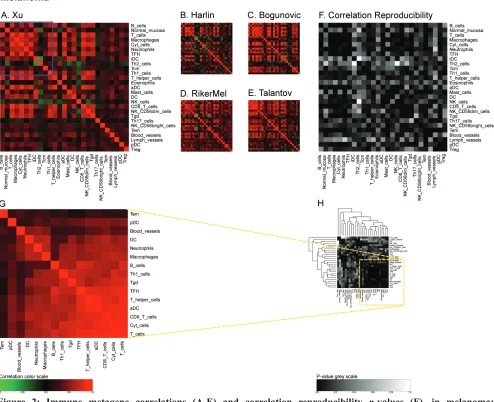
and B cells), which were denoted in red, as well as some negative correlations (for instance between follicular helper T cells [TFH] on one side and B or T cells on the other side), which were denoted in green (Figure 2A). The same correlation matrix was re-calculated for four distinct melanoma cohorts denoted ‘Harlin’, ‘Bogunovic’,
‘RikerMel’, ‘Talantov’ according to the names of the
authors describing them [20, 21, 22, 23]. While some correlations including the aforementioned ones are conserved across the cohorts, other positive and negative
correlations appeared to be cohort-specific (Figure
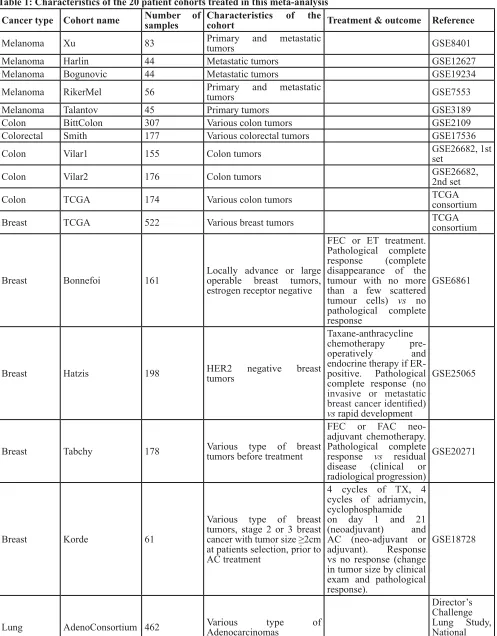
table 1: characteristics of the 20 patient cohorts treated in this meta-analysis
cancer type cohort name number of samples characteristics of the cohort treatment & outcome reference
Melanoma Xu 83 Primary and metastatic tumors GSE8401
Melanoma Harlin 44 Metastatic tumors GSE12627
Melanoma Bogunovic 44 Metastatic tumors GSE19234
Melanoma RikerMel 56 Primary and metastatic tumors GSE7553
Melanoma Talantov 45 Primary tumors GSE3189
Colon BittColon 307 Various colon tumors GSE2109
Colorectal Smith 177 Various colorectal tumors GSE17536
Colon Vilar1 155 Colon tumors GSE26682, 1st set
Colon Vilar2 176 Colon tumors GSE26682, 2nd set
Colon TCGA 174 Various colon tumors TCGA consortium
Breast TCGA 522 Various breast tumors TCGA consortium
Breast Bonnefoi 161 Locally advance or large operable breast tumors, estrogen receptor negative
FEC or ET treatment.
Pathological complete response (complete disappearance of the tumour with no more than a few scattered tumour cells) vs no pathological complete response
GSE6861
Breast Hatzis 198 HER2 negative breast tumors
Taxane-anthracycline chemotherapy
pre-operatively and endocrine therapy if
ER-positive. Pathological complete response (no invasive or metastatic breast cancer identified) vs rapid development
GSE25065
Breast Tabchy 178 Various type of breast tumors before treatment
FEC or FAC
neo-adjuvant chemotherapy. Pathological complete response vs residual disease (clinical or radiological progression)
GSE20271
Breast Korde 61
Various type of breast tumors, stage 2 or 3 breast
cancer with tumor size ≥2cm
at patients selection, prior to
AC treatment
4 cycles of TX, 4 cycles of adriamycin, cyclophosphamide on day 1 and 21 (neoadjuvant) and
AC (neo-adjuvant or
adjuvant). Response vs no response (change in tumor size by clinical exam and pathological response).
GSE18728
Lung AdenoConsortium 462 Various type of Adenocarcinomas
Director’s Challenge
Lung Study, National
Cancer
correlations, as well as absent correlations, that were observed throughout all cohorts received a low p value,
denoted as black or dark grey, while major variations in
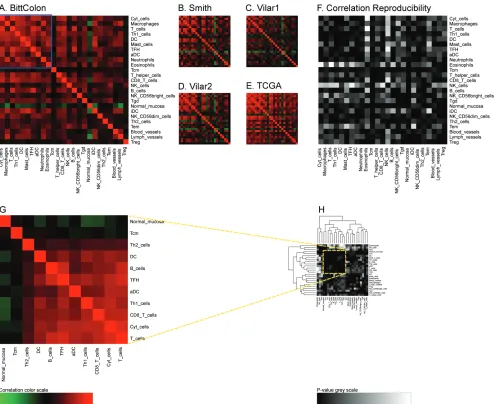
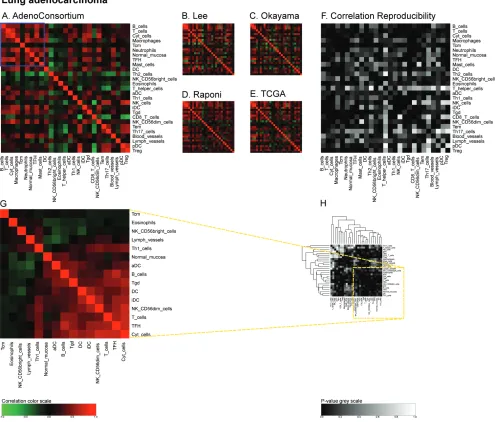
the correlations received a high p value, denoted as light grey or white (Figure 2F). We then applied the same type of meta-analysis to colorectal cancers in which we
calculated a first correlation matrix on the ‘Bitt’ cohort
(http://www.intgen.org/) (Figure 3A), re-calculated this matrix for four additional cohorts (Smith [24, 25], Vilar1
& Vilar2 [26-28], TCGA (http://cancergenome.nih.gov/)) (Figure 3B-3E), and determined the reproducibility among such correlations (Figure 3F).
Similarly, we calculated correlation matrices for
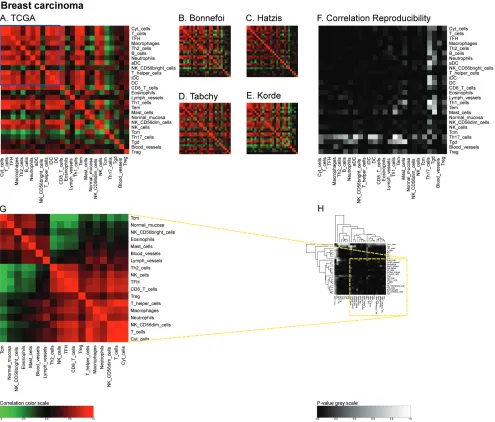
the ‘TCGA’ breast cancer cohort (http://cancergenome. nih.gov/) (Figure 4A) and four smaller cohorts (Bonnefoi [29], Hatzis [30], Tabchy [31], Korde [32]) (Figure 4B-4E) and the resulting correlation reproducibility (Figure 4F). Finally, we determined immune cell subtype-related
correlation matrices for the large ‘AdenoConsortium’
cohort of non-small cell lung cancers [33] (Figure 5A),
four additional cohorts (Lee [34], Okayama [35, 36], Raponi [37], TCGA (http://cancergenome.nih.gov/)) (Figure 5B-5E), and their reproducibility (Figure 5F). These correlation matrices were then subjected to a
meta-analysis to reveal organ-specific differences in the characteristics of the immune infiltrate that can be deduced
from microarray data.
A meta-analysis of distinct leukocyte and stress
response-associated metagenes in distinct cancer types
For the purpose of the meta-analysis, we included all reproducible correlations, i.e. correlations that received a global p value of <0.1 (note that this threshold was high because there were very few correlations with
reproducibility p-values <5%, as indicated in Figure 6D)
and analyzed their distribution for each cancer type. The density plots shown in Figure 6A indicate clear
organ-specific differences in the correlations among metagenes reflecting the cancer immune infiltrate. A finer analysis
of these correlations can be obtained by separating these densities into two modes, by means of an expectation maximization algorithm (Figure 6B). In melanomas and in mammary carcinomas the higher modes of the
correlation coefficient (R) were superior to those observed
in colorectal cancer and in non-small cell lung cancer
(Figure 6C, 6E). In mammary carcinoma, the range of
correlation coefficients of the lower mode was broader than for the three other cancer types (Figure 6D, 6E). As a correlate of this finding, reproducible correlation
matrices exhibited more anticorrelated subgroups in breast cancer microarrays (Figure 4G) than for all other cancer types (Figures 2G, 3G, 5G). The reproducibility of correlations among immune subtype-related metagenes
also revealed organ-specific variations, as indicated by box plot analysis (Figure 6D). Thus, the reproducibility
of such correlations was the highest (with hence the lowest p values), in breast cancer, followed by colorectal carcinoma, non-small cell lung cancer and melanoma. As
a visual correlate of this finding, the black color (which
symbolizes high reproducibility) is more preponderant in correlation reproducibility matrices describing breast cancer microarray (Figure 4F) than in other cancer types (Figures 2F, 3F, 5F).
Subsequently we extended this type of analysis beyond the immune system, by looking at metagenes that reflect endoplasmic reticulum (ER) stress, lysosomal
function and autophagy, while correlating such metagenes with immune cell subtype-relevant metagents (Supplemental Figure 1). Globally, the mean R values
obtained for this kind of correlation was close to zero for
all cancer types (Supplemental Figure 1A). However the reproducibility of correlations was somewhat better for colorectal and mammary carcinomas than for lung cancers and melanomas (Supplemental Figure 1B). Nonetheless, there were rather few correlations between, on one hand, immune parameters and, on the other hand, cellular functions (ER stress, lysosomal function, autophagy)
that reached statistical significance (p < 0.05), much less though than this was found within the immune cell
subtype-specific metagenes (Figure 6D and Supplemental
Figure 1B).
Prognostic features of individual metagene correlations in breast cancer
Clinical information on the response of breast cancer
patients to neo-adjuvant chemotherapy was available for
four out of the five cohorts (Bonnefoi, Hatzis, Tabchy,
Korde) analyzed in this study, allowing us to classify patients into ‘responders’ and ‘non-responders’ (Table 1). We previously reported on three of these four cohorts,
showing that a high level of expression of a
CXCL13-centered, highly reproducible metagene signature
indicative of the intratumoral presence of
interferon-γ-Lung Lee 138 Adenocarcinoma and squamous cell carcinoma GSE8894
Lung Okayama 226 Adenocarcinoma GSE31210
Lung Raponi 130 Squamous cell carcinoma GSE4573
[image:4.612.54.560.50.123.2]Figure 1: Immune metagene reproducibility. Heat maps of reproducibility p-values, for each cancer type, for each immune metagene, in each dataset. P-values are produced by reproducibility test described in Material and Methods (by definition, reproducibility
producing T cells had positive prognostic features, as did
a number of additional immune-related metagenes [18].
We used this information to interrogate our databases
with regard to the following two questions. First, are their
correlations among immune cell type-related metagenes that distinguish responders and non-responders? Second, are there correlation between immune cell type-related metagenes and cell-stress related metagenes that differ among responders and non-responders?
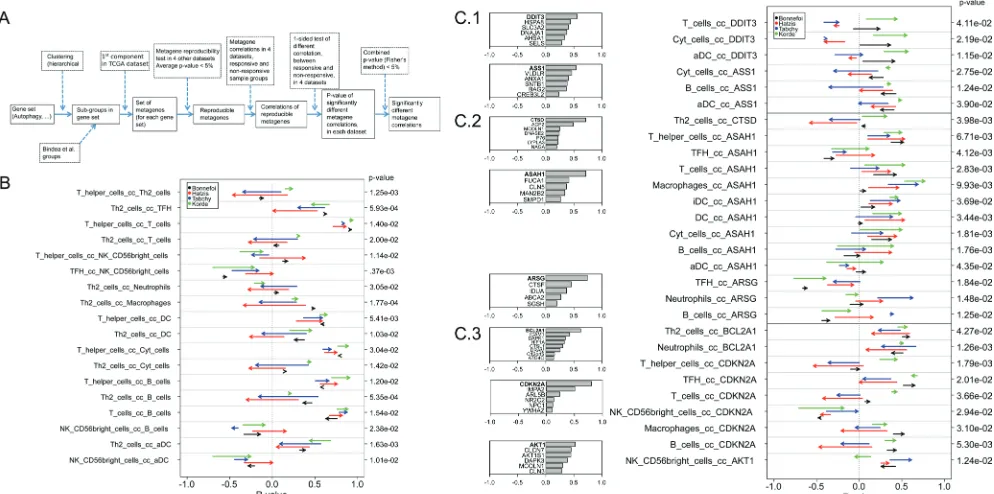
To respond to these questions, we followed a
strategy (Figure 7A) that involved the generation of
reproducible metagenes with the consequent exclusion
of non-reproducible metagenes (as in Figure 1), the meta-analysis of correlations among metagenes and the
subsequent exclusion of non-reproducible correlations
(as in Figure 3), followed by the analysis of correlations
among metagenes that differ between responders and non-responders, including only those differences that showed some degree of coherence among the four analyzable cohorts (with a combined p-value calculated according to Fisher’s exact test of p < 0.05). Only very few correlations among immune cell type-related metagenes differed among responders and non-responders (Figure 7B).
Thus the correlation between a metagene reflecting the intratumoral presence of Th2 cells and other leukocyte
subtypes (T cells, neutrophils, macrophages, cytotoxic cells, B cells) tended to have higher R values in non-responders (start of the arrows in Figure 7B) than in responders (arrowheads in Figure 7B), although these trends were not uniform among all four cohorts.
We identified a few correlations between
immune cell type-related metagenes and cell
stress-Figure 2: Immune metagene correlations (A-e) and correlation reproducibility p-values (F), in melanoma;
reproducible correlations of first dataset (G), identified by hierarchical clustering of reproducibility p-values (H).
Heat map representation of metagene correlation matrices, in the 5 datasets of melanoma transcriptome (blue rectangle corresponds to reproducible metagenes of Figure 1). A correlation reproducibility test is applied to the 5 correlation matrices, producing a matrix of
p-values. Clustering of correlation reproducibility (H) allows for the identification of a sub-part of correlation matrix (yellow square),
[image:7.612.61.555.263.665.2]related metagenes that neatly distinguished responders
from non-responders (Figure 7C). Among these, one
metagene (ASAH1) correlated more with a number
of leukocyte subtype-related metagenes (T cells,
macrophages, immature dendritic cells, neutrophils, B cells) in responders than in non-responders. This trend was uniform among all four cohorts. ASAH1 codes for N-acylsphingosine amidohydrolase-1 (also called acid ceramidase), the enzyme that catalyzes the synthesis and degradation of ceramide into sphingosine, both
of which have immunomodulatory functions [38, 39].
ASAH1 formed a reproducible metagene with a few other lysosome-relevant genes, namely FUCA1 (which
codes for tissue alpha-L-fucosidase, which breaks down
fucose), CLN5 (coding for ceroid-lipofuscinosis neuronal protein 5), MAN2B2 (which codes for mannosidase, alpha, class 2B, member) and SMPD1 (coding for
sphingomyelin phosphodiesterase 1, also known as acidic sphingomyelinase, ASM) (Figure 7C). This was not
directly related to metagene expression levels because
many leukocyte-related metagenes were overexpressed in
responsive tumors, contrasting with the ASAH1 metagene that was actually underexpressed in responsive tumors
[image:8.612.61.555.248.652.2](Supplemental Figure 8).
Figure 3: Immune metagene correlations (A-e) and correlation reproducibility p-values (F), in colorectal cancer;
reproducible correlations of first dataset (G), identified by hierarchical clustering of reproducibility p-values (H).
Heatmap representation of metagene correlation matrices, in the 5 datasets of melanoma transcriptome (blue rectangle corresponds to reproducible metagenes of Figure 1). A correlation reproducibility test is applied to the 5 correlation matrices, producing a matrix of
p-values. Clustering of correlation reproducibility (H) allows identifying sub-part of correlation matrix (yellow square), represented for the
Concluding remarks
The present study revealed that multiple metagenes
initially designed for the analysis of leukocyte subtypes infiltrating colorectal cancers [11] were highly
reproducible across distinct cancer cohorts, underscoring
that they indeed share cell type-specific expression
patterns that are stable enough to be detectable in different tissues, including the highly heterogeneous
tumor microenvironment. Subsequent correlation analyses
demonstrated a large number of positive correlations in the expression of distinct immune-related metagenes. However, there was a neat difference among the four cancer types included in this meta-analysis. For example,
the strength of positive correlations was stronger in breast cancer and melanoma then in colon and lung carcinomas. Moreover, breast cancer represented the only type of malignancy in which multiple negative correlations were tangible and reproducible. The reproducibility of the correlations among immune-relevant metagenes was stronger in mammary carcinoma (followed by colorectal cancer, non-small cell lung cancer and
melanoma, in this order), reflecting the fact that breast
cancer has an intrinsically better prognosis than the three other malignancies [40]. It is tempting to translate these statistical calculations in immunological terms. Indeed, the strong and homeostatic correlations among the expression patterns of distinct immune cell
subtype-Figure 4: Immune metagene correlations (A-e) and correlation reproducibility p-values (F), in breast cancer;
reproducible correlations of first dataset (G), identified by hierarchical clustering of reproducibility p-values (H).
Heatmap representation of metagene correlation matrices, in the 5 datasets of melanoma transcriptome (blue rectangle corresponds to reproducible metagenes of Figure 1). A correlation reproducibility test is applied to the 5 correlation matrices, producing a matrix of
p-values. Clustering of correlation reproducibility (H) allows identifying sub-part of correlation matrix (yellow square), represented for the
[image:9.612.60.555.235.657.2]specific metagenes suggest that, in breast cancer, immune infiltrates – if present – are highly organized, contrasting
with other cancer types where such an organization, perhaps in tertiary lymphoid structures [5], may be less
efficient, resulting in the presence of isolated (or few)
lymphoid and myeloid subpopulations. Systematic histological and immunohistochemical analyses will be
required to explore this speculation at the experimental
level.
We were unable to detect highly consistent shifts in the correlation among immune cell subtype-relevant metagenes that would distinguish responders and non-responders among a population of breast cancer patients treated with neo-adjuvant chemotherapy. Obviously,
there are large differences in the characteristics of these populations as well as in the treatment schedules (Table 1) that might render undetectable any subtle impact of such intra-immune correlations on the fate of breast cancer patients. In contrast, we found consistent shifts in the relationship between the expression level of one lysosome-relevant metagene (composed by ASAH1, FUCA1, CLN5, MAN2B2 and SMPD1, which all code for lysosomal hydrolases with the exception of CLN5) and several major
leukocyte populations (including T and B lymphocytes,
as well as several major myeloid cell types, including immature dendritic cells, macrophages and neutrophils) from responders to non-responders [41]. In responders, these correlations tended to be more positive than in
non-Figure 5: Immune metagene correlations (A-e) and correlation reproducibility p-values (F), in lung cancer;
reproducible correlations of first dataset (G), identified by hierarchical clustering of reproducibility p-values (H).
Heatmap representation of metagene correlation matrices, in the 5 datasets of melanoma transcriptome (blue rectangle corresponds to reproducible metagenes of Figure 1). A correlation reproducibility test is applied to the 5 correlation matrices. producing a matrix of
p-values. Clustering of correlation reproducibility (H) allows identifying sub-part of correlation matrix (yellow square), represented for the
[image:10.612.58.553.237.659.2]Figure 6: Global pattern of reproducible correlations and correlation reproducibility, for immune metagene
correlations. A. Density plot of reproducible correlations (reproducibility p-value <10%) for each cancer type; b. Plot of Figure A
densities, separated in two modes by means of the expectation–maximization algorithm; c. Box plot representation of the two modes in b; d. Box plot representation of correlation reproducibility p-values; e.t-test p-values of reproducible correlations across distinct cancer
[image:11.612.60.557.47.277.2]types, referring to the high modes shown in C; F.t-test p-values of reproducible correlations, comparing cancer type, referring to the low modes shown in c. Boxplots of reproducible correlations used the values of metagene correlations in the learning dataset (in Figures 2-4, A, excluding diagonal elements), for which correlation reproducibility had a p-value < 10%. Boxplots of correlation reproducibility distribution used matrices of Figures 2-5, F (excluding diagonal elements).
Figure 7: Variability of metagene correlations, upon treatment response in breast cancer. A. Flow chart for producing
B & C. (B & C) Metagene correlations, when they are significantly different upon treatment response, b. for immune metagenes, c. for
correlations between immune metagenes and ER-stress (C.1), lysosome (C.2), autophagy (C.3). Heads of arrow represent correlations
for responsive tumors, tails of arrow represent correlation for non-responsive tumors. P-values were associated to the combination of
[image:11.612.59.556.405.652.2]responders. High expression of ASAH1 (independently of any immune parameter) is associated with positive prognosis in breast cancer [42], and the estrogen receptor antagonist tamoxifen reportedly inhibits this enzyme via an off-target effect [43]. High expression of FUCA1 also has been attributed a positive prognostic value in breast cancer [44]. These results are based on microarray results as well, meaning that there is information available whether these genes are expressed by immune cells or by other parenchymatous and stromal elements of the tumor. Irrespective of these uncertainties, the present study reveals novel facets of the correlations between immune- and cell stress-related metagenes. In particular, it appears that the immune system is more ‘structured’ (with a higher degree of reproducible positive correlations in the
expression or leukocyte subtype-related metagenes) in the immune infiltrate of tumors with an intrinsically favorable
prognosis such as breast cancer than in cancers with a poor prognosis such as non-small cell lung cancer and melanoma.
MAterIAls And MetHods
datasets
Public datasets of transcriptome microarray were considered. For each cancer type, 5 transcriptome datasets
were used. Among the 5 datasets, the first one (with the
largest number of samples) was used as “learning” dataset in order to construct metagenes.
For Melanoma, the following datasets were used:
“Xu” for melanomas from dataset GSE8401 (83
samples), “Harlin” for melanomas from dataset GSE12627 (44 samples), “Bogunovic” for melanomas from dataset
GSE19234 (44 samples), “RikerMel” for melanomas from skin cancer dataset GSE7553 (56 samples), “Talantov” for melanomas from dataset GSE3189 (45 samples).
For Colon cancers, the following datasets were used: “BittColon” for colon cancers from multi-cancer
dataset GSE2109 (307 samples), “Smith” for colorectal cancers of dataset GSE17536 (177 samples), “Vilar1”
for colon cancers of the dataset GSE26682 (first part,
155 samples), “Vilar2” for colon cancers of the dataset
GSE26682 (second part, 176 samples), “TCGA” for colon cancers from TCGA consortium (174 samples).
For Breast cancers, the following datasets were used:
“TCGA” for breast cancers from TCGA consortium
(522 samples), “Bonnefoi” for breast cancers from dataset
GSE6861 (161 samples), “Hatzis” for breast cancers from dataset GSE25065 (198 samples), “Tabchy” for breast cancers from dataset GSE20271 (178 samples), “Korde” for breast cancers from dataset GSE18728 (61 samples).
The latter four datasets were chosen because treatment
response are annotated.
For Lung cancers, the following datasets were used:
“LungAC” for lung adenocarcinoma from a consortium (Director’s Challenge Lung Study, National Cancer Institute (NHI)) (462 samples), “Lee” for lung adenocarcinoma and squamous cell carcinoma of the dataset GSE8894 (138 samples), “Okayama” for lung
adenocarcinoma of the dataset GSE31210 (226 samples),
“Raponi” for squamous cell carcinoma of the dataset GSE4573 (130 samples), “TCGA” for squamous cell carcinoma from TCGA consortium (134 samples). We
joined these two lung cancer subtypes to have enough samples for statistical analysis. It should be noted that the metagene correlation matrices did not exhibit different patterns according to the distinct tumor subtypes (Figure 5).
If transcriptome were produced by Affymetrix® technology (www.affymetrix.com), the best probe sets were chosen according to “Jetset” annotation ([45]).
Datasets were downloaded and processed within the
R environment [46].
For all datasets, normalized data available on the
web was used. Log (base 2) was taken for those datasets
that did not have Gaussian tails in their expression distribution.
construction of metagenes
Metagenes were constructed according to the
method described in Stoll et al. [18], by identifying sets of genes and assigning coefficients inside sets:
1) Identification of sets of genes. For immune metagenes, sets were taken from Bindea et al. [11],
using genes that represent immune cell types. For other metagenes, (autophagy, ER-stress and lysosome), sets of genes were extracted from genes related to autophagy,
ER-stress and lysosomes [18]. Hierarchical clustering was
applied to these genes in the learning dataset. Hierarchical clusters were reduced to obtain a maximum of 20 gene sets related to autophagy, ER-stress and lysosomes.
2) Assignation of gene coefficients. Inside each gene set, coefficients were obtained by performing principal
component analyses on covariance of gene expression,
keeping the first component, in the learning dataset. By
construction, metagenes differed for each cancer type.
correlation of metagenes
Correlations of metagenes were obtained by calculating Pearson’s correlation coefficients applied
to metagene expressions. For a given sample, metagene expression was obtained as the scalar product of gene
expressions and gene coefficients within the metagene.
of correlation reproducibility led to the identification
of the subpart of the correlation matrix that was most reproducible (yellow rectangle in bottom left of Figures 2H-5H).
Pearson’s correlation was chosen because each datasets have Gaussian tails in their expression distribution. Nonetheless, it has been shown [47] that low expression values in microarrays poorly correlate
with expression values obtained by qPCR, which can affect the value of correlation coefficients. To test this, we
considered alternative metagene correlations by removing data for genes that are poorly expressed and hence fall into the lower tail of the gene expression distribution.
We used non-equality correlation tests (Steiger test in R [46], package “psych” [48]), to determine if metagene correlation coefficients depended on such outliers. We
applied this procedure to the two largest Affymetrix® datasets in breast carcinoma (Bonnefoi and Hatzis), within immune metagenes. Global correlation patterns (similar to Figure 6) were stable (see Supplemental Figures 2 and 3) and almost all p-values associated with correlation differences were larger than 5% (see Supplemental Figures 4 and 5 for p-value distribution)
The cancer stage dependence was tested by means
of a similar procedure. The TCGA dataset was separated
into two parts encompassing either stages I-II or stages III-IV. Global correlation patterns are shown in Supplemental
Figure 6, for immune metagene correlation coefficients.
The difference between boxplots is smaller than those
observed between different cancer types in Figure 6C.
Most p-values associated with correlation difference are larger than 5% (see Supplemental Figure 7 for p-value distribution).
statistical tests
Metagene reproducibility was computed according
to Stoll et al. [18], using a bootstrapping method that
compared metagene components. By construction, a p-value was associated with each metagene, in each non-learning dataset.
Metagene correlation reproducibility was computed
according to Stoll et al. [18], using a bootstrapping
method based on correlation variance between datasets. This method is different from a more classical approach that would combine correlation p-values; in particular, low values of correlation that are similar within datasets produce a low p-value of correlation reproducibility. In addition, this bootstrapping approach is supposed to avoid bias due to the size of datasets (for instance, melanoma
datasets were significantly smaller that the others).
selection of treatment dependent correlations
A correlation difference test was used to select correlations that vary between responsive and non-responsive tumor. It is based on the Steiger Test (r.test in R
package “psych” [48]). This method is applied for a
“one-sided test of different correlation, between responsive and
non-responsive, in 4 datasets” in the flow chart of Figure 7A, for producing Figure 7B, 7C.
two modes distribution separation
The package “mixtools” [49], within R environment
[46], was used to separate reproducible correlation distribution (Figure 6A) in two parts, applying an EM algorithm on a double Gaussian model. We imposed that each Gaussian mode represents at least 20% of the whole set of reproducible correlations
ACknowledGments
We would like to thank D. Enot for his advices in
statistics.
conFlIcts oF Interest
The authors declare no conflict of interest.
GrAnt support
GK is supported by the Ligue contre le Cancer (équipe labellisée); Agence National de la Recherche (ANR) – Projets blancs; ANR under the frame of E-Rare-2, the ERA-Net for Research on Rare Diseases; Association pour la recherche sur le cancer (ARC); Cancéropôle Ile-de-France; Institut National du Cancer (INCa); Fondation Bettencourt-Schueller; Fondation de
France; Fondation pour la Recherche Médicale (FRM); the
European Commission (ArtForce); the European Research Council (ERC); the LabEx Immuno-Oncology; the SIRIC Stratified Oncology Cell DNA Repair and Tumor Immune Elimination (SOCRATE); the SIRIC Cancer Research and Personalized Medicine (CARPEM); and the Paris Alliance of Cancer Research Institutes (PACRI).
reFerences
1. Denkert C, Loibl S, Noske A, Roller M, Muller BM, Komor M, Budczies J, Darb-Esfahani S, Kronenwett R, Hanusch C, von Torne C, Weichert W, Engels K, Solbach C, Schrader I, Dietel M, et al. Tumor-associated lymphocytes
as an independent predictor of response to neoadjuvant
chemotherapy in breast cancer. J Clin Oncol. 2010;
2. Anitei MG, Zeitoun G, Mlecnik B, Marliot F, Haicheur N, Todosi AM, Kirilovsky A, Lagorce C, Bindea G, Ferariu D, Danciu M, Bruneval P, Scripcariu V, Chevallier JM,
Zinzindohoue F, Berger A, et al. Prognostic and predictive values of the immunoscore in patients with rectal cancer.
Clin Cancer Res. 2014; 20:1891-1899.
3. Galon J, Pages F, Marincola FM, Thurin M, Trinchieri G,
Fox BA, Gajewski TF and Ascierto PA. The immune score as a new possible approach for the classification of cancer.
J Transl Med. 2012; 10:1.
4. Vasaturo A, Verweij D, Heinzerling L, de Vries J, Blokx W and Figdor CG. Immune infiltrates impact on the prediction
of prognosis and response to immunotherapy of melanoma
patients. J Transl Med. 2015; 13:2080.
5. Goc J, Fridman WH, Hammond SA, Sautes-Fridman C and Dieu-Nosjean MC. Tertiary lymphoid structures in human
lung cancers, a new driver of antitumor immune responses.
Oncoimmunology. 2014; 3:e28976.
6. Salmon H, Franciszkiewicz K, Damotte D, Dieu-Nosjean MC, Validire P, Trautmann A, Mami-Chouaib F and Donnadieu E. Matrix architecture defines the preferential
localization and migration of T cells into the stroma of
human lung tumors. J Clin Invest. 2012; 122:899-910. 7. Galon J, Costes A, Sanchez-Cabo F, Kirilovsky A, Mlecnik
B, Lagorce-Pages C, Tosolini M, Camus M, Berger A, Wind P, Zinzindohoue F, Bruneval P, Cugnenc PH, Trajanoski Z, Fridman WH and Pages F. Type, density, and
location of immune cells within human colorectal tumors predict clinical outcome. Science. 2006; 313:1960-1964.
8. Mlecnik B, Tosolini M, Kirilovsky A, Berger A, Bindea G, Meatchi T, Bruneval P, Trajanoski Z, Fridman WH, Pages
F and Galon J. Histopathologic-based prognostic factors of colorectal cancers are associated with the state of the local
immune reaction. J Clin Oncol. 2011; 29:610-618. 9. Pages F, Berger A, Camus M, Sanchez-Cabo F, Costes A,
Molidor R, Mlecnik B, Kirilovsky A, Nilsson M, Damotte D, Meatchi T, Bruneval P, Cugnenc PH, Trajanoski Z,
Fridman WH and Galon J. Effector memory T cells, early metastasis, and survival in colorectal cancer. N Engl J Med. 2005; 353:2654-2666.
10. Fridman WH, Pages F, Sautes-Fridman C and Galon J. The
immune contexture in human tumours: impact on clinical
outcome. Nat Rev Cancer. 2012; 12:298-306.
11. Bindea G, Mlecnik B, Tosolini M, Kirilovsky A, Waldner M, Obenauf AC, Angell H, Fredriksen T, Lafontaine L, Berger A, Bruneval P, Fridman WH, Becker C, Pages F, Speicher MR, Trajanoski Z, et al. Spatiotemporal dynamics
of intratumoral immune cells reveal the immune landscape
in human cancer. Immunity. 2013; 39:782-795.
12. Coussens LM, Zitvogel L and Palucka AK. Neutralizing tumor-promoting chronic inflammation: a magic bullet? Science. 2013; 339:286-291.
13. Finn OJ. Cancer immunology. N Engl J Med. 2008; 358:2704-2715.
14. Remark R, Alifano M, Cremer I, Lupo A, Dieu-Nosjean MC, Riquet M, Crozet L, Ouakrim H, Goc J, Cazes A, Flejou JF, Gibault L, Verkarre V, Regnard JF, Pages ON, Oudard S, et al. Characteristics and clinical impacts
of the immune environments in colorectal and renal cell
carcinoma lung metastases: influence of tumor origin. Clin Cancer Res. 2013; 19:4079-4091.
15. Badoual C, Hans S, Merillon N, Van Ryswick C, Ravel
P, Benhamouda N, Levionnois E, Nizard M, Si-Mohamed A, Besnier N, Gey A, Rotem-Yehudar R, Pere H, Tran
T, Guerin CL, Chauvat A, et al. PD-1-expressing tumor-infiltrating T cells are a favorable prognostic biomarker in HPV-associated head and neck cancer. Cancer Res. 2013; 73:128-138.
16. Wang Z, Gerstein M and Snyder M. RNA-Seq: a
revolutionary tool for transcriptomics. Nat Rev Genet. 2009; 10:57-63.
17. Angelova M, Charoentong P, Hackl H, Fischer ML, Snajder R, Krogsdam AM, Waldner MJ, Bindea G, Mlecnik B, Galon J and Trajanoski Z. Characterization of the
immunophenotypes and antigenomes of colorectal cancers reveals distinct tumor escape mechanisms and novel targets for immunotherapy. Genome Biol. 2015; 16:64.
18. Stoll G, Enot D, Mlecnik B, Galon J, Zitvogel L and
Kroemer G. Immune-related gene signatures predict the outcome of neoadjuvant chemotherapy. Oncoimmunology.
2014; 3:e27884.
19. Xu L, Shen SS, Hoshida Y, Subramanian A, Ross K, Brunet JP, Wagner SN, Ramaswamy S, Mesirov JP and Hynes RO. Gene expression changes in an animal melanoma model correlate with aggressiveness of human melanoma
metastases. Mol Cancer Res. 2008; 6:760-769.
20. Harlin H, Meng Y, Peterson AC, Zha Y, Tretiakova M, Slingluff C, McKee M and Gajewski TF. Chemokine expression in melanoma metastases associated with CD8+ T-cell recruitment. Cancer Res. 2009; 69:3077-3085. 21. Bogunovic D, O’Neill DW, Belitskaya-Levy I, Vacic V, Yu
YL, Adams S, Darvishian F, Berman R, Shapiro R, Pavlick AC, Lonardi S, Zavadil J, Osman I and Bhardwaj N. Immune profile and mitotic index of metastatic melanoma
lesions enhance clinical staging in predicting patient survival. Proc Natl Acad Sci U S A. 2009; 106:20429-20434.
22. Riker AI, Enkemann SA, Fodstad O, Liu S, Ren S, Morris C, Xi Y, Howell P, Metge B, Samant RS, Shevde LA, Li W, Eschrich S, Daud A, Ju J and Matta J. The gene expression profiles of primary and metastatic melanoma yields a transition point of tumor progression and metastasis. BMC Med Genomics. 2008; 1:13.
23. Talantov D, Mazumder A, Yu JX, Briggs T, Jiang Y, Backus J, Atkins D and Wang Y. Novel genes associated
with malignant melanoma but not benign melanocytic
lesions. Clin Cancer Res. 2005; 11:7234-7242.
and Beauchamp RD. Smad4-mediated signaling inhibits
intestinal neoplasia by inhibiting expression of beta-catenin. Gastroenterology. 2012; 142:562-571 e562.
25. Smith JJ, Deane NG, Wu F, Merchant NB, Zhang B, Jiang A, Lu P, Johnson JC, Schmidt C, Bailey CE, Eschrich S, Kis C, Levy S, Washington MK, Heslin MJ, Coffey RJ,
et al. Experimentally derived metastasis gene expression
profile predicts recurrence and death in patients with colon cancer. Gastroenterology. 2010; 138:958-968.
26. Sanz-Pamplona R, Cordero D, Berenguer A, Lejbkowicz
F, Rennert H, Salazar R, Biondo S, Sanjuan X, Pujana
MA, Rozek L, Giordano TJ, Ben-Izhak O, Cohen HI,
Trougouboff P, Bejhar J, Sova Y, et al. Gene expression
differences between colon and rectum tumors. Clin Cancer
Res. 2011; 17:7303-7312.
27. Schmit SL, Gollub J, Shapero MH, Huang SC, Rennert
HS, Finn A, Rennert G and Gruber SB. MicroRNA
polymorphisms and risk of colorectal cancer. Cancer Epidemiol Biomarkers Prev. 2015; 24:65-72.
28. Vilar E, Bartnik CM, Stenzel SL, Raskin L, Ahn J, Moreno V, Mukherjee B, Iniesta MD, Morgan MA, Rennert G and Gruber SB. MRE11 deficiency increases sensitivity to poly(ADP-ribose) polymerase inhibition in microsatellite unstable colorectal cancers. Cancer Res. 2011;
71:2632-2642.
29. Bonnefoi H, Piccart M, Bogaerts J, Mauriac L, Fumoleau P, Brain E, Petit T, Rouanet P, Jassem J, Blot E, Zaman K,
Cufer T, Lortholary A, Lidbrink E, Andre S, Litiere S, et
al. TP53 status for prediction of sensitivity to taxane versus non-taxane neoadjuvant chemotherapy in breast cancer
(EORTC 10994/BIG 1-00): a randomised phase 3 trial.
Lancet Oncol. 2011; 12:527-539.
30. Hatzis C, Pusztai L, Valero V, Booser DJ, Esserman L,
Lluch A, Vidaurre T, Holmes F, Souchon E, Wang H,
Martin M, Cotrina J, Gomez H, Hubbard R, Chacon JI,
Ferrer-Lozano J, et al. A genomic predictor of response and survival following taxane-anthracycline chemotherapy for
invasive breast cancer. JAMA. 2011; 305:1873-1881.
31. Tabchy A, Valero V, Vidaurre T, Lluch A, Gomez H,
Martin M, Qi Y, Barajas-Figueroa LJ, Souchon E, Coutant C, Doimi FD, Ibrahim NK, Gong Y, Hortobagyi GN,
Hess KR, Symmans WF, et al. Evaluation of a 30-gene
paclitaxel, fluorouracil, doxorubicin, and cyclophosphamide
chemotherapy response predictor in a multicenter
randomized trial in breast cancer. Clin Cancer Res. 2010;
16:5351-5361.
32. Korde LA, Lusa L, McShane L, Lebowitz PF, Lukes L, Camphausen K, Parker JS, Swain SM, Hunter K and Zujewski JA. Gene expression pathway analysis to predict
response to neoadjuvant docetaxel and capecitabine for
breast cancer. Breast Cancer Res Treat. 2010; 119:685-699. 33. Shedden K, Taylor JM, Enkemann SA, Tsao MS, Yeatman
TJ, Gerald WL, Eschrich S, Jurisica I, Giordano TJ, Misek DE, Chang AC, Zhu CQ, Strumpf D, Hanash S, Shepherd FA, Ding K, et al. Gene expression-based survival
prediction in lung adenocarcinoma: a multi-site, blinded
validation study. Nat Med. 2008; 14:822-827.
34. Lee ES, Son DS, Kim SH, Lee J, Jo J, Han J, Kim H, Lee HJ, Choi HY, Jung Y, Park M, Lim YS, Kim K, Shim Y, Kim BC, Lee K, et al. Prediction of recurrence-free survival
in postoperative non-small cell lung cancer patients by using an integrated model of clinical information and gene
expression. Clin Cancer Res. 2008; 14:7397-7404. 35. Okayama H, Kohno T, Ishii Y, Shimada Y, Shiraishi K,
Iwakawa R, Furuta K, Tsuta K, Shibata T, Yamamoto S, Watanabe S, Sakamoto H, Kumamoto K, Takenoshita S, Gotoh N, Mizuno H, et al. Identification of genes
upregulated in ALK-positive and
EGFR/KRAS/ALK-negative lung adenocarcinomas. Cancer Res. 2012;
72:100-111.
36. Yamauchi M, Yamaguchi R, Nakata A, Kohno T, Nagasaki M, Shimamura T, Imoto S, Saito A, Ueno K, Hatanaka Y, Yoshida R, Higuchi T, Nomura M, Beer DG, Yokota J,
Miyano S, et al. Epidermal growth factor receptor tyrosine
kinase defines critical prognostic genes of stage I lung
adenocarcinoma. PLoS One. 2012; 7:e43923.
37. Raponi M, Zhang Y, Yu J, Chen G, Lee G, Taylor JM, Macdonald J, Thomas D, Moskaluk C, Wang Y and Beer DG. Gene expression signatures for predicting prognosis of squamous cell and adenocarcinomas of the lung. Cancer
Res. 2006; 66:7466-7472.
38. Fischer CL, Blanchette DR, Brogden KA, Dawson DV, Drake DR, Hill JR and Wertz PW. The roles of cutaneous
lipids in host defense. Biochim Biophys Acta. 2014;
1841:319-322.
39. Pitson SM. Regulation of sphingosine kinase and
sphingolipid signaling. Trends Biochem Sci. 2011; 36:97-107.
40. Siegel RL, Miller KD and Jemal A. Cancer statistics, 2015. CA Cancer J Clin. 2015; 65:5-29.
41. Galon J, Angell HK, Bedognetti D and Marincola FM.
The continuum of cancer immunosurveillance: prognostic, predictive, and mechanistic signatures. Immunity. 2013; 39:11-26.
42. Sanger N, Ruckhaberle E, Gyorffy B, Engels K, Heinrich T, Fehm T, Graf A, Holtrich U, Becker S and Karn T. Acid
ceramidase is associated with an improved prognosis in
both DCIS and invasive breast cancer. Mol Oncol. 2015; 9:58-67.
43. Morad SA, Levin JC, Tan SF, Fox TE, Feith DJ and Cabot MC. Novel off-target effect of tamoxifen-inhibition of acid
ceramidase activity in cancer cells. Biochim Biophys Acta.
2013; 1831:1657-1664.
44. Milde-Langosch K, Karn T, Schmidt M, zu Eulenburg
C, Oliveira-Ferrer L, Wirtz RM, Schumacher U, Witzel I, Schutze D and Muller V. Prognostic relevance of
glycosylation-associated genes in breast cancer. Breast
Cancer Res Treat. 2014; 145:295-305.
AC. Jetset: selecting the optimal microarray probe set to represent a gene. BMC Bioinformatics. 2011; 12:474. 46. R Development Core Team. (2008). R: A Language and
Environment for Statistical Computing. (Vienna, Austria. 47. Morey JS, Ryan JC and Van Dolah FM. Microarray
validation: factors influencing correlation between oligonucleotide microarrays and real-time PCR. Biol Proced Online. 2006; 8:175-193.
48. Revelle W. (2015). psych: Procedures for Psychological,
Psychometric, and Personality Research. (Evanston, Illinois).
49. Benaglia T, Chauveau D, Hunter DR and Young D. mixtools: An R Package for Analyzing Finite Mixture