0095-1137/08/$08.00⫹0 doi:10.1128/JCM.00339-08
Copyright © 2008, American Society for Microbiology. All Rights Reserved.
Uropathogens and Host Characteristics
䌤
James H. Tabibian,
1Jeffrey Gornbein,
2Arash Heidari,
1,4Sarah L. Dien,
4Valerie H. Lau,
3Puneet Chahal,
1Bernard M. Churchill,
3and David A. Haake
1,3,4*
Departments of Medicine,1Biomathematics,2and Urology,3David Geffen School of Medicine at the University of California—Los Angeles, Los Angeles, California 90095, and Veterans Affairs Greater Los Angeles Healthcare Center,
Los Angeles, California 900734
Received 18 February 2008/Returned for modification 6 July 2008/Accepted 30 September 2008
Uropathogens other than Escherichia coli occur with greater frequency in patients with risk factors for
urinary tract infection (UTI). However, little is known about associations between uropathogen species and host characteristics. Three hundred nineteen urine specimens containing a balanced distribution of uropatho-gen species were selected from inpatients and outpatients at a university hospital clinical microbiology laboratory. Information on host characteristics was retrospectively collected by chart review. Differences in the frequencies of host characteristics in UTI groups, as defined by the causative uropathogen, were compared by chi-square/Fisher analysis. Multivariate classification and regression tree analysis were used to identify host characteristic subsets that distinguish among uropathogen groups. In this exploratory study, several uro-pathogen species were found to be strongly linked to host characteristics relevant to UTI. Patients with
Pseudomonas aeruginosaUTIs were more likely to have undergone urinary tract procedures (43% versus 15% overall), to have a neurogenic bladder (29% versus 12% overall), to have received recent antibiotic therapy (52%
versus 24% overall), and to be male (76% versus 28% overall). Patients withProteus mirabilisUTIs were more
likely to have a foreign body in the lower urinary tract (48% versus 30% overall). The classification tree identified males over the age of 27 years who had undergone a prior urinary tract procedure as belonging to
a host characteristic profile associated withP. aeruginosaUTI: 38% of patients withP. aeruginosaUTIs fit this
profile. These data may be useful for planning future targeted prophylaxis studies.
Urinary tract infections (UTIs) account for more than 8 mil-lion visits to physicians’ offices, 1.5 milmil-lion emergency room visits, and 300,000 hospital admissions in the United States annually (2, 4, 9). UTIs are the second most common infection of any organ system and the most common urological disease in the United States, with a total annual cost of more than $3.5 billion (4).
In general,Escherichia coliis the most common
uropatho-gen, responsible for approximately 80% of UTIs (2, 7, 12). Non-E. coliinfection is considerably more common (44% to 72%) in the subset of patients with complicated UTIs (7). UTIs are defined as complicated when they occur in patients with immunosuppression, including diabetes, or in the context of structural or functional abnormalities of the urinary tract.
Complicated UTIs, due to either intrinsic or extrinsic uri-nary tract abnormalities, are becoming increasingly common due, in part, to increases in the elderly population. For exam-ple, benign prostatic hyperplasia is an intrinsic obstructive
ab-normality affecting⬎50% of the male population over 60, and
40% of benign prostatic hyperplasia patients will develop suf-ficient obstruction to require a prostatic tissue-ablative inter-vention, amounting to nearly 400,000 prostate procedures per year (5). Other intrinsic abnormalities potentially increasing the risk of UTI include congenital anomalies, a neurogenic bladder, and fistulae involving the urinary tract. Extrinsic ab-normalities, such as stents and catheters, are also important
risk factors for UTI. Catheter-associated UTI is responsible for 40% of nosocomial infections, making it the most common cause of nosocomial infection. Catheter-associated UTIs ac-count for more than 1 million cases in hospitals and nursing
homes annually and often involve uropathogens other thanE.
coli(2). While the epidemiology and pathogenic mechanisms
of uropathogenicE. colihave been extensively studied, little is
known about the associations between other uropathogens and the risk factors for their acquisition.
Uropathogens differ in terms of the virulence factors and pathogenic mechanisms that allow them to colonize and infect the
urinary tract. For example, some uropathogens, especiallyProteus
spp., make the enzyme urease, which hydrolyzes urea to ammonia and carbon dioxide. The release of ammonia raises the urinary pH, which favors the precipitation of urinary salts in the form of kidney or bladder stones, which frequently serve as a nidus for
recurrentP. mirabilisinfection. Another mechanism for
coloniza-tion of the urinary tract, particularly relevant to stones and other
foreign bodies, is biofilm formation.Pseudomonas aeruginosais
well known to be adept at biofilm formation because of genes, such as alginase, that are involved in the formation of the exopo-lysaccharide matrix of the biofilm. Nosocomial UTIs frequently involve organisms selected for by their antibiotic resistance mech-anisms, such as vancomycin-resistant enterococci and
extended-spectrum beta-lactamase-producing Klebsiella pneumoniae (3,
10). The emergence of antibiotic resistance in the hospital setting has frequently been associated with UTIs (11). However, com-paratively little is known about the associations between specific uropathogen species and patient populations with risk factors for UTI (1, 6, 8, 13, 14).
We conducted an exploratory case-case comparison study
* Corresponding author. Mailing address: Division of Infectious Diseases, 111F, VA Greater LA Healthcare System, Los Angeles, CA 90073. Phone: (310) 268-2814. Fax: (310) 268-4928. E-mail: dhaake @ucla.edu.
䌤Published ahead of print on 8 October 2008.
3980
on May 16, 2020 by guest
http://jcm.asm.org/
using a novel microbiological approach: we started with the urine isolate and then asked which host characteristics were negatively or positively associated with a particular uropatho-gen species. Urine specimens containing a diverse set of uro-pathogen species were prospectively collected, and host char-acteristics of the corresponding patients were then obtained by
chart review. We found that certain uropathogens, especiallyP.
aeruginosa, were strongly associated with particular host char-acteristics, including the male gender, recent antibiotic ther-apy, prior urinary tract procedures, and a neurogenic bladder. This is the first study we are aware of to examine the relation-ship between particular uropathogen species and host charac-teristics.
MATERIALS AND METHODS
Uropathogen isolates and clinical urine specimens.Consecutive uropathogen isolates were obtained from the UCLA Clinical Microbiology Laboratory with approval from the UCLA Institutional Review Board and an appropriate Health Insurance Portability and Accountability Act exemption. To obtain a balanced distribution of uropathogen species, the numbers of specimens were limited to 80 forEscherichia coli, 40 forKlebsiella pneumoniae, 40 forEnterobacterspp., 40 for P. aeruginosa, 40 forProteus mirabilis, 80 forEnterococcusspp., and 80 for miscellaneous uropathogens. Half of the specimens provided from each category were from inpatients, and the other half were from outpatients. Only the initial specimen from a patient was included (i.e., subsequent isolates from the same patient were excluded), and isolates from specimens containing less than 105 CFU per milliliter were excluded.
Data collection.A review of medical records was performed to acquire infor-mation on 15 different characteristics of the patients from whom the specimens were obtained. These consisted of (i) gender, (ii) age, (iii) prior UTI within the last year with a culture density greater than 105CFU/ml, (iv) prior antibiotic therapy within the past month, (v) prior procedures (surgical procedures at any time and nonsurgical procedures within the past year), (vi) prior urinary tract procedures (surgical procedures at any time and nonsurgical procedures within the past year), (vii) upper urinary tract obstruction (e.g., hydronephrosis, hy-droureter, kidney or ureteral stone, vesicoureteral reflux, ureteropelvic junction obstruction) within the past year, (viii) lower urinary tract obstruction (e.g., bladder stone, enlarged prostate, urethral stone or stricture) within the past year, (ix) upper urinary tract foreign body (e.g., ureteral stent, nephrostomy tube) within the past year, (x) lower urinary tract foreign body (e.g., intermittent or indwelling catheterization, suprapubic catheter) within the past year, (xi) diabe-tes at the time of infection, (xii) immunocompromised state (e.g., bone marrow or solid-organ transplantation, immunosuppressant therapy, human immunode-ficiency virus, liver failure, bed-bound nursing home patient) at the time of infection, (xiii) history of neurogenic bladder, (xiv) pregnancy at the time of infection, and (xv) urinary tract reconstruction (e.g., renal transplant, prostatec-tomy, appendicovesicosprostatec-tomy, ureteroneocystostomy) at any time. If there was no mention of a particular host characteristic in the medical record, it was assumed that the patient did not have that host characteristic. The medical record of each isolate was also reviewed for antibiotic susceptibility data.
Data analysis. (i) Bivariate.Each host characteristic was compared one at a time across uropathogen groups. The exact overall (omnibus) chi-squarePvalue across groups was computed using specialized software (Stat Xact, version 8, 2007, Cytel Inc., Cambridge MA). Under the Fisher least-significant-difference criterion, for host characteristics that were significant overall across groups, exact Pvalues were computed by using Fisher’s exact test for pairwise comparisons between the uropathogen group with the lowest percentage and each of the other uropathogen groups. To further explore these findings, chi-square test compar-isons were also made to see if there were significant differences between host characteristics in patients withE. coliversusP. aeruginosainfections.
For descriptive purposes only, the log of the relative ratio was reported where the relative ratio is defined as the proportion with the given host characteristic in each uropathogen group divided by the overall sample proportion with that host characteristic. The group proportions were divided by the overall proportion in order to make standardized, qualitative comparisons across host characteristics. If the proportion with a given host characteristic was the same across groups, the relative ratio would be 1 and its log would be zero. For age, the relative ratio was defined as the mean age in each uropathogen group divided by the overall mean. In addition to chi square tests, the corresponding 95% confidence intervals
were reported for selected important host characteristic proportions by uro-pathogen group.
(ii) Multivariate.A classification and regression tree (CART) model (Answer Tree, version 3.0; SPSS Inc., Chicago, IL) was used to simultaneously identify host characteristic profiles that distinguish amongE. coli,P. aeruginosa, other gram-negative bacteria, and gram-positive bacteria. Equal prior probabilities were assumed for the four bacterial groups in this model so that a terminal node’s predictive classification would be assigned to the bacterial group whose proportion exceeded its overall proportion. A 1,000-fold resampling cross-vali-dation of the tree was performed to test whether the tree nodes were significant. The overall absolute proportions of these four bacterial groups were not neces-sarily representative of the true absolute risks of infection for the population.
RESULTS
Between 16 December 2002 and 16 May 2003, 453 urine specimens with positive cultures were selected. Of these, 134 were excluded: 91 for not being a patient’s initial specimen and
43 for containing less than 105CFU/ml. Of the remaining 319
specimens, 149 were from outpatients and 170 were from in-patients. The 319 urine specimens contained isolates repre-senting 24 different bacterial species. The specimens were or-ganized into 10 groups, each group containing a minimum of
10 specimens (Table 1). TheEnterobacter genus was divided
into theEnterobacter aerogenesand Enterobacter cloacae
spe-cies, because each had more than 10 samples. Specimens con-taining two or three organisms were placed in the polymicro-bial group.
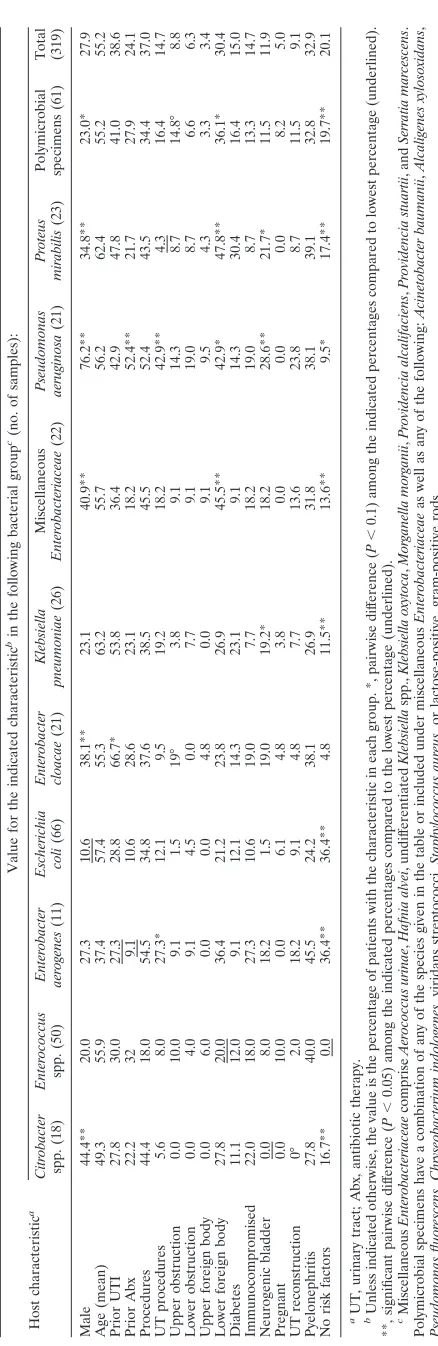
The medical record of each patient corresponding to the 319 specimens was reviewed for 17 host characteristics predispos-ing to UTI. The mean age of the total patient sample was 55 years, 27.9% were male, and 79.9% were positive for at least one host characteristic. Whereas there was no significant age difference among bacterial groups, chi-square omnibus
screen-ing comparison revealed significant P values for gender
(⬍0.0001), prior UTI (0.0583), prior antibiotics (0.0199),
uri-nary tract procedures (0.0098), a lower foreign body (0.0647),
a neurogenic bladder (0.0179), and no risk factors (0.0001).P
values for the other 10 host characteristics were⬎0.1. Given
the importance of gender for UTI, it is not surprising that there were highly significant differences in gender between UTIs
caused by E. coliand several uropathogen groups including
Citrobacter spp., E. cloacae, P. mirabilis, and P. aeruginosa.
Aside from male gender, patients withP. aeruginosiainfections
were also significantly more likely to have had prior antibiotics, prior urinary tract procedures, and a neurogenic bladder. Other significant associations were found between a prior UTI and E. cloacae infection and between a foreign body in the
urinary tract andP. mirabilisinfection. Indicators of
pyelone-phritis (elevated white blood cell count, fever, flank pain, or upper urinary tract obstruction) were found in 32.9% of pa-tients but were not associated with any particular bacterial group. Interestingly, none of the 50 patients with enterococcal infections were free of UTI risk factors.
Comparison of patients withE. coliandP. aeruginosa
infec-tions revealed statistically significant differences in the propor-tion with recent antibiotic therapy, as well as in six of the host characteristics directly relevant to the urinary tract, including urinary tract procedures, a neurogenic bladder, and obstruc-tion of, and a foreign body in, the upper and/or lower urinary tract (Table 2). The only host characteristics relevant to the
urinary tract in which patients withE. coliandP. aeruginosa
on May 16, 2020 by guest
http://jcm.asm.org/
infections did not differ were a prior history of UTI and urinary tract reconstruction.
Figure 1 illustrates the variation in relative ratios of host char-acteristics for patients with four types of common uropathogens. Mean age was the least variable host characteristic, followed by a history of prior surgical or nonsurgical procedures, suggesting that
[image:3.585.59.278.56.729.2]TABLE 1. Host characteristics of patients with UTIs due to various bacterial groups Host characteristic a Value for the indicated characteristic b in the following bacterial group c(no. of samples): Citrobacter spp. (18) Enterococcus spp. (50) Enterobacter aerogenes (11) Escherichia coli (66) Enterobacter cloacae (21) Klebsiella pneumoniae (26) Miscellaneous Enterobacteriaceae (22) Pseudomonas aeruginosa (21) Proteus mirabilis (23) Polymicrobial specimens (61) Total (319) Male 44.4** 20.0 27.3 10.6 38.1** 23.1 40.9** 76.2** 34.8** 23.0* 27.9 Age (mean) 49.3 55.9 37.4 57.4 55.3 63.2 55.7 56.2 62.4 55.2 55.2 Prior UTI 27.8 30.0 27.3 28.8 66.7* 53.8 36.4 42.9 47.8 41.0 38.6 Prior Abx 22.2 32 9.1 10.6 28.6 23.1 18.2 52.4** 21.7 27.9 24.1 Procedures 44.4 18.0 54.5 34.8 37.6 38.5 45.5 52.4 43.5 34.4 37.0 UT procedures 5.6 8.0 27.3* 12.1 9.5 19.2 18.2 42.9** 4.3 16.4 14.7 Upper obstruction 0.0 10.0 9.1 1.5 19° 3.8 9.1 14.3 8.7 14.8° 8.8 Lower obstruction 0.0 4.0 9.1 4.5 0.0 7.7 9.1 19.0 8.7 6.6 6.3 Upper foreign body 0.0 6.0 0.0 0.0 4.8 0.0 9.1 9.5 4.3 3.3 3.4 Lower foreign body 27.8 20.0 36.4 21.2 23.8 26.9 45.5** 42.9* 47.8** 36.1* 30.4 Diabetes 11.1 12.0 9.1 12.1 14.3 23.1 9.1 14.3 30.4 16.4 15.0 Immunocompromised 22.0 18.0 27.3 10.6 19.0 7.7 18.2 19.0 8.7 13.3 14.7 Neurogenic bladder 0.0 8.0 18.2 1.5 19.0 19.2* 18.2 28.6** 21.7* 11.5 11.9 Pregnant 0.0 10.0 0.0 6.1 4.8 3.8 0.0 0.0 0.0 8.2 5.0 UT reconstruction 0° 2.0 18.2 9.1 4.8 7.7 13.6 23.8 8.7 11.5 9.1 Pyelonephritis 27.8 40.0 45.5 24.2 38.1 26.9 31.8 38.1 39.1 32.8 32.9 No risk factors 16.7** 0.0 36.4** 36.4** 4.8 11.5** 13.6** 9.5* 17.4** 19.7** 20.1 aUT, urinary tract; Abx, antibiotic therapy. bUnless indicated otherwise, the value is the percentage of patients with the characteristic in each group. *, pairwise dif ference ( P ⬍ 0.1) among the indicated percentages compared to lowest percentage (underlined). **, significant pairwise dif ference ( P ⬍ 0.05) among the indicated percentages compared to the lowest percentage (underlined). cMiscellaneous Enterobacteriaceae comprise Aerococcus urinae , Hafnia alvei , undif ferentiated Klebsiella spp., Klebsiella oxytoca , Morganella morganii , Providencia alcalifaciens , Providencia stuartii , and Serratia marcescens . Polymicrobial specimens have a combination of any of the species given in the table or included under miscellaneous Enterobacteriaceae as well as any of the following: Acinetobacter baumanii , Alcaligenes xylosoxidans , Pseudomonas fluorescens , Chryseobacterium indologenes , viridans streptococci, Staphylococcus aureus , or lactose-positive, gram-positive rods.
TABLE 2. Comparison of host characteristics inE. coliversus
P. aeruginosaUTIsa
Host characteristicb
Value for the indicated characteristiccin UTI with:
Pvalue E. coli P. aeruginosa
Male 10.6 76.2 ⬍0.00001
Age (mean) 57.4 56.2 0.86
Prior UTI 28.8 42.9 0.23
Prior Abx 10.6 52.4 0.00004
Procedures 34.8 52.4 0.78
UT procedures 12.1 42.9 0.002
Upper obstruction 1.5 14.3 0.015
Lower obstruction 4.5 19.0 0.033
Upper foreign body 0.0 9.5 0.011
Lower foreign body 21.2 42.9 0.05
Diabetes 12.1 14.3 0.79
Immune compromise 10.6 19.0 0.31
Neurogenic bladder 1.5 28.6 0.00007
Pregnancy 6.1 0.0 0.25
UT reconstruction 9.1 23.8 0.077
Pyelonephritis 24.2 38.1 0.21
No risk factors 36.4 9.5 0.019
a
Differences in percentages of host characteristics were compared by chi-square analysis.
b
Abx, antibiotic therapy; UT, urinary tract.
c
[image:3.585.301.542.87.287.2]Except where indicated otherwise, the value is the percentage of patients with the indicated characteristic.
FIG. 1. Log relative ratio of host characteristics in UTIs due to four uropathogens. The relative ratio, defined as the proportion with the given host characteristic divided by the overall sample proportion with that characteristic, is compared descriptively across characteristics for four uropathogens:Escherichia coli(Ec),Klebsiella pneumoniae(Kp),
Pseudomonas aeruginosa(Pa), andProteus mirabilis(Pm). A log
rela-tive ratio of zero results from a relarela-tive ratio of 1, indicating no difference in the proportion with a host characteristic compared with the overall patient population. Host characteristics are arranged from lowest (left) to highest (right) cumulative deviations of the log relative ratio from zero. For example, patient age was similar in UTIs due to all four uropathogens. In contrast, there were strong positive (P.
aeruginosa) and negative (E. coliandK. pneumoniae) associations with
a foreign body in the upper urinary tract. One or two asterisks indicate host characteristics with significant (P⬍0.1) or highly significant (P⬍
0.05) differences among uropathogen groups. Abx, antibiotic therapy.
on May 16, 2020 by guest
http://jcm.asm.org/
[image:3.585.301.542.439.578.2]these host characteristics either were not associated with infection or were equally associated with all uropathogen types. In contrast, considerable differences among patients with different types of UTIs were observed for host characteristics such as pregnancy and an upper foreign body. Although these host characteristics did not occur frequently enough for the differences to be
statis-tically significant at aPvalue of⬍0.05, it is notable that noP.
aeruginosaor P. mirabilisinfections occurred among pregnant
women (compared to 5% of total infections), while noE. colior
K. pneumoniae infections occurred among patients with upper foreign bodies (compared to 3.4% of total infections).
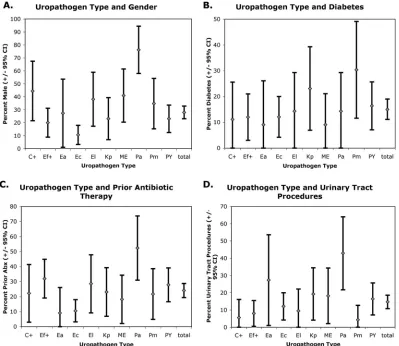
Patients withP. aeruginosainfection differed in a number of
respects from those with infections due to other types of uro-pathogens. Of the host characteristics illustrated in Fig. 2, differences in gender were the most striking, where 95%
con-fidence intervals forP. aeruginosainfection do not overlap with
those of any of the other bacterial groups exceptCitrobacter
spp., E. cloacae, and the miscellaneous uropathogen group.
The percentages of patients with recent antibiotic therapy,
prior urinary tract procedures, and a history of neurogenic
bladder were numerically higher for patients withP. aeruginosa
infections than for patients with any other uropathogen species and were significantly greater than those in the total sample
(Table 1). In contrast, patients with P. aeruginosa infections
were similar to the overall patient population in the frequency
of diabetes, which occurred more frequently in patients withP.
mirabilisinfection (Fig. 1B).
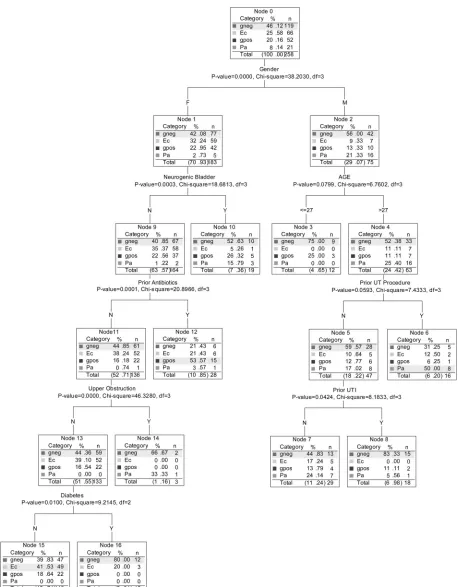
A multivariate CART analysis was carried out to identify host characteristics simultaneously associated with particular bacterial uropathogen groups. Patients’ infections were divided
into four simplified categories: UTI due toE. coli,P.
aerugi-nosa, other gram-negative bacteria, and gram-positive bacteria
[image:4.585.94.493.69.415.2](excluding polymicrobial specimens). As shown in Fig. 3, gen-der was found to be the host characteristic most strongly as-sociated with a uropathogen category. Although mean age was not a significant host characteristic in any bacterial group in the bivariate analysis, the CART analysis identified an association between age and uropathogen category. For example, all the
FIG. 2. Host characteristics and uropathogen types. Percentages (⫾95% confidence intervals) of patients with four host characteristics were compared for patient groups with UTIs due to various uropathogens (C⫹,Citrobacterspp.; Ef⫹,Enterococcusspp., Ea,Enterobacter aerogenes; Ec,
Escherichia coli; El,Enterobacter cloacae; Kp, Klebsiella pneumoniae; ME, miscellaneousEnterobacteriaceae [Aerococcus urinae,Hafnia alvei,
undifferentiatedKlebsiellaspp.,Klebsiella oxytoca,Morganella morganii,Providencia alcalifaciens,Providencia stuartii, andSerratia marcescens]; Pa,
Pseudomonas aeruginosa; Pm,Proteus mirabilis; PY, polymicrobial specimens [a combination of any of the aforementioned 16 isolates as well as
any of the following:Acinetobacter baumanii,Alcaligenes xylosoxidans,Pseudomonas fluorescens,Chryseobacterium indologenes, viridans strepto-cocci,Staphylococcus aureus, or lactose-positive, gram-positive rods]). Associations withP. aeruginosaUTI were found for gender (A), prior antibiotic therapy (C), and urinary tract procedures (D). An association was also found betweenP. mirabilisUTI and diabetes (B).
on May 16, 2020 by guest
http://jcm.asm.org/
FIG. 3. Classification tree showing host characteristics most strongly associated with categories of uropathogens. A multivariate CART analysis was performed to identify the host characteristics most strongly associated with uropathogen groups. The tree follows an equal-prior-probabilities rule, in that predictions are relative to the proportions in the root node and thus are not biased by initial group sizes. The shaded band in each node indicates the predicted (most likely) bacterial group based on equal prior probabilities. Polybacterial specimens were not included in this analysis. Uropathogen group abbreviations: gneg, gram-negative bacteria; gpos, gram-positive bacteria; Ec,E. coli;
Pa,P. aeruginosa.
on May 16, 2020 by guest
http://jcm.asm.org/
male patients withP. aeruginosainfections were over 27, and half of them (8/16) had undergone a urinary tract procedure. The shaded band in each node in Fig. 3 indicates the predicted (most likely) bacterial group based on equal prior
probabili-ties. For example, in “node 6,”P. aeruginosais the predicted
bacterial group, since its prevalence of 8/16 (50.00%) in this node is higher than its overall prevalence of 8.14% (node 0),
makingP. aeruginosa“more likely than average,” whereas the
prevalences of the other three groups are lower than their overall prevalences (less likely than average). The typical
pa-tient with a UTI due toP. aeruginosawas a male older than 27
who had undergone a urinary tract procedure. In contrast, the
typical patient with a UTI due toE. coliwas a female without
the host characteristics of neurogenic bladder, prior antibiotic therapy, upper urinary tract obstruction, or diabetes. By using all eight variables (tree nodes), the accuracy of patient cate-gorization was 56%. A 1,000-fold resampling cross-validation showed that the same tree nodes are significant except for the upper-obstruction node, which had only three patients. The average accuracy after the 1,000-fold cross-validation was re-duced only slightly, from 56% to 53%.
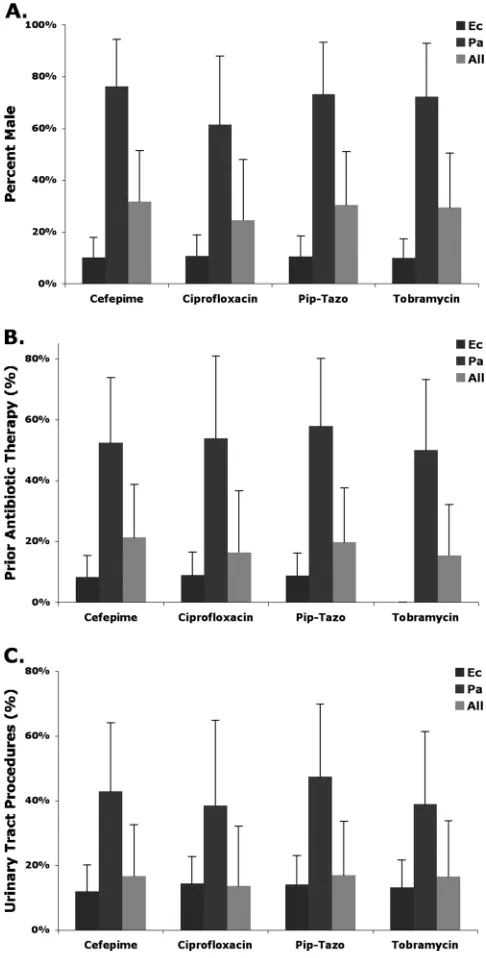
Antibiotic susceptibility results were available for 99% (255/ 258) of the uropathogens obtained from single-isolate speci-mens examined in this study (Table 1). We considered the possibility that some of the strength of negative (in the case of
E. coli) and positive (in the case ofP. aeruginosa) associations between causes of UTI and host characteristics may be due to antibiotic susceptibility and resistance, respectively. To control for the role of antibiotic resistance in host characteristics, an additional analysis was performed using only infections due to antibiotic-susceptible bacteria. The antibiotics chosen for anal-ysis were those that spanned a broad range of mechanistic groups and had sufficient laboratory information to produce reasonably large sample sizes.
Trimethoprim-sulfomethox-azole was not included in this analysis, becauseP.aeruginosais
intrinsically resistant to this antibiotic combination. As shown in Fig. 4, when only organisms susceptible to cefepime, cipro-floxacin, piperacillin-tazobactam, or tobramycin were
exam-ined, the associations betweenE. coliandP. aeruginosa
infec-tions with regard to male gender, prior antibiotic therapy, and urinary tract procedures were largely preserved.
DISCUSSION
In this study, we utilized a novel, microbiology-oriented ap-proach to identify host characteristics associated with UTIs due to a variety of uropathogen species. To obtain a data set containing a broad range of uropathogens, we limited the num-ber of specimens containing any one uropathogen species, thereby avoiding dominance of the study by specimens
con-taining common uropathogens such asE. coli. Specimens
con-taining various uropathogen species were collected prospec-tively, followed by data extraction from the medical records of patients from whom the specimens were collected. As
ex-pected, specimens containingE. coli were typically from
pa-tients with uncomplicated UTIs. In contrast, specimens
con-taining organisms other than E. coli were more commonly
isolated from patients with complicated UTIs. The organism
that stood out most strikingly in this regard wasP. aeruginosa.
Patients with P. aeruoginosa UTIs were more likely to have
[image:6.585.299.542.69.548.2]undergone urinary tract procedures (43% versus 15% overall), to have a neurogenic bladder (29% versus 12% overall), to have received recent antibiotic therapy (52% versus 24% over-all), and to be male (76% versus 28% overall). These results
FIG. 4. Associations between antibiotic-susceptible uropathogens and host characteristics. The percentages of samples from patients who were male (A), received antibiotic therapy within the past month (B), or had a history of urinary tract procedures (C) among urine specimens containing antibiotic-susceptible uropathogens (E. coli,P. aeruginosa, and all bacte-ria) are shown. Differences betweenE. coliandP. aeruginosawere signif-icant (P⬍0.05) in all cases except for cefepime susceptibility in patients with prior antibiotic therapy (B). The higher percentage of host charac-teristics in UTIs due toP. aeruginosapersisted despite the inclusion of antibiotic-susceptible organisms only in the analysis, indicating that the association with host characteristics is independent of antibiotic suscepti-bility. Ec,E. coli; Pa,P.aeruginosa; Pip-Tazo, piperacillin-tazobactam.
on May 16, 2020 by guest
http://jcm.asm.org/
implicate P. aeruginosa as an opportunistic pathogen in pa-tients with susceptibility to UTI.
The association with antibiotic therapy within the past
month in patients withP. aeruginosainfections might suggest
that selection for antibiotic-resistant uropathogens was an im-portant factor in determining why patients at risk for UTI acquire particular uropathogens. Medical records indicated that 24% of patients had received antibiotics within 1 month of specimen collection, and we acknowledge that this may be an underestimate resulting from our method of data collection.
One explanation for this association is thatP. aeruginosa is
intrinsically resistant to many of the antibiotics these patients received. However, two lines of evidence suggest that antibiotic resistance is only a partial explanation for our results. First, the
associations between P. aeruginosa infection and gender,
re-cent antibiotic therapy, and prior urinary tract procedures per-sisted even after data were analyzed using only antibiotic-susceptible organisms (Fig. 4). Second, CART analysis
revealed that the male gender, an age of⬎27 years, and a prior
urinary tract procedure were more strongly associated withP.
aeruginosainfection than recent antibiotic therapy (Fig. 3). An
alternative explanation for the relationship betweenP.
aerugi-nosaUTIs and antibiotic therapy is that the latter leads to an
alteration in the resident microflora, facilitating colonization withP. aeruginosaprior to UTI.
Some of the UTIs in the study sample were probably related to an indwelling bladder catheter. Thirty percent of patients had a foreign body in the lower urinary tract, the most common being a bladder catheter. Catheters and other foreign bodies in the urinary tract predispose to UTI by violating natural barri-ers to infection (urethral sphincter) and providing a nidus for infection by serving as a substrate for biofilm formation. Most uropathogens are able to form biofilms, which is reflected in the fact that no single bacterial type was significantly associated with a lower foreign body (Table 1). Comparatively little was
known about the prevalence of non-E. coli uropathogens in
patients with complicated UTIs (1, 6, 8, 13, 14). In a prospec-tive study of bacteriuria in patients with chronic indwelling urethral catheters, the most common isolates were enterococci,
P. aeruginosa, and coagulase-negative staphylococci (14). In the same study, the organism that caused infections of the
longest duration wasProvidencia stuartii.P. stuartiiwas also the
most common bacterial species isolated in a prospective study of 47 chronically catheterized women who underwent weekly urine culture (13). In a study of 54 patients with spinal cord injuries who were undergoing intermittent catheterization, a variety of uropathogens were associated with UTIs in males; of
these,E. colicomposed only 18% (1). This contrasts with the
UTIs of females, whereE. coliaccounted for 53% of cases, the
rest being due to Klebsiella, Enterococcus, and other species
(1). Our study complements and extends previously published studies of the microbiology of complicated UTIs.
This case-case comparison study does not address whether certain host characteristics predispose to infection with partic-ular uropathogens. A population-based study would be re-quired in order to determine which host characteristics are predictive of specific uropathogens. Although the only basis for
specimen selection was the uropathogen species in the speci-men, different results might be observed in other patient pop-ulations. Our study sample was predominantly an older group (mean age, 55), with only 8.2% of patients under the age of 18 years. Furthermore, the UCLA Medical Center is a tertiary referral center, so patients with urological disorders may be overrepresented in this study, as evidenced by the relatively high percentage of patients who had undergone surgery or another procedure (37%).
This is the first study we are aware of to systematically examine the association between uropathogen species and host characteristics. The current study should be considered explor-atory in nature but is sufficient to allow hypotheses to be generated regarding the relationship between particular uro-pathogen species and characteristics of the host that predis-pose to infection. Additional studies involving larger numbers of patients will be needed to confirm these data, examine the hypotheses, and improve the classification accuracy.
ACKNOWLEDGMENTS
This study was supported by Bioengineering Research Partnership grant EB00127 (to B.M.C.) from the National Institute of Biomedical Imaging and Bioengineering, by Cooperative Agreement Award AI075565 (to D.A.H.) from the National Institute of Allergy and Infectious Diseases, and by the Wendy and Ken Ruby Fund for Ex-cellence in Pediatric Urology Research. B. M. Churchill holds the Judith and Robert Winston Chair in Pediatric Urology.
REFERENCES
1.Bennett, C. J., M. N. Young, and H. Darrington.1995. Differences in urinary tract infection in male and female spinal cord injury patients on intermittent catheterization. Paraplegia33:69–72.
2.Foxman, B.2003. Epidemiology of urinary tract infections: incidence, mor-bidity, and economic costs. Dis. Mon.49:53–70.
3.Gold, H. S.2001. Vancomycin-resistant enterococci: mechanisms and clinical observations. Clin. Infect. Dis.33:210–219.
4.Litwin, M. S., C. S. Saigal, E. M. Yano, C. Avila, S. A. Geschwind, J. M. Hanley, et al.2005. Urologic Diseases in America Project: analytical meth-ods and principal findings. J. Urol.173:933–937.
5.Nelson, D. A.1998. Differentiating prostate disorders. J. Am. Acad. Nurse Pract.10:415–422.
6.Raz, R., N. Okev, Y. Kennes, A. Gilboa, I. Lavi, and N. Bisharat.2000. Demographic characteristics of patients with community-acquired bacteri-uria and susceptibility of urinary pathogens to antimicrobials in northern Israel. Isr. Med. Assoc. J.2:426–429.
7.Ronald, A.2003. The etiology of urinary tract infection: traditional and emerging pathogens. Dis. Mon.49:71–82.
8.Senay, H., and M. B. Goetz.1991. Epidemiology of bacteremic urinary tract infections in chronically hospitalized elderly men. J. Urol.145:1201–1204. 9.Stamm, W. E., and T. M. Hooton.1993. Management of urinary tract
infec-tions in adults. N. Engl. J. Med.329:1328–1334.
10.Tankhiwale, S. S., S. V. Jalgaonkar, S. Ahamad, and U. Hassani.2004. Evaluation of extended spectrum beta lactamase in urinary isolates. Indian J. Med. Res.120:553–556.
11.Wagenlehner, F. M., W. Weidner, and K. G. Naber.2005. Emergence of antibiotic resistance amongst hospital-acquired urinary tract infections and pharmacokinetic/pharmacodynamic considerations. J. Hosp. Infect.60:191– 200.
12.Warren, J. W.1996. Clinical presentations and epidemiology of urinary tract infections, p. 3–27.InH. L. T. Mobley and J. W. Warren (ed.), Urinary tract infections: molecular pathogenesis and clinical management. ASM Press, Washington, DC.
13.Warren, J. W., D. Damron, J. H. Tenney, J. M. Hoopes, B. Deforge, and H. L. Muncie, Jr.1987. Fever, bacteremia, and death as complications of bacteri-uria in women with long-term urethral catheters. J. Infect. Dis.155:1151– 1158.
14.Warren, J. W., J. H. Tenney, J. M. Hoopes, H. L. Muncie, and W. C. Anthony.1982. A prospective microbiologic study of bacteriuria in patients with chronic indwelling urethral catheters. J. Infect. Dis.146:719–723.