6
I
January 2018
Robust Method of Foreground Detection for
Object Tracking
P. Joel1, L. Bharathi2, N. Rajagopalakrishnan 3
1, 2, 3
Department of Electronics and Communication Engineering Excel Engineering College,Komarapalayam,Namakkal-637303, Tamilnadu, India
Abstract: This paper proposes a technique for foreground detection for moving objects in a video. Foreground detection was achieved by applying background subtraction techniques on the video frames. Background subtraction a pre-processing step in video processing and therefore has numerous applications including video surveillance, traffic monitoring, human detection, gesture recognition, etc. At airports, train stations and several other susceptible public places, video surveillance has become an invaluable tool to ensure the safety of these places The proposed method uses a background subtraction algorithm based on The Gaussian mixture models to detect the moving objects. Morphological operations are applied to the resulting foreground mask to eliminate noise. Then finally, blob analysis detects groups of connected pixels, which are likely to correspond to moving objects. Keywords: background subtraction, Gaussian mixture model, computer vision, change detection and object tracking
I. INTRODUCTION
Video change detection or Background Subtraction (BS) is one of the most widely studied topics in computer vision. It is a initial step in video processing and it was useful in many real time applications like video surveillance, traffic monitoring, human detection, object tracking and object counting. the background subtraction (BS) process gives a foreground (FG) binary mask of the given input image and a background. background subtraction is a difficult problem because of the diversity in background scenes and the changes originated from the camera itself. Two main problems to background subtraction are change detection and salient motion detection .Change detection addresses the detection of the changes between two images. So, background subtraction is a particular case when one image is the background image and the other one is the current image, and the changes are due to moving objects. considering, salient motion detection aims to find semantic regions and to filter out the unimportant areas.
II. BACK GROUND SUBTRACTION METHODS
A vast number of back ground subtraction techniques were analyzed in surveys like[ 1,2]the researchers mainly classify the techniques into four categories called, pixel based, region based Frame based and learning based[3]
A. Running Gaussian Average
For every pixel, the background is demonstrated independently as a Gaussian probability density function. The Gaussian appropriation is fitted to the n most recent pixel values and a pixel is arranged by ascertaining the probability that the most recent pixel esteem depicts an indistinguishable question from the prior pixel values did.
B. Mixture of Gaussians (MOG)
Sometimes the part of an image that should be classified as background is not entirely static, some parts might move a little (due to wind, vibrations of the camera etc.) and should still be classified as background.
To adapt to that sort of background a single valued background model is inadequate. The thought is to have distinctive MOG models for various conceivable background objects, if a pixel esteem is probably not going to originate from any of the diverse conveyances then it is named foreground.
C.Kernel density estimation (KDE)
D.Frame difference method
In this method Firstly, calculate the absolute difference between the two frames, and it is referred to as the difference image. Next optimal threshold value to the difference image. This threshold value is the binary threshold for the image . If the pixel value of the difference image is greater than or equal to threshold, then it would be considered as a Foreground Pixel, Region of Interest (Binary “1” would be assigned for the foreground element), otherwise as a Background Pixel (Binary “0” would be assigned for the
background element), thereby detecting a moving object. Diff_image = |(Current_frame) – (Previous_frame) | (eqn 1)
III.RELATED WORK
The technique called multimode background subtraction (MBS)[4]Presents a change detection system based on multiple
[image:3.612.225.388.270.495.2]background model scheme. This system deals with challenges of illumination changes and dynamic background. The proposed approach uses a Background Model Bank (BMB) that comprises of multiple Background (BG) models of the scene. To separate foreground pixels from changing background pixels , they apply Mega-Pixel (MP) based spatial denoising to pixel level probability estimates on different color spaces to obtain multiple Foreground (FG) masks. They are then combined to produce a final output FG mask. However Detection is not accurate for all moving object.
Fig 1 Block diagram of MBS[4]
To perform background subtraction in urban traffic videos ,the authors of [5]compares various background sub- traction algorithms for detecting moving vehicles and pedestrians in urban traffic video sequences. They consider approaches varying from simple techniques such as frame differencing and adaptive median filtering, to more sophisticated probabilistic modeling techniques. While complicated techniques often produce superior performance, they show that simple techniques such as adaptive median filtering can produce good results with much lower computational complexity
For using frame difference method [6] demonstrates a new approach to foreground detection. They found a new frame difference method which uses correlation co efficient between frames. In the correlation between blocks of current image and background image to categorize the pixels as foreground and background. The blocks in the current image which are highly correlated with the background image are considered as background.. However, this study needs to focus towards other information available in the blocks such as shape and edge can be used to improve the detection accuracy
IV.PROPOSED WORK
In the proposed system detects the moving object using Gaussian Mixture Model based background subtraction. This background subtraction method efficiently detects the foreground from varying environmental condition like, camera calibration, illuminance changes. Finally, blob analysis detects groups of connected pixels,which are likely to correspond to moving objects. This section mainly describes the system build algorithms and methods. First, input video is converted to frames and then RGB image converted to binary image. Second, smoothing process to reduce noise and make blurring image. Third, background subtraction based on Gaussian Mixture Model (GMM) to get moving object candidates. Forth, binary image is obtained by thersholding. In final step, edge detection is used to merge separated blobs belonging to one object.
[image:4.612.241.364.188.410.2]. FIG 2Block diagram of proposed system
A. Pre Processing
Frame conversion is performed to convert the video into frames. the obtained frames then sent for color conversion. Here we use Hsv color space for foreground extraction, and gray scale for output foreground image
B.Gaussian Mixture Model
The Gaussian mixture model (GMM) algorithm is based on the assumption that background is more regularly visible than the foreground, and background variance is little. As a single Gaussian is not a decent model for outdoor scenes this method for background subtraction was proposed by Stauffer and Grimson in which every pixel in the background is modeled as a mixture of Gaussian. Each and every pixel value is matched with current set of models to discover the match. If no match is found, the least model that is acquired is rejected and it is substituted by new Gaussian with initialization by the existing pixel value means the pixel value that don’t suit into the background are taken to be background. This method requires less memory to work and gives very accurate results as well as can deal with slow lighting variation though it cannot handle multimodal background and involves rigorous computation.
The probability of occurrence of a color at a given pixel s is given by
(eqn 2)
Where N (µi,s,t, Σi,s,t) is the iTHGaussian model and ωi,s,tits weight. Note that for computational purposes, the covariance matrix Σi,s,t
can be assumed to be diagonal, Σ = σ2Id.In this method, parameters of the matched component (i.e. the nearest Gaussian for which
Is,t is within 2.5 standard deviations of its mean) are updated as follows :
(i,s,t)=(1- ) (i,s,t)+ (i,s,t) (eqn 4)
2
(i,s,t)=(1- ) 2(i,s,t)+ .d2 (eqn 5)
where α is an user-defined learning rate, ρ is a second learning rate defined as ρ = αN (µi,s,t, Σi,s,t) and d2 is the distance .Parameters µ
and σ of unmatched distributions remain the same while their weight is reduced as follows : ωi,s,t = (1 − α)ωi,s,t−1 to achieve decay.
Whenever no component matches a color Is,t, the one with the lowest weight is replaced by a Gaussian with mean Is,t, a large initial
variance σ02and a small weight ω0. Once every Gaussian has been updated, the K weights ωi,s,t are normalized so they sum up to 1.
Then, the K distributions are ordered based on a fitness value ωi,s,t/σi,s,t and only the H most reliable ones are chosen as part of the background :
(eqn 6)
where τ is a threshold. Then, those pixels whose color Is,t is located at more than 2.5 standard deviations away from every H distributions are labeled “in motion”. And edge detection is applied for smooth foreground object.
C. Morphology Operations
The next stage is to apply morphological techniques. Morphological image processing is a collection of non-linear operations related to the shape or morphology of features in an image. Morphological operations rely only on the relative ordering of pixel values, not on their numerical values, and therefore are especially suited to the processing of binary images. Morphological operations can also be applied to gray scale images such that their light transfer functions are unknown and therefore their absolute pixel values are of no or minor interest.
V.EXPRIMENTAL RESULTS
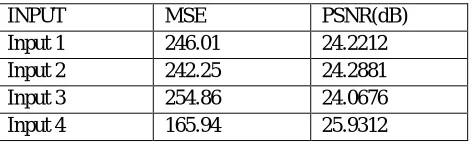
The code for proposed system is written in MATLAB and executed with test input video. all the input video sequences are taken from CDNET 2014[10]dataset. There are more than 15 sequences available in CDNET dataset under different situations. However we took four datasets and analyze them.The mean square error or MSE and peak signal to noise ratio (PSNR) are the two common error measurement metrics that are used to evaluate the superiority of background image. The MSE correspond to the increasing squared error between the original and the background image.
PSNR is most easily defined via the mean squared error (MSE). Given a noise-free m×n monochrome image I and its noisy
approximation K, MSE is defined as
(eqn 7)
Table I :Foreground Detection Results Of Proposed System On Examples Frames From Cdnet 2014 Dataset. Input Image(Row 1), Mbs Output(Row 2), Proposed System Output (Row 3)
The Peak Signal To Noise Ratio PSNR calculated as
(eqn 8)
Here MAX represents utmost instability for the input images. For example, if the input image possesses double-precision of floating-point data, then MAXis 1. For an 8-bit unsigned integer data type, MAX is 255,
Table Ii: Mse And Psnr Of Proposed System
VI.CONCLUSION
In this paper a new approach is proposed for robust and online foreground segmentation using Gaussian Mixture Model. Our approach has been also tested on dataset of complex background scenes.. A real-time and accurate new method for detecting moving object is proposed, based on background subtraction. In this research, we could find the disadvantage; for one moving object, the proposed sometimes detects more than one moving objects. Even though we used smoothing filter for preprocessing, the result shows separated blobs even for one object. To improve the performance, we are going to investigate to detect objects with exact the number of them. And minimize the mean square error.
REFERENCES
[1] Thierry Bouwmans. “ Recent Advanced Statistical Background Modeling for Foreground Detection - A Systematic Survey”(2011). Recent Patents on Computer Science, Bentham Science Publishers, 4 (3), pp.147-176.
[2] Thierry Bouwmans “ Traditional and recent approaches in background modeling for foreground detection: An overview”(2014) ,Elsevier computer science review I
[3] L. P. Vosters, C. Shan, and T. Gritti, “Background subtraction under sudden illumination changes.” in AVSS, 2010.
[4] Hasansajid,senching Samson cheung, “universal multimode background subtraction” ,(2016), IEEE transactions on image processing.
[5] S. C. Sen-Ching and C. Kamath “ Robust techniques for background subtraction in urban traffic video”,(2004), Proc. SPIE 5308, Visual Communications and Image Processing.
[6] Ramya and Rajeswari “ A Modified frame difference method using correlation coefficient for background subtraction”,(2016),6th International Conference On Advances In Computing & Communications, ICACC 2016.
[7] Bohyung Han, Larry S. Davis.” Density-Based Multifeature Background Subtraction with Support Vector Machine”(2012) IEEE transactions on pattern analysis and machine intelligence, vol. 34, no.
[8] Brutzer, S., Hoferlin, B., and Heidemann, G. “Evaluation of background Subtraction Techniques for Video Surveillance”, (2011), Proceedings of the IEEE International Conference on Computer Vision and Pattern Recognition (CVPR), pages 1937–1944, Colorado Spring, USA
[9] M. Sahasri ,C.Gireesh“object motion detection and tracking for video surveillance(2017),International Journal of Engineering Trends and Technology(IJETT) – Special Issue – April 2017
INPUT MSE PSNR(dB)
Input 1 246.01 24.2212
Input 2 242.25 24.2881
Input 3 254.86 24.0676
[image:6.612.190.426.361.433.2][10] Y. Wang, P.-M. Jodoin, F. Porikli, J. Konrad, Y. Benezeth, and P. Ishwar, “"CDnet 2014: An expanded change detection benchmark dataset",” in Computer Vision and Pattern Recognition Workshops (CVPRW), 2014.
[11] “Change detection dataset [online]. available:,” www.changedetection.net.SriramVaradarajan, Paul Miller and Huiyu Zhou ” Spatial Mixture of Gaussians for dynamic background modelling”( 2013) in 10th IEEE International Conference on Advanced Video and Signal Based Surveillance 2013
[12] ArchitaTah, Sudipta Roy, Prasenjit Das and AnirbanMitra“ Moving Object Detection and Segmentation using Background Subtraction by KalmanFilter”Indian Journal of Science and Technology, Vol 10(19), May 2017
[13] H. Sajid and S.-C. S. Cheung, “Background subtraction under sudden illumination change”, (2014),IEEE16th International Workshop on Multimedia Signal Processing (MMSP),
![Fig 1 Block diagram of MBS[4]](https://thumb-us.123doks.com/thumbv2/123dok_us/8295069.852572/3.612.225.388.270.495/fig-block-diagram-of-mbs.webp)