Design and Development of a Motorized Coconut
Dehusking Machine
Engr. John Paul D. Galvan1, Engr. Shirly O. Agcaoili2, Engr. Marvin D. Adorio3, Mhell Ruth Ann B. Cabutaje4, Engr. George M. Curammeng Jr5.
1,2,3,4
Researcher, Faculty, Department of Agricultural Engineering, College of Agriculture, Cagayan State University, Sanchez Mira, Cagayan
5
Researcher, Department of Agricultural Engineering, College of Agriculture, Cagayan State University, Sanchez Mira, Cagayan
Abstract: The motorized coconut dehusking machine was designed using AutoCAD and made of locally available materials using local manufacturing technology and tested to evaluate its performance in terms of dehusking capacity, de-husking efficiency, percent nut damage and energy consumption at different angular speed of dehusking rollers and nominal diameter of nuts; three levels of dehusking roller’s angular speeds (50 rpm, 60 rpm and 70 rpm) and three levels of nuts’ nominal diameters (178 mm, 212 mm and 248 mm) were used. The study was laid-out in two-factorial experiment in randomized complete block design.
The performance evaluated in terms of dehusking capacity, de-husking efficiency, percent nut damage and energy consumption at different angular speeds of dehusking rollers and different nominal diameters of nuts indicated that the dehusking capacity was dependent on the angular speed and nominal diameter of coconut as well as their interaction. A dehusking capacity of 271 nuts per hour was obtained at an angular speed of 60 rpm. A dehusking efficiency of 100% was obtained when the machine was operated at angular speed of 50 rpm and 70 rpm using different nominal diameter of nuts ranging from 212 mm to 248 mm and 248 mm, respectively. The dehusking efficiency decreased to 67% when the machine was operated 60 rpm using nuts with nominal diameter of 178 mm. the percent nut damage was dependent on the nominal diameter of coconuts. There was no damage nuts obtained when the machine was operated at dehusking rollers’ angular speed ranging from 50 rpm to 70 rpm using different nominal diameters of coconut ranging from 178mm to 248mm. The highest energy consumption of 0.02506 kW-hours was obtained at an angular speed of 70 rpm using coconut nominal diameter of 248 mm.
The cost analysis showed that the total cost of the machine was Php16, 911.70 with an operating cost of Php139, 867.65 per year. The benefit cost analysis showed that the total fixed cost and total variable cost were estimated with a value of Php5, 158.05 per year and Php134, 709.6 per year, respectively. The annual net income was Php420, 212.35. The benefit cost ratio was 3:1 which shows that the utilization of the unit is economically variable.
Keywords: motorized coconut dehusking machine, design, development, angular speed, capacity, efficiency, and nut damaged and fuel consumption.
I. INTRODUCTION
The coconut palm (Cocos nucifera) is found all over the globe most especially on tropical climate countries. It is so called “tree of life”, as all of its parts, from leaves to trunk can utilized by man. It can be used as food, drink, fire woods, medicines, fuel and domestic utensils (Varghese, 2014). With the value and benefit that coconut palm provides, there is a great need for it. In fact, in the Philippines alone, it exports an average of 2.56 million metric tons (MT) of copra in the year 2010-2013(PCA, 2013). Based from the survey of the provincial agriculturist office of Cagayan, Sanchez Mira is found to have the most number of coconut trees planted. In addition, Sanchez Mira celebrates Coco Festival that highlights the coconut product such as geo-textile production, vinegar-making and coco-based organic fertilizer in an agro-industrial trade fair and other activities (Greedy 2014).
At present, Sanchez Mira, Cagayan uses traditional way in de-husking coconut which was observed to be time consuming task that involves much of manpower to accomplish the operation. Hence, this study.
II. OBJECTIVES OF THE STUDY
A. Generally, this study designed and developed a motorized coconut de-husking machine. 1) Specifically, it aimed:
2) to evaluate the performance of the coconut de-husker in terms of
3) De-husking capacity
4) De-husking efficiency
5) Percent nut damage, an
6) Energy consumption
7) prepare a cost analysis for the machine
8) Benefit Cost Ratio (BCR)
III. METHODS
A. Design of the Motorized Coconut Dehusking Machine
The coconut de-husker machine as shown in figure 1, was constructed using galvanized iron sheets, common construction materials such as angle bars, flat bar and with a total dimension of 60 cm x 47 cm x 115 cm (L x W x H). The machine consist three major components, namely: the frame (14), the de-husking unit/working chamber (15) and the prime mover (1).The frame (14) which was made up of 1 ½ in x 1 ½ in x ¼ in steel angle bars. It serves as a support for the de-husking unit (15) and other components of the machine. The prime mover (1) was the source of mechanical power for the whole system or machine. It has a rated capacity of 1.5 horsepower and rated speed of 1740 rpm. The de-husking unit (15) which consists two rotating rollers (5 & 6), rotating in the opposite direction, was fixed using bearings on both side of the frames, and was made up of upper roller (6) of 7 teeth in a straight line and lower roller (5) of 4 teeth in a straight line at 6 points on the circumference. The teeth are of different height that corresponds to the shape of the coconut. The purpose of which is to penetrate the husk and pull it apart and to facilitate the de-husking of different size of coconut. The design of the adjustable tension lever (9) is a concave-like shape with a diameter of 30 cm and an inward curve of 10 cm diameter to prevent the coconut from falling, which pushed by springs (10). The fixed roller and adjustable tension lever (9) units are apart in such a way as to prevent different size of coconut to drop down.
[image:3.612.33.560.449.641.2](a) (b) (c)
Figure 1. Component parts of the motorized coconut dehusking machine in different views, (a) perspective view; (b) rear view and (c) front view.
B. Principles of Operation
And to facilitate de-husking of different size of coconut an adjustable tension lever (9) will pushes the nuts though springs (10) was attached adjacent to the two rollers. The husk was stopped by spikes (11) that is connected to the frame and the husk was discharge outside the machine or in front of the operator and the husked coconut was drop down to the discharge chute (12) and if the de-husk coconut doesn’t freely an adjustable lever (3) is provided to facilitate discharging.
C. Design Calculations and Performance Evaluations
The following formulas and equations were used in the conduct of the study.
1) De-husking capacity. It is the ratio between the numbers of de-husked nuts and the duration of operation. It is expressed in number of nuts per hour.
C =
Where:
Cd = de-husking Capacity (no. of nuts/ h)
Dn = de-husked nuts
To = time of operation (h)
2) De-husking efficiency. It is the ratio of the husked coconut and the total number of coconut input expressed in percent (%).
D = x 100
Where:
De = De-husking Efficiency (%)
Dc = Number of de-husked coconut
Ti = Total number of coconut input
3) Percent nut damaged. It is the ratio of the number of nuts damage and the total number of nuts input expressed in percent (%).
P = x 100
Where:
Pnd = percent nuts damage, %
Nd = Number of Damage nuts
Ti = Total number of coconut input
4) Energy Consumption. It is the energy consumed by the coconut de-husker in kilowatts-hour.
E = P(T )
Where:
E = Energy consumption, (kW-h).
P =Power rating of the motor, kW
To = time of operation (h)
5) Design of revolution per minute and pulley diameter. The approximate revolution per minute and diameter for a pulley can be calculated using the formula;
=
Where:
DL = pitch diameter of the large pulley, mm
DS = pitch diameter of the small pulley, mm
NS = number of revolutions of the small pulley, rpm
6) Design of belt length. The approximate belt length for a two-pulley drive can be calculated using the formula.
L = 2C + π(D + D ) +( )
Where:
L = length of the belt (mm)
C = distance between centers of pulleys (mm) DL = pitch diameter of the large pulley (mm) DS = pitch diameter of the small pulley (mm)
7) Design of sprocket size. The approximate revolution per minute and number of teeth for a sprocket can be calculated using the formula.
T N = T N
Where:
T1 = no. of teeth of driver sprocket (no. of teeth)
T2 = no. of teeth of driven sprocket (no. of teeth)
N2 = reduction speed (rpm)
N3 = required speed (rpm)
8) Determination of power requirement. To meet the required power of the prime mover, the formula to be used is:
P =
.
PT = Pdsw + Pdsf
P =
. ; P = .
T = F(r);F = mω r
Where:
T = torque (joules)
PT = power required
Pdsw = power due to the self-weight of the roller (watts)
Pdsf = power due to the maximum shear force required (watts)
N = revolution per minute (rpm) F = force (newton)
m = mass of the roller (kg) = ρ (vol. of the dehusking roller)
= angular velocity (rad/sec)
r = radius of the de-husking roller (meter)
9) Rotating shaft design. The diameter of the shaft can be determined by:
D =
π
TE = (M ) + T
Where:
= Permissible Shear Stress of the Shaft Material (MPa) D = Diameter of Shaft (m)
Mmax = maximum moment
TE = equivalent twist moment (kN-m)
10) functionality and Field Testing
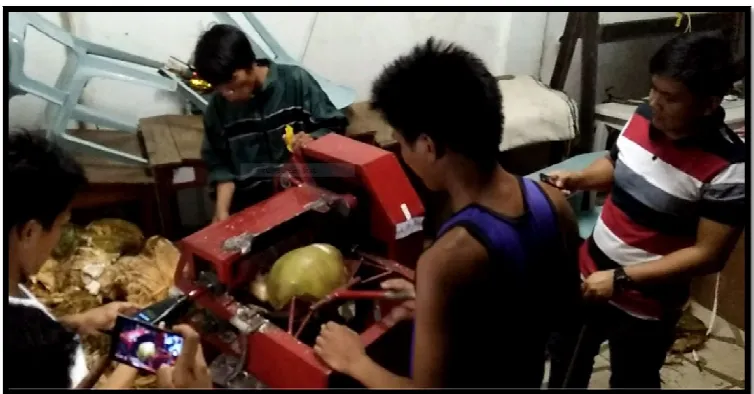
Figure 2.Actual dehusking operations of the machine during the final tests conducted by the researchers
IV. RESULTS AND DISCUSSIONS
A. De-husking Capacity (nut/hour)
Table 1 shows the de-husking capacity of the electric motor driven coconut de-husker at varying ranges of angular speed and nominal diameter of coconut with a grand mean of 263 nuts per hour. The analysis of variance revealed that the de-husking capacity of the electric motor driven coconut husker as influenced by the nominal diameter was significantly affected the machine’s
de-husking capacity at 5% level. Table 1b shows the de-de-husking capacity for the different levels of Factor B (nominal diameter). B1, B2,
and B3 had means of 251.33nut/hour, 278nut/hour and 259nut/hour, respectively. Comparison of means using LSD revealed that the
[image:6.612.94.519.458.576.2]de-husking capacity was greater when it was operated at 212 mm and 248 mm nominal diameter and least when it was operated at 178 mm nominal diameter. These means that bigger the nominal diameter, the higher the de-husking capacity.
Table 1. Interaction on De-husking Capacity on Table of angular speed and nominal diameter of coconut (nut/hour).
Angular Speed
Nominal diameter of coconut
Total Mean
B1 B2 B3
A1 226 270 255 2401 267
A2 263 285 266 2442 271
A3 265 279 256 2256 251
Total 754 834 777
Mean 251.33b 278a 259a 263
*means carrying the same letter are significantly different at 5% level
B. Percentage of damaged nuts (%)
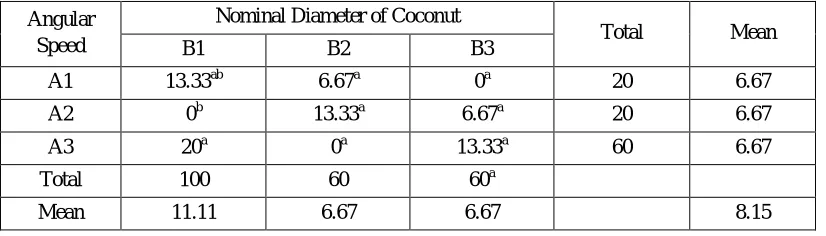
The percent nut damage during the operation of the electric motor driven coconut de-husker at varying ranges of angular speed and nominal diameter of coconut is presented in Table 2 with a grand mean of 8.15%.
Table 2. Interaction Table on Percent Nut Damage of angular speed and nominal diameter of coconut (%)
Angular Speed
Nominal Diameter of Coconut
Total Mean
B1 B2 B3
A1 13.33ab 6.67a 0a 20 6.67
A2 0b 13.33a 6.67a 20 6.67
A3 20a 0a 13.33a 60 6.67
Total 100 60 60a
Mean 11.11 6.67 6.67 8.15
C. Dehusking Efficiency
[image:7.612.98.507.375.493.2]Table 3 shows the de-husking efficiency of the motorized coconut de-husking machine at varying ranges of angular speed and nominal diameter of coconut with a grand mean of 87.41%. The analysis of variance revealed that the de-husking efficiency of the electric motor driven coconut husker as influenced by the nominal diameter was highly significantly affected the machine’s de-husking efficiency at 1% level. Table 1b shows the de-de-husking efficiency for the different levels of Factor B (nominal diameter). B1, B2, and B3 had means of 73.33%, 88.89% and 100%, respectively. Comparison of means using LSD revealed that the highest de-husking efficiency was when operated at 50 rpm, 60 rpm and 70 rpm angular speed and at 248 mm nominal diameter, and 50 rpm angular speed and at 212 mm nominal diameter with a mean of 100%. In addition, the lowest de-husking efficiency was attained when the machine was operated at 60 rpm angular speed at 178 mm nominal diameter with a mean of 66.67%. It means that de-husking a bigger nominal diameter at different angular speed gives the higher de-husking efficiency.
Table 3. Interaction on De-husking Efficiency table of angular speed and nominal diameter of coconut (%).
Angular Speed
Nominal diameter of Coconut
Total Mean
B1 B2 B3
A1 80 100 100 280 93.33
A2 66.67 86.67 100 253.34 84.45
A3 73.33 80 100 253.34 84.45
Total 253.34 266.68 266.67
Mean 73.33b 88.89a 100a 87.41
*means carrying the same letter are significantly different at 5% level
D. Energy Consumption
The energy consumption during the operation of the electric motor driven coconut de-husker at varying ranges of angular speed and nominal diameter of coconut is presented in Table 4 with a grand mean of 0.0215 kW-hour.
[image:7.612.92.508.657.725.2]The analysis of variance revealed that the energy consumption of the electric motor driven coconut de-husker as influenced by the nominal diameter was significantly affected the machine’s energy consumption at 5% level. Comparison of means showed that the energy consumption was least when the coconut de-husker was operated at 60 rpm angular speed and at 212 mm nominal diameter with a mean of 0.0197 kW-hour. In addition, energy consumption is greater when the machine was operated at 50 rpm angular speed at 178 mm nominal diameter with a mean of 0.02506 kW-hour. It means that operating the machine at lower speed and smaller nominal diameter resulted to higher energy consumptions.
Table 4.Interaction Table on Percent Nut Damage of angular speed and nominal diameter of coconut
Angular Speed
Nominal Diameter
Total Mean
B1 B2 B3
A1 0.02506 0.02075 0.02195 0.19042 0.02116
A3 0.0213 0.02015 0.02203 0.20327 0.02259
Total 0.06768 0.0606 0.06498
Mean 0.02256a 0.0202b 0.02166ab 0.0215
*means carrying the same letter are significantly different at 5% level
V. SUMMARY, CONCLUSIONS AND RECOMMENDATIONS
A. Summary
This research focused on the post-production of the coconut palm, especially on the de-husking process. It aimed to develop an electric motor driven coconut de-husker. Specifically, it aimed to test the machine in terms of de-husking capacity, de-husking efficiency, percent nut damage, and energy consumption. It is also aimed to analyze the economic performance of the de-husker in terms of benefit cost ratio, payback period, net present value, and internal rate return.
The machine was fabricated and evaluated its technical performance using the Analysis of variance two-factorial Experiment in Randomized Complete Block Design (RCBD) with different angular speed and matured coconut with nominal diameter of (178 mm, 212 mm, and 248 mm) as the factor, and is replicated three (3) times. The results of the study showed that the de-husking capacity was dependent on the angular speed and nominal diameter of the coconut as well as their interaction. The 60 revolution per minute speed of the roller resulted to a high de-husking capacity of 271 nuts per hour. The de-husking efficiency was dependent on the nominal diameter of the coconut. The bigger the nominal diameter would result to higher de-husking efficiency. The percent nut damage was dependent on the nominal diameter of the coconut. The bigger the nominal diameter would result to lower the percent nut damage. The energy consumption of the machine is higher when de-husking a small nominal diameter of coconut.
The cost analysis showed that the total cost of the machine was P 16,911.70. The depreciation cost per year was P 3,044.1 per year with an estimated machine life span of five (5) years. The salvage value was assumed to be ten percent (10%) of the machine cost. The interest of investment was P 930.14 per year with an annual interest of 10%. The repair and maintenance was P 845.58/year with a total fixes cost of P 5,158.05 per year. The total variable cost was P 139,709.6/year. The benefit cost ratio was 3 which show that the machine utilization is economically viable for small livestock raisers to use and operate. The annual net income was P 420,212.35 per year. This implies that the famer who owns the machine would be recover this expense for 15 day continues operation of the machine for six (6) hours per day to payback the investment and the cost of the machine with an internal rate of return of 75%. The net present value was P 280,344.70 /year.
VI. CONCLUSIONS
Based on the result of the study, the following conclusions were drawn:
A. De-husking Capacity, nut/hour
Operating the machine at higher angular speed corresponds to higher de-husking capacity of the machine. The 60 revolutions per minute resulted to a high de-husking capacity of 271 nut/hour. On the other hand, 212 mm nominal diameter of coconut gave the highest rate of de-husking capacity of 278 nuts/hour. The best combination in the de-husking capacity of the machine was when it was operated at 60 revolutions per minute angular speed and 212 mm nominal diameter of coconut gave 285 nuts/hour.
B. De-husking Efficiency, %
The De-husking Efficiency was high when it was operated at 50 revolutions per minute angular speed with the 93.33%.A 248 mm nominal diameter of coconut gave the highest de-husking efficiency of 100%.In addition, the best combination that gave the highest de-husking efficiency was when the coconut de-husker was operated at an angular speed of 50 revolution per minute and 212 mm, 248 mm nominal diameter of coconut and an angular speed of 60 and 70 revolution per minute and 248 mm nominal diameter of coconut with a mean de-husking efficiency of 100%.
C. Percent Nut Damage, %
nominal diameter of coconut;, and an angular speed of 60 revolution per minute and 178 mm nominal diameter of coconut gave zero (0) percent nut damage.
D. Energy Consumption, kW-hour
Operating the machine at higher roller speed would result to higher energy consumption. A 212 mm nominal diameter of coconut has the lowest energy consumption. Energy consumption was higher when it was operated at 50 revolutions per minute roller speed and 178 mm nominal diameter of the coconut.
E. Cost Analysis
The total operating cost was P 139,867.65 per year with annual net income of P 420,212.35 per year.
It has benefit cost ratio of 3 with a payback period of 15 days and internal rate of return of 75%. Net present value was P 280,344.70 per year.
F. Recommendations
Based on the results, the following recommendations were drawn by the researcher:
G. For operation,
To attain the highest de-husking capacity of the de-husker, operate the machine at angular speed of approximately 60 revolutions per minute.Use the smaller coconut holder when de-husking a small coconut.There must be at least two (2) operators to operate the machine.
REFERENCES
[1] Aragon, C. (2000).Coconut Program Area Research Planning and Prioritization, p. 74-79.Baleza, A. (2014.) I-SUPPORT InfoACE Unit, DA-RAFID 5. [2] Bohol Agriculture Master Plan (BAMP) C.Y. 2006-2026. Volume II, Part III Programs and Projects.
[3] Dinanath, Chaguanas, Trinidad and Tobago, coconut de-husking machine, US patent No 4,708,056, November. 24, 1987 Ghosal, M.K. and Mohanty,S.K. (2011).
[4] Ergonomical study and performance evaluation of different types of coconut de-huskers, Internat. J. Agric.Engg., p. 45-51.
[5] DA- Philippine Coconut Authority to intensify exports of coco fiber, peat, or dust, April 1, 2011, (http://www.gov.ph/2011/04/01/da-philippine-coconut-authority-to-intensify-exports-of-coco-fiber-peat-or-duct/)Provincial Government of Bohol EXECUTIVE LEGISLATIVE AGENDA (ELA), 2011-2013 [6] Varghese A., Jippu J. (2014) International Journal of Design and Manufacturing Technology: Proceedings of the International Conference on Emerging Trends
in Engineering and Management (ICETEM14) 30-31,December, 2014, Ernakulam, India.