Volume 74
Issue 3
Fall
Article 13
Fall 1983
The Pervasiveness of Arbitrariness and
Discrimination under Post-Furman Capital
Statutes
William J. Bowers
Follow this and additional works at:
https://scholarlycommons.law.northwestern.edu/jclc
Part of the
Criminal Law Commons
,
Criminology Commons
, and the
Criminology and Criminal
Justice Commons
This Symposium is brought to you for free and open access by Northwestern University School of Law Scholarly Commons. It has been accepted for inclusion in Journal of Criminal Law and Criminology by an authorized editor of Northwestern University School of Law Scholarly Commons.
Recommended Citation
Copyright @ 1983 by Northwestern University School of Law Prilnted in US.A.
THE PERVASIVENESS OF
ARBITRARINESS AND
DISCRIMINATION UNDER
POST-FURMAN CAPITAL STATUTES*
WILLIAM J. BOWERS**
I. INTRODUCTION
The United States Supreme Court's decision in Fuman v. Georgia5 was not a clear statement reflecting a single perspective on the ills of capital punishment. Rather, it was nine separate statements reflecting the particular views and concerns of each Justice. Of the five concur-ring Justices, Brennan and Marshall found that, arbitrariness aside, the death penalty was cruel and unusual punishment per se; Justice Mar-shall also found that it was used in a discriminatory way against blacks and other minorities. Justices Douglas, Stewart, and White, on the other hand, found the death penalty unconstitutional because of the ar-bitrariness of its administration under then existing statutes. Justice Douglas identified discrimination against minorities, blacks, and disad-vantaged persons as an aspect of the arbitrariness. Justice Stewart and White, however, described the arbitrariness in different terms-as "freakish," "random," and "rare," like being "struck by lightning" or being "chosen in a lottery." These two pivotal members of the Furman plurality thus adopted formulations of the arbitrariness as unsystematic in nature, dissociated from specific extralegal sources, such as race or class, that might exercise a systematic effect. The problem, according to their diagnosis, was like that faced by a traveler following an unclear or
* Will appear in an expanded form as Chapter Ten in W. Bowers, Legal Homicide:
Death as Punishment in America, 1864-1982 (Northeastern University Press, Spring, 1984) (forthcoming).
The author wishes to thank Glenn Pierce and Tracy Mayors for their help in the analysis of Florida court processing data, David Baldus and Mary Brennan for permission to reproduce and cite portions of their unpublished research, John McDevitt and Augusto Diana for their help in the analysis of data on the Georgia appellate review process, and Jeanne Winner and Susan Laws for their assistance in the preparation of the manuscript.
This work was supported in part by a grant from the Chicago Resource Center.
** Director of the Center for Applied Social Research, Northeastern University; Ph.D., Sociology, Columbia University, 1965; B.A., Washington & Lee University, 1957.
408 U.S. 238 (1972).
imprecise map; he or she must rely on intuition and guesswork and is thus apt to make mistakes. The solution for the traveler is, obviously, a better map.
By a similar logic, the Court blamed this arbitrariness on shortcom-ings in the pre-Furman capital statutes. These laws provided unclear or insufficient guidance to those who must decide whether to impose a sen-tence of death. The unguided, standardless exercise of discretion in cap-ital sentencing is subject to errors of judgment in much the same way as is the traveler with an inadequate map. The solution was to formulate capital statutes with (1) clear standards that would guide juries in sen-tencing, (2) procedures to remove these decisions from extraneous influ-ences, and (3) provisions that would subject the decisions to oversight. Thus, the statutes included provisions for explicit enumerated aggravat-ing and mitigataggravat-ing circumstances, separate guilt and sentencaggravat-ing hear-ings, and automatic appellate review. This was the remedy approved four years after Furman in Gregg v. Georgia,2 which upheld the capital statutes of Florida, Georgia, and Texas with the concurrence of Justices White and Stewart of the Furman plurality.
There is, however, another view of the arbitrariness found unac-ceptable in Furman. That some persons are sentenced to death and others are not for essentially the same crime is not, according to this interpretation, simply the result of confusion owing to insufficient gui-dance, insulation, and oversight in the exercise of discretion. Rather, it exists because those who exercise such discretion are consistent and be-cause their behavior reflects systematic, though perhaps unrecognized, extralegal influences such as race, class, and origin.
Behind this alternative diagnosis is a perspective on capital punish-ment which holds that death as punishpunish-ment is unique in its power to express community sentiments of condemnation. Death, therefore, will be imposed for those crimes that most offend community conscience, not strictly because they are the most legally culpable, but because they vio-late social mores and boundaries.3 Thus, offenses will be viewed as more or less shocking and abhorrent depending upon who the victims and offenders are in social, not just legal, terms. Persons disfavored or disad-vantaged by class, race, or origin will be singled out disproportionately for capital punishment, especially when their victims are members of the dominant group in the community. Further, the death penalty's expressive functions will be sought especially when cultural mores and boundaries are threatened by social change, when social change is
asso-2 428 U.S. 153 (1976).
ciated with rising crime rates, and when those crime rates are attributed to socially disfavored or disadvantaged persons. Under such conditions, community sentiments will call for capital punishment whether it is le-gally justified or not.
As a representative cross-section of the community, the jury embod-ies community sentiments. Jurors are not like travelers in an unfamiliar territory. They have their own internalized maps of the social land-scape. Jurors may have difficulty replacing their socially conditioned views of victims and offenders with strictly legal considerations, espe-cially for the crimes they find most shocking and abhorrent. Thus, in-terpretations of statutory aggravating and mitigating circumstances in the sentencing decision are apt to be colored by extralegal considera-tions. Such extralegal influences will not be restricted to the sentencing process; indeed, according to this view, they will be deeply imbedded in other discretionary decisions in the processing of potentially capital cases.
Prosecutors, who are typically elected,4 must be sensitive to com-munity sentiments and reactions to crime, which they will encounter in the media, among associates; and from the police, families of victims, and prominent community spokesmen. In addition to the courtroom presentation of a case, such sentiments and reactions may influence a host of less public actions that greatly affect the likelihood of a death sentence: whether to bring a capital charge, whether to accept a guilty plea in return for a reduced charge or sentence, whether to offer a re-duced charge or sentence to one defendant in return for testimony against another, whether to develop evidence of statutory aggravating circumstances, and whether to seek a death sentence given conviction. To maintain community support and to win reelection, prosecutors are likely to seek the death penalty when the community wants it, apart from strictly legal considerations.
Defense attorneys in capital cases are also affected by community sentiments. A disproportionate number of them are court-appointed, rather than privately retained attorneys, who work with severely limited resources for conducting investigations, hiring expert witnesses, and in general preparing an effective capital defense.5 Intense community hos-tility toward defendants can add to the difficulty of investigating the
4 See National Criminal Justice Information and Statistics Service, U.S. Department of Justice, Sourcebook of Criminial Justice Statistics 100 & Table 1.51 (1979). Forty-four states have only elected prosecutors; one state has both elected and appointed; three states have no local prosecutors because all cases are handled by the attorney general.
5 The figures compiled by the State Public Defenders' Office in California give some
case, identifying rebuttal witnesses, and developing evidence of mitiga-tion. Community sentiment may also develop into mistrust or animos-ity toward the lawyer who aggressively attempts to build a strong trial record, expose police, prosecutorial, or judicial errors, and challenge the constitutionality of capital punishment itself. For court-appointed at-torneys in particular, this sort of defense can provoke impatience and resentment from the bench, and thus jeopardize future court appoint-ments. In other words, the system assigns to the least experienced, re-sourceful, and independent members of the bar these especially difficult cases where the defendant's life is at stake and extralegal influences are strongly felt.
Nor are judges-federal, state, or local-immune from extralegal influences. Like prosecutors, defense attorneys, and jurors, they are the products of the cultures and the communities from which they come. In many places, state and local judges, like prosecutors, are elected and thus accountable to the public. Appellate court judges usually are re-moved from the specific influences at work in the local community where a crime occurs, but they are not removed from the broader histor-ical, polithistor-ical, and social context that has supported the arbitrary and discriminatory imposition of capital punishment. Indeed, most appel-late court judges are only a step or two removed from the trial court where they themselves may have imposed the death penalty.
To summarize the argument, if the death penalty exists primarily for the extralegal functions it serves, and if the arbitrariness found unac-ceptable in Furman is a systematic reflection of this fact, then this arbi-trariness should be evident in the decisions of participants at the various stages throughout the processing of potentially capital cases. Statutory reforms designed to regulate the exercise of discretion at one stage of the process, such as those approved in Gregg, are predicated upon a diagno-sis that fails to recognize the pervasive and systematic character of the problem. To the extent that such reforms are effective at one point in the process, they may simply shift or displace arbitrariness to other points in the process.
This Article analyzes the decisions and actions of individuals in-volved at four stages in the procedural history of potentially capital cases: the prosecutor's discretionary decision to bring charges and to go
with Michael G. Millman, Director, State Public Defenders' Office, California, September 28, 1983.
to trial; the allocation and effectiveness of defense services; the decisions to seek and to impose the death sentence upon convicted offenders; and the proportionality review of death sentences by state appellate courts. The analysis concludes with a closer look at the exercise of discretion in the federal appeals process.
II. PROSECUTORIAL DISCRETION IN CHARGING AND TRYING CASES
A beneficial effect of post-Funnan guided discretion statutes, noted Justice White in Gregg v. Georgia, is that prosecutors will be guided in
their exercise of discretion by the same statutory aggravating and miti-gating standards "as those by which a jury will decide the questions of guilt and sentence."'6 Our analysis posits, however, that in the hands of prosecutors the statutory guidelines approved in Gregg may operate to promote, rather than to curb, arbitrariness and discrimination early in the handling of potentially capital cases. In a previous examination of data on the grand jury indictments of persons charged with criminal homicide in Florida, we observed that indictment disparities by race and location within the state contribute substantially to the overall level of arbitrariness and discrimination in the process leading to the death sentence.7 These data suggested further that racial considerations lead prosecutors to "upgrade" some cases by alleging an aggravating felony circumstance or charging the defendant with an accompanying felony, and to "downgrade" others by ignoring evidence in police reports or withholding a charge, depending upon the race of the offender and the
victim.8
Using the Florida processing data, we now carry the analysis of prosecutorial discretion a step further by examining factors that may affect the prosecutor's ability to obtain a first degree murder indictment.
6 Gregg v. Georgia, 428 U.S. 153, 225 (1976) (White, J., concurring).
7 See Bowers & Pierce, Arbitrariness and Discrimination under Post- Furman Capital Statutes, 26 CRIME AND DELINQ. 563 (1980). The work of Bowers and Pierce will be published as Chap-ter Seven of W. Bowers, supra note 3. LaChap-ter references to this article will, for the sake of brevity, be restricted to Chapter Seven of the book, but this is identical to Bowers & Pierce, supra.
8 A further study of the upgrading and downgrading of cases in terms of an aggravating
With a sample of persons charged with criminal homicide in twenty Florida counties during 1976-77,9 we have conducted a multiple regres-sion analysis (see Table 1) to determine how the indictment deciregres-sion was affected by extralegal factors such as race, region, and attorney type, and a broader group of legally relevant factors than we have previously considered. 10
The aggravating circumstances include: (1) the presence of an ac-companying felony; (2) multiple alleged offenders; (3) multiple murder victims; (4) the fact that the murder victim was old, young, or female (suggesting victim vulnerability); and (5) the use of a gun as the murder weapon (suggesting intent to kill). The mitigating factors include evi-dence from the court record (1) that the defendant was an accomplice or accessory to the crime, but not the triggerman or actual killer; (2) that the crime was the result of, or precipitated by, an argument, dispute, or quarrel; and (3) that the offender was less than eighteen years of age.
We have included in our analysis three factors that in principle should not affect the handling of the defendant's case: (1) three variables designating the racial character of the crime-black kills white, white kills white, white kills black (black kills black is omitted); (2) two vari-ables identifying the location of the crime within the state: the northern region, including the north and panhandle of Florida, and the central region (the circuits of the southern region are omitted); and (3) two vari-ables indicating type of attorney: private attorneys appointed to the case and paid for their services by the court, and attorneys employed as pub-lic defenders by the state to provide services to indigent clients (privately retained counsel is omitted).
The interpretation of the regression coefficient is straightforward. All variables in the analysis have been entered in binary forms,1' hence the regression coefficient for a given variable corresponds to the percent-age difference in first degree murder indictments between the category of that variable in the table and the omitted or reference category, con-trolling statistically for all other variables in the analysis. For example, a coefficient of .25 for a felony-related killing corresponds to a twenty-five point difference in the percentage receiving first degree murder indict-ments between cases with and cases without an accompanying felony, controlling for the other variables entered into the regression analysis. In cases where several mutually exclusive binary variables have been
con-9 For a description of the data, see Zeisel, Race Bias in the Administration of the Death Penalty: The Florida Experience, 95 HARv. L. REv. 456 (1981).
10 These were restricted to variables in the Florida court processing data with missing information on no more than 15% of the cases.
11 The characteristic or category of the variable identified in the table is scored "1" and
TABLE 1
ESTIMATED EFFECTS OF LEGAL AND EXTRALEGAL FACTORS ON
FIRST DEGREE MURDER INDICTMENT AMONG PERSONS CHARGED
WITH CRIMINAL HOMICIDE IN FLORIDA, 1976-1977
Regression
A. Legally Relevant Factors Coefficients
Felony related killing 0.25**
More than one offender 0.20**
More than one victim 0.18
Female victim 0.18**
Victim 60 years or oldera 0.04
Victim 16 years or youngera -0.07
Gun used as murder weapon -0.06
Defendant accessory -0.04
Defendant 18 years or younger 0.12
Quarrel precipitated killing -0.04
B. Race
Black kills whiteb 0.19*
White kills whiteb 0.15**
White kills blackb -0.08
C. Region
Northc -0.02
Centralc 0.10*
D. Type of Attorney
Court appointedd 0.17**
Public defenderd 0.03
Adjusted R2 0.27
Number of Cases 507
a Victims aged 17-59 is the reference category.
b Black kills black is the reference category.
C Southern region of Florida is the reference category. Regional groupings of circuits are as follows: panhandle (1, 2, 3, 14); north (4, 5, 7, 8); central (6, 9, 10, 12, 13, 18,
19); south (11, 15, 16, 17).
d Privately retained attorneys is the reference category.
* p < .05, 1 test.
** p < .01,1 test.
of these variables for 508, or sixty-six percent of the 771 cases.12 The regression results appear in Table 1.
The analysis shows that four legally aggravating factors play a sub-stantial role in determining a first degree murder indictment: a felony-related killing has the greatest effect, followed by multiple offenders, multiple victims, and female victims. Three of the four of these vari-ables show effects significant beyond the .01 probability level. Contrary to expectation, one other factor advanced as a mitigating circum-stance-the offender's youthfulness-also appears to contribute to a first degree murder indictment, though not significantly so. The remaining legally relevant factors show slight effects, not exceeding coefficients of .10.
Critically, the variables designating racial combinations show sub-stantial and significant effects. That a black has killed a white is virtu-ally as strong a predictor of a first degree indictment as any of the legally relevant factors except felony circumstance, ie., the commission of a separate felony in the course of the homicide.1 3 When the offender and victim are both white, the effect is not quite as strong but even more significant statistically. Together, these two racial variables represent a white-victim effect on first degree indictment that is statistically signifi-cant well beyond the effect of either variable alone. A further examina-tion of the data shows that white-victim cases tend to be more aggravated, but the remaining strongly significant race-of-victim effect in Table 1 indicates that race figures prominently in the first degree indictment decision above and beyond legally relevant considerations.
The location of the crime within the state also is an important fac-tor. The analysis shows a significantly higher level of first degree mur-der indictments in the central region of Florida (the southern region is the reference category), when other legally relevant factors have been controlled. Moreover, the disparity is even greater if we compare this region with the rest of Florida (the southern and northern regions com-bined as the reference category). In other words, the chances of a first degree murder indictment for otherwise comparable cases were signifi-cantly greater in the central region than elsewhere in Florida.
12 Michael Radelet has supplemented the information available at the time of our earlier analysis, see W. Bowers, supra note 3, at Chapter Seven, with additional data on race of victim and date and location of offense from the Florida vital statistics records. The 1976-1977 sam-ple of criminal homicide arraignments used here excludes four cases used by.Radelet. See Radelet, Racial Characteristics and the Imposition of the Death Penalty, 46 AM. Soc. REv. 918 (1981).
Finally, defendants with court-appointed attorneys were far more likely to receive a first degree murder indictment compared to those with privately retained attorneys. Analysis of the data further indicates that court-appointed attorneys typically handle more difficult cases in terms of legally aggravating and mitigating considerations than do pub-lic defenders or privately retained counsel. However, the highly signifi-cant regression coefficient for court-appointed attorneys in the presence of these legally aggravating and mitigating factors strongly suggests that such attorneys are less effective in averting a first degree murder
indict-ment than are other types of attorneys.
Thus, the statistical evidence shows that race and location are pow-erful independent influences on the likelihood of a first degree murder indictment. At this early stage in the process that leads to the death sentence, the prosecutor exercises almost total discretion over the deci-sion whether to indict for first degree murder.14 The effects of race and location remain strong not only in the presence of felony circumstances, but also with controls for other legally relevant considerations.
How does this statistical evidence square with the experiences of those who handle capital cases? The decisions of prosecutors to bring a capital charge and to take such a charge to trial recently have been examined by the Florida Justice Institute through interviews with judges, prosecutors, and defense attorneys.1 5 The sample was drawn from the same counties as the Florida court processing data presented above. Many of the respondents had participated in the cases that con-stitute the data base for the analyses presented above.
The respondents reported a wide range of extralegal influences on prosecutors' decisions to charge and try capital cases. The answers of a state circuit court judge illustrate the point. To the question, "What influences the decision to indict for first degree murder?" he answered:
A high publicity case is more likely to be filed first degree murder. [Also] pressure from the police-the police will convince themselves they've got a better case than they do, and the Assistant State Attorney assigned to charge the case may not be strong enough to stand up to a particular po-lice investigator.16
In response to the question, "What influences the decision to take the case to trial on a first degree murder charge?" he answered:
Facts of the case plus how well the attorneys know each other and how closely they worked together. You pay more attention to a good attorney
14 See LaFave, Prosecutors' Discretion in the United States, 18 AM. J. COMPAR. L. 532 (1970). For a more specific discussion of the extent of prosecutorial discretion in capital cases, see Boris, Sterolypes and Dispositionsfor Criminal Homicides , 17 CRIMINOLOGY 139 (1979); see also W.
Bowers, supra note 3, at Chapter Seven.
15 M. Brennan, supra note 5.
TABLE 2
FACTORS AFFECTING THE DECISION TO BRING A CAPITAL CHARGE AND TO TAKE SUCH A CHARGE TO TRIAL ACCORDING TO FLORIDA
JUDGES, PROSECUTORS AND DEFENSE ATTORNEYS
A. Legal Factors or Considerations
Al. Facts of the case, fact pattern, facts (e.g., do facts fit the definition of Murder 1)
A2. Aggravating or mitigating considerations (presence, number, relative weight)
A3. Particular aggravating circumstance (prior record, accompanying felony, premeditation, heinous or execution-type killing)
A4. Overall strength of case/probability of conviction
A5. Evidence, quality of evidence/witness credibility, reliability B. Personal Orientations or Values of Prosecutors
Bl. Aggressiveness, competitiveness, ambition (e.g., personal pride, win-loss record, notch-in-the-gun syndrome, desire to be re-elected)
B2. Orientation toward punishment (deterrence, retribution, appropriateness)
B3. Attitude toward particular defendant or victim (prominence, character, class, race)
C. Situational Pressures or Constraints in Handling Cases
Cl. Plea bargaining strategy, opposing counsel (e.g., indict high to force plea, plead 2' for accomplice testimony, experience of defense counsel)
C2. Time, caseload, office policies, judge's reputation C3. Influence of victim's family (e.g., victim's family wants
death, can't reduce charge)
C4. Pressure from police (e.g., police press for Murder 1)
D. Social InflUences or Pressures from Community
Dl. Media coverage, publicity, notoriety (including effects on political climate, plea bargaining, re-election)
D2. Public opinion, reaction (community conscience, confidence, outrage, anger)
D3. Political/racial climate (politics, political realities, race, racism)
Number of Responses
75
Percent of Total
39.9
20 10.6
16 8.5
30 15.9
44 23.5
39 20.7
17
17
5
than one you know is a lightweight, when he communicates with you about the case ....
[image:11.454.62.407.58.520.2]not proved as a matter of law so the jury is not allowed to convict for first degree murder regardless of the original charge] looks better publicity-wise on the elected State Attorney's record than the office dropping [dismissing or reducing] the case.17
Pressure from the police, the division of responsibility in the prose-cutor's office, the proseprose-cutor's relationship with the defense attorney, and the political advantage of seeking a death sentence even when the facts of the case do not warrant it are only a few of the extralegal consid-erations described by respondents. A more comprehensive picture emerges from the answers of all respondents. The two questions about filing a capital charge and taking such a charge to trial yielded some 188 codable responses18 from sixteen judges, sixteen prosecutors, and thirty-eight defense attorneys.19 These responses have been grouped into fifteen categories under four general headings in Table 2.
Respondents mentioned more extralegal considerations-including the personal orientation of the prosecutor, situational pressures and con-straints in handling a case, and social influences and pressures from the community-than factors falling within the general category labelled "legal factors or considerations." The personal characteristics of prose-cutors most frequently mentioned were aggressiveness, competitiveness, and ambition (B 1). The only legal consideration that is cited more often than these personal attributes is the "facts of the case" (Al). Among situational pressures and constraints, the most frequently cited were those referring to plea bargaining (Cl). This category includes state-ments such as "indict high to force a plea," and "plead to second degree murder for accomplice testimony." Two themes were prominently men-tioned under "social influences or pressures from the community:" me-dia coverage, publicity, and notoriety (Dl), and public opinion and reactions (D2). Only two other specific categories (Al, the facts of the case, and Cl, plea bargaining) were more frequently mentioned.
Thus, the influence of extralegal considerations on- the decision to bring a capital charge and to take it to trial is broadly recognized by those who prosecute, defend, and judge such cases. One could quarrel with the placement of certain categories of response in the general groupings in Table 2. For instance, pressures from the victim's family
(C3) or from the police (C4) might be regarded as social rather than
situational factors; the use of a single aggravating factor to the exclusion
17 Id.
18 Answers were recorded, written down verbatim, and classified into 15 categories. Most
respondents provided a single answer to each question, but some gave more extensive, multi-ple responses.
of others (A3) might be considered a personal predisposition of the pros-ecutor rather than a strictly legal consideration. But these objections do not alter the fundamental picture of a decision-making process which responds to social influences from the community, situational pressures in handling cases, and personal orientations of prosecutors, as well as legal considerations.
III. ALLOCATION AND EFFECTIVENESS OF DEFENSE SERVICES
It is generally said that a good lawyer can greatly affect the out-come of a case. The unavoidable implication is that those who can
af-ford to retain a good lawyer will have a distinct advantage in the legal process. Does it work the other way as well? Are impoverished or indi-gent defendants who must rely upon public defenders or court-ap-pointed attorneys at a distinct disadvantage in the legal process? The type of attorney is not a legally relevant consideration that should influ-ence the outcome of any case, certainly not that of a capital case.
We have seen in Table 1 that defendants with court-appointed at-torneys are more likely to be indicted for first degree murder than those with public defenders or privately retained counsel, and that this is not simply because the most difficult cases end up in the hands of court-appointed attorneys. Indeed, in equally death-prone cases,20 court-ap-pointed attorneys are evidently less effective than other types of attor-neys in maneuvering to avert a first degree murder indictment. For whatever reasons, court-appointed attorneys appear to provide less effec-tive defense services at this early stage in the process. Is this disadvan-tage to their clients cumulative? Does the defendant with a court-appointed attorney lose ground at each successive stage of the process? To learn more about how attorney type affects the defendant's overall chances of receiving a death sentence, we examined the separate and joint effects of attorney type, race, region, and legally relevant fac-tors on the likelihood of a first degree murder conviction from the sam-ple of those indicted for first degree murder in Florida from 1973 through 1977.21 The independent variables and the analytic procedures are the same as those used in Table 1 to examine the factors influencing indictment. The difference is that we are now considering only those defendants who moved a step closer to a death sentence. The data on all variables was available for 613, or fifty-nine percent, of the 1045
20 Death-prone cases are cases that, by our analysis, are equally likely to lead to a first degree murder indictment.
TABLE 3
ESTIMATED EFFECTS OF LEGAL AND EXTRALEGAL FACTORS ON FIRST DEGREE MURDER CONVICTION AMONG PERSONS INDICTED
FOR FIRST DEGREE MURDER IN FLORIDA, 1973-1977
Regression
A. Legally Relevant Factors Coefficients
Felony related killing 0.15**
More than one offender 0.10*
More than one victim 0.11
Female victim 0.13**
Victim 60 years or oldera -0.06
Victim 16 years or youngera 0.09
Gun used as murder weapon -0.03
Defendant accessory -0.29**
Defendant 18 years or younger -0.16"*
Quarrel precipitated killing 0.02
B. Race
Black kills whiteb 0.29**
White kills whiteb 0.18**
White kills blackb -0.07
C. Region
Northc 0.07
Centralc 0.13**
D. Type of Attorney
Court appointedd 0.06
Public defenderd 0.00
Adjusted R2 0.14
Number of Cases 612
a Victims aged 17-59 is the reference category.
b Black kills black is the reference category.
c Southern region of Florida is the reference category as defined in Table 1, note c.
d Privately retained attorneys is the reference category.
* p < .05, 1 test.
** p < .01, t test.
cases in the combined sample of 1973-1977 criminal homicide cases.22 The results of the regression analysis appear in Table 3.
[image:14.454.68.383.126.438.2]Again, as with first degree murder indictment, the variables of fel-ony circumstance, number of offenders, and female victim are statisti-cally significant predictors, and number of victims is comparable in magnitude but not significant among the legally aggravating factors. There are, however, two distinct differences between Tables 1 and 3 in the presumably mitigating factors. First, the youthfulness of the defend-ant has become a significdefend-ant mitigating factor in the process leading to conviction, as compared to its apparently aggravating role at indict-ment. Second, the fact that a defendant was an accessory rather than the triggerman significantly reduces the likelihood of a first degree mur-der conviction. The corresponding reduction in the coefficient for mul-tiple offenders from Tables 1 to 3 suggests that prosecutors typically will indict all offenders for first degree murder in multiple-offender cases in order to bargain for testimony that will convict the alleged triggerman. Again, the age of the victim, a quarrel as a precipitating factor, and the use of a gun as the murder weapon show little effect in the presence of the other predictors.
Race and region remain statistically powerful determinants in-dependent of legally relevant considerations. Black defendant-white victim has as strong an effect as any other variable in the analysis. In fact, the effect on a black offender of having killed a white rather than a black person (the reference category) is equivalent to the effect on any offender of committing the murder rather than being the accessory to the crime. White defendant-white victim is the third strongest predictor of a first degree murder conviction; thus, the race of the defendant given a white victim has a nearly significant effect (p =.067) on the likelihood of a first degree murder conviction, controlling for legally relevant fac-tors.2 3 Racial bias is stronger in the conviction process than it is in the indictment (as shown in Table 1).
Region has a statistically significant impact on the conviction stage of the process as well, and again it is the central region of Florida where first degree murder convictions are most likely compared with otherwise comparable cases in the rest of the state. The northern region also shows a greater likelihood of first degree murder conviction than the southern region (as the reference category) but the difference does not reach sta-tistical significance. Thus, there are substantial regional disparities in the likelihood that a person indicted for first degree murder will actually be convicted on that charge, and this pattern is compounded when we
consider the indictment and conviction stages together.
23 To estimate this effect we have omitted the white kills white category and included black kills black in the regression equation. Black kills white shows a regression coefficient of .11 (equal to the difference between .29 and .18 above in Table 1) with a probability of
Attorney type appears to have less effect on conviction than it did on indictment, and less effect on conviction than race, region, or legally relevant factors. In otherwise comparable cases, court-appointed attor-neys are less likely to avert a first degree murder conviction than either public defenders or privately retained counsel, a finding consistent with the pattern at indictment, though the effect shown in Table 3 is not statistically significant. That attorney type appears to have less effect on conviction is contrary to our expectation. One reason the difference at conviction is not greater may be that privately retained counsel and public defenders are more effective than court-appointed attorneys in negotiating an agreement that the prosecutor not ask for a death pen-alty in exchange for the defendant pleading guilty to first degree mur-der. The data to be presented in Table 4 bear further upon this possibility.
That type of attorney will affect the outcome of capital cases is a fact accepted by most of those members of the bar interviewed in the Florida Justice Institute study.24 The study concentrated chiefly on the provision of defense services, rather than the exercise of prosecutorial discretion in capital cases. The interviews with judges, prosecutors, and defense attorneys dealt with the selection and appointment of defense counsel in such cases, the remuneration available to them, their motives and justifications for taking such cases, the training and experience they bring to these cases, and the conditions of independence or interference under which they work. Their responses help to explain the relatively poor performance of court-appointed attorneys revealed in the statistical analysis.
In response to questions about the impact of limited resources, espe-cially the $3,500 maximum fee cap for defense services in capital cases,25 respondents made the following observations:
The court won't give you anywhere near the kind of money you need to try a capital case-the defendant is supposed to be on the same footing [as one who can afford an attorney] and in no way is he-you can't prepare any case for $2-3,000 and that's about what you're going to get.26
You're doing a disservice to your other clients if you take the appointment and get $3,500 and your paying clients suffer. . . .[t]he cap deters compe-tent attorneys and leaves the judges a smaller pool of good attorneys to
24 M. Brennan, Capital Representation in the State of Florida 16-18 (Draft Report pre-pared for the Florida Justice Institute, 1982).
25 M. Brennan, supra note 5, at 75. At the time the survey was conducted, FLA. STAT.
ANN. § 925.036 (West Supp. 1983) provided that no matter how many charges or counts were
involved, the maximum fee paid an attorney appointed according to FLA. STAT. ANN. § 925.035 (West 1973 & West Supp. 1983) to defend a capital case was $3,500.
appoint from . . . [and] doesn't provide much incentive to do the job competently.2 7
Dollar-wise [appointed attorneys] peak out before going to trial, meaning the trial is his gift to the defendant-it's free-that's his practice he's cut-ting into. His bills continue to pile up, his clierts call and ask, "Where is he?" The cap makes hungry, inexperienced guy take cases, but attorneys who can command fees can't afford to.28
Several attorneys described the approach of court-appointed attor-neys to such cases:
[W]here a judge appoints an attorney [that attorney's] natural reaction is not to give the judge too hard a time.
If the defendant has to have an attorney appointed for him, he is lower class and nobody cares if you lose the case.
[A]n appointed attorney is more likely to plead a defendant guilty-even to first degree murder. They're happy, they got their fee and if they don't negotiate the judge gets pissed.
It's insane to ruin your practice with a case like that unless to curry favor with the judge [by taking the case despite the dollar cap].2 9
Some members of the bar explained that the way appointments are made tends to load the dice against some categories of defendants. Ac-cording to one judge, "[I don't] go down the list and automatically ap-point the next name but [try] to use discretion and apap-point a qualified attorney, but not the 'best."'30 Another said that a judge in the city where he practices is believed to be "matching up incompetent attor-neys with heinous defendants. ' 3 1
Respondents also reported a lack of independence, if not interfer-ence, from the bench. One attorney commented,
There's a problem where the judge holds the purse strings; judges make it clear to the appointed attorney [that his] fee will be diminished and/or he won't be appointed again, according to what he does outside of what they
expect of him (ie., to plead guilty, not make motions, etc.).3 2
Those who take such appointments are generously characterized by their colleagues as "new inexperienced attorneys" or more disparagingly as attorneys who "appear to be competent in the sense that they are not disbarred."3 3
The Florida Justice Institute's analysis of these interviews presents a detailed picture of a system that assigns the most death-prone
defend-27 M. Brennan, supra note 5, at 86.
28 Id. at 75.
29 Id. at 73, 76.
30 Id. at 65 (corrected by Mary Brennan from verbatim transcript of interview).
31 M. Brennan, supra note 24, at 42, 71.
32 M. Brennan, supra note 5, at 76.
ants to the least experienced attorneys, who lack the resources, incen-tives, and even the independence to provide the kind of defense their clients especially require. Moreover, even if the perceptions of these re-spondents are not accurate in all instances, they nevertheless constitute a "social reality" that is bound to have a demoralizing effect upon the way court-appointed attorneys approach their work.34 Thus, the statis-tical data on court processing of homicide cases in Florida and the inter-view data from the Florida Justice Institute's study tell the same story in different but complementary ways.
IV. THE EXERCISE OF DISCRETION IN THE SENTENCING STAGE OF THE PROCESS
Sentencing decisions were the chief locus of the arbitrariness in cap-ital punishment according to the Supreme Court's diagnosis. As a solu-tion, the Supreme Court, in Gregg v. Georgia 3 5 approved sentencing reforms that were supposed to insulate and guide the exercise of sentenc-ing discretion and also were believed to eliminate arbitrariness that might otherwise enter at earlier stages in the process. As we have seen, however, the Court was wrong about the presumed derivative benefits of these sentencing reforms; arbitrariness by race and location are strongly evident at indictment and conviction. What about the primary target of post-Funnan statutory reforms? Has this solution at least suc-ceeded in purging arbitrariness from the sentencing process?
To carry our analysis of the sentencing decision a step further with the Florida processing data, we have performed a multiple regression analysis using the same legal and extralegal factors examined in Tables 2 and 3. The analysis is based on 191 cases with complete information, or sixty-three percent of the 305 first degree murder convictions in the
1973-1977 combined sample. The results of this analysis appear in Ta-ble 4.
34 For a summary discussion of the differences between various types of attorneys and what that social reality is like, see M. Brennan, supra note 5, at 90-92.
TABLE 4
ESTIMATED EFFECTS OF LEGAL AND EXTRALEGAL FACTORS ON DEATH SENTENCES AMONG PERSONS CONVICTED OF FIRST DEGREE
MURDER IN FLORIDA, 1973-1977
A. Legally Relevant Factors
Felony related killing More than one offender More than one victim Female victim
Victim 60 years or oldera Victim 16 years or youngera Gun used as murder weapon Defendant accessory
Defendant 18 years or younger Quarrel precipitated killing
Regression Coefficients,
0.23**
0.11
0.10 -0.00
0.03 0.20 0.02 -0.12 -0.14 -0.06
B. Race
Black kills whiteb White kills whiteb White kills blackb
C. Region
Northc Centralc
D. Type of Attorney
Court appointedd Public defenderd
0.13 0.13 -0.17
0.22** 0.09
0.22** 0.16*
Adjusted R2
Number of Cases 191
a Victims aged 17-59 is the reference category.
b Black kills black is the reference category.
c Southern region of Florida is the reference category as defined in Table 1, note c.
d Privately retained attorneys is the reference category.
* p < .05, t test.
[image:19.454.69.390.66.536.2]Among the legally aggravating factors, felony circumstance, and, to a lesser, nonsignificant extent, both multiple offenders and multiple vic-tims appear to contribute to the imposition of a death sentence. In contrast to the indictment and the conviction stages, however, a female victim has no effect, but a youthful victim has a sizeable, though non-significant,36 effect on sentencing. All three mitigating factors appar-ently impede the imposition of a death sentence. Because this sample of first degree murder convictions is much smaller than the samples in Ta-bles 1 and 3, estimated effects of a given size are less likely to achieve statistical significance. Thus, of six legally relevant variables with coef-ficients of. 10 or greater, only felony circumstance has an effect that is statistically significant.
Among the variables reflecting offender-victim racial combinations, there is evidence of a white-victim effect at the sentencing stage. Both black kills white and white kills white cases are more likely to receive a death sentence than the black kills black reference category, and far more likely than the relatively few white kills black cases. When the white-victim cases are combined and examined with black-victim cases as the reference category, the effect of having a white victim (b = .13) approaches statistical significance (p = .11).37 Thus, racial considera-tions appear to affect each successive stage of the process and have a consistent cumulative effect over the entire process, apart from a number of legally aggravating and mitigating factors.
Regional disparities in sentencing are even greater than they were at other stages of the process. Courts in the northern region are far more likely to impose a death sentence on convicted first degree murder-ers than those elsewhere in the state. The difference between the north-ern and the southnorth-ern regions (as the reference category) is highly significant and virtually as great as any other effect in Table 4. The likelihood of a death sentence is also greater in the central than in the southern region, though not significantly so, given the size of the sample. Since the central region is also more likely to indict and convict on capi-tal charges, the cumulative effect of the process in the central region may nevertheless rival the death sentence proneness of the northern re-gion at the sentencing stage. At each stage of the process, the southern region is clearly less likely than the rest of the state to move otherwise
36 Because of the relatively small number of youthful offenders convicted of first degree
murder in this sample, the regression coefficient that would be significant in a larger sample does not reach statistical significance here.
37 It should be noted at this point that the use of the felony circumstance variable drawn
comparable cases toward a death sentence. These regional disparities are statistically significant at each stage of the process and their cumula-tive effect over the entire process is far beyond chance statistical variation.
Finally, type of attorney is among the strongest factors affecting the sentences received by convicted first degree murderers. Being defended by a court-appointed attorney is on a par with having committed a fel-ony-related murder as a predictor that a convicted defendant will be sentenced to death. Having a public defender as counsel is also signifi-cantly associated with receiving a death sentence. The disadvantage of being defended by court-appointed attorneys in the sentencing process may reflect, in part, their ineffectiveness at the earlier stage in trading a first degree murder guilty plea for the prosecutor's promise not to seek the death penalty. This would mean that more of the court-appointed attorney's cases that resulted in a first degree murder conviction were subjected to a penalty trial. In any case, over the entire process from indictment through sentencing, having a court appointed attorney is al-most as great a disadvantage in the defendant's effort to avoid the death penalty as having killed a white rather than a black person.
Our findings in Florida were replicated recently by a study con-ducted in Georgia. There, still stronger evidence of racial and regional disparities in sentencing were compiled in the preliminary report of David Baldus, George Woodworth, and Charles Pulaski.38 Baldus, Woodworth, and Pulaski collected. extensive data on more than 600 cases in which the defendants were found guilty by a jury or pleaded guilty to first degree murder charges between 1973 and 1978. They ob-tained data on over 250 potentially aggravating or mitigating factors for each case from official records of the Georgia Supreme Court, the Geor-gia Department of Offender Rehabilitation, the GeorGeor-gia Department of Probations and Paroles, and Georgia's Bureau of Vital Statistics; data were also obtained from questionnaires sent to defense counsel and pros-ecutors. With these data, Baldus and his associates examined race-of-victim disparities in sentencing for cases that were: (1) eligible for a death sentence on each of Georgia's ten statutory aggravating circum-stances; (2) matched in terms of the number of statutory aggravating circumstances present; (3) equated on an index constructed to reflect both aggravating and mitigating factors most predictive of sentencing outcomes; (4) similar in terms of specific aggravating and mitigating
fac-38 D. Baldus, G. Woodworth & C. Pulaski, The Impact of Procedural Reform on
Exces-siveness, Differential Treatment Along Racial Lines and Arbitrariness in Death Sentencing: The Georgia Experience Before and After Furman v. Georgia (1982) (Draft Report to the
TABLE 5
LIKELIHOOD OF A PENALTY TRIAL BY RACE OF VICTIM AT VARIOUS
LEVELS OF AGGRAVATION/MITIGATION AMONG CONVICTED FIRST
DEGREE MURDERERS IN GEORGIA: 1973-1978a
Level of
aggravation/mitigation White Victim Cases Black Victim Cases
1 (low) .05 .0
(41) (70)
2 .08 .07
(52) (54)
3 .15 .06
(60) (53)
4 .30 .22
(50) (23)
5 .71 .35
(41) (26)
6 .88 .64
(50) (11)
7 .91 .87
(34) (7)
8 (high) 1.0 1.0
(32) (3)
a Drawn from Baldus, Woodworth & Pulaski, supra note 38, at n.98, Part II.
tors identified as most important in regression analyses; and (5) alike in "salient features" as determined on an ad hoc basis from a close reading of the cases.3 9 In each of these analyses, they found substantial and con-sistent sentencing differences by race of victim in otherwise comparable cases. They found, moreover, that these disparities were due more to prosecutorial decisions to seek the death sentence than to jury decisions to impose the death sentence.
The role of prosecutorial discretion in the sentencing process is presented in Table 5. As to white victim and black victim murders for which there were jury convictions, the Table shows the likelihood of a sentencing trial at corresponding levels on an index constructed to re-flect the most predictive aggravating and mitigating factors on the hold-ing of a penalty trial. This is the third and the most conservative of their analytic approaches presented.40 The regression-based index of aggra-vating and mitigating factors was constructed specifically to provide a conservative test of hypothesized racial disparities by excluding race of
39 Id. at 17-27.
[image:22.454.60.384.89.341.2]TABLE 6
LIKELIHOOD OF A DEATH SENTENCE BY REGION AT VARIOUS
LEVELS OF AGGRAVATION/MITIGATION AMONG CONVICTED FIRST
DEGREE MURDERERS IN GEORGIA: 1973-1978a
Levels of North Fulton
aggravation/mitigation North Central County Southeast Southwest
1 (low) .0 .0 - -
-(1) (5)
2 .0 .0 .0 .0 .0
(11) (12) (7) (14) (14)
3 .0 .0 .0 .0 .0
(14) (34) (24) (45) (25)
4 .0 .0 .0 .07 .0
(9) (21) (20) (14) (26)
5 .0 .14 .06 .0 .17
(9) (28) (17) (11) (12)
6 .0 .05 .10 .14 .11
(2) (21) (10) (7) (9)
7 .0 .61 .17 .07 .10
(6) (18) (6) (14) (10)
8 (high) .40 .75 .38 .77 .68
(10) (51) (16) (26) (28)
a Drawn from Baldus, Woodworth & Pulaski, supra note 38, at Table 25.
victim as a regressor. Thus, some of the effects of victim's race are incor-porated into the index by the presence of correlated factors such as vic-tim's social class.
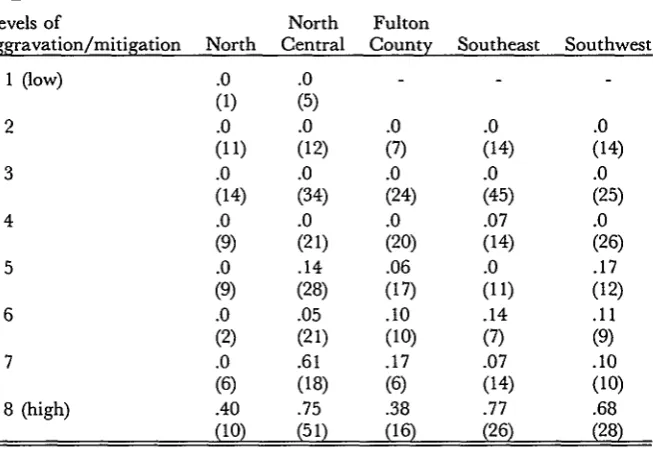
According to Table 5, Georgia prosecutors decide to hold penalty trials disproportionately in white victim cases as opposed to black victim cases at most levels of aggravation/mitigation. There are consistent and sometimes striking disparities of treatment by race of victim, notwith-standing the conservative bias of this regression-based aggrava-tion/mitigation index. As a consequence, sentencing juries see mostly white victim cases at relatively high levels of aggravation. Race-of-vic-tim comparisons of jury decisions to impose death sentences are thus limited by the small number of black victim cases at a given aggrava-tion/mitigation level. The differences that do appear, however, tend to compound further the disparities at intermediate levels of aggravation/mitigation.
[image:23.454.76.403.110.335.2]judicial circuits in Georgia.4' Their analysis reveals extreme sentencing disparities by region, especially as aggravation level increases, as shown in Table 6. Thus, among the most aggravated cases, no more than forty percent of the convicted murderers receive a death sentence in the northern region and Fulton County, compared to at least two-thirds of their counterparts in the other three regions. The investigators show, moreover, that these extreme disparities persist when the comparisons are restricted to white victim cases.42
These regional disparities are un-derscored by the fact that just twenty-six, or fifteen percent, of Georgia's 159 counties were responsible for eighty-five percent of the death sentences imposed between 1973 and 1978 in that state.4 3
In continuing research, Baldus and his associates have gathered ad-ditional data on the process of Georgia homicide cases from indictment through sentencing, extending the period of coverage through 1979. Al-though the analyses of these data are still preliminary, Baldus summa-rized the cumulative findings of this research in an affidavit of June 22,
1982, prepared for the petitioner in Smith v. Balkcom:44
Differential treatment of white and black victim cases appears to prevail at each stage of the capital charging and sentencing process beyond initial indictment-specifically in plea bargaining decisions, jury guilt decisions, the prosecutor's decision to proceed to a penalty trial, and the jury's deci-sion at sentencing.45
With the evidence of race- and region-linked sentencing differen-tials in Florida46 and with stronger, more rigorously controlled evidence of this sort now becoming available on Georgia,4 7 it is obvious that de-spite statutory sentencing guidelines and separate sentencing hearings, the sentencing stage of the process is still subject to the extralegal influ-ence of race and place. Thus, of the three reforms approved in Gregg-statutory sentencing guidelines, separate sentencing hearings, and auto-matic appellate review-the last of these must-bear a heavy burden if the post-Furman capital statutes are to meet the Furman standard.
41 Id at 104-11.
42 Id. at 110 Table 26. 43 Id. at 106 n.107,
44 Smith v. Balkcom, 660 F.2d 573 (5th Cir. 1981), cert. denied, 103 S. Ct. 181 (1982).
45 D. Baldus, G. Woodworth & C.'Pulaski, The Differential Treatment of White and
Black Victim Homicide Cases in Georgia's Capital Charging and Sentencing Process: Prelim-inary Findings 29, app. D to Petitioner's, cert. petition in Smith v. Balkcom, 660 F.2d 573 (5th Cir. 1981),petition for cert. filed, 50 U.S.L.W. - (U.S. June 22, 1982) (No. 81-6978), cert. denied, 103 S. Ct. 181 (1982).
V. STATE APPELLATE REVIEW
The United States Supreme Court declared in Gregg that automatic appellate review of all death sentences "serves as a check against the random or arbitrary imposition of the death penalty. '4 In this context, Justice White commented that Georgia's statutory provision for "pro-portionality review" requires the Georgia Supreme Court to "do much more than determine whether the penalty was lawfully imposed. '49 He noted that "[i]t must go on to decide-after reviewing the penalties im-posed in 'similar cases'-whether the penalty is 'excessive or
dispropor-tionate' considering both the crime and the defendant."50
State appellate courts however, may, be ill-prepared and perhaps disinclined to perform the oversight and monitoring functions assigned to them under the new capital statutes. They generally do not compare the sentence in one case with those in others, nor do they directly collect and evaluate evidence; instead, arguments are reviewed on the basis of evidence that has been admitted in other courts. Evidence that the ap-pellate review process is not living up to the Supreme Court's expecta-tions is mounting. We have demonstrated elsewhere5' that racial and locational disparities in the imposition of death sentences are not being reduced by the actions of the state supreme courts of Florida and Georgia.
Baldus, Pulaski, and Woodworth recently completed a more de-tailed study of Georgia's appellate review process.5 2 For its proportion-ality review, the Georgia Supreme Court is required by statute to identify cases "similar" in characteristics of the crime and the defendant to the one under review, and then to compare the sentence under review with those imposed in these similar cases. The pool from which the court may select "similar" cases should, according to the Georgia stat-ute, include capital cases in which sentences were imposed after January 1, 1970. The statute also requires that the cases selected as similar be cited in an appendix to each of the court's published opinions upholding a death sentence.5 3
Baldus and his associates examined the court's selection of similar cases for its proportionaltiy reviews of sixty-eight affirmed post-Funman death sentences for murder. Using the detailed data collected on some
48 Gregg v. Georgia, 428 U.S. 153, 206 (1976).
49 Id. at 223.
50 Id.
51 See W. Bowers, supra note 3, at 36, Tables 7-14 and 7-15 and accompanying text. 52 D. Baldus, G. Woodworth & C. Pulaski, Proportionality Review of Death Sentences: An Empirical Study of the Georgia Experience (1982) (Draft report to the National Institute of Justice, Center for Interdisciplinary Studies, College of Law, Syracuse University).
750 capital cases (approximately 150 pre-Furman and 600 post-Funnan) during the period 1970-1978, Baldus, Woodworth, and Pulaski com-pared the cases cited as similar by the court with cases identified as (1) comparable in terms of aggravation/mitigation index scores; (2) matched on the basis of specific facts or main determinants analysis; and (3) alike in the salient features of the case.54 They found that the cases cited as similar by the Georgia Supreme Court were more highly aggra-vated and more likely to have received a death sentence than those iden-tified as similar by any of the three empirically based and objectively specified methods the researchers employed.
The author is currently conducting an analysis of the Georgia re-view process using a somewhat different approach.5 5 Instead of identify-ing similar cases by objective standards and then comparidentify-ing them with those cited by the court as similar, our approach has been to identify the factors that distinguish the cases chosen as similar from those eligible cases the court did not select. That is, we have attempted to discover the criteria the Georgia Supreme Court actually applies, knowingly or otherwise, in the selection of similar cases.5 6
We are using the Georgia Supreme Court's own data, collected spe-cifically for purposes of proportionality review as directed by Georgia's capital statute, on all capital cases resulting in life or death sentences that were appealed to the Georgia Supreme Court after January, 1970. The data come from a six-page questionnaire completed by trial judges in cases where a death sentence was imposed under the post-Furmkn stat-ute, and by a clerk of the court for all cases where the sentence was life as well as for the pre-Funnan cases where the sentence was death. The questionnaires provide data on the crime, the defendant, the trial pro-cess, and the outcome or disposition of the case including jury findings and sentence imposed. The data for some 297 murder cases tried be-tween 1970 and 1977 (including the first thirty-six post-Furman death sentences for murder reviewed for proportionality) were obtained pursu-ant to a motion for discovery filed by Atlpursu-anta attorney Millard
54 These correspond to procedures (3) through (5) as enumerated in the text accompany-ing note 39, supra, and they are described in detail in D. Baldus, G. Woodworth & C. Pulaski, supra note 38.
55 W. Bowers, J. McDevitt & A. Diana, Proportionality Review by the Georgia Supreme Court: Evaluation or Rationalization? (1983) (unpublished manuscript, Center for Applied Social Research, Northeastern University).
Farmer.57 The Georgia Supreme Court has since refused to release the data on subsequently reviewed cases.58
These data show that the Georgia Supreme Court chose cases that are not more consistently similar to the ones under review than the other cases in the pool. By statute, the characteristics of the crime and the defendant should determine which cases are similar and the court should compare the sentence imposed in the case under review with the cases found to be similar. Instead, the court seems to have reversed the procedure. What most distinguishes the cases chosen by the court from those eligible59 but not chosen is the fact that the original sentence was death and has been upheld by the Georgia Supreme Court. In effect, the court defines as similar those cases in which the death sentence has been handed down and upheld, whether the characteristics of the crime or the defendant are similar to the ones under review.
Our complex statistical analysis led us to the simple but revealing picture of the proportionality review process given in Table 7. It shows for each of the first thirty-six affirmed death sentences for murder how many of the cases cited as "similar" were life cases after 1970, how many were death cases under the pre-Furman statute, and how many were death cases under the present post-Furman statute effective April 1973.
In all, the Georgia Supreme court cited only eighteen life cases (the total of the second column figures), or less than ten percent, of the more than 200 life sentences appealed to the Court between 1970 and 1977. Moreover, seventeen of these were pre-April 1973 life cases cited in the first six reviews, and not cited again after the thirteenth case (A. Smith). The court cited only one life case under the new statute (as similar to Dix). In only one case (Moore) were more life than death sentences cited as similar.60
The court cited twenty-two pre-Furman death cases, almost two-thirds of them in the very first review. Over half of these were cited in ten of the first fourteen reviews, and no additional pre-Furman death cases were cited after the ninth review (Jarrell). Then, as post-Furnan
57 Willis v. State, 243 Ga. 185, 253 S.E.2d 70, cert. denied, 444 U.S. 885 (1979).
58 D. Baldus, Personal communication with Curtis French, Clerk of the Georgia Supreme
Court (Sept. 28, 1983).
59 For a given proportionality review, the eligible pool is defined as all life and death cases
after 1970 that have been appealed to and reviewed by the Georgia Supreme Court on or before the review date of the case in question.
60 Moore's case is truly extraordinary in that the trial judge imposed death-without jury