200
Chapter 27
Food Technopreneur A Design of New Curriculum in Indonesia
’
s Higher
Education
Sekar Wulan Prasetyaningtyas1,a
1
Prasetiya Mulya Business School, BSD-Tangerang, Indonesia a
Abstract. This article describes the curriculum design of a new undergraduate degree program in Food
Technology at the Prasetiya Mulya Business School, BSD-Tangerang. The main objective of this undergraduate program is to address the country’s need for producing qualified and skilful food technologytrained engineers with entrepreneurial skills. Therefore, one of the program’s educational objectives is to build tomorrow’s technopreneur leaders. The needs of the students, industries and other stakeholders of this program will also be highlighted in the development of the program educational objectives and program outcomes. Data and analysis of the market survey conducted from both the industry and student perspective will be presented. The curriculum structure of the program to accomplish the program outcomes will also be discussed in this article.
Keywords: Food technology, Food technopreneur, Higher education curriculum, Food industry
I.
Introduction
Indonesia, as the fourth most populous country in the world with a population of 235 million people, is a very large market for food and beverage products. The sector has proven to be very resilient during economic downturns, and for many multinational food companies, Indonesia is among their most important markets. Until the last trimester of 2015, the food industry in Indonesia predicted to reach 700 trillion IDR, around 10% of Indonesia’s GDP [1].
Central Bureau of Statistics reported that Food products is 7.3 % of GDP , which grew significantly to 35% from 2004 until 2010 and involved more than 5,000 business units [1]. Until now, the food industry is still a mainstay of the non-oil manufacturing sector in Indonesia.
However, to mobilize the national food industry, Indonesia still imports raw materials & food additives in a big amount. In 2014 we imported 5.6 million tons of wheat , 2.7 million tons of sugar , 2 million tons of soybeans and more than 70 % of raw materials for dairy processing industry [1]. Moreover, More than 30 % of the food additives, ranging from coloring, artificial sweeteners, preservatives, flavorings, flavor enhancers, antioxidants, acidity regulator, bleach, bund flour, emulsifiers and the thickener, still imported from Europe and the United States [1].
The above fact is ironic considering Indonesia has a big potential for natural resources. Another ironic reality is that the food technology graduates in Indonesia had only become ' spectator ' than being ' main actors ' in the food industry in Indonesia. They used to be a worker, not yet having the sense to produce new products from Indonesia's natural resources.
Central Bureu of Statistics data in 2013 describes the percentage of entrepreneurs in Indonesia amounted to only 0.24 % of the total population, in which the neighboring countries, Malaysia has reached 3 % . To reach 2% , Indonesia needs at least 3.6 million new entrepreneurs [2].
201
to explain the importance of mindset change in the pattern of education in the faculty of food technologyy, to produce not only food technology workers but also a reliable food technopreneur.
II.
The Need For Technopreneurship In The Food Industry
The term technopreneurs arose from within Singapore culture to describe entrepreneurs who combine entrepreneurial skills with technology [3]. The best candidates for technopreneurship, especially in the area of food technologist are researchers as well as students with science and technology background. Therefore, the education of engineers must be a multi-frontal effort. The fundamentals of engineering must be instilled into the student. The knowledge of how to manage an enterprise must be taught and the practical method of problem solving must be applied. The engineer who barely knows how to take his or her theory out of academic idealism progresses to being someone who is a master craftsman. They become a manager of an enterprise with several roles. They must train new engineers, must operate the engine correctly, and they must review the economics of the enterprise. They must have technical, economic and people skills - not a commonly found combination. It is easy to find two of the three skills in one person; but it is difficult to fine all three skills in one person [4]. Therefore, Prasetiya Mulya Business School feels the urgent need to address this issue in the design of a new curriculum in their Food Technology
The new programme will be developed by designing the curriculum backwards by first identifying the major outcomes as the focus and linking planning, teaching and assessment decisions directly supporting these intended outcomes. The new developed programme will have a more directed and coherent curriculum so as to produce strategic thinking technoprenours, who will have the skills to succeed in a rapidly changing global business environment. This will provide an avenue for students to compete in the global business area and emerge as successful future entrepreneurs [5]. The main design objectives of this new programme can be summarised as follows:
To carry out unprecedented investigation on the level of implementation, and development of food technology in Indonesia industries and universities. •To address the industry and country’s need for qualified and skillful
food technology-trained engineers with entrepreneurship skills. • To propose a novel outcome-based
educational model for the food technology ungraduate programme and its impact on student learning, curriculum development and assessment.
III.
Business Competence in The New Curiculum of Food Technology
Prasetiya Mulya Business School applying the outcome based curriculum in designing their new department. The key underlying principles in the design of the outcome based curriculum reflects the requirements and the needs of the main stakeholders of the undergraduate programme, namely the university, industry, students and parents, and the government. In addition to the above underlying principles in the design of the outcome-based curriculum, the programme must also abide by the statutory regulations set by the university. The set of guidelines adopted for the content of the new postgraduate programme can be summarised as follows:
1) The curriculum is packaged as a eight semester (four year) programme.
2) The programme must have a minimum of 14 credit hours (1 credit is equivalent to 50 minutes of lectures or 1 hour tutorial/laboratory work).
3) The curriculum is to be built upon the foundation of a balance between food technology, business and information technology (IT).
4) The programme must instil technopreneurship knowledge in the students. 5) The curriculum must include courses from the business and marketing faculty.
202
Fig 1. The breakdown of Prasetiya Mulya Business School Food Technology curriculum
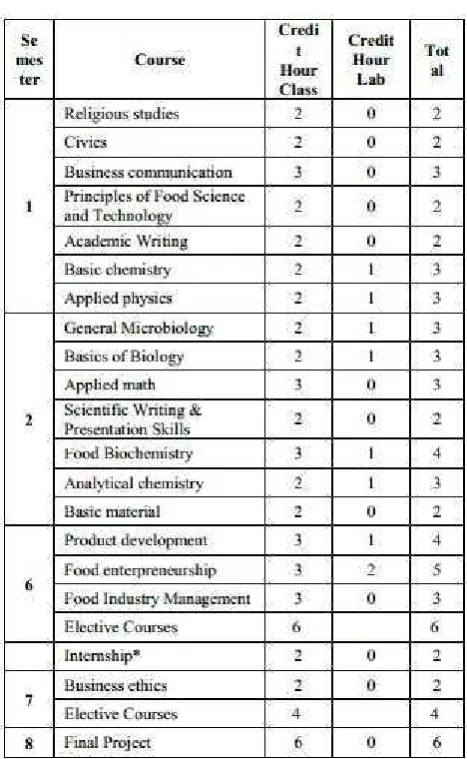
For the course offered, Prasetiya Mulya Business School using the standard from the Institute of Foos Technology, USA. Below is the detail course offered in Prasetiya Mulya Business School, Food Technology Faculty.
Table 1. course offered in PMBS
The curriculum was designed to strengthen students’knowledge in the core courses with a total of 72 credit hours. The students also have to take specialised elective courses, which are offered as specialisation in food technology and business. The electives in the specialisation area total nine 25 hours.
[image:3.595.181.428.289.649.2]203
Community development course to build the capacity of student social awareness ,social adaptability and social responsibility and to build networking capabilities of students during the learning program at the Prasetiya Mulya Business School. In the Community Development course I student must do social work at least 20 hours during the semester 2 in social homes or community residences and do social projects in the group. The activity was conducted to train sensitivity, awareness and empathy in the community about a particular student need. In the Community Development II courses , students in the group will run a program of capacity building and the welfare of society through entrepreneurial activities when the semester break for a month before the 6th semester and perform project monitoring and guidance during the semester 6. Project work must have positive impact on families’partners in village.
The Food Technology Technopreneurship course is offered in the seventh semester. In this course, students will be taught about the knowledge of business organisation and management, accounting and marketing, business proposals and business financial issues. Case studies will be used to strengthen their soft skills and enhance their business strategy. This course is a co -requisite to their final year project and the assessment is based purely on reports and presentations. In the technepreneurship course, students are required to write up a proper business plan pertaining to the commercialisation aspect of their research work in the final year project.
[image:4.595.186.420.352.732.2]In addition to the core and elective courses, all students are required to take courses that are basic to all undergraduate students from all disciplines. These courses are research methodology and thesis writing, and a presentation course, religious studies and civics. The detail for basic course offered in PMBS can be seen in table 2.
204
IV.
Conclusions
Many factors have the potential to reshape or redirect the Food engineering world. Significant changes in the responsibilities and expectations of engineers have occurred over the last ten years and will continue for the next ten. To meet the challenge of employability or marketability, engineers will still be judged by what knowledge and skills they have acquired from their education. They must equip themselves with technical expertise or risk being phased out.
Moreover, engineers graduating in food technology, outside the technical knowledge, their skills must include components such as business, soft skills and interdisciplinary food technology knowledge. Given the rapid advancement of food technology, specific job training will not prepare engineers for an entire career, but they will need additional skills such as tenhnopreneurship skills along with the ability and desire for lifelong learning. Therefore, engineers will need to have technopreneurship skills to stay employable. It is hoped that this new undergraduatgraduate course will consolidate the following aspects:
1) Creating a technopreneurship culture and increasing the supply of new entrepreneurs through a food technology project-based programme.
2) Driving a culture change towards OBE for learning in engineering programmes that can anticipate real benefits and improvement.
3) Enhancing relationships between university and industries, leading to useful linkages and seamless collaboration.
References
[1] Ministry of Trade Republic of Indonesia, Commodities Import Policy Analysis of food additives and ingredients in reducing the trade balance deficitAgency for the Assessment and Development of Trade Policy Foreign Trade Policy Centre, Jakarta (2013)
[2] Kasali, Rhenald. Independent Young Interpreneur, Gramedia Pustaka Utama, 2010
[3] Depositario, R., et al., Enterpreneural Skills Development Needs of Potential Agri-Based Enterpreneur. J.ISSAS Vol. 17, No. 1:106-120 (2011)
[4] Greater Expectation: A new Vision for Learning as a Nation Goes to College. National Panel Report. Association of American Colleges and Universities (2002) (www.aacu.org).