146
Chapter 20
Line Balancing by combining given Work Cell and single tasks, a Small Scale
Industry case
Gamawan Ananto1,a, Adimas D. Januardy1,b
1
Manufacture Engineering Dept, Bandung Polytechnic For Manufacturing (POLMAN), Jl.Kanayakan 23, Bandung 40135, Indonesia
a
[email protected],[email protected]
Abstract. A clothing small scale industry produced a kind of trousers that needs operation order of 25 tasks, is
lamented that the productivity is not as expected. Through a tracing of production data, the series of operations and the processing time of each operation are determined. Since certain tasks in production floor are using the same machines that could be declared as defined work cells, there are unnecessary waiting time on several point of operations. The company is suggested to combine previous defined work cells with new others by common work cell line balancing. This conditional work cell balancing could increase the efficiency as the man cost and waiting time are reduced. It shows that line balancing idea is still the relevant way to improve such case although other recommendation related with machine layout should still be initiated for better time and distance of material or product transportation in the shop.
Keywords: line balancing, productivity, work cell.
I.
Introduction
This manuscript explains a case of a clothing small scale industry in the West of Bandung, Indonesia, that produced a kind of trousers. Although the procedure of its production was not that proper since the goal is just simply answer the market, but their quality is quite good. Anyhow, there is a willingness and spirit to develop the company in order to grow the market share up. Therefore few evaluations were made and there are several points could be improved.
It is found in the production flow with operation order of 25 tasks, operated by 18 workers, that the productivity is not as expected since there are unnecessary waiting time on several point of operations. There are no any information of standard operation time of each task, its flow succession of operation, etc, but the employees are capable to do their activities well due to their skill, experience and product knowledge.
147
II.
Literature Review and Methodology
In work cell line balancing, defining task list of the case with each tasks’operation time is a mandatory[1] in order to get total operation time and create its precedence diagram because there are the predecessor tasks as well in such list content. Referred to this task list and precedence diagram, maximum capacity (K) could be calculated with company’s operation time (OT), whereas the cycle time (CT) is taken from the longest task time[1], using following general equation:
K = OT / CT (1)
Further, the CT which will be used for each work cell could be calculated by equation that is taken from (1) where K might be assumed considering te demand level conditionally:
CT = OT / K (2)
Moreover, the minimum number of Work Cell then could be defined as one of necessary factors in the line balancing principle by below mentioned equation :
N = Total‘t’ /CT (3)
where Total ‘t’ is the sum of the whole tasks in the system. The efficiency of reached condition can be then calculated by:
Balance Efficiency = Total‘t’ /(CT.N) (4)
where CT is the maximum cycle time of each work cells in the system[3] that calculated by previous equation (2). Commonly, the task assignment into work cells successively in heuristic method is using the combination by prioritizing few criteria; choose the task that does not have any predecessor or the predecessor is already assigned, the task with most followers, or which had the longest operation time‘t’[2].
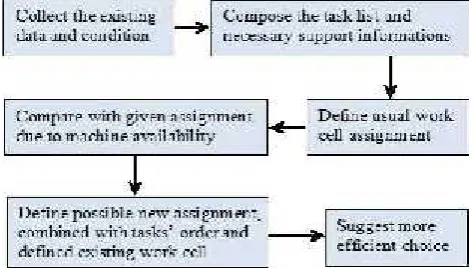
The first thing that have to be traced are the production data related with series of operations, operation time of each task and other necessary information, as stated in following Fig.1. The number of operation and machines will be named in simple identities as A, B, C and so forth, in order to make the task list won’t be more complicated and the usual work cell assignment could be defined easier for the precedence diagram.
[image:2.595.186.424.548.682.2]This assignment then should be checked with actual situation where certain machine is used for several tasks, for those such machine is operated. The new next possible assignments then could be defined where given work cells or machine that used for certain tasks are combined with stand alone tasks. This could be an alternative of choice that theoretically could be better or more efficient than the previous or actual situation.
148
III.
Results and Discussions
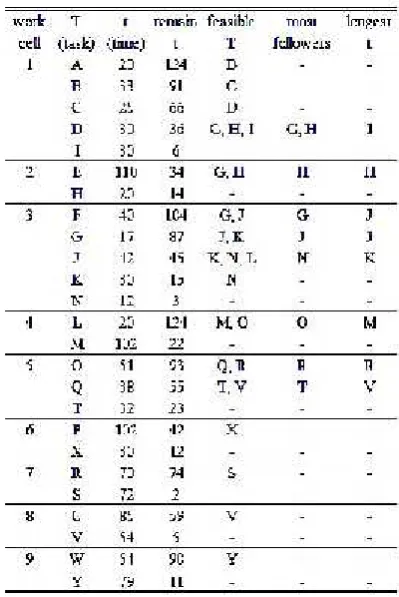
[image:3.595.236.363.194.568.2]Below mentioned“Table-1”shows the list of tasks that is used to produce a kind of Trouser discussed in the topic, where the unit of time (t) are in second. As stated, the tasks’operation time are obtained by a time motion study and statistical approach that won’t be discussed, whereas its series of operations are defined from production floor investigation.
TABLE I TASKLIST OFTROUSERSPRODUCTIONLINE
Though the number of production target is not clearly stated, the actual performance with normal working time of 7 hours per day is approximately 195 units per day in average, that may called as their contribution part of market share with other companies. The fluctuation or increase of demand just simply provided by overtime conditionally. Regarding the willingness for capacity up, maximum capacity (K) could be calculated by assuming operation time (OT) to 12 hours per day or 43’200 seconds per day and cycle time (CT) is taken from the longest task time[1], using equation (1). Since the longest task time is task‘E’ (110 seconds) the possible maximum K is 43’200 / 110 = 393 units per day, and the realistic K possibly assumed to 300 units per day.
Using this assumed K, the CT which will be used for each work cell could be calculated by equation (2) thus the cycle time result is 43’200 / 300 = 144 seconds per unit. Using (3) the minimum N then 1’198 / 144 = 8.3 Work Cells, rounded up to 9. By prioritizing the criteria of choosing the task that does not have any predecessor or the predecessor is already assigned, the task with most followers, or which had the longest operation time
149
[image:4.595.203.403.128.427.2]But actually there are three machines that operate several tasks and these could be called as‘given Work Cells’. They are: Work Cell-1 that had task A, C, G, H and L; Work cell-2 for Q and S; and Work Cell-3 which operates N, O and R. The other task such as B, D, E etc are executed by each single machine and man.
TABLE II THECOMMONASSIGNMENTPROCESS
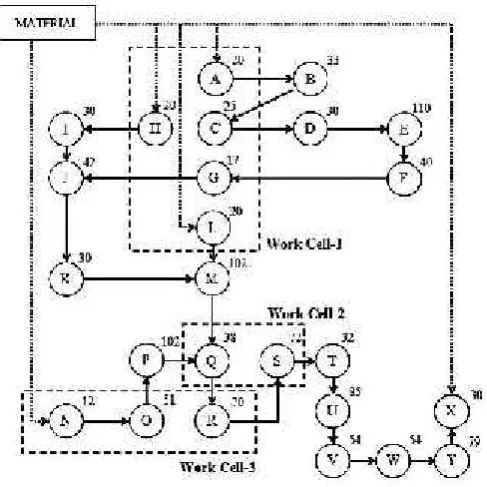
Therefore, in fact the company worked with 18 work cells in total, means the assignment on“Table-2’is not valid any longer. Following “Fig.2”shows the actual assignments in non scaled and not real machine layout or position, in order to explain the work flow clearly. As CT is the cycle time of the system[3] that calculated by equation (1), in this condition the result of its efficiency is 1’198 / (144 x 18) = 46.2%. In such condition, it is easy to imagine that there are unnecessary waiting time on several point of operations. It shows easily the duration differences of tasks in succession.
At task M for instance, the product output from K should wait 72 seconds for each cycle before it could be processed, or machine F has to wait up to 70 seconds each cycle until machine E is finished. It is found by investigation that the operators of several machines even decided to do other activity while waiting until the products from previous process became a pile and they would execute the process with no interrupted for certain quantity of products.
Therefore, a conditional work cell line balancing should be initiated. A new possible assignment then could be defined where given work cells or machine that used for certain tasks are combined with stand alone tasks. The assignment process seems not possible to use the heuristic method but the trial-error way. The reason is that in heuristic way the given Work Cell (W/C) that are W/C-1, W/C-2 and W/C-3 have to be stated as a task for each W/C, whereas actually they had several real tasks per W/C that caused by multiple in and out work flow between such W/C and its predecessors or operations after.
150
Fig. 2. The Original Trousers Precedence Diagram
The whole assignments in the system is explained in“Fig.3”,as stated, by combining the heuristic method and trial-error way. With such new assignment, using equation (4) where total ‘t’is 1’198 seconds and CT is 144 seconds per unit with execution by 11 W/S, the efficiency then will be 1’198 / (144 x 11) = 75.6%. Compared to 46.2% previously, such increasing is contributed especially from the number of W/S and man. Though do not use standard way nor usual method, this conditional work cell balancing could reduce man cost and waiting time, thus line balancing idea is still the relevant way to improve such case. In this new assignment of production line, every remain worker will do the tasks without any unnecessary waiting time or much less. The company may or should consider or decide to minimize the number of worker from this kind of product by assigning them for other job, project, task etc.
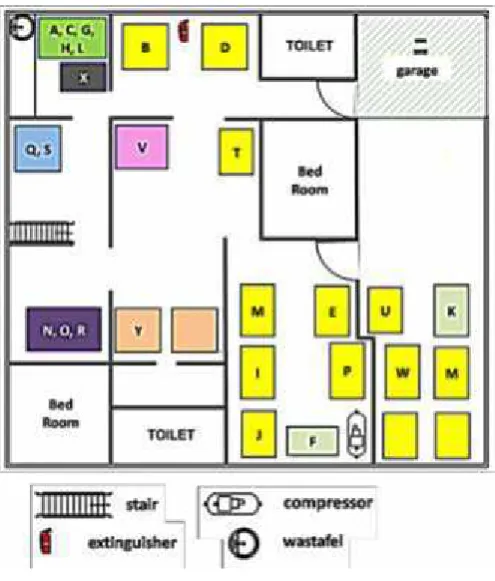
Since such assignments are made theoretically without considering the machines position in the actual situation, the next stage of improvement could be machine re-layout due to time or distance of material or product transportation in theshop. “Fig.4” showsthe existing or real workplace layout where the different kind of machines are identified with different color; those are machine-1 (task A, C, G, H, L), machine-2 (Q, S), machine-3 (N, O, R), machine-4 (V), machine-5 (F, K), machine-6 (Y), machine-7 (B, D, T, M, I, J, E, P, U, or W) and machine-8 (X).
151
Fig. 3. The New Trousers Precedence Diagram
Fig. 4. The Existing Workplace Layout
[image:6.595.181.429.351.642.2]152
IV.
Conclusions
In a clothing small scale industry in the West of Bandung, Indonesia, a kind of trousers is produced where operation order of 25 tasks is needed. As the productivity is not as expected, through a tracing of production data the series of operations and the processing time of each operation are determined, in order to analyze related things for improvement. Since certain tasks in such production floor are using the same machines that could be declared as defined work cells, whereas many other tasks operate by each specific machine, there are unnecessary waiting time on several point of operations. The company is suggested to combine previous defined work cells with new others by common work cell line balancing.
Though do not use standard way nor usual method, this conditional work cell balancing could increase the efficiency from 46.2% up to 75.6% as the man cost and waiting time are reduced. The company may consider to minimize the number of worker from this kind of product by assigning them for other job, project, task etc. It shows that line balancing idea is still the relevant way to improve such case. It is no doubt that other recommendation related with machine layout should be initiated on the next stage due to improve the material flow, avoiding‘jumble flow’like in the‘job shop’in order to get the shortest distance of transportation in the shop. Nevertheless; this could be possibly not that easy since there are consequences such as few walls in the actual condition that should be replaced or moved in order to get an ideal layout. This recommendation then should be in line with the general business plan appropriateness related with certain term of enterprise planning.
References
[1]. Eddy Heryanto, “Manajemen Produksi & Operasi”, Grasindo, 1999
[2]. Barry Render, Ralph M.Stair Jr & Michael E.Hanna, “Quantitative Analysis for Management”, 8th Edition, Prentice Hall, 2003.