Journal of the Statistical and Social Inquiry Society of Ireland, Vol. XXVI, Part 111
SYMPOSIUM ON EC STRUCTURAL FUNDS
SEAN D. BARRETT
Economics Department, Trinity College, Dublin (Read before the Society, 4 March 1993)
1. INTRODUCTION
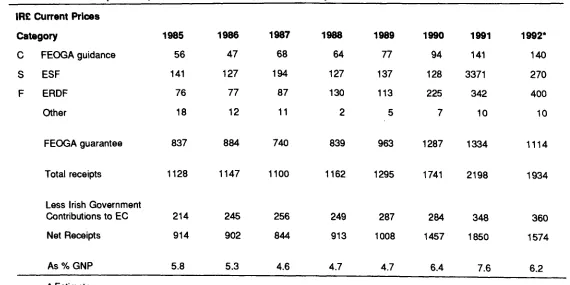
Ireland is the recipient of one of the largest foreign aid programmes in the world. Our net receipts from the EC between 1990 and 1992 averaged 6.7 per cent of GNP. The analysis of so large a transfer is obviously important and the Society should be commended for organising this symposium.
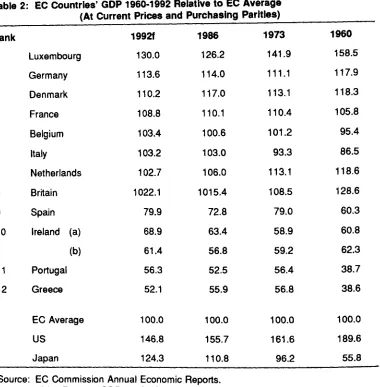
Table 1 shows the transfers from the EC to Ireland since 1985. Table 2 shows Irish progress towards the EC average incomes. When one deflates for the widening difference between Irish GNP and GDP there has been a decline in Ireland relative to the average EC level since 1960 and a gain of 2 points since 1973, from 59.2 per cent to 61.4 per cent of the EC average. Spain has been much more successful by moving from 60.3 per cent to 79.9 per cent. Portugal has increased from 38.7 per cent to 56.3 per cent and Greece from 38.6 per cent to 52.1 per cent.
Smith (IFS, 1992) shows net transfers from the EC to Ireland in 1992 at 6 per cent of GNP, compared with Greece at 5 per cent, Portugal at 1.3 per cent and Spain at 0.5 per cent. The efficiency of the total EC funds in redistribution is weakened by the FEOGA Guarantee Fund, or CAP, which accounted for 57.6 per cent of gross EC transfers to Ireland in 1992. The CAP still takes 58 per cent of the total EC budget and its impact means that Denmark with 110 per cent of the EC GDP per head is a net recipient of the same proportion of GDP as Spain which has 80 per cent of the EC average. The FEOGA Guarantee Fund is the longest running EC Fund and its operations may provide some explanations of Ireland's poor growth performance towards achieving the EC average GNP per head, in addition to any pursuit of ill-advised economic policies by the Irish authorities.
Table 1: Irish Receipts From, and Contributions To, the Community
IRC Current Prices
Category C S F 15 7 FEOGA guidance ESF ERDF Other FEOGA guarantee Total receipts
Less Irish Government Contributions to EC Net Receipts
As % GNP
Table 2: EC Countries1 GDP 1960-1992 Relative to EC Average
(At Current Prices and Purchasing Parities)
Rank 1 2 3 4 5 6 7 8 9 10 11 12 Luxembourg Germany Denmark France Belgium Italy Netherlands Britain Spain Ireland (a) (b) Portugal Greece EC Average US Japan 1992f 130.0 113.6 110.2 108.8 103.4 103.2 102.7 1022.1 79.9 68.9 61.4 56.3 52.1 100.0 146.8 124.3 1986 126.2 114.0 117.0 110.1 100.6 103.0 106.0 1015.4 72.8 63.4 56.8 52.5 55.9 100.0 155.7 110.8 1973 141.9 111.1 113.1 110.4 101.2 93.3 113.1 108.5 79.0 58.9 59.2 56.4 56.8 100.0 161.6 96.2 1960 158.5 117.9 118.3 105.8 95.4 86.5 118.6 128.6 60.3 60.8 62.3 38.7 38.6 100.0 189.6 55.8 Source: EC Commission Annual Economic Reports.
Irish Data (a) GDP (b) GNP.
assistance, one may question whether the strategy is in the long-term interest of Irish agriculture. There is a stronger case that it has not been in the interest of developing a food industry in Ireland.
2. THE STRUCTURAL FUNDS
The EC has three structural funds; the guidance section of FEOGA (the Agricultural Fund), the Social Fund and the Regional Fund; a fourth, the Cohesion Fund, is to come into effect before the end of 1993 under the Maastricht Treaty. The FEOGA Guidance Fund seeks increased productivity through the modernisation of agricultural structures, marketing and processing activities. The Social Fund seeks to improve employment opportunities through vocational training and increasing occupational and geographical mobility. The Regional Fund supports public and private organisations in industrial and infrastructural investments in underdeveloped regions. The Cohesion Fund will support measures to reduce the disparities between regions and the backwardness of the less developed regions. It will assist projects in the fields of environment and trans-European networks. The share of structural spending in the EC budget is set to increase from 18 per cent in 1987, to 29 per cent in 1992 and 36 per cent in 1999.
In an ideal world Ruritania would achieve cohesion towards the EC average income per head by a large transfer of funds which would be used for vocational training and retraining, industrial grants and infrastructural investments in underdeveloped regions. It would also use EC transfers to improve its environment and seek to designate as many as possible of its transport facilities as trans-European networks.
Ireland, as we have seen, has not emulated Ruritania. From 1989 to 1992, inclusive, the structural funds increased 2.5 times to £81 Om but Ireland remained at 61 per cent of EC average GNP per head. The investments may take longer to have an impact but the investment of £3.6 billion in structural funds since 1985 has been associated with a rise from 58 per cent to 61 per cent of the EC average GNP per head. In explaining this rise, the structural funds would have to compete with alternative explanations such as the policy of expansionary fiscal contraction as examined by McAleese and the doubling of tourism after airline deregulation in 1986.
The ability of government borrowing to stimulate output and employment in Ireland is limited by the openness of the economy. The small open economy model may explain the apparently smaller impact of larger EC transfers in Ireland where international trade is 135 per cent of GNP compared to Spain where international trade is only 30 per cent of GNP. In Portugal and Greece the trade ratios are 70 per cent and 45 per cent, respectively. The perceived stimulatory effects of government borrowing in Ireland are sought in three policy instruments: (1) The introduction of the Public Capital Programme in 1950; (2) A policy of continuous current budget deficits since 1972, and (3) The use of EC funds to increase the level of public capital expenditure.
The Public Capital Programme was subject to early criticism from the Central Bank because it exceeded the savings available to finance it, included projects which were not self-supporting, caused inflation, and imposed debt service obligations on the Exchequer (Annual Report 1950, p. 13). The public capital programme evolved as merely a statement of spending intentions without relating these to the outputs expected. Without measures of output, indicators of productivity could not be devised. Spending programmes were not compared with alternatives. Rate of return estimates were not prepared and the opportunity cost of funds was treated as zero. Many of the objectives were social rather than economic and the programme may be more correctly treated as a current budget deficit rather than an investment programme.
Following exceptionally large public programmes in the early 1980s when the investment to GNP ratio reached almost 30 per cent, the programme was reduced. The 1983 Public Capital Programme stated that "our investment ratio (that is investment as a percentage of GNP) is one of the highest in the OECD countries. The results in terms of growth and net employment creation, have been disappointing".
Between 1983 and 1989 the Public Capital Programme was reduced in volume terms by 45 per cent (PCP, 1992, Table 5). The years 1986-90 were, none the less, years of significant growth in output and almost a golden age in terms of the growth of employment.
investments:-a cleinvestments:-arly defined set of objectives for the project;
a statement of alternatives that would meet the objectives; a statement of the constraints that impinge on the project. The appraisals were intended to include for each chosen economic alternative:
a list of the benefits and costs expected over the economic life of the project and the underlying assumptions;
• a quantification of the benefits and costs in cash flows or economic flows, as appropriate;
• a calculation of the decision criteria (net present value, cost/benefit ratio, internal rate of return, maximum effectiveness at least cost) and a test for sensitivity to changes in key variables;
identification, and whenever possible, quantification of the distributional effects of the costs and benefits;
an assessment of the pay-back period (where appropriate); a recommendation as to the preferred alternative;
the recommended rate of discount for future benefits and costs in the appraisals is 5 per cent.
The 1984 PCP guidelines were a useful advance in project appraisal. The establishment of central criteria in the PCP by the Department of Finance would have facilitated a common standard of assessment across departments with a common discount rate and set of shadow prices. The failure to implement the 1984 guidelines has brought a return to the previous era of current budget deficits in the guise of capital investment. Many project justifications are contained in secret unpublished studies commissioned by the spending agencies. The role of easier availability of EC funds in weakening project appraisal standards from the 1984 guidelines either through the easy availability of funds or the sheer volume of projects to be processed in a 50 per cent increase in spending is of interest this evening.
3. EVALUATIONS
The White Paper on the Treaty on European Union (1992) cites ESRI research that "the effect of the Structural Funds and the completion of the internal market by the end of 1992 alone could raise the level of GNP by between 7 and 8 percentage points by the year 2000. The impact of the Funds could lead to the creation of 30,000 additional jobs by the same year" (p. 19).
"It is estimated that the increase in Community support negotiated in 1989 has boosted annual growth by approximately 0.25 per cent to 0.5 per cent. It has also resulted in higher employment than would otherwise have been possible and it was a key factor in the net increase of 39,000 non-agricultural jobs in the two years to April 1991" (p. 40).
In regard to the industrial programme, the White Paper stated that "the employment target has been surpassed for the first three years of the programme with a total of 63,245 new jobs created to the end of 1991. As a result there has been a significant overall net increase in employment in this sector1* (p. 40). The contrast with the Culliton Report (1992) is marked. It found that the expenditure of £1.6b in grants to industry between 1981 and 1990 resulted in an additional 7,000 jobs (p. 65).
The ESRI model (Bradley et aL, 1992) assumes that there is a long-run rate of return of 7.5 per cent on the sums invested in human resource programmes; that the investment in the peripherally programme produces a 5 per cent reduction in transport costs over the period 1989-93 and that investment in tourism infrastructure yields a 7.5 per cent increase in terms of tourist revenue. These beneficial supply side effects are assumed rather than evaluated. The assumptions should be tested in advance of any further allocations of such Structural Funds to Ireland.
The lack of marketable qualifications from training courses may account for the high rate of unemployment of the trainees. One might also question the emphasis on vocational training rather than education and its income distribution consequences. Lack of qualifications in Ireland is highly correlated with unemployment. The ESF policy in favour of training rather than education may divert those with low incomes from acquiring qualifications which would enhance their labour market prospects. Tussing suggested that as resources became available in Irish education they should be concentrated in the age groups where attendance is compulsory and in grants to attend the discretionary parts of the education system by those with low incomes. Any increase in resources would be spent on raising the age of compulsory attendance and in a combination of more generous grants to those on low incomes with a raising of the income limits for grant eligibility (Tussing, 1978). This would enhance the system from the bottom up rather than from the top down.
At third level, the ESF policy of designating certain graduate courses as "Advanced Technical Skills" and subsidising heavily the students attending them and the Colleges providing them, appears to be an unwise diversion of resources from the compulsory part of the system and from assistance to those with low incomes whose participation rates at third level are less than 1 in 20 compared to the higher social groups. There is little evidence that some courses can be designated more than others as causes of economic growth in the Irish case. We have strong evidence, however, that the earnings of graduates show a substantial return on their investment in education and that participation remains heavily skewed by social group. There is no case, therefore, for using EC monies to abolish fees at third level as was proposed in the recent General Election.
Last month there was an invitation from the HEA to the universities to bid for £100m of structural funds at short notice. It was hardly a way to ensure carefully analysed projects but rushed proposals to ensure that no money was lost" by any college. The belief that economic growth is "caused" by some university courses was again central to the allocation of the funds. Libraries apparently do not cause economic growth in the eyes of either the EC or the HEA.
4. INFRASTRUCTURE
(Barrett, 1991, p. 54). Only Austria (1.5 per cent) and Switzerland (1.5 per cent) invested a heavier proportion of GNP on transport infrastructure in the mid-1980s than Ireland's 1.29 per cent in 1992. Ireland is now a major investor in transport infrastructure, with the EC bearing 67 per cent of the cost of the national roads in the years 1989-93 (National Development Plan 1989-93, Summary, Table 2).
Deficiencies in Irish infrastructure reflect unwillingness to finance in the past rather than inability to pay. For example, in 1990 the expenditure on roads in the Comprehensive Public Expenditures Programme was £320m while the annual report of the Revenue Commissioners shows over £900m in tax revenues levied on road use.
The interpretation of the nature of infrastructure has changed radically in recent years. Previously it was seen as part of social overhead capital or basic government services without which primary, secondary and tertiary productive services would not be produced. The characteristics of social overhead capital, as opposed to directly productive activities, were: a large capital-output ratio; capital lumpiness; the non-measurability of output and public provision at free or regulated prices (Hirschman, 1958).
The modern perception of infrastructure has blurred the distinction between infrastructure and directly productive investment. Changes in technology have improved the pricing systems available. The growth of funds in private financial institutions at a time of rising public sector debts contrasts with the previous perception that some projects were so large that only the State could raise the necessary finance. Much infrastructure has already been privatised such as sea and airports, airlines, truck and bus companies, shipping companies, telecommunications, and utilities such as water, gas and electricity. Road pricing is to be the subject of a White Paper in Britain this summer and Germany recently announced is intention to privatise its autobahn system.
estimated that "total use of resources in transport in the UK amounted to some £50b, of which only about £5b was public expenditure" in 1982.
Gramlich (1992), in examining pressures on President Clinton to "do something" about infrastructure in the United States, asked "Would it not make sense to charge tolls on interstate roads, to charge heavy vehicles in proportion of axle-weight and place time-of-day charges on congested urban roads? When all these measures are taken there will be a much clearer picture of any true need for highway construction and renovation".
The COBA evaluation of highway investments was applied by the author to the first motorway project, the Naas Motorway Bypass (Barrett, 1984). The quantified benefits in COBA are time savings, accident cost reductions and fuel savings and the internal rate of return on the project is calculated on these items. The ex post analysis (Barrett, 1991) showed time and accident savings greater than expected but traffic volumes lower than anticipated, with the overall evaluation of the project still highly positive. COBA also includes presentations of environmental issues such as noise and air pollution in towns and impacts on the countryside. The latter considerations are incorporated In environmental impact assessments such as on the Newbridge bypass.
Railways are the legacy of excessive investment by the business sector in the last century. Their presence in the public budget reflects the success of the previous owners in having the State nationalise them. Overthe mainline rail system any external benefits from railways are minimal. The benefits are enjoyed by the users as recognised in the recent introduction of a £60 return business class carriage on the Dublin-Cork line. The problem, however, is that even the most optimistic projections of rail passenger traffic with over £500m of investment show little prospect of passenger or freight traffic growth. The worst option in the McKinsey (1980) examination of the railways was the high investment-increase volume strategy. Nothing has happened since then to change that picture except that railway management now sees EC funds as the solution to their chronic financial problems. There is an unpublished study which supports the investment of £100m on the Dublin-Belfast line in order to bring about 650 passengers a day in each direction between the cities some ten minutes quicker (Irish Statistical Bulletin, December 1993, p. 631).
No money should be paid to the railways until the study is published. At a 10 per cent interest charge the fare would have to rise by £21 a passenger journey just to service the extra £100m invested. I simply do not believe that the investment can be justified and neither can the decision of both governments to withhold copies of the reports allegedly justifying the project. Documents seeking £400-£500m of investment in the mainline railway system have been cited in the Dail by opposition deputies. They should be published and independently evaluated. Proposals to "solve" the high cost of rail infrastructure by separating operating and infrastructure costs must also be explained. In Ireland, CIE is the sole user of the rail infrastructure and therefore must bear the cost.
The technical studies of the Dublin Transportation Initiative must also be published. Reports of many of the proposals indicate that they assume as much as 90 per cent EC funding in order to be "viable". The Transport Consultative Commission (1982) recommended a diesel train plus busway system as the one with by far the highest benefit to cost ratio for public transport in the Dublin area. The light rail option was shown then as the least attractive. The media accounts of the DTI to date indicate a system which is subsidy-driven with the belief that the more expensive the option the higher the subsidy we will extract from Brussels. The opinion polls published asking people what they want, without telling them the price tags, except for road pricing, seem to me of little practical value. The rejection of road pricing by opinion polls is hardly a surprise. I suspect that free drink would do well in opinion polls also. Without price tags, those in the polls will tend to opt for the expensive options and the DTI will inevitably end up requiring heavy subsidies from the EC.
for EC involvement in the subsidised funding of this commercial concern. In the case of the non-Aer Rianta airports at Waterford, Galway, Knock, Sligo, Kerry, and Carrickfin, the difficulty has been to attract airlines. The existing infrastructure is underused. The regional airports and the western section of the M1 motorway in Northern Ireland illustrate that investing in infrastructure in excess of demand does not generate economic growth. The statement in the Operational Programme on Peripherality (1990) that "the Irish air carriers (Aer Lingus and Ryanair) are fully and enthusiastically committed to the development of the regional airport network" (p. 28) has not stood the test of time.
The surplus of £2.2m earned by CIE on revenues of £5.2m at Rosslare harbour would indicate that that venture is quite attractive commercially with a 42.3 per cent surplus after operating cost and interest payable. The value of docks, harbours and wharves is shown in the accounts at £12.7m at the end of 1990. The remaining ports in the country had an income of £32m in 1989, an operating surplus of £8.4m and a net surplus of £2.7m or 8.3 per cent of income. Many Irish ports have a track record on which they could finance their investments commercially. The Dun Laoghaire Harbour Board Development Plan (1992) states that the ferry development at a cost of £24m could be funded by any of a variety of mechanisms including the harbour authority's own revenues (p. 28). The most profitable ports in 1989 were Drogheda, Foynes and Cork, in addition to Rosslare, operated by CIE and Dun Laoghaire, operated by a board appointed by the Minister for the Marine. The success of Associated British Ports in developing harbours as an investment is illustrated by their market capitalisation in early 1992 at over £630m compared to £70m at privatisation between 1981 and 1984. In 1990 ABP had a turnover of £211.3m comprising £176.4m on port operations and £34.9m on property transactions. The profit was £69.4m , of which £59.5m was from port operations and £9.9m from property. The tonnage handled was 101 m tonnes, or about four times the total traffic handled at Republic of Ireland ports. If ports are managed in a commercial way, there is little case for assisting them from EC funds.
None the less, the Review Group on Commercial Harbours and Pilotage Policy and Legislation (1992) recommended up to 75 per cent EC grants for investment in harbours. I disputed the case in the Minority Report as
by Durkan and Reynolds-Feighan (1990) was based on returns by 147 firms with sales of £3.9b. It found an average ratio of transport costs to foreign sales revenues for Irish exporters to European countries of 3.58 per cent.
(2) Capital subsidies would promote capital intensity and excessive investment in ports in both Northern Ireland and the Republic. Management would be diverted towards subsidy-seeking and away from labour problems, pricing policy, and resource allocation decisions.
(3) The Sectoral Development Committee had shown in 1990 that RoRo charges in Rosslare were double those at Lame and those in Dublin were 4 to 5 times greater. For LoLo traffic charges in Dublin were between double and 3.4 times those in the Waterford Bellferry, while Cork was 74 per cent greater.
(4) Waterford and Lame operate as 24-hour ports. Most other Irish ports do not. They are not, therefore, experiencing bottleneck conditions. Price is not used as an allocator of scarce space in harbours. Many ports have quays and jetties tied to particular operations and frequently unused. Higher investment is not the solution to these problems.
(5) No project appraisals were submitted to the group.
The National Development Plan also mentions some bus subsidisation from EC sources. The success of Bus Eireann Expressway services since 1987 on a commercial basis should be noted. They currently carry over 4 million passengers compared to 7.8 million on mainline rail. There is also a substantial independent bus sector which has steadily increased is share of the national bus fleet since 1980 to virtual equality with CIE. In the light of these market developments, a case for subsidising bus fleets from the EC is difficult to make.
5. SUBSIDY, EFFICIENCY AND RENT
"I am against subsidies for transport. I believe that subsidies mean dear transport, dear to the community as a whole. 1 believe that they mean inefficient transport and I believe that they mean nothing but a repetition of the old incompetent method of providing transport services and allowing unnecessary waste to appear at every phase. If we make it clear that we are not going to subsidise, that transport must be sold at a cost which will cover all the changes associated therewith, we will force those providing the services to eliminate waste and ensure that, right throughout the whole of their organisation, there will be complete efficiency and good management." The quote is from Mr Sean Lemass in the debate on the 1945 Transport Act (Dail Debates, Vol. 95, Cols. 420-121).
The Culliton Report noted that "the competitive edge of Irish industry has been blunted as effort and energy have been distracted from the proper emphasis on serving the market and achieving high productivity into maximising the grant or tax benefit. Tax avoidance and grant maximisation are the directly unproductive activities (or rent seeking in the economist's jargon) par excellence" (p. 22).
Three other aspects of the EC structural funds in Ireland were noted by Culliton.
(1) "the funds have underwritten a level of public expenditure in Ireland that would not, otherwise, have been possible";
(2) "a widely held perception, in both the public and private sectors, that the structural funds represent in some way 'free money from Brussels'";
(3) "the directives and regulations governing the structural funds have been too narrowly and rigidly defined. Wider eligibility criteria are required to ensure that the programmes and schemes co-financed are more balanced from a national development perspective" (p. 49).
From membership of the Harbours Review Group, from the submissions to Culliton and observing recent developments in the public finances, it appears that Irish public life remains deeply clientelist. Many transport companies and their employees spend much time lobbying here and in Brussels. Irish governments spend much time in lobbying the EC. Local government in Ireland raises so little of is income in taxation that it mainly operates as a lobby group. The tackling of the public finance problem between 1987 and 1990 has to me been replaced by efforts to draw down as much EC money as possible and project appraisal standards have fallen. The Culliton Group expressed its concern at an early stage about these developments and made a case for a more flexible approach to the funds. We found much agreement with this view then but regret that the matter was not pursued. Ireland's lack of progress towards the EC average GNP per head and the rapid rise in unemployment make it urgent that we seek EC assistance in the forms which help rather than hinder the Irish economy.
The Department of Finance has raised important questions for discussion of the balance of spending in the next CSF (Tutty, 1992).
Is there a need to support greater investment in the energy and telecommunications areas which received little or no funding in the first CSF? A. No, these are commercial activities which should raise their funds in the market.
Given the Commission to extend eligibility in the education area in the second CSF, to which education areas should priority be given and what should be the balance between education and training activities?
A. Priority should be given to those whom the system now fails by leaving them without any qualifications. The EC distinction between education and training is spurious.
In the transport area, what should be the balance between expenditure on roads and on public transport and between internal and access transport?
How much emphasis should be put on local development initiatives? Are there new ideas on how rural development should be approached?
A. The jury must be still out. I have serious reservations about County Enterprise Boards.
How should resources from the new Cohesion Fund, which will finance projects in the area of the environment and the transport aspects of Trans-European Networks, be used?
A. The Cohesion Fund should address the real causes of Ireland's failure to approach the EC average GNP per head. Since Ireland claims peripherality as the basis for other subsidies, it can hardly claim with much credibility to be on Trans-European Networks.
6. IRELAND'S ECONOMIC PROBLEMS
The problems of the Irish economy which EC aids do not address are the high debt to GNP ratio; the high ratio of public expenditure and taxation in relation to GNP and the high income tax burden especially on below average incomes. Ireland's high unemployment problem is only indirectly addressed by EC programmes and may be exacerbated by EC programmes such as the social chapter and by capital subsidies.
Ireland does not have a capital shortage but a capital outflow of £3.2b, or over 11 per cent of GNP in 1993. Free money from Brussels may displace money from the economy which under other policies would have been invested in Irish infrastructure. Nor do Ireland's problems arise from a low investment to GNP ratio by OECD standards. The large share of investment carried out or assisted by the public sector may account for low investment productivity. In this case it is mistaken for the EC to use the Irish public sector as its vehicle for transferring structural funds to Ireland. One must also question the EC wisdom in increasing further the government share in the Irish economy since the share is already high by the standards of the other EC countries seeking convergence, Spain, Greece and Portugal.
The debt to GNP ratio is over 100 per cent compared to an EMU target of 60 per cent by 1996. Over 70 per cent of the revenue from income tax goes on servicing the national debt. Single persons face marginal tax rates of over 50 per cent on below-the-average industrial wage. Married persons on below-average wages and with children have take-home pay little more than their social welfare entitlement.
I propose, therefore, that the EC transfers to Ireland should be used to retire national debt rather than co-finance further public expenditure. In 1992 debt service cost £2.4b on a national debt of £27.2b. Debt service costs were therefore 8.8 per cent of the national debt. The retirement of Irish national debt by EC transfers should be part of an economic agreement between the EC and Ireland to tackle Ireland's national debt, high tax burden and high public expenditure problems. Such an agreement should include the elimination of the current budget deficit, the elimination of the Exchequer borrowing requirement, the harmonisation of Irish income taxes and public expenditure share in GNP with the other low-income countries in the EC and the attainment of the EMU target of debt to GNP. The benefits in the market sector of the economy would occur quickly and to the benefit of average income workers and their employers. This would be superior to the present EC policy of co-funding Irish public expenditure which is exacerbating Ireland's economic problems rather than solving them. Ireland has a small market economy with few significant large indigenous firms. The disbursement of the EC funds is determined by bureaucrats in both Ireland and the EC and the problems of the traded goods sector are frequently not understood. In the recent exchange rate debate, the views of the traded goods sector were frequently ignored partly in the belief that we might get more subsidies from the EC by not devaluing. This would be a serious additional cost of the structural funds to Ireland were it to recur.
There are two other alternative methods of using EC aid to Ireland more effectively than at present. The EC might subsidise interest rates and allow the market rather than administrative decision determine the allocation of EC funds. This would have attractions during the present time of high interest rates. Ireland also has very high 22 per cent unemployment rate. This is likely to increase even further under most likely economic scenarios. The payment of the Irish social welfare costs of unemployment by the EC instead of the structural funds would relieve a severe burden on the Irish economy and channel EC assistance to some of those in greatest need.
Bibliography
Barrett, Sean D., 1984. HA Cost Benefit Analysis of the Naas Motorway Bypass", Quarterly Economic Commentary, October.
Barrett, Sean D., 1991. Transport Policy in Ireland in the 1990s, Dublin, Gill and Macmillan.
Barrett, Sean D., 1992. Minority Report, Review Group on Commercial Harbours and
Pilotage Policy and Legislation, Government Publications.
Boyle, G., 1992. The Competitiveness of Irish Agriculture, Allied Irish Banks.
Bradley, J., et a/., 1992. The Role of the Structural Funds: Analysis of Consequences for
Ireland in the Context of 1992, Policy Research Series No. 13, Dublin, ESRI.
Culliton, J., 1992. Report of the Industrial Policy Review Group (The Culliton Report).
Dun Laoghaire Harbour Board, Development Plan, 1992.
Durkan, J., and A. Reynolds-Feighan, 1990. "A Survey of Manufacturers' Transport
Costs", in Bradley etal (eds.), Dublin, ESRI.
Government of Ireland, White Paper on European Union, 1992, Operational Programme
on Peripherality, 1990 (Joint publication with EC Commission).
Gramlich, E.f 1992. "Economics in Government, Setting National Priorities", Economic
Perspectives, Spring.
Hlrsehman, A., 1958. The Strategy of Economic Development, Yale.
Kelsey, A., 1986. "How the Stock Market Sees Transport", Transport, February.
Lazarus, P., 1984. "U.K. Transport Development - Making the Most of the Private Purse",
Transport, March/April.
McAleese, D., 1990. "Ireland's Economic Recovery", Irish Banking Review, Summer.
Smith, S., 1992. "Financing the European Community; A Review of the Options", Fiscal
Studies, November.
Tansey, P. and F. Roche, 1992. Industrial Training in Ireland, Industrial Policy Review
Group.
Transport Consultative Commission, 1990. Report on Passenger Transport Services in
the Dublin Area.
Tusslng, D., 1978. Irish Educational Expenditures, Past Present, Future, General Research
Series No. 92, Dublin, ESRI.
Tutty, M., 1992. Outlook for Existing and New Operational Programmes in Phase 11 of the
DISCUSSION
Michael G. Tutty: Mr Tutty expressed surprise at the comment in Mr Durkan's paper that
the Department of Finance should not have engaged outside consultants to advise on strategy for the next National Development Plan. He would have expected, instead, that Mr Durkan would have praised the Department for seeking the best advice available to supplement its own expertise. The consultants1 report will inform the Department's and the Government's thinking but the ultimate decisions on strategy will be taken by the Government, not the consultants.
He was disappointed that the three speakers had concentrated their recommendations largely on proposals that could not be implemented within the scope of the Structural Funds, such as repayment of the national debt and support for unemployment payments. The EC member states were willing to provide the resources only for investment in areas such as physical and human capital. It would be more fruitful to examine the best use of the resources in these areas rather than look at what might be done if we had full freedom in their use.
Efforts had been made in the negotiation of the Treaty on European Union to move the Community in the direction of fiscal federalism but little progress had been made, even on the side of contributions to the Community budget, since the Member States are not yet ready to accept this.
As regards Mr Durkan's proposals for labour subsidies and direct labour projects, these would hardly leave a lasting benefit at the end of the period to help our long-term competitive position in the Community.
On Dr Barrett's comments on evaluation, he indicated that considerable resources are being devoted to this within the Department of Finance and also in special evaluation units set up in the Departments of Labour and Industry and Commerce and through outside evaluators assisting the Operational Programme Monitoring Committees.
On Dr McCarthy's proposal for a counterpart fund rather than co-financing, this is already there in a sense through the additionality requirement, since the domestic input m the structural area has to be kept at least at its 1988 level in real terms and be spent along wrth the Structural Funds.
and Berlin have been designated as Objective 1 regions and so Germany will itself be receiving significant support from the Structural Funds.
Rev. John Brady, SJ: I agree with what Mr Michael Tutty has said. I am amazed and not
a little appalled by the apparent lack of any importance attached by any of our speakers to strategic investment in the economy as a necessary condition for economic growth. Investment in roads may be taken as an example.
If we look back to 1985, there was a major congestion blockage on every main road leading out of Dublin. Although recent investment has improved the position, the job is only half done.
If we take the roads between Dublin and the North as an example, we find that two main roads serving everything north of a line between Gweedore and Dublin approximately are only four miles apart 35 miles out of Dublin. Both roads have problems and the case for a motorway to cope with the growth of traffic on replace both roads is very strong.
In 1968 the Buchanan Report recommended that a motorway be built between Dublin and Belfast, beginning in 1972, after extensive studies. Twenty-one years later only three miles of that motorway are operational. We would not be doing something wild if we were to decide to press ahead with its construction.
Dr Sean Barrett's figure of 500 persons a day using the Dublin-Belfast railway is grossly inaccurate. There are 12 trains a day on the route, 6 carriages, on average, per train and about 70 per cent seat occupancy. There must be at least 2,000 people a day using the railway. Irish Rail and Northern Ireland Railways have well worked out plans based on a reasonable expectation that if the line is brought up to a European standard, traffic will grow. Such plans cannot be dismissed by a passing remark.
S«an Barrett: The presentations of the other speakers and the overspill audience this
evening reinforces my view of the EC funds issue. We should have started from an analysis of the problems of the Irish economy, identified policy measures to deal with these problems and ranked the various policy instruments in terms of efficiency with respect to solving the problems. The donor countries should have been involved so that they would not have been asked to fund schemes which were expensive for them and ineffective in terms of the problems of the recipients. Perhaps the Society should also hold a meeting on this topic in Germany so that the views of the donors might be discussed?
hazards of such rent-seeking. If our core problems are in the labour market and the public finances, why cannot both the donor and recipient countries work out efficient instruments to tackle these problems? Michael Tutty's statement that the EC would not allow debt repayment or labour market price intervention raises a most serious question for the whole funds debate. Why does the EC insist on helping Ireland in a way that does not tackle major problems and may even make them worse? Are we to believe that the EC ruled out debt redemption and reduced the price of labour but insisted on subsidising the Dublin-Belfast railway line instead. Why should the German taxpayer be asked to fund low value Irish public expenditure when there are major problems in this economy?