Volume 93
Issue 4
Summer
Article 5
Summer 2003
For Mice or Men or Children - Will the Expansion
of the Eighth Amendment in Atkins v. Virginia
Force the Supreme Court to Re-Examine the
Minimum Age for the Death Penalty
Jamie Hughes
Follow this and additional works at:
https://scholarlycommons.law.northwestern.edu/jclc
Part of the
Criminal Law Commons,
Criminology Commons, and the
Criminology and Criminal
Justice Commons
This Supreme Court Review is brought to you for free and open access by Northwestern University School of Law Scholarly Commons. It has been accepted for inclusion in Journal of Criminal Law and Criminology by an authorized editor of Northwestern University School of Law Scholarly Commons.
Recommended Citation
0091-4169/03/9304-0973
THE JOURNAL OF CRIMINAL LAW & CRIMINOLOGY Vol. 93, No. 4
Copyright D 2003 by Northwestern University, School of Law Printed in U.S.A.
FOR MICE OR MEN OR CHILDREN? WILL
THE EXPANSION OF THE EIGHTH
AMENDMENT IN A TKINS V. VIRGINIA
FORCE THE SUPREME COURT TO
RE-EXAMINE THE MINIMUM AGE FOR THE
DEATH PENALTY?
Atkins v. Virginia, 536 U.S. 304 (2002)
I. INTRODUCTION
II. BACKGROUND: THE EVOLVING STANDARD OF THE EIGHTH
AMENDMENT'S PROHIBITION ON CRUEL AND UNUSUAL PUNISHMENT
A. THE BEGINNING OF THE COURT'S MODERN ANALYSIS OF THE EIGHT AMENDMENT
1. Weems v. United States
In Weems v. United States,' the Court found that it was "cruel and unusual punishment" under the Eighth Amendment2 to sentence a man convicted of falsifying two public documents to "twelve years and one day, a chain at the ankle and wrist of the offender, hard and painful labor, no assistance from friend or relative, no marital authority or parental rights or rights of property, no participation even in the family council. 3 The Court wrote that such a punishment offended Americans' belief that "it is a precept of justice that punishment for crime should be graduated and proportioned to offense."4 The Court acknowledged that the Framers of the Bill of Rights and the members of Congress who passed the Bill explicitly left the term "cruel and unusual punishment" without a strict definition.5 The lack of a confined definition has allowed the Court to look beyond the original intent of the drafters and has forced the Constitution to evolve. "Time works changes, brings into existence new conditions and purposes. Therefore a principle to be vital must be capable of wider application than the mischief which gave it birth.",6 Constitutions are "'designed to approach immortality as nearly as human institutions can approach it.' ... In the application of a constitution, therefore, our contemplation cannot be only of what has been but of what may be."7 By allowing the Constitution to evolve along with society and demonstrating the battle between the legislative and judicial branches, this decision set the tone for the development of Eighth Amendment "cruel and unusual" jurisprudence.
' 217 U.S. 349 (1910).
2 "Excessive bail shall not be required, nor excessive fines imposed, nor cruel and
unusual punishments inflicted." U.S. CONST. amend. VIII.
3 Weems, 217 U.S. at 366.
4 Id. at 366-67.
5 See id. at 368-69.
6 Id. at 373.
2003] ATKINS v. VIRGINIA
2. Trop v. Dulles
In Trop v. Dulles,8 the Court decided that Section 401(g) of the Nationality Act of 1940 violated the Eighth Amendment as "cruel and unusual punishment."9 The Act allowed for the citizenship rights to be revoked from a deserter of the armed forces who was court-martialed and dishonorably discharged.1 ° Chief Justice Warren recognized the inherent vagueness of the terms "cruel and unusual," but instead of inserting a rigid definition, the Court stated that the meaning must be found in the "evolving standards of decency that mark the progress of a maturing society."'1 1 In deciding what constituted "evolving standards of decency," the Court looked to international law.12 The reality of a punishment such as loss of citizenship was not physical, but instead, stripped the offender of all political rights and left him stateless.13 At the time of this decision, denationalization was the punishment for desertion in only two other countries, the Philippines and Turkey.14 These statistics led the Court to declare denationalization "a fate universally decried by civilized people," thereby establishing that it did not fall within the "standard of decency."15
' 356 U.S. 86 (1957).
9 Id. at 101. The text of section 401(g) read:
A person who is a national of the United States, whether by birth or naturalization, shall lose his nationality by ... (g) Deserting the military or naval forces of the United States in time of war, provided he is convicted thereof by court martial and as the result of such conviction is dismissed or dishonorably discharged from the service of such military or naval forces: Provided, That notwithstanding loss of nationality or citizenship or civil or political rights under the terms of this or previous Acts by reason of desertion committed in time of war, restoration to active duty with such military or naval forces in time of war or the reenlistment or induction of such a person in time of war with permission of competent military or naval authority, prior or subsequent to the effective date of this Act, shall be deemed to have the immediate effect of restoring such nationality or citizenship and all civil and political rights heretofore or hereafter so lost and of
removing all civil and political disabilities resulting therefrom ....
Id. at 88 n.1 (citing Nationality Act of 1940 § 401(g), 8 U.S.C. § 1481(a)(8) (2002)). '0 Id. at 88.
Id. at 101. 12 See id. at 102.
'3 Id. at 101. 14 Id. at 103.
B. DEATH PENALTY AND THE EIGHTH AMENDMENT-THE CONSENSUS ANALYSIS
1. Coker v. Georgia-Death Penalty for a Crime less than Murder
In Coker v. Georgia,'6 the Court struck down a Georgia statute that allowed persons convicted of rape to be sentenced to death.7 The Court found that there was a consensus against the proportionality of this punishment within the United States and around the world.'8 Following
Furman v. Georgia,9 only three out of sixteen states that had revised their
death penalty sentencing schemes to ensure constitutionality included death as an available sentence for a rape conviction.20 No state that had previously excluded death for a rape conviction imposed the penalty in their new statute.2' Nineteen states had recently enacted death penalty statutes and none of them had included rape as a capital offense.22 Overall, at the time of this decision, Georgia was the only jurisdiction that allowed a death sentence to be imposed upon an individual convicted of the rape of an adult woman.2 3
Beyond the legislation relating to rape and the death penalty, the Court considered jury verdicts persuasive in finding a national consensus against imposing a death sentence for rape.24 In Georgia, nine out of ten juries had not imposed death on a convicted rapist.25 These two considerations led the Court to find that death was a "grossly disproportionate and excessive punishment for the crime of rape and ... therefore forbidden by the Eighth Amendment as cruel and unusual punishment."26
16 433 U.S. 584 (1977).
i7
ld. at 592.
I' Id. at 593-95.
'9 408 U.S. 238 (1972) (per curiam). In Furman, the Court decided that the death
penalty was unconstitutional due to the arbitrary nature in which it was being applied. Id. at 295 (Brennan, J., concurring).
20 Coker, 433 U.S. at 594. North Carolina and Louisiana had statutes that made death the
mandatory sentence for the crime of rape. Both of these statutes were invalidated by
Woodson v. North Carolina, which required individualized consideration for death to be
imposed. Id.; see Woodson v. North Carolina, 428 U.S. 280, 305 (1976); Roberts v. Louisiana, 428 U.S. 325, 336 (1976). When both of these states revamped their death penalty statutes again, rape was not included as a capital offense. Coker, 433 U.S. at 594.
21 Coker, 433 U.S. at 594. 22 Id. at 595.
23 Id. at 595-96.
24 Id. at 596.
25 Id. at 597.
ATKINS v. VIRGINIA
2. Enmund v. Florida-Culpability and the Death Penalty
In Enmund v. Florida,27 the Court declared unconstitutional a Florida statute that allowed persons who had been convicted of felony murder but had "neither [taken] life, attempted to take life, nor intended to take life" to be sentenced to death.28 The Court followed the pattern of reasoning established in Coker.2 9 The Court first analyzed various state laws with
respect to punishment of an offender such as Enmund.3 ° It found that only eight states expressly permitted such an offender to be given a sentence of death.3' The Court recognized that the legislation did not reflect a unanimous condemnation of such punishment and as such was not dispositive; instead it found the state laws to be a factor of substantial weight.32 The Court then looked to the sentencing patterns of juries to shed light on society's reaction to the death penalty in the case of felony murder.33 It found that only six people (all executed prior to 1955) out of the 362 executed since 1954 had been convicted as a non-triggerman felony murderer.34 These two factors combined to establish a consensus against the death penalty for an offender who did not kill nor contemplate death during the offense.35
3. Thompson v. Oklahoma-Age and the Death Penalty
In Thompson v. Oklahoma,36 the Court held that a national consensus existed against the execution of an offender who was under the age of sixteen at the time of the offense.37 In 1988, fourteen states did not allow any kinds of executions and nineteen states did not specify a minimum age
27 458 U.S. 782 (1982).
28 Id. at 787.
29 Id. at 788-89. 30 Id. at 789-93.
31 Id. at 792. This statistic was disputed by the dissent. The dissent interpreted the
language of the statutes in thirty-one states as allowing "a sentencer to impose a death sentence for a death that occurs during the course of a robbery." Id. at 819 (O'Connor, J., dissenting).
32 Id. at 792-93. The Court juxtaposed this situation to Coker and decided that the various state legislation were less persuasive in this case. Id.
13 Id. at 794.
34 Id. at 794-95. Again the Court compared these results to those in Coker; however, the evidence ofjury verdicts for non-triggerman felony murder was far more persuasive than the verdicts involving those executed for rape. Id.
31 See id. at 789-96.
36 487 U.S. 815 (1988).
37 Id. at 824-25.
in their death penalty statutes.3 8 The remaining eighteen states had established a minimum age and "all of them require[d] that the defendant have attained at least the age of 16 at the time of the capital offense., 39 The Court also stated that professional organizations and the international community decried such punishment.4 °
In this case, the Court did not hold that a national consensus against the punishment was enough to be "cruel and unusual punishment"; instead they looked beyond the objective indicia to the culpability of juvenile offenders.4' Prior court precedent stated that, based on juveniles' "[i]nexperience, less education, and less intelligence," they were inherently less culpable than adults for crimes of similar magnitude.42 This diminished culpability led the Court to conclude that the principle of retribution was not served by sentencing an offender under the age of sixteen to death.43
4. Stanford v. Kentucky-Age and the Death Penalty Revisited
In Stanford v. Kentucky,44 the Court again confronted the issue of a minimum age of eligibility for the death penalty.45 The plurality opinion, written by Justice Scalia, determined that there was not a national consensus against the execution of sixteen or seventeen-year-old offenders.46 The fact that fifteen states did not impose death upon anyone under the age of seventeen and twelve states set the bar at eighteen did not meet the Court's requirement for a national consensus.47 The individualized consideration given to age as a mitigating circumstance was enough to ensure that an offender was properly culpable for the death penalty.48 The lack of a national consensus was enough to preclude the Court from looking at outside sources such as public interest polls and the views of professional
i
Id. at 826-27.
9 Id. at 829.
40 Id. at 830-31.
4' Id. at 833. 42 Id. at 835. 43 Id. at 836-37.
4' 492 U.S. 361 (1989).
41 Id. at 380.
46 Id. at 377.
47 Id. at 370-71. The dissent (written by Justice Brennan and joined by Justices
Blackmun, Marshall and Stevens) viewed these statistics differently and found a national consensus against sentencing offenders under eighteen to death. id. at 384-85 (Brennan, J., dissenting).
ATKINS v. VIRGINIA
organizations.49 "[O]ur job is to identify the 'evolving standards of decency'; to determine, not what they should be, but what they are.' 50
5. Penry v. Lynaugh-Mental Retardation and the Death Penalty
Prior to the Court's decision in Atkins, Penry v. Lynaugh51 set the standard for the treatment of mentally retarded people under death penalty sentencing statutes. In Penry, the Court52 decided that it was not "cruel and unusual punishment under the Eighth Amendment to execute a mentally retarded person with Penry's reasoning ability."53 Looking back to common law, the Court stated that it would be "cruel and unusual" to allow the execution of those who are "profoundly or severely retarded and wholly lacking the capacity to appreciate the wrongfulness of their actions.' '5 At the time of the Penry decision, only the federal government and the state of Georgia had statutes that specifically excluded mentally retarded individuals from eligibility for the death penalty.55 The Court did not consider this to be a national consensus, even when combining these two jurisdictions with the fourteen that outlawed the death penalty altogether.6
Beyond legislation, the Court looked at whether the application of the death penalty to mentally retarded offenders accomplished the goals of retribution and deterrence.57 The Court held that, because almost every state sentencing statute allowed the jury to consider the capacity of the
49 Id. at 377. Justice O'Connor in a concurrence and the dissent disagreed with this
contention and would have used these outside sources as indicative of society's values. Id. at 380-81 (O'Connor, J., concurring); id. at 388 (Brennan, J., dissenting).
50 Id. at 378 (quoting Trop v. Dulles, 356 U.S. 86, 101 (1958)).
"' 492 U.S. 302 (1989).
52 The majority opinion was written by Justice O'Connor and the sections relevant to
mental retardation were joined by Chief Justice Rehnquist and Justices Scalia, White, and
Kennedy.
53 Penry, 492 U.S. at 313. Penry was determined to have the mental age of a 6V2 year old
with the social ability of a nine or ten year old. He had never completed the first grade, and his aunt struggled for over a year to teach him to print his own name. Id. at 307-09.
54 Id. at 333. The Court bases this on the common law rule that "idiots and lunatics are
not chargeable for their own acts, if committed when under these incapacities." Id. at 331 (quoting 4 WILLIAM BLACKSTONE, COMMENTARIES 24-25). The Court states that severely or profoundly mentally retarded people are the modem equivalent of a common law idiot. Id. at 332-33.
55 Id. at 334. The Court noted that Maryland had passed a similar statute that had not yet
taken effect. Id.
56 Id. at 334.
7 Id. at 335-36.
defendant to appreciate the criminality of the offense as a mitigating factor, the offender's culpability was considered.58
The majority was troubled by the heterogeneity of the class of individuals characterized as "mentally retarded., 59 The Court expressed concern about when mental retardation was serious enough to warrant exclusion from the death penalty, noting that education and habilitation
60
could lessen some of the symptomatic effects of retardation. Justice 61
Brennan disagreed, stating that "there are characteristics as to which there is no danger of spurious generalization because they are a part of the clinical definition of mental retardation. 62 Brennan also questioned the effectiveness of the death penalty as a retributive device against the mentally retarded.63 He characterized the impairment of a mentally retarded offender as so limiting on their culpability that "the ultimate penalty of death is always and necessarily disproportionate to his or her blameworthiness and hence unconstitutional.,64 Brennan argued that because mentally retarded individuals have difficulty anticipating the consequences of their actions and have a diminished ability to control their impulses, the death penalty as a punishment serves no deterrent purpose and becomes "nothing more than the purposeless and needless imposition of pain and suffering."65
After recognizing that mental retardation may in fact reduce culpability, the majority declined to exclude all mentally retarded offenders from eligibility for the death penalty.66 However, the majority left the door open for future reconsideration by stating, "[w]hile a national consensus against execution of the mentally retarded may someday emerge reflecting the 'evolving standards of decency that mark the progress of a maturing
8 Id. at 337.
9 See id. at 338-39. I
Id. at 338.
61 Three separate dissents were written in this case. However, only two of the dissenting opinions disagreed with the majority on issues relevant to this case note. The dissent cited here was written by Justice Brennan and joined by Justice Marshall. The other was written by Justice Stevens and joined by Justice Blackmun.
62 Penry, 492 U.S. at 344 (Brennan, J., dissenting). The dissent would have adopted the
definition of mental retardation proffered by the American Association on Mental Retardation in an amicus brief. Id. at 344-45 (Brennan, J., dissenting).
63 Id. at 348 (Brennan, J., dissenting). 64 Id. at 346 (Brennan, J., dissenting).
65 Id. at 349 (Brennan, J., dissenting) (quoting Coker v. Georgia, 433 U.S. 584, 592
ATKINS v. VIRGINIA
society,' there is insufficient evidence of such a consensus today.,67 Eleven years later, however, the Court re-examined this exact issue.
III. ATKINS V. VIRGINIA
A. FACTUAL BACKGROUND
On August 18, 1996, Daryl Renard Atkins and William Jones abducted Eric Nesbitt, robbed him of the money on his body, and then drove him to an ATM machine and forced him to withdraw more cash.68 They then drove Nesbitt to an isolated location and shot him eight times.69 The cameras at the ATM recorded their picture, leading to their arrest.70
Jones pled to first degree murder in exchange for his testimony against Atkins and a life sentence.7' During the sentencing phase of Atkins's trial, both Atkins and Jones testified, agreeing on most of the important details but each alleging that the other had pulled the trigger.72 The jury believed Jones, whose testimony the Court characterized as "both more coherent and credible than Atkins's [testimony]. 73 Atkins's testimony was discredited by the fact that his statements at trial varied greatly from his statement to the police after the arrest.74
B. PROCEDURAL HISTORY
1. The First Sentencing Hearing
In the sentencing phase of Atkins's trial, the state presented his prior convictions for assault and robbery to prove future dangerousness. 75 The trial record itself, including the autopsy report and pictures of Nesbitt's body, was used as another aggravating factor.7 6 Atkins called only one witness, a forensic psychologist, Dr. Evan Nelson, who testified that Atkins was "mildly mentally retarded., 77 This classification was based upon a review of school and court records, interviews of people associated with
67 Id. (quoting Trop v. Dulles, 356 U.S. 86, 101 (1958)).
68 Atkins v. Virginia, 536 U.S. 304, 307 (2002).
69 id.
70 Id.
71 Id. at 307 n.1.
72 Id. at 307.
73 id.
74 Id. at 307 n.2. 71 Id. at 308.
76 id.
77 Id.
Atkins, and an intelligence test showing that Atkins had a full scale IQ of 59.78 After hearing this evidence, the jury was not convinced that Atkins's
retardation mitigated his culpability and returned a verdict of death.79
2. The Second Sentencing Hearing
The Virginia Supreme Court ordered another sentencing hearing because the trial court used a misleading jury verdict form.80 The defense again called Dr. Nelson to testify about Atkins's mental abilities.8' This time the state presented its own doctor, who testified that "Atkins was not mentally retarded, but rather was of 'average intelligence at least,' and diagnosable as having antisocial personality disorder., 82 The jury again sentenced Atkins to death, unconvinced that Atkins's retardation mitigated his culpability enough to reduce the maximum penalty.83
3. The Virginia Supreme Court decision
Atkins' attorneys appealed the second death sentence to the Virginia Supreme Court under the theory that Atkins was not eligible to be sentenced to death because of his mental retardation.4 The court reviewed the sentence for proportionality of "the penalty [to that] imposed in similar cases, considering both the crime and the defendant., 85 Basing their decision on Penry, a divided court upheld the sentence.86 The majority recognized that the Penry decision required consideration of an individual's mental retardation as a mitigating factor, but did not allow retardation alone to exempt an individual from eligibility for the death penalty.87
Under the Virginia sentencing scheme, the jury could consider mental retardation as a mitigating factor in capital murder cases.88 The jury was
presented with conflicting expert opinions as to Atkins's retardation, and determination of the credibility of these witnesses was the role of the finder
78 Id. at 308-09.
'9 Id. at 309. 80 Id.
8' Id. 82 Id.
83 Id.
84 Atkins v. Virginia, 534 S.E.2d 312, 318 (Va. 2000), cert. granted, 533 U.S. 976 (2001).
85 Id.; see also VA. CODE ANN. § 17.1-313(C) (2003).
86 Atkins, 534 S.E.2d at 321.
87 id. at 319-20.
A TKINS v. VIRGINIA
of fact.89 Thus, the majority held that the jury had properly considered this testimony and upheld their sentence of death.90
Justices Hassell and Koontz dissented from the majority opinion. Hassell's opinion (in which Koontz joined) went through a complete review of the record of the case and picked apart the expert testimony given by both parties' witnesses.9' He concluded that the state's witness, Dr. Samenow, had not completely tested Atkins and thus his testimony was far less credible.92 Hassell opined that Atkins' case was distinguishable from the Penry decision because it was not a constitutional question but was to be considered under section 17.1-313(C) of the Virginia Code as "disproportionate to the penalty imposed in similar crimes, considering both the crime and the defendant. 9 3 Justice Koontz wrote separately to make a more philosophical argument against sentencing a mentally retarded individual to death.94 Koontz stated that "it is indefensible to conclude that individuals who are mentally retarded are not to some degree less culpable for their criminal acts."95 Both of these opinions advocated the reduction of Atkins's sentence to life without the possibility of parole.96
Atkins appealed this decision to the United States Supreme Court. The Court granted certiorari based on the serious concern expressed by the dissenting justices on the Virginia Supreme Court.97
In light of the shift in the legislative landscape, the Court thought it proper to re-examine the
Penry decision and reconsider the eligibility of mentally retarded offenders
for the death penalty.98
C. THE UNITED STATES SUPREME COURT
1. The Majority Opinion
Relying on long-standing precedent, Justice Stevens, writing for the majority,99 opines that the Eighth Amendment "must draw its meaning from
89 Atkins, 534 S.E.2d at 319-20.
90 Id. at 321.
91 Id. at 323-24 (Hassell, J., dissenting).
92 Id. at 324 (Hassell, J., dissenting). 93 Id. (Hassell, J., dissenting).
94 Id. at 324-25 (Koontz, J., dissenting). 95 Id. at 325 (Koontz, J., dissenting).
96 Id. at 323 (Hassell, J., dissenting); id at 325 (Koontz, J., dissenting).
97 Atkins v. Virginia, 536 U.S. 304, 310 (2002).
98 id.
99 The majority opinion is written by Justice Stevens and joined by Justices O'Connor, Kennedy, Souter, Ginsberg, and Breyer.
the evolving standards of decency that mark the progress of a maturing society."'0 0 Legislation is the best objective measure of where the "standard of decency" lies within today's society.'0' Where a national consensus has developed against a certain behavior or punishment, the Court "ha[s] no reason to disagree with that judgment for purposes of construing and applying the Eighth Amendment."''02 However, "the objective evidence, though of great importance, [does] not 'wholly determine' the controversy .... Instead, the Constitution requires the Court to impose its own judgment in cases where there is a consensus "by asking whether there is reason to disagree with the judgment reached by the citizenry and its legislators."'0 4
The majority first examines the recent legislation passed regarding the treatment of mentally retarded individuals under various states' sentencing schemes.10 5 The Court juxtaposes the legislative situation now with what existed at the time of the Penry decision.'06 In 1989, only the federal government and the state of Georgia had statutes prohibiting the execution of mentally retarded individuals.107 Since this decision was handed down (and possibly in reaction to it), eighteen states have enacted similar legislation. 108 "It is not so much the number of these States that is
significant, but the consistency of the direction of the change."'0 9 This legislation is particularly compelling given the increase in anti-crime legislation and the decline of laws granting rights to those convicted of crimes." 0 Further, the eighteen state statutes have passed with overwhelming support in the states that have addressed the issue, further compelling the notion that "today our society views mentally retarded offenders as categorically less capable than the average criminal."'"
10 Atkins, 536 U.S. at 311-12 (quoting Trop v. Dulles, 356 U.S. 86, 101 (1958)). The
Eighth Amendment states, "Excessive bail shall not be required, nor excessive fines imposed, nor cruel and unusual punishments inflicted." U.S. CONST. amend. VIII.
101 Atkins, 536 U.S. at 322-23.
102Id. at 313 (quoting Enmund v. Florida, 458 U.S. 782, 801 (1982)) (emphasis
removed).
103 Id. at 312. 104 Id. at 313.
1o5 Id. 106 Id. at 314.
107 Penry v. Lynaugh, 492 U.S. 302 (1989).
10' Atkins, 536 U.S. at 314-15. The state of Maryland enacted legislation prohibiting
mentally retarded offenders from being sentenced to death in 1989 while the Penry case was
being decided. 09 Id. at 315.
110 Id. at 315-16.
ATKINS v. VIRGINIA
Beyond legislation, the statistics show that since 1989, only five executions have been carried out on mentally retarded individuals. 12 Combining these factors, the Court concludes that "[t]he practice . . . has become truly unusual, and it is fair to say that a national consensus has developed against it.,,113
In a footnote, the Court considers the viewpoints of the world community, religious organizations and professional organizations.1 4 The Court finds persuasion in the conglomeration of professional organizations that have filed amicus briefs in various death penalty cases.' 5 The American Psychological Association and the American Association on Mental Retardation (AAMR) both have adopted official positions against sentencing mentally retarded offenders to death."16 Multiple religious organizations wrote together to oppose the practice, with the Court noting that "though their views about the death penalty differ, they all 'share a conviction that the execution of persons with mental retardation cannot be morally justified.""' 7 The European Union filed on behalf of multiple countries in opposition to the practice." 8 Polling data submitted by the AAMR shows a "widespread consensus among Americans, even those who support the death penalty, that executing the mentally retarded is wrong."' 19 Although the statements of these organizations are in no way dispositive, the "consistency with the legislative evidence lends further support to our conclusion that there is a consensus among those who have addressed the issue.' ' 2
Justice Stevens states that the legal dispute is not whether the practice of executing mentally retarded offenders should be legal, but in who qualifies as mentally retarded.12' "Not all people who claim to be mentally
retarded will be so impaired as to fall within the range of mentally retarded offenders about whom there is a national consensus.'2 2 The Court declines to define the term "mentally retarded," stating, "we leave to the State[s] the
112 Id. In making this statistical determination, the Court looks to executions of people
with an IQ less than seventy. 113 id.
i4 Id. at 316 n.21.
115 id.
116 id.
117 Id. (citing Brief of Amici Curiae United States Catholic Conference et al. at 2,
McCarver v. North Carolina, 533 U.S. 975 (2001) (No. 00-8727)). 118 Id.
119 Id.
120 id.
121 Id. at 317. 122 id.
task of developing appropriate ways to enforce the constitutional restriction upon their execution of sentences." 23
After evaluating the national consensus against the practice of executing mentally retarded individuals evidenced by the objective indicia, the Court turns to an examination of how the reduced capacity of mentally retarded persons justifies exclusion from the death penalty. 24 The Court first discusses whether the practice of executing mentally retarded offenders accomplishes the goals of the death penalty: retribution and deterrence.
25
"Unless the imposition of the death penalty on a mentally retarded person 'measurably contributes to one or both of these goals, it is nothing more than the purposeless and needless imposition of pain and suffering,' and hence an unconstitutional punishment."' 26
The relative culpability of mentally retarded offenders determines whether retribution is served by allowing the sentence of death. 27 While "[m]entally retarded persons frequently know the difference between right and wrong and are competent to stand trial," the impairments associated with being mentally retarded are such that personal culpability is
diminished. 28 "There is no evidence that they are more likely to engage in criminal conduct than others, but there is abundant evidence that they often act on impulse rather than pursuant to a premeditated plan, and that in group settings they are followers rather than leaders."'' 29 Precedent establishes that only the most heinous of offenders are to be sentenced to death. 30 "If the culpability of the average murderer is insufficient to justify the most extreme sanction available to the State, the lesser culpability of the mentally retarded offender surely does not merit that form of retribution."'
31
In evaluating the deterring effect of the death sentence for mentally retarded offenders, the Court looks to Enmund, stating that "capital punishment can serve as a deterrent only when murder is the result of premeditation and deliberation."'3 2 The deterrence theory in capital
123 Id. (quoting Ford v. Wainwright, 477 U.S. 399, 416 (1986)) (alteration in original). This is the same approach the Court took when they outlawed execution of the insane.
124 Id. at 318. 125 Id. at 319-20.
126 Id. at 319 (quoting Enmund v. Florida, 458 U.S. 782, 798 (1982)). 127 Id. at 318.
128 Id. 129 Id.
130 Id. at 319. See Godrey v. Georgia, 446 U.S. 420, 433 (1980) (setting aside the sentence of death for an offender whose crimes did not show "a consciousness materially more 'depraved' than that of any person guilty of murder").
13, Id. at 319.
ATKINS v. VIRGINIA
sentencing is based on the idea that increasingly serious consequences (such as death) will discourage the criminal contemplating murder.,33 However, because of the "cognitive and behavioral impairments" of the mentally retarded, this deterring effect is lost.134 Because they suffer from a "diminished ability to understand and process information, to learn from experience, to engage in logical reasoning, or to control impulses," mentally retarded offenders are not deterred from committing murder by the possible consequence of being sentenced to death.'35
The Court also looks at how the mentally retarded offender's culpability affects the sentencing process.
The risk "that the death penalty will be imposed in spite of factors which may call for a less severe penalty," is enhanced, not only by the possibility of false confessions, but also by the lesser ability of mentally retarded defendants to make a persuasive showing of mitigation in the face of prosecutorial evidence of one or more aggravating factors.'
36
This argument is bolstered by at least one conviction of a mentally retarded individual that was recently overturned when it was discovered that the individual had confessed to a crime in which he was not involved. 37 Mentally retarded individuals are also less likely to be helpful to their own counsel in mounting a defense, make poor witnesses, and are not prone to showing remorse in the courtroom. 38 These factors may enhance the likelihood that a jury will sentence the retarded offender to death when an average individual would receive a lesser sentence.139 The Court also looks at Penry, where it was shown that jurors considered the offender's mental retardation to be indicative of future dangerousness (and thus an aggravating rather than mitigating factor in the sentencing equation) and sentenced the offender to death.140
Because of the consensus national opinion against the execution of mentally retarded individuals and the lack of a deterring and retributive effect of the possibility of death, the Court concluded that "such punishment is excessive" and therefore unconstitutional under the Eighth Amendment.141
113 Id. at 320.
134 id.
135 id.
136 Id. (quoting Lockett v. Ohio, 438 U.S. 586, 605 (1978)). 137 Id. at 320 n.25.
38 Id. at 320-21.
139 See id.
140 Id. at 321. See Penry v. Lynaugh, 492 U.S. 302, 323-25 (1989). 14' Atkins, 536 U.S. at 321.
2. The Dissenting Opinions
a. Rehnquist's Dissent
Chief Justice Rehnquist (joined by Scalia and Thomas) writes separately to argue against the majority's reliance on "foreign laws, the views of professional and religious organizations, and opinion polls.' 42 This reliance has little basis in precedent and goes against all notions of federalism in the Constitution. 43 While Rehnquist acknowledges that the Court has recognized the influence of international viewpoints in previous cases, "[the Court has] since explicitly rejected the idea that the sentencing practices of other countries could 'serve to establish the first Eighth Amendment prerequisite, that [a] practice is accepted among our people."",144 This precedent developed, because "if it is evidence of a
national consensus for which we are looking, then the viewpoints of other
countries simply are not relevant."'145 Rehnquist criticizes the majority's reliance on expressed viewpoints of religious organizations, stating "none should be accorded any weight on the Eighth Amendment scale when the elected representatives of a State's populace have not deemed them persuasive enough to prompt legislative action."'146
Of particular concern for the Chief Justice is the majority's "blind faith" acceptance of the opinion polls proffered by the petitioner and various outside organizations. 47 "An extensive body of social science literature describes how methodological and other errors can affect the reliability and validity of estimates about the opinions and attitudes of a population derived from various sampling techniques."'' 48 Any opinion poll data should have been offered at trial, where the results could have been examined and cross-examined. 49 Rehnquist considers the polls flawed for reasons such as the questions asked by those conducting the polls, the polls failure to disclose the population that was sampled, the sampling techniques, who conducted the poll or why the poll was conducted. 50 All
142 Id. at 322 (Rehnquist, C.., dissenting).
143 Id. (Rehnquist, C.J., dissenting).
144 Id. at 325 (Rehnquist, C., dissenting) (quoting Stanford v. Kentucky, 492 U.S. 361,
369 n.1 (1989)).
145 Id. (Rehnquist, C.., dissenting).
146 Id. at 326 (Rehnquist, C.J., dissenting).
147 Id. (Rehnquist, C.J., dissenting). 148 Id. (Rehnquist, C.J., dissenting).
149 Id. at 327-28 (Rehnquist, C., dissenting).
ATKINS v. VIRGINIA
of these issues could have affected the objectivity of the results of the polling. 5'
Instead, the Court should look solely to "the work product of legislatures and sentencing jury determinations" to "ascertain the contemporary American conceptions of decency for purposes of the Eighth Amendment. ' 5 "[I]n a democratic society legislatures, not courts, are
constituted to respond to the will and consequently the moral values of the people."'53 The Court also should give more deference to jury verdicts as indicative of society's views because of the "jury's intimate involvement in the case and its function of 'maintain[ing] a link between contemporary community values and the penal system.""5 4 Rehnquist takes particular
issue with the majority's refusal to acknowledge that neither petitioner nor the amici had presented "comprehensive statistics that would conclusively prove (or disprove) whether juries routinely consider death a disproportionate punishment for mentally retarded offenders."' 55
b. Scalia's Dissent
Justice Scalia (joined by Chief Justice Rehnquist and Justice Thomas) writes a scathing dissent, characterizing the majority's decision as "an opinion . . . rest[ing] upon nothing but the personal views of its Members."'156 The only way that a punishment could be considered "cruel and unusual," is to either fit within the definition of "cruel and unusual" at the time the Constitution was written, or be "inconsistent with modem 'standards of decency,' as evinced by objective indicia, the most important of which is 'legislation enacted by the country's legislatures."",157 Because the majority does not argue that execution of mentally retarded individuals was considered "cruel and unusual" at the time of the writing of the Constitution, this issue is not addressed.5 8 Instead, Scalia concentrates his
151 Id. (Rehnquist, C.J., dissenting).
152 Id. at 324 (Rehnquist, C.J., dissenting).
153 Id. at 323 (Rehnquist, C.J., dissenting) (quoting Furman v. Georgia, 408 U.S. 238,
383 (1972) (Burger, C.J., dissenting)).
154 Id. (Rehnquist, C.J., dissenting) (quoting Gregg v. Georgia, 428 U.S. 153, 181 (1976)
(joint opinion of Stewart, Powell and Stevens, JJ.)).
155 Id. (Rehnquist, CI., dissenting). The dissent also expressed doubt about the existence of any such statistics. Id. (Rehnquist, C.J., dissenting).
116 Id. at 338 (Scalia, J., dissenting).
' Id. at 339-40 (Scalia, J., dissenting) (quoting Penry v. Lynaugh, 492 U.S. 302, 330-31 (1989)).
158 Id. at 340 (Scalia, J., dissenting).
argument on the majority's use of the recently enacted legislation to find a national consensus against execution of mentally retarded offenders. 159
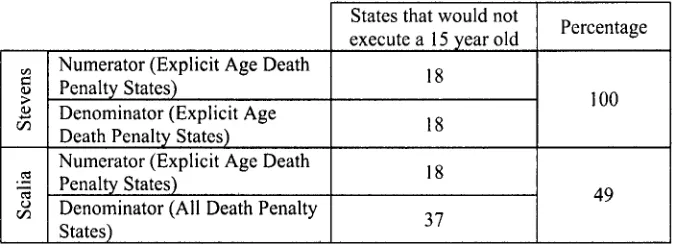
Scalia looks at the legislation passed in eighteen states prohibiting the execution of mentally retarded offenders in a completely different manner than the majority. 60 He notes that only forty-seven percent, eighteen out of
the thirty-eight states that allow executions, had outlawed executions of mentally retarded individuals.1 6' Also, because only seven of those
eighteen states allowed for the legislation to be applied retroactively, the legislation "is not a statement of absolute moral repugnance, but one of current preference between two tolerable approaches."'162 Additionally, two
states have stipulations within their laws that allow for the imposition of the death penalty upon certain mentally retarded offenders.163 Finally, Scalia takes issue with the time frame of the passing of these eighteen statutes. 64 After breaking down how long each had been in existence (the longest of which was fourteen years), he states that "[i]t is 'myopic to base sweeping constitutional principles upon the narrow experience of [a few] years."",165
For the sake of argument, Scalia accepts the questionable figure of eighteen for how many states have legislation outlawing the execution of mentally retarded offenders.' 66 "That bare number of States
alone-18-should be enough to convince any reasonable person that no 'national consensus' exists. How is it possible that agreement among 47% of the death penalty jurisdictions amounts to 'consensus' ?,167 Scalia compares the majority's definition of a "consensus" with past Supreme Court findings.'6 8 Previous decisions had determined that a consensus existed when all but one state was punishing an offender in a certain way or when seventy-eight percent of states had decided in a certain manner. 69 The instant case is
159 Id. at 341-42 (Scalia, J., dissenting). 160 Id. at 342 (Scalia, J., dissenting).
161 Id. (Scalia, J., dissenting).
162 Id. (Scalia, J., dissenting).
163 Id. at 342-43 (Scalia, J., dissenting). "Kansas apparently permits execution of all
except the severely mentally retarded; New York permits execution of the mentally retarded who commit murder in a correctional facility." Id. (Scalia, J., dissenting).
164 Id. at 344 (Scalia, J., dissenting).
165 Id. (Scalia, J., dissenting) (alteration in original) (quoting Coker v. Georgia, 433 U.S.
584, 614 (1977) (Burger, CI., dissenting)). 166 Id. at 343 (Scalia, J., dissenting). 161 Id. (Scalia, J., dissenting).
161 Id. (Scalia, J., dissenting).
169 Id. (Scalia, J., dissenting). See Coker, 433 U.S. at 595-96 (invalidating death penalty
ATKINS v. VIRGINIA
more closely related to situations where the Court had failed to find the existence of a consensus, such as when thirty percent and forty-two percent of the states were aligned.170
After breaking apart the statistics for "consensus" upon which the majority opinion was based, Scalia moves on to criticize the majority's reliance on the direction of the change as persuasive.'71 "Given that 14 years ago all the death penalty statues included the mentally retarded, any change ... was bound to be in the one direction the Court finds significant
enough to overcome the lack of real consensus."'172 Scalia cautions against reliance on any trend by recounting how public opinion towards the death penalty in general has swayed through the years.1
73
Scalia also questions the reliance by the majority on the "margins by which state legislatures have enacted bans on execution of the retarded" as indicative of their conviction against the topic. 74 The majority relies upon "the fact that 49% of the legislators in a State with a population of 60 million voted against the bill should be more impressive than the fact that 90% of the legislators in a State with a population of 2 million voted for it.'' 17 5 Scalia characterizes this pattern of reasoning as "absurd," stating that "the Eighth Amendment is a consensus of the same sort as the consensus that adopted the Eighth Amendment: a consensus of the sovereign States that form the Union, not a nose count of Americans for and against.",
76
Scalia questions the validity of the statistics that the majority used to show that executions of mentally retarded persons are rare.'77 Two different sources reported that twelve states had executed thirty-five allegedly mentally retarded offenders from 1984-2000, and that ten percent of all individuals currently on death row are retarded. 78 Scalia also
Wainwright, 477 U.S. 399, 408 (1986) (disallowing the execution of insane offenders because no state permits it).
70 Atkins, 536 U.S. at 343-44 (Scalia, J., dissenting). See Tison v. Arizona, 481 U.S.
137, 158 (1987) (upholding state law that allowed an offender convicted of felony murder to be sentenced to death because only thirty percent of the death penalty states prohibited such a sentence); Stanford v. Kentucky, 492 U.S. 361, 372 (1989) (allowing execution of a sixteen-year-old because only forty-two percent of states prohibited death for such an offender).
17' Atkins, 536 U.S. at 344 (Scalia, J., dissenting).
172 Id. at 344-45 (Scalia, J., dissenting).
73 Id. at 345 (Scalia, J., dissenting) (quoting Thompson v. Oklahoma, 487 U.S. 815,
854-855 (1988) (O'Connor, J., concurring)).
174 Id. at 346 (Scalia, J., dissenting).
... Id. (Scalia, J., dissenting).
176 Id. (Scalia, J., dissenting).
177 Id. (Scalia, J., dissenting).
78 Id. at 346-47 (Scalia, J., dissenting) (citing D. Keyes et al., People with Mental
construes the scarcity of executions of mentally retarded offenders differently than the majority. 79 Instead of being indicative of society's complete abhorrence of the practice, the scarcity can be characterized as showing that prosecutors and juries believe that the death penalty should
rarely be imposed on mentally retarded offenders'8 0
The dismantling of the majority's "consensus" moves on with Scalia awarding the "Prize for the Court's Most Feeble Effort to fabricate 'national consensus"' to the reliance on "the views of assorted professional and religious organizations, members of the so-called 'world community,' and respondents to opinion polls."'' Scalia restates his approval of Chief Justice Rehnquist's dissent calling these views "irrelevant."'8 2 "We must never forget that it is a Constitution for the United States of America that we are expounding .. . .[W]here there is not first a settled consensus among our own people, the views of other nations ... cannot be imposed upon Americans through the Constitution."'8 3
Scalia disagrees with the majority's conclusion that the Eighth Amendment fundamentally prohibits "excessive punishments."''84 The Eighth Amendment was not written to prevent "excessive punishments," but rather to forbid "always-and-everywhere 'cruel' punishments, such as the rack and the thumbscrew."'8 5 The death penalty for the mentally retarded does not fit into this category because it is not considered to be cruel everywhere or on everyone. Not every state has declared the practice cruel, nor is "[t]he Eighth Amendment... a ratchet, whereby a temporary consensus on leniency for a particular crime fixes a permanent constitutional maximum, disabling the States from giving effect to altered beliefs and responding to changed social conditions."'8 6
Scalia also criticizes the majority's argument that juries are unable to account for an offender's mental retardation, as well as the characterization
Retardation Are Dying Legally, 35 MENTAL RETARDATION (Feb. 1977); Bonner & Rimer,
Executing the Mentally Retarded Even as Laws Begin to Shift, N.Y. TIMES, Aug. 7, 2000, at Al).
179 Id. at 347 (Scalia, J., dissenting).
s id. (Scalia, J., dissenting).
i Id. (Scalia, J., dissenting). 182 Id. (Scalia, J., dissenting).
183 Id. at 348 (Scalia, J., dissenting) (quoting Thompson v. Oklahoma, 487 U.S. 815,
868-69 n.4 (1988) (Scalia, J., dissenting)). 184 Id. at 349 (Scalia, J., dissenting).
185 Id. (Scalia, J., dissenting).
186 Id. (Scalia, J., dissenting) (quoting Harmelin v. Michigan, 501 U.S. 957, 990 (1991)).
ATKINS v. VIRGINIA
of retarded individuals as being "no more culpable" than the average offender.187 "[W]hat scientific analysis can possibly show that a mildly retarded individual who commits an exquisite torture-killing is 'no more culpable' than the 'average' murderer in a holdup-gone-wrong or a domestic dispute?"'8 Culpability depends not only upon the offender's mental condition but also upon the depravity of the crime, and this is "precisely why this sort of question has traditionally been thought answerable not by a categorical rule of the sort the Court today imposes upon all trials, but rather by the sentencer's weighing of the circumstances."'8 9 The majority's blanket prohibition on the imposition of the death penalty on mentally retarded offenders misplaces the power of judgment. 90 "[O]nly the sentencer can assess whether [the offender's] retardation reduces his culpability enough to exempt him from the death penalty for the particular murder in question.' 9'
Scalia logically breaks apart the majority's argument that mentally retarded offenders are not deterred from commission of murders by the threat of a death sentence.192 The assumption that retarded individuals are less likely to be deterred by a possible punishment leads to the conclusion "that the mentally retarded (because they are less deterred) are more likely to kill.''19 3 Because this conclusion is patently untrue, the precepts cannot be valid.19 4 The majority doesn't claim that all retarded offenders can not
appreciate the possibility of a death sentence, so "surely the deterrent effect of a penalty is adequately vindicated if it successfully deters many, but not all, of the target class."'9 5 Instead of precluding all mentally retarded
offenders from being sentenced to death,
we should treat a mentally retarded murderer the way we treat an offender who may be 'less likely' to respond to the death penalty because he was abused as a child. We do not hold him immune from capital punishment, but require his background to be considered ... as a mitigating factor.196
In conclusion, Scalia laments over the Court's multiple procedural and substantive exceptions to the death penalty under their "death-is-different"
187 Id. at 349-50 (Scalia, J., dissenting).
188 Id. at 350 (Scalia, J., dissenting).
9 Id. at 350-51 (Scalia, J., dissenting).
190 Id. (Scalia, J., dissenting).
191 Id. at 351 (Scalia, J., dissenting). 192 Id. (Scalia, J., dissenting).
193 Id. (Scalia, J., dissenting).
194 Id. (Scalia, J., dissenting).
"9 Id. (Scalia, J., dissenting).
196 Id. at 352 (Scalia, J., dissenting) (citing Eddings v. Oklahoma, 455 U.S. 104, 113-17
jurisprudence. 97 "There is something to be said for popular abolition of the death penalty; there is nothing to be said for its incremental abolition by this Court."'198
Because many of the components of the definition of mental retardation can be faked, the majority's decision will turn "the process of capital trial into a game.' 199 Under this decision, faking retardation comes without consequence.200 Scalia dissents from the blanket ban on execution of mentally retarded offenders, preferring to leave the sentencing decision to the jury.20'
IV. ANALYSIS
A. CONSENSUS OR NOT?
The Supreme Court first established that the best indicator of the modem perception of "evolving standards of decency" is legislation in
Coker v. Georgia.20 2
Since this case, current state laws have been the main consideration in the Court's attempt to determine the country's stance on various intricacies of the death penalty.20 3 This analytical pattern was continued in the Atkins decision.20 4
1. A Comparison of the Atkins' Consensus with Previously Determined Cases Involving a National Consensus
In Coker, the Court evaluated the legislation regarding the possible sentences for a person found guilty of the rape of an adult.2 05 At the time, only Georgia allowed an offender to be sentenced to death.206 The Court was persuaded by this fact, but also by the trend in legislation over the previous ten years.20 7 Only five years prior to the decision in Coker,
Furman v. Georgia was handed down, effectively invalidating every state
'9' Id. (Scalia, J., dissenting).
198 Id. at 353 (Scalia, J., dissenting).
'99 Id. (Scalia, J., dissenting).
200 Id. (Scalia, J., dissenting). This is contrasted to the feigning of insanity where, under
Jones v. United States, 463 U.S. 354, 370 n.20 (1983), the offender can be committed until
cured, then tried and executed.
201 Id. at 354 (Scalia, J., dissenting).
202 See Coker v. Georgia, 433 U.S. 584, 593 (1977).
203 See, e.g., Penry v. Lynaugh, 492 U.S. 302, 331 (1989); Thompson v. Oklahoma, 487
U.S. 817, 826-29 (1988); Enmund v. Florida, 458 U.S. 782, 789-93 (1982). 204 Atkins, 536 U.S. at 312.
205 Coker, 433 U.S. at 594-96.
ATKINS v. VIRGINIA
death penalty statute.2°8 At that time, sixteen states allowed an offender convicted of the rape of an adult to be sentenced to death.20 9 In the wake of
Furman, every state was forced to re-evaluate their sentencing scheme to
comply with the new standards.21 ° While thirty-five states re-instated the death penalty for certain specific crimes, only three states included rape amongst their capital offenses.21 Thus, thirteen states evaluated their death penalty statutes and eliminated rape from those offenses eligible for capital punishment. When two of the three capital rape state statutes were invalidated by Woodson v. North Carolina,212 Georgia was the sole jurisdiction left that allowed for a sentence of death when the rape victim was an adult woman.21 3
Beyond legislation, the Court also looked to jury verdicts as objective indicators of society's views.2 14 They determined that only six juries in Georgia had sentenced rapists to death between 1973 and 1977; nine times out of ten, death was not imposed.2 15 This evidence showed that a national consensus had developed against the punishment of death for an offender convicted of the rape of an adult.2 16
In Enmund v. Florida, similar (albeit more complicated) statistics existed relating to the death sentence for an individual who had neither killed nor contemplated death in their offense.21 7 The Court looked at the thirty-six states that had death penalty statutes in place in 1982.218 Of these thirty-six, felony murder was not a capital offense in four of the states.2 19 Another state rejected outright death for an offender who did not commit the actual murder.220 Eleven more states had culpability requirements in their capital murder sentencing schemes, requiring the prosecutor to prove that the offender had some degree of culpability for the murder.221 Nine
208 Id. at 593.
209 id. 210 Id.
211 Id. at 593-94.
212 428 U.S. 280, 301 (1976). In Louisiana and North Carolina, death was the mandatory penalty for rape; Woodson established the requirement of individualized sentencing for death penalty jurisdictions.
213 Coker, 433 U.S. at 595-96.
214 Id. at 596.
215 Id. at 597.
216 Id. at 596.
217 458 U.S. 782, 789-90 (1982). 28 Id. at 789.
219 id. 220 Id. at 791.
221 Id. at 789. The actual degree of culpability varied in different jurisdictions. Eight
states required the prosecutor to prove the offender's culpability was at the level of
other states had statutes that did not allow for the death penalty when an offender had merely participated in a felony and did not cause the death of the victim.222 These states considered the offender's minor role in the crime as a mitigating circumstance and thus, without culpability as an aggravator, death could not be imposed.223 Two jurisdictions did not allow for death when the defendant played only a minor role in the crime.224 Another state's definition of capital felony murder was so narrow that the facts of the Enmund case did not apply.225 This left only eight jurisdictions that would have allowed Enmund to be sentenced to death.226
The trend of enacted legislation was also compelling to the Court.227 "[O]f the eight states which have enacted new death penalty statutes since 1978, none authorize capital punishment in such circumstances., 228 The Court looked past the legislation to the jury verdicts and found that out of 362 individuals executed since 1954, only six people who were not the actual triggermen in felony murder cases were put to death and all six of
"knowing, intentional, purposeful, or premeditated killing." Id. See ALA. CODE §§ 13A-2-23, 13A-5-40(a)(2), 13A-6-2(a)(1) (1977 & Supp. 1982) (to be found guilty of capital murder, accomplice must have had "intent to promote or assist the commission of the offense" and murder must be intentional); 38 ILL. COMP. STAT. 9/1(a)(3), 9/1(b)(6) (1979) (capital crime only if defendant killed intentionally or with knowledge that his actions "created a strong probability of death or great bodily harm"); LA. REV. STAT. ANN. § 14:30(1) (West Supp. 1982) ("intent to kill or inflict great bodily harm"); N.M. STAT. ANN. §§ 30-2-1(A)(1), 31-18-14(A), 31-20A-5 (Supp. 1981) (felony murder is a capital crime but death penalty may not be imposed absent intent to kill unless victim was a peace officer); OHio REV. CODE ANN. §§ 2903.01(B), (C), (D), 2929.02(A), 2929.04(A)(7) (1982) (accomplice not guilty of capital murder unless he intended to kill); TEX. PENAL CODE ANN. §§ 19.02(a), 19.03(a)(2) (1974) ("intentionally commits the murder in the course of [a felony]"); UTAH CODE ANN. § 76-5-202(1) (1978) ("intentionally or knowingly causes the death of another"); VA. CODE ANN. § 18.2-31 (1982) ("The willful, deliberate, and premeditated killing of any person in the commission of robbery or attempted robbery."). The remaining three required something less, more similar to "reckless or extreme indifference to human life." Enmund, 458 U.S. at 789. See ARK. CODE ANN. §
41-1501(l)(a) (1977) ("extreme indifference to ... life"); see also § 41-1501, Commentary ("an inadvertent killing in the course of a felony will not... support ... a conviction entailing punishment by death"); DEL. CODE ANN. tit. 11, §§ 636(a)(2), (6) (1979) ("recklessly" or "with criminal negligence" causes death during the commission of a felony); KY. REV. STAT. ANN. § 507.020(l)(b) (Supp. 1980) (defendant must manifest "extreme indifference to human life" and "wantonly engage" in conduct which creates a grave risk of death ... and thereby causes ... death").
222 Enmund, 458 U.S. at 791.
223 Id. at 792.
224 Id. at 791. 225 id.
226 Id. at 792. 227 Id.
ATKINS v. VIRGINIA
these executions were in 1955.229 Only sixteen individuals out of the 739 offenders then on death row had been sentenced to die for murders committed when they were not physically present.230 Of this sixteen, only three (including Enmund) had not hired or conspired to hire someone else to commit the murder.23'
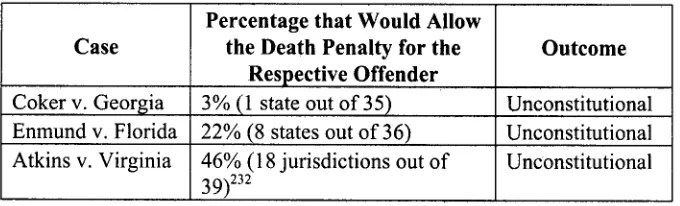
Table 1
Percentage that Would Allow
Case the Death Penalty for the Outcome
Respective Offender
Coker v. Georgia 3% (1 state out of 35) Unconstitutional
Enmund v. Florida 22% (8 states out of 36) Unconstitutional
Atkins v. Virginia 46% (18 jurisdictions out of Unconstitutional
1 _ 1__
3
9)232 1In Atkins, the totality of the state legislation with regard to mentally retarded offenders was not nearly as unbalanced as in Coker or Enmund.2 33 At the time of this decision, at least eighteen of the thirty-nine death penalty jurisdictions implicitly allowed mentally retarded offenders to be sentenced to death.234 Under Supreme Court precedent, if the majority decision in
Atkins was based purely on numbers of states with the requisite legislation,
the decision would have been wrongly decided. However, Stevens did not rely only on the numerical data; the trend of the legislation was extremely persuasive to him.235 The Atkins decision, therefore, is in line with Coker and Enmund with respect to this facet of the analysis.236 The majority in
Atkins was persuaded by the fact that since the Penry decision was handed
down in 1989, eighteen states had enacted legislation precluding the mentally retarded from eligibility for the death penalty.237 Not a single
229 Id. at 794-95.
230 Id.
231 id.
232 This number includes the federal jurisdiction.
233 Atkins, 536 U.S. at 313-16; Enmund, 458 U.S. at 789-93; Coker v. Georgia, 433 U.S.
584, 593-96 (1977).
234 Atkins, 536 U.S. at 342 (Scalia, J., dissenting). These statistics are uncertain because
of the various legislative requirements that established what constituted mental retardation. In Atkins, the Court left it to the states to determine the level of retardation necessary to exclude an offender from eligibility for the death penalty. Id. at 313.
235 Id, at 313-17.
236 See Ennund, 458 U.S. at 793-95; Coker, 433 U.S. at 594-95.
237 Atkins, 536 U.S. at 313-16.
[image:26.505.57.397.170.273.2]