Journal of Criminal Law and Criminology
Volume 24
Issue 5
January-February
Article 3
Winter 1934
New Conception of Moral Behavior, A
E. Mira
Follow this and additional works at:
https://scholarlycommons.law.northwestern.edu/jclc
Part of the
Criminal Law Commons
,
Criminology Commons
, and the
Criminology and Criminal
Justice Commons
This Article is brought to you for free and open access by Northwestern University School of Law Scholarly Commons. It has been accepted for inclusion in Journal of Criminal Law and Criminology by an authorized editor of Northwestern University School of Law Scholarly Commons.
Recommended Citation
DR. E. MIRAY
A satisfactory psychological study of human behavior must be supplemented by an inquiry into its motives. As long as the behavior-ist merely confines himself to establishing a chronological relation be-tween a stimulus and its response, his task will be an easy one; but it will fail to enable us to understand, and much less to explain, the most essential and interesting phenomena of psychical life. On the other hand, if he intends to enter boldly into a study of values, the sacred field reserved until now to the activity of philosophers, he will soon find himself caught in the subtle nets of speculation, his objectivity will not be kept alive and his two most effective scientific weapons, experiment and statistical classification, will lose their effi-ciency. This dilemma is particularly perplexing if we try to in-vestigate the moral aspect of human behavior. Our modem science, strictly based on experiment, cannot surrender the study of the .high-est manif.high-estations of life into the hands of arm-chair psychologists
who lack the training of proper philosophers or of psychologists. American psychology was the first to face these difficulties, and to begin by an experimental study of values, considering them from an objective point of view, not as a priori realities but as final prod-ucts of a psychical evolution capable of being recognized and estimated only in so far as they are strictly shown in human behavior. Esti-mative actions, i. e., those resulting from an election between several possible ways of behaving, are the data that modem experimental psychology can use as circumstances that arouse a conflict between primitive and acquired tendencies.
Since 1931 we have given attention to tests of the latter type and specially to the so-called "blood-transfusion test" and "poisoned candy test." In these two tests the subject is obliged to make quick de-cisions under conditions of great emotion, capable of manifesting the affective roots of -his personality. The technique of these tests has been described in several articles published in the "Revista de Peda-gogia," "Revista M6dica de Barcelona," in the "Compte-Rendus de
la VI Conference Internationale de Psychotechnique," in the "Pro-'Address delivered before Section I of the American Association for the Advancement of Science, Chicago, June 22, 1933.
2Professor of Experimental Psychology, University of Barcelona.
MORAL BEHAVIOR
ceedings of the IX International Congress of Psychology" and in my book "Psichologia Juridica" (Legal Psychology). It is not now the occasion to explain this technique, but only to acquaint you with the facts that have been discovered during our experimental work, and then to attempt a systematic classification of them. We thus may arrive at a new conception of moral behavior more in agreement with the experimental facts than the one generally accepted. But let us first briefly state the problem as we find it at present, reviewing the latest and more "authentic" opinions.
The nativist and the social theories of morality.
From immemorial times two theories have been struggling in the field of Ethics: one that postulates an inborn origin for the moral sense or tendencies, and another that affirms that their acquisition takes place in the process of individual development, thus being necessarily derived from social contacts. The first theory was sup-ported by English intuitionalists, but at present it seems to be entirely abandoned. Only a few anglo-saxon psychiatrists, Maudsley and Tredgold amongst them, still support it with perhaps more good faith than good judgment.
The immense majority of psychologists do therefore agree that man has no more morality at birth than any other animal. The child is at first amoral and only begins -to exhibit a moral behavior in the measure that prohibitions and commands from his elders work upon him. Morality thus comes into the child from the outside, as a wedge, in the form of rules of conduct imposed compulsorily. Children from 4 to 6 years of age, when asked why they do not commit a certain fault, answer: "I cannot, mother doesn't allow me."
The unity and duality theories about the origin of morality.
Whilst the nativists postulate a single origin for moral behavior, the supporters of the empiric theory are divided into two groups: unicists and dualists. In the first group are Durkheim and his pupils for whom the development of individual morality goes through sev-eral stages without any lack of continuity between them. This au-thor explains the changes that take place from the "compulsory agree-ment" that rules in primitive societies up to that form of "organic solidarity" that can be observed in democratic societies as due to a decrease in the vigilance of the collectivity over the individual. "Plus
im-portants sont les rapports de coop6ration entre les individus 6gaux." (Durkheim, "Sociologie et Philosophie," pag. 65 et suiv.)
The psychoanalysts (Freud, Ferenczi, Rank) also favor the theory of unity and derive the origin of all morality from the con-stant evolution and sublimation of the destructive principles (the death instinct) which directed first against the environment (sadism) are turned afterward against one's own "self" and become its most
severe judge. According to this theory, the stronger the violence of the primary impulses has been and the more intensity the Oedipus complex has reached, so much easier will be the development of a "Super-self," or strong moral conscience. The transition from the first to the second stage (sadism-masochism) takes place on account of the process known as "introjection" by which the paternal image is identified with the "self," the subject inflicting upon himself the same penalties that he had previously intended for his father (con-sidered as symbol of authority). The mechanism of introjection, or identification with the "self," sometimes fails and then a hostile at-titude against society, and especially against all symbols representa-tive of power and authority (kings, wealthy people, political men, or even police agents) persists in later life. Ferenczi has thus proved by the psychoanalysis of several criminals and anarchists accused of having murdered important people that in all of them the Oedipus complex was in full activity so that the political or social crime they had committed was in reality a symbolic parricide, a revenge against the primitive and oppressive tyranny of his begetter. On the other hand, the introjective mechanism that forms the "super-self" is found in a higher state of activity in the so-called compulsive neurotics. These people live always tortured by a feeling of great responsibility and are terribly afraid of acting ("peur de l'action." of P. Janet) because they believe that their actions will have evil results. They always believe they are acting wrongly and they are obliged to de-velop a private religion based on ceremonial and on expiatory prac-tices in order to purify their conscience from sin (Schuldbewustsein). This consciousness of fault is so great that in extreme cases it leads the subject to accuse himself of faults he has not committed and he asks to be severely punished, or he punishes himself with self-tor-tures and even with suicide.
MORAL BEHAVIOR
with the activity of the anal erotism). A socially good person would be so in the measure that he was bad against himself. The classic opposition between Bad and Good thus becomes reduced to these two terms: bad for others or bad for ourselves. Psychoanalysts natur-ally admit the existence of indifferent persons, that is, those who are neither bad nor good. These lack affective life. The influence of the environment and the super-self scarcely have any importance for them; only the "self" remains, calculating and perfectly adapted to the principle of reality. Amongst this type of beings incapable of transgressing (through fear of punishment) and also incapable of self-sacrifice (through fear of suffering) psychoanalysts include the majority of intellectual people and men of science.
Fortunately, for our idea of the origin of moral behavior there exist other psychological conceptions not so harsh and fully deserv-ing the same attention as those just now considered. We mean the dualistic theories, also empirical but less materialistic. We shall only briefly mention the one developed by Bergson in his latest work: "Les deux sources de la Morale et de la R6ligion (F. Alcan. Paris 1932. Xed.). This author also recognizes the primitively amoral origin of man when he says (1. c. pag. 4) "C'est en notant ses propres faiblesses qu'on arrive a plaindre ou a m6priser l'homme. L'humanit6 dont on se d~tourne alors est celle qu'on a d6couverte au fond de soi." But he affirms at the same time that there exist in man two moral con-ducts that obey different origins: the first one has its origin in the pressure that the elements of society mutually exert amongst themselves, whilst the second one receives its strength from an inner vital impulse ("Dans la seconde l'obligation est la force d'une aspira-tion ou d'un 6lan, de l'6lan m~me qui a abouti a l'espece humaine, a la vie sociale." Ibid. pig. 52). The first form of morality, resulting from the pressure of the community is called by Bergson closed morality (morale ferme) and the second open morality (morale ouverte) because in it the individual, free from social bonds, ascends in search of the absolute Good, openly adopting what he calls mystique attitude against the primitive mecanique attitude.
previous experiments (concerning the evolution of the thought of the child) he has been able to prove that two types of moral conduct coexist in children from 6 to 14 years of age, which he calls: heter-onomous and autheter-onomous. The first or primitive type is based on a one-sided regard (of the child for his elders or for society in general) due to force or external compulsion. In this stage the rule (law) is immutable, sacred, and the notion of justice is interdependent with the result of action (an action will be just or unjust according to whether it is or is not in accordance with the rule). This heterono-mous morality that we are describing involves therefore the concep-tions of duty and punishment associated in a causal relation. Any breach of duty (non-obeying of -a rule) must be punished, but once it has been, amends are made and the equilibrium of justice is re-established. In this connection I remember a personal observation that is very illuminating: It was a child 8 years old who used to accuse himself of faults before he had committed them; he patiently underwent punishment, and then he committed the fault with entire satisfaction because, as he said, he had already paid for it. Thus, for instance, he told his mother on a holiday that he had taken the sweet prepared for some guests. He was punished with two slaps on the face which he received without winking. He then went to find his little sister and asked her whether she would like to eat half of the sweet he had concealed. She answered "yes" and he, quite seriously, gave her a slap on the face and said: now we can eat at ease because we have already been punished.
The second type mentioned by Piaget as a result of his experi-ments is the one he calls autonomous. The subject in this case does not obey an external rule but a free impulse of cooperation, that arises in him and is based on the existence of bilateral respect between the individual and the community. In this second type the moral con-duct also conforms to certain standards but those are neither fixed nor relentless; they arise simply from a mutual agreement between the subject and the community where he lives democratically, and so they can be modified at any moment. Ghildren who have reached this phase of moral autonomy judge actions not by their results but
by their intention and they prefer, as Piaget says, a distributive
MORAL BEHAVIOR 865
frangaises de Giard, Duprat, Alcan). You all know that this great investigator also maintains a natural point of view, he denies the existence of innate duties and affirms that in moral consciousness there appears always to exist an opposition between the several in-ternal tendencies that constitute the self. This lack of harmony takes place the moment the child performs his first act of obedience, which is neither simple imitation nor ejection. Obedience creates in reality a new self, that is, a part of personality that rules over the rest which Baldwin calls "ideal self." To save time we shall not explain this doctrine in detail, besides I assume you are acquainted with it, and we shall only insist on pointing out that it occupies in reality an inter-mediate position between the sociological theory of Durkheim and the dualistic theory of Piaget. This author criticizes above all the superficial way in which Baldwin deals with the difficult problem of the passing from the "syndoxique" stage to the "synnomique" stage.
The general and the particular theories of moral conduct.
Leaving aside the problem as to whether morality has been per-formed or acquired and as to whether it has a single or a double origin, another problem of great interest presents itself. Once it has been developed, is it a factor that intervenes generally and uniformly in all actions (acting like a tint on a texture) or, on the contrary, does it represent only the imaginery abstraction from a series of con-crete and specific factors, independents amongst themselves? The ruling conception before the experimental stage of Psychology was, as you know, that Goodness and Badness were general qualities acting in a constant way in each individual, tainting all his acts with a uni-form intensity. It was therefore believed that when a subject had become very good or very bad he acted always in a very good or a very bad way in reference to moral situations. This idea led to the notion of a collective distribution of persons in regard to moral stand-ards just like the biological notion of a bodily type composed of fac-tors such as weight, height, muscular strength, etc.
1931) lead us to believe that the theory of specificity of learning also applies to the case of moral conduct and that it is therefore impossible to apply an ethical qualification to a person without telling exactly the concrete situations and reactions to which this judgment must be referred.
In Europe the investigations of Cyril Burt, Henning, Marta Moers, W. Peters and Aloys Fischer, although not so conclusive seem also to confirm the idea that what we might call "average morality" of a person is not more than a statistical abstaction (obtained in a visionary manner by adding up the numbers expressive of the degree of morality exhibited by him in all his ethical reactions and dividing this sum by the number of those reactions). In this case the "index of morality" would not be a better expression of the moral character of the individual than the mean or average temperature of a town is of its climate. In order to arrive at a valuable judgment about the moral character it would be necessary to know the standard devia-tion of the data and, what is more important, it would also be neces-sary to know what causes produce the variations in the same class of data.
The problem in the field of morality therefore presents itself as similar to those for the other aptitudes of the subject, none of which is considered to be a general faculty but each is a concrete re-sult of the experimental evolution of the primitive emotional mechan-isms of reaction. And as it is possible, for instance, that the same individual may be at the same time brave under some circumstances and cowardly under others, intelligent for some work but dull for other types of problems, impatient with certain persons and patient with others, etc., so it is possible that goodness, equanimity, sincerity and, in general, all his moral virtues and defects may change from one moment to another according to the objects on which their action is exerted, and to the special prospect aroused in him.
Personal results obtained with our experiments.
Now that we have reviewed, though briefly and incompletely, the present state of the problem of morality (considered from the psy-chological standpoint) we may mention some of the facts gathered from personal investigations, in order to relate them to the different questions whose solution has not yet been attained in this field of our science.
pos-MORAL BEHAVIOR 867
sibilities, since from a theoretical point of view it is generally admitted that certain inherited characteristics may not appear in the pheno-type until a relatively late period of his evolution. Therefore the fact that the child may be born entirely amoral does not mean that he may not contain in the form of an inclination (Anlage) the capacity of becoming moral under the action of suitable paratypical influences.
Our psychiatric experience has given us instances of people who, at a given moment, under the same conditions of environment (and without it being possible to discover any injury of the nervous centers or of the endocrinal glands) show a sudden change of moral reac-tions in situareac-tions that seemed to have already determined a process of behavior perfectly habitual and nearly automatic in the particular subject. In such cases there always remains the possibility of ad-mitting the sudden coming into action of a genotypical tendency, until then latent, and which has disturbed the whole process of moral conduct. This would be similar to what happens in epidemic neu-raxitis, according to the observations that have been reported by many psychiatrists, Economo, Claude, Donaggio, Lugaro, Lafora, Mira, Ley and Bumke among them. But there is no doubt that the other two problems have a greater interest from the practical point of view and also we can have better founded opinions about them. Is there amongst subjects a single, general, motivation of moral con-duct or is motivation multiple? Is the quarrel amongst philosophers endeavoring to discover an ultimate ratio of moral conduct explain-able, or has that ultimate reason no existence, and it is equally right and human to found the origin of the moral criterion on usefulness, pleasure, definite command, piety, justice, etc., according to the in-dividual cases? Let us see the results that we have obtained by submitting a select group of intellectual people (composed of lawyers. psychologists, physicians, engineers, teachers . . . . and philosophers)
were given. There is no leading criterion in the whole group, nor does the subdivision of subjects according to profession, age, sex and other characteristics give us a greater consistency in the results. Practically every action has been included in all possible stages. But an even more paradoxical fact is that the rank deviations are less in the responses of children from 10 to 12 years (869 cases) than in the above mentioned selected group of elders. For the adults the average arrangement of the 7 actions varies between 2.17 and 2.42 whilst in the children it varies between 2.12 and 5.09, which evi-dently means a greater variety of judging criteria amongst the elders. As a matter of fact, no other result could be expected, consider-ing the nature of the test and the absence of all previous information concerning the motives of the different actions, since every subject judges according to the intentions that he presumes to exist in John, but which in reality he does not know. The ideal behavior of our subjects would have been to refuse to write down such an arrangement since they had not sufficient elements for judgment. But this response
did not occur in even a single case, on the contrary, when a subject had made an arrangement he defended it with enthusiasm and was extremely surprised on discovering that no one had exactly agreed with him. The inference we can draw from these facts is that the so-called moral judgment that serves as a seemingly logical motive in moral conduct is, in the immense majority of cases, only a poor rationalization of intuitions determined preferentially by affective at-titudes. And the moral judgments are the more variable when the nucleus of the primitive reaction mechanism has been the less directly affected by the conflict in view. As we see this conclusion is rather pessimistic and depressing for those who believe in the existence of an objective and transcendent moral criterion. Besides, the extraordi-nary variety of the motives that the subjects of the experiment brought forward consciously, shows us that, even in the case of in-telligent and cultured persons, it is not possible to establish an aver-age type of motives that may be found with an acceptable maximum of frequency in a definite group of persons.
MORAL BEHAVIOR 869
Here is a summary of its technique.. A printed booklet is given to each subject, on the first page are found the following directions:
"On the following page you will find a moral conflict stated with 10 solutions that you may have to classify according to your personal judgment, marking with number 1 the one you consider best, that is to say, the most advisable; the next in order of preference you will mark with number 2, then put 3 in front of the following, etc., until you mark with number 10 the one you believe to be the worst
(the least advisable).
You are also asked to write down the solution you think you would follow if the case really happened to you. This solution may agree or not with one of the ten.
You must act with absolute sincerity and frankness since this only will aid in showing what is the opinion of the majority of people in this country with regard to this problem."
On the following page of the booklet we had printed the situa-tion and the 10 solusitua-tions to be classified as follows:
"Peter is married and adores his wife. One day he finds a letter from her addressed to his friend Lewis which shows that she is keeping intimate relations with him. Under these circumstances Peter can perform one of these ten actions which you are to set in order from worst to best, as requested on the previous page."
1. To revenge his honor by challenging Lewis to a duel. 2. To kill Lewis in a direct manner.
3. To kill his wife in a direct manner.
4. To revenge the insult by making love to Lewis's wife until he (Peter) obtains the same intimacy with her.
5. To try to catch the two lovers in fraganti and try to get a divorce with the help of the authorities.
6. To be secretly separated from his wife while both continue to live under the same roof and remain, to all outward appearances, a married couple.
7. To be secretly separated from his wife, each one going his or her own way and bringing other reasons for their separation in the eyes of society.
8. To try by all possible means to make Lewis look ridiculous in the
eyes of his (Peter's) wife in order to regain her affection.
9. To analyse the causes which have led up to his wife's infidelity
and endeavour to remove them if possible.
10. To put the problem fairly and squarely to the two lovers, and, if
(To save time we omit to outline the solutions open to women sub-jects: they may readily be imagined.)
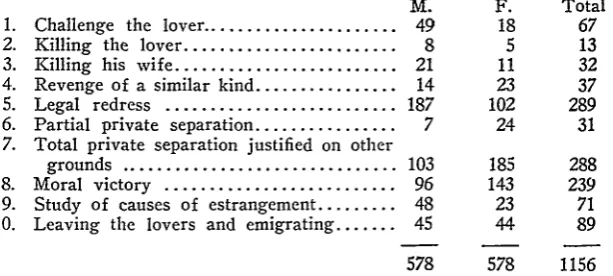
It is obvious that the possibility of conjugal infidelity is a sub-ject of greater concern to a married person than the stealing of a pencil, and one on which he or she may be expected to have definite ideas. Furthermore, the possible courses open are sufficiently diverse in character to admit a clearly definite choice of them. Nevertheless in spite of this, we have again found the aforesaid actions classified in all possible ranks in the 1156 answers received. And not only this: some solutions have obtained a fairly equal number of votes in spite of their essential difference. We give below the numerical results:
TABLE I-PREFERRED SOLUTIONS FOR CONJUGAL INFIDELITY Course of action
M. F. Total
1. Challenge the lover ... 49 18 67 2. Killing the lover ... 8 5 13 3. Killing his wife ... 21 11 32
4. Revenge of a similar kind ... 14 23 37 5. Legal redress ... 187 102 289 6. Partial private separation ... 7 24 31 7. Total private separation justified on other
grounds ... 103 185 288 8. Moral victory ... 96 143 239 9. Study of causes of estrangement ... 48 23 71 10. Leaving the lovers and emigrating ... 45 44 89
578 578 1156
Once more we have the surprising result that there have been no two single cases absolutely identical in ranking. We cannot give more de-tails, as we should be wandering too far from our main subject. We have sufficiently demonstrated our thesis, namely, the absence of a norm of moral judgment and the existence of innumerable points of view, all equally respectable, upon which to base a standard (rule) of individual moral conduct, not only applicable to hypothetical cases,
but to concrete ones too.
[image:12.431.46.353.286.424.2]MORAL BEHAVIOR
who chose each alternative solution: "A nurse is in charge of 6 patients in a hospital situated in the middle of a malarial zone, cut off from ordinary means of communication. The necessary provisions are brought by aeroplane every 24 hours. Three patients out of the 6 are seriously ill; all have to take fixed doses of quinine and other medicines. By accident, exactly half the amount of quinine is rendered totally unfit for use. There is not the remotest possibility of being able to obtain a further supply until the following day. In such circumstances the aforesaid nurse may either":
TABLE 2-JUDGMENTS OF TRAINED NuRsEs
Course of action No. of Preferences
1. Reduce each patient's dose by half until the next day ... 35 2. Stop giving quinine to the 3 less seriously ill and give the full
dose to the other three ... 19 3. Stop giving quinine to the 3 who are seriously ill and give the
full dose to the others... 14 4. Give the full dose to the younger patients without reference
to their state of health bearing in mind only the fact that they will live longer, if they recover, than the others ... 44 5. Give the full dose to those patients who have the greatest social
obligations to fulfill (who have wife and children, for example) 29 6. Give the full dose to those of greater value to the community
(greater prestige and attainments) ... 15
156
As you see, we were right in saying that in the case of concrete situa-tions, in dealing with which the individual has the advantage of specialized training, the same diversity in criterions is observable as for abstract moral problems.
hated his superior officer and hoped he would thus be able to infect him with syphilis from which he had suffered formerly. At a certain hospital, a girl who was also anxious to give of her blood to benefit certain imaginary victims of an accident was caught in the act of feeling in the coat pockets of one of those carrying out the experi-ment. All these examples serve to show the impossibility of judging a moral action by itself without knowing beforehand whether the individual regards it as a means or as an end, that is to say, if it springs from a selfish or immoral motive or from a real desire to do good.
In short, then, we can affirm: 1. That individuals of distinctly similar intellectual capacity, culture and social experience nevertheless differ, to a great extent, in their manner of judging or passing sum-mary judgment on certain definite moral problems; 2. That the mere observation of the conduct of an individual, i. e., of his external actions, is not a sufficient criterion by which to judge of the moral quality of his personal reactions at any given moment.
From this it is but a step to the belief that moral conduct is essentially determined by motives of affection and that all the com-plicated intellectual process which accompanies it is, as Pareto says, in his "Trait6 de Sociologie Gn6rale," "une sorte de bavardage in-consistant, destin6 en sa fonction a renforcer l'action, mais dont le contenu peut etre d6pourvu de toute signification intelligible." And indeed, we might ere now have made this step were it not the fact that what Pareto calls "bavardage, consistant en d6rivations multi-formes et arbitraires, fond~es sur les r6sidus affectifs des actions non logiques" is nothing more nor less than the whole of moral theories. Now let us see the results of our experiments in so far as they relate to the third problem we are dealing with, that is, the general or special nature of moral attitudes. Some of the partial correlations obtained (using the "ranks" .method) from a group of 56 students who were subjected successively, over a period of two years, to our tests on moral equipment, abstract ethical judgment, sincerity, spirit of self-sacrifice (generosity) and honesty, have been the following:
TABLE 3-CORRELATIONS BETWEEN THE RESPONSES ON DIFFERENT TESTS Correlation between the rank averages of the test of
moral information and of ethical judgment ... +.38 (P. E. ±0.061) Correlation between the rank averages of the tests of
sincerity and self-sacrifice ... +.43 (P. E. ±-0.13) Correlation between the ranks of the test of blood transf.
(generosity) and the Fernald-Jacobsohn test ... +.09 (P. E. ±0.026) Correlation between the ranks of the two tests of spirit of
MORAL BEHAVIOR
A consideration of the above facts will show that the correlation
be-tween the theoretical conduct tests is small; that bebe-tween theoretical conduct and actual conduct is practically zero and that between two actual conduct tests in circumstances requiring the exercise of the same moral quality (spirit of self sacrifice) but expressed in two dif-ferent forms: action (offering of blood for transfusion purposes) in one case and inhibition (not asking for an antidote) in the other, is highly convincing.
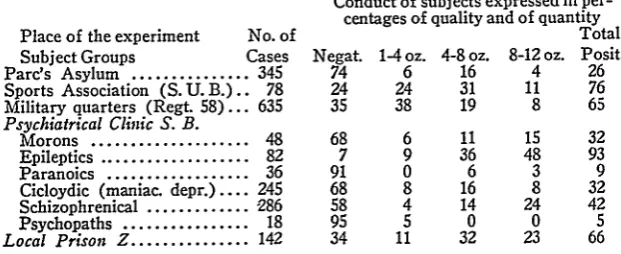
But the greatest surprises await us when we consider the relative percentage of generous actions observed from our blood-transfusion and poisoned candy tests between groups of individuals with well-marked moral characteristics formed by experience. In the first of these tests the spirit of sacrifice of the individual was appraised in accordance with the quantity of blood he is prepared to give, vol-untarily, to save the lives of the victims of an imaginary street acci-dent. Taking all the normal cases which have come under our ob-servation, we find the percentage of individuals ready to offer their blood for purposes of transfusion to be 13%o. But this average value is subjected to striking variations when we consider the different subject groups in relation to their environment and experience.
The comparative results are given in Table 4.
TABLE 4--COIPAmIsONs OF THE RESPONSES OF DIFFERENT SUBJECT GRouPs Conduct of subjects expressed in
per-centages of quality and of quantity
Place of the experiment No. of Total
Subject Groups Cases Negat. 1-4 oz. 4-8 oz. 8-12 oz. Posit. Parc's Asylum ... 345 74 6 16 4 26 Sports Association (S.U.B.).. 78 24 24 31 11 76 Military quarters (Regt. 58) ... 635 35 38 19 8 65 Psychiatrical Clinic S. B.
Morons ... 48 68 6 11 15 32 Epileptics ... 82 7 9 36 48 93
Paranoics ... 36 91 0 6 3 9
Cicloydic (maniac. depr.) .... 245 68 8 16 8 32
Schizophrenical ... 286 58 4 14 24 42
Psychopaths ... 18 95 5 0 0 5
Local Prison Z ... 142 34 11 32 23 66
[image:15.431.40.351.388.515.2]Sec-ond, and more obviously paradoxical, from the ranks of epileptics (those subject to the most violent and dangerous reactions) we get the highest percentage of those willing to offer their blood, uncon-ditionally. It is a pity that so far we have not had the opportunity of making this test in a prison containing a large number of crim-inals, but judging by the admittedly incomplete and limited investiga-tions carried out in the local prison of Z. We have strong grounds for expecting that criminals of the murderer class have also a stronger spirit of 'self-sacrifice than thieves and swindlers. The conclusion which it would seem one is entitled to form from the above test (as also from the "poisoned candy" test, the results of which cannot be explained in detail in order not to increase unduly the length of this paper) is that those individuals generally considered to be the least adaptable socially or the most anti-social are precisely the ones most capable of performing disinterested action, or briefly, the worst are also the best, and that the two extremes also meet when it is a ques-tion of judging a moral quality.
MORAL BEHAVIOR
have judged sexual delinquencies; while burglars would punish mur-derers with exaggerated severity and sexual perverts suggest punish-ments out of all proportion to the offense for all crimes other than their own. This fact had already been observed by the wardens of prisons, who have had opportunities to notice the contempt and hatred shown by the prisoners for all their fellow-inmates who are there for offenses different from their own. A murderer, twice convicted, broke into a fit of weeping because he was accused wrongly of having stolen a packet of cigarettes, and said in very decided tone: "I'm a crim-inal, and proud of it, but I'm not a bally thief !" Furthermore, we have the curious case of one of our magistrates, distinguished for his spotless character being convicted of a particularly disgusting form of rape. When examined, he confessed to having been a sex-ual pervert all his life.
What Conception of Moral Behavior Can Be Deduced from Our Experimentsf
The data set forth in the previous paragraphs, seem to prove that:
1) Moral conduct does not depend upon the existence of any definite general factor or motive.
2) Its causes are more likely to be found in the evolution of emotional attitudes than in a process of reasoning.
3) There are no moral standards of judgment that allow of a definite and constant ethical evaluation of all the possible reactions in the presence of definite circumstances.
4) The standard of moral judgment not only varies from one person to another but differs also in the same person, according to the dif-ferent kinds of situations faced and the moment in which he makes the judgment.
5) There are certain classes of people that are considered as morally
deficient who, nevertheless, in behaviour tests have shown themselves more unselfish than those regarded as normal.
an action performed under this moral attitude will be considered as psychologically good, although its results may be of doubtful social benefit.
If we accept this criterion we shall be able to define moral be-havior as a direct result of living in a positively moral attitude of mind. But, since we have defined this attitude as the expression of a spontaneous impulse of unselfishness, we shall conclude that the subject in whom the fundamental vital impulses (which are of selfish nature) are not satisfied, will be incapable of adopting such an atti-tude of mind, although, if forced by his environment, he may perform actions that from the point of view of society will appear as moral. The history of evolution (ontogenetic and philogenetic) confirms us in the opinion that the primitive springs of conscious action in man are bound up with the development of the three chief emotional stages: fear, rage and affection. We prefer this last word to "love" because "love" has been too much employed in a limited and sexual meaning. Taking the three terms in their natural sequence we find first the defensive attitude, based on inhibition (return to the pre-natal state). Then follows the aggressive, offensive, attitude in which the individual instead of flying from his surroundings, tries to con-trol or to dominate them by violent means. In these two stages, the struggle of the individual against his surroundings wears itself out. These are the weapons of the primitive life. But, later on, once the violence of these selfish impulses is attenuated by evolution, it is possible that the individual may be impressed by his environment, without feeling either fear nor rage. A new and special kind of im-pression that comes into him as a cosmic influence (represented by the image of another living being, a landscape or an idea) develops and then he experiences the need of adopting another attitude abso-lutely opposed to those previously mentioned: the attitude of fondness. In this he has a tendency to merge and become absolutely immersed in and allied with the environment; feels himself attached to it, bound up with its varying conditions, forming a part of something which attracts instead of repelling him.
head-MORAL BEHAVIOR
ing of compulsory (closed, heteronomous) morality. The Watchund
(motto) of this morality is not to do anything which is prohibited or considered as provoking or offensive to other people. The second mode of behavior, truly violent, vital and revolutionary, gives us the
so-called utilitarian morality in the worst sense of the word. The third gives us what Piaget calls the morality of cooperation, Bergson's
all-embracing morality and which I would call true human morality. It is interesting to notice that the second and third types of morality in-troduce already the idea of Good; but there is a fundamental opposi-tion between them (as it lies also between both and the first type) : in fact, in the second type (utilitarian) the subject only performs what is convenient or good for him, while in the third case he performs what he believes to be good for the spiritual world.
Probably in no person does this emotional cycle regularly take place with regard to all possible stimuli. Therefore each individual throughout life will show an arrangement of the fearful, angry and fondness attitudes, and we shall not be surprised that each person re-mains at one and the same time, harmless in respect to certain beings and principles, bad in respect to others and good in respect to a further class of beings and principles, according to whether the emo-tional attitude which he has taken up in regard to them may induce him to adopt a behavior of inhibition (blind obedience to physical or psychical compulsion) of destruction (placing first the selfish, ag-gressive and destroying impulses) or of creation (complete fusion
we notice in late middle age the reappearance of angry attitudes of mind, tinged now with a certain pessimism (hypercriticism, scepti-cism. Finally, in old age, the fearful attitude reappears, more or less sublimated, in the form of exaggerated caution, mistrust, ava-riciousness and misoniems (love for tradition) proper to the majority of old people. Here we are speaking in terms of mental oldness and not merely in terms of chronological evolution; thus, when an old person is able to live extraverted, without experiencing the feelings already referred, we must consider that he is not yet mentally old. The same evolutionary processes can be noticed in the history of countries: first they are submitted to a period of tyranny; then there comes a period of revolution and iconoclasticism and finally they become free and democratic animated by the spirit of universal brotherhood. And in the pathological field, whenever a cause or series of causes hinders the normal psychic evolution, the same law prevails, by which the moral outlook changes in accordance with the present attitude of mind at any given moment.
But this new conception of morality requires a few supple-nientary explanations in order to be better understood. As a matter of fact, there exists a process in conscious individuals, called thought, that must necessarily modify in some measure the automatic process of the primitive emotional mechanisms of reaction. Our experiments have proved, once more, the small part played by logical argument in the determination of moral conduct. But we must not infer the entire uselessness of thought in this regard. Because, besides cold logic there exists that "intelleto d'ani ore" perceived by Spinoza. By virtue of this re-discovered modality of thought, the so-called intuition, we are able to free ourselves from the limitations imposed by time and live in the past or in the future. The projection of the mind towards the future in a prospective sense is of great importance for the modi-fication of moral behavior, since it provides the ideals of the self.
MORAL BEHAVIOR 879