Trinity
Trinity
Education
Education
Papers
Papers
Volume 2, Number 1
Volume 2, Number 1
Summer 2013
Inter University Symposium Journal
Volume 1, June 2014
Editor: Dr. Paula Flynn, Trinity College
© 2014, School of Educa on, Trinity College Dublin
CONTENTS
2
Using compara ve case studies in educa onal
research: principles and prac ces.
Richard Rose & Michael Shevlin
11
Using ‘voice’ as a research approach
John Kubiak & Miriam Twomey
31
Working hard to try to include the hard to include
Meanu Bajwa
-
Patel & Phil Ellender
46
ABSTRACTS
-
Group One
46 Dandy George Dampson 47 Stella Long
48 Genevieve Murray 49 Remi Odunsi 50 Saneeya Qureshi
51
ABSTRACTS
-
Group Two
51 Meanu Bajwa-Patel 52 Emma Farrell 53 Paula Flynn 54 Benny Kuruvilla 55 Vivian Rath
56
ABSTRACTS
-
Group Three
62
ABSTRACTS
-
Group Four
62 Phil Ellender 63 Colin McElroy 64 Aoife O’Brien 65 Miriam Twomey 66 Yu Zhao
68
Approaches to Inclusive Research in Educa on:
Opportuni es and Challenges
Editorial Note
The Inclusion in Educa on and Society Research Group, hosted the first Inter-University Symposium between the Schools of Educa on from the University of Northampton and Trinity College Dublin on 6th June, 2013. The focus of the event was encapsulated in the tle, ‘Approaches to Inclusive Research in Educa on: Opportuni es and Challenges' and included three keynote presenta ons and subsequent round table discus-‐ sions of four par cipant groups, all of which addressed ethical issues and/or research methods relevant to 'Inclusive Educa on' research.
The idea for this symposium was the brainchild of Professors Richard Rose and Michael Shevlin who have enjoyed a long and successful research partnership. Doctoral students and recent graduates from both universi es par cipated in the round table collabora ons and presented feedback to a plenary discussion before the conclusion of the symposium.
This journal is an opportunity to disseminate the keynote papers and lively collabora ons from the group discussions ably compiled by rapporteurs amongst the par cipants.
In the first paper, Rose and Shevlin cri cally examine ‘case study research’ and conclude that data generated from this approach needs to be managed systema cally and with care, in order to yield useful and trustworthy data. Kubiak and Twomey draw on their doctoral research studies to introduce and analyse crea ve methodological strategies that can effec vely elicit ‘voice’ in inclusive research. In the final keynote paper, Bajwa-Patel and Ellender address the challenge of including the views of all strata of society, in par cular the ‘hard to reach’, and provide an overview of methods and techniques that can be helpful when trying to access research par cipants who are o en marginalised in society.
research ac vity and interests of the doctoral graduates and students who par cipated in the symposium. Despite the broad range of subject ma er and methodological approaches represented across the par cipants, significant areas of commonality were inter-‐ rogated and discussed at length during the round table discussions and these issues as relevant to inclusive research are presented through the rapporteur submissions for each of the four groups.
The topics which were discussed across the tables and represented in the paper submissions of the rapporteurs include ethical issues related to the sensi ve nature of data generated through ‘inclusive research’; the challenges associated with ‘sampling’ and ‘access’; the posi on of the researcher in a rela onship with co-researcher par c-‐ ipants, most par cularly the percep ons associated with ‘insider’ or ‘outsider’ or indeed ‘limbo status’ of the researcher; disclosure of ‘insider’ status for some researchers and ethical implica ons in the research rela onship; the ‘language of research’, including paradig-‐ ma c stance and philosophical assump ons.
The range of issues will be of interest to many researchers but most par cularly, to those nego a ng the terrain of inclusive research. I would like to take this opportunity to congratulate and thank the contributors for their par cipa on in a truly enjoyable and s mula ng mee ng of research minds through the collabora on of two groups; The Centre for Special Needs Educa on and Research Group (CeSNER), University of Northampton and The Inclusion in Educa on and Society (IES) Research Group, Trinity College Dublin.
Using compara ve case studies in educa onal
research: principles and prac ces.
Richard Rose, University of Northampton & Michael Shevlin, Trinity College Dublin
Case studies that provide insights into phenomena within educa onal se ngs have proven popular with many researchers (Stake 1995; Merriam 1998; Denzin and Lincoln 2003). However, educa onal researchers need to be aware that the use of case study has been the focus of some cri cism by a number of writers (Hodkinson and Hodkinson 2001; Benne & Elman 2006;).
The concerns expressed are generally focused upon a lack of rigour in data collec on and the limited generalizability of findings. Flyybjerg (2006 p.221) in recognising the jus fica on of some of these cri cisms defines a series of common ‘misunderstandings’ or oversimplifica ons with regards to case studies. These he suggests have their origins in a lack of a en on given to theory, reliability, and validity. In making these observa ons he recognises that there have been many instances where researchers have produced case studies that are uncri cal and offer only limited empirical evidence to jus fy the claims made about what they are intending to demonstrate.
which have drawn upon data from a variety of sources can provide a trustworthy means of triangula on based upon recogni on that any subject studied is likely to be strengthened when based upon mul -‐ ple perspec ves and interpreta ons.
Generaliza on is an issue that, with some jus fica on, recurs in many cri ques of case study. Flyyberg once again can aid our understanding of how this issue can be addressed by educa onal researchers. He suggests that generaliza on is not always a requirement within research in the social sciences, especially where the researcher is concerned to obtain a detailed analysis of a specific unique situa on, such as might exist in a school or group of schools.
In these circumstances, he suggests, a case study may provide an illus-‐ tra on which adds to our understanding of a specific situa on and may provide the founda ons for further discussion and analysis. Bassey (1995; 1999) in introducing the concept of ‘fuzzy generaliza on’ takes this argument a step further. He explains his ideas around this concept by sta ng that in examining a number of cases with similar condi ons (for example, primary schools) we may not be able to generalise in the tradi onal sense, but may be able to make informed supposi ons.
Educa onal researchers do, of course, need to follow careful procedures if case study research is to be used as a central part of an inves ga on. It is essen al that those who use case studies clearly record the steps taken to ensure the trustworthiness of the data used for the repor ng of findings. Van Wynsberghe and Khan (2007) suggest that in educa onal research where the inten on is to provide a detailed illustra on of a school or other educa onal se ng this is best achieved by ensuring that a range of perspec ves from individuals associated with that school are examined in detail.
Gillham (2000) demonstrated how the use of mul ple case studies can be useful in comparing phenomena within a range of se ngs. He suggests that by focusing upon a specific issue, such as the manage-‐ ment of behaviour across a number of schools, it is possible to estab-‐ lish what kinds of provision may be seen as typical of schools as a whole. This approach may have advantages in the accumula on of data from mul ple sites that may have some (fuzzy) generalizability to a wider educa onal context. However, it is important that educa-‐ onal researchers take account of the variables across schools that may impact upon the trustworthiness of interpreta on.
Developing Case Study Research
allows for comparison of phenomena across schools in a manner that enables discussion of commonali es and excep onali es. These two concepts may be defined as follows:-
A commonality: Phenomena that were seen to be common across schools and might therefore be used to formulate ‘fuzzy generaliza ons’.
Excep onali es: Phenomena that were seen in only one or a small number of schools and cannot therefore be generalized beyond the specific loca on.
Other researchers, such as Yin (2009) describe cases that may be defined as ‘representa ve’ or ‘typical’ and others that are ‘extreme’ or ‘unique’. The issue here is one of being able to acknowledge that when comparing data across cases there are likely to be features within all schools that are similar, and others that are unique to the individual establishment.
These terms are important in maintaining the credibility of research because a well reported weakness of mul -site case studies is the poten al to report findings as being representa ve of a system when they provide a view obtained from only a limited number of loca ons.
observed within cases by comparing findings from a range of sources in different loca ons.
On the basis of Ragin’s work the model (figure 1) presented shows how a process of data gathering can be established for each case, built upon data obtained from interviews, observa ons and docu-‐ ment analysis and used to allow comparison across cases. In each case school data is collected using interviews and observa ons. The researchers match across the individual case studies to ensure that they interview teachers, pupils and parents of similar age, gender and experience in order that they can build a picture within each school but also make fair comparisons across schools.
Similarly the researchers will a empt to conduct observa ons in matched situa ons and may even compare similar documents across the schools. In addi on to no ng similari es of staff, pupils, parents and environment it is, of course important to record differences. A further considera on may be the ming of visits to schools. Events, both internal and external such as annual tes ng or prepara on for Christmas o en have a significant impact in schools and need to be taken into considera on for their poten al influence when collec ng data.
also be needed if accusa ons of researcher bias are to be voided.
Here, Pa on (2001) provides useful advice on how we may adopt varying types of triangula on. In par cular he iden fies four ap-‐ proaches to triangula on that can assist researchers with ensuring the trustworthiness of their findings. The first of these he describes as methods triangula on whereby the researcher verifies their findings through the use of several methods of data collec on as in the model presented above. The second, which he describes as triangula on of sources, depends upon being able to examine the consistency of find-‐ ings across a range of different se ngs and at different points of
me. This may mean returning to the case study school to check that what was seen on one visit was typical and that data was not collected on a day that was excep onal for the school.
Analyst triangula on defined by Pa on’s third approach is based upon using mul ple analysts of the data in order to share perspec-‐
ves and reach agreement with regards to the meaning of data. This is not always possible in small scale studies, but finding a colleague to read transcripts or documents and compare interpreta on of the data can be a useful approach to ensuring security of judgements. Finally Pa on advocates theory or perspec ve triangula on which enables the researchers to examine data from differing theore cal standpoints. Again this last approach requires colleagues who may have differing perspec ves or experiences coming together to discuss the data. At a simplified level this last approach might involve a teacher and a teaching assistant (or special needs assistant) examin-‐ ing a transcript or observa on and giving their personal perspec ve on the data.
research. It has o en been seen as a simple process and one that is easily managed by researchers. However, this is far from the case and if case studies are to be trustworthy and yield useful data they need to be managed systema cally and with care. Case studies as part of a mixed methods approach can be par cularly valuable and are seen by some researchers as a means of using an understandable situa on to illustrate findings to a lay audience.
References
Bassey, M. (1999) Case Study Research in Educa onal Se ngs. Buckingham: Open University
Benne , A, & Elman, C. (2006) Qualita ve research: Recent developments in case study methods. Annual Review of Poli cal Science. 9 455 – 476
Denzin, N, & Lincoln, Y (2003) (2nd edi on) Strategies of Qualita ve Inquiry. London: Sage
Flyybjerg, B. (2006) Five misunderstandings about case-study research. Qualita ve Inquiry 12 (2) 219 – 245
Gillham, B. (2000). Case Study Research Methods. London: Con nuum.
Hartas, D. (2010) Educa onal Research and Inquiry: Qualita ve and Quan ta ve Approaches. London: Con nuum
Merriam, S.B. (1998) Qualita ve Research and Case Study
Applica ons in Educa on. San Francisco: Jossey Bass
Pa on, M.Q. (2001). Qualita ve Evalua on and Research Methods (2nd Edi on). Thousand oaks, CA: Sage Publica ons
Ragin, C. & Rihoux, B. (2009) Qualita ve Compara ve Analysis (QCA) as an approach. In B. Rihoux and C. Ragin (eds.),
Configura onal Compara ve Methods: Qualita ve Compara ve Analysis (QCA) and Related Techniques. Thousand Oaks: Sage.
Ragin, C, & Byrne, D. (2009) The Sage Handbook of Case-Based Methods. London: Sage
Stake, R. E. (1995) The Art of Case Study Research. London: Sage
Van Wynsberghe, R, & Khan, S. (2007) Redefining Case Study.
Interna onal Journal of Qualita ve Methods 6 (2) 69 - 79
Wellington, J. (2001) Educa onal Research: Contemporary Issues and Prac cal Approaches. London: Con nuum
Using ‘voice’ as a research approach
John Kubiak & Miriam Twomey
Trinity College Dublin
There is a growing awareness of the value of listening to children’s and adults’ voices. Appropriate to this acknowledgement is a requirement to develop suitable methodological strategies that can effec vely elicit these voices. The two projects presented here foreground the use of crea ve research methodologies.
The first author Kubiak (Project 1) built on current descrip ons of inclusive and par cipatory research as well as phenomenographic approaches to educa onal research which places its focus on inves -‐ ga ng learning from the perspec ves of the learners themselves. Six intellectually disabled students were trained as co-researchers and used visual s muli to elicit informa on from their peers; this data base formed the founda on for an understanding of how these students with intellectual disabili es experience learning. In the second project, Twomey explains how she enhanced rapport and developed insight into children's embodied experiences of voice through the use of puppetry and role play and used puppets to model facial expressions, emo ons and social interac on skills.
Using ‘voice’ as a research approach: Project 1 - college students with intellectual disabili es
John Kubiak
Introduc on
Students with intellectual disabili es (ID) are very gradually becoming more recognised as part of a subgroup of diverse learners in higher educa on in Ireland and interna onally. However, due to the paucity of evidence-based research in this area, assump ons are o en made about how students with ID learn. This paper sets out to address this concern by repor ng on the findings of an inclusive research project (Kubiak, 2013) conducted in one higher educa on ins tu on in the Republic of Ireland - Trinity College Dublin - where a cer ficate programme en tled The Cer ficate in Contemporary Living (CCL) is offered to students with intellectual disabili es (O’Brien, O’Keeffe, Kenny, Fitzgerald & Cur s, 2008; Brien, O'Keeffe, Healy, Kubiak, Lally, & Hughes, 2009; O’Connor, Kubiak, Espiner, & O’Brien, 2012). This ar cle presents a summary of the two stages of this research that addressed: 1) how can students with intellectual disabili es be meaningfully included in a research project on their own learning? and 2), what kind of varia on exists in intellectually disabled people’s ways of experiencing their learning while a ending college?
Method
Research Design
Par cipants
Three main groups of individuals par cipated in this study: 1) co
-researchers (three males and three females, n=6), 2) CCL students (eight females and ten males, n=18), and 3), the current author.
Ethical Approval
Ethical approval for this research was gained from the School of Educa on ethics commi ee, Trinity College Dublin. Confiden ality and anonymity in repor ng results were guaranteed to all par cipants.
Data Collec on and Analysis
Stage 1 involved 6 CCL students - three males and three females, and the current author. A purposeful sampling strategy was adopted in which six students who experienced the phenomenon of learning on the CCL programme, were invited to be part of the research. Step-by
-step training sessions were delivered over a period of 11 weeks during the second semester of the second year of the CCL programme. The aim of these sessions was to build on co-researchers’ understand-‐ ings of research and to provide training for them in the skills needed (i.e. co- designing accessible materials, presenta on skills, interviewing tech-‐ niques, ques oning) to co-research on this project.
For Stage 2 individual semi-structured interviews with CCL students were conducted by the 6 co-researchers to explore how their peers experience learning while on the CCL programme. The interviews were transcribed verba m by the current author and respondents’ names replaced by unique iden fiers. Data were then analyzed using a phenomenographic approach; the outcomes consisted of
Results – Stage 1
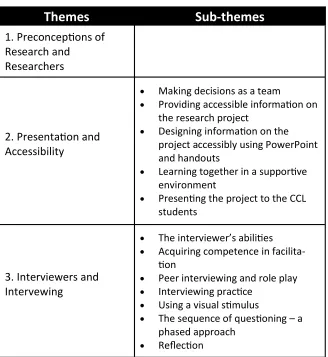
[image:23.421.48.376.182.539.2]Data for Stage 1 are presented using thema c analysis. The input and exper se of the voices of co-researchers were vital in providing guid-‐ ance to the design and presenta on of informa on to their intellectu-‐ ally disabled peers. The three themes that emerged for Stage 1 are: 1) Preconcep ons of Research and Researchers; 2) Presenta on and Ac-‐ cessibility, and 3) Interviewers and Interviewees.
Table 1 - Themes and sub-themes
Themes
Sub
-
themes
1. Preconcep ons ofResearch and Researchers
2. Presenta on and Accessibility
Making decisions as a team
Providing accessible informa on on the research project
Designing informa on on the project accessibly using PowerPoint and handouts
Learning together in a suppor ve environment
Presen ng the project to the CCL students
3. Interviewers and Intervewing
The interviewer’s abili es Acquiring competence in facilita-‐
on
Peer interviewing and role play Interviewing prac ce
Using a visual s mulus
The sequence of ques oning – a phased approach
As a research method, interviewing had several benefits to offer the par cipants of this study. This interview has a proven track record in the field of inclusive research and has been shown to be an efficient instru-‐ ment in giving ‘voice’ to people with intellectual disabili es who have historically been denied an opportunity to par cipate in a research project (Williams 2011). With some crea vity, (i.e. using a visual s mulus to help elicit informa on from CCL students), co-researchers encouraged a free-flowing conversa on and a worldview to unfold which was guided by the interviewee’s own vocabulary. This resulted in the produc on of focused, in-depth data that ul mately helped shape the project’s requirement of Stage 2 – a phenomenographic “outcome
space” (Åkerlind, 2005, p.323).
Findings – Stage 2
Table 2 - Categories of descrip on & Defini on
1. The Cogni ve Stages of Learning
Learning is seen as (a) increasing knowledge, (b) memorising and re-‐ producing knowledge, and (c) apply-‐ ing one’s knowledge.
2. Self-regula on of learning
Learning focuses on three phases: (1) The forethought phase, (2) The per-‐ formance phase and (3) The self -reflec on phase. This phase also out-‐ lines students’ engagement with their emo ons during the performance of learning, and how feelings of self -sa sfac on and posi ve affect en-‐ hanced their mo va on, self-beliefs,
self-management and goals.
3. Learning as collec ve meaning making
Learning moves from individual meaning to collec ve or shared meaning. Students par cipate in a dialogue with others (for example, tutors, peers, mentors, parents, work colleagues) in order to create new understandings.
4. The suppor ve environment and learning
Environment as a ‘safe-space’ in-‐ formed by students establishing a ‘group culture’, i.e. ‘how we wish to behave together’. Facilitator of learning sensi ve to promo ng posi-‐
Conclusion
The experiences of learning of college students with ID has shown that the learning process for this group of students is as mul faceted as any college student: learning is cogni ve (memorising, reproducing and applying knowledge), self-regulated (se ng goals, monitoring and reflec ng) and social (discussions and interac on with people). These stages of learning are underpinned and strengthened by an environment that promotes and supports posi ve student-teacher rela onships. The complexity of this experience – informed by co
-researchers’ and students’ voices – can provide a model of learning that could serve as a learning awareness tool for students with ID, as well as a way for teachers to improve their knowledge and awareness of how people with ID learn. Indeed, it is argued that the model of learning presented in this paper enhances the image of intellectually disabled students as valued and contribu ng students in the eyes of their educators.
Ul mately, the findings of this paper have demonstrated the im-‐ portance of voice and the value of researching with rather than on
people with ID. In this way these individuals can move from being passive in their approaches to learning and research to becoming more ac vely empowered as they con nue the process of lifelong learning.
References
Turnbull, P., Friesen, B.J., & Ramirez, C. (1998). Par cipatory Ac on Research as a Model for Conduc ng Family Research. RPSI,
Kubiak, J. (2013). Intellectually disabled students' experiences of learning in ter ary educa on : an inclusive phenomenography. Unpublished D.Ed. thesis. Trinity College Dublin.
Marton, F., & Booth, S. (1997). Learning and awareness. Mahwah, MJ; Lawrence Erlbaum Associates.
O’Brien, P., O’Keeffe, M., Kenny, M., Fitzgerald, S., & Cur s, S. (2008).
Inclusive educa on: A ter ary experience and transferable model? Lessons learned from the Cer ficate in Contemporary Living Programme: Dublin: Na onal Ins tute for Intellectual Disability, TCD, No 3, Monograph series, pp. 1- 97.
O'Brien, P., O'Keeffe, M., Healy, U., Kubiak, J., Lally, N., & Hughes, Z. (2009). Inclusion of students with intellectual disability within a university se ng. The Frontline of Learning Disability, 74: 6-7.
O’Connor, B., Kubiak, J., Espiner, D., & O’Brien, P. (2012). Lecturer responses to the inclusion of students with intellectually disabili es audi ng undergraduate classes, Journal of Policy and Prac ce in Intellectual Disability, 9(4): 247-256.
Walmsley, J, & Johnson, K. (2003). Inclusive research with people with intellectual disabili es: past, present and futures. London: Jessica Kingsley.
Williams, V. (2011). Disability and Discourse: Analysing Inclusive Conversa on with People with Intellectual Disabili es. Wiley
-Blackwell: UK.
Using ‘voice’ as a research approach: Project 2
-
disabled
children with and without the label of Au sm
Miriam Twomey
Introduc on
There is a growing awareness of the value of listening to children’s voices. Appropriate to this acknowledgement is a requirement to develop suitable methodological strategies that can effec vely elicit children’s voice. MacNaughton, Hughes and Smith (2007) assert that children as young as two have a voice; while Kelly (2005) advocates that we encourage the voice of young disabled children. In the case of disabled childhood this research seeks to explore beyond essen alist, biological representa ons and reinforce it as a site of agency and iden ty emana ng from wider social construc ons. The use of crea ve method-‐ ologies is foregrounded.
This ar cle will explore methodologies to include and bring to voice young children with Au sm while acknowledging how crea ve methods may enhance the ‘paradigm shi ’ encouraging agen c representa ons of children (Christensen & James, 2000; MacNaughton, Smith & Davis, 2007). This sec on of the ar cle is based on doctoral research of one of the authors which explored the poten al contribu on of voice to children’s self- knowledge influenced by ‘space’ (rela onships) and ‘place’ (environments).
Ra onale
rights espoused by the United Na ons Conven on on the Rights of the Child (UNCRC) (United Na ons General Assembly, 1989). Fundamental to this research is an explora on of children’s capacity to relate to self and others, where voice may be considered an expression of iden ty. Iden fica on of the self’s most basic founda ons are represented by the body and manifested through the body (Damasio, 1994; 2000;
Panksepp, 1998; Schore, 1994). Innova ve research by Reddy (2012) advances this concept and emphasises the interpersonal nature of mind and language asser ng that ‘being moved’ by others is an innate human capacity (Reddy, 2012).
Movement in this sense refers to physical movement but also to the subjec vity and connec on between physical movement, and the ability to be moved emo onally or affec vely by others. Reddy has built on Bråten (2007) and Hobson’s (2007) work. Bråten (2007) describes this as the ability to be centred in another’s body and refers to this as ‘alter-centric’. Hobson (2007) refers to how we iden fy with the other. His thesis is that being moved by others in a subjec ve orienta on is a central feature to understanding the thoughts, feel-‐ ings and a tudes of others.
Methods
This research sought to inves gate if space and place can influence the iden es of young children with Au sm. In-depth qualita ve case studies describing Callum, Jack, Adam, Charlie and Aaron’s experienc-‐ es were developed. Case study was considered an op mal research strategy that inves gated a phenomenon within real-life contexts (Yin, 2002). Case studies must reflect mul ple perspec ves of par ci-‐ pants and stakeholders. To authen cate this, the case studies in this research were contextualised in naturally occurring circumstances in Early Interven on and school se ngs (Simons, 2009). Case studies enhanced the construc vist nature of this research; they explored how par cipants construct their worlds as well as their understanding and interpre ng of it.
This study examined ways of listening to and consul ng children with Au sm and their peers (Jones & Gillies, 2010; Kellet, 2006; Kelly, 2005 Lewis, 2002). Over 80 interviews were conducted with a variety of representa ve stakeholders including parents, Early Interven onists, teachers, school principals, SNAs and allied health professionals over a period of 18 months in different geographical regions. For the pur-‐ poses of this ar cle inclusive methodological approaches to inter-‐ viewing and observing children will be described.
Methods included a por olio of sensi ve and crea ve approaches to elici ng children’s voice.
1. Observa ons and interac ve methods took place in a sample of Early Interven on and mainstream school se ngs;
Crea ve Methods
While this research has taken the form of small-scale qualita ve embedded case studies, involving interviews and focus groups, it has also yielded valuable informa on rela ng to a range of crea ve, visual and augmenta ve methods which were designed to simultaneously engage children’s interest and facilitate communica on. Effec ve approaches accommodate children’s propensity to understand and represent their world visually. Having noted the par cular difficul es disabled children experience in ar cula ng voice (Lewis & Porter, 2007) this research observed recommenda ons made by Lewis, Newton and Vials (2008), Jones and Gillies (2010) and Long, McPhillips, Shevlin and Smith (2012) and sought to develop more crea ve methods. Similar to these authors this research sought to inves gate no ons of rights and their limita ons (Kilkelly, Kilpatrick, Lundy, Moore & Scraton, 2005; Lundy, 2007).
Elici ng Young Children’s Voice
For children who understood basic Sign Language, it was established that they understood the sign for stop during the research visits.
Finding ways to circumvent children’s difficul es with communica on and expression must be innova ve. Integral to the Methods of this research, the crea on and use of tools to elicit children’s voice was an evolu onary process. Methods and approaches moved along a loosely aligned process (Kelly, 2005) a emp ng to invite children to contribute as researchers (Jones & Gillies, 2010; Kelle , 2006). Rapport was greatly enhanced with inclusive groups by the use of puppetry and role play in children’s focus groups (Schrandt, Buffington-Townsend & Poulson, 2009; Salmon & Sainato, 2005; Epstein, Steven, McKeever, Baruchel & Jones 2008).
This research also paid homage to Trimingham’s (2010) no ons of embodiment where children’s neurological pa erns are developed through physical interac on with the world. Her work addresses ways in which this pa erning may be interrupted or disturbed, and how puppets, as innocuous but controllable physical objects, may have a therapeu c role in re-establishing disrupted pa erns. She explores the use of puppets as Winnico ’s (1971) ‘transi onal objects’ opera ng in a ‘transi onal space’. Using Winnico ’s no on of a bridge between the inner world that we control, and the external world, which we do not, these ac vi es are linked to a crea ve ‘space’ of mind. Puppets operate in this space. The material reality of the puppet and its ‘objectness’ is emphasised and adds to its effec-‐
veness (Trimingham, 2010).
and un-knowing the world. Children’s world views were not yet formed. For young children with Au sm, sensory knowing may have had disrupted pa erns. Typically infants learn to focus their a en on selec vely (Stern, 1985). Bogdashina (2011) associates these as yet insufficiently understood phenomena as a precursor of Winnico ’s (1960) ‘true self’ experience.
Combining aspects of drama and puppetry during focus groups ensured that children were less in midated by the researcher. The puppets allowed children freedom to talk when they were not sure about things. While some children were aware of my presence, they were more absorbed in the puppet’s animated gestures. They responded to the puppet ‘like a new friend’ or another pupil in the class. My large child
-sized puppet had movable hands to add to the expressive features of the face. I made the puppet more demonstrable and interac ve using hand signals and body movements to emphasise non-verbal, interpersonal behaviour. A further argument for using puppets was their related use in teaching mirror behaviours and as a possible s mulus to the mirror neuron system in children with Au sm. This strategy endeavoured to prompt children with Au sm to respond to imita ve efforts (Caldwell, 2006; Ingersoll, 2008; Rogers, 2000). I used puppets to model facial expressions, emo ons and social interac on skills. The frequency with which I used the puppet ensured success.
The puppets (co-researchers respec vely known as Pre y Girl and Pre y Boy) conducted inclusive children’s focus groups; ini ally through role
evident when children asked “Are the puppets coming?” My role resorted to that of untrained ventriloquist; I had replaced myself as researcher.
Ethical Issues
Similar to Smith, Taylor and Gollop (2000) listening to children’s voices and encouraging them to ac vely par cipate was integral to the research design. Efforts to elicit children’s voice were cognisant of the complex power imbalances that shape ideological contexts rela ng to voice. To address these difficul es an ‘intersubjec ve, situated and nego ated’ approach to ethics advocated by Renold, Holland, Ross and Hillman, (2008, p. 428) was implemented. Similar to the authors, an
-always-in-process awareness of the complexi es of research ethics was experienced during the par cipatory aspects of the research. Even when the child was unable to give informed consent, there were oppor-‐ tuni es for assent and dissent to ensure that their inclusion in the study was voluntary and that they were not being coerced (Lewis & Porter, 2007).
Conclusion
voices, this research sought not only to listen to children but to provide detailed portrayals ‘embodied in the words they speak’ (James, 2007, p. 269) and add to the refinement of research methodologies to advance these concepts.
References
Beresford, B. (1997) Personal Accounts: Involving Disabled Children in Research. University of York. Social Policy Research Unit: H.M. Sta onery Office.
Bogdashina, O. (2011) Au sm and the Edges of the Known World: Sensi vi es, Language and Constructed Reality. London: Jessica Kingsley Publishers.
Borgnon, L. (2007) 'Concep ons of the Self in Early Childhood:
Territorializing iden es'. Educa onal Philosophy and Theory,
39:3, 264-274.
Bråten, S. (2007) On Being Moved: From Mirror Neurons to Empathy.
Amsterdam: John Benjamins Publishing Company.
Caldwell, P. (2006) Finding You Finding Me: Using Intensive Interac on to Get in Touch with People Whose Severe Learning Disabili es Are Combined with Au s c Spectrum Disorder. London and Philadelphia: Jessica Kingsley.
Christensen, P. and James, A. (eds.) (2000) Research with Children: Perspec ves and Prac ces, London: Falmer Press.
Dahlberg, G. and Moss, P. (2005) Ethics and poli cs in early childhood educa on. London: RoutledgeFalmer.
Damasio, A.R. (2000) The Feeling of What Happens: Body and Emo on in the Making of Consciousness. Florida: Houghton Mifflin Harcourt.
Epstein, I., Stevens, B., McKeever, P., Baruchel, S. and Jones, H. (2008) 'Using puppetry to elicit children's talk for research'. Nursing Inquiry, 15:1, 49-56.
Hobson, R.P. (2007) 'On Being Moved in Thought and Feeling: An Approach to Au sm'. In: P.M.G. Juan Martos Pérez , María Llorente Comí , Carmen Nieto (ed.) New Developments in Au sm: The Future Is Today. London: Jessica Kingsley.
Ingersoll, B. (2008) 'The effect of context on imita on skills in children with au sm'. Research in Au sm Spectrum Disorders, 2:2, 332 –340.
James, A. (2007). Giving voice to children’s voices: Prac ces and problems, pi alls and poten als. American Anthropologist, 109, 261-272.
Jones, P. and Gillies, A. (2010) 'Engaging young children in research about an inclusion project'. In: R. Rose (ed.) Confron ng obstacles for inclusion -interna onal responses to developing educa on. London: Routledge, 123-136.
Kelle , M. (2006). Children as ac ve researchers: a new research paradigm for the 21st century? ESRC: Na onal Centre for Research Methods.
Kelly, B. (2005) 'Chocolate… makes you au sm: impairment, disability and childhood iden es'. Disability & Society, 20:3,261-275.
Kilkelly, U., Kilpatrick, R., Lundy, L., Moore, L. and Scraton, P. (2005)
Commissioner for Children and Young People.
Komulainen, S. (2007) 'The Ambiguity of the Child's 'Voice' in Social Research'. Childhood, 14:1, 11-28.
Lenz Taguchi, H. (2008) 'An ‘Ethics of resistance’ challenges taken-for
-granted ideas in Swedish early childhood educa on'.
Interna onal Journal of Educa onal Research, 47:5, 270-282.
Lewis, A. (2002) 'Accessing through research interviews the views of children'. Support for Learning, 17:3, 110-116.
Lewis, A., Newton, H. and Vials, S. (2008) 'Realising child voice: the development of Cue Cards'. Support for Learning, 23:1, 26-31.
Lewis, A. and Porter, J. (2007) 'Research and Pupil Voice'. In: L. Florian (ed.) The SAGE Handbook of Special Educa on. London: SAGE Publica ons Ltd.
Lewis, A., Robertson, C. and Parsons, S. (2005). DRC Research Report - Experiences of disabled students and their families: Phase 1.
University of Birmingham: Disability Rights Commission.
Long, L., McPhillips, T., Shevlin, M. and Smith, R. (2012) 'U lising crea ve methodologies to elicit the views of young learners with addi onal needs in literacy'. Support for Learning, 27:1, 20-28.
Lundy, L. (2007) '‘Voice’ is not enough: conceptualising Ar cle 12 of the United Na ons Conven on on the Rights of the Child'.
Bri sh Educa onal Research Journal, 33:6, 927-942.
Panksepp, J. (1998) Affec ve Neuroscience: The Founda ons of Human and Animal Emo ons. New York ; Oxford: Oxford University Press.
Reddy, V. (2012) 'Moving others ma ers'. In: A. Foolen, U.M. Lüdtke, T.P. Racine & J. Zlatev (eds.) Moving Ourselves, Moving Others. Amsterdam: John Benjamins Publishing Company, 139 –164.
Renold, E., Holland, S., Ross, N.J. and Hillman, A. (2008) '`Becoming Par cipant': Problema zing `Informed Consent' in
Par cipatory Research with Young People in Care'. Qualita ve Social Work, 7:4, 427-447.
Rogers, S.J. (2000) 'Interven ons that facilitate the socialisa on of children with au sm '. Journal of Au sm and Developmental Disorders, 30:399-408.
Salmon, M.D. and Sainato, D.M. (2005) 'Beyond Pinocchio: Puppets as Teaching Tools in Inclusive Early Childhood Classrooms'. Young Excep onal Children, 8:3, 12-19.
Schrandt, J.A., Buffington Townsend, D.B. and Poulson, C.L. (2009) 'Teaching empathy skills to children with au sm'. Journal of Applied Behavior Analysis, 42:1, 17-32.
Schore, A.N. (1994) Affect Regula on and the Origin of the Self: The Neurobiology of Emo onal Development. Hillsdale, N.J.: Erlbaum.
Simons, H. (2009) Case Study Research in Prac ce. Thousand Oaks: SAGE Publica ons.
Spyrou, S. (2011) 'The limits of children's voices: From authen city to cri cal, reflexive representa on'. Childhood, 18:2,151-165.
Stern, D.N. (1985) The interpersonal world of the infant: a view from psychoanalysis and developmental psychology. New York: Basic Books.
Tozer, R. (2003) 'Involving children with ASD in research about their lives' Methodological issues in interviewing children and young people with learning difficul es, University of Birmingham: ESRC 2001–3.
Trimingham, M. (2010) 'Objects in transi on: The puppet and the au s c child'. Journal of Applied Arts & Health, 1:3, 251-265.
United Na ons Commi ee on the Rights of the Child (1989) United Na ons Conven on on the Rights of the Child CRC/SP/SR. Geneva: United Na ons.
Warming, H. (2012) 'Theorizing (Adults' facilita on of) Children's Par cipa on and Ci zenship'. In: C.I. Baraldi, V. (ed.)
Par cipa on, Facilita on, and Media on: Children and Young People in Their Social Contexts. New York: Taylor & Francis.
D. W. Winnico , "Ego distor on in terms of true and false self," in The Matura onal Process and the Facilita ng Environment: Studies in the Theory of Emo onal Development. New York: Interna onal UP Inc., 1965, pp. 140-152.
Winnico , D.W. (1971) Playing and reality. New York: Basic Books.
Working hard to try to include the hard to include
Meanu Bajwa
-
Patel & Phil Ellender
University of Northampton
Despite the desire of researchers and policy makers to hear and include the views of all strata of society, there is an acknowledged, though not o en wri en or talked about, awareness of the problems of reaching some groups. As Kennan et al., (2012) write
It might understandably be thought that those with the greatest needs or exposed to the greatest risk are the most important group to involve in research, which is to inform policy and service development. However, these groups can o en be the most difficult to access (2012
p.276).
Hidden popula ons such as NEETs, students excluded from schools and those in local authority care or missing can be difficult to locate or access. They may have very good reasons for not wan ng to be ‘found’. Then there are the groups on the margins of society: criminals, drug users, gang members, teenage parents who again may have very good reasons to avoid being involved; they may feel s gma sed or disassoci-‐ ated from society or just not interested. However if research is to have “any effect on, change or benefit to the economy, society, culture, pub-‐ lic policy or services, health, the environment or quality of life beyond academia” (REF 2014, p.3) then there is no doubt that it needs to be based on the groups which represent society. So who are these groups and why are they so hard to reach/engage? It is noteworthy that using the term hard to reach/hidden implies a certain homogeneity within these groups (Shaghaghi et al., 2011)which does not necessarily exist.
Who are they? Examples include:
Those living in vulnerable social and economic situa on
(Shaghaghi et al., 2011) / socially deprived communi es (Sixsmith
et al., 2003)
Emo onally vulnerable and ‘missing’ (Macnab et al., 2007)
Those being under social pressure of the broader community whether immigrants, newly arrived residents, living in faith based communi es or from indigenous cultures (Kawulich, 2010)
The homeless (Shpungin and Lyubansky, 2006); homeless people, pros tutes and drug addicts (Faugier and Sargeant, 1997) sex industry workers (Benoit et al., 2005)
Those giving their baby up for adop on (Mander and Scm, 1992)
Those receiving pallia ve care (Ewing et al., 2004)
Those who have no interest in being found or contacted, including those who fear confronta on with legal authori es and those with very low literacy skills
Those living in remote physical and geographical loca on or at the other extreme those who have been over-researched.
Why are they so hard to access/engage? Some mes because of gatekeepers whose mo va on might be:
Altruis c: They may have reasons to refuse access because of the intrusion on private family life, and in some cases the fear of a child protec on interven on, par cularly in light of the limita ons on confiden ality. (Kennan et al., 2012)
Professionally sensi ve or even selfish: Gatekeepers may feel the research will reflect badly on them. “Gatekeepers grant formal access but withhold co-opera on if they think studies threaten them or their schools”(Macnab et al., 2007).
Lee and Renze (1990) believe that research seen as threatening or involving poten al costs to those par cipa ng in the research should be regarded as ‘sensi ve research’.
Wanat (2008) considered that, “Gatekeepers’ coopera on was influ-‐ enced by what they perceived were benefits and threats to par cipa-‐
on. If gatekeepers thought a project would benefit them, they would more likely cooperate. They were less likely to par cipate if they felt threatened personally or thought their jobs were threat-‐ ened.” It is not clear how the author detected the extent to which gatekeepers’ mo ves were ethical or selfish. It would be interes ng to compare the interpreta ons of researchers with different levels of professional experience in the field.
Some mes communi es may be reluctant to par cipate if they feel that they have been misunderstood or misrepresented in the past:
Presenters’ experiences of recrui ng par cipants:
Inves ga ng the transi on of children with SEN statements from mainstream primary to secondary school.
Phil
Why is this area important? Because of the addi onal challenges which pupils with SEN face at secondary school.
What sample was sought, and why and how?
Pupils with SEN statements were selected as they were easily iden fi-‐ able and finite in number. However:
Some children with statements no longer have complex needs; Some with complex needs do not have statements;
The schools involved were iden fied by a SENCo trainer as amenable to involvement so likely to be confident in the provision being made;
Rates of success / impact on my research?
Of the 20 families contacted, 8 volunteered; one dropped out when the placement failed, leaving 7 par cipants. In the opinion of all involved when ques oned half way through year 7, transi on had been success-‐ ful for these 7. Families expressed great sa sfac on with the outcome but sympathised that this might be inconvenient for the researcher! Par cipants iden fied many factors which they felt contributed to successful transi on, and offered some improvement sugges ons, but it was not possible to learn from examples of transi on ‘failure’.
Meanu
last 15 years has increased pressure on LAs to place children in main-‐ stream wherever possible.
What sample was sought, why and how?
Wanted families from a range of backgrounds (gender, ethnic, socio
-economic, age), geographical areas and different SEN statements, used statements as was easier to iden fy children, although as PE men ons, statements brings their own difficul es. I felt that interviewing a range of families would give a more representa ve picture of the reality around school placement decisions for children with statements. I wanted to know if families with different backgrounds, in different loca ons, whose children had different needs - would have similar or different concerns. Ini al par cipants were volunteers from survey, then snowballing and various canvassing op ons were explored – presen ng at mee ngs of head teachers, SENCos, parent support groups mee ngs, leaflets drops in: doctors’/den sts’ surgeries, clinics, supermarkets, schools, gurudwa-‐ ras, indoor play centres, children’s centres, friends/colleagues were given them to pass on, an advert was placed in a community magazine, LAs were contacted……etc.
Rates of success / impact on my research?
stream with a specialist units – this suggests that perhaps the sample was quite broad, however we also need to note that all the parents were white, many were middle class, all of the interviewees were women, although male partners were present on some occasions they said li le. Difficult to say yet what the impact on the research has been, I know what I know from these interviews but of course I don’t know what I have missed through a lack of diversity in my sample. Any recommenda-‐
ons I make to schools or LAs regarding children with SEN statements and school placement may not actually represent the views of many of the families that didn’t speak to me, the ones that were too busy, or not interested or oblivious…..
How can we be more successful in engaging with these groups?
that can work and also help us to appreciate that we are not alone. So how do they do it?
Groger (Groger et al., 1999) researched African American elders and their long term care choices. They had problems with access and found that gatekeepers refused access for a range of reasons from shyness to illness. Owing to the requirements of the ins tu onal review boards in the US, which was the route to gaining their funding, they found that they were very restricted in terms of being able to make changes to their research design and could not ‘play it by ear’ as even every change of wording in a le er had to be approved. They ended up using what they call ‘scrounging sampling’ – “desperate & con nuing efforts, against moun ng odds, to round out the collec on of individuals with relevant types of experience we know to exist but have not been able to capture” (p.830) to complete their sample of 60 interviews. However they were unable to achieve maximum varia on sampling and argue that as qualita ve researchers we need to be clear that, if our findings are not based on access to the whole popula on, although our results might (not??) be generalisable we need to ask ourselves ‘what if?’ So scrounging sampling is our first method, one which I know will be familiar to many researchers.
Another familiar method is snowball sampling – this is a method where we iden fy respondents who then refer us to other respond-‐ ents, in their paper Sampling hard to reach popula ons, Faugier and Sargeant, (1997), suggest that “in a emp ng to study hidden popula-‐
star ng the ball rolling and then it ge ng bigger and bigger as the par cipants simply gather. It is o en a slow and careful process in which the researcher has to avoid many pi alls and o en results in a sample which is strongly biased towards the inclusion of par cipants who have many interrela onships; this may in turn distort the findings. However there is li le doubt that this is the only way of accessing some vulnerable and more impenetrable social groupings. Provided that we report on any likely sources of bias and the constraints on our findings, we might improve our understanding of the needs of these groups even if we cannot generalise from our findings.
Shaghaghi et al.(2011) in their literature review on hard to reach popula ons have iden fied a range of techniques to recruit hard-to
-reach popula ons, including a number of methods, among which snowball sampling and a varia on on it called respondent-driven
sampling (RDS), developed by Heckathorn in 1997. RDS is a form of
undesirable behaviours, in some cases it can also allow research into areas that would likely be impossible to access otherwise, for example highly marginalised and s gma sed communi es such as sex workers. Benoit et al. (2005) recruited former sex workers as their indigenous research assistants (IRAs) in their study of sex work-‐ ers in a metropolitan Canadian city. They managed to interview a sample of over 200 which gave them really useful data on the needs of these workers.
Shaghaghi et al (2011) also found several other methods: Facility
-based sampling (FBS); Targeted sampling (TS); Conven onal cluster
sampling (CCS) and finally capture re-capture sampling (CR) all of
which are designed to overcome some of the problems of trying to access hard to reach groups in our society. However they conclude that, regardless of the advantages and disadvantages of each method, their success is ul mately based upon our knowledge about specific charac-‐ teris cs of the sub group we are a emp ng to study.
not mean that they iden fy themselves as such.
Also speaking of iden ty, another lesson worth remembering, albeit not a method as such, is reported on by Maginn (2007) in his work in ethnically diverse neighbourhoods in London. He spent nearly 15 months intensively networking, using formal and informal methods, to gain access to his par cipants. In previous work in Northern Ireland and with Travellers he had asserted different aspects of his iden ty and highlighted common ground to overcome suspicions and build rapport with poten al informants. For example he highlighted his experiences of segrega on and discrimina on in Northern Ireland as a way of connec ng himself, a white middle class researcher, with ethnic minori es in London. He also carried out what he called commitment acts; to build rapport, he would turn up early at mee ngs and help set up, and also worked hard to “induce a sense of familiarity, similarity and sympathy among gatekeepers and informants towards my research” (Maginn, 2007, p. 431). In my research I had tried to do some similar rapport building and tried a few commitment acts of my own, however I found myself uncomfortable with the ethics of the process and am s ll ques oning whether it was right for me to emphasise my iden ty as a mother when talking to par cipants about their children or to turn up to a parents’ support mee ng in the hope of recrui ng more par cipants.