© 2018, IRJET | Impact Factor value: 6.171 | ISO 9001:2008 Certified Journal | Page 1275
IoT Based Smart Management
P.P.Shendage¹, S.U.Bhosale², P.B.PATIL³, V.V.Patil
41Assistant Professor, SETI, Panhalal
2,3,4 UG Student, SETI PANHALA
---***---Abstract – Population increasing day to day due to
increasing population creates many problems like air pollutions, water pollution, load shielding, and continuous use of non-renewable energy sources (petrol, LPG gas) .The main objective of the system to save the environment. To reduce above problems and to save the environment describes the specific characteristics of smart management IoT. Such that the system manages garbage management, water management, street light management. In propose system develop by using Atmega16, IR sensors, ESP module, Micro C. In garbage management system will reduce the wastage of garbage, create hygienic environment, water management for the equal distribution of water, street light for the saving the energy , and display the message to citizen and government authority. Use renewable energy sources like for generates pollution free energy.
This energy utilize for street light, traffic signal and in garden. By using waste material produce biogas. It utilize for the apartment for cooking and many other thing.
Key Words: Atmega16, ESP8266.
1. INTRODUCTION
The proposed system design by using Atmega16, sensors, ESP module, Relay and Micro C software. A t m e g a 1 6 is a heart of a system. Which interfacing between sensors and data base. Raspberry pi camera module to take high definition video as well as stills photography. The
IR sensor sense the object on street. Sensors are placed on the poll of road and it gives updates of intensity circuit and . The Atmega16 gives this information to the ESP module.
In database management systems are in charge of storing the large amount of information produced by IoT peripheral nodes such as sensors.
Street light: It is the leaf part of the system where IoT nodes are placed. Each streetlight is geographically localized on the city map and uniquely associated to the IoT node attached to it, so that IoT data can be enhanced with context information. The monitoring of the correct operation of the bulbs is performed through IR sensors.
2. PROPOSED SYSTEM
[image:1.595.317.565.188.388.2]
In this section all processed input are stored in the ESP module data base and which stored data is access through the webpage. Citizens are easily access the all information.
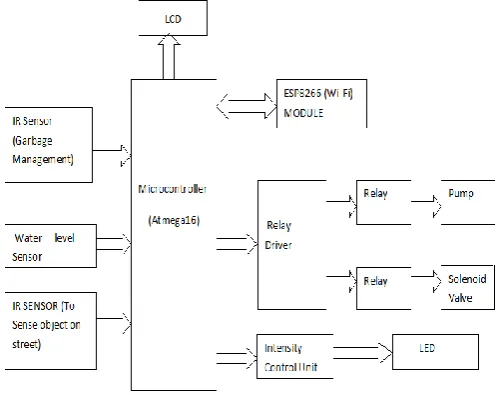
Fig -1: -System Block Diagram
The chart-1 gives the general description of system block diagram in which each block has following description. This system divided into main 3 sections as follows:
INPUT: In which all the sensors are present and senses the appropriate value .This sensed value is then passed to the main processing unit i.e. Atmega16.
MAIN PROCESSING UNIT: Which includes Atmega16 .Atmega16 having the more rang of memory. it also having extra onboard features on board.
OUPUT: In this section two part consist are DATA IN ESP8266 WEBPAGE
The main aim of the purposed system is save the environment. System is based on IoT. In IoT implements various ideas and applications. All those various ideas and application built in single app. This app is useful for every citizens and government authority. This purpose system mobile app is maintain all data like water level ,air pollution, traffic congestion, road conditions for the specific area.
diseases. This will degrade the standard of living. To overcome these situations an efficient smart waste collection system has to be developed.
Water management: Water is an important resource for all the livings on the earth. In that, some people are not getting sufficient amount of water because of unequal distribution. We can use this approach so that everyone gets the equal amount of water. It is also used to avoid the wastage of water during the distribution period. In the previous method, the employee will go to that place and open the valve for a particular duration, then again the employee will go to the same place and close the valve, it is waste of time. The proposed system is fully automated. Here human work and time are saved.
Street light management: Load shedding serious issue .Using this management some amount of energy saved. And saved energy we can use anywhere. Therefor in all areas all peoples get light.
Hardware Requirement:
• ATmega16:-
The ATmega16 is low –power CMOS 8 –bit microcontroller based on the AVR enhanced RISC architecture. The AVR core combines a rich instruction set with 32 general purpose working resisters. The Atmega16 AVR is supported with a full suite of program and system development tools including:C compiler ,micro assemblers ,program debugger /simulator . Maximum operating frequency 20MHZ. Flash memory 32KB.Maximum input/output pins 26. It operates between 1.8-5.5 volts.
• IR Sensor:
An infrared (IR) sensor is used to detect level in the dustbin whether the dustbin is full or not. An IR sensor consists of emitter, detector and associated circuitry. The circuit required to make an IR sensor consist of two ports. The emitter circuit and receiver circuit. Emitter is simply IR diode. Detector is simply IR photodiode.
• Water level sensor :
We will use two conductor pipes as a water level sensor .In this we will place one conductor at lower side and another at higher side of street. When water level goes above the higher side of conductor then it will generate some amount of electricity due to this conductor acts as a switch and it will inform to microcontroller. Due to this flood will control.
• Solenoid Valve:-
A solenoid valve is an electromechanically operated valve. The valve is controlled by an electric current through a solenoid. Solenoid valve are most frequently use control elements in fluidic’s. Their tasks are to shut of, release, dose,
areas. Solenoids offer fast and safe switching, high reliability, long service life, good medium, compatibility of material used.
ESP Module:
Esp ressif’s ESP8266EX delivers highly integrated Wi-Fi SoC solution to meet users’ continuous demands for efficient power usage, compact design and reliable performance in the Internet of Things industry. With the complete and self-contained Wi-Fi networking capabilities, ESP8266EX can perform either as a standalone application or as the slave to a host MCU. When ESP8266EX hosts the application, it promptly boots up from the flash. The integrated high speed cache helps to increase the system performance and optimize the system memory.
Display:
LCD (liquid crystal display) screen is an electronic display model and find a wide range of applications. A 16X2 LCD display is very basic module and is very commonly used in various devices and circuits. A 16X2 LCD means it can display 16 characters per line and there are 2 such lines. In this project display is used to show the current condition of road to peoples who present the
3.CONCEPT AND THEORY
Applications of project:
1. Garbage management 2. Water management 3. Street light management
1. Garbage management
[image:2.595.321.550.550.755.2]Garbage wastage is serious issue. The market springs from the synergic interconnection of key industry and service sectors, such as smart governance, smart mobility.
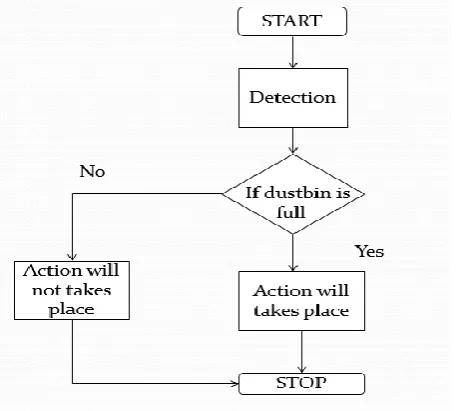
The services provided like water level controller, temperature sensors, pollution sensors, image processing these services have number of application. Flow graph shows the detection garbage. The garbage controller it is a single application use in various way at the time of waste garbage about the garbage level IR sensor sense the level. We can also see on webpage.
2. Water management
[image:3.595.321.506.67.403.2]The project is based on smart city. The various ides and applications we can used very smarty on only single app. everyone has an updates of data. It’s useful because of single water level can provide no of services.
Fig.3. 2 water management flow graph
The project is save the environment damage due to human pollution. Solar panels, wind mills, rain water harvesting. The sun is biggest sours of energy; by using the natural resources of energy we can generate the clean energy & reduce pollution.
Water very essential thing for human. Due to water level controller we can manage the water supply, like when water level above the critical level system will alert to block the road and suggest the other way to travel. Similarly we can use this application in underground water pipe line, when tank is full we can see on webpage. Then we can open valve.
3. Street light management
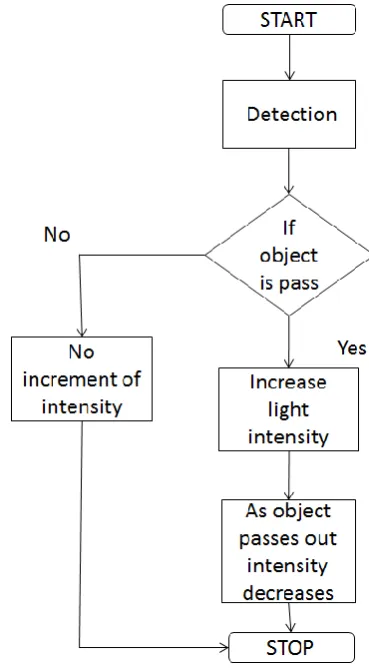
We propose a system for controlling the street light management. The vehicles are detected by the system through IR sensor .It sense the object then counter will be increase and light intensity will be also increase.
Fig3.3 street light management
When object pass out then automatically light intensity will decrease.It is a better technique to control the energy. It visualizes the practicality, so it functions much better than those systems that rely on the detection of the vehicles’ metal content. main system and citizens an their single application. It is useful for accident detection.
Due to live updates traffic monitoring possible. When object are present on road light intensity will be increase. sensor give the update to system and again suggest the other objects. The Fig,3.2 gives the street light. IR sensor detect the target takes action and increment the counter . when object pass out light intensity will decrease. It help us to save some amount of energy.
4. SYSTEM DESIGN & IMPLEMENTATION
Fig 4.1 Webpage
Fig. 4.2 webpage initial
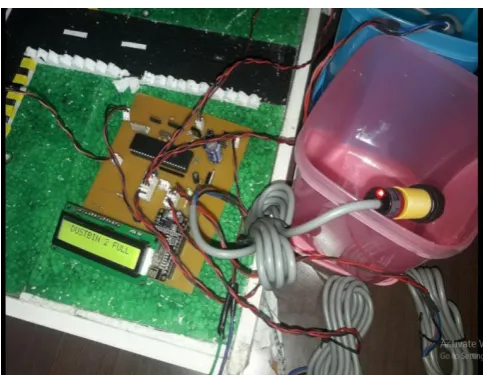
The system will available to the citizens to check the all-LIVE situation on the road .The ESP module is placed on the system that will detect the garbage ,water level and object on the road .The webpage is designed for the citizens. When they will requested to information like dustbin in shown in fig 4.3 the all information is on the webpage, road they will find high intensity.
Webpage of Garbage management
Webpage of street light management
In this project we are designing a information exchange system which will keep the daily commuter updated about the route information so that the user can take a informed decision regarding the route selection which will take him to his destination with least amount of obstacles which saves time.
5 CONCLUSION
In this paper, we analyzed the solutions currently available for the implementation of urban IoT. The discussed technologies are close to being standardized, and industry players are already active in the production of devices that take advantage of these technologies to enable the applications of interest. The range of design options for IoT systems is rather wide; the set of open and standardized protocols is significantly smaller. The enabling technologies, furthermore, have reached a level of maturity that allows for the practical realization of IoT solutions and services, starting from field trials that will hopefully help clear the uncertainty that still prevents a massive adoption of the IoT paradigm.
6. REFERENCES
Parkash, Prabu V, DanduRajendra “Internet of Things Based
Intelligent StreetLightingSystem for Smart City”
International Journal of Innovative Research in Science, Engineering and Technology (An ISO 3297: 2007 Certified Organization) Vol. 5, Issue 5, May 2016.
[2]. Andrea Zanella, Lorenzo Vangelista “Internet of Things for Smart Cities” IEEE Internet ofThings Journal, Vol. 1, NO. 1, February 2014.
[3]. L. Atzori, A. Iera, and G. Morabito, “The internet of things: A survey,”Computer. Newt. Vol54, no. 15, pp.2787–2805, 2010.
[4]IEEE Standard for Local and Metropolitan Area Networks—Part 15.4: Low-Rate Wireless Personal Area Networks (LR-WPANs), IEEE Standard802.15.4-2011.
[5] IEEE 802.15 WPAN Task Group 4e (TG4e), IEEE Standard 802.15.4b, 2014.
[6] Sahani, M., Rout, S.K., Sharan, A.K., Dutta, S. real time color image enhancement with a high regard for restoration of skin color by using raspberry pi Communications and Signal Processing (ICCSP), 2014 International Conference IEEE.
[7] IEEE Communications Society, P1901.2-2013— Standard for Low Frequency(less than 500 kHz) Narrow Band Power Line Communications for Smart Grid Applications, IEEE Standard P1901.2-2013.
BIOGRAPHIES:
Priyanka Shendage is received B.E degree in M . t e c h i n VLSI and Embedded. F r o m Shivaji University in Kolhapur, Maharashtra India. She joined as Assistant Professor in SETI Panhala.
Shubham U. Bhosale is Final Year Student B.E in Electronics and Telecommunication from Sanjeevan Engineering and Technology Institute Panhala Maharashtra India. Also
ReceivedDiploma in Electronics &
Telecommunication from D.Y.Patil Polytechnic Talsande, Maharashtra INDIA.
Punam B. Patil is Final Year Student of B.E in Electronics and Telecommunication from Sanjeevan Engineering and Technology Institute Panhala Maharashtra India. Also Received Diploma in Electronics &Telecommunication from Government Polytechnic Tasgaon, Maharashtra India