© 2017, IRJET | Impact Factor value: 6.171 | ISO 9001:2008 Certified Journal
| Page 1209
Block diagonalization for Multi-user MIMO Beamforming performance
over Rician Channel
Cebrail Çiftlikli
1, Musaab sami
21
Professor,
Department of Electrical and Electronics Engineering, Erciyes university, kayseri, turkey .
2Department of Electrical and Electronics Engineering, Erciyes university, kaysers, turkey.
---***---Abstract -
In traditional wireless cellular networks, wirelessmobile communication faces adversities due to noise and fading. At same cell, users can cause the co-channel interference (CCI) between each other. Thereby, CCI can deteriorate the downlink channel’s capacity. Depending on the multiple-input multiple-output (MIMO) system theory, wireless communication network systems researches have been important developments. MIMO system is used to overcome individual channel fading effect by employing spatial multiplexing. Exploiting the matrix of channel state information (CSI) can improve performance of wireless channel link. CCI which is created via additional users inside the cell borders can be limited by designing the beamforming precoding vectors for every user in Multi-User MIMO system (MU-MIMO). Linear precoder has number of methods; one of them is Block diagonalization (BD) method. This method using by beamforming precoding as a linear precoder in the MU-MIMO broadcast channel system that transmits various information streams without interference to manifold users. This paper presents evaluation of the BD precoding performances in MU-MIMO beamforming over a Raylegh fading channel with CSI. Then, the channel matrix replaces the typical channel assumption with its correlated realistic Rician fading channel. Simulation results show that the Rician fading channel has performance improvement until with low Rician factor value, compared to a conventional channel. The high value of Rician factor can reduce the error rate.
Key Words: Block diagonalization; Beamforming; CSI;
Fading; MU-MIMO
1.INTRODUCTION
In all wireless communication systems, the broadcast environment when the system transmits information over wireless channel will be described as Line of Sight (LOS) or Non Line of Sight (NLOS). In case of NLOS, the data that is transmitted over a wireless channel has Rayleigh distribution as the probability density function (PDF). On the other hand, in case of LOS, the data that is transmitted over wireless channel has Rician distribution as PDF [1].
In general, transmitting data through a wireless channel may lead to the possibility of changes to the data, causing errors. The error probability for a fading channel is inversely
proportional to the signal-to-noise ratio (SNR). Each wireless channel has an individual and independent fading channel that is different from the other channels [2]. Based on space– time theory, the performance of any wireless system is improved through a powerful tool generated by using suitable techniques (at the receiver node) and signaling (at the transmitter node), together with a number of antennas at both sides of the wireless communication network nodes [3].
Increasing numbers of wireless communication customers lead to reuse frequency for the efficient use of the available spectrum. Unfortunately, the reason for decreasing system capacity and service quality may be because of interference that comes from increased frequency reuse. Therefore, the MIMO system has captured significant attention, considering its possible ability to improve the capacity of wireless channel networks. For this reason, MIMO systems have been extensively studied due to their features. Nevertheless, it has been depending on the unreality models of channels such as Rayleigh and the Rician fading channel, which is presumption and theoretical channel to evaluate the performance of MIMO systems [4].
© 2017, IRJET | Impact Factor value: 6.171 | ISO 9001:2008 Certified Journal
| Page 1210
feedback channel, reconnaissance of limited CSI and employment of CSI is very critical point for a MIMO system [9]. In cases when the channel state information at the transmitter (CSIT) is on hand and using a MIMO system with a liner precoding technique, it can accrue additional profits [10]. CSIT is very important, because when it is fully available at the base station, the MIMO system performs best in numerous ways via using the precoding method. For example, to mitigate symbol interference, precoding can be used with spatial diversity and spatial multiplexing provided by the MIMO system. Besides high gain coding, if space–time codes can be combined with precoding, maximum gain diversity is available [10] [11]. The BD method that supports multiple-stream transmission for MU-MIMO system can be considered as one of the biggest promising approaches [12]. In [13], in the MU-MIMO scenario where every user has a number of antennas try to connect with base station in wireless communication network, BD precoding have been presented as a precoding of linear method [14]. Therefore, it have been proposed BD algorithm to get beamforming technique with uncomplicated way, this technique which do not depend on time or frequency slots sent to each mobile station linear group of data in the same time or frequency slots. Nevertheless, BD and zero forcing (ZF) approaches put limitation on design of the system which is the antennas number for the transmitter and receiver. In this paper, we have analyzed and presented an evaluation of the BD at the transmitter for the wireless fading channel as transmission media to the signal and ZF detection at the receiver when CSI exists. We also discuss our simulation of the performance of an MU-MIMO beamforming system that employs BD with ZF and transmits the signal over a Rayleigh fading channel (in the NLOS environment) and then over a correlated realistic Rician fading channel (in the LOS environment).
2. MU-MIMO BROADCAST SIGNAL MODEL
We have considered an environment of downlink MU-MIMO broadcast channel consisting of geographically sparse mobile stations communicates with the base station (BS) has antennas. In such this environment system, each user is
independent and employing antennas of user . These
users will receive their own signal, as shown in Fig. 1. Define
= as the total users’ antennas number.
For a typical wireless communication network, we imagine
that ≤ with the independent channels of flat fading.
Suppose that the intended message signal for the user u is the
scalar . Therefore, the transmitted symbol vector to U
users is:
(1)
In the precoding step, we denote to the matrix of precoding as:
(2)
where ∈ is the joint precoding vector
(beamforming coefficients) for uth user. After joint precoding step, the symbol is multiplied by beamforming vector and then the transmitted vector would be:
(3)
The symbol and the coefficients of beamforming
precoding will be normalized as follows:
It is assumed that signals WS∈ are broadcast over the
channels denoted as:
(4)
where ∈ describes the channel coefficients
between receiver antenna at uth user and BS antennas as:
(5)
where denotes the channel coefficient between the
base station which has mth transmitter array antenna and uth user which has the nth receiver array antenna.
Thus, the received signals at receivers’ antennas as:
(6)
where ∈ representing the signal which is received
at ith recipient, whilst for the additive noise is denoted by n
∈ . When we have given careful consideration to each
user separately, we will find the received signal at an ith
recipient as:
© 2017, IRJET | Impact Factor value: 6.171 | ISO 9001:2008 Certified Journal
| Page 1211
The vector has complex Gaussian variables components
with unit-variance and zero-mean.
Moreover, the components of the additive noise have
distribution as (0, ) and is temporarily white and
spatially.
3. FADING CHANNAL MODEL
Usually, the strongest propagation component of MIMO channel corresponds to specular component (due to LOS propagation also referred to as deterministic components). While all the other components are scattering components
(due to NLOS also referred to as random components) [2].
When there is no component of LOS (for K= 0), in this case, the channel fading is described by the Gaussian distribution
with a variance of and zero mean or Rayleigh distribution
as:
where K is Rician factor value. The channel fading distribution has been following the Gaussian distribution
with a variance of and mean of q or Rician distribution
when K increases (For K > 0) as:
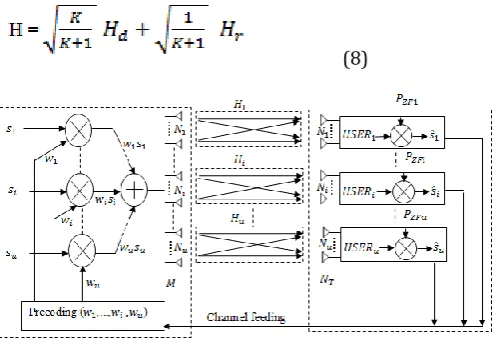
Therefore, in this work, channel matrix of MIMO system is tends to be described as [15]:
(8)
Fig -1: Block diagram of the multiple independent SU-MIMO beamforming system.
Where representing the component of the normalized
deterministic channel matrix, while representing the
component of random channel matrix, ,
E{ }= 1, = 1: , = 1: [15]. While is known
as factor of the Rician channel which is the relation between the component of the specular power and the component
of scattering power , displayed as [2]:
(9)
3. DOWNLINK PRECODING
In the system introduced in section MU-MIMO broadcast signal model can be used two precoding methods, which is linear and non-linear precoding method. Precoding can be used in MIMO to mitigate or cancel the inter user interference. We concentrate on linear precoding methods in this paper, because it is lower complexity. One of these linear precoding methods is BD. BD method is compatible with the multiple users, every user has multiple antennas. By the precoding process of this method, the interference signal that is coming from other user signals will be canceled. Therefore, MU-MIMO channel model will be converted into multiple independent single user MIMO channels model by BD method [2].
We suppose that the CSI of the wireless communication network in the cell is recognized to BS in Frequency-division duplexing (FDD) or Time-division duplexing (FDD) systems. In FDD systems, BS can get the downlink CSI by feedback of the users at same cell. While in TDD systems, according to channel reciprocity, BS can correctly guess the downlink CSI duo to the uplink CSI.
BD Precoding
Let is H with out , then compute the null space of all
users except ith user by SVD to :
(10)
[image:3.595.38.290.547.718.2]© 2017, IRJET | Impact Factor value: 6.171 | ISO 9001:2008 Certified Journal
| Page 1212
, (11)
Therefore, the broadcast through the MU-MIMO channel by any user in this system is look like to the user transmitted through a single-user MIMO channel system (SU-MIMO). Thereby, any cell has a BS work with MU-MIMO system is converting into cell has a BS work with multiple independent SU-MIMO system. Now to compute the equivalent SU-MIMO
channel of ith user , we can use SVD as suitable
precoding techniques.
= (12)
Where is the null space of ith user, while is the beam
of ith user. Then, the precoding matrix for ith user under
the condition ≤ is:
= (13)
By substituting (11) and (13) into (7), we can obtain
(14)
we can note that the received signal is consist of the required
signal of ith user as only.
ZF Detection
The ZF approach nullifies the interference of inter-stream by the following weight matrix [2]:
(15)
where denotes Hermitian transposition. Then, the
received signal multiplies by from the left as space
filter output:
(16)
From (16), it can note that the performance of error is
immediately linked to the ( ).
4. SIMULATION RESULTS AND EVALUATION
In this part, It was evaluated the signal-to-noise ratio (SNR) against the bit error rate (BER) as a scale of precoding efficiency. A typical MU-MIMO scheme is imitated to estimate the performance of the suggested MU-MIMO beamforming precoding scheme over Rician fading channel as a realistic channel in comparison to the same scheme over Rayleigh fading channel as conventional channel. For random Rayleigh and Rician fading channel cases, the samples of these parameters are set up to 10000 with elements generated as zero-mean for Rayleigh fading channel while m-mean for Rician fading channel and unit-variance independent and identically distributed (i.i.d) complex Gaussian random variables.
We simulate for {2, 2} × 4, {2, 2, 2} × 6, {3, 3, 3} × 9 and {4, 4, 4} × 12 MU-MIMO system, where the average BER is taken of BD approach at BS while the receiver was using a ZF
approach. BS transmits by antennas to each user over the
noise and flat fading channel while each user has employed antennas to receive the signal. QPSK signal constellation has been used as a broadcast modulation in all simulations and the results are averaged through several channel investigations. For all receivers the noise variance per
receive antenna is supposed the equal, = . . . = = .
Notice that BD is used in the BS as precoding method and ZF is used in the user as detection method. While the MU-MIMO beamforming system transmit the data over conventional channel has bad results with regard to BER (Fig. 2.), the realistic channel gives a suitable BER in the existence of 2 and 3 dynamic users. To best comprehend the behavior of the suggested scheme, the BER was plotted for different values of k (k > 0), compared to the Rayleigh fading channel. BD may well remove the multiuser interference perfectly, but it as well minimize the power of wanted receive signal, then has capacity loss particularly at low SNR (16).
© 2017, IRJET | Impact Factor value: 6.171 | ISO 9001:2008 Certified Journal
| Page 1213
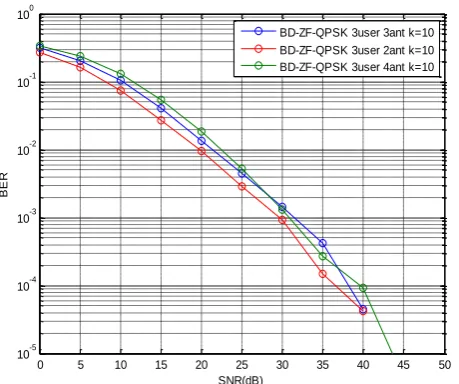
SNRs. The two users, for different k, enjoys with a better presentation than three users. On second thought, multiuser interference turns into the major factor restricting the performance of system for high SNRs. Then the three users, for different k, have performs better than two users. For the same reasons, Fig. 3 illustrates that to achieve high performance with high number of antennas it need to high SNR. Therefore, the multiplicity of antennas in mobile devices is impractical. Specifically due to size, hardware or cost practical limitations wireless mobile devices may not be able to support high number of antennas.
0 5 10 15 20 25 30 35 40 45 50
10-5
10-4
10-3
10-2
10-1
100
SNR(dB)
BER
BD-ZF-QPSK 3user k=10 BD-ZF-QPSK 2user k=10 BD-ZF-QPSK 2user k=15 BD-ZF-QPSK 3user k=15 BD-ZF-QPSK 3user k=0 BD-ZF-QPSK 2user k=0 BD-ZF-QPSK 3user k=25 BD-ZF-QPSK 2user k=25
Fig -2: BER performance of MU-MIMO system using BD at the transmitter and ZF detection at 3 receivers each
equipped with 2,3and4 receive antennas.
0 5 10 15 20 25 30 35 40 45 50
10-5 10-4 10-3 10-2 10-1 100
SNR(dB)
BER
[image:5.595.51.279.251.434.2]BD-ZF-QPSK 3user 3ant k=10 BD-ZF-QPSK 3user 2ant k=10 BD-ZF-QPSK 3user 4ant k=10
Fig- 3. BER performance of MU-MIMO system using BD at the transmitter and ZF detection at 3 receivers each
equipped with 2,3and4 receive antennas.
CONCLUSION
The significant topic of various MIMO downlink fading channel models using pragmatic beamforming by BD precoding and ZF detection is addressed here. This paper presents evaluation of the MU-MIMO downlink channel system’s precoding performance after it has been converting into multiple independent SU-MIMO downlink channels system over Rayleigh fading channel and Rician fading channel and its parameters, given estimated CSI. The simulation results discovered how to MU-MIMO system precoding could achieve great performance improvement over realistic channel with high SNR for different Rician factor ( k > 0 ) compared to conventional channel, i.e., Rayleigh fading channel. Rayleigh fading is not realistic because it has stationary performance. Therefore, it is not appropriate enough to estimate the performance of wireless communication channels compared to Rician fading channel
spatially with MU-MIMO beamforming system.
REFERENCES
[1] K. Deergha Rao. 2015. Channel Coding Techniques for
Wireless Communications
[2] Y. S. Cho, J. Kim, W. Y. Yang, C-G. Kang. 2010.
MIMO-OFDM WIRELESS COMMUNICATIONS WITH MATLAB.
[3] A. J. Paulraj, R. U. Nabar, and D. A. Gore, 2003.
Introduction to Space-Time Wireless Communications. Cambridge, UK: Cambridge University Press.
[4] 4. V. Erceg, L. Schumacher, and P. Kyritsi, May 2004 .
“IEEE P802.11 wireless LANs. TGn channel models.
[5] 5. Jai-Hoon Lee, Seokkwon Kim, Seung-Ri Jin and
Dong-Jo Park, 2011. A Multi-User Beamforming Scheme in MIMO Downlink Channels for Multi-Cell Networks. Consumer Electronics (ICCE), IEEE International Conference.
[6] 6. Ahlem Khlass, Thomas Bonald and Salah Eddine
Elayoubi, 2014. Flow-level Modeling of Multi-User Beamforming in Mobile Networks. Modeling and Optimization in Mobile, Ad Hoc, and Wireless Networks (WiOpt), 12th International Symposium.
[7] 7. S. A. Jafar and A. Goldsmith, Jun. 2004. "On the
capacity region of the vector fading broadcast channel with no CSIT," in Proc. IEEE ICC, Paris, Multiuser Space-Time Block Coded MIMO System with Downlink Precoding.
[8] 8. Runhua Chen, J. G. Andews, and R. W. Health, 2004.
Multiuser Space-Time Block Coded MIMO System with
Downlink Precoding. Communications,IEEE
[image:5.595.50.280.495.687.2]© 2017, IRJET | Impact Factor value: 6.171 | ISO 9001:2008 Certified Journal
| Page 1214
[9] Feng Han, Ying-zhuang Liu, Guang-xi Zhu and Jun
Sun,2007. A Multi-user Multi-beam Selection Scheme based on Orthonormal Random Beamforming for MIMO Downlink System. Communications, Circuits and Systems. ICCCAS 2007. International Conference.
[10] 10. D. Love, R. Heath, V. Lau, D. Gesbert, B. Rao, and M.
Andrews, October 2008 . “An overview of limited feedback in wireless communication systems,” IEEE Journal on Selected Areas in Communications, vol. 26, no. 8, pp. 1341 1365.
[11] 11. X. Shi, C. Siriteanu, S. Yoshizawa, and Y. Miyanaga,
October 2011. "MIMO precoding performance for correlated and estimated Rician fading,". in Proc. 11th Int. Symp. on Communications and Information Technologies, (ISCIT '11), Hangzhou, China, accepted.
[12] 12. Seijoon Shim, Jin Sam Kwak, Robert W. Heath and
Jeffrey G. Andrews, 2008. Block Diagonalization for Multi-User MIMO with Other-Cell Interference. IEEE Transactions on Wireless Communications (Volume:7 , Issue: 7 )
[13] 13. H. J. Sung, S. R. Lee, and I. K. Lee, May 2008.
“Generalization of Channel Inversion Algorithms for Multiuser MIMO Downlink Systems,” in Proc. International Conference on Communications, pp. 3350– 3354.
[14] 14. Hakjea Sung, Kyoung-Jae Lee and Inkyu Lee 2009.
An MMSE based Block Diagonalization for Multiuser MIMO Downlink Channels with Other Cell Interference. Vehicular Technology Conference Fall (VTC 2009-Fall), IEEE 70thAn Interference-Aware Precoding Scheme with Other-Cell Interference for Downlink Multi-User MIMO Channel.
[15] 15. X Shi, C Siriteanu, S Yoshizawa and Yoshikazu
Miyanaga, 2012. Realistic Rician Fading Channel based Optimal Linear MIMO Precoding Evaluation. Communications Control and Signal Processing (ISCCSP), 5th International Symposium.
[16] 16. Hongxuan Liu, Xiantao Cheng, Zhixun Zhou and
Gang Wu, 2010. Block Diagonalization Eigenvalue Based Beamforming precoding design for Downlink Capacity Improvement in Multiuser MIMO channel. Wireless Communications and Signal Processing (WCSP).
BIOGRAPHY:
Cebrail Ciflikli was born in K. Maras, Turkey, in 1961. He received the Ph.D. degree in electronics engineering from Erciyes University in 1990. In 2004, he joined Erciyes University Kayseri Vocational College as Professor where he is now Principal. Dr. Ciftlikli's current research interests include
spreadspectrum communications,
wireless ATM/LAN, signal processing, DSCDMA system engineering, RF power amplifier linearization for wireless communication systems.
Musaab sami was born in Bagdad, Iraq, in 1981. 2000-2004 B.Sc. in
department of Electrical
engineering / AlMustanseria
University/Iraq. 2010-2013 M.Sc. in Electrical Engineering /
Universiti Tenaga
Nasional/Malaysia.Since 2014 he