© 2018, IRJET | Impact Factor value: 6.171 | ISO 9001:2008 Certified Journal | Page 873
STUDY ON FOAMED CONCRETE WITH POLYURETHANE AS FOAMING
AGENT
Mr. ABIN CHANDY
1,
Mr. S.S. JANAGAN
2
1M.E. Structural Engineering, Gnanamani College of Engineering, Namakkal, Tamilnadu, India
2Assistant Professor, Dept. of Civil Engineering, Gnanamani College of Engineering, Namakkal, Tamilnadu , India
---***--- Abstract: The development of construction industries
provides countless benefits to the society and the people. At present scenario construction field all around the world is facing a serious problem with price hike of raw materials. So they are very much concern to reduce the consumption of readily available raw materials.. It is also important for engineers to develop ecofriendly material, as environment is getting affected day by day by the increasing construction activities. Usage of foam concrete is an innovative idea to achieve the requirements. Because of its lightweight, the rate of construction is quick and the installation becomes easy. The benefits of gas concrete are endless, which are lightweight in turn saves foundation cost, high load bearing strength, high durability, easy handling and rapid construction, good in sound absorption, earthquake resistant and so on. The focus of this project is to study the properties of lightweight foam concrete with addition of various binders /fillers such as Fly ash, Micro silica, Sio2 powder, clay and Rice husk ash. The results are discussed elaborately with respect to compressive strength, split tensile strength, and water absorption. Recently, foamed concrete is being widely used in civil construction and building, because of its high fluidity and settlement, low self-weight and low thermal conductivity. However, it has some major setbacks such as low strength and increased shrinkage at later ages. The strength gain of concrete depends upon several variables; one of these is the curing conditions. This work aims to study the potential production of foamed concrete as a sustainable structural material by varying the curing methods.
Keywords: Foam concrete, Clay, Fly Ash,
Compressive Strength, Split Tensile Strength.
1. INTRODUCTION
The adverse development in the field of concrete has led to the innovation of lightweight concrete materials. The development of lightweight concrete is made with a
good achievement of performance in their
characteristics. The reason for the need of lightweight concrete is to facilitate the rate of construction and to reduce the cost of construction attaining an economical construction practice. At the same time it is essential to reduce the consumption of raw materials for the production of concrete because it involves use of cement which during production emits large volume of CO2. In
lightweight concrete it is possible for us to use cement with partial replacement of some other additives, thereby reducing the usage of cement. There are many types of lightweight concrete such as cellular concrete, foamed concrete, aerated or gas concrete. There are many studies going around the world regarding all types of lightweight concrete. Foam concrete is produced when foam is added to cement-based slurry. The foaming agent is diluted with water and aerated to create the foam. The cement paste or slurry sets around the foam bubbles and when the foam being to degenerate, the paste has sufficient strength to maintain its shape around the voids. The optimal value of foam generation pressure (less than 150 kPa) and SLS concentration of around 2% was studied [1]. A control unit of foamed concrete mixture with ordinary Portland cement and 10% and 20% silica fume was prepared and proved that replacing high proportions of cement with silica fume does not significantly affect the long term compressive strength of well cured foamed concrete [2]. Water absorption by complete immersion are measured for various mixes with different fly ash replacement levels for sand and different foam volume and concluded that the water absorption of foam concrete are lower than the corresponding base mixes [3]. The high performance foamed concrete using Portland cement, ultra-fine granulated blast furnace slag, pulverized fly ash and condensed silica fume by means of pre foaming process. The compressive strength of foamed concrete with oven dried bulk density of 1500 Kg/m3 in appropriate mix proportion and with small amount of super plasticizer reached as high as 44.1 Mpa [4].
1.1. Benefit of research
The goals of this work are to:
• Find applicability to produce foamed concrete using polyurethane as a foaming agent and its applicability as a construction building material.
• Test the effect of different curing conditions on some mechanical properties of polyurethane foamed concrete.
© 2018, IRJET | Impact Factor value: 6.171 | ISO 9001:2008 Certified Journal | Page 874 2. EXPERIMENTAL WORK
2.1. Materials
Combinations of the following constituent materials were used to produce foamed concrete in this study:
• Ordinary Portland Cement type (I): The chemical and physical properties of this cement conformed to BSEN 196-1; 2005 [8].
• Class F fly ash supplied by a local supplier and conformed to ASTM C618 [3].
• Natural sand supplied locally and conformed to the requirements of BS 812-103.1:1985 [7] for verifying distribution and particle size. The specific gravity of the sand was 2.6.
• High range water reducing agent (HRWRA) Glenium 51; the normal dosage for Glenium 51 is (0.5–0.8) l/100 kg of cement.
• Tap water was used for both mixing and curing.
• Liquid membrane-forming curing compounds: Set seal 22 is a water based curing compound formulated from selected emulsified paraffin to form a low viscosity wax emulsion. The color is a white liquid, which creates a white film when applied to concrete surfaces and reflects (60–80)% of the sunlight.
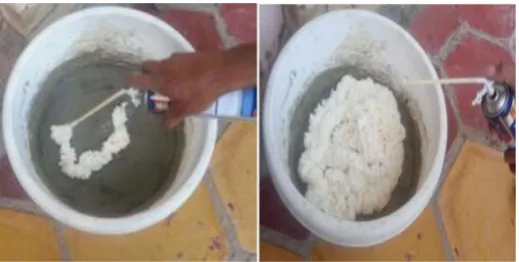
[image:2.595.309.566.66.237.2]• Foam: The foaming agent of density 45 kg/m3 used in this study was polyurethane (PU) foam. As shown in the pictures below:
Table: 1 Chemical and physical properties of cement, fly ash and fine aggregate.
Oxides composition
Cement Oxides Content
%
Fly Ash Oxides Content %
ASTM C618(Class
F)
CaO 62.8 5.0 <10
SiO2 22.3 54.2
70 (min)
Al2O3 4.5 31.6
Fe2O3 1.9 3.8
Na2O 0.1 0.7
5 (max)
K2O 0.7 0.6
MgO 4.4 1.3
SO3 2.0 0.1
CO2 2.5
Free CaO 1.2
Loss on
Ingition 0.8
Blain Surface
Area m2/kg 250 350
Relative
Density 3.15 2.2
2.2. Mix proportions
The mix proportion guideline of ASTM C796 [4] was followed in the laboratory mixing. The mix proportions of foamed concrete for this study are given in Table 2. The final mix proportions were established by laboratory trials to achieve a target density of 1600 kg/m3.
2.3. Specimens preparation
For this investigation, a pre-foaming method was adopted to provide polyurethane foamed concrete. The mixing procedure started with the cleaning of the laboratory mixer and emptying the excess water, one-third of the calculated mixing water was added, then the fine aggregate followed by the cement. The materials were allowed to mix for three minutes, then the fly ash and the remaining water was added. This was allowed to blend together till an appreciable slurry was achieved. The ready-made foam was added to the base mix through the nozzle of the foam can according to the calculated amount by trial and error. The density of the foamed concrete produced was then checked against the target density, 1600 kg/m3.
Table : 2 Mix Proportions for Polyurethane Foamed Concrete.
Mix details Mixed with fly ash Mixed without Fly ash
Target Density 1600 1600
Cement kg 440 600
sand kg 960 960
fly ash kg 160 0
water kg 300 300
w/C+FA 50 50
HRWRA L 3.6 2.64
foam kg 60 60
[image:2.595.36.296.498.629.2]© 2018, IRJET | Impact Factor value: 6.171 | ISO 9001:2008 Certified Journal | Page 875 before being separated and transferred to the place
where they cured using four different curing conditions, which were: water curing; moist curing; membrane compound curing and air curing. All the specimens remained under same curing condition till the date of testing except the water and moisture cured samples that were removed and placed in an oven for 24 h before testing. The density was checked before placing in an oven and after placing in an oven.
The curing regime adopted was as below:
• Air curing: in laboratory air entire time with the constant range (25 ± 2) °C and an average relative humidity of 60%.
• Water curing: in air under laboratory conditions after seven days of water curing with the constant range of temperature (25 ± 5)° C.
• Moisture curing: covered with wet burlap for seven days.
• Liquid membrane-forming curing compounds: Set seal 22 was applied after 24 h from casting, except for the top face of the casting mold where the liquid compound was applied after 1 h from casting.
Most of these adopted curing conditions in this study chosen were completely compatible with the curing conditions which are performed in the field.
2.4. Testing methods
2.4.1. Fresh state properties
The fresh properties of polyurethane foamed concrete consist of flow and fresh density. A flow table test was performed to find the consistency of the freshly mixed mortar as described in ASTM C 1437 [6]. The fresh polyurethane foamed concrete produced was first poured into an inverted slump flow cone without any compaction and vibration in accordance with ASTM C 1611 [5]. The fresh density was established according to ASTM C 138 [20]
2.4.2. Hardened properties
a) Compressive Strength
The compressive strength tests were performed according to (BS. 1881: Part 116: 1983) [10]. A total number of 72 cubes of (100×100)mm were tested by using a hydraulic compression machine of 1800 kn, at a loading rate of 18 MPa per minute. The average of three cubes was taken for each test and the test was conducted at ages of (7, 28, and 56) days.
b) Shrinkage
Shrinkage was measured by apparatus with dial gauge of 0.002mm accuracy. Prisms of (100×100×400)mm were used for this test. Measurements of the shrinkage strain were made according to (ASTM C157-2008) [2]. After removing the samples from the mold at an age of 24 h, shrinkage nails were installed on the surface of prisms after being demoded. The readings were taken at ages (3, 7, 14, 21, 28, 56) days for different curing conditions. Two specimens were prepared for each test condition.
c) Static Modulus of Elasticity
The static modulus of elasticity was measured according to (ASTM C 469). A total number of 48 cylinders of (150×300) mm were tested at ages of (7, 14, and 28) days. The average of two cylinders was taken for each test.
3. RESULTS AND DISCUSSIONS
3.1. Fresh properties
a) Flow ability and Fluidity
For this study, the flow ability of polyurethane foamed concrete mixes was measured by the diameter of the slump. It was found that the flow ability for a mix without fly ash had a lower diameter of a slump than the mix with fly ash. The average slump flow values obtained for fly ash mix and mix without fly ash were 230mm and 200 mm, respectively. This phenomenon is due to the lubrication effect of the spherical shape of most fly ash particles which led to greater workability.
The fluidity of polyurethane foamed concrete mixes measured by the diameter of four different angles of the slump. The inverted slump cone spread values are given in Table 4 clearly indicated that the fluidity of the polyurethane foamed concrete was dependent on the fly ash in the mixes. Slump cone spread values obtained for the fly ash mix and the mix without fly ash were 478mm and 452 mm, respectively. This may be ascribable to the higher fineness of fly ash compared to that of the mix without fly ash.
Table 3 Properties of the fresh polyurethane foamed concrete.
Sample Mix with fly ash Mix without fly ash
Consistency 1.04 1.05
Stability 1.015 1.018
Inverted slump cone
spread value (mm) 478 452
© 2018, IRJET | Impact Factor value: 6.171 | ISO 9001:2008 Certified Journal | Page 876 b) Consistency and Stability
The consistency of the fresh polyurethane foamed concrete represented by a measured fresh density to designated density ratio was kept to nearly unity, without segregation and bleeding. Stability can be represented by a measured fresh density to measured hardened density Lim et al. [16]. The measured hardened density of the foamed concrete produced was (1640 and 1650) kg/m3 for the fly ash mix and the mix without fly ash respectively. The fresh density of polyurethane foamed concrete is measured in a container of known volume in order to determine density (unit weight). The use of fly ash resulted in a slight decrease in the fresh density of polyurethane foamed concrete samples. The average fresh density values obtained for the fly ash mix and the mix without fly ash were 1665 kg/m3 and 1680 kg/m3, respectively. However, such results are attributed to the low specific gravity of the fly ash. Portland cement has a higher specific gravity than that of fly ash so they increase the overall density of the polyurethane foamed concrete to a greater extent.
3.2. Hardened properties
a) Compressive Strength
The average of the tests results are shown in Figs. 1 and 2 for polyurethane foamed concrete mixes with and without fly ash for different curing conditions. The compressive strength results for mixes without fly ash range between (7.8–20.1) MPa, (10.3–24.2) MPa and (11.1–26.2) MPa at (7, 28 and 56) days while the results for the mixes with fly ash range between (8.1–22.5) MPa, (11.1–29.2) MPa and (12.1–32.1) MPa at (7, 28 and 56) days.
Fig.1. Compressive Strength development of foamed concrete mixes without fly ash under different curing
regime.
From Figs. 1 and 2, it can be seen that the results of mixes without fly ash give lower results of compressive strength when compared with mixes with fly ash under different curing conditions at all ages with percent (9.2, 29.1 and 40.4) for water curing, (11.6, 20.6 and 22.6) for moisture curing, (3.4, 8.7 and 9.4) for air curing and (8.7, 23.7 and 32.2) for the membrane forming curing compound at (7, 28 and 56) days respectively. This behavior is explained by the densified effect of fly ash with a decrease in the porosity at early ages, while at later ages, in addition to the densified effect of fly ash, a pozzolanic reaction occurs with calcium hydroxide released from cement hydration reacting with the fly ash resulting in a filling effect in the voids among the cement and other powder particle.
3.2. Hardened properties
a) Compressive Strength
The average of the tests results are shown in Figs. 1 and 2 for polyurethane foamed concrete mixes with and without fly ash for different curing conditions. The compressive strength results for mixes without fly ash range between (7.8–20.1) MPa, (10.3–24.2) MPa and (11.1–26.2) MPa at (7, 28 and 56) days while the results for the mixes with fly ash range between (8.1–22.5) MPa, (11.1–29.2) MPa and (12.1–32.1) MPa at (7, 28 and 56) days.
Fig.1. Compressive Strength development of foamed concrete mixes without fly ash under different curing
regime.
© 2018, IRJET | Impact Factor value: 6.171 | ISO 9001:2008 Certified Journal | Page 877 behavior is explained by the densified effect of fly ash
[image:5.595.44.271.176.329.2]with a decrease in the porosity at early ages, while at later ages, in addition to the densified effect of fly ash, a pozzolanic reaction occurs with calcium hydroxide released from cement hydration reacting with the fly ash resulting in a filling effect in the voids among the cement and other powder particle.
Fig. 2. Compressive Strength for foamed concrete mixes with fly ash under different curing regime.
From Fig. 1, it can be seen that moisture cured specimens improve compressive strength more than membrane curing compound, water and air cured specimens respectively by (14.9, 44.9 and 177.3)% at 7 days, (5.0, 18.0 and 162.3)% at 28 days, (6.3, 10.0 and 165.5)% at 56 days. That can be ascribed to the gel stiffening by drying for moisture curing, however, it is due to relaxation in the gel of filler type due to the presence of water by water curing. An important observation is drawn here, which reflects the same previous trends for mixes with fly ash and for all type of curing conditions at a different age.
The results also yielded that curing by membrane forming curing compound was effective in improving the compressive strength of foamed concrete mixes with and without fly ash more than water and air curing. Like other types of concrete, the compressive strength for polyurethane foamed concrete specimens with air curing is lower than that of the other types of curing. However, the extent of strength reduction for air cured specimens up to an age of 56 days was due to the insufficient curing.
b) Shrinkage
The average results of two prisms are plotted in Figs. 3 for mixes with fly ash under different curing conditions. The results clarify that the values of drying shrinkage are higher for mixes without fly ash than those for fly ash mixes. The values range from (160–610) microstrain for the mixes without fly ash and these values decrease to (150–550) microstrain when fly ash is added at the age from 3 days to 56 days. The drying shrinkage for all
[image:5.595.323.553.325.498.2]mixes extends with time till the age of 56 days. Indicating to the earlier Figures there is a small decrement in drying shrinkage for water cured specimens. Moreover, moisture cured samples showed slightly lower values than those for compound cured samples. An important observation is drawn here, which reflects the same previous trends for mixes with and without fly ash and for all type of curing conditions at different ages. It that the internalization of fly ash as a partial replacement of cement leads to a slightly decrease in shrinkage of mixes during the time of drying as compared with mixes without fly ash. This phenomenon is ascribed to the reaction of fly ash consuming more free water in the system, leaving less water evaporation during shrinkage. This promotes the deduction that fly ash mix has a lower porosity and finer pore structure, which encourages loss of water by self-desiccation and not by diffusion to the surrounding environment.
Fig. 3. Drying shrinkage of foamed concrete mixes with fly ash under different curing condition.
Fig. 4 indicates that the internalization of fly ash as a partial replacement of cement leads to a slightly decrease in shrinkage of mixes during the time of drying as compared with mixes without fly ash. This phenomenon is ascribed to the reaction of fly ash consuming more free water in the system, leaving less water evaporation during shrinkage. This promotes the deduction that fly ash mix has a lower porosity and finer pore structure, which encourages loss of water by self-desiccation and not by diffusion to the surrounding environment.
c) Static Modulus of Elasticity
© 2018, IRJET | Impact Factor value: 6.171 | ISO 9001:2008 Certified Journal | Page 878 for mixes without fly ash range between (4.0–9.1) MPa,
(4.8–11.5) MPa and (6.0–16.3) MPa at (7, 14 and 28) days while the results for the mixes with fly ash range between (4.5–9.8) MPa, (5.1–12.4) MPa and (6.1–16.5) MPa at (7, 14 and 28) days. This behavior may be attributed to the incorporation of fly ash as a partial replacement of cement in the mixes that increases the densification of concrete and leads to lower strain under compression at transition zone, thus leads to higher static modulus of elasticity of those mixes.
[image:6.595.49.261.333.485.2]From Fig. 4., it can be seen that moisture cured specimens improve modulus of elasticity more than the membrane curing compound, air cured specimens respectively by (10.4, 12.2 and 55.6)% at 7 days, (5.2, 11.6 and 58.3)% at 14 days, (8.1, 9.0 and 63.3)% at 28 days. An important observation is drawn here, which reflects approximately the same previous trends for mixes with fly ash and for all type of curing conditions at different ages.
Fig. 4. Modulus of Elasticity of foamed concrete mixes with fly ash under different curing conditions.
d) Oven-dry density
The oven-dry density of hardened polyurethane foamed concrete was measured according to ASTM C 642 [16]. For polyurethane foamed concrete, the oven-dry density increased slightly by adding fly ash. The average density values obtained for fly ash mix and mix without fly ash were 1590 kg/m3 and 1600 kg/m3, respectively.
4. CONCLUSIONS
Based on the tests results of the present study on influence of curing methods and fly ash on progressive compressive strength, the following conclusions are drawn:
1. The flow ability and fluidity are increased by the presence of fly ash in comparison to mixtures without fly ash of the polyurethane foamed concrete.
2. The compressive strength of samples cured under moisture and membrane forming curing compound produce higher compressive strength range (20–32) MPa. This revealed that polyurethane foamed concrete is satisfactory to be used for structural applications.
3. The samples cured under moisture curing achieve higher strength at all ages than all others curing conditions considered. This revealed that moisture curing affects the compressive strength of foamed concrete more than those cured by a membrane forming curing compound, water, and air curing.
4. Curing by a membrane forming compound was effective in developing the compressive strength of foamed concrete mixes with and without fly ash more than water and air curing.
5. The fly ash utilized improves workability and diminishes the drying shrinkage of foamed concrete.
6. At all ages, the compressive strength of polyurethane foamed concrete without fly ash is lower than that of the polyurethane foamed concrete with fly ash for all curing conditions.
REFERENCES
[1] M. Arif, S. Akhtar, A. Masood, F. Basit, M. Garg, Flexural behavior of fly ash mortar ferrocement panels for low-cost housing, J. Ferrocement 31 (2) (2001) 125–135.
[2] ASTM C157, Standard Test Method for Length
Change of Hardened Hydraulic Cement Mortar and Concrete, ASTM International C, 2008 (157, M).
[3] ASTM C618, Standard Specification for Coal Fly Ash and Raw or Calcined Natural Pozzolan for Use in Concrete, American Society for Testing and Materials, 2002.
[4] ASTM C796-97, Standard Test Method for
Foaming Agents for Use in Producing Cellular Concrete Using Preformed Foam, ASTM International, West Conshohocken, PA, 1989, http://dx.doi.org/10.1520/C0033-03
www.astm.org.
[5] ASTMC1437-13. Standard Test Method for Flow
of Hydraulic Cement Mortar.
[6] BS 812-103.1:1985, Testing Aggregates. Method
© 2018, IRJET | Impact Factor value: 6.171 | ISO 9001:2008 Certified Journal | Page 879
[7] B. EN, Methods of Testing Cement, (2005)
(196-1).
[8] F. Falade, E. Ikponmwosa, C. Fapohunda, A study
on the compressive and tensile strength of foamed concrete containing pulverized bone as a partial replacement of cement, Pak. J. Eng. Appl. Sci. 13 (July) (2013) 82–93.
[9] B.S. Institutions, Method for Determination of Compressive Strength of Concrete Cubes, London BS, 1881.
[10]B. Karthikeyan, R. Selvaraj, S. Saravanan,
Mechanical properties of foam concrete, Int. J. Earth Sci. Eng. 08 (2015) 115–119.
[11]E.P. Kearsley, The use of foam concrete for affordable development in third world countries, Concr. Serv. Mankind: Approp. Concr. Technol. 3 (2006) 232.
[12]E.P. Kearsley, P.J. Wainwright, The effect of high fly ash content on the compressive strength of foamed concrete, Cem. Concr. Res. 31 (1) (2001) 105–112.
[13]Z. Li, Advanced Concrete Technology, John Wiley
& Sons, 2011.
[14]S. Liang, H.L. Chen, Investigation on the square cell honeycomb structures under axial loading, Compos. Struct. 72 (4) (2006) 446–454.
[15]ASTM C 138, Standard Test Method for Density
(unit Weight), Yield, and Air Content (gravimetric) of Concrete. Annual Book of ASTM Standards Vol. 04.02 (2001).
[16]ASTM C 642, Standard Test Method for Density,
Absorption, and Voids in Hardened Concrete. Annual Book of ASTM Standards Vol. 04.02 (1997).
[17]Guide for structural lightweight aggregate
concrete, ACI 213R, American Concrete Institute, Farmington Hills, MI,