© 2017, IRJET | Impact Factor value: 5.181 | ISO 9001:2008 Certified Journal
| Page 2240
A STUDY OF PERFORMANCE OF PRE-ENGINEERED BUILDING OF AN
INDUSTRIAL WAREHOUSE FOR DYNAMIC LOAD
Apurv Rajendra Thorat
1, Santosh K. Patil
21
A
purv Rajendra Thorat Post Graduation student, Civil Engineering Department,
K. J. College of Engineering Management and Research, Pune, India
2
Santosh K. Patil, Associate professor, Civil Engineering Department,
K. J. College of Engineering Management and Research, Pune, India
---***---Abstract -
In the present study Pre-engineered Buildingsare designed and studied in accordance with Kirby Technical Specification which is based on ASCE-07.Two examples have been taken for the study. Comparison of Pre Engineered Buildings (PEB) with bracings and Pre Engineered Buildings (PEB) without bracings is done in two examples. Later Pre Engineered Buildings (PEB) is analyzed for Dynamic loads using El-centro specified ground motion.
Key Words: Pre Engineered Building, Dynamic load,
conventional structure, STAAD.pro software, Time History Analysis.
1. INTRODUCTION
The industry is growing speedily in the majority the elements of the globe. The employment of steel structures isn't solely economical however conjointly eco-friendly at the time once there's a danger of world warming. Here, “economical “word suggests that considering time and price. Time is that the most vital side, steel structures (Pre-fabricated) square measure inbuilt terribly short amount and one such example is Pre-Engineered Buildings (PEB).
Pre-engineered buildings square measure nothing however steel buildings within which additional steel is avoided by tapering the sections as per the bending moment’s demand. One might imagine regarding its risk, however it’s a truth many folks don't seem to be better-known regarding Pre built Buildings. If we have a tendency to opt for regular steel structures, time span are a lot of, and conjointly value are a lot of, and each along i.e. time and price, makes it uneconomical. So in pre-engineered buildings, the full style is completed within the manufacturing plant, and as per the planning, members square measure pre-fabricated and so transported to the location wherever they're erected in an exceedingly time but half dozen to eight weeks. The structural performance of those buildings is accepted and, for the foremost half, adequate code provisions square measure presently in situ to make sure satisfactory behaviour in high winds. Steel structures even have far better Strength-to-weight ratios
than RCC and that they can also be simply razed. Pre-built Buildings have barred connections and thence also can be reused when razing. Thus, pre-engineered buildings are often shifted or expanded as per the necessities in future.
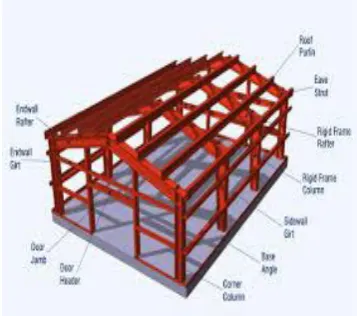
Fig -1: Industrial steel frame structure
In this paper we will discuss the various advantages of pre-engineered buildings and also, with the help of three examples, a comparison will be made between pre-engineered buildings and conventional steel structures.
1.1 Concept of Pre-Engineered Buildings
[image:1.595.344.523.321.479.2]© 2017, IRJET | Impact Factor value: 5.181 | ISO 9001:2008 Certified Journal
| Page 2241
systems are extensively utilized in industrial and plenty of different non-residential constructions worldwide, it's comparatively a brand new construct in Asian country.
1.2 Classification of Steel Building
Steel is that the material of selection for style as a result of its inherently ductile and versatile. It flexes beneath hyper-loads instead of crushing and crumbling. Structural steels low value, strength, durability, style flexibility, ability, and recyclability still build it the fabric of selection in building construction. Today’s steel framing is transferal grace, art, and performance along in nearly limitless ways that and is giving new solutions and opportunities to make difficult structures, that were once thought not possible. Steel structures have reserve strength. easy stick style within the steel framings permits construction to proceed apace from the beginning of the erection.
1.3. Pre-Engineered Steel buildings
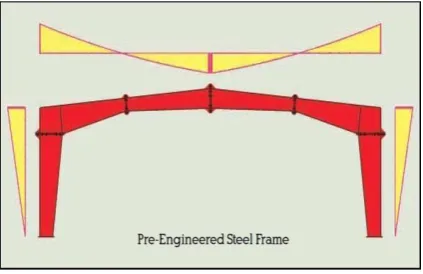
Pre-built Steel Buildings are factory-made or made within the plant itself. The producing of structural members is finished on client needs. The careful structural members are designed for their several locations and are numbered, that cannot be altered; as a result of members is factory-made with regard to style options. These parts are created in standard or fully knocked condition for transportation. These materials are transported to the client website and are erected. Fastening and cutting method aren't performed at the client site.
Fig -2: Pre-Engineered Steel Frame
2. Previous Research
G. Sai Kiran (2014). Comparison of style procedures for pre engineering buildings (PEB) in recent years, the introduction of pre-engineered building (PEB) idea within the style of structures has helped in optimizing the look. The ability of PEB within the place of typical steel building (CSB) style idea resulted in several benefits, as well as the economy and easier fabrication. During this study, associate industrial structure (warehouse) is analyzed and designed
consistent with the Indian standards, is 1984, is 800-2007 and additionally by referring mbma-96 and aisc-89.steel is that the material of selection for style as a result of its inherently ductile and versatile. In structural engineering, a pre-engineered building (PEB) is intended by a manufacturer, to be made-up employing a pre-determined inventory of raw materials and producing ways that may with efficiency satisfy a large vary of structural and aesthetic style needs. PEB is fitted with totally different structural accessories as well as mezzanine floors, canopies, fasciae, interior partitions, etc.
Pradeep V (March-2014) Comparative Study of Pre designed and standard Industrial Building PEBs are unit developed victimization potential style software package. The onset of technological advancement enabling 3d modeling and particularization of the planned structure and
coordination has revolutionized typical building
construction. Pre-Engineered Buildings (PEB) is that the future for Republic of India. Low weight versatile frames of PEB supply higher resistance to earthquake hundreds. PEB roof structure is sort of twenty sixth lighter than typical Steel Building. In secondary members, lightweight weight “Z” purlins are unit used for PEB structure, whereas heavier hot-rolled sections are unit used for CSB. Support reactions for PEB are unit lesser than CSB as per analysis. Light-weight foundation is adopted for PEB that ends up in simplicity in style and reduction within the price of construction of the inspiration. The significant foundation is going to be needed for CSB structure. PEB building price is half-hour lesser than the value of CSB structure. PEB offers low price, strength, durability, style flexibility, ability, and recyclability. To conclude “Pre-Engineered Building construction provides finish users a way a lot of economical and higher resolution for long span structures wherever giant column-free are unites are required.
Milind Bhojkar P (Dec-2014) Comparison of Pre Engineering Building and Steel Building with value and Time Effectiveness Pre-Engineering building means that steel building system that is predesigned and prefab. During this study, know the value effective tool that helps to utilize the optimum cross-sections of steel. During this study varied the varied the assorted} ideas relating to the pre-engineering building and its various applications. In this, we all know the support and element used for pre-engineering building. there's numerous kind of parts like; Primary parts, Secondary parts, textile during this study we discover out that Pre-engineering building is a lot of economical than standard steel building for low rise building.
[image:2.595.56.268.479.616.2]© 2017, IRJET | Impact Factor value: 5.181 | ISO 9001:2008 Certified Journal
| Page 2242
assembled on actual web site at the time of construction. Presently, massive column-free space is that the utmost demand for any kind of trade and with the advent of computer software’s it is now easily possible. With the improvement in technology, computer software’s have contributed immensely to the enhancement of quality of life through new researches. Pre-engineered building (PEB) is one of such revolution. "Pre-engineered buildings" are fully fabricated in the factory after designing, then transported to the site in completely knocked down (CKD) condition and all components are assembled and erected with nut-bolts, thereby reducing the time of completion. This paper effectively conveys that PEB structures can be easily designed by simple design procedure. PEB structures are more advantageous than conventional structures in economy, speed of construction & simple erection. Hence it is concluded that PEB has wide scope in India but they are still not preferred
3. Methodology
The present study deals with the comparative analysis of PEB industrial sheds with a traditional style. within the initial stage, an industrial shed is valid by comparing support reaction and axial force of every member.
Industrial structures standard (IS 1893: part IV, 2005) To perform well in associate degree earthquake, the commercial structure should possess adequate strength, stiffness, and malleability. Generally, structures have large capacities of energy absorption in its dead region. Structures that are unit careful as per IS 13920 and instrumentation that are unit made from ductile materials art stand up to earthquakes several folds above the planning spectra while not collapse, and injury in such cases is restricted to cracking solely. Structures are unit classified into the subsequent four categories:
a) Category 1: Structures whose failure can cause conditions that can lead directly or indirectly to extensive hundreds of life/property to population at large in the ares adjacent to the plant complex.
b) Category 2: Structures whose failure can cause conditions that can lead directly or indirectly to serious fire hazard/extensive damage within the plant complex
c) Category 3: Structures, which are required to handle emergencies immediately after an earthquake, are also included.
d) Category 4: Structures whose failure, although expensive, does not lead to serious hazard within the plant complex.
For comparative purpose following models are proposed:
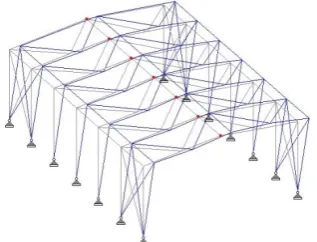
Model No.1 PEB sheds with 6 bays with X-bracings
Model No.2 PEB sheds with 6 bays without X-bracings
3.1. Structural analysis and design
1. Static Analysis
2. Dynamic / Seismic Analysis
3. Secondary Analysis
4. El-Centro data for Time History Analysis
3.2
Load combinations
All dead loads, live loads, wind load, accidental load will be confirming to IS: 875-1987. Earthquake loads will be confirming to IS: 1893-2002 part-IV Load combinations considered
1. Self-Weight of structure 2. Weight of Purlins
3. Wind Force in X direction 4. Wind Force in Z direction
5. Negative Wind Pressure in X direction 6. Negative Wind Pressure in Z direction 7. Ground motion in X and Z direction
3.3. STAAD.Pro generated frames
3.3.1. Industrial shed with bracings:
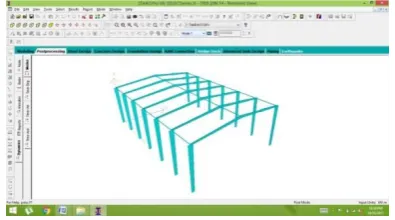
Fig -3: PEB model with 6 Bays without X-cross bracings
[image:3.595.335.533.440.550.2] [image:3.595.330.535.594.725.2]© 2017, IRJET | Impact Factor value: 5.181 | ISO 9001:2008 Certified Journal
| Page 2243
4. Results and Discussion
4.1. Deflection of an industrial shed without bracings
after applying the load combinations on STAAD.pro model We ran Time History Analysis on the model from the El-Centro Data and the top nodal results were as below:
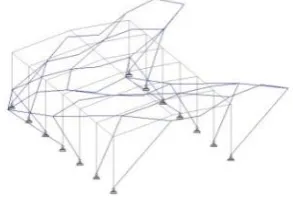
Fig -5: Deflection in Time History Analysis Mode-1
Fig -6: Deflection in Time History Analysis Mode-6
[image:4.595.124.547.37.731.2]All the results of Time History Analysis in table form are as shown in table below:
Table -1: Time History analysis results
Seismic loading results in Time History Analysis results Mode Frequency
(Hz)
Period
(Sec.)
Participation X
(%)
Participation Y
(%)
Type
1 0.275 3.637 0.00 99.236 Elastic
2 0.486 2.056 0.001 0.00 Elastic
3 0.964 1.037 97.845 0.001 Elastic
4 0.967 1.034 0.074 0.762 Elastic
5 1.018 0.982 0.540 0.00 Elastic
6 1.121 0.892 0.943 0.00 Elastic
Reactions on top nodal points of a model in all X, Y and Z direction are as below:
Fig -7: Time Vs. Acceleration along X axis
Fig -8: Time Vs. Acceleration along Z axis
Fig -9: Time Vs. Displacement along X axis
Fig -10: Time Vs. Displacement along Z axis
2.4
2.4
10.
[image:4.595.91.230.191.290.2] [image:4.595.98.245.334.433.2] [image:4.595.32.294.518.678.2] [image:4.595.324.546.585.691.2]© 2017, IRJET | Impact Factor value: 5.181 | ISO 9001:2008 Certified Journal
| Page 2244
4.2. Deflection of an industrial shed with bracings
After applying the load combinations on STAAD.Pro model. We ran Time History Analysis on the model from the El-Centro Data and the top nodal results were as below.
[image:5.595.52.562.83.793.2]Fig -11: Deflection in Time History Analysis Mode-1
Fig -12 Deflection in Time History Analysis Mode-6
4.2.1. All the results of Time History Analysis in table form are as shown in table below:
Table -2: Time History analysis results
Seismic loading results in Time History Analysis results Mode Frequency
(Hz)
Period
(Sec.)
Participation X
(%)
Participation Y
(%)
Type
1 0.795 1.257 99.343 0.00 Elastic
2 3.077 0.325 0.025 0.00 Elastic
3 3.282 0.305 0.019 0.356 Elastic
4 5.155 0.194 0.00 0.00 Elastic
5 6.993 0.143 0.00 1.754 Elastic
6 7.434 0.135 0.008 0.001 Elastic
[image:5.595.87.246.173.294.2]4.2.2. Reactions on top nodal points of a model in all X, Y and Z direction are as below:
Fig -13: Time Vs. Acceleration along X axis
[image:5.595.82.239.343.463.2]Fig -14: Time Vs. Acceleration along Z axis
Fig -15: Time Vs. Displacement along X axis
Fig -16: Time Vs. Displacement along Z axis
492
1.03
9.41
[image:5.595.30.291.554.718.2]© 2017, IRJET | Impact Factor value: 5.181 | ISO 9001:2008 Certified Journal
| Page 2245
4.3 Comparison of results from models
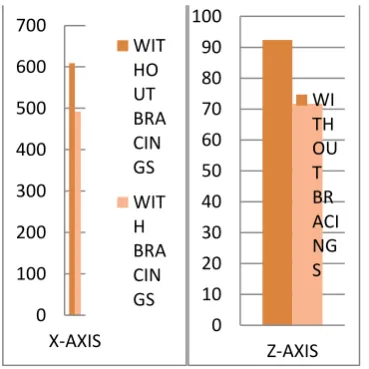
[image:6.595.75.247.200.375.2]Here we are comparing the results we got from the seismographs after applying the el-centro data on all the models using time history analysis. From the readings taken from the graphs of Acceleration, Displacement & velocity we have drawn the following bar charts:
Fig -17: Comparison of acceleration along X & Z axis of two models
Fig -18: Comparison of displacement along X & Z axis of two models
5. CONCLUSIONS
In this paper Dynamic load action on Pre Engineered Building is observed and checked for El-Centro data using Time History Analysis. Two parametric models of Pre Engineered Buildings of 21 meter span with and without bracings. The sections are designed using KIRBY TECHNICAL HANDBOOK(9) which is in accordance of ASCE(07)
After the checks the following conclusion is obtained:
1. Displacement along X-direction of Pre Engineered
building with bracings is observed 34% less than the Pre Engineered Building without bracings along longitudinal direction
2. Displacement along Y-direction is observed 13% less than the Pre Engineered Building without bracings but it is permissible in both cases hence no extra bracings required for specified ground motion
3. Displacement along Z-direction is observed 23% less than the Pre Engineered Building without bracings 4. Acceleration at time period 3.02 seconds observed
609m/s2 and 492 m/s2 for with and without bracings respectively which is very severe and need to be controlled for current structural configuration.
ACKNOWLEDGEMENT
I am grateful to my Principal Dr. S. S. KHOT for his encouragement and guidance throughout the preparation of this project report. I specially thank to Prof. Mr. S. K. PATIL Head of Civil Engineering Department, KJCOEMR, Pune. For inspiring guidance and timely cooperation, without which it would not have been in its present shape. I am expressing my sincere thanks to all the staff and colleagues who have helped me directly or indirectly in completing this report.
REFERENCES
[1] G. Sai Kiran (2014). Comparison of Design Procedures
for Pre Engineering Buildings (PEB).
[2] Pradeep V (March-2014) Comparative Study of Pre
Engineered and Conventional Industrial Building Sagar D. Wankhade (June-2014)Design & Comparison of Various Types of Industrial Buildings.
[3] Milind Bhojkar P (Dec-2014). Comparison of Pre
Engineering Building and Steel Building with Cost and Time Effectiveness
[4] Dale C. Perry, Herbert S. Saffir, James R. McDonald,
“Performance of Metal Buildings in High Winds”, Journal of Wind Engineering and Industrial Aerodynamics, 36 (1990) 985-999 985, Elsevier Science Publishers.
[5] Syed Firoz, Sarath Chandra Kumar B, S.Kanakambara
Rao,” Design Concept of Pre Engineered Building”, IJERA Vol. 2, Issue 2,Mar- Apr 2012, pp.267-272
[image:6.595.70.255.444.629.2]© 2017, IRJET | Impact Factor value: 5.181 | ISO 9001:2008 Certified Journal
| Page 2246
http://www.ijera.com/papers/Vol2_issue2/AS22267 272.pdf
[6] IS 875- Part II (1987), Indian Standard Code of
Practice for Design Loads (Other Than Earthquake) for Buildings and Structures.
[7] IS 1893- Part IV (2002) Indian Standard Criteria for
Earthquake Resistant of Design of Structures.
[8] IS 875- Part III (1987), Indian Standard Code of
Practice for Design Loads (Other Than Earthquake) for Buildings and Structures. Aijaz Ahmad Zende (Jan-Feb 2013).
[9] Kirby technical handbook for special structural & PEB
pre-engineered building systems, 2013 Alghanim Industries.