© 2017, IRJET | Impact Factor value: 5.181 | ISO 9001:2008 Certified Journal | Page 190
Characterization on Gasoline Engine Using MTBE and DIE Additives
Mohammed Shamim
1, C. Syed Aalam
2, D. Manivannan
1, Shashank Kumar
31 PG Student, 2 Assistant Professor, 3 UG Student, Department of Mechanical Engineering
Annamalai University, Tamilnadu, India
---****---
Abstract
In this work, two oxygenated additives like methyl tert butyl ether (MTBE) and di-isopropyl ether (DIE) are identified for the experimental investigation by blending them to 5 ml with gasoline sole fuel. The performance and emission analysis were examined in twin cylinder SI engine with both additives blend with gasoline. The physical and chemical properties of the gasoline fuel and additives are tested through ASTM standards and reported. From the experimental results, it was found that brake thermal efficiency increased to 1-2% and emissions like HC and CO reduced to7-9% and 13-25%, respectively for addition of MTBE and DIE. NOx emission found increased in the both additive cases.
Key Words:Gasoline engine, Methyl tert butyl ether, Di-isopropyl ether, Performance, Emission.
NOMENCLATURE:
MTBE - Methyl tert butyl ether
DIE - Di-isopropyl ether
Additive -1 - MTBE
Additive – 2 - DIE
Rpm - Revolution per minute
HSU - Hatridge smoke unit
Ppm - Parts per million
BP - Brake power
BTE - Brake thermal efficiency
HC - Hydrocarbon emission
CO -Carbon monoxide emission
NOx - Oxides of nitrogen emission
1. INTRODUCTION
© 2017, IRJET | Impact Factor value: 5.181 | ISO 9001:2008 Certified Journal | Page 191 give these fuels an added property which serves a pressing need from consumers. While fuel additives are largely related with additives to gasoline and oil based fuels in the interest of environmental protection, un-burning emissions and increasing mileage, the innovation around additives has a broader impact of being able to change, alter or enhance specific attributes of a fuel whether liquid, solid or gas [2,3].Additives have been developed to increase combustion rates, as anti-oxidants, to effect burn rates, to enable fuels to work under extreme temperatures, reduce harmful emissions and more [4]. Over the years various hybrid compounds and blends have been engineered to create better fuels for industries commercial use and end consumers alike.Methyl tertiary butyl ether (MTBE) is a chemical compound obtained from a reaction between methanol and isobutylene [5]. Methanol is mainly derived from natural gas while isobutylene is derived either from natural gas or from by-products of fluid and steam crackers [6]. Its principal use is as an additive to automotive fuels. When blended into gasoline, MTBE enriches octane ratings and improves fuel combustion, thus reducing harmful exhaust emissions. Di-isopropyl ether is secondary ether that is used as a solvent. It is a colorless liquid that is marginally soluble in water, but miscible with organic solvents [7]. It is used as an extractant and an oxygenate gasoline additive. It is obtained industrially as a byproduct in the production of iso-proponal by hydration of propane. Di-isopropyl ether is sometimes represented by the abbreviation "DIPE". Whereas at 20 °C, diethyl ether will dissolve 1% by weight water, DIPE only dissolves half as considerable. It is used as a specialized solvent to eliminate or extract polar organic compounds from aqueous solutions, e.g. phenols, ethanol, acetic acid. DIPE is used as antiknock agent Di-isopropyl ether can form explosive peroxides upon standing in air for long periods [8]. This reaction continues more easily than for ethyl ether, due to the secondary carbon next to the oxygen atom. Antioxidants can be used to prevent this process [9]. The stored solvent should therefore be tested for the existence of peroxides more often (recommended once every 3 months for di-isopropyl ether vs. once every 12 months for ethyl ether). Peroxides may be removed by shaking the ether with a solution of iron (II) sulfate. For safety causes, methyl tert-butyl ether is often used as an alternative solvent [10]. In this study to improve the performance and reduce the harmful emissions like HC and CO, MTBE and DIE additives are blend with gasoline fuel in the proportion of 5ml.
2. FUEL MODIFICATION
© 2017, IRJET | Impact Factor value: 5.181 | ISO 9001:2008 Certified Journal | Page 192
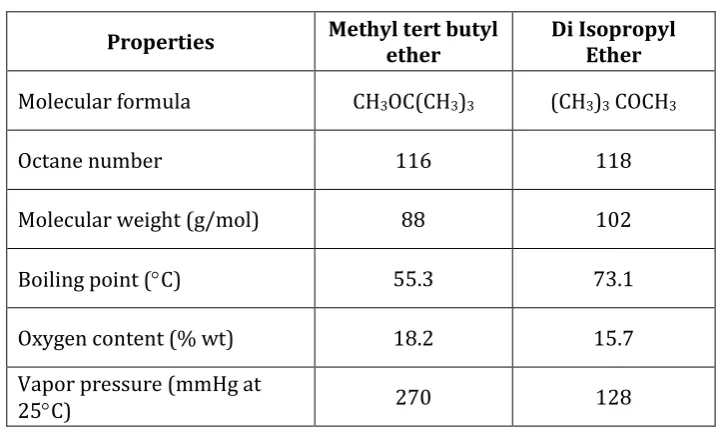
Table 1 Properties of MTBE and Di-isopropyl ether
(Source: The European Fuel Oxygenates Association, 2006)
Properties Methyl tert butyl ether Di Isopropyl Ether
Molecular formula CH3OC(CH3)3 (CH3)3 COCH3
Octane number 116 118
Molecular weight (g/mol) 88 102
Boiling point (C) 55.3 73.1
Oxygen content (% wt) 18.2 15.7
Vapor pressure (mmHg at
25C) 270 128
Table 2 Physical and chemical properties of petrol, MTBE and Di-isopropyl ether
(Source: ETA Laboratory, Chennai)
Property Petrol Methyl tert butyl
ether
Di isopropyl ether
Specific gravity 0.72 0.7463 0.7449
Kinematic viscosity 1.37 1.36 1.40
Flash pointC -43 -11 -12
Fire point C -13 -9 -10
Pour point C -32 -18 -19
Gross calorific value
(kJ/kg)
45650 45738 45664
Acidity as mg of
KoH/gm 0.024 0.012 0.011
© 2017, IRJET | Impact Factor value: 5.181 | ISO 9001:2008 Certified Journal | Page 193
3. EXPERIMENTAL SETUP
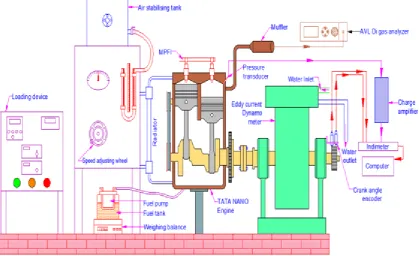
[image:4.595.90.510.310.566.2]The experimental setup is shown in Figure 1. The level of the fuel and lubricating oil were checked before starting the engine. The eddy current dynamometer control unit panel is switched “ON’ to note down the load, speed and temperature from the indicator provided in the panel board. Then the ignition switch is turned “ON” position. The fuel flowed from the fuel tank through the electronic fuel injection pump and then started the engine at no load condition. The engine was allowed to run with sole fuel at a constant speed of 2500 rpm for nearly 30 minutes to obtain steady state condition. The cooling water temperature reached 50C. fuel consumption was measured by stop watch for one minute of fuel. In the same readings for 20%, 40%, 60%, 80% and full load were observed. After taking the required readings the ignition switch is turned “OFF” position to stop the engine and the eddy current dynamometer control unit panel was also switched “OFF”.
Figure 1 Experimental setup
Table 3 Specification of the test engine (TATA NANO)
Type Vertical In-line Engine with MPFI
No. of Cylinder 2
Displacement 624 cc
Bore 73.5 mm
Stroke 73.5 mm
Compression Ratio 9.5:1
© 2017, IRJET | Impact Factor value: 5.181 | ISO 9001:2008 Certified Journal | Page 194
Cycle 4-Stroke
Max. Engine output 25.74 kW @ 5250 rpm
Max. Torque 48 Nm @ 3000 rpm
Speed 2500 rpm
Orifice Diameter 20 mm
Cooling System Water
Loading Device Eddy current Dynamometer
4. RESULT AND DISCUSSION
The experimental investigations were conducted by gasoline fuel with two kinds of oxygenated additives such as methyl-tert butyl ether and di isopropyl ether. The investigations were experimentally conducted in TATA NANO gasoline engine by various load condition at constant speed (2500 rpm) of the engine.
4.1 PERFORMANCE CHARACTERISTICS
4.1.1 BRAKE THERMAL EFFICIENCY
© 2017, IRJET | Impact Factor value: 5.181 | ISO 9001:2008 Certified Journal | Page 195
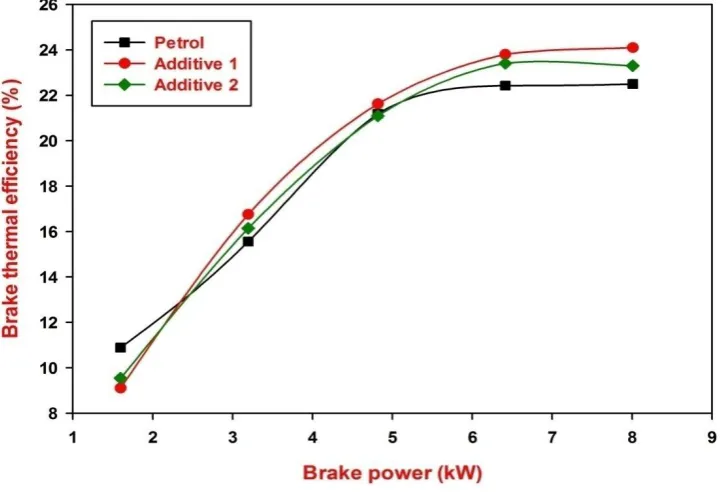
Figure 2 Variations of brake thermal efficiency with brake power
4.2 EMISSION CHARACTERISTICS
4.2.1 OXIDES OF NITROGEN (NOx)
The variations of NOx emission against brake power for various blends of additives and gasoline fuel are
shown in the Figure 3. The NOx emission is increases for the Additive-1 blend by 33.7% when compared to that
of gasoline sole fuel. It may be increased oxygen content gives better combustion thereby in-cylinder temperature is increased due to which an increased NOx emission is observed for Additive-1 with sole gasoline
fuel. The NOx emission for sole gasoline fuel and Additive-2 is 106, 150 respectively with full load condition and
© 2017, IRJET | Impact Factor value: 5.181 | ISO 9001:2008 Certified Journal | Page 196
Figure 3 Variations of oxides of nitrogen with brake power
4.2.2 CARBON MONOXIDE (CO)
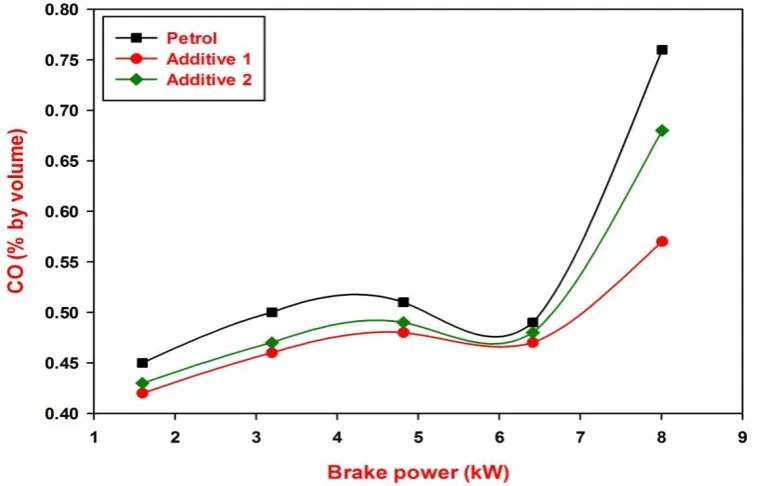
The variations of CO emission against brake power for various blends of additives and gasoline fuel are shown in the Figure 4.Additive-1 blend shows decreased CO emission since the availability of additional oxygen content improve the combustion process and converts CO in to CO2. It has a decrease of 26% when compared to
that of sole gasoline fuel and constant speed of the engine with full load condition.
[image:7.595.107.486.487.730.2]© 2017, IRJET | Impact Factor value: 5.181 | ISO 9001:2008 Certified Journal | Page 197
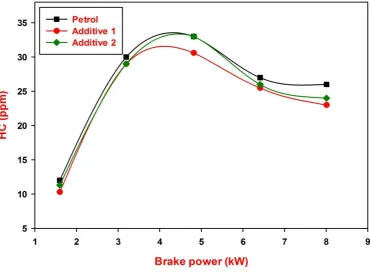
4.2.3 HYDROCARBON (HC)
[image:8.595.111.482.255.527.2]The variations of HC emission against brake power for various blends of additives and gasoline fuel are shown in the Figure 5.Additive-1 shows decreases in HC emission when compared to that of sole gasoline fuel. The reason is due to complete combustion provided by the oxygenated additive. It has shown a decrease of 11.5% when compare to sole gasoline fuel. The HC emission for the Additive-2 and sole gasoline fuel is 24ppm, 26ppm respectively with full load condition.
Figure 5 Variations of HC emission with brake power
CONCLUSION
The main conclusions of this study are;
1. The Additive-1 shows increased brake thermal efficiency than that of other additives. It has shown an increase of 6.6% when compare to sole gasoline fuel.
2. The Additive-1 gasoline fuel show significant reduction in CO, HC emission and increases of NOx
© 2017, IRJET | Impact Factor value: 5.181 | ISO 9001:2008 Certified Journal | Page 198
REFERENCES
[1] Mohammed Shamim, C. Syed Aalam, D. Manivannan, R. Ravi Kumar, T. Dinesh Kumar, G. Prabagaran: Performance and Emission Test on Gasoline Engine Using Cyclohexylamine and n- Butyl alcohol Additives, International Research Journal of Engineering and Technology(IRJET), Volume 04, 2017, Pages 1351-1360.
[2] Mohammed Shamim, C. Syed Aalam, D. Manivannan: Combustion and Emission Analysis of Mahua and Jujube Biodiesel Blends as Fuel in a CI Engine, International Journal of Advanced Engineering Research and Science(IJAERS), Volume 4, 2017, Pages 116-123.
[3] Aradi, A., Colucci, W., Scull, H., and Openshaw, M., "A Study of Fuel Additives for Direct Injection Gasoline (DIG) Injector Deposit Control," SAE Technical Paper 2000-01-2020, 2000, DOI: 10.4271/2000-01-2020.
[4] AbdeL-Rahman, M. M. Osman, Experimental investigation on varying the compression ratio of SI engine working under different ethanol-gasoline fuel blends, International Journal of Energy Research, Vol. 21, pp.31-40, 1997.
[5] Ananda Srinivasan, C.G. Saravanan, Study of Combustion Characteristics of an SI Engine Fuelled with Ethanol and Oxygenated Fuel Additives, Journal of Sustainable Energy & Environment, Vol.1, pp.85-91, 2010. [6] Prajapati Simit B, Rathod Pravin P, Patel Nikul K, Effect of Oxygenated Fuel Additives on Performance and Emission Characteristics of CI Engines - A Review study, Journal of Engineering Research and Studies, Vol.3, pp.108-110, 2012.
[7] V. Balaji Raman, X. Alexander, Emission and performance test on petrol engine using fuel Modification, International Journal of Emerging Technology and Advanced Engineering, Vol.3, pp.119-123, 2013.
[8] T. Ramakrishnan, D. John Panneer Selvam, Studies on Emission Control in S.I. Engine Using Organic Fuel Additives, International Journal of Engineering Trends and Technology (IJETT), Vol.11, pp.249-254, 2014. [9] M. Ghazikhani M. Hatami, B. Safari, The effect of alcoholic fuel additives on energy parameters and emissions in a two stroke gasoline engine, Springer, Arabian Journal of Engineering, Vol. 39, pp.2117-2125, 2014.
[10] Amit R.Patil, R. N. Yerrawar, Shrinath A.Nigade, Onkar B.Chavan, Mr.Hitendra S.Rathod, Bhushan K.Hiran, International Journal for Research & Development in Technology, Vol.2, pp.2349-3585, 2014.
[11] Vivek Singh Shekhawat and Ravi Shankar Padwa, Role of Additives and their Influence on Performance of Engine for Petroleum Diesel Fuel, Oxygenated-Diesel Blend: A Review, International Journal of Engineering Research & Technology (IJERT) Vol. 4, pp.1-5, 2015.
© 2017, IRJET | Impact Factor value: 5.181 | ISO 9001:2008 Certified Journal | Page 199
BIOGRAPHIES
Mohammed Shamim received the B.E. degree in Mechanical Engineering from Annamalai University, Faculty of Engineering and Technology, Annamalainagar, Chidambaram, Tamil Nadu in 2013 and pursuing Masters of Engineering degree in Energy Engineering and Management from Annamalai University, Faculty of Engineering and Technology, Annamalainagar, Chidambaram, Tamil Nadu respectively.
C. Syed Aalam is currently working as assistant professor in Annamalai University, Faculty of Engineering and Technology, Annamalainagar, Chidambaram, Tamil Nadu, India, with 10 years of teaching experience. He is publishing many research papers in the field of IC engines and biodiesel.
D. Manivannan received the B.E. degree in Mechanical Engineering from Annamalai University, Faculty of Engineering and Technology, Annamalainagar, Chidambaram, Tamil Nadu in 2014 and pursuing Masters of Engineering degree in Energy Engineering and Management from Annamalai University, Faculty of Engineering and Technology, Annamalainagar, Chidambaram, Tamil Nadu respectively.